1-29
teleological argument
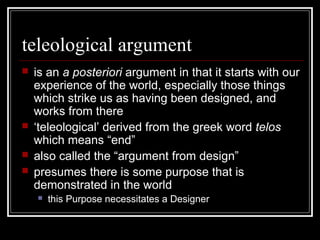
 is an a posteriori argument in that it starts with our
experience of the world, especially those things
which strike us as having been designed, and
works from there
 ‘teleological’ derived from the greek word telos
which means “end”
 also called the “argument from design”
 presumes there is some purpose that is
demonstrated in the world
 this Purpose necessitates a Designer
design inference patterns
 [Q] p. 87, first statement by cleanthes
articulates the basic idea
 there are a variety of different forms the
argument can take
 analogical design arguments
 deductive design arguments
 abductive design arguments
analogical design argument
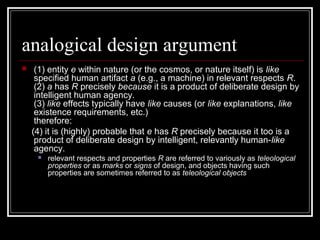
 (1) entity e within nature (or the cosmos, or nature itself) is like
specified human artifact a (e.g., a machine) in relevant respects R.
(2) a has R precisely because it is a product of deliberate design by
intelligent human agency.
(3) like effects typically have like causes (or like explanations, like
existence requirements, etc.)
therefore:
(4) it is (highly) probable that e has R precisely because it too is a
product of deliberate design by intelligent, relevantly human-like
agency.
 relevant respects and properties R are referred to variously as teleological
properties or as marks or signs of design, and objects having such
properties are sometimes referred to as teleological objects
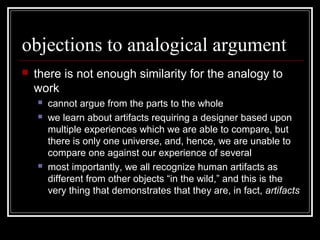
objections to analogical argument
 there is not enough similarity for the analogy to
work
 cannot argue from the parts to the whole
 we learn about artifacts requiring a designer based upon
multiple experiences which we are able to compare, but
there is only one universe, and, hence, we are unable to
compare one against our experience of several
 most importantly, we all recognize human artifacts as
different from other objects “in the wild,” and this is the
very thing that demonstrates that they are, in fact, artifacts
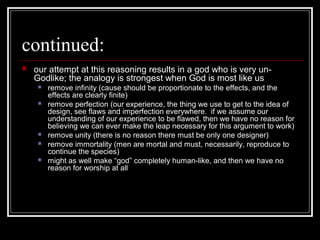
continued:
 our attempt at this reasoning results in a god who is very un-
Godlike; the analogy is strongest when God is most like us
 remove infinity (cause should be proportionate to the effects, and the
effects are clearly finite)
 remove perfection (our experience, the thing we use to get to the idea of
design, see flaws and imperfection everywhere. if we assume our
understanding of our experience to be flawed, then we have no reason for
believing we can ever make the leap necessary for this argument to work)
 remove unity (there is no reason there must be only one designer)
 remove immortality (men are mortal and must, necessarily, reproduce to
continue the species)
 might as well make “god” completely human-like, and then we have no
reason for worship at all
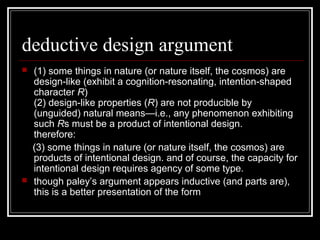
deductive design argument
 (1) some things in nature (or nature itself, the cosmos) are
design-like (exhibit a cognition-resonating, intention-shaped
character R)
(2) design-like properties (R) are not producible by
(unguided) natural means—i.e., any phenomenon exhibiting
such Rs must be a product of intentional design.
therefore:
(3) some things in nature (or nature itself, the cosmos) are
products of intentional design. and of course, the capacity for
intentional design requires agency of some type.
 though paley’s argument appears inductive (and parts are),
this is a better presentation of the form
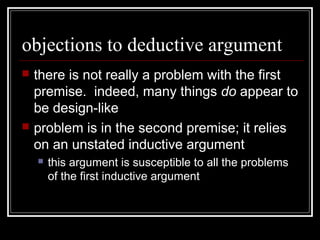
objections to deductive argument
 there is not really a problem with the first
premise. indeed, many things do appear to
be design-like
 problem is in the second premise; it relies
on an unstated inductive argument
 this argument is susceptible to all the problems
of the first inductive argument
abductive design argument
 the surprising fact, C, is observed:
but if A were true, C would be a matter of
course,
hence:
there is reason to suspect that A is true.
 a Designer is seen as the best explanation
to the question of why things appear
designed
objections to abductive argument
 always reasons to the best explanation, and this
means it beats out its competitors in terms of
explanatory value (e.g. predictive value,
conciseness, simplicity, etc)
 there are other explanations which seem to make more
sense given all the information
 one possible explanation is that our species is predisposed
to see regularities and “design,” and this is why we see
faces in clouds, etc
 most troubling would be a supernatural explanation for
what started out as an explicitly natural question

1-29

  • 1.
  • 2.
    teleological argument  isan a posteriori argument in that it starts with our experience of the world, especially those things which strike us as having been designed, and works from there  ‘teleological’ derived from the greek word telos which means “end”  also called the “argument from design”  presumes there is some purpose that is demonstrated in the world  this Purpose necessitates a Designer
  • 3.
    design inference patterns [Q] p. 87, first statement by cleanthes articulates the basic idea  there are a variety of different forms the argument can take  analogical design arguments  deductive design arguments  abductive design arguments
  • 4.
    analogical design argument (1) entity e within nature (or the cosmos, or nature itself) is like specified human artifact a (e.g., a machine) in relevant respects R. (2) a has R precisely because it is a product of deliberate design by intelligent human agency. (3) like effects typically have like causes (or like explanations, like existence requirements, etc.) therefore: (4) it is (highly) probable that e has R precisely because it too is a product of deliberate design by intelligent, relevantly human-like agency.  relevant respects and properties R are referred to variously as teleological properties or as marks or signs of design, and objects having such properties are sometimes referred to as teleological objects
  • 5.
    objections to analogicalargument  there is not enough similarity for the analogy to work  cannot argue from the parts to the whole  we learn about artifacts requiring a designer based upon multiple experiences which we are able to compare, but there is only one universe, and, hence, we are unable to compare one against our experience of several  most importantly, we all recognize human artifacts as different from other objects “in the wild,” and this is the very thing that demonstrates that they are, in fact, artifacts
  • 6.
    continued:  our attemptat this reasoning results in a god who is very un- Godlike; the analogy is strongest when God is most like us  remove infinity (cause should be proportionate to the effects, and the effects are clearly finite)  remove perfection (our experience, the thing we use to get to the idea of design, see flaws and imperfection everywhere. if we assume our understanding of our experience to be flawed, then we have no reason for believing we can ever make the leap necessary for this argument to work)  remove unity (there is no reason there must be only one designer)  remove immortality (men are mortal and must, necessarily, reproduce to continue the species)  might as well make “god” completely human-like, and then we have no reason for worship at all
  • 7.
    deductive design argument (1) some things in nature (or nature itself, the cosmos) are design-like (exhibit a cognition-resonating, intention-shaped character R) (2) design-like properties (R) are not producible by (unguided) natural means—i.e., any phenomenon exhibiting such Rs must be a product of intentional design. therefore: (3) some things in nature (or nature itself, the cosmos) are products of intentional design. and of course, the capacity for intentional design requires agency of some type.  though paley’s argument appears inductive (and parts are), this is a better presentation of the form
  • 8.
    objections to deductiveargument  there is not really a problem with the first premise. indeed, many things do appear to be design-like  problem is in the second premise; it relies on an unstated inductive argument  this argument is susceptible to all the problems of the first inductive argument
  • 9.
    abductive design argument the surprising fact, C, is observed: but if A were true, C would be a matter of course, hence: there is reason to suspect that A is true.  a Designer is seen as the best explanation to the question of why things appear designed
  • 10.
    objections to abductiveargument  always reasons to the best explanation, and this means it beats out its competitors in terms of explanatory value (e.g. predictive value, conciseness, simplicity, etc)  there are other explanations which seem to make more sense given all the information  one possible explanation is that our species is predisposed to see regularities and “design,” and this is why we see faces in clouds, etc  most troubling would be a supernatural explanation for what started out as an explicitly natural question