PHIL 101-03 Introduction to Philosophy
Contact Information Instructor: James Clayton Office:  NWCMB 424 Office Hours: W/F, 10:00-11:00 (and by appointment) Phone & Voicemail: (504) 862-3392 Email:  [email_address]   Course Webpage:  blackboard.tulane.edu
Required Texts [ 1 ] L. P. Pojman (2006):  Philosophy: The Quest for Truth .  6th ed. Oxford: Oxford. ISBN 0-19-518944-2. [ Q ] [ 2 ] L. P. Pojman (2006):  Philosophy:  The Pursuit of Wisdom .  5th ed. Thomson:  Belmont, CA.  ISBN 0-495-00712-9. [ P ]
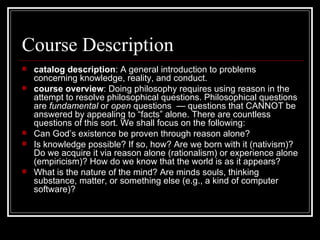
Course Description catalog description : A general introduction to problems concerning knowledge, reality, and conduct. course overview : Doing philosophy requires using reason in the attempt to resolve philosophical questions. Philosophical questions are  fundamental  or  open  questions  — questions that CANNOT be answered by appealing to “facts” alone. There are countless questions of this sort. We shall focus on the following:  Can God’s existence be proven through reason alone? Is knowledge possible? If so, how? Are we born with it (nativism)? Do we acquire it via reason alone (rationalism) or experience alone (empiricism)? How do we know that the world is as it appears? What is the nature of the mind? Are minds souls, thinking substance, matter, or something else (e.g., a kind of computer software)?
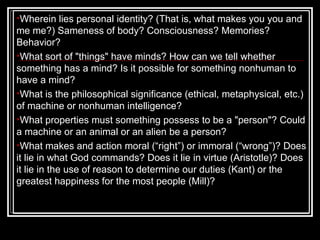
Wherein lies personal identity? (That is, what makes you you and me me?) Sameness of body? Consciousness? Memories? Behavior? What sort of "things" have minds? How can we tell whether something has a mind? Is it possible for something nonhuman to have a mind?  What is the philosophical significance (ethical, metaphysical, etc.) of machine or nonhuman intelligence? What properties must something possess to be a "person"? Could a machine or an animal or an alien be a person?  What makes and action moral (“right”) or immoral (“wrong”)? Does it lie in what God commands? Does it lie in virtue (Aristotle)? Does it lie in the use of reason to determine our duties (Kant) or the greatest happiness for the most people (Mill)?
To explore these questions, we might not limit ourselves to discussions of philosophical texts alone, for philosophy can be explored through movies (and TV episodes) too. Hence, we may watch some movie or TV episode in class. (Examples of movies that  could  be shown include  The Meaning of Life ,  The Name of the Rose ,  Total Recall ,  Memento ,  Fight Club ,  The Truman Show ,  The Matrix ,  AI: Artificial Intelligence, The Thirteenth Floor ,  Star Trek: First Contact, Nemesis,  and  Saving Private Ryan.)  The movie will make the “abstract” concepts raised in the text more “real” or “concrete.” Following the movie we shall critically evaluate what we have read and seen. In the end, the aim of this course is not to “solve” the philosophical questions that will be raised. Rather, the aim is survey some of the major ideas, figures, and problems that have shaped Western philosophy.
Learning Objectives Upon successfully completing this course, students will be able to do the following: to recognize philosophical questions and problems to know the various subfields of philosophy and the sorts of questions dealt with by philosophers in those areas to read philosophical texts to evaluate the cogency of arguments informally to understand cosmological, teleological, and ontological arguments for the existence of God (and the problems associated with each of those arguments) to understand the philosophical problems associated with the nature of minds and persons to understand the philosophical problems associated with personal identity to understand the nature of the mind-body problem to understand the problem of other minds to understand the philosophical implications of the computer metaphor to understand the philosophical implications of whether a machine can think to know the different views of Descartes, Locke, Hume, etc. with respect to knowledge and personal identity to know the difference between moral objectivism and moral nonobjectivism and different theories of each to know the different views of Aristotle, Kant, Mill, etc. with respect to morality  to defend your own claims with respect to the philosophical issues raised in this course
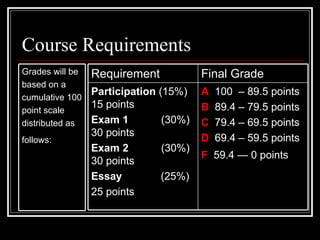
Course Requirements Grades will be  based on a  cumulative 100 point scale distributed as follows:   A   100  – 89.5 points B   89.4 – 79.5 points C   79.4 – 69.5 points D   69.4 – 59.5 points F   59.4 — 0 points   Participation  (15%)   15 points Exam 1   (30%) 30 points Exam 2   (30%) 30 points Essay  (25%) 25 points  Final Grade Requirement
PARTICIPATION : You are required to be prepared for class and to participate. Your participation is worth 15% of your final grade. Its value will be based on your preparedness, attendance, tardiness, and both the quantity and quality of your in-class contributions.  In addition, you will be required to provide via Blackboard a short answer to a question given each week. EXAMS : There will be  2  in-class exams, each covering about 1/2 of the course material. Each exam will be composed of various short answer (T/F and MC) and short essay questions taken mainly from the study questions (on BlackBoard). The exams are worth 60% of your final grade. ESSAY : Each student will be required to write  1  critical essay. The (  1500 word) essay (and draft) must be completed in accordance with the guidelines. The essay is worth 25% of your final grade. EXTRA CREDIT : There will be an extra credit question on each of the exams.
Course Policies What follows are my class policies. If for any reason you are unable to  abide by these policies, you should withdraw from my course . ACADEMIC DISHONESTY : Academic honesty is fundamental to the process of learning and to evaluating academic performance.  Academic   dishonesty  includes the following: cheating, plagiarizing, tampering with academic records or exams, falsifying identity, and being an accessory to acts of academic dishonesty. I HAVE  ZERO  TOLERANCE FOR ACADEMIC DISHONESTY! For example, if I find you guilty of cheating or plagiarizing, not only will you receive a ‘0’ on the assignment, I shall aggressively pursue both your receiving an overall ‘F’ AND a permanent blemish on your record. Refer to the Tulane Judicial Code for further information. ATTENDANCE : Your attendance is required. Classes begin on time. Do NOT stroll in late. You may miss or be tardy for one class without penalty. For each subsequent absence or tardiness, your participation grade will be penalized one point. If you miss more than three classes you risk failing the course.  If you know that you must leave class early, let me know.
AUDITS :  Whether an audit is successful will depend only on your class participation performance. INCOMPLETES :  Incompletes are STRONGLY discouraged. Should you need to take an incomplete, arrangements must be made with me well before the last class meeting.  LANGUAGE :  Feel free to say anything to me or to your peers, but tailor your remarks so as not to be uncivil or abusive. (See my "warning" below.)  LATE-STARTS :  There are no special dispensations for late-start students.  LATE WORK :  A draft of your essay is due  4/16 . Your final essay is due  5/10 . If either assignment is late, your essay will be penalized 10%. If you do not submit a draft, your essay will be penalized 50%. If you do not submit your final essay by the time I turn in grades, you will receive a '0' for the essay. MAKE-UPS :  If you miss an exam, it is YOUR responsibility to tell me promptly (via phone, email, or in person) what extreme circumstances prevented your presence in class. Failing to do so will result in your receiving a ‘0’ on the exam. Regardless of the reason for the make-up, if I give one, it will be harder than the original. Make-up exams are bad, bad things. Don't be tempted by them.
PARTICIPATION :  This class will be taught in a highly interactive manner. You are required to participate. Participation includes asking questions, answering questions, and contributing to discussions. Failing to do such things will constitute a failure to participate. So too will being unprepared. A failure to participate will be treated like an absence. PHONES :  Distracting interruptions are inconsiderate, disrespectful, and time-wasting. Phones should be turned off before class begins.  WITHDRAWALS :  You may withdraw from this course for any reason. Withdrawal is strictly up to   you   and none of my business. Look in the course listings for the last day to withdraw without a penalty — a 'W' appearing on your transcript.  WARNING!  Doing philosophy requires a willingness to think critically. Critical thinking does not consist in merely making claims. Rather, it requires offering reasons/evidence in support of your claims. It also requires your willingness to entertain criticism from others who do not share your assumptions. You will be required to do philosophy in this class. Doing philosophy can be hazardous to your cherished beliefs. Consequently, if you are unwilling to participate, to subject your views to critical analysis, to explore issues that cannot be resolved empirically, or to use computers, then my course is not for you.
Subfields Metaphysics (concerned with the ultimate nature of reality) Epistemology (regarding the nature of knowledge) Ethics (takes up questions of how we should act) Logic (having to do with the forms of argument)
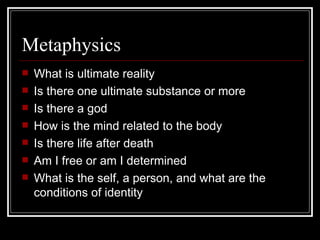
Metaphysics What is ultimate reality Is there one ultimate substance or more Is there a god How is the mind related to the body Is there life after death Am I free or am I determined What is the self, a person, and what are the conditions of identity
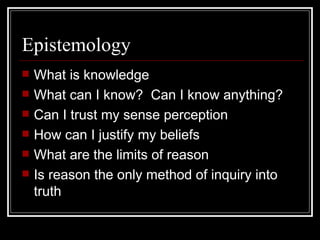
Epistemology What is knowledge What can I know?  Can I know anything? Can I trust my sense perception How can I justify my beliefs What are the limits of reason Is reason the only method of inquiry into truth
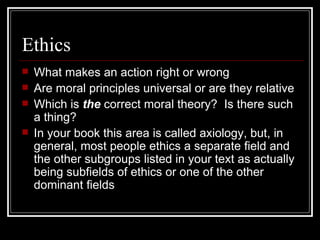
Ethics What makes an action right or wrong Are moral principles universal or are they relative Which is  the  correct moral theory?  Is there such a thing? In your book this area is called axiology, but, in general, most people ethics a separate field and the other subgroups listed in your text as actually being subfields of ethics or one of the other dominant fields
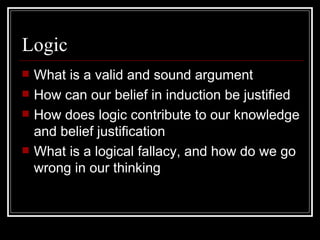
Logic What is a valid and sound argument How can our belief in induction be justified How does logic contribute to our knowledge and belief justification What is a logical fallacy, and how do we go wrong in our thinking

1/17

  • 1.
  • 2.
    Contact Information Instructor:James Clayton Office: NWCMB 424 Office Hours: W/F, 10:00-11:00 (and by appointment) Phone & Voicemail: (504) 862-3392 Email: [email_address] Course Webpage: blackboard.tulane.edu
  • 3.
    Required Texts [1 ] L. P. Pojman (2006): Philosophy: The Quest for Truth . 6th ed. Oxford: Oxford. ISBN 0-19-518944-2. [ Q ] [ 2 ] L. P. Pojman (2006): Philosophy: The Pursuit of Wisdom . 5th ed. Thomson: Belmont, CA. ISBN 0-495-00712-9. [ P ]
  • 4.
    Course Description catalogdescription : A general introduction to problems concerning knowledge, reality, and conduct. course overview : Doing philosophy requires using reason in the attempt to resolve philosophical questions. Philosophical questions are fundamental or open questions — questions that CANNOT be answered by appealing to “facts” alone. There are countless questions of this sort. We shall focus on the following: Can God’s existence be proven through reason alone? Is knowledge possible? If so, how? Are we born with it (nativism)? Do we acquire it via reason alone (rationalism) or experience alone (empiricism)? How do we know that the world is as it appears? What is the nature of the mind? Are minds souls, thinking substance, matter, or something else (e.g., a kind of computer software)?
  • 5.
    Wherein lies personalidentity? (That is, what makes you you and me me?) Sameness of body? Consciousness? Memories? Behavior? What sort of "things" have minds? How can we tell whether something has a mind? Is it possible for something nonhuman to have a mind? What is the philosophical significance (ethical, metaphysical, etc.) of machine or nonhuman intelligence? What properties must something possess to be a "person"? Could a machine or an animal or an alien be a person? What makes and action moral (“right”) or immoral (“wrong”)? Does it lie in what God commands? Does it lie in virtue (Aristotle)? Does it lie in the use of reason to determine our duties (Kant) or the greatest happiness for the most people (Mill)?
  • 6.
    To explore thesequestions, we might not limit ourselves to discussions of philosophical texts alone, for philosophy can be explored through movies (and TV episodes) too. Hence, we may watch some movie or TV episode in class. (Examples of movies that could be shown include The Meaning of Life , The Name of the Rose , Total Recall , Memento , Fight Club , The Truman Show , The Matrix , AI: Artificial Intelligence, The Thirteenth Floor , Star Trek: First Contact, Nemesis, and Saving Private Ryan.) The movie will make the “abstract” concepts raised in the text more “real” or “concrete.” Following the movie we shall critically evaluate what we have read and seen. In the end, the aim of this course is not to “solve” the philosophical questions that will be raised. Rather, the aim is survey some of the major ideas, figures, and problems that have shaped Western philosophy.
  • 7.
    Learning Objectives Uponsuccessfully completing this course, students will be able to do the following: to recognize philosophical questions and problems to know the various subfields of philosophy and the sorts of questions dealt with by philosophers in those areas to read philosophical texts to evaluate the cogency of arguments informally to understand cosmological, teleological, and ontological arguments for the existence of God (and the problems associated with each of those arguments) to understand the philosophical problems associated with the nature of minds and persons to understand the philosophical problems associated with personal identity to understand the nature of the mind-body problem to understand the problem of other minds to understand the philosophical implications of the computer metaphor to understand the philosophical implications of whether a machine can think to know the different views of Descartes, Locke, Hume, etc. with respect to knowledge and personal identity to know the difference between moral objectivism and moral nonobjectivism and different theories of each to know the different views of Aristotle, Kant, Mill, etc. with respect to morality to defend your own claims with respect to the philosophical issues raised in this course
  • 8.
    Course Requirements Gradeswill be based on a cumulative 100 point scale distributed as follows: A 100 – 89.5 points B 89.4 – 79.5 points C 79.4 – 69.5 points D 69.4 – 59.5 points F 59.4 — 0 points Participation (15%) 15 points Exam 1 (30%) 30 points Exam 2 (30%) 30 points Essay (25%) 25 points Final Grade Requirement
  • 9.
    PARTICIPATION : Youare required to be prepared for class and to participate. Your participation is worth 15% of your final grade. Its value will be based on your preparedness, attendance, tardiness, and both the quantity and quality of your in-class contributions. In addition, you will be required to provide via Blackboard a short answer to a question given each week. EXAMS : There will be 2 in-class exams, each covering about 1/2 of the course material. Each exam will be composed of various short answer (T/F and MC) and short essay questions taken mainly from the study questions (on BlackBoard). The exams are worth 60% of your final grade. ESSAY : Each student will be required to write 1 critical essay. The (  1500 word) essay (and draft) must be completed in accordance with the guidelines. The essay is worth 25% of your final grade. EXTRA CREDIT : There will be an extra credit question on each of the exams.
  • 10.
    Course Policies Whatfollows are my class policies. If for any reason you are unable to abide by these policies, you should withdraw from my course . ACADEMIC DISHONESTY : Academic honesty is fundamental to the process of learning and to evaluating academic performance. Academic dishonesty includes the following: cheating, plagiarizing, tampering with academic records or exams, falsifying identity, and being an accessory to acts of academic dishonesty. I HAVE ZERO TOLERANCE FOR ACADEMIC DISHONESTY! For example, if I find you guilty of cheating or plagiarizing, not only will you receive a ‘0’ on the assignment, I shall aggressively pursue both your receiving an overall ‘F’ AND a permanent blemish on your record. Refer to the Tulane Judicial Code for further information. ATTENDANCE : Your attendance is required. Classes begin on time. Do NOT stroll in late. You may miss or be tardy for one class without penalty. For each subsequent absence or tardiness, your participation grade will be penalized one point. If you miss more than three classes you risk failing the course. If you know that you must leave class early, let me know.
  • 11.
    AUDITS : Whether an audit is successful will depend only on your class participation performance. INCOMPLETES : Incompletes are STRONGLY discouraged. Should you need to take an incomplete, arrangements must be made with me well before the last class meeting. LANGUAGE : Feel free to say anything to me or to your peers, but tailor your remarks so as not to be uncivil or abusive. (See my "warning" below.) LATE-STARTS : There are no special dispensations for late-start students. LATE WORK : A draft of your essay is due 4/16 . Your final essay is due 5/10 . If either assignment is late, your essay will be penalized 10%. If you do not submit a draft, your essay will be penalized 50%. If you do not submit your final essay by the time I turn in grades, you will receive a '0' for the essay. MAKE-UPS : If you miss an exam, it is YOUR responsibility to tell me promptly (via phone, email, or in person) what extreme circumstances prevented your presence in class. Failing to do so will result in your receiving a ‘0’ on the exam. Regardless of the reason for the make-up, if I give one, it will be harder than the original. Make-up exams are bad, bad things. Don't be tempted by them.
  • 12.
    PARTICIPATION : This class will be taught in a highly interactive manner. You are required to participate. Participation includes asking questions, answering questions, and contributing to discussions. Failing to do such things will constitute a failure to participate. So too will being unprepared. A failure to participate will be treated like an absence. PHONES : Distracting interruptions are inconsiderate, disrespectful, and time-wasting. Phones should be turned off before class begins. WITHDRAWALS : You may withdraw from this course for any reason. Withdrawal is strictly up to you and none of my business. Look in the course listings for the last day to withdraw without a penalty — a 'W' appearing on your transcript. WARNING! Doing philosophy requires a willingness to think critically. Critical thinking does not consist in merely making claims. Rather, it requires offering reasons/evidence in support of your claims. It also requires your willingness to entertain criticism from others who do not share your assumptions. You will be required to do philosophy in this class. Doing philosophy can be hazardous to your cherished beliefs. Consequently, if you are unwilling to participate, to subject your views to critical analysis, to explore issues that cannot be resolved empirically, or to use computers, then my course is not for you.
  • 13.
    Subfields Metaphysics (concernedwith the ultimate nature of reality) Epistemology (regarding the nature of knowledge) Ethics (takes up questions of how we should act) Logic (having to do with the forms of argument)
  • 14.
    Metaphysics What isultimate reality Is there one ultimate substance or more Is there a god How is the mind related to the body Is there life after death Am I free or am I determined What is the self, a person, and what are the conditions of identity
  • 15.
    Epistemology What isknowledge What can I know? Can I know anything? Can I trust my sense perception How can I justify my beliefs What are the limits of reason Is reason the only method of inquiry into truth
  • 16.
    Ethics What makesan action right or wrong Are moral principles universal or are they relative Which is the correct moral theory? Is there such a thing? In your book this area is called axiology, but, in general, most people ethics a separate field and the other subgroups listed in your text as actually being subfields of ethics or one of the other dominant fields
  • 17.
    Logic What isa valid and sound argument How can our belief in induction be justified How does logic contribute to our knowledge and belief justification What is a logical fallacy, and how do we go wrong in our thinking