2-26 mind-body problem dualism
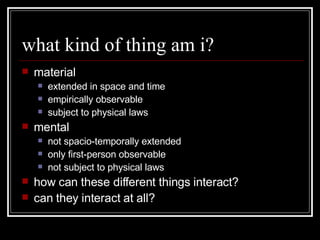
what kind of thing am i? material extended in space and time empirically observable subject to physical laws mental not spacio-temporally extended only first-person observable not subject to physical laws how can these different things interact? can they interact at all?
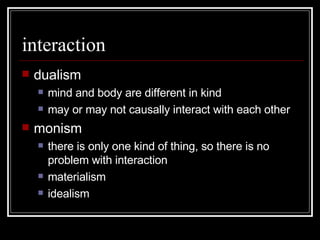
interaction dualism mind and body are different in kind may or may not causally interact with each other monism there is only one kind of thing, so there is no problem with interaction materialism idealism
ontological types of dualism substance dualism property dualism predicate dualism
predicate dualism weakest in the sense that it claims the least are non-reductive physicalists says that psychological or mentalistic predicates are (a) essential for a full description of the world and (b) are not reducible to physicalistic predicates  no true reduction is possible because, unlike water being reducible to H 2 O, psychological states are irreducible such is the case because these states are functional terms rather than natural kind terms; that is, they are described more in terms of what they do rather than in terms of their composition or structure think if attempting to describe a hurricane in purely chemical or physical terms
property dualism there is more than one type of property in the world suggests that the ontology of a pure materialism is insufficient for an accurate description holds that when matter is organized in a certain kind of way that new properties arise may be thought of as a kind of emergent materialism; though may be grounded in the material, there is nothing in physics to explain for the emergent properties of things like beliefs, phenomenal experiences, or consciousness itself
substance dualism there are two fundamentally different kind of substances in the world it is not the case that one arises from the other, but that they are essentially different it is not merely the properties that are different but the thing that has those properties mental is the thinking substance the material cannot think
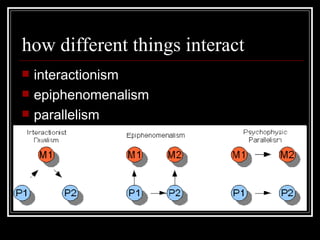
how different things interact interactionism epiphenomenalism parallelism
parallelism denies causal interaction between mental and material mental and brain events do not run in parallel because of any kind of influence of one over the other at all; only act  as if  they are interacting almost always adopted by those who already believe in some pre-established harmony set in place by God
epiphenomenalism mental events are caused by brain events, but the converse is not true some versions claim that all mental phenomena are inert while others that only some are inert in the latter it is usually qualitative mental states such as feeling pain or seeing green that have such a status; beliefs may have some causal influence
interactionism the view that mind and body causally influence one another there seems to be a great deal of intuitive force behind this position it certainly  seems  to be the case that hitting my thumb causes the feeling of pain, and that causes me to cry out and withdraw my hand it also seems that my experience of pain is not located in the brain state but is something different; that is, suggesting that there is nothing going on other than the firing of c-fibers in my head seems to leave out something vitally important, namely the  feeling  of the pain
problems with interactionism where does this interaction take place? how can such an interaction occur? how does this sit with the law of conservation of energy? can this be reconciled with occam’s razor? what does this mean for the possibility of knowing other minds?
where is the interaction? one might be inclined to wonder where such interaction could occur.  certainly, descartes was concerned with such. there does not appear to be any central location of the mind in the world if the mental is not locatable, then it seems strange to talk about  where  there interaction with anything else takes place the dualist generally takes it as a given that the mental affects the physical in the brain, but why must this be the case?  if we are prepared to posit some mysterious means of interaction, why can we not also posit that such interaction occurs somewhere other than the brain?  why not the heart?  if we are relying on some sort of reasoning towards the best explanation, some sort of occam’s razor answer, then we might be inclined to abandon dualism altogether
how does this interaction occur? this is one of the most powerful arguments against interactionism how can something that is not in any way material affect something that is? what do we even mean by “cause” here?  don’t our laws of causation only refer to material objects?  don’t they exist only in light of physical theory?  how can we make sense of something immaterial “causing” a change in the material? the big issue is that there doesn’t seem any way for the mental to get any friction with the material
what happens to the conservation law? the law of conservation of energy says that within a closed system the amount of energy is constant; energy is neither created nor destroyed as the mental is immaterial, any “push” it gives to the material, in effect, is a creation of energy
what about occam’s razor? shouldn’t we look for the simplest explanation? does the positing of not only more than one kind of thing, but also of some mysterious means of interaction, create unnecessary complications?
how can one know other minds? we experience only ourselves as thinking beings we never experience the consciousness of other individuals as a singular instance, we have no legitimate means of inducing that outward behavior similar to our own in any way indicated some sort of similar interaction does not rule out interactionism for one’s self, but does indicate that one cannot make such interaction a universal
the zombie argument we can imagine some being identical to us except that it lacks consciousness, and this includes psychologically identical if this is the case, then consciousness is not the same thing as our psychological, brain-oriented set of states can we really do this? this would not seem to save interactionism in any way; it salvages, at best, some sort of epiphenomenalism

2-26

  • 1.
  • 2.
    what kind ofthing am i? material extended in space and time empirically observable subject to physical laws mental not spacio-temporally extended only first-person observable not subject to physical laws how can these different things interact? can they interact at all?
  • 3.
    interaction dualism mindand body are different in kind may or may not causally interact with each other monism there is only one kind of thing, so there is no problem with interaction materialism idealism
  • 4.
    ontological types ofdualism substance dualism property dualism predicate dualism
  • 5.
    predicate dualism weakestin the sense that it claims the least are non-reductive physicalists says that psychological or mentalistic predicates are (a) essential for a full description of the world and (b) are not reducible to physicalistic predicates no true reduction is possible because, unlike water being reducible to H 2 O, psychological states are irreducible such is the case because these states are functional terms rather than natural kind terms; that is, they are described more in terms of what they do rather than in terms of their composition or structure think if attempting to describe a hurricane in purely chemical or physical terms
  • 6.
    property dualism thereis more than one type of property in the world suggests that the ontology of a pure materialism is insufficient for an accurate description holds that when matter is organized in a certain kind of way that new properties arise may be thought of as a kind of emergent materialism; though may be grounded in the material, there is nothing in physics to explain for the emergent properties of things like beliefs, phenomenal experiences, or consciousness itself
  • 7.
    substance dualism thereare two fundamentally different kind of substances in the world it is not the case that one arises from the other, but that they are essentially different it is not merely the properties that are different but the thing that has those properties mental is the thinking substance the material cannot think
  • 8.
    how different thingsinteract interactionism epiphenomenalism parallelism
  • 9.
    parallelism denies causalinteraction between mental and material mental and brain events do not run in parallel because of any kind of influence of one over the other at all; only act as if they are interacting almost always adopted by those who already believe in some pre-established harmony set in place by God
  • 10.
    epiphenomenalism mental eventsare caused by brain events, but the converse is not true some versions claim that all mental phenomena are inert while others that only some are inert in the latter it is usually qualitative mental states such as feeling pain or seeing green that have such a status; beliefs may have some causal influence
  • 11.
    interactionism the viewthat mind and body causally influence one another there seems to be a great deal of intuitive force behind this position it certainly seems to be the case that hitting my thumb causes the feeling of pain, and that causes me to cry out and withdraw my hand it also seems that my experience of pain is not located in the brain state but is something different; that is, suggesting that there is nothing going on other than the firing of c-fibers in my head seems to leave out something vitally important, namely the feeling of the pain
  • 12.
    problems with interactionismwhere does this interaction take place? how can such an interaction occur? how does this sit with the law of conservation of energy? can this be reconciled with occam’s razor? what does this mean for the possibility of knowing other minds?
  • 13.
    where is theinteraction? one might be inclined to wonder where such interaction could occur. certainly, descartes was concerned with such. there does not appear to be any central location of the mind in the world if the mental is not locatable, then it seems strange to talk about where there interaction with anything else takes place the dualist generally takes it as a given that the mental affects the physical in the brain, but why must this be the case? if we are prepared to posit some mysterious means of interaction, why can we not also posit that such interaction occurs somewhere other than the brain? why not the heart? if we are relying on some sort of reasoning towards the best explanation, some sort of occam’s razor answer, then we might be inclined to abandon dualism altogether
  • 14.
    how does thisinteraction occur? this is one of the most powerful arguments against interactionism how can something that is not in any way material affect something that is? what do we even mean by “cause” here? don’t our laws of causation only refer to material objects? don’t they exist only in light of physical theory? how can we make sense of something immaterial “causing” a change in the material? the big issue is that there doesn’t seem any way for the mental to get any friction with the material
  • 15.
    what happens tothe conservation law? the law of conservation of energy says that within a closed system the amount of energy is constant; energy is neither created nor destroyed as the mental is immaterial, any “push” it gives to the material, in effect, is a creation of energy
  • 16.
    what about occam’srazor? shouldn’t we look for the simplest explanation? does the positing of not only more than one kind of thing, but also of some mysterious means of interaction, create unnecessary complications?
  • 17.
    how can oneknow other minds? we experience only ourselves as thinking beings we never experience the consciousness of other individuals as a singular instance, we have no legitimate means of inducing that outward behavior similar to our own in any way indicated some sort of similar interaction does not rule out interactionism for one’s self, but does indicate that one cannot make such interaction a universal
  • 18.
    the zombie argumentwe can imagine some being identical to us except that it lacks consciousness, and this includes psychologically identical if this is the case, then consciousness is not the same thing as our psychological, brain-oriented set of states can we really do this? this would not seem to save interactionism in any way; it salvages, at best, some sort of epiphenomenalism