

 - is an outgrowth of Berkeley’s views.
 -The first chief advocate of
phenomenalism was David Hume who
is the father of the movement by virtue
of his reaction to Berkeley.
 -1st Berkeley’s analysis of the knowing
experience.
 -2nd The view of Berkeley that “ to be is to
be perceived” is accepted in one sense but
rejected in another.
 -when the phenomenalist says that
something exists, he means that if you set
up the right circumtances, you will have the
sensation of experiencing the object.
 Differs from common sense data, or
images, but not the object. It differs
from dualism in that dualism involves
a gap between the sense data and the
object behind the sense data.
 Defends only the sense data as the
object and behind that there is no
other object to be sought.
 IMMANUELL KANT- he published The
Critique of Pure Reason I 1781.
 - Kant argued that man’s knowledge of
reality is limited to appearances or
phenomena
 -Kant accepted a dualism in the knowledge
situation.
 -there is what we see in terms of
perception and this is all we ever see.
 DING AN SICH- “the thing in itself”
also called noumenon.
 Noumenon- is never seen but is
inferred from the senses related to the
phenomenon.
 KANT WROTE:
 Appearances are the sole object which can
be given to us immediately, and that in
them which relates immediately to the
object is called intuition. But these
appearances are not things in
themselves, they are not only
representations, which in turn have their
object –an object which cannot itself be
intuited by us, and which may
, therefore, be named the non-emperical
, that is, transcedental object.
 Hitherto it has been assumed that all our
knowledge must conform to objects. But
all attempts to extend our knowledge of
objects by establishing something in regard
to them a priori, by means of concepts
have, on this assumption, ended in failure.
We must therefore make trial whether we
may not have more success in the tasks of
metaphysics, if we suppose that objects
must conform to our knowledge.
 Argued that perception is one rather than
two in its make up
 A Phenomenalist will maintain that
every emperical statement about a
physical object, whether it sees to
refer to a scientific entity or to an
object of the more familiar kind that
we normally claim to perceive, is
reducible to a statement, or a set of
statements, which refer exclusively to
sense-data.
 Seems to bring considerable certainty
to the matter of perception, for after
all, a sense datum that I have appears
to be quite certain and almost
infallible.
 1st The precision of statements about
sense data is totally lacking and there
are varities of sense data-statements
about same data in different people.
 2nd Charge against phenomenalism is
that it implies a continual regression
from the statement about the sense
data to other qualifying statements
which in turn are in relation to other
statements.
 If the phenomenalist is right ,the
existance of a physical object of a
certain sort must be sufficient
condition for the occurrence, in the
appropriate circumtance, of certain
sense-data; there must, in short, be a
deductive step from descrriptions of
physical reality to decriptions of
possible, if in actual, appearances.
 Up to this point we have been dealing
often with extremes . There are two
opposites.
 1st There is Descartes, of whom we
have said little, who began with the
inner itself, the cogito, and argued that
“clear and simple ideas” are
certain, but these are solely within the
world of mind and reason.
 2nd The other side is Empirical
approach which may emphasize by
Locke
 Merely looking at something does not
reveal what it is. Judgement is
required. In some experiences the
mind must gather all the data and only
then can it “see” what is before it, in a
sense the mind projects meaning.
 This is complicated by one other twist.
In Descartes view of the self and
reason, knowledge was secure as long
as it was confined to the inner mind.
Because of the unreliability of the
senses, there was no sure route to the
world outside the mind.
 He published his work (The
Phenomenology of Perception)
 Modern philosopher who formulated
an answer giving credibility to a body
and a self.
 1. Knowing is much more than
sensationism.
 Sensationism is built on simple, pure
sensations.
 Ex. Picture from a camera
 Sensationism- is meaningless apart from
the process of interpretation which involves
the idea oof mind or person.
 No pure sensation, and sensationism is not
the place to begin for an understanding of
knowledge.
 2. Knowing centers around attention.
 Attention plays no role in the two
opposite views we have
described, empiricism and
rationalism.
 Attention is related to a field . Many
objects nay be in the visual field of the
person that do not gain his attention.
 3. The body is “subjectivized” or
subject filled.
 The body is that “by which there are
objects”My body however, is never an
object to me.
 4. The body involves synaesthetic
perception. This involves several
things
 Body synthesis that goes on between
the senses helps to illustrate the
meaning involved in a phenomenal
field.
 My bodily being is the means to
knowing things.
 5. The visual field makes sense out of
sense.
 The problem of depth in perception
was a difficult one for traditional
explanations of knowing.
 6. The body subjectivized restores
integrity to the knowing experience.
The attack upon the senses led to
skepticism.
The past experience o philosophy has
revolved around the game of being
absolutely ignorant.
 We have traced the issue of knowledge
particularly as it relates to perception
from common sense realism to a
phenomenology of perception.
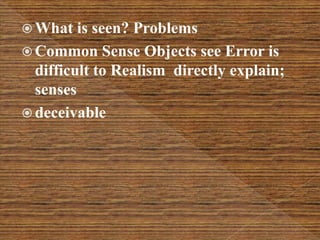
 What is seen? Problems
 Common Sense Objects see Error is
difficult to Realism directly explain;
senses
 deceivable
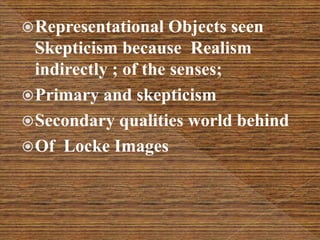
Representational Objects seen
Skepticism because Realism
indirectly ; of the senses;
Primary and skepticism
Secondary qualities world behind
Of Locke Images
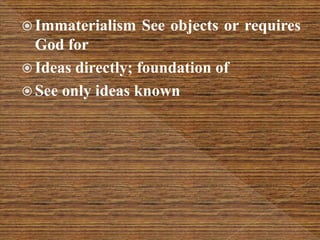
 Immaterialism See objects or requires
God for
 Ideas directly; foundation of
 See only ideas known
 Phenomenalism See Indirectly
Skepticism about
 Because of Ideas; the world behind
 Ideas reflect images or Ideas;
 The world rejects God as
 Cause of Ideas
 Phenomenology of See directly Error
is possible,
 Perception but correctible;
 Confidence in knowing the world
 We have seen problems in each position.
Any theory of knowledge must give
credence to the senses, the knowing
subject, and provide a synthesis of the
different facets of man’s experience. A
study of perception along the lines
developed by Merleau-Ponty seems to do
this with the greatest advantages. While
this may not be completely without
questions, his view helps to remove the
shadowy world of unknown behind sense
data and the same time give credibility to
our knowledge of ourselves as well as

Chapter 3

  • 2.
     - isan outgrowth of Berkeley’s views.  -The first chief advocate of phenomenalism was David Hume who is the father of the movement by virtue of his reaction to Berkeley.
  • 3.
     -1st Berkeley’sanalysis of the knowing experience.  -2nd The view of Berkeley that “ to be is to be perceived” is accepted in one sense but rejected in another.  -when the phenomenalist says that something exists, he means that if you set up the right circumtances, you will have the sensation of experiencing the object.
  • 4.
     Differs fromcommon sense data, or images, but not the object. It differs from dualism in that dualism involves a gap between the sense data and the object behind the sense data.  Defends only the sense data as the object and behind that there is no other object to be sought.
  • 5.
     IMMANUELL KANT-he published The Critique of Pure Reason I 1781.  - Kant argued that man’s knowledge of reality is limited to appearances or phenomena  -Kant accepted a dualism in the knowledge situation.
  • 6.
     -there iswhat we see in terms of perception and this is all we ever see.
  • 7.
     DING ANSICH- “the thing in itself” also called noumenon.  Noumenon- is never seen but is inferred from the senses related to the phenomenon.
  • 8.
     KANT WROTE: Appearances are the sole object which can be given to us immediately, and that in them which relates immediately to the object is called intuition. But these appearances are not things in themselves, they are not only representations, which in turn have their object –an object which cannot itself be intuited by us, and which may , therefore, be named the non-emperical , that is, transcedental object.
  • 9.
     Hitherto ithas been assumed that all our knowledge must conform to objects. But all attempts to extend our knowledge of objects by establishing something in regard to them a priori, by means of concepts have, on this assumption, ended in failure. We must therefore make trial whether we may not have more success in the tasks of metaphysics, if we suppose that objects must conform to our knowledge.
  • 10.
     Argued thatperception is one rather than two in its make up
  • 11.
     A Phenomenalistwill maintain that every emperical statement about a physical object, whether it sees to refer to a scientific entity or to an object of the more familiar kind that we normally claim to perceive, is reducible to a statement, or a set of statements, which refer exclusively to sense-data.
  • 12.
     Seems tobring considerable certainty to the matter of perception, for after all, a sense datum that I have appears to be quite certain and almost infallible.
  • 13.
     1st Theprecision of statements about sense data is totally lacking and there are varities of sense data-statements about same data in different people.  2nd Charge against phenomenalism is that it implies a continual regression from the statement about the sense data to other qualifying statements which in turn are in relation to other statements.
  • 14.
     If thephenomenalist is right ,the existance of a physical object of a certain sort must be sufficient condition for the occurrence, in the appropriate circumtance, of certain sense-data; there must, in short, be a deductive step from descrriptions of physical reality to decriptions of possible, if in actual, appearances.
  • 15.
     Up tothis point we have been dealing often with extremes . There are two opposites.
  • 16.
     1st Thereis Descartes, of whom we have said little, who began with the inner itself, the cogito, and argued that “clear and simple ideas” are certain, but these are solely within the world of mind and reason.  2nd The other side is Empirical approach which may emphasize by Locke
  • 17.
     Merely lookingat something does not reveal what it is. Judgement is required. In some experiences the mind must gather all the data and only then can it “see” what is before it, in a sense the mind projects meaning.
  • 18.
     This iscomplicated by one other twist. In Descartes view of the self and reason, knowledge was secure as long as it was confined to the inner mind. Because of the unreliability of the senses, there was no sure route to the world outside the mind.
  • 19.
     He publishedhis work (The Phenomenology of Perception)  Modern philosopher who formulated an answer giving credibility to a body and a self.
  • 20.
     1. Knowingis much more than sensationism.  Sensationism is built on simple, pure sensations.  Ex. Picture from a camera  Sensationism- is meaningless apart from the process of interpretation which involves the idea oof mind or person.  No pure sensation, and sensationism is not the place to begin for an understanding of knowledge.
  • 21.
     2. Knowingcenters around attention.  Attention plays no role in the two opposite views we have described, empiricism and rationalism.  Attention is related to a field . Many objects nay be in the visual field of the person that do not gain his attention.
  • 22.
     3. Thebody is “subjectivized” or subject filled.  The body is that “by which there are objects”My body however, is never an object to me.
  • 23.
     4. Thebody involves synaesthetic perception. This involves several things  Body synthesis that goes on between the senses helps to illustrate the meaning involved in a phenomenal field.  My bodily being is the means to knowing things.
  • 24.
     5. Thevisual field makes sense out of sense.  The problem of depth in perception was a difficult one for traditional explanations of knowing.
  • 25.
     6. Thebody subjectivized restores integrity to the knowing experience. The attack upon the senses led to skepticism. The past experience o philosophy has revolved around the game of being absolutely ignorant.
  • 26.
     We havetraced the issue of knowledge particularly as it relates to perception from common sense realism to a phenomenology of perception.
  • 27.
     What isseen? Problems  Common Sense Objects see Error is difficult to Realism directly explain; senses  deceivable
  • 28.
    Representational Objects seen Skepticismbecause Realism indirectly ; of the senses; Primary and skepticism Secondary qualities world behind Of Locke Images
  • 29.
     Immaterialism Seeobjects or requires God for  Ideas directly; foundation of  See only ideas known
  • 30.
     Phenomenalism SeeIndirectly Skepticism about  Because of Ideas; the world behind  Ideas reflect images or Ideas;  The world rejects God as  Cause of Ideas
  • 31.
     Phenomenology ofSee directly Error is possible,  Perception but correctible;  Confidence in knowing the world
  • 32.
     We haveseen problems in each position. Any theory of knowledge must give credence to the senses, the knowing subject, and provide a synthesis of the different facets of man’s experience. A study of perception along the lines developed by Merleau-Ponty seems to do this with the greatest advantages. While this may not be completely without questions, his view helps to remove the shadowy world of unknown behind sense data and the same time give credibility to our knowledge of ourselves as well as