2-5 the problem of evil
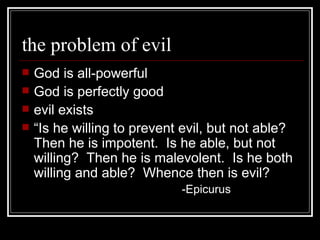
the problem of evil God is all-powerful God is perfectly good evil exists “Is he willing to prevent evil, but not able?  Then he is impotent.  Is he able, but not willing?  Then he is malevolent.  Is he both willing and able?  Whence then is evil? -Epicurus
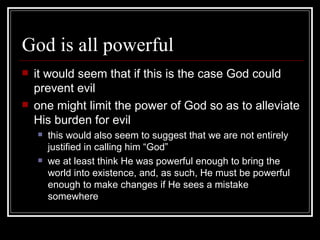
God is all powerful it would seem that if this is the case God could prevent evil one might limit the power of God so as to alleviate His burden for evil this would also seem to suggest that we are not entirely justified in calling him “God” we at least think He was powerful enough to bring the world into existence, and, as such, He must be powerful enough to make changes if He sees a mistake somewhere
God is perfectly good there is a general consensus on this among religions if this is not the case we have little reason to worship Him God cannot do evil and remain “God”
overcoming the problem free will defense theodicy
free will problem of evil arises because of humanity’s ability to choose between a variety of options given the exact same circumstances; that is, given the same set of factors about the world, whatever we choose to do, we could have chosen otherwise freedom necessitates the option of choosing evil, and sometimes people do indeed choose that option
problems with free will solution presumes that we do, indeed, have free will, and this might not be the case events in the world appear to be causally related if some event is not the result of a causal chain, it appears to the result of chance decisions made because of chance or randomness are arbitrary and, hence, cannot be the result of a free will even if we do have free will, our agency before God appears to be diminished, like a child before an adult, and, as such, humanity cannot be held responsible for the amount or quality of evil in the world same argument could be used to justify an all evil god, the Devil, actually creating the world
theodicy this is the best of all possible worlds one view says that we lack a “God’s eye view” of the world to see that it is really all good another view suggests that this world is a testing ground in which we complete our growth into fully mature beings who have the  likeness  and not merely the  image  of God we require the possibility of evil in order to have the potential to do good.  without evil in the world we would never have the chance to develop moral qualities
problems with theodicy couldn’t God have used a better mechanism for instruction? how can the immense suffering experienced possibly contribute to the spiritual growth of humanity? supposing that a God’s Eye View would show everything to actually be good turns our notion of good on its head.  as such, saying that what we think of as bad might really be good provides no coherent solution to the problem at all even if God has some reason, we are in no position to know it as he has not communicated that reason to us.  as such, it is more reasonable to believe one of the following:  1) he doesn’t exist; 2) he is not all-powerful; 3) he is not all good again, we can use the same justification to argue for the existence of an all-powerful Devil who tolerates good for the purpose of allowing us to act evil

2-5

  • 1.
  • 2.
    the problem ofevil God is all-powerful God is perfectly good evil exists “Is he willing to prevent evil, but not able? Then he is impotent. Is he able, but not willing? Then he is malevolent. Is he both willing and able? Whence then is evil? -Epicurus
  • 3.
    God is allpowerful it would seem that if this is the case God could prevent evil one might limit the power of God so as to alleviate His burden for evil this would also seem to suggest that we are not entirely justified in calling him “God” we at least think He was powerful enough to bring the world into existence, and, as such, He must be powerful enough to make changes if He sees a mistake somewhere
  • 4.
    God is perfectlygood there is a general consensus on this among religions if this is not the case we have little reason to worship Him God cannot do evil and remain “God”
  • 5.
    overcoming the problemfree will defense theodicy
  • 6.
    free will problemof evil arises because of humanity’s ability to choose between a variety of options given the exact same circumstances; that is, given the same set of factors about the world, whatever we choose to do, we could have chosen otherwise freedom necessitates the option of choosing evil, and sometimes people do indeed choose that option
  • 7.
    problems with freewill solution presumes that we do, indeed, have free will, and this might not be the case events in the world appear to be causally related if some event is not the result of a causal chain, it appears to the result of chance decisions made because of chance or randomness are arbitrary and, hence, cannot be the result of a free will even if we do have free will, our agency before God appears to be diminished, like a child before an adult, and, as such, humanity cannot be held responsible for the amount or quality of evil in the world same argument could be used to justify an all evil god, the Devil, actually creating the world
  • 8.
    theodicy this isthe best of all possible worlds one view says that we lack a “God’s eye view” of the world to see that it is really all good another view suggests that this world is a testing ground in which we complete our growth into fully mature beings who have the likeness and not merely the image of God we require the possibility of evil in order to have the potential to do good. without evil in the world we would never have the chance to develop moral qualities
  • 9.
    problems with theodicycouldn’t God have used a better mechanism for instruction? how can the immense suffering experienced possibly contribute to the spiritual growth of humanity? supposing that a God’s Eye View would show everything to actually be good turns our notion of good on its head. as such, saying that what we think of as bad might really be good provides no coherent solution to the problem at all even if God has some reason, we are in no position to know it as he has not communicated that reason to us. as such, it is more reasonable to believe one of the following: 1) he doesn’t exist; 2) he is not all-powerful; 3) he is not all good again, we can use the same justification to argue for the existence of an all-powerful Devil who tolerates good for the purpose of allowing us to act evil