2-12 epistemology
epistemology study of knowledge what is knowledge? how is knowledge acquired? what do we know?
what is knowledge epistemology deals with propositional knowledge (knowing-that) this is contrasted with knowing-how, with practical knowledge, and with perceptual knowledge roughly, if you can replace “i know” with “i believe,” and it still makes sense, that is propositional knowledge must involve belief  makes no sense to say “i know p, but i don’t believe that p” must be true makes no sense to say that “i know p, but p is not true” rough definition is that knowledge is justified true belief
what is truth? correspondence theory of truth something is true if it accurately reflects some objective state of affairs, that is, if it corresponds to how the world  really  is coherence theory of truth truth is a property of systems of beliefs, and truth if granted to any single belief only derivatively depending upon the proper position of that belief within the true system pragmatic theory of truth sees truth as a practical product that is the result of a process like inquiry
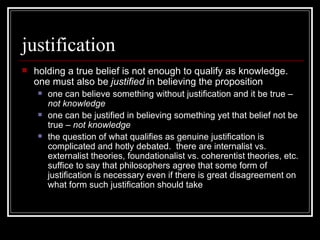
justification holding a true belief is not enough to qualify as knowledge.  one must also be  justified  in believing the proposition one can believe something without justification and it be true –  not knowledge one can be justified in believing something yet that belief not be true –  not knowledge the question of what qualifies as genuine justification is complicated and hotly debated.  there are internalist vs. externalist theories, foundationalist vs. coherentist theories, etc.  suffice to say that philosophers agree that some form of justification is necessary even if there is great disagreement on what form such justification should take
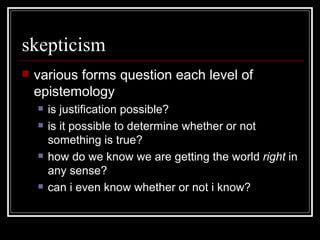
skepticism various forms question each level of epistemology is justification possible? is it possible to determine whether or not something is true? how do we know we are getting the world  right  in any sense? can i even know whether or not i know?
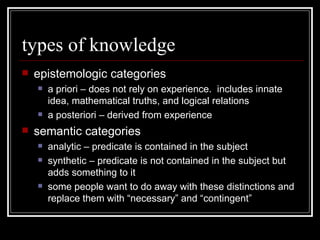
types of knowledge epistemologic categories a priori – does not rely on experience.  includes innate idea, mathematical truths, and logical relations a posteriori – derived from experience semantic categories analytic – predicate is contained in the subject synthetic – predicate is not contained in the subject but adds something to it some people want to do away with these distinctions and replace them with “necessary” and “contingent”
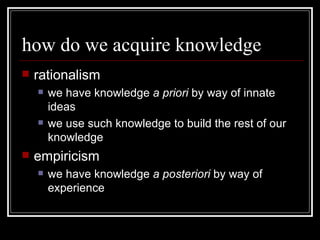
how do we acquire knowledge rationalism we have knowledge  a priori  by way of innate ideas we use such knowledge to build the rest of our knowledge empiricism we have knowledge  a posteriori  by way of experience

2-12

  • 1.
  • 2.
    epistemology study ofknowledge what is knowledge? how is knowledge acquired? what do we know?
  • 3.
    what is knowledgeepistemology deals with propositional knowledge (knowing-that) this is contrasted with knowing-how, with practical knowledge, and with perceptual knowledge roughly, if you can replace “i know” with “i believe,” and it still makes sense, that is propositional knowledge must involve belief makes no sense to say “i know p, but i don’t believe that p” must be true makes no sense to say that “i know p, but p is not true” rough definition is that knowledge is justified true belief
  • 4.
    what is truth?correspondence theory of truth something is true if it accurately reflects some objective state of affairs, that is, if it corresponds to how the world really is coherence theory of truth truth is a property of systems of beliefs, and truth if granted to any single belief only derivatively depending upon the proper position of that belief within the true system pragmatic theory of truth sees truth as a practical product that is the result of a process like inquiry
  • 5.
    justification holding atrue belief is not enough to qualify as knowledge. one must also be justified in believing the proposition one can believe something without justification and it be true – not knowledge one can be justified in believing something yet that belief not be true – not knowledge the question of what qualifies as genuine justification is complicated and hotly debated. there are internalist vs. externalist theories, foundationalist vs. coherentist theories, etc. suffice to say that philosophers agree that some form of justification is necessary even if there is great disagreement on what form such justification should take
  • 6.
    skepticism various formsquestion each level of epistemology is justification possible? is it possible to determine whether or not something is true? how do we know we are getting the world right in any sense? can i even know whether or not i know?
  • 7.
    types of knowledgeepistemologic categories a priori – does not rely on experience. includes innate idea, mathematical truths, and logical relations a posteriori – derived from experience semantic categories analytic – predicate is contained in the subject synthetic – predicate is not contained in the subject but adds something to it some people want to do away with these distinctions and replace them with “necessary” and “contingent”
  • 8.
    how do weacquire knowledge rationalism we have knowledge a priori by way of innate ideas we use such knowledge to build the rest of our knowledge empiricism we have knowledge a posteriori by way of experience