1© PTU's Gian Jyoti School of TQM & Entrepreneurship
Lean Manufacturing
Vijay Kapoor – Principal Consultant
Naresh K Chawla - Sr. Consultant
2© PTU's Gian Jyoti School of TQM & Entrepreneurship
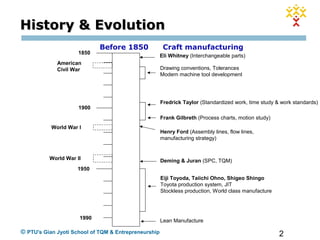
Eli Whitney (Interchangeable parts)
Drawing conventions, Tolerances
Modern machine tool development
1850
1900
Fredrick Taylor (Standardized work, time study & work standards)
Frank Gilbreth (Process charts, motion study)
Henry Ford (Assembly lines, flow lines,
manufacturing strategy)
Deming & Juran (SPC, TQM)
1990
1950
Eiji Toyoda, Taiichi Ohno, Shigeo Shingo
Toyota production system, JIT
Stockless production, World class manufacture
Lean Manufacture
American
Civil War
World War I
World War II
History & EvolutionHistory & Evolution
Before 1850 Craft manufacturing
3© PTU's Gian Jyoti School of TQM & Entrepreneurship
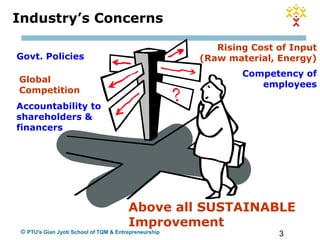
Govt. Policies
Global
Competition
Rising Cost of Input
(Raw material, Energy)
Accountability to
shareholders &
financers
Industry’s Concerns
Competency of
employees
Above all SUSTAINABLE
Improvement
4© PTU's Gian Jyoti School of TQM & Entrepreneurship
• Create precise customer value
- goods and services with higher quality
and fewer defects
– with less human effort, less space, less
capital, and less time than the traditional
system of mass production.
• Remove ‘waste’
– Consume ‘just enough’ recourses
– Do more with less
Survival Kit
5© PTU's Gian Jyoti School of TQM & Entrepreneurship
Defining Value and Waste
• Defining value - an item or feature for
which a customer willing to pay.
• Every thing else – waste
• Waste - activities that consume time,
resource and/or space but do not add
value.
• Lean - Production of product to meet
demand on daily basis with minimum lead
time & non value added activities
eliminated or minimized
6© PTU's Gian Jyoti School of TQM & Entrepreneurship
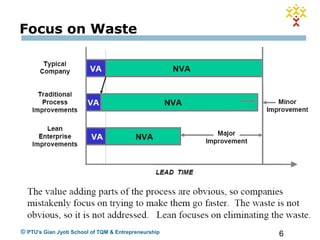
Focus on Waste
7© PTU's Gian Jyoti School of TQM & Entrepreneurship
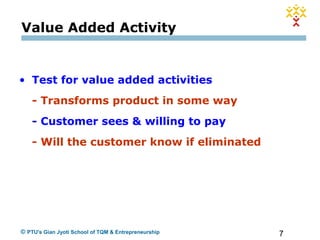
Value Added Activity
• Test for value added activities
- Transforms product in some way
- Customer sees & willing to pay
- Will the customer know if eliminated
8© PTU's Gian Jyoti School of TQM & Entrepreneurship
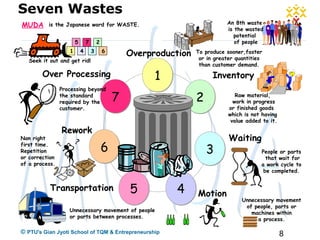
Overproduction
Waiting
Inventory
Transportation
Motion
Over Processing
Rework
11
66
77
55 44
33
22
To produce sooner,faster
or in greater quantities
than customer demand.
Raw material,
work in progress
or finished goods
which is not having
value added to it.
People or parts
that wait for
a work cycle to
be completed.
Unnecessary movement
of people, parts or
machines within
a process.
Unnecessary movement of people
or parts between processes.
Non right
first time.
Repetition
or correction
of a process.
Processing beyond
the standard
required by the
customer.
is the Japanese word for WASTE.MUDA
Seek it out and get rid!
1
2
34
5
6
7
An 8th waste
is the wasted
potential
of people
Seven Wastes
9© PTU's Gian Jyoti School of TQM & Entrepreneurship
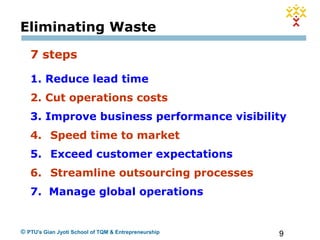
Eliminating Waste
7 steps
1. Reduce lead time
2. Cut operations costs
3. Improve business performance visibility
4. Speed time to market
5. Exceed customer expectations
6. Streamline outsourcing processes
7. Manage global operations
10© PTU's Gian Jyoti School of TQM & Entrepreneurship
“Lean manufacturing is not a collection of best
practices from which manufacturers can pick
and choose. It is a production philosophy, a
way of conceptualizing the manufacturing
process from raw material to finished goods
and from design concept to customer
satisfaction. Lean is truly a different way of
thinking about manufacturing.”
- Running Today’s Factory: A Proven Strategy
for Lean Manufacturing, Charles Standard.
Lean manufacturing is a systems
approach
11© PTU's Gian Jyoti School of TQM & Entrepreneurship
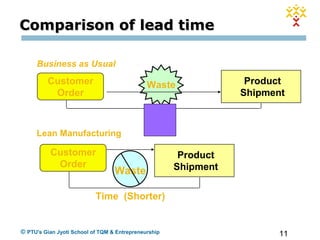
Comparison of lead timeComparison of lead time
Customer
Order
Waste Product
Shipment
Time
Customer
Order
Product
Shipment
Time (Shorter)
Business as Usual
Waste
Lean Manufacturing
12© PTU's Gian Jyoti School of TQM & Entrepreneurship
Main Features of Lean ManufacturingMain Features of Lean Manufacturing
• Greater Product Variety
• Fast Response (Flexibility)
• Stable Production Schedules
• Supply Chain Integration
• Demand Management
• Broader jobs, highly skilled workers, proud of
product
• Excellent quality
• Reduced costs
• Ability to meet global market & competition
13© PTU's Gian Jyoti School of TQM & Entrepreneurship
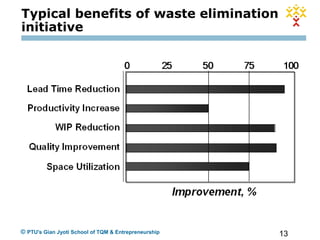
Typical benefits of waste elimination
initiative
14© PTU's Gian Jyoti School of TQM & Entrepreneurship
Lean Thinking, Lean Tools &
Supporting Strategies
16© PTU's Gian Jyoti School of TQM & Entrepreneurship
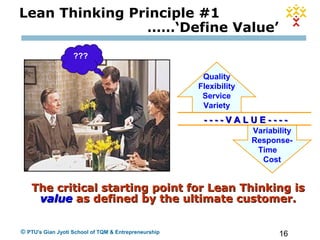
Lean Thinking Principle #1
……‘Define Value’
Quality
Flexibility
Service
Variety
Variability
Response-
Time
Cost
- - - - V A L U E - - - -- - - - V A L U E - - - -
The critical starting point for Lean Thinking isThe critical starting point for Lean Thinking is
valuevalue as defined by the ultimate customer.as defined by the ultimate customer.
???
17© PTU's Gian Jyoti School of TQM & Entrepreneurship
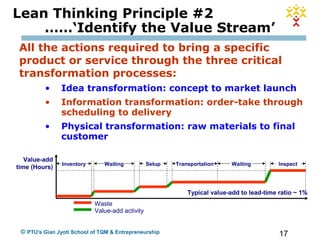
Lean Thinking Principle #2
……‘Identify the Value Stream’
All the actions required to bring a specific
product or service through the three critical
transformation processes:
• Idea transformation: concept to market launch
• Information transformation: order-take through
scheduling to delivery
• Physical transformation: raw materials to final
customer
Value-add
time (Hours)
Inventory Waiting
Typical value-add to lead-time ratio ~ 1%
Waste
Value-add activity
Setup Transportation Waiting Inspect
18© PTU's Gian Jyoti School of TQM & Entrepreneurship
Lean Thinking Principles #3,4,5
#3: Make the work flow
• Every time the flow of work stops we
consume resources that adds costs but
generates no value
#4: Respond only when the customer pulls work
• Overproduction is the worst form of waste
as it generate all other waste types e.g.
transportation, inventory, waiting,…..
#5: Strive to seek perfection
• The real benchmark is zero waste, not what
your competitors are doing!
19© PTU's Gian Jyoti School of TQM & Entrepreneurship
Lean Tools & Supporting Strategies
• 5S
• Visual control
• Team building
• Problem solving
• Standardised processes
• Value stream mapping
20© PTU's Gian Jyoti School of TQM & Entrepreneurship
Lean Tools & Supporting Strategies
• Pull system
• Kanban
• Takt time – rate of customer
demand
• Manufacturing Cells
• Heijunka
• 5Ws & 1H
21© PTU's Gian Jyoti School of TQM & Entrepreneurship
• Kaizen
• Total Productive Maintenance
• SMED (setup reduction)
• Poka-Yoke or mistake-proofing
• Cycle time reduction
• Andon – signalling system to stop line
Lean Tools & Supporting Strategies
22© PTU's Gian Jyoti School of TQM & Entrepreneurship
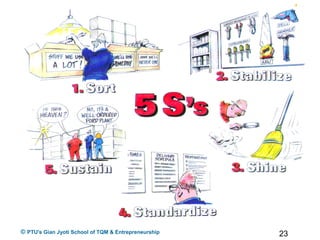
5S
A method for organizing a workplace, and
keeping it organized.
Benefits
1.Improve safety
2.Decrease down time
3.Raise employee morale
4.Identify problems more quickly
5.Develop control through visibility
6.Establish convenient work practices
23© PTU's Gian Jyoti School of TQM & Entrepreneurship
24© PTU's Gian Jyoti School of TQM & Entrepreneurship
Visual Control
Any communication device used in the work
environment that tells us at a glance how work
should be done and whether it is deviating from
the standard
Benefits
1. Increase productivity
2. Improve quality
3. On-time delivery
4. Reduce inventory
5. Increase equipment reliability
6. Boosts bottom-line profits
25© PTU's Gian Jyoti School of TQM & Entrepreneurship
Visual controls show
• Where items belong?
• How many items belong there?
• What is the standard procedure for doing
something?
• Status of work in process.
• Many other types of information critical to
the flow of work activities.
26© PTU's Gian Jyoti School of TQM & Entrepreneurship
Visual management
• Visual management maintains an orderly
work environment.
• Employees have quicker and safer access to
items that are needed.
• Colour-coding is often used to remind
employees of where items belong.
• If order is not continually stressed, disorder
will result and create an unfriendly work
atmosphere.
27© PTU's Gian Jyoti School of TQM & Entrepreneurship
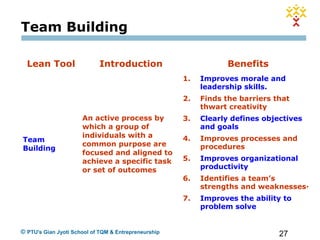
Lean Tool Introduction Benefits
Team
Building
An active process by
which a group of
individuals with a
common purpose are
focused and aligned to
achieve a specific task
or set of outcomes
1. Improves morale and
leadership skills.
2. Finds the barriers that
thwart creativity
3. Clearly defines objectives
and goals
4. Improves processes and
procedures
5. Improves organizational
productivity
6. Identifies a team’s
strengths and weaknesses·
7. Improves the ability to
problem solve
Team Building
28© PTU's Gian Jyoti School of TQM & Entrepreneurship
Lean Tool Introduction Benefits
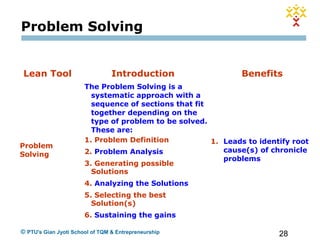
Problem
Solving
The Problem Solving is a
systematic approach with a
sequence of sections that fit
together depending on the
type of problem to be solved.
These are:
1. Problem Definition
2. Problem Analysis
3. Generating possible
Solutions
4. Analyzing the Solutions
5. Selecting the best
Solution(s)
6. Sustaining the gains
1. Leads to identify root
cause(s) of chronicle
problems
Problem Solving
29© PTU's Gian Jyoti School of TQM & Entrepreneurship
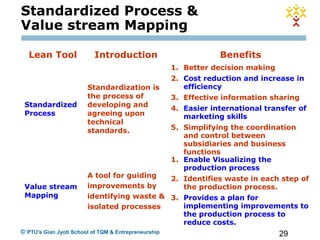
Lean Tool Introduction Benefits
Standardized
Process
Standardization is
the process of
developing and
agreeing upon
technical
standards.
1. Better decision making
2. Cost reduction and increase in
efficiency
3. Effective information sharing
4. Easier international transfer of
marketing skills
5. Simplifying the coordination
and control between
subsidiaries and business
functions
Value stream
Mapping
A tool for guiding
improvements by
identifying waste &
isolated processes
1. Enable Visualizing the
production process
2. Identifies waste in each step of
the production process.
3. Provides a plan for
implementing improvements to
the production process to
reduce costs.
Standardized Process &
Value stream Mapping
30© PTU's Gian Jyoti School of TQM & Entrepreneurship
Lean Tool Introduction Benefits
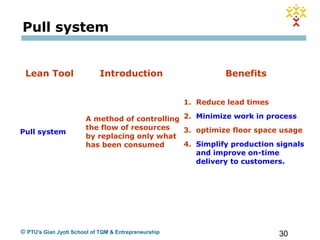
Pull system
A method of controlling
the flow of resources
by replacing only what
has been consumed
1. Reduce lead times
2. Minimize work in process
3. optimize floor space usage
4. Simplify production signals
and improve on-time
delivery to customers.
Pull system
31© PTU's Gian Jyoti School of TQM & Entrepreneurship
Lean Tool Introduction Benefits
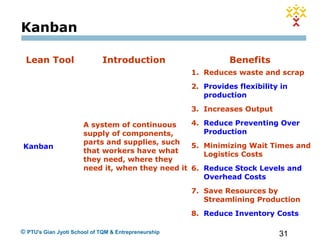
Kanban
A system of continuous
supply of components,
parts and supplies, such
that workers have what
they need, where they
need it, when they need it
1. Reduces waste and scrap
2. Provides flexibility in
production
3. Increases Output
4. Reduce Preventing Over
Production
5. Minimizing Wait Times and
Logistics Costs
6. Reduce Stock Levels and
Overhead Costs
7. Save Resources by
Streamlining Production
8. Reduce Inventory Costs
Kanban
32© PTU's Gian Jyoti School of TQM & Entrepreneurship
Lean Tool Introduction Benefits
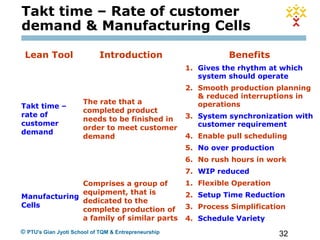
Takt time –
rate of
customer
demand
The rate that a
completed product
needs to be finished in
order to meet customer
demand
1. Gives the rhythm at which
system should operate
2. Smooth production planning
& reduced interruptions in
operations
3. System synchronization with
customer requirement
4. Enable pull scheduling
5. No over production
6. No rush hours in work
7. WIP reduced
Manufacturing
Cells
Comprises a group of
equipment, that is
dedicated to the
complete production of
a family of similar parts
1. Flexible Operation
2. Setup Time Reduction
3. Process Simplification
4. Schedule Variety
Takt time – Rate of customer
demand & Manufacturing Cells
33© PTU's Gian Jyoti School of TQM & Entrepreneurship
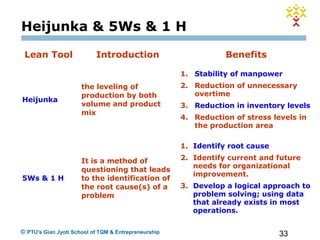
Lean Tool Introduction Benefits
Heijunka
the leveling of
production by both
volume and product
mix
1. Stability of manpower
2. Reduction of unnecessary
overtime
3. Reduction in inventory levels
4. Reduction of stress levels in
the production area
5Ws & 1 H
It is a method of
questioning that leads
to the identification of
the root cause(s) of a
problem
1. Identify root cause
2. Identify current and future
needs for organizational
improvement.
3. Develop a logical approach to
problem solving; using data
that already exists in most
operations.
Heijunka & 5Ws & 1 H
34© PTU's Gian Jyoti School of TQM & Entrepreneurship
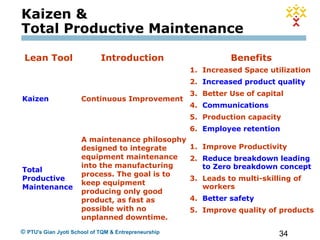
Lean Tool Introduction Benefits
Kaizen Continuous Improvement
1. Increased Space utilization
2. Increased product quality
3. Better Use of capital
4. Communications
5. Production capacity
6. Employee retention
Total
Productive
Maintenance
A maintenance philosophy
designed to integrate
equipment maintenance
into the manufacturing
process. The goal is to
keep equipment
producing only good
product, as fast as
possible with no
unplanned downtime.
1. Improve Productivity
2. Reduce breakdown leading
to Zero breakdown concept
3. Leads to multi-skilling of
workers
4. Better safety
5. Improve quality of products
Kaizen &
Total Productive Maintenance
35© PTU's Gian Jyoti School of TQM & Entrepreneurship
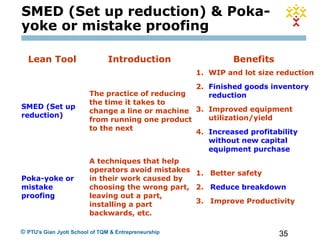
Lean Tool Introduction Benefits
SMED (Set up
reduction)
The practice of reducing
the time it takes to
change a line or machine
from running one product
to the next
1. WIP and lot size reduction
2. Finished goods inventory
reduction
3. Improved equipment
utilization/yield
4. Increased profitability
without new capital
equipment purchase
Poka-yoke or
mistake
proofing
A techniques that help
operators avoid mistakes
in their work caused by
choosing the wrong part,
leaving out a part,
installing a part
backwards, etc.
1. Better safety
2. Reduce breakdown
3. Improve Productivity
SMED (Set up reduction) & Poka-
yoke or mistake proofing
36© PTU's Gian Jyoti School of TQM & Entrepreneurship
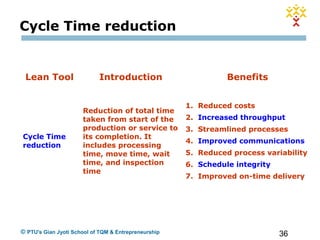
Lean Tool Introduction Benefits
Cycle Time
reduction
Reduction of total time
taken from start of the
production or service to
its completion. It
includes processing
time, move time, wait
time, and inspection
time
1. Reduced costs
2. Increased throughput
3. Streamlined processes
4. Improved communications
5. Reduced process variability
6. Schedule integrity
7. Improved on-time delivery
Cycle Time reduction
37© PTU's Gian Jyoti School of TQM & Entrepreneurship
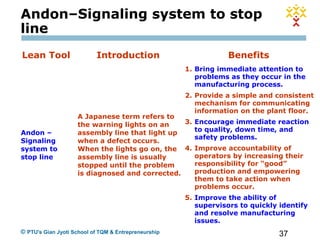
Lean Tool Introduction Benefits
Andon –
Signaling
system to
stop line
A Japanese term refers to
the warning lights on an
assembly line that light up
when a defect occurs.
When the lights go on, the
assembly line is usually
stopped until the problem
is diagnosed and corrected.
1. Bring immediate attention to
problems as they occur in the
manufacturing process.
2. Provide a simple and consistent
mechanism for communicating
information on the plant floor.
3. Encourage immediate reaction
to quality, down time, and
safety problems.
4. Improve accountability of
operators by increasing their
responsibility for “good”
production and empowering
them to take action when
problems occur.
5. Improve the ability of
supervisors to quickly identify
and resolve manufacturing
issues.
Andon–Signaling system to stop
line

203109245 lean-manufacturing (1)

  • 1.
    1© PTU's GianJyoti School of TQM & Entrepreneurship Lean Manufacturing Vijay Kapoor – Principal Consultant Naresh K Chawla - Sr. Consultant
  • 2.
    2© PTU's GianJyoti School of TQM & Entrepreneurship Eli Whitney (Interchangeable parts) Drawing conventions, Tolerances Modern machine tool development 1850 1900 Fredrick Taylor (Standardized work, time study & work standards) Frank Gilbreth (Process charts, motion study) Henry Ford (Assembly lines, flow lines, manufacturing strategy) Deming & Juran (SPC, TQM) 1990 1950 Eiji Toyoda, Taiichi Ohno, Shigeo Shingo Toyota production system, JIT Stockless production, World class manufacture Lean Manufacture American Civil War World War I World War II History & EvolutionHistory & Evolution Before 1850 Craft manufacturing
  • 3.
    3© PTU's GianJyoti School of TQM & Entrepreneurship Govt. Policies Global Competition Rising Cost of Input (Raw material, Energy) Accountability to shareholders & financers Industry’s Concerns Competency of employees Above all SUSTAINABLE Improvement
  • 4.
    4© PTU's GianJyoti School of TQM & Entrepreneurship • Create precise customer value - goods and services with higher quality and fewer defects – with less human effort, less space, less capital, and less time than the traditional system of mass production. • Remove ‘waste’ – Consume ‘just enough’ recourses – Do more with less Survival Kit
  • 5.
    5© PTU's GianJyoti School of TQM & Entrepreneurship Defining Value and Waste • Defining value - an item or feature for which a customer willing to pay. • Every thing else – waste • Waste - activities that consume time, resource and/or space but do not add value. • Lean - Production of product to meet demand on daily basis with minimum lead time & non value added activities eliminated or minimized
  • 6.
    6© PTU's GianJyoti School of TQM & Entrepreneurship Focus on Waste
  • 7.
    7© PTU's GianJyoti School of TQM & Entrepreneurship Value Added Activity • Test for value added activities - Transforms product in some way - Customer sees & willing to pay - Will the customer know if eliminated
  • 8.
    8© PTU's GianJyoti School of TQM & Entrepreneurship Overproduction Waiting Inventory Transportation Motion Over Processing Rework 11 66 77 55 44 33 22 To produce sooner,faster or in greater quantities than customer demand. Raw material, work in progress or finished goods which is not having value added to it. People or parts that wait for a work cycle to be completed. Unnecessary movement of people, parts or machines within a process. Unnecessary movement of people or parts between processes. Non right first time. Repetition or correction of a process. Processing beyond the standard required by the customer. is the Japanese word for WASTE.MUDA Seek it out and get rid! 1 2 34 5 6 7 An 8th waste is the wasted potential of people Seven Wastes
  • 9.
    9© PTU's GianJyoti School of TQM & Entrepreneurship Eliminating Waste 7 steps 1. Reduce lead time 2. Cut operations costs 3. Improve business performance visibility 4. Speed time to market 5. Exceed customer expectations 6. Streamline outsourcing processes 7. Manage global operations
  • 10.
    10© PTU's GianJyoti School of TQM & Entrepreneurship “Lean manufacturing is not a collection of best practices from which manufacturers can pick and choose. It is a production philosophy, a way of conceptualizing the manufacturing process from raw material to finished goods and from design concept to customer satisfaction. Lean is truly a different way of thinking about manufacturing.” - Running Today’s Factory: A Proven Strategy for Lean Manufacturing, Charles Standard. Lean manufacturing is a systems approach
  • 11.
    11© PTU's GianJyoti School of TQM & Entrepreneurship Comparison of lead timeComparison of lead time Customer Order Waste Product Shipment Time Customer Order Product Shipment Time (Shorter) Business as Usual Waste Lean Manufacturing
  • 12.
    12© PTU's GianJyoti School of TQM & Entrepreneurship Main Features of Lean ManufacturingMain Features of Lean Manufacturing • Greater Product Variety • Fast Response (Flexibility) • Stable Production Schedules • Supply Chain Integration • Demand Management • Broader jobs, highly skilled workers, proud of product • Excellent quality • Reduced costs • Ability to meet global market & competition
  • 13.
    13© PTU's GianJyoti School of TQM & Entrepreneurship Typical benefits of waste elimination initiative
  • 14.
    14© PTU's GianJyoti School of TQM & Entrepreneurship Lean Thinking, Lean Tools & Supporting Strategies
  • 15.
    16© PTU's GianJyoti School of TQM & Entrepreneurship Lean Thinking Principle #1 ……‘Define Value’ Quality Flexibility Service Variety Variability Response- Time Cost - - - - V A L U E - - - -- - - - V A L U E - - - - The critical starting point for Lean Thinking isThe critical starting point for Lean Thinking is valuevalue as defined by the ultimate customer.as defined by the ultimate customer. ???
  • 16.
    17© PTU's GianJyoti School of TQM & Entrepreneurship Lean Thinking Principle #2 ……‘Identify the Value Stream’ All the actions required to bring a specific product or service through the three critical transformation processes: • Idea transformation: concept to market launch • Information transformation: order-take through scheduling to delivery • Physical transformation: raw materials to final customer Value-add time (Hours) Inventory Waiting Typical value-add to lead-time ratio ~ 1% Waste Value-add activity Setup Transportation Waiting Inspect
  • 17.
    18© PTU's GianJyoti School of TQM & Entrepreneurship Lean Thinking Principles #3,4,5 #3: Make the work flow • Every time the flow of work stops we consume resources that adds costs but generates no value #4: Respond only when the customer pulls work • Overproduction is the worst form of waste as it generate all other waste types e.g. transportation, inventory, waiting,….. #5: Strive to seek perfection • The real benchmark is zero waste, not what your competitors are doing!
  • 18.
    19© PTU's GianJyoti School of TQM & Entrepreneurship Lean Tools & Supporting Strategies • 5S • Visual control • Team building • Problem solving • Standardised processes • Value stream mapping
  • 19.
    20© PTU's GianJyoti School of TQM & Entrepreneurship Lean Tools & Supporting Strategies • Pull system • Kanban • Takt time – rate of customer demand • Manufacturing Cells • Heijunka • 5Ws & 1H
  • 20.
    21© PTU's GianJyoti School of TQM & Entrepreneurship • Kaizen • Total Productive Maintenance • SMED (setup reduction) • Poka-Yoke or mistake-proofing • Cycle time reduction • Andon – signalling system to stop line Lean Tools & Supporting Strategies
  • 21.
    22© PTU's GianJyoti School of TQM & Entrepreneurship 5S A method for organizing a workplace, and keeping it organized. Benefits 1.Improve safety 2.Decrease down time 3.Raise employee morale 4.Identify problems more quickly 5.Develop control through visibility 6.Establish convenient work practices
  • 22.
    23© PTU's GianJyoti School of TQM & Entrepreneurship
  • 23.
    24© PTU's GianJyoti School of TQM & Entrepreneurship Visual Control Any communication device used in the work environment that tells us at a glance how work should be done and whether it is deviating from the standard Benefits 1. Increase productivity 2. Improve quality 3. On-time delivery 4. Reduce inventory 5. Increase equipment reliability 6. Boosts bottom-line profits
  • 24.
    25© PTU's GianJyoti School of TQM & Entrepreneurship Visual controls show • Where items belong? • How many items belong there? • What is the standard procedure for doing something? • Status of work in process. • Many other types of information critical to the flow of work activities.
  • 25.
    26© PTU's GianJyoti School of TQM & Entrepreneurship Visual management • Visual management maintains an orderly work environment. • Employees have quicker and safer access to items that are needed. • Colour-coding is often used to remind employees of where items belong. • If order is not continually stressed, disorder will result and create an unfriendly work atmosphere.
  • 26.
    27© PTU's GianJyoti School of TQM & Entrepreneurship Lean Tool Introduction Benefits Team Building An active process by which a group of individuals with a common purpose are focused and aligned to achieve a specific task or set of outcomes 1. Improves morale and leadership skills. 2. Finds the barriers that thwart creativity 3. Clearly defines objectives and goals 4. Improves processes and procedures 5. Improves organizational productivity 6. Identifies a team’s strengths and weaknesses· 7. Improves the ability to problem solve Team Building
  • 27.
    28© PTU's GianJyoti School of TQM & Entrepreneurship Lean Tool Introduction Benefits Problem Solving The Problem Solving is a systematic approach with a sequence of sections that fit together depending on the type of problem to be solved. These are: 1. Problem Definition 2. Problem Analysis 3. Generating possible Solutions 4. Analyzing the Solutions 5. Selecting the best Solution(s) 6. Sustaining the gains 1. Leads to identify root cause(s) of chronicle problems Problem Solving
  • 28.
    29© PTU's GianJyoti School of TQM & Entrepreneurship Lean Tool Introduction Benefits Standardized Process Standardization is the process of developing and agreeing upon technical standards. 1. Better decision making 2. Cost reduction and increase in efficiency 3. Effective information sharing 4. Easier international transfer of marketing skills 5. Simplifying the coordination and control between subsidiaries and business functions Value stream Mapping A tool for guiding improvements by identifying waste & isolated processes 1. Enable Visualizing the production process 2. Identifies waste in each step of the production process. 3. Provides a plan for implementing improvements to the production process to reduce costs. Standardized Process & Value stream Mapping
  • 29.
    30© PTU's GianJyoti School of TQM & Entrepreneurship Lean Tool Introduction Benefits Pull system A method of controlling the flow of resources by replacing only what has been consumed 1. Reduce lead times 2. Minimize work in process 3. optimize floor space usage 4. Simplify production signals and improve on-time delivery to customers. Pull system
  • 30.
    31© PTU's GianJyoti School of TQM & Entrepreneurship Lean Tool Introduction Benefits Kanban A system of continuous supply of components, parts and supplies, such that workers have what they need, where they need it, when they need it 1. Reduces waste and scrap 2. Provides flexibility in production 3. Increases Output 4. Reduce Preventing Over Production 5. Minimizing Wait Times and Logistics Costs 6. Reduce Stock Levels and Overhead Costs 7. Save Resources by Streamlining Production 8. Reduce Inventory Costs Kanban
  • 31.
    32© PTU's GianJyoti School of TQM & Entrepreneurship Lean Tool Introduction Benefits Takt time – rate of customer demand The rate that a completed product needs to be finished in order to meet customer demand 1. Gives the rhythm at which system should operate 2. Smooth production planning & reduced interruptions in operations 3. System synchronization with customer requirement 4. Enable pull scheduling 5. No over production 6. No rush hours in work 7. WIP reduced Manufacturing Cells Comprises a group of equipment, that is dedicated to the complete production of a family of similar parts 1. Flexible Operation 2. Setup Time Reduction 3. Process Simplification 4. Schedule Variety Takt time – Rate of customer demand & Manufacturing Cells
  • 32.
    33© PTU's GianJyoti School of TQM & Entrepreneurship Lean Tool Introduction Benefits Heijunka the leveling of production by both volume and product mix 1. Stability of manpower 2. Reduction of unnecessary overtime 3. Reduction in inventory levels 4. Reduction of stress levels in the production area 5Ws & 1 H It is a method of questioning that leads to the identification of the root cause(s) of a problem 1. Identify root cause 2. Identify current and future needs for organizational improvement. 3. Develop a logical approach to problem solving; using data that already exists in most operations. Heijunka & 5Ws & 1 H
  • 33.
    34© PTU's GianJyoti School of TQM & Entrepreneurship Lean Tool Introduction Benefits Kaizen Continuous Improvement 1. Increased Space utilization 2. Increased product quality 3. Better Use of capital 4. Communications 5. Production capacity 6. Employee retention Total Productive Maintenance A maintenance philosophy designed to integrate equipment maintenance into the manufacturing process. The goal is to keep equipment producing only good product, as fast as possible with no unplanned downtime. 1. Improve Productivity 2. Reduce breakdown leading to Zero breakdown concept 3. Leads to multi-skilling of workers 4. Better safety 5. Improve quality of products Kaizen & Total Productive Maintenance
  • 34.
    35© PTU's GianJyoti School of TQM & Entrepreneurship Lean Tool Introduction Benefits SMED (Set up reduction) The practice of reducing the time it takes to change a line or machine from running one product to the next 1. WIP and lot size reduction 2. Finished goods inventory reduction 3. Improved equipment utilization/yield 4. Increased profitability without new capital equipment purchase Poka-yoke or mistake proofing A techniques that help operators avoid mistakes in their work caused by choosing the wrong part, leaving out a part, installing a part backwards, etc. 1. Better safety 2. Reduce breakdown 3. Improve Productivity SMED (Set up reduction) & Poka- yoke or mistake proofing
  • 35.
    36© PTU's GianJyoti School of TQM & Entrepreneurship Lean Tool Introduction Benefits Cycle Time reduction Reduction of total time taken from start of the production or service to its completion. It includes processing time, move time, wait time, and inspection time 1. Reduced costs 2. Increased throughput 3. Streamlined processes 4. Improved communications 5. Reduced process variability 6. Schedule integrity 7. Improved on-time delivery Cycle Time reduction
  • 36.
    37© PTU's GianJyoti School of TQM & Entrepreneurship Lean Tool Introduction Benefits Andon – Signaling system to stop line A Japanese term refers to the warning lights on an assembly line that light up when a defect occurs. When the lights go on, the assembly line is usually stopped until the problem is diagnosed and corrected. 1. Bring immediate attention to problems as they occur in the manufacturing process. 2. Provide a simple and consistent mechanism for communicating information on the plant floor. 3. Encourage immediate reaction to quality, down time, and safety problems. 4. Improve accountability of operators by increasing their responsibility for “good” production and empowering them to take action when problems occur. 5. Improve the ability of supervisors to quickly identify and resolve manufacturing issues. Andon–Signaling system to stop line

Editor's Notes

  • #5 Many of the key principles were pioneered by Henry Ford, who was the first person to integrate an entire production system, under what he termed “flow production." Following World War II, the Toyota Motor Company adapted Ford’s principles as a means of compensating for its challenge of limited human, financial, and material resources. The Toyota Production System (or TPS), which evolved from this need, was one of the first managerial systems using lean principles throughout the enterprise to produce a wide variety of products at lower volumes and many fewer defects than competitors. Leaders today in a wide range of industries, nonprofit organizations, government agencies, healthcare, and other areas are finding ways to apply the principles of lean as a means of producing goods and delivering services that creates value for the customer with the minimum amount of waste and the maximum degree of quality
  • #6 When this metric of value is implemented it allows companies using TPS to have an exceedingly clear vision when analyzing an activity or process. No organization likes waste, however it is difficult to eliminate waste if it cannot be identified.