S
T
U
D
E
N
T
S
F
O
C
U
S
.
C
O
M
CE6303 - MECHANICS OF FLUIDS
(FOR III – SEMESTER)
UNIT – II
FLUID STATICS & KINEMATICS
PREPARED BY
R.SURYA, M.E
Assistant Professor
DEPARTMENT OF CIVIL ENGINEERING
SRI VIDYA COLLEGE OF ENGINEERING AND TECHNOLOGY-626001
S
T
U
D
E
N
T
S
F
O
C
U
S
.
C
O
M
UNIT – II
FLUID STATICS & KINEMATICS
Pascal’s Law and Hydrostatic equation – Forces on plane and curved surfaces –
Buoyancy – Meta centre – Pressure measurement – Fluid mass under relative equilibrium
Fluid Kinematics
Stream, streak and path lines – Classification of flows – Continuity equation (one, two and three
dimensional forms) – Stream and potential functions – flow nets – Velocity measurement (Pilot
tube, current meter, Hot wire and hot film anemometer, float technique, Laser Doppler
velocimetry)
S.NO 2 MARKS PAGE NO
1 Define “Pascal’s Law” 7
2 What is mean by Absolute pressure and Gauge pressure? 7
3 Define Manometers 7
4 A differential manometer is connected at the two points A and B .
At B pr is 9.81 N/cm2
(abs), find the absolute pr at A
7
5 Define Buoyancy 7
6 Define META – CENTRE 8
7 Write a short notes on “ Differential Manometers” 8
8 Define Centre of pressure 8
9 Write down the types of fluid flow 8
10 Write a short notes on “Laminar flow”. 8
11 Define “ Turbulent flow”. 8
12 What is mean by Rate flow or Discharge? 9
13 What do you understand by Continuity Equation? 9
14 What is mean by Local acceleration? 9
15 What is mean by Convective acceleration? 9
16 Define Velocity potential function. 9
17 Define Stream function 9
18 What is mean by Flow net? 10
19 Write the properties of stream function. 10
20 What are the types of Motion? 10
21 Define “Vortex flow”. 10
22
Water is flowing through two different pipes, to which an inverted
differential manometer having an oil of sp. Gr 0.8 is connected the
pressure head in the pipe A is 2 m of water, find the pressure in the
10
S
T
U
D
E
N
T
S
F
O
C
U
S
.
C
O
M
pipe B for the manometer readings.
23
A differential manometer is connected at the two points A and B .
At B pr is 9.81 N/cm2
(abs), find the absolute pr at A
11
24
A hydraulic pressure has a ram of 30 cm diameter and a plunger of
4.5 cm diameter. Find the weight lifted by the hydraulic pressure
when the force applied at the plunger is 500 N.
11
25
The diameters of a pipe at the sections 1 and 2 are 10 cm and 15 cm
respectively. Find the discharge through the pipe if the velocity of
water flowing through the pipe section 1 is 5 m/s. determine also
the velocity at section 2
12
S
T
U
D
E
N
T
S
F
O
C
U
S
.
C
O
M
S.NO 16 MARKS PAGE NO
1
A U-Tube manometer is used to measure the pressure of
water in a pipe line, which is in excess of atmospheric pressure.
The right limb of the manometer contains water and mercury is in
the left limb. Determine the pressure of water in the main line, if
the difference in level of mercury in the limbs U. U tube is 10
cm and the free surface of mercury is in level with over the centre
of the pipe. If the pressure of water in pipe line is reduced to
9810 N/m2
, Calculate the new difference in the level of mercury.
Sketch the arrangement in both cases
13
2
A differential manometer is connected at the two points A and B
of two pipes a shown in figure. The pipe A contains a liquid of
sp. Gr = 1.5 while pipe b contains a liquid of sp . gr = 0.9 . The
pressures at A and B are 1 kgf / cm2
respectively. Find the
difference in mercury level in the differential manometer
15
3
A vertical sluice gate is used to cover an opening in a dam. The
opening is 2m wide and 1.2m high. On the upstream of the
gate, the liquid of sp. Gr 1.45, lies upto a height of 1.5m above
the top of the gate, whereas on the downstream side the water is
available upto a height touching the top of the gate. Find the
resultant force acting on the gate and position of centre of
pressure. Find also the force acting horizontally at the top of the
gate and posiotn of centre of pressure. Find also the force acting
horizontally at the top of the gate which is capable of opening it.
Assume the gate is hinged at the bottom
16
4
Find the density of a metallic body which floats at the interface
of mercury of sp. Gr 13.6 and water such that 40% of its volume
is sub-merged in mercury and 60% in water
19
5
A solid cylinder of diameter 4.0 m has a height of 3m. Find the
meta – centric height of the cylinder when it is floating in water
with its axis vertical. The sp gr of the cylinder – 0.6
20
6
A wooden cylinder of sp. Gr = 0.6 and circular in cross – section
is required to float in oil (sp.gr = 0.90) . Find the L/D ratio for
the cylinder to float with its longitudinal axis vertical in oil,
where L is the height of cylinder and D is its diameters
21
7
Water flows through a pipe AB 1.2m diameter at 3 m/s and then
passes through a pipe BC 1.5 m diameter at C, the pipe branches.
Branch CD is 0.8m in diameter and carries one third of the flow
in AB. The flow velocity in branch CE is 2.5 m/s. find the
volume rate of flow in AB, the velocity in BC, the velocity in
CD and the diameter of CE
2 3
8.
In a two – two dimensional incompressible flow, the fluid
velocity components are given by u = x – 4y and v= - y – 4x.
show that velocity potential exists and determine its form. Find
25
S
T
U
D
E
N
T
S
F
O
C
U
S
.
C
O
M
also the stream function..
2 MARKS QUESTIONS AND ANSWERS
1. Define “Pascal’s Law”:
It stats that the pressure or intensity of pressure at a point in a static fluid is equal
in all directions.
2. What is mean by Absolute pressure and Gauge pressure?
Absolute Pressure:
It is defined as the pressure which is measured with the reference to absolute
vacuum pressure.
Gauge Pressure:
It is defined as the pressure which is measured with the help of a pressure
measuring instrument, in which the atmospheric pressure is taken as datum. The
atmospheric pressure on the scale is marked as zero.
3. Define Manometers.
Manometers are defined as the devices used for measuring the pressure at a point
in a fluid by balancing measuring the column of fluid by the same or another column of
fluid.
1. Simple M
2. Differential M
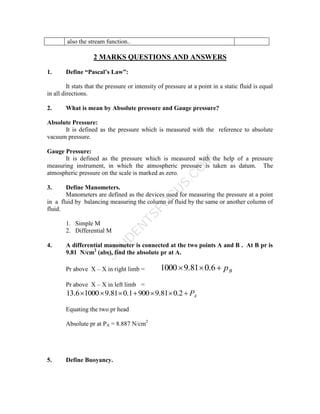
4. A differential manometer is connected at the two points A and B . At B pr is
9.81 N/cm2
(abs), find the absolute pr at A.
Pr above X – X in right limb = B
p


 6
.
0
81
.
9
1000
Pr above X – X in left limb =
A
P






 2
.
0
81
.
9
900
1
.
0
81
.
9
1000
6
.
13
Equating the two pr head
Absolute pr at PA = 8.887 N/cm2
5. Define Buoyancy.
S
T
U
D
E
N
T
S
F
O
C
U
S
.
C
O
M
When a body is immersed in a fluid, an upward force is exerted by the fluid on the
body. This upward force is equal to the weight of the fluid displaced by the body and is
called the force of buoyancy or simply buoyancy.
6. Define META – CENTRE
It is defined as the point about which a body starts oscillating when the body is
fitted by a small angle. The meta – centre may also be defined as the poit at which the
line of action of the force of buoyancy wil meet the normal axis of the body when the
body is given a small angular displacement.
7. Write a short notes on “ Differential Manometers”.
Differential manometers are the devices used for measuring the difference of
pressures between two points in a pipe or in two different pipes/ a differential manometer
consists of a U – tube containing a heavy liquid, whose two ends are connected to the
points, whose difference of pressure is to be measured. Most commonly types of
differential manometers are:
1. U – tube differential manometer.
2. Inverted U – tube differential manometers.
8. Define Centre of pressure.
Is defined as the point of application of the total pressure on the surface.
The submerged surfaces may be:
1. Vertical plane surface
2. Horizontal plane surface
3. Inclined plane surface
4. Curved surface
9. Write down the types of fluid flow.
The fluid flow is classified as :
1. Steady and Unsteady flows.
2. Uniform and Non – uniform flows.
3. Laminar and turbulent flows.
4. Compressible and incompressible flows.
5. Rotational and irrotational flows
6. One, two and three dimensional flows.
10. Write a short notes on “Laminar flow”.
Laminar flow is defined as that type of flow in which the fluid particles move
along well – defined paths or stream line and all the stream lines are straight and parallel.
S
T
U
D
E
N
T
S
F
O
C
U
S
.
C
O
M
Thus the particles move in laminas or layers gliding over the adjacent layer. This type of
flow is also called stream – line flow or viscous flow/
11. Define “ Turbulent flow”.
Turbulent flow is that type of flow in which the fluid particles move in a zig –zag
way. Due to the movement of fluid particles in a zig – zag way.
12. What is mean by Rate flow or Discharge?
It is defined as the quantity of a fluid flowing per second through a section of a
pipe or channel. For an incompressible fluid( or liquid) the rate of flow or discharge is
expressed as volume of fluid flowing across the section per section. For compressible
fluids, the rate of flow is usually expressed as the weight of fluid flowing across the
section.
The discharge (Q) = A X V
Where, A = Cross – sectional area of pipe.
V = Average velocity of fluid across the section.
13. What do you understand by Continuity Equation?
The equation based on the principle of conservation of mass is called continuity
equation. Thus for a fluid flowing through the pipe at all the cross-section, the quantity of
fluid per second is constant.
A1V1 = A2V2..
14. What is mean by Local acceleration?
Local acceleration is defined as the rate of increase of velocity with respect to
time at a given point in a flow field. In equation is given by the expression
(Ә u / Әt ) , ( Әv / Әt) or ( Әw / Әt) is known as local acceleration.
15. What is mean by Convective acceleration?
It is defined as the rate of change of velocity due to the change of position of
fluid particles in a fluid flow. The expressions other than (Ә u / Әt ) , ( Әv / Әt) and
( Әw / Әt) in the equation are known as convective acceleration.
16. Define Velocity potential function.
It is defined as a scalar function of space and time such that its negative derivative
with respect to any direction gives the fluid velocity in that direction. It is defined by Φ
(Phi). Mathematically, the velocity, potential is defined as Φ = f ( x,y,z) for steady flow
such that.
u = - (Ә Φ/Әx)
v = - ( Ә Φ/Әy)
w = - ( Ә Φ/Әz) where, u,v and w are the components of velocity in x.y and
z directions respectively.
S
T
U
D
E
N
T
S
F
O
C
U
S
.
C
O
M
17. Define Stream function.
It is defined as the scalar function of space and time, such that its partial
derivative with respect to any direction gives the velocity component at right angles to
that direction. It is denoted by ψ (Psi) and only for two dimensional flow.
Mathematically. For steady flow is defined as ψ = f(x,y) such that ,
(Ә ψ / Әx) = v
(Ә ψ / Әy) = - u.
18. What is mean by Flow net?
A grid obtained by drawing a series of equipotential lines and stream lines is
called a flow net. The flow net is an important tool in analyzing the two – dimensional
irrotational flow problems.
19. Write the properties of stream function.
The properties of stream function (ψ) are:
1. If stream function (ψ) exists, it is possible case of fluid flow which may be
rotational or irrotational.
2. If stream function (ψ) satisfies the Laplace equation, it is a possible case of
irrotational flow.
20. What are the types of Motion?
1. Linear Translation or Pure Translation.
2. Linear Deformation.
3. Angular deformation.
4. Rotation.
21. Define “Vortex flow”.
Vortex flow is defined as the flow of a fluid along a curved path or the flow of a
rotating mass of a fluid is known ‘ Vortex Flow’. The vortex flow is of two types namely:
1. Forced vortex flow, and
2. Free vortex flow.
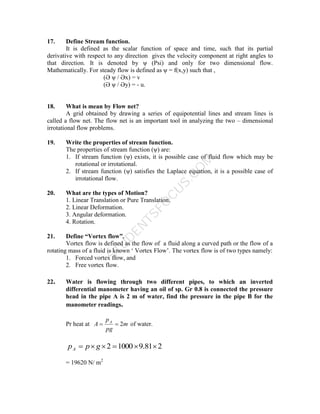
22. Water is flowing through two different pipes, to which an inverted
differential manometer having an oil of sp. Gr 0.8 is connected the pressure
head in the pipe A is 2 m of water, find the pressure in the pipe B for the
manometer readings.
Pr heat at m
pg
p
A A
2

 of water.
2
81
.
9
1000
2 




 g
p
pA
= 19620 N/ m2
S
T
U
D
E
N
T
S
F
O
C
U
S
.
C
O
M
Pr below X – X in left limb = PA – p1 gh1 = 19620 - 1000 x 781 x 0.3 =
16677 N/m2
Pr below X – X in right limb
76
.
1922
12
.
0
81
.
9
800
1
.
0
81
.
9
1000 






 B
B P
p
Equating two pressure, we get,
2
2
/
8599
.
1
/
76
.
18599
76
.
1922
16677 cm
N
m
N
PB 



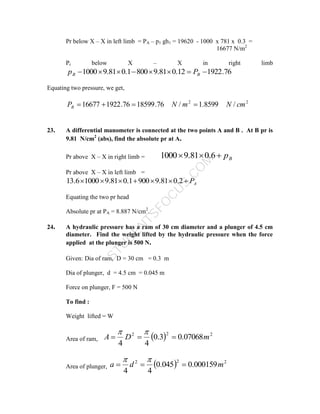
23. A differential manometer is connected at the two points A and B . At B pr is
9.81 N/cm2
(abs), find the absolute pr at A.
Pr above X – X in right limb = B
p


 6
.
0
81
.
9
1000
Pr above X – X in left limb =
A
P






 2
.
0
81
.
9
900
1
.
0
81
.
9
1000
6
.
13
Equating the two pr head
Absolute pr at PA = 8.887 N/cm2
.
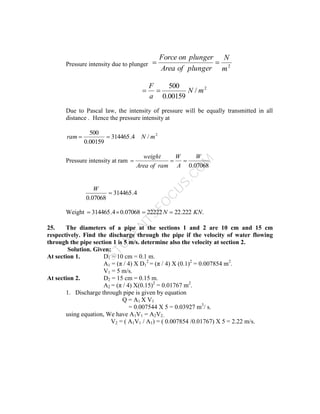
24. A hydraulic pressure has a ram of 30 cm diameter and a plunger of 4.5 cm
diameter. Find the weight lifted by the hydraulic pressure when the force
applied at the plunger is 500 N.
Given: Dia of ram, D = 30 cm = 0.3 m
Dia of plunger, d = 4.5 cm = 0.045 m
Force on plunger, F = 500 N
To find :
Weight lifted = W
Area of ram,   2
2
2
07068
.
0
3
.
0
4
4
m
D
A 




Area of plunger,   2
2
2
000159
.
0
045
.
0
4
4
m
d
a 




S
T
U
D
E
N
T
S
F
O
C
U
S
.
C
O
M
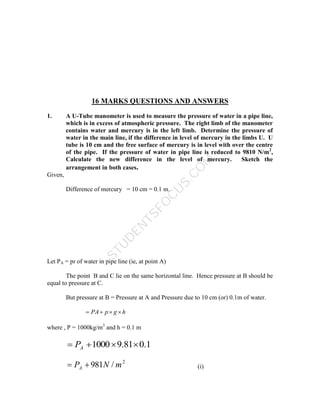
Pressure intensity due to plunger 2
m
N
plunger
of
Area
plunger
on
Force


2
/
00159
.
0
500
m
N
a
F


Due to Pascal law, the intensity of pressure will be equally transmitted in all
distance . Hence the pressure intensity at
2
/
4
.
314465
00159
.
0
500
m
N
ram 

Pressure intensity at ram
07068
.
0
W
A
W
ram
of
Area
weight



4
.
314465
07068
.
0

W
Weight .
222
.
22
22222
07068
.
0
4
.
314465 KN
N 



25. The diameters of a pipe at the sections 1 and 2 are 10 cm and 15 cm
respectively. Find the discharge through the pipe if the velocity of water flowing
through the pipe section 1 is 5 m/s. determine also the velocity at section 2.
Solution. Given:
At section 1. D1 = 10 cm = 0.1 m.
A1 = (π / 4) X D1
2
= (π / 4) X (0.1)2
= 0.007854 m2
.
V1 = 5 m/s.
At section 2. D2 = 15 cm = 0.15 m.
A2 = (π / 4) X(0.15)2
= 0.01767 m2
.
1. Discharge through pipe is given by equation
Q = A1 X V1
= 0.007544 X 5 = 0.03927 m3
/ s.
using equation, We have A1V1 = A2V2..
V2 = ( A1V1 / A1) = ( 0.007854 /0.01767) X 5 = 2.22 m/s.
S
T
U
D
E
N
T
S
F
O
C
U
S
.
C
O
M
16 MARKS QUESTIONS AND ANSWERS
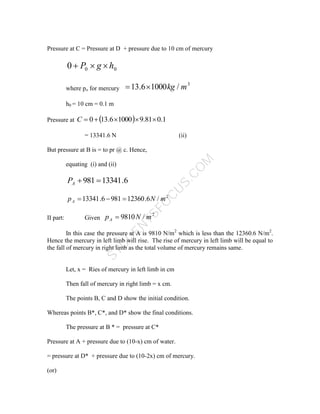
1. A U-Tube manometer is used to measure the pressure of water in a pipe line,
which is in excess of atmospheric pressure. The right limb of the manometer
contains water and mercury is in the left limb. Determine the pressure of
water in the main line, if the difference in level of mercury in the limbs U. U
tube is 10 cm and the free surface of mercury is in level with over the centre
of the pipe. If the pressure of water in pipe line is reduced to 9810 N/m2
,
Calculate the new difference in the level of mercury. Sketch the
arrangement in both cases.
Given,
Difference of mercury = 10 cm = 0.1 m.
Let PA = pr of water in pipe line (ie, at point A)
The point B and C lie on the same horizontal line. Hence pressure at B should be
equal to pressure at C.
But pressure at B = Pressure at A and Pressure due to 10 cm (or) 0.1m of water.
h
g
p
PA 



where , P = 1000kg/m3
and h = 0.1 m
1
.
0
81
.
9
1000 


 A
P
2
/
981 m
N
PA 
 (i)
S
T
U
D
E
N
T
S
F
O
C
U
S
.
C
O
M
Pressure at C = Pressure at D + pressure due to 10 cm of mercury
0
0
0 h
g
P 


where po for mercury
3
/
1000
6
.
13 m
kg


h0 = 10 cm = 0.1 m
Pressure at   1
.
0
81
.
9
1000
6
.
13
0 




C
= 13341.6 N (ii)
But pressure at B is = to pr @ c. Hence,
equating (i) and (ii)
6
.
13341
981 

A
P
2
/
6
.
12360
981
6
.
13341 m
N
pA 


II part: Given
2
/
9810 m
N
pA 
In this case the pressure at A is 9810 N/m2
which is less than the 12360.6 N/m2
.
Hence the mercury in left limb will rise. The rise of mercury in left limb will be equal to
the fall of mercury in right limb as the total volume of mercury remains same.
Let, x = Ries of mercury in left limb in cm
Then fall of mercury in right limb = x cm.
The points B, C and D show the initial condition.
Whereas points B*, C*, and D* show the final conditions.
The pressure at B * = pressure at C*
Pressure at A + pressure due to (10-x) cm of water.
= pressure at D* + pressure due to (10-2x) cm of mercury.
(or)
S
T
U
D
E
N
T
S
F
O
C
U
S
.
C
O
M
2
2
1
1 * h
g
p
pD
h
g
p
PA 





(or)





 


100
10
81
.
9
81
.
9
1000
8
.
9
9810 x
 





 





100
2
10
81
.
9
81
.
9
1000
6
.
13
0
x
Dividing by 9.81 , we get,
x
x 272
1360
10
100
1000 



1100
1360
10
272 

 x
x
262 x = 260
cm
x 992
.
0
262
260


 New difference of mercury = 10 - 2 x cm
992
.
0
2
10 


= 8.016 cm.
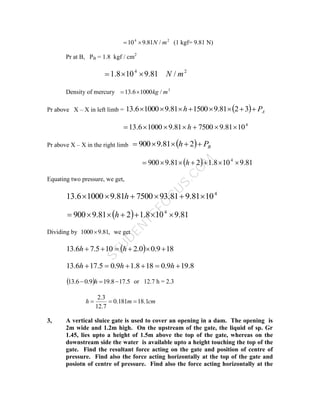
2. A differential manometer is connected at the two points A and B of two pipes
a shown in figure. The pipe A contains a liquid of sp. Gr = 1.5 while pipe b
contains a liquid of sp . gr = 0.9 . The pressures at A and B are 1 kgf / cm2
respectively. Find the difference in mercury level in the differential
manometer.
Given,
Sp. Gr of liquid at A, S1 = 1.5  p1 = 1500
Sp. Gr of liquid at B, S2 = 0.9  p2 = 900
Pr at A, PA = 1kgf / cm2
=
2
4
/
10
1 m
kgf

S
T
U
D
E
N
T
S
F
O
C
U
S
.
C
O
M
2
4
/
81
.
9
10 m
N

 (1 kgf= 9.81 N)
Pr at B, PB = 1.8 kgf / cm2
2
4
/
81
.
9
10
8
.
1 m
N



Density of mercury 3
/
1000
6
.
13 m
kg


Pr above X – X in left limb =   A
P
h 






 3
2
81
.
9
1500
81
.
9
1000
6
.
13
4
10
81
.
9
7500
81
.
9
1000
6
.
13 





 h
Pr above X – X in the right limb   B
P
h 



 2
81
.
9
900
  81
.
9
10
8
.
1
2
81
.
9
900 4






 h
Equating two pressure, we get,
4
10
81
.
9
81
.
93
7500
81
.
9
1000
6
.
13 




 h
  81
.
9
10
8
.
1
2
81
.
9
900 4






 h
Dividing by ,
81
.
9
1000 we get
  18
9
.
0
0
.
2
10
5
.
7
6
.
13 




 h
h
8
.
19
9
.
0
18
8
.
1
9
.
0
5
.
17
6
.
13 




 h
h
h
  5
.
17
8
.
19
9
.
0
6
.
13 

 h or 12.7 h = 2.3
cm
m
h 1
.
18
181
.
0
7
.
12
3
.
2



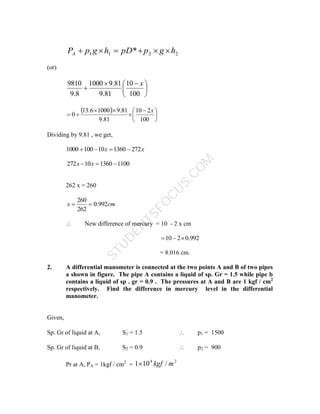
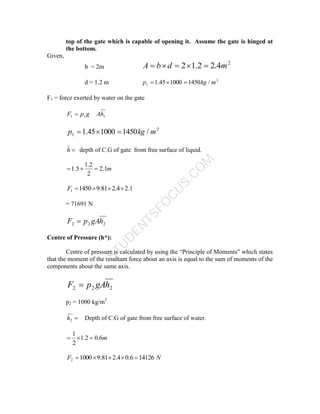
3, A vertical sluice gate is used to cover an opening in a dam. The opening is
2m wide and 1.2m high. On the upstream of the gate, the liquid of sp. Gr
1.45, lies upto a height of 1.5m above the top of the gate, whereas on the
downstream side the water is available upto a height touching the top of the
gate. Find the resultant force acting on the gate and position of centre of
pressure. Find also the force acting horizontally at the top of the gate and
posiotn of centre of pressure. Find also the force acting horizontally at the
S
T
U
D
E
N
T
S
F
O
C
U
S
.
C
O
M
top of the gate which is capable of opening it. Assume the gate is hinged at
the bottom.
Given,
b = 2m
2
4
.
2
2
.
1
2 m
d
b
A 




d = 1.2 m 3
1 /
1450
1000
45
.
1 m
kg
p 


F1 = force exerted by water on the gate
1
1
1 h
A
g
p
F 
2
1 /
1450
1000
45
.
1 m
kg
p 



h depth of C.G of gate from free surface of liquid.
m
1
.
2
2
2
.
1
5
.
1 


1
.
2
4
.
2
81
.
9
1450
1 



F
= 71691 N
2
2
2 h
gA
p
F 
Centre of Pressure (h*):
Centre of pressure is calculated by using the “Principle of Moments” which states
that the moment of the resultant force about an axis is equal to the sum of moments of the
components about the same axis.
2
2
2 h
gA
p
F 
p2 = 1000 kg/m3

2
h Depth of C.G of gate from free surface of water.
m
6
.
0
2
.
1
2
1



N
F 14126
6
.
0
4
.
2
81
.
9
1000
2 




S
T
U
D
E
N
T
S
F
O
C
U
S
.
C
O
M
i. Resultant force on the gate 14126
71691
2
1 


 F
F
= 57565 N.
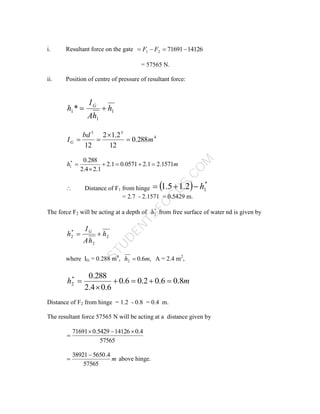
ii. Position of centre of pressure of resultant force:
1
1
1* h
h
A
I
h G


4
3
3
288
.
0
12
2
.
1
2
12
m
bd
IG 



m
h 1571
.
2
1
.
2
0571
.
0
1
.
2
1
.
2
4
.
2
288
.
0
*
1 





 Distance of F1 from hinge   *
1
2
.
1
5
.
1 h



= 2.7 - 2.1571 = 0.5429 m.
The force F2 will be acting at a depth of *
2
h from free surface of water nd is given by
2
2
*
2 h
h
A
I
h G


where IG = 0.288 m4
, ,
6
.
0
2 m
h  A = 2.4 m2
,
m
h 8
.
0
6
.
0
2
.
0
6
.
0
6
.
0
4
.
2
288
.
0
*
2 





Distance of F2 from hinge = 1.2 - 0.8 = 0.4 m.
The resultant force 57565 N will be acting at a distance given by
57565
4
.
0
14126
5429
.
0
71691 



m
57565
4
.
5650
38921
 above hinge.
S
T
U
D
E
N
T
S
F
O
C
U
S
.
C
O
M
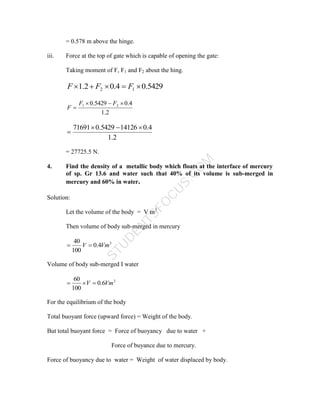
= 0.578 m above the hinge.
iii. Force at the top of gate which is capable of opening the gate:
Taking moment of F, F1 and F2 about the hing.
5429
.
0
4
.
0
2
.
1 1
2 



 F
F
F
2
.
1
4
.
0
5429
.
0 2
1 



F
F
F
2
.
1
4
.
0
14126
5429
.
0
71691 



= 27725.5 N.
4. Find the density of a metallic body which floats at the interface of mercury
of sp. Gr 13.6 and water such that 40% of its volume is sub-merged in
mercury and 60% in water.
Solution:
Let the volume of the body = V m3
Then volume of body sub-merged in mercury
3
4
.
0
100
40
Vm
V 

Volume of body sub-merged I water
3
6
.
0
100
60
Vm
V 


For the equilibrium of the body
Total buoyant force (upward force) = Weight of the body.
But total buoyant force = Force of buoyancy due to water +
Force of buyance due to mercury.
Force of buoyancy due to water = Weight of water displaced by body.
S
T
U
D
E
N
T
S
F
O
C
U
S
.
C
O
M
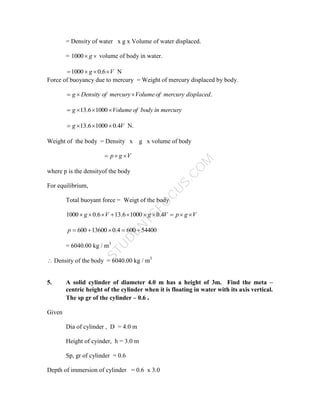
= Density of water x g x Volume of water displaced.
= 
 g
1000 volume of body in water.
V
g 


 6
.
0
1000 N
Force of buoyancy due to mercury = Weight of mercury displaced by body.
.
displaced
mercury
of
Volume
mercury
of
Density
g 


mercury
in
body
of
Volume
g 


 1000
6
.
13
V
g 4
.
0
1000
6
.
13 


 N.
Weight of the body = Density x g x volume of body
V
g
p 


where p is the densityof the body
For equilibrium,
Total buoyant force = Weigt of the body
V
g
p
V
g
V
g 








 4
.
0
1000
6
.
13
6
.
0
1000
54400
600
4
.
0
13600
600 




p
= 6040.00 kg / m3
 Density of the body = 6040.00 kg / m3
5. A solid cylinder of diameter 4.0 m has a height of 3m. Find the meta –
centric height of the cylinder when it is floating in water with its axis vertical.
The sp gr of the cylinder – 0.6 .
Given
Dia of cylinder , D = 4.0 m
Height of cyinder, h = 3.0 m
Sp, gr of cylinder = 0.6
Depth of immersion of cylinder = 0.6 x 3.0
S
T
U
D
E
N
T
S
F
O
C
U
S
.
C
O
M
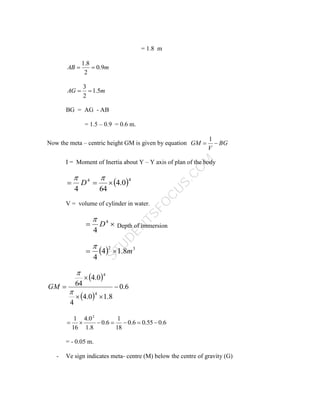
= 1.8 m
m
AB 9
.
0
2
8
.
1


m
AG 5
.
1
2
3


BG = AG - AB
= 1.5 – 0.9 = 0.6 m.
Now the meta – centric height GM is given by equation BG
V
GM 

1
I = Moment of Inertia about Y – Y axis of plan of the body
 4
4
0
.
4
64
4





D
V = volume of cylinder in water.

 4
4
D

Depth of immersion
  3
2
8
.
1
4
4
m



 
 
6
.
0
8
.
1
0
.
4
4
0
.
4
64
4
4







GM
6
.
0
55
.
0
6
.
0
18
1
6
.
0
8
.
1
0
.
4
16
1 2







= - 0.05 m.
- Ve sign indicates meta- centre (M) below the centre of gravity (G)
S
T
U
D
E
N
T
S
F
O
C
U
S
.
C
O
M
6. A wooden cylinder of sp. Gr = 0.6 and circular in cross – section is required
to float in oil (sp.gr = 0.90) . Find the L/D ratio for the cylinder to float with
its longitudinal axis vertical in oil, where L is the height of cylinder and D is
its diameters.
Solution:
Dia of cylinder = D
Height of cylinder = L
Sp gr of cylinder, S1 = 0.6
Sp gr of oil, S2 = 0.9
Let, depth of cylinder immersed in oil = h
Buoyancy principle
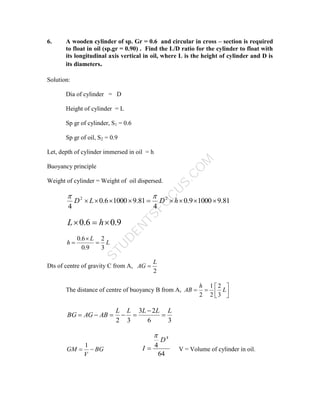
Weight of cylinder = Weight of oil dispersed.
81
.
9
1000
9
.
0
4
81
.
9
1000
6
.
0
4
2
2








 h
D
L
D


9
.
0
6
.
0 

 h
L
L
L
h
3
2
9
.
0
6
.
0



Dts of centre of gravity C from A,
2
L
AG 
The distance of centre of buoyancy B from A, 






 L
h
AB
3
2
2
1
2
3
6
2
3
3
2
L
L
L
L
L
AB
AG
BG 






BG
V
GM 

1
64
4
4
D
I

 V = Volume of cylinder in oil.
S
T
U
D
E
N
T
S
F
O
C
U
S
.
C
O
M
h
D2
4


L
D
L
D
h
D
h
D
D
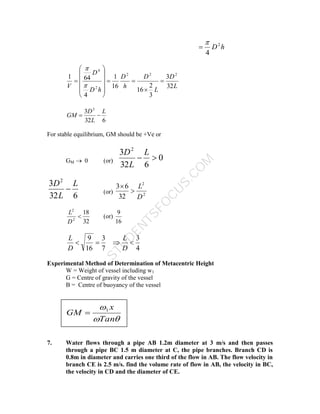
V 32
3
3
2
16
16
1
4
64
1 2
2
2
2
4



















6
32
3 3
L
L
D
GM 

For stable equilibrium, GM should be +Ve or
GM  0 (or) 0
6
32
3 2


L
L
D
6
32
3 2
L
L
D
 (or) 2
2
32
6
3
D
L


32
18
2
2

D
L
(or)
16
9
4
3
7
3
16
9




D
L
D
L
Experimental Method of Determination of Metacentric Height
W = Weight of vessel including w1
G = Centre of gravity of the vessel
B = Centre of buoyancy of the vessel
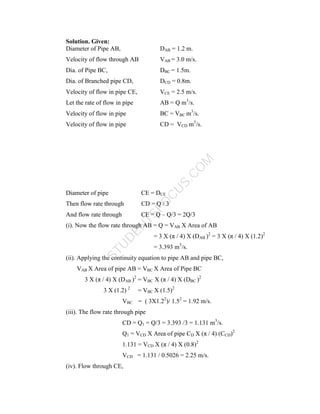
7. Water flows through a pipe AB 1.2m diameter at 3 m/s and then passes
through a pipe BC 1.5 m diameter at C, the pipe branches. Branch CD is
0.8m in diameter and carries one third of the flow in AB. The flow velocity in
branch CE is 2.5 m/s. find the volume rate of flow in AB, the velocity in BC,
the velocity in CD and the diameter of CE.



Tan
x
GM 1

S
T
U
D
E
N
T
S
F
O
C
U
S
.
C
O
M
Solution. Given:
Diameter of Pipe AB, DAB = 1.2 m.
Velocity of flow through AB VAB = 3.0 m/s.
Dia. of Pipe BC, DBC = 1.5m.
Dia. of Branched pipe CD, DCD = 0.8m.
Velocity of flow in pipe CE, VCE = 2.5 m/s.
Let the rate of flow in pipe AB = Q m3
/s.
Velocity of flow in pipe BC = VBC m3
/s.
Velocity of flow in pipe CD = VCD m3
/s.
Diameter of pipe CE = DCE
Then flow rate through CD = Q / 3
And flow rate through CE = Q – Q/3 = 2Q/3
(i). Now the flow rate through AB = Q = VAB X Area of AB
= 3 X (π / 4) X (DAB )2
= 3 X (π / 4) X (1.2)2
= 3.393 m3
/s.
(ii). Applying the continuity equation to pipe AB and pipe BC,
VAB X Area of pipe AB = VBC X Area of Pipe BC
3 X (π / 4) X (DAB )2
= VBC X (π / 4) X (DBC )2
3 X (1.2) 2
= VBC X (1.5)2
VBC = ( 3X1.22
)/ 1.52
= 1.92 m/s.
(iii). The flow rate through pipe
CD = Q1 = Q/3 = 3.393 /3 = 1.131 m3
/s.
Q1 = VCD X Area of pipe CD X (π / 4) (CCD)2
1.131 = VCD X (π / 4) X (0.8)2
VCD = 1.131 / 0.5026 = 2.25 m/s.
(iv). Flow through CE,
S
T
U
D
E
N
T
S
F
O
C
U
S
.
C
O
M
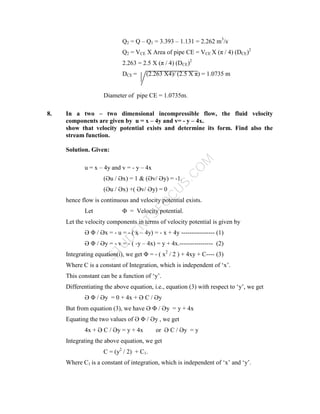
Q2 = Q – Q1 = 3.393 – 1.131 = 2.262 m3
/s.
Q2 = VCE X Area of pipe CE = VCE X (π / 4) (DCE)2
2.263 = 2.5 X (π / 4) (DCE)2
DCE = (2.263 X4)/ (2.5 X π) = 1.0735 m
Diameter of pipe CE = 1.0735m.
8. In a two – two dimensional incompressible flow, the fluid velocity
components are given by u = x – 4y and v= - y – 4x.
show that velocity potential exists and determine its form. Find also the
stream function.
Solution. Given:
u = x – 4y and v = - y – 4x
(Әu / Әx) = 1 & (Әv/ Әy) = -1.
(Әu / Әx) +( Әv/ Әy) = 0
hence flow is continuous and velocity potential exists.
Let Φ = Velocity potential.
Let the velocity components in terms of velocity potential is given by
Ә Φ / Әx = - u = - ( x – 4y) = - x + 4y ---------------- (1)
Ә Φ / Әy = - v = - ( -y – 4x) = y + 4x.---------------- (2)
Integrating equation(i), we get Φ = - ( x2
/ 2 ) + 4xy + C---- (3)
Where C is a constant of Integration, which is independent of ‘x’.
This constant can be a function of ‘y’.
Differentiating the above equation, i.e., equation (3) with respect to ‘y’, we get
Ә Φ / Әy = 0 + 4x + Ә C / Әy
But from equation (3), we have Ә Φ / Әy = y + 4x
Equating the two values of Ә Φ / Әy , we get
4x + Ә C / Әy = y + 4x or Ә C / Әy = y
Integrating the above equation, we get
C = (y2
/ 2) + C1.
Where C1 is a constant of integration, which is independent of ‘x’ and ‘y’.
S
T
U
D
E
N
T
S
F
O
C
U
S
.
C
O
M
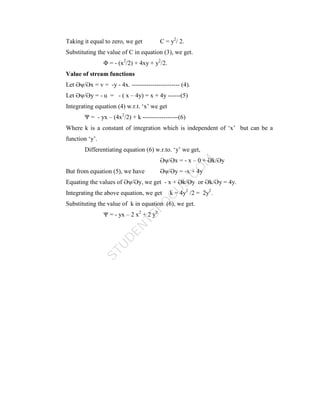
Taking it equal to zero, we get C = y2
/ 2.
Substituting the value of C in equation (3), we get.
Φ = - (x2
/2) + 4xy + y2
/2.
Value of stream functions
Let Әψ/Әx = v = -y - 4x. ----------------------- (4).
Let Әψ/Әy = - u = - ( x – 4y) = x + 4y ------(5)
Integrating equation (4) w.r.t. ‘x’ we get
Ψ = - yx – (4x2
/2) + k -----------------(6)
Where k is a constant of integration which is independent of ‘x’ but can be a
function ‘y’.
Differentiating equation (6) w.r.to. ‘y’ we get,
Әψ/Әx = - x – 0 + Әk/Әy
But from equation (5), we have Әψ/Әy = -x + 4y
Equating the values of Әψ/Әy, we get - x + Әk/Әy or Әk/Әy = 4y.
Integrating the above equation, we get k = 4y2
/2 = 2y2
.
Substituting the value of k in equation (6), we get.
Ψ = - yx – 2 x2
+ 2 y2

Qb103352

  • 1.
    S T U D E N T S F O C U S . C O M CE6303 - MECHANICSOF FLUIDS (FOR III – SEMESTER) UNIT – II FLUID STATICS & KINEMATICS PREPARED BY R.SURYA, M.E Assistant Professor DEPARTMENT OF CIVIL ENGINEERING DEPARTMENT OF CIVIL ENGINEERING SRI VIDYA COLLEGE OF ENGINEERING AND TECHNOLOGY-626001
  • 2.
    S T U D E N T S F O C U S . C O M UNIT – II FLUIDSTATICS & KINEMATICS Pascal’s Law and Hydrostatic equation – Forces on plane and curved surfaces – Buoyancy – Meta centre – Pressure measurement – Fluid mass under relative equilibrium Fluid Kinematics Stream, streak and path lines – Classification of flows – Continuity equation (one, two and three dimensional forms) – Stream and potential functions – flow nets – Velocity measurement (Pilot tube, current meter, Hot wire and hot film anemometer, float technique, Laser Doppler velocimetry) S.NO 2 MARKS PAGE NO 1 Define “Pascal’s Law” 7 2 What is mean by Absolute pressure and Gauge pressure? 7 3 Define Manometers 7 4 A differential manometer is connected at the two points A and B . At B pr is 9.81 N/cm2 (abs), find the absolute pr at A 7 5 Define Buoyancy 7 6 Define META – CENTRE 8 7 Write a short notes on “ Differential Manometers” 8 8 Define Centre of pressure 8 9 Write down the types of fluid flow 8 10 Write a short notes on “Laminar flow”. 8 11 Define “ Turbulent flow”. 8 12 What is mean by Rate flow or Discharge? 9 13 What do you understand by Continuity Equation? 9 14 What is mean by Local acceleration? 9 15 What is mean by Convective acceleration? 9 16 Define Velocity potential function. 9 17 Define Stream function 9 18 What is mean by Flow net? 10 19 Write the properties of stream function. 10 20 What are the types of Motion? 10 21 Define “Vortex flow”. 10 22 Water is flowing through two different pipes, to which an inverted differential manometer having an oil of sp. Gr 0.8 is connected the pressure head in the pipe A is 2 m of water, find the pressure in the 10
  • 3.
    S T U D E N T S F O C U S . C O M pipe B forthe manometer readings. 23 A differential manometer is connected at the two points A and B . At B pr is 9.81 N/cm2 (abs), find the absolute pr at A 11 24 A hydraulic pressure has a ram of 30 cm diameter and a plunger of 4.5 cm diameter. Find the weight lifted by the hydraulic pressure when the force applied at the plunger is 500 N. 11 25 The diameters of a pipe at the sections 1 and 2 are 10 cm and 15 cm respectively. Find the discharge through the pipe if the velocity of water flowing through the pipe section 1 is 5 m/s. determine also the velocity at section 2 12
  • 4.
    S T U D E N T S F O C U S . C O M S.NO 16 MARKSPAGE NO 1 A U-Tube manometer is used to measure the pressure of water in a pipe line, which is in excess of atmospheric pressure. The right limb of the manometer contains water and mercury is in the left limb. Determine the pressure of water in the main line, if the difference in level of mercury in the limbs U. U tube is 10 cm and the free surface of mercury is in level with over the centre of the pipe. If the pressure of water in pipe line is reduced to 9810 N/m2 , Calculate the new difference in the level of mercury. Sketch the arrangement in both cases 13 2 A differential manometer is connected at the two points A and B of two pipes a shown in figure. The pipe A contains a liquid of sp. Gr = 1.5 while pipe b contains a liquid of sp . gr = 0.9 . The pressures at A and B are 1 kgf / cm2 respectively. Find the difference in mercury level in the differential manometer 15 3 A vertical sluice gate is used to cover an opening in a dam. The opening is 2m wide and 1.2m high. On the upstream of the gate, the liquid of sp. Gr 1.45, lies upto a height of 1.5m above the top of the gate, whereas on the downstream side the water is available upto a height touching the top of the gate. Find the resultant force acting on the gate and position of centre of pressure. Find also the force acting horizontally at the top of the gate and posiotn of centre of pressure. Find also the force acting horizontally at the top of the gate which is capable of opening it. Assume the gate is hinged at the bottom 16 4 Find the density of a metallic body which floats at the interface of mercury of sp. Gr 13.6 and water such that 40% of its volume is sub-merged in mercury and 60% in water 19 5 A solid cylinder of diameter 4.0 m has a height of 3m. Find the meta – centric height of the cylinder when it is floating in water with its axis vertical. The sp gr of the cylinder – 0.6 20 6 A wooden cylinder of sp. Gr = 0.6 and circular in cross – section is required to float in oil (sp.gr = 0.90) . Find the L/D ratio for the cylinder to float with its longitudinal axis vertical in oil, where L is the height of cylinder and D is its diameters 21 7 Water flows through a pipe AB 1.2m diameter at 3 m/s and then passes through a pipe BC 1.5 m diameter at C, the pipe branches. Branch CD is 0.8m in diameter and carries one third of the flow in AB. The flow velocity in branch CE is 2.5 m/s. find the volume rate of flow in AB, the velocity in BC, the velocity in CD and the diameter of CE 2 3 8. In a two – two dimensional incompressible flow, the fluid velocity components are given by u = x – 4y and v= - y – 4x. show that velocity potential exists and determine its form. Find 25
  • 5.
    S T U D E N T S F O C U S . C O M also the streamfunction.. 2 MARKS QUESTIONS AND ANSWERS 1. Define “Pascal’s Law”: It stats that the pressure or intensity of pressure at a point in a static fluid is equal in all directions. 2. What is mean by Absolute pressure and Gauge pressure? Absolute Pressure: It is defined as the pressure which is measured with the reference to absolute vacuum pressure. Gauge Pressure: It is defined as the pressure which is measured with the help of a pressure measuring instrument, in which the atmospheric pressure is taken as datum. The atmospheric pressure on the scale is marked as zero. 3. Define Manometers. Manometers are defined as the devices used for measuring the pressure at a point in a fluid by balancing measuring the column of fluid by the same or another column of fluid. 1. Simple M 2. Differential M 4. A differential manometer is connected at the two points A and B . At B pr is 9.81 N/cm2 (abs), find the absolute pr at A. Pr above X – X in right limb = B p    6 . 0 81 . 9 1000 Pr above X – X in left limb = A P        2 . 0 81 . 9 900 1 . 0 81 . 9 1000 6 . 13 Equating the two pr head Absolute pr at PA = 8.887 N/cm2 5. Define Buoyancy.
  • 6.
    S T U D E N T S F O C U S . C O M When a bodyis immersed in a fluid, an upward force is exerted by the fluid on the body. This upward force is equal to the weight of the fluid displaced by the body and is called the force of buoyancy or simply buoyancy. 6. Define META – CENTRE It is defined as the point about which a body starts oscillating when the body is fitted by a small angle. The meta – centre may also be defined as the poit at which the line of action of the force of buoyancy wil meet the normal axis of the body when the body is given a small angular displacement. 7. Write a short notes on “ Differential Manometers”. Differential manometers are the devices used for measuring the difference of pressures between two points in a pipe or in two different pipes/ a differential manometer consists of a U – tube containing a heavy liquid, whose two ends are connected to the points, whose difference of pressure is to be measured. Most commonly types of differential manometers are: 1. U – tube differential manometer. 2. Inverted U – tube differential manometers. 8. Define Centre of pressure. Is defined as the point of application of the total pressure on the surface. The submerged surfaces may be: 1. Vertical plane surface 2. Horizontal plane surface 3. Inclined plane surface 4. Curved surface 9. Write down the types of fluid flow. The fluid flow is classified as : 1. Steady and Unsteady flows. 2. Uniform and Non – uniform flows. 3. Laminar and turbulent flows. 4. Compressible and incompressible flows. 5. Rotational and irrotational flows 6. One, two and three dimensional flows. 10. Write a short notes on “Laminar flow”. Laminar flow is defined as that type of flow in which the fluid particles move along well – defined paths or stream line and all the stream lines are straight and parallel.
  • 7.
    S T U D E N T S F O C U S . C O M Thus the particlesmove in laminas or layers gliding over the adjacent layer. This type of flow is also called stream – line flow or viscous flow/ 11. Define “ Turbulent flow”. Turbulent flow is that type of flow in which the fluid particles move in a zig –zag way. Due to the movement of fluid particles in a zig – zag way. 12. What is mean by Rate flow or Discharge? It is defined as the quantity of a fluid flowing per second through a section of a pipe or channel. For an incompressible fluid( or liquid) the rate of flow or discharge is expressed as volume of fluid flowing across the section per section. For compressible fluids, the rate of flow is usually expressed as the weight of fluid flowing across the section. The discharge (Q) = A X V Where, A = Cross – sectional area of pipe. V = Average velocity of fluid across the section. 13. What do you understand by Continuity Equation? The equation based on the principle of conservation of mass is called continuity equation. Thus for a fluid flowing through the pipe at all the cross-section, the quantity of fluid per second is constant. A1V1 = A2V2.. 14. What is mean by Local acceleration? Local acceleration is defined as the rate of increase of velocity with respect to time at a given point in a flow field. In equation is given by the expression (Ә u / Әt ) , ( Әv / Әt) or ( Әw / Әt) is known as local acceleration. 15. What is mean by Convective acceleration? It is defined as the rate of change of velocity due to the change of position of fluid particles in a fluid flow. The expressions other than (Ә u / Әt ) , ( Әv / Әt) and ( Әw / Әt) in the equation are known as convective acceleration. 16. Define Velocity potential function. It is defined as a scalar function of space and time such that its negative derivative with respect to any direction gives the fluid velocity in that direction. It is defined by Φ (Phi). Mathematically, the velocity, potential is defined as Φ = f ( x,y,z) for steady flow such that. u = - (Ә Φ/Әx) v = - ( Ә Φ/Әy) w = - ( Ә Φ/Әz) where, u,v and w are the components of velocity in x.y and z directions respectively.
  • 8.
    S T U D E N T S F O C U S . C O M 17. Define Streamfunction. It is defined as the scalar function of space and time, such that its partial derivative with respect to any direction gives the velocity component at right angles to that direction. It is denoted by ψ (Psi) and only for two dimensional flow. Mathematically. For steady flow is defined as ψ = f(x,y) such that , (Ә ψ / Әx) = v (Ә ψ / Әy) = - u. 18. What is mean by Flow net? A grid obtained by drawing a series of equipotential lines and stream lines is called a flow net. The flow net is an important tool in analyzing the two – dimensional irrotational flow problems. 19. Write the properties of stream function. The properties of stream function (ψ) are: 1. If stream function (ψ) exists, it is possible case of fluid flow which may be rotational or irrotational. 2. If stream function (ψ) satisfies the Laplace equation, it is a possible case of irrotational flow. 20. What are the types of Motion? 1. Linear Translation or Pure Translation. 2. Linear Deformation. 3. Angular deformation. 4. Rotation. 21. Define “Vortex flow”. Vortex flow is defined as the flow of a fluid along a curved path or the flow of a rotating mass of a fluid is known ‘ Vortex Flow’. The vortex flow is of two types namely: 1. Forced vortex flow, and 2. Free vortex flow. 22. Water is flowing through two different pipes, to which an inverted differential manometer having an oil of sp. Gr 0.8 is connected the pressure head in the pipe A is 2 m of water, find the pressure in the pipe B for the manometer readings. Pr heat at m pg p A A 2   of water. 2 81 . 9 1000 2       g p pA = 19620 N/ m2
  • 9.
    S T U D E N T S F O C U S . C O M Pr below X– X in left limb = PA – p1 gh1 = 19620 - 1000 x 781 x 0.3 = 16677 N/m2 Pr below X – X in right limb 76 . 1922 12 . 0 81 . 9 800 1 . 0 81 . 9 1000         B B P p Equating two pressure, we get, 2 2 / 8599 . 1 / 76 . 18599 76 . 1922 16677 cm N m N PB     23. A differential manometer is connected at the two points A and B . At B pr is 9.81 N/cm2 (abs), find the absolute pr at A. Pr above X – X in right limb = B p    6 . 0 81 . 9 1000 Pr above X – X in left limb = A P        2 . 0 81 . 9 900 1 . 0 81 . 9 1000 6 . 13 Equating the two pr head Absolute pr at PA = 8.887 N/cm2 . 24. A hydraulic pressure has a ram of 30 cm diameter and a plunger of 4.5 cm diameter. Find the weight lifted by the hydraulic pressure when the force applied at the plunger is 500 N. Given: Dia of ram, D = 30 cm = 0.3 m Dia of plunger, d = 4.5 cm = 0.045 m Force on plunger, F = 500 N To find : Weight lifted = W Area of ram,   2 2 2 07068 . 0 3 . 0 4 4 m D A      Area of plunger,   2 2 2 000159 . 0 045 . 0 4 4 m d a     
  • 10.
    S T U D E N T S F O C U S . C O M Pressure intensity dueto plunger 2 m N plunger of Area plunger on Force   2 / 00159 . 0 500 m N a F   Due to Pascal law, the intensity of pressure will be equally transmitted in all distance . Hence the pressure intensity at 2 / 4 . 314465 00159 . 0 500 m N ram   Pressure intensity at ram 07068 . 0 W A W ram of Area weight    4 . 314465 07068 . 0  W Weight . 222 . 22 22222 07068 . 0 4 . 314465 KN N     25. The diameters of a pipe at the sections 1 and 2 are 10 cm and 15 cm respectively. Find the discharge through the pipe if the velocity of water flowing through the pipe section 1 is 5 m/s. determine also the velocity at section 2. Solution. Given: At section 1. D1 = 10 cm = 0.1 m. A1 = (π / 4) X D1 2 = (π / 4) X (0.1)2 = 0.007854 m2 . V1 = 5 m/s. At section 2. D2 = 15 cm = 0.15 m. A2 = (π / 4) X(0.15)2 = 0.01767 m2 . 1. Discharge through pipe is given by equation Q = A1 X V1 = 0.007544 X 5 = 0.03927 m3 / s. using equation, We have A1V1 = A2V2.. V2 = ( A1V1 / A1) = ( 0.007854 /0.01767) X 5 = 2.22 m/s.
  • 11.
    S T U D E N T S F O C U S . C O M 16 MARKS QUESTIONSAND ANSWERS 1. A U-Tube manometer is used to measure the pressure of water in a pipe line, which is in excess of atmospheric pressure. The right limb of the manometer contains water and mercury is in the left limb. Determine the pressure of water in the main line, if the difference in level of mercury in the limbs U. U tube is 10 cm and the free surface of mercury is in level with over the centre of the pipe. If the pressure of water in pipe line is reduced to 9810 N/m2 , Calculate the new difference in the level of mercury. Sketch the arrangement in both cases. Given, Difference of mercury = 10 cm = 0.1 m. Let PA = pr of water in pipe line (ie, at point A) The point B and C lie on the same horizontal line. Hence pressure at B should be equal to pressure at C. But pressure at B = Pressure at A and Pressure due to 10 cm (or) 0.1m of water. h g p PA     where , P = 1000kg/m3 and h = 0.1 m 1 . 0 81 . 9 1000     A P 2 / 981 m N PA   (i)
  • 12.
    S T U D E N T S F O C U S . C O M Pressure at C= Pressure at D + pressure due to 10 cm of mercury 0 0 0 h g P    where po for mercury 3 / 1000 6 . 13 m kg   h0 = 10 cm = 0.1 m Pressure at   1 . 0 81 . 9 1000 6 . 13 0      C = 13341.6 N (ii) But pressure at B is = to pr @ c. Hence, equating (i) and (ii) 6 . 13341 981   A P 2 / 6 . 12360 981 6 . 13341 m N pA    II part: Given 2 / 9810 m N pA  In this case the pressure at A is 9810 N/m2 which is less than the 12360.6 N/m2 . Hence the mercury in left limb will rise. The rise of mercury in left limb will be equal to the fall of mercury in right limb as the total volume of mercury remains same. Let, x = Ries of mercury in left limb in cm Then fall of mercury in right limb = x cm. The points B, C and D show the initial condition. Whereas points B*, C*, and D* show the final conditions. The pressure at B * = pressure at C* Pressure at A + pressure due to (10-x) cm of water. = pressure at D* + pressure due to (10-2x) cm of mercury. (or)
  • 13.
    S T U D E N T S F O C U S . C O M 2 2 1 1 * h g p pD h g p PA      (or)          100 10 81 . 9 81 . 9 1000 8 . 9 9810 x               100 2 10 81 . 9 81 . 9 1000 6 . 13 0 x Dividing by 9.81 , we get, x x 272 1360 10 100 1000     1100 1360 10 272    x x 262 x = 260 cm x 992 . 0 262 260    New difference of mercury = 10 - 2 x cm 992 . 0 2 10    = 8.016 cm. 2. A differential manometer is connected at the two points A and B of two pipes a shown in figure. The pipe A contains a liquid of sp. Gr = 1.5 while pipe b contains a liquid of sp . gr = 0.9 . The pressures at A and B are 1 kgf / cm2 respectively. Find the difference in mercury level in the differential manometer. Given, Sp. Gr of liquid at A, S1 = 1.5  p1 = 1500 Sp. Gr of liquid at B, S2 = 0.9  p2 = 900 Pr at A, PA = 1kgf / cm2 = 2 4 / 10 1 m kgf 
  • 14.
    S T U D E N T S F O C U S . C O M 2 4 / 81 . 9 10 m N   (1kgf= 9.81 N) Pr at B, PB = 1.8 kgf / cm2 2 4 / 81 . 9 10 8 . 1 m N    Density of mercury 3 / 1000 6 . 13 m kg   Pr above X – X in left limb =   A P h         3 2 81 . 9 1500 81 . 9 1000 6 . 13 4 10 81 . 9 7500 81 . 9 1000 6 . 13        h Pr above X – X in the right limb   B P h      2 81 . 9 900   81 . 9 10 8 . 1 2 81 . 9 900 4        h Equating two pressure, we get, 4 10 81 . 9 81 . 93 7500 81 . 9 1000 6 . 13       h   81 . 9 10 8 . 1 2 81 . 9 900 4        h Dividing by , 81 . 9 1000 we get   18 9 . 0 0 . 2 10 5 . 7 6 . 13       h h 8 . 19 9 . 0 18 8 . 1 9 . 0 5 . 17 6 . 13       h h h   5 . 17 8 . 19 9 . 0 6 . 13    h or 12.7 h = 2.3 cm m h 1 . 18 181 . 0 7 . 12 3 . 2    3, A vertical sluice gate is used to cover an opening in a dam. The opening is 2m wide and 1.2m high. On the upstream of the gate, the liquid of sp. Gr 1.45, lies upto a height of 1.5m above the top of the gate, whereas on the downstream side the water is available upto a height touching the top of the gate. Find the resultant force acting on the gate and position of centre of pressure. Find also the force acting horizontally at the top of the gate and posiotn of centre of pressure. Find also the force acting horizontally at the
  • 15.
    S T U D E N T S F O C U S . C O M top of thegate which is capable of opening it. Assume the gate is hinged at the bottom. Given, b = 2m 2 4 . 2 2 . 1 2 m d b A      d = 1.2 m 3 1 / 1450 1000 45 . 1 m kg p    F1 = force exerted by water on the gate 1 1 1 h A g p F  2 1 / 1450 1000 45 . 1 m kg p     h depth of C.G of gate from free surface of liquid. m 1 . 2 2 2 . 1 5 . 1    1 . 2 4 . 2 81 . 9 1450 1     F = 71691 N 2 2 2 h gA p F  Centre of Pressure (h*): Centre of pressure is calculated by using the “Principle of Moments” which states that the moment of the resultant force about an axis is equal to the sum of moments of the components about the same axis. 2 2 2 h gA p F  p2 = 1000 kg/m3  2 h Depth of C.G of gate from free surface of water. m 6 . 0 2 . 1 2 1    N F 14126 6 . 0 4 . 2 81 . 9 1000 2     
  • 16.
    S T U D E N T S F O C U S . C O M i. Resultant forceon the gate 14126 71691 2 1     F F = 57565 N. ii. Position of centre of pressure of resultant force: 1 1 1* h h A I h G   4 3 3 288 . 0 12 2 . 1 2 12 m bd IG     m h 1571 . 2 1 . 2 0571 . 0 1 . 2 1 . 2 4 . 2 288 . 0 * 1        Distance of F1 from hinge   * 1 2 . 1 5 . 1 h    = 2.7 - 2.1571 = 0.5429 m. The force F2 will be acting at a depth of * 2 h from free surface of water nd is given by 2 2 * 2 h h A I h G   where IG = 0.288 m4 , , 6 . 0 2 m h  A = 2.4 m2 , m h 8 . 0 6 . 0 2 . 0 6 . 0 6 . 0 4 . 2 288 . 0 * 2       Distance of F2 from hinge = 1.2 - 0.8 = 0.4 m. The resultant force 57565 N will be acting at a distance given by 57565 4 . 0 14126 5429 . 0 71691     m 57565 4 . 5650 38921  above hinge.
  • 17.
    S T U D E N T S F O C U S . C O M = 0.578 mabove the hinge. iii. Force at the top of gate which is capable of opening the gate: Taking moment of F, F1 and F2 about the hing. 5429 . 0 4 . 0 2 . 1 1 2      F F F 2 . 1 4 . 0 5429 . 0 2 1     F F F 2 . 1 4 . 0 14126 5429 . 0 71691     = 27725.5 N. 4. Find the density of a metallic body which floats at the interface of mercury of sp. Gr 13.6 and water such that 40% of its volume is sub-merged in mercury and 60% in water. Solution: Let the volume of the body = V m3 Then volume of body sub-merged in mercury 3 4 . 0 100 40 Vm V   Volume of body sub-merged I water 3 6 . 0 100 60 Vm V    For the equilibrium of the body Total buoyant force (upward force) = Weight of the body. But total buoyant force = Force of buoyancy due to water + Force of buyance due to mercury. Force of buoyancy due to water = Weight of water displaced by body.
  • 18.
    S T U D E N T S F O C U S . C O M = Density ofwater x g x Volume of water displaced. =   g 1000 volume of body in water. V g     6 . 0 1000 N Force of buoyancy due to mercury = Weight of mercury displaced by body. . displaced mercury of Volume mercury of Density g    mercury in body of Volume g     1000 6 . 13 V g 4 . 0 1000 6 . 13     N. Weight of the body = Density x g x volume of body V g p    where p is the densityof the body For equilibrium, Total buoyant force = Weigt of the body V g p V g V g           4 . 0 1000 6 . 13 6 . 0 1000 54400 600 4 . 0 13600 600      p = 6040.00 kg / m3  Density of the body = 6040.00 kg / m3 5. A solid cylinder of diameter 4.0 m has a height of 3m. Find the meta – centric height of the cylinder when it is floating in water with its axis vertical. The sp gr of the cylinder – 0.6 . Given Dia of cylinder , D = 4.0 m Height of cyinder, h = 3.0 m Sp, gr of cylinder = 0.6 Depth of immersion of cylinder = 0.6 x 3.0
  • 19.
    S T U D E N T S F O C U S . C O M = 1.8 m m AB9 . 0 2 8 . 1   m AG 5 . 1 2 3   BG = AG - AB = 1.5 – 0.9 = 0.6 m. Now the meta – centric height GM is given by equation BG V GM   1 I = Moment of Inertia about Y – Y axis of plan of the body  4 4 0 . 4 64 4      D V = volume of cylinder in water.   4 4 D  Depth of immersion   3 2 8 . 1 4 4 m        6 . 0 8 . 1 0 . 4 4 0 . 4 64 4 4        GM 6 . 0 55 . 0 6 . 0 18 1 6 . 0 8 . 1 0 . 4 16 1 2        = - 0.05 m. - Ve sign indicates meta- centre (M) below the centre of gravity (G)
  • 20.
    S T U D E N T S F O C U S . C O M 6. A woodencylinder of sp. Gr = 0.6 and circular in cross – section is required to float in oil (sp.gr = 0.90) . Find the L/D ratio for the cylinder to float with its longitudinal axis vertical in oil, where L is the height of cylinder and D is its diameters. Solution: Dia of cylinder = D Height of cylinder = L Sp gr of cylinder, S1 = 0.6 Sp gr of oil, S2 = 0.9 Let, depth of cylinder immersed in oil = h Buoyancy principle Weight of cylinder = Weight of oil dispersed. 81 . 9 1000 9 . 0 4 81 . 9 1000 6 . 0 4 2 2          h D L D   9 . 0 6 . 0    h L L L h 3 2 9 . 0 6 . 0    Dts of centre of gravity C from A, 2 L AG  The distance of centre of buoyancy B from A,         L h AB 3 2 2 1 2 3 6 2 3 3 2 L L L L L AB AG BG        BG V GM   1 64 4 4 D I   V = Volume of cylinder in oil.
  • 21.
    S T U D E N T S F O C U S . C O M h D2 4   L D L D h D h D D V 32 3 3 2 16 16 1 4 64 1 2 2 2 2 4                    6 32 33 L L D GM   For stable equilibrium, GM should be +Ve or GM  0 (or) 0 6 32 3 2   L L D 6 32 3 2 L L D  (or) 2 2 32 6 3 D L   32 18 2 2  D L (or) 16 9 4 3 7 3 16 9     D L D L Experimental Method of Determination of Metacentric Height W = Weight of vessel including w1 G = Centre of gravity of the vessel B = Centre of buoyancy of the vessel 7. Water flows through a pipe AB 1.2m diameter at 3 m/s and then passes through a pipe BC 1.5 m diameter at C, the pipe branches. Branch CD is 0.8m in diameter and carries one third of the flow in AB. The flow velocity in branch CE is 2.5 m/s. find the volume rate of flow in AB, the velocity in BC, the velocity in CD and the diameter of CE.    Tan x GM 1 
  • 22.
    S T U D E N T S F O C U S . C O M Solution. Given: Diameter ofPipe AB, DAB = 1.2 m. Velocity of flow through AB VAB = 3.0 m/s. Dia. of Pipe BC, DBC = 1.5m. Dia. of Branched pipe CD, DCD = 0.8m. Velocity of flow in pipe CE, VCE = 2.5 m/s. Let the rate of flow in pipe AB = Q m3 /s. Velocity of flow in pipe BC = VBC m3 /s. Velocity of flow in pipe CD = VCD m3 /s. Diameter of pipe CE = DCE Then flow rate through CD = Q / 3 And flow rate through CE = Q – Q/3 = 2Q/3 (i). Now the flow rate through AB = Q = VAB X Area of AB = 3 X (π / 4) X (DAB )2 = 3 X (π / 4) X (1.2)2 = 3.393 m3 /s. (ii). Applying the continuity equation to pipe AB and pipe BC, VAB X Area of pipe AB = VBC X Area of Pipe BC 3 X (π / 4) X (DAB )2 = VBC X (π / 4) X (DBC )2 3 X (1.2) 2 = VBC X (1.5)2 VBC = ( 3X1.22 )/ 1.52 = 1.92 m/s. (iii). The flow rate through pipe CD = Q1 = Q/3 = 3.393 /3 = 1.131 m3 /s. Q1 = VCD X Area of pipe CD X (π / 4) (CCD)2 1.131 = VCD X (π / 4) X (0.8)2 VCD = 1.131 / 0.5026 = 2.25 m/s. (iv). Flow through CE,
  • 23.
    S T U D E N T S F O C U S . C O M Q2 = Q– Q1 = 3.393 – 1.131 = 2.262 m3 /s. Q2 = VCE X Area of pipe CE = VCE X (π / 4) (DCE)2 2.263 = 2.5 X (π / 4) (DCE)2 DCE = (2.263 X4)/ (2.5 X π) = 1.0735 m Diameter of pipe CE = 1.0735m. 8. In a two – two dimensional incompressible flow, the fluid velocity components are given by u = x – 4y and v= - y – 4x. show that velocity potential exists and determine its form. Find also the stream function. Solution. Given: u = x – 4y and v = - y – 4x (Әu / Әx) = 1 & (Әv/ Әy) = -1. (Әu / Әx) +( Әv/ Әy) = 0 hence flow is continuous and velocity potential exists. Let Φ = Velocity potential. Let the velocity components in terms of velocity potential is given by Ә Φ / Әx = - u = - ( x – 4y) = - x + 4y ---------------- (1) Ә Φ / Әy = - v = - ( -y – 4x) = y + 4x.---------------- (2) Integrating equation(i), we get Φ = - ( x2 / 2 ) + 4xy + C---- (3) Where C is a constant of Integration, which is independent of ‘x’. This constant can be a function of ‘y’. Differentiating the above equation, i.e., equation (3) with respect to ‘y’, we get Ә Φ / Әy = 0 + 4x + Ә C / Әy But from equation (3), we have Ә Φ / Әy = y + 4x Equating the two values of Ә Φ / Әy , we get 4x + Ә C / Әy = y + 4x or Ә C / Әy = y Integrating the above equation, we get C = (y2 / 2) + C1. Where C1 is a constant of integration, which is independent of ‘x’ and ‘y’.
  • 24.
    S T U D E N T S F O C U S . C O M Taking it equalto zero, we get C = y2 / 2. Substituting the value of C in equation (3), we get. Φ = - (x2 /2) + 4xy + y2 /2. Value of stream functions Let Әψ/Әx = v = -y - 4x. ----------------------- (4). Let Әψ/Әy = - u = - ( x – 4y) = x + 4y ------(5) Integrating equation (4) w.r.t. ‘x’ we get Ψ = - yx – (4x2 /2) + k -----------------(6) Where k is a constant of integration which is independent of ‘x’ but can be a function ‘y’. Differentiating equation (6) w.r.to. ‘y’ we get, Әψ/Әx = - x – 0 + Әk/Әy But from equation (5), we have Әψ/Әy = -x + 4y Equating the values of Әψ/Әy, we get - x + Әk/Әy or Әk/Әy = 4y. Integrating the above equation, we get k = 4y2 /2 = 2y2 . Substituting the value of k in equation (6), we get. Ψ = - yx – 2 x2 + 2 y2