THE  TOYOTA WAY14 MANAGEMENT PRINCIPLES FROM THE WORLD’S GREATEST MANUFACTURERBy Wg Cdr DK Sharma
THE TOYOTA WAY 02/49Toyota Production System (TPS) Also called The Toyota Way
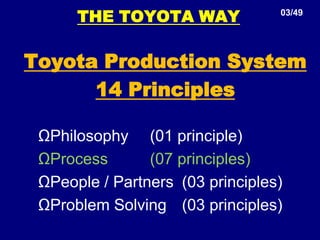
THE TOYOTA WAY 03/49Toyota Production System 14 PrinciplesPhilosophy	(01 principle)
Process		(07 principles)
People / Partners	(03 principles)
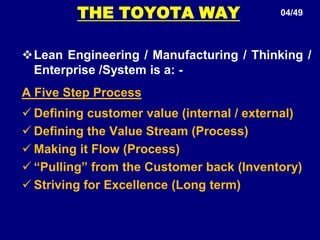
Problem Solving	(03 principles)THE TOYOTA WAY 04/49Lean Engineering / Manufacturing / Thinking / Enterprise /System is a: - A Five Step ProcessDefining customer value (internal / external)
Defining the Value Stream (Process)
Making it Flow (Process)
“Pulling” from the Customer back (Inventory)
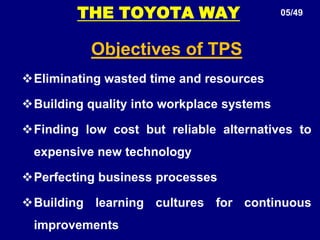
Striving for Excellence (Long term)THE TOYOTA WAY 05/49Objectives of TPSEliminating wasted time and resources
Building quality into workplace systems
Finding low cost but reliable alternatives to expensive new technology
Perfecting business processes
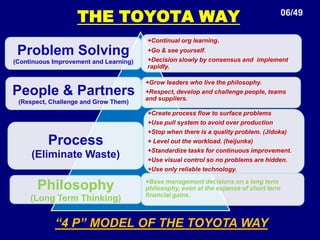
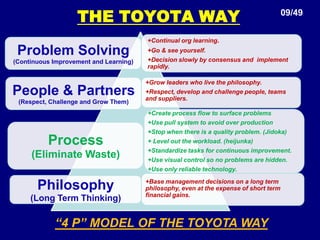
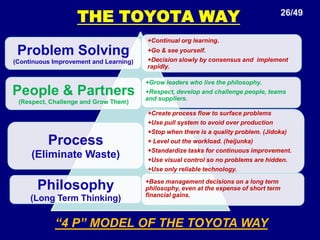
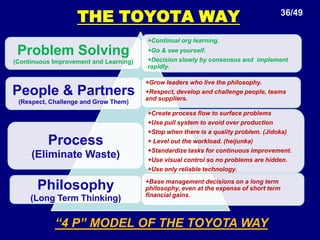
Building learning cultures for continuous improvementsTHE TOYOTA WAY 06/49+Continual org learning.+Go & see yourself.+Decision slowly by consensus and  implement rapidly. +Grow leaders who live the philosophy.+Respect, develop and challenge people, teams and suppliers.+Create process flow to surface problems+Use pull system to avoid over production+Stop when there is a quality problem. (Jidoka)+ Level out the workload. (heijunka)+Standardize tasks for continuous improvement.+Use visual control so no problems are hidden. +Use only reliable technology.+Base management decisions on a long term philosophy, even at the expense of short term financial gains.“4 P” MODEL OF THE TOYOTA WAY
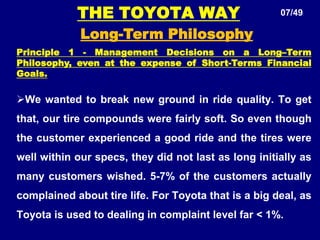
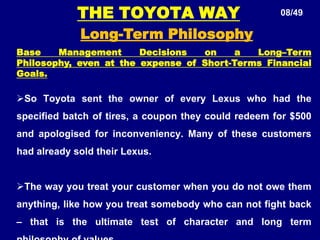
THE TOYOTA WAY 07/49Principle 1 - Management Decisions on a Long–Term Philosophy, even at the expense of Short-Terms Financial Goals.We wanted to break new ground in ride quality. To get that, our tire compounds were fairly soft. So even though the customer experienced a good ride and the tires were well within our specs, they did not last as long initially as many customers wished. 5-7% of the customers actually complained about tire life. For Toyota that is a big deal, as Toyota is used to dealing in complaint level far < 1%. THE TOYOTA WAY 08/49Base Management Decisions on a Long–Term Philosophy, even at the expense of Short-Terms Financial Goals.So Toyota sent the owner of every Lexus who had the specified batch of tires, a coupon they could redeem for $500 and apologised for inconveniency. Many of these customers had already sold their Lexus.
The way you treat your customer when you do not owe them anything, like how you treat somebody who can not fight back – that is the ultimate test of character and long term philosophy of values. THE TOYOTA WAY 09/49+Continual org learning.+Go & see yourself.+Decision slowly by consensus and  implement rapidly. +Grow leaders who live the philosophy.+Respect, develop and challenge people, teams and suppliers.+Create process flow to surface problems+Use pull system to avoid over production+Stop when there is a quality problem. (Jidoka)+ Level out the workload. (heijunka)+Standardize tasks for continuous improvement.+Use visual control so no problems are hidden. +Use only reliable technology.+Base management decisions on a long term philosophy, even at the expense of short term financial gains.“4 P” MODEL OF THE TOYOTA WAY
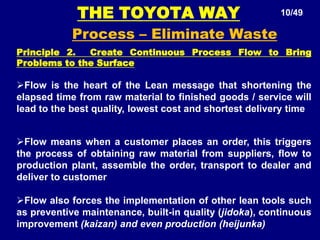
THE TOYOTA WAY 10/49Principle 2.  Create Continuous Process Flow to Bring Problems to the SurfaceFlow is the heart of the Lean message that shortening the elapsed time from raw material to finished goods / service will lead to the best quality, lowest cost and shortest delivery time
Flow means when a customer places an order, this triggers the process of obtaining raw material from suppliers, flow to production plant, assemble the order, transport to dealer and deliver to customer
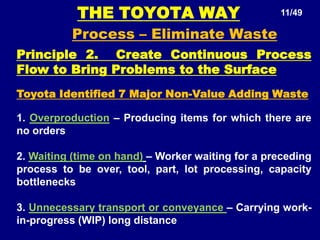
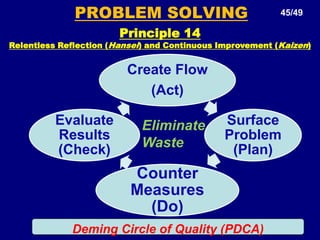
Flow also forces the implementation of other lean tools such as preventive maintenance, built-in quality (jidoka), continuous improvement (kaizan) and even production (heijunka)THE TOYOTA WAY 11/49Principle 2.  Create Continuous Process Flow to Bring Problems to the SurfaceToyota Identified 7 Major Non-Value Adding Waste1. Overproduction – Producing items for which there are no orders2. Waiting (time on hand)– Worker waiting for a preceding process to be over, tool, part, lot processing, capacity bottlenecks3. Unnecessary transport or conveyance – Carrying work-in-progress (WIP) long distance
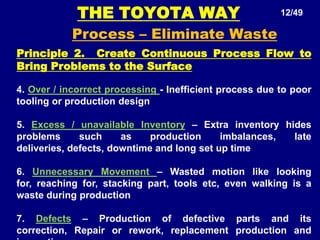
THE TOYOTA WAY 12/49Principle 2.  Create Continuous Process Flow to Bring Problems to the Surface4. Over / incorrect processing - Inefficient process due to poor tooling or production design5. Excess / unavailable Inventory– Extra inventory hides problems such as production imbalances, late deliveries, defects, downtime and long set up time6. Unnecessary Movement – Wasted motion like looking for, reaching for, stacking part, tools etc, even walking is a waste during production7. Defects – Production of defective parts and its correction, Repair or rework, replacement production and inspection
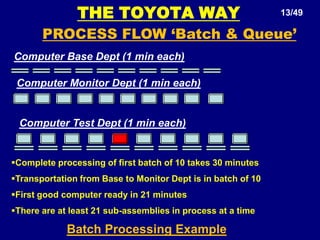
THE TOYOTA WAY 13/49Computer Base Dept (1 min each)Computer Monitor Dept (1 min each)Computer Test Dept (1 min each)Complete processing of first batch of 10 takes 30 minutes
Transportation from Base to Monitor Dept is in batch of 10
First good computer ready in 21 minutes
There are at least 21 sub-assemblies in process at a timeBatch Processing Example
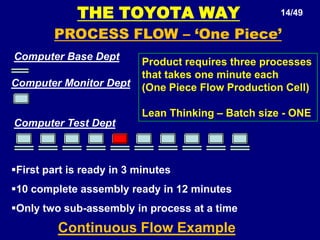
THE TOYOTA WAY 14/49Computer Base DeptProduct requires three processes that takes one minute each (One Piece Flow Production Cell) Lean Thinking – Batch size - ONEComputer Monitor DeptComputer Test DeptFirst part is ready in 3 minutes
10 complete assembly ready in 12 minutes
Only two sub-assembly in process at a timeContinuous Flow Example
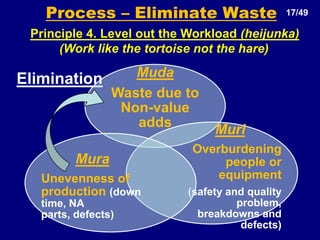
Process – Eliminate Waste15/49Principle 3. Use “Pull” Systems to Avoid Overproduction“The more inventory a company has, .....the less likely they will have what they need.”			TaiichiOhnoProvide your down line customers in the production process with what they want,  when they want it, and in the amount they want.  Material replenishment initiated by consumption is the basic principle of just-in-time (JIT). It triggers at a customer’s orders of Toyota. Minimize your work in process (WIP) and warehousing of inventory by stocking small amounts of each product and frequently restocking based on what the customer actually takes away. Be responsive to the day-by-day shifts in customer demand rather than relying on computer schedules and systems to track wasteful inventory.Process – Eliminate Waste16/49Principle 4. Level out the Workload (heijunka)(Work like the tortoise not the hare)   Eliminating waste is just one-third of the equation for making lean successful. Eliminating overburden to people and equipment and eliminating unevenness in the production schedule are just as important The slower and consistent tortoise causes less waste and is much more desirable than the speedy hare that races ahead and then stops occasionally to doze. The TPS can be realised only when all move at the speed of tortoise. Process – Eliminate Waste17/49Principle 4. Level out the Workload (heijunka)(Work like the tortoise not the hare)   Elimination
Process – Eliminate Waste18/49Principle 5.Build a Culture of Stopping to Fix Problems, to Get Quality Right the First TimeGM followed the golden rule of automotive engine production: do not shut down the assy plant! At GM, managers were judged by their ability to deliver the numbers, Get the job done no matter what – and that meant getting the assy plant to keep it running.
How Toyota Reacted – If you are not shutting down the assy plant, it means that you have no problem. All mfg plants have problems. So you must be hiding your problems. It is better to shut down the plant and work on quality and continue to solve your problems.Process – Eliminate Waste19/49Principle 5. Keep Quality Controls Simple and Involve Team Members	Things like ISO-9000, an industrial quality standard that calls for all kinds of detailed SOPs, for whatever good they have done, have made companies believe that if they put together detailed rule books the rules will be followed. Quality planning dept are armed with reams of data analyzed using most sophisticated statistical analysis methods. Six Sigma has brought us roving bands of black belts who attack major quality problems with a vengeance, armed with an arsenal of sophisticated technical methods. But at Toyota........................
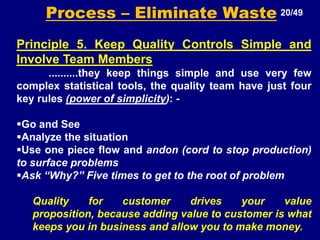
Process – Eliminate Waste20/49Principle 5. Keep Quality Controls Simple and Involve Team Members..........they keep things simple and use very few complex statistical tools, the quality team have just four key rules (power of simplicity): -Go and See
Analyze the situation
Use one piece flow and andon (cord to stop production) to surface problems
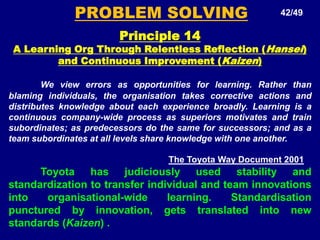
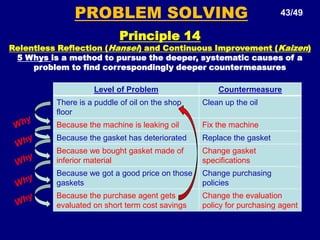
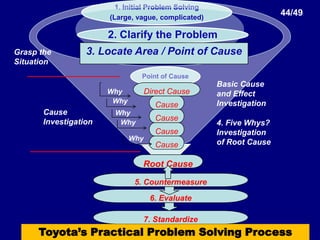
Ask “Why?” Five times to get to the root of problemQuality for customer drives your value proposition, because adding value to customer is what keeps you in business and allow you to make money.
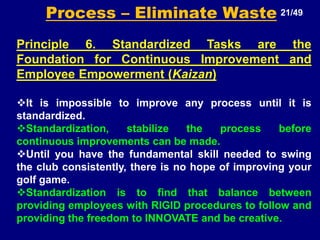
Process – Eliminate Waste21/49Principle 6. Standardized Tasks are the Foundation for Continuous Improvement and Employee Empowerment (Kaizan)It is impossible to improve any process until it is standardized.
Standardization, stabilize the process before continuous improvements can be made.
Until you have the fundamental skill needed to swing the club consistently, there is no hope of improving your golf game.
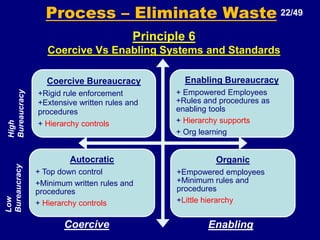
Standardization is to find that balance between providing employees with RIGID procedures to follow and providing the freedom to INNOVATE and be creative. Process – Eliminate Waste22/49Principle 6Coercive Vs Enabling Systems and StandardsHigh BureaucracyLow BureaucracyCoerciveEnabling
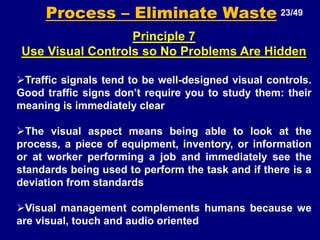
Process – Eliminate Waste23/49Principle 7 Use Visual Controls so No Problems Are HiddenTraffic signals tend to be well-designed visual controls. Good traffic signs don’t require you to study them: their meaning is immediately clear
The visual aspect means being able to look at the process, a piece of equipment, inventory, or information or at worker performing a job and immediately see the standards being used to perform the task and if there is a deviation from standards
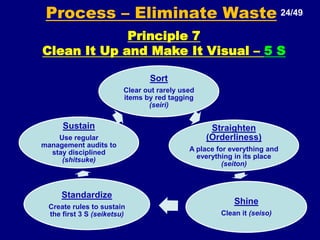
Visual management complements humans because we are visual, touch and audio orientedProcess – Eliminate Waste24/49Principle 7 Clean It Up and Make It Visual – 5 S
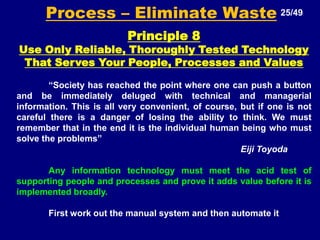
Process – Eliminate Waste25/49Principle 8 Use Only Reliable, Thoroughly Tested Technology That Serves Your People, Processes and Values“Society has reached the point where one can push a button and be immediately deluged with technical and managerial information. This is all very convenient, of course, but if one is not careful there is a danger of losing the ability to think. We must remember that in the end it is the individual human being who must solve the problems”Eiji ToyodaAny information technology must meet the acid test of supporting people and processes and prove it adds value before it is implemented broadly.First work out the manual system and then automate it
THE TOYOTA WAY 26/49+Continual org learning.+Go & see yourself.+Decision slowly by consensus and  implement rapidly. +Grow leaders who live the philosophy.+Respect, develop and challenge people, teams and suppliers.+Create process flow to surface problems+Use pull system to avoid over production+Stop when there is a quality problem. (Jidoka)+ Level out the workload. (heijunka)+Standardize tasks for continuous improvement.+Use visual control so no problems are hidden. +Use only reliable technology.+Base management decisions on a long term philosophy, even at the expense of short term financial gains.“4 P” MODEL OF THE TOYOTA WAY
PEOPLE & PARTNERS27/49Principle 9 Grow Leaders Who Thoroughly Understand the Work, Live the Philosophy, and Teach It to OthersThe Automotive News recognized newsmakers in the auto industry. Direct quotes from the issue about these newsmakers: -Bill Ford (Ford): Talks up revitalization, brings backs old guys, stars in TV commercial. Ford stock remains mired in the $10 rangeRobert Lutz (GM):Former Marine pilot inspires GM’s troops and simplifies product development, giving designers a bigger voiceDieter Zetzsche (Chrysler):  Turns the company around a year early with 3 Qtrs in the black
PEOPLE & PARTNERS28/49Principle 9 Grow Leaders Who Thoroughly Understand the Work, Live the Philosophy, and Teach It to OthersFujio Cho (Toyota):Toyota President presides over rise in operating profit to industry record. Take lead on hybrids. Grabs 10 point of US market. Joins with Peugeot for plants in Eastern Europe. 	Changing the culture each time a new leader comes into office necessarily means jerking the company about superficially, without developing any real depth or loyalty from the employees. The problem with the radical shifts in the culture is that organization will never learn – it loses its ability to build on achievements, mistakes, or enduring principles. Deming, the Quality Guru terms it “Constancy of Purpose”.
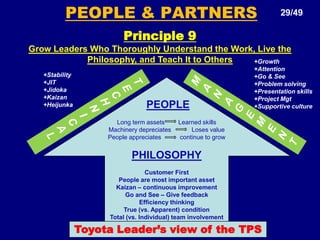
PEOPLE & PARTNERS29/49Principle 9 Grow Leaders Who Thoroughly Understand the Work, Live the Philosophy, and Teach It to Others+Growth+Attention+Go & See+Problem solving+Presentation skills+Project Mgt+Supportive culture+Stability+JIT+Jidoka+Kaizan+HeijunkaLong term assets        Learned skillsMachinery depreciatesLoses valuePeople appreciates           continue to growPHILOSOPHYCustomer FirstPeople are most important assetKaizan – continuous improvementGo and See – Give feedbackEfficiency thinkingTrue (vs. Apparent) conditionTotal (vs. Individual) team involvementPEOPLEMANAGEMENTTECHN                                                             I  CALToyota Leader’s view of the TPS
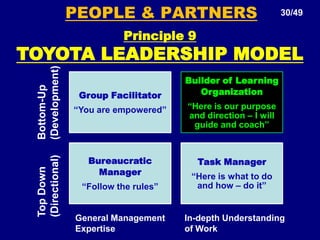
PEOPLE & PARTNERS30/49Principle 9 TOYOTA LEADERSHIP MODELBottom-Up (Development)Top Down(Directional)General Management ExpertiseIn-depth Understanding of Work
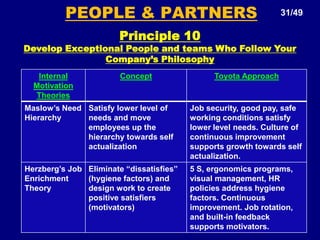
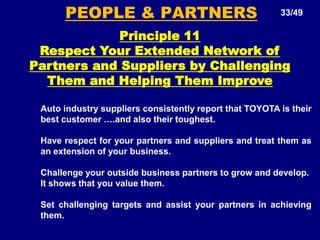
PEOPLE & PARTNERS31/49Principle 10 Develop Exceptional People and teams Who Follow Your Company’s Philosophy
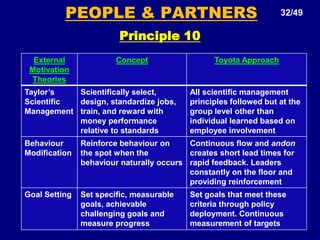
PEOPLE & PARTNERS32/49Principle 10

Toyota Production System 14 Management Principles

  • 1.
    THE TOYOTAWAY14 MANAGEMENT PRINCIPLES FROM THE WORLD’S GREATEST MANUFACTURERBy Wg Cdr DK Sharma
  • 2.
    THE TOYOTA WAY02/49Toyota Production System (TPS) Also called The Toyota Way
  • 3.
    THE TOYOTA WAY03/49Toyota Production System 14 PrinciplesPhilosophy (01 principle)
  • 4.
  • 5.
  • 6.
    Problem Solving (03 principles)THETOYOTA WAY 04/49Lean Engineering / Manufacturing / Thinking / Enterprise /System is a: - A Five Step ProcessDefining customer value (internal / external)
  • 7.
    Defining the ValueStream (Process)
  • 8.
  • 9.
    “Pulling” from theCustomer back (Inventory)
  • 10.
    Striving for Excellence(Long term)THE TOYOTA WAY 05/49Objectives of TPSEliminating wasted time and resources
  • 11.
    Building quality intoworkplace systems
  • 12.
    Finding low costbut reliable alternatives to expensive new technology
  • 13.
  • 14.
    Building learning culturesfor continuous improvementsTHE TOYOTA WAY 06/49+Continual org learning.+Go & see yourself.+Decision slowly by consensus and implement rapidly. +Grow leaders who live the philosophy.+Respect, develop and challenge people, teams and suppliers.+Create process flow to surface problems+Use pull system to avoid over production+Stop when there is a quality problem. (Jidoka)+ Level out the workload. (heijunka)+Standardize tasks for continuous improvement.+Use visual control so no problems are hidden. +Use only reliable technology.+Base management decisions on a long term philosophy, even at the expense of short term financial gains.“4 P” MODEL OF THE TOYOTA WAY
  • 15.
    THE TOYOTA WAY07/49Principle 1 - Management Decisions on a Long–Term Philosophy, even at the expense of Short-Terms Financial Goals.We wanted to break new ground in ride quality. To get that, our tire compounds were fairly soft. So even though the customer experienced a good ride and the tires were well within our specs, they did not last as long initially as many customers wished. 5-7% of the customers actually complained about tire life. For Toyota that is a big deal, as Toyota is used to dealing in complaint level far < 1%. THE TOYOTA WAY 08/49Base Management Decisions on a Long–Term Philosophy, even at the expense of Short-Terms Financial Goals.So Toyota sent the owner of every Lexus who had the specified batch of tires, a coupon they could redeem for $500 and apologised for inconveniency. Many of these customers had already sold their Lexus.
  • 16.
    The way youtreat your customer when you do not owe them anything, like how you treat somebody who can not fight back – that is the ultimate test of character and long term philosophy of values. THE TOYOTA WAY 09/49+Continual org learning.+Go & see yourself.+Decision slowly by consensus and implement rapidly. +Grow leaders who live the philosophy.+Respect, develop and challenge people, teams and suppliers.+Create process flow to surface problems+Use pull system to avoid over production+Stop when there is a quality problem. (Jidoka)+ Level out the workload. (heijunka)+Standardize tasks for continuous improvement.+Use visual control so no problems are hidden. +Use only reliable technology.+Base management decisions on a long term philosophy, even at the expense of short term financial gains.“4 P” MODEL OF THE TOYOTA WAY
  • 17.
    THE TOYOTA WAY10/49Principle 2. Create Continuous Process Flow to Bring Problems to the SurfaceFlow is the heart of the Lean message that shortening the elapsed time from raw material to finished goods / service will lead to the best quality, lowest cost and shortest delivery time
  • 18.
    Flow means whena customer places an order, this triggers the process of obtaining raw material from suppliers, flow to production plant, assemble the order, transport to dealer and deliver to customer
  • 19.
    Flow also forcesthe implementation of other lean tools such as preventive maintenance, built-in quality (jidoka), continuous improvement (kaizan) and even production (heijunka)THE TOYOTA WAY 11/49Principle 2. Create Continuous Process Flow to Bring Problems to the SurfaceToyota Identified 7 Major Non-Value Adding Waste1. Overproduction – Producing items for which there are no orders2. Waiting (time on hand)– Worker waiting for a preceding process to be over, tool, part, lot processing, capacity bottlenecks3. Unnecessary transport or conveyance – Carrying work-in-progress (WIP) long distance
  • 20.
    THE TOYOTA WAY12/49Principle 2. Create Continuous Process Flow to Bring Problems to the Surface4. Over / incorrect processing - Inefficient process due to poor tooling or production design5. Excess / unavailable Inventory– Extra inventory hides problems such as production imbalances, late deliveries, defects, downtime and long set up time6. Unnecessary Movement – Wasted motion like looking for, reaching for, stacking part, tools etc, even walking is a waste during production7. Defects – Production of defective parts and its correction, Repair or rework, replacement production and inspection
  • 21.
    THE TOYOTA WAY13/49Computer Base Dept (1 min each)Computer Monitor Dept (1 min each)Computer Test Dept (1 min each)Complete processing of first batch of 10 takes 30 minutes
  • 22.
    Transportation from Baseto Monitor Dept is in batch of 10
  • 23.
    First good computerready in 21 minutes
  • 24.
    There are atleast 21 sub-assemblies in process at a timeBatch Processing Example
  • 25.
    THE TOYOTA WAY14/49Computer Base DeptProduct requires three processes that takes one minute each (One Piece Flow Production Cell) Lean Thinking – Batch size - ONEComputer Monitor DeptComputer Test DeptFirst part is ready in 3 minutes
  • 26.
    10 complete assemblyready in 12 minutes
  • 27.
    Only two sub-assemblyin process at a timeContinuous Flow Example
  • 28.
    Process – EliminateWaste15/49Principle 3. Use “Pull” Systems to Avoid Overproduction“The more inventory a company has, .....the less likely they will have what they need.” TaiichiOhnoProvide your down line customers in the production process with what they want, when they want it, and in the amount they want. Material replenishment initiated by consumption is the basic principle of just-in-time (JIT). It triggers at a customer’s orders of Toyota. Minimize your work in process (WIP) and warehousing of inventory by stocking small amounts of each product and frequently restocking based on what the customer actually takes away. Be responsive to the day-by-day shifts in customer demand rather than relying on computer schedules and systems to track wasteful inventory.Process – Eliminate Waste16/49Principle 4. Level out the Workload (heijunka)(Work like the tortoise not the hare) Eliminating waste is just one-third of the equation for making lean successful. Eliminating overburden to people and equipment and eliminating unevenness in the production schedule are just as important The slower and consistent tortoise causes less waste and is much more desirable than the speedy hare that races ahead and then stops occasionally to doze. The TPS can be realised only when all move at the speed of tortoise. Process – Eliminate Waste17/49Principle 4. Level out the Workload (heijunka)(Work like the tortoise not the hare) Elimination
  • 29.
    Process – EliminateWaste18/49Principle 5.Build a Culture of Stopping to Fix Problems, to Get Quality Right the First TimeGM followed the golden rule of automotive engine production: do not shut down the assy plant! At GM, managers were judged by their ability to deliver the numbers, Get the job done no matter what – and that meant getting the assy plant to keep it running.
  • 30.
    How Toyota Reacted– If you are not shutting down the assy plant, it means that you have no problem. All mfg plants have problems. So you must be hiding your problems. It is better to shut down the plant and work on quality and continue to solve your problems.Process – Eliminate Waste19/49Principle 5. Keep Quality Controls Simple and Involve Team Members Things like ISO-9000, an industrial quality standard that calls for all kinds of detailed SOPs, for whatever good they have done, have made companies believe that if they put together detailed rule books the rules will be followed. Quality planning dept are armed with reams of data analyzed using most sophisticated statistical analysis methods. Six Sigma has brought us roving bands of black belts who attack major quality problems with a vengeance, armed with an arsenal of sophisticated technical methods. But at Toyota........................
  • 31.
    Process – EliminateWaste20/49Principle 5. Keep Quality Controls Simple and Involve Team Members..........they keep things simple and use very few complex statistical tools, the quality team have just four key rules (power of simplicity): -Go and See
  • 32.
  • 33.
    Use one pieceflow and andon (cord to stop production) to surface problems
  • 34.
    Ask “Why?” Fivetimes to get to the root of problemQuality for customer drives your value proposition, because adding value to customer is what keeps you in business and allow you to make money.
  • 35.
    Process – EliminateWaste21/49Principle 6. Standardized Tasks are the Foundation for Continuous Improvement and Employee Empowerment (Kaizan)It is impossible to improve any process until it is standardized.
  • 36.
    Standardization, stabilize theprocess before continuous improvements can be made.
  • 37.
    Until you havethe fundamental skill needed to swing the club consistently, there is no hope of improving your golf game.
  • 38.
    Standardization is tofind that balance between providing employees with RIGID procedures to follow and providing the freedom to INNOVATE and be creative. Process – Eliminate Waste22/49Principle 6Coercive Vs Enabling Systems and StandardsHigh BureaucracyLow BureaucracyCoerciveEnabling
  • 39.
    Process – EliminateWaste23/49Principle 7 Use Visual Controls so No Problems Are HiddenTraffic signals tend to be well-designed visual controls. Good traffic signs don’t require you to study them: their meaning is immediately clear
  • 40.
    The visual aspectmeans being able to look at the process, a piece of equipment, inventory, or information or at worker performing a job and immediately see the standards being used to perform the task and if there is a deviation from standards
  • 41.
    Visual management complementshumans because we are visual, touch and audio orientedProcess – Eliminate Waste24/49Principle 7 Clean It Up and Make It Visual – 5 S
  • 42.
    Process – EliminateWaste25/49Principle 8 Use Only Reliable, Thoroughly Tested Technology That Serves Your People, Processes and Values“Society has reached the point where one can push a button and be immediately deluged with technical and managerial information. This is all very convenient, of course, but if one is not careful there is a danger of losing the ability to think. We must remember that in the end it is the individual human being who must solve the problems”Eiji ToyodaAny information technology must meet the acid test of supporting people and processes and prove it adds value before it is implemented broadly.First work out the manual system and then automate it
  • 43.
    THE TOYOTA WAY26/49+Continual org learning.+Go & see yourself.+Decision slowly by consensus and implement rapidly. +Grow leaders who live the philosophy.+Respect, develop and challenge people, teams and suppliers.+Create process flow to surface problems+Use pull system to avoid over production+Stop when there is a quality problem. (Jidoka)+ Level out the workload. (heijunka)+Standardize tasks for continuous improvement.+Use visual control so no problems are hidden. +Use only reliable technology.+Base management decisions on a long term philosophy, even at the expense of short term financial gains.“4 P” MODEL OF THE TOYOTA WAY
  • 44.
    PEOPLE & PARTNERS27/49Principle9 Grow Leaders Who Thoroughly Understand the Work, Live the Philosophy, and Teach It to OthersThe Automotive News recognized newsmakers in the auto industry. Direct quotes from the issue about these newsmakers: -Bill Ford (Ford): Talks up revitalization, brings backs old guys, stars in TV commercial. Ford stock remains mired in the $10 rangeRobert Lutz (GM):Former Marine pilot inspires GM’s troops and simplifies product development, giving designers a bigger voiceDieter Zetzsche (Chrysler): Turns the company around a year early with 3 Qtrs in the black
  • 45.
    PEOPLE & PARTNERS28/49Principle9 Grow Leaders Who Thoroughly Understand the Work, Live the Philosophy, and Teach It to OthersFujio Cho (Toyota):Toyota President presides over rise in operating profit to industry record. Take lead on hybrids. Grabs 10 point of US market. Joins with Peugeot for plants in Eastern Europe. Changing the culture each time a new leader comes into office necessarily means jerking the company about superficially, without developing any real depth or loyalty from the employees. The problem with the radical shifts in the culture is that organization will never learn – it loses its ability to build on achievements, mistakes, or enduring principles. Deming, the Quality Guru terms it “Constancy of Purpose”.
  • 46.
    PEOPLE & PARTNERS29/49Principle9 Grow Leaders Who Thoroughly Understand the Work, Live the Philosophy, and Teach It to Others+Growth+Attention+Go & See+Problem solving+Presentation skills+Project Mgt+Supportive culture+Stability+JIT+Jidoka+Kaizan+HeijunkaLong term assets Learned skillsMachinery depreciatesLoses valuePeople appreciates continue to growPHILOSOPHYCustomer FirstPeople are most important assetKaizan – continuous improvementGo and See – Give feedbackEfficiency thinkingTrue (vs. Apparent) conditionTotal (vs. Individual) team involvementPEOPLEMANAGEMENTTECHN I CALToyota Leader’s view of the TPS
  • 47.
    PEOPLE & PARTNERS30/49Principle9 TOYOTA LEADERSHIP MODELBottom-Up (Development)Top Down(Directional)General Management ExpertiseIn-depth Understanding of Work
  • 48.
    PEOPLE & PARTNERS31/49Principle10 Develop Exceptional People and teams Who Follow Your Company’s Philosophy
  • 49.