By Solomon Tilahun
Course name: Lean system
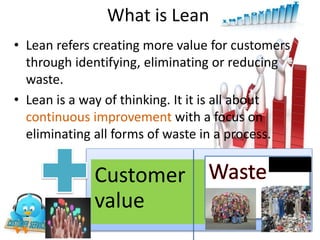
• Lean refers creating more value for customers
through identifying, eliminating or reducing
waste.
• Lean is a way of thinking. It it is all about
continuous improvement with a focus on
eliminating all forms of waste in a process.
What is Lean?
Customer
value
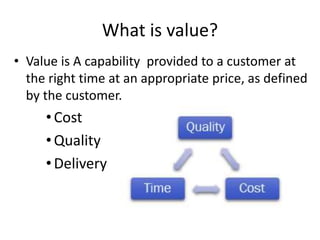
• Value is A capability provided to a customer at
the right time at an appropriate price, as defined
by the customer.
•Cost
•Quality
•Delivery
What is value?
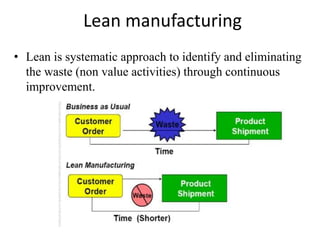
• Lean is systematic approach to identify and eliminating
the waste (non value activities) through continuous
improvement.
Lean manufacturing
• Lean Manufacturing is all about making a product
in the most efficient and effective manner, while
looking for ways to continuously improve.
• Continuous Improvements:
– Decrease Cycle Time
– Eliminate sources of waste in a process
– Increase Throughout
Continued…..
what makes a manufacturing system Lean?
The 3 m’s of lean
Muda____Waste
Mura____Inconsistency
Muri___unreasonableness
• 1950 to 1890
• Eli Whitey is most famous for perfection of interchangeable
parts. Whitney developed this about 1799.
• As production system or system changed; few people
concerned themselves with:
What happened between processes?
How multiple processes where arranged within the factory?
How each worker went about a task?
This changed in the late 1890’s with the work of early
industrial engineers.
History of lean management
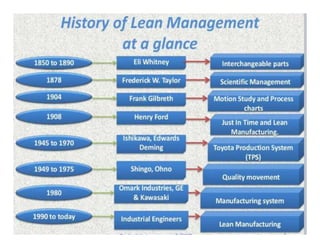
• Prepare power point on the following history of
lean management.
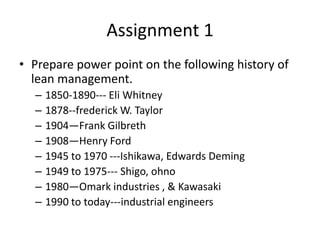
– 1850-1890--- Eli Whitney
– 1878--frederick W. Taylor
– 1904—Frank Gilbreth
– 1908—Henry Ford
– 1945 to 1970 ---Ishikawa, Edwards Deming
– 1949 to 1975--- Shigo, ohno
– 1980—Omark industries , & Kawasaki
– 1990 to today---industrial engineers
Assignment 1
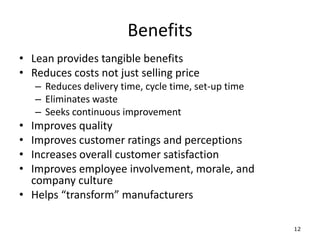
• Lean provides tangible benefits
• Reduces costs not just selling price
– Reduces delivery time, cycle time, set-up time
– Eliminates waste
– Seeks continuous improvement
• Improves quality
• Improves customer ratings and perceptions
• Increases overall customer satisfaction
• Improves employee involvement, morale, and
company culture
• Helps “transform” manufacturers
12
Benefits
Toyota Production System (TPS)
• Quality, Cost, Delivery
– Shorten Production Flow by
Eliminating Waste
• Just In Time
– The Right Part at the Right Time in
the Right Amount
– Continuous Flow
– Pull Systems
– Level Production
• Built-In Quality
– Error Proofing – Poka Yoke
– Visual Controls
• Operational Stability
– Standardized Work
– Robust Products & Processes
– Total Productive Maintenance
– Supplier Involvement
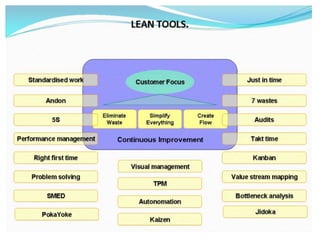
Lean manufacturing tools
14
• The Japanese word for waste is muda, which is
defined as “uselessness.”
• Lean tools are designed to reduce Muda in
organizations and improve quality control.
• In other words, Lean tools seek to eliminate
processes that aren’t valuable.
What Are Lean Tools?
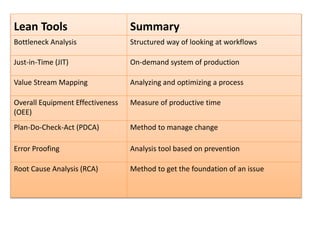
Lean Tools Summary
Bottleneck Analysis Structured way of looking at workflows
Just-in-Time (JIT) On-demand system of production
Value Stream Mapping Analyzing and optimizing a process
Overall Equipment Effectiveness
(OEE)
Measure of productive time
Plan-Do-Check-Act (PDCA) Method to manage change
Error Proofing Analysis tool based on prevention
Root Cause Analysis (RCA) Method to get the foundation of an issue
lean.pptx

lean.pptx

  • 1.
    By Solomon Tilahun Coursename: Lean system
  • 2.
    • Lean referscreating more value for customers through identifying, eliminating or reducing waste. • Lean is a way of thinking. It it is all about continuous improvement with a focus on eliminating all forms of waste in a process. What is Lean? Customer value
  • 3.
    • Value isA capability provided to a customer at the right time at an appropriate price, as defined by the customer. •Cost •Quality •Delivery What is value?
  • 5.
    • Lean issystematic approach to identify and eliminating the waste (non value activities) through continuous improvement. Lean manufacturing
  • 6.
    • Lean Manufacturingis all about making a product in the most efficient and effective manner, while looking for ways to continuously improve. • Continuous Improvements: – Decrease Cycle Time – Eliminate sources of waste in a process – Increase Throughout Continued…..
  • 7.
    what makes amanufacturing system Lean? The 3 m’s of lean Muda____Waste Mura____Inconsistency Muri___unreasonableness
  • 10.
    • 1950 to1890 • Eli Whitey is most famous for perfection of interchangeable parts. Whitney developed this about 1799. • As production system or system changed; few people concerned themselves with: What happened between processes? How multiple processes where arranged within the factory? How each worker went about a task? This changed in the late 1890’s with the work of early industrial engineers. History of lean management
  • 11.
    • Prepare powerpoint on the following history of lean management. – 1850-1890--- Eli Whitney – 1878--frederick W. Taylor – 1904—Frank Gilbreth – 1908—Henry Ford – 1945 to 1970 ---Ishikawa, Edwards Deming – 1949 to 1975--- Shigo, ohno – 1980—Omark industries , & Kawasaki – 1990 to today---industrial engineers Assignment 1
  • 12.
    • Lean providestangible benefits • Reduces costs not just selling price – Reduces delivery time, cycle time, set-up time – Eliminates waste – Seeks continuous improvement • Improves quality • Improves customer ratings and perceptions • Increases overall customer satisfaction • Improves employee involvement, morale, and company culture • Helps “transform” manufacturers 12 Benefits
  • 13.
    Toyota Production System(TPS) • Quality, Cost, Delivery – Shorten Production Flow by Eliminating Waste • Just In Time – The Right Part at the Right Time in the Right Amount – Continuous Flow – Pull Systems – Level Production • Built-In Quality – Error Proofing – Poka Yoke – Visual Controls • Operational Stability – Standardized Work – Robust Products & Processes – Total Productive Maintenance – Supplier Involvement
  • 14.
  • 15.
    • The Japaneseword for waste is muda, which is defined as “uselessness.” • Lean tools are designed to reduce Muda in organizations and improve quality control. • In other words, Lean tools seek to eliminate processes that aren’t valuable. What Are Lean Tools?
  • 17.
    Lean Tools Summary BottleneckAnalysis Structured way of looking at workflows Just-in-Time (JIT) On-demand system of production Value Stream Mapping Analyzing and optimizing a process Overall Equipment Effectiveness (OEE) Measure of productive time Plan-Do-Check-Act (PDCA) Method to manage change Error Proofing Analysis tool based on prevention Root Cause Analysis (RCA) Method to get the foundation of an issue