THE TOYOTA WAY
  14 MANAGEMENT PRINCIPLES
FROM THE WORLD’S GREATEST MANUFACTURER


           JEFFREY K. LIKER
CHALLENGE EVERYTHING….
• “All elements to be practiced everyday in a
  very consistent manner, not in spurts”
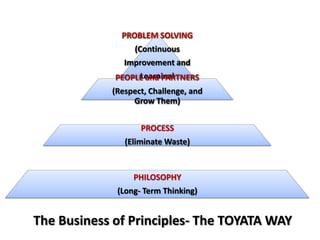
PROBLEM SOLVING
                  (Continuous
               Improvement and
                  Learning)
             PEOPLE and PARTNERS
            (Respect, Challenge, and
                 Grow Them)


                   PROCESS
               (Eliminate Waste)


                 PHILOSOPHY
             (Long- Term Thinking)


The Business of Principles- The TOYATA WAY
Organizational learning…
•   Philosophy
•   Process right
•   People and partners building
•   Problem solving

    “operational excellence” as strategic weapon…
5 step ‘Lean Manufacturing’
1.   Defining customer value
2.   Defining value stream
3.   Making it flow
4.   Pulling from the customer back
5.   Striving for excellence

      Cost, quality and service to be the BEST
Founders’ thoughts
• King of inventors of Japan- Sakichi Toyoda
• Toyota way- genchi genbutsu (1926)
• Toyota conglomerate- Keiretsu
• Automation with a human touch and mistake
  proofing- Jidoka/ autonomation
• Hard work, perseverance, discipline- James
  Watt
• Management by Facts…
Kiichiro Toyoda
• “everyone should tackle some great project at
  least once in their life”
• Education from Tokyo Imperial University
• Learning by Doing
• Pillars of the Toyota Production System-
  jidoka, just-in-time
• Creativity, challenge, courage, commitment
  and patience
Taichi Ohno
• One piece flow
• Pull system
• Kanban
• “Shortening lead time by eliminating waste in
  each step of a process leads to best quality
  and lowest cost, while improving safety and
  morale”
• Spirit of challenge- the acceptance of
  responsibility to meet the challenge
• “we accept challenges with a creative spirit and
  the courage to realize our own dreams without
  losing drive or energy. We approach our work
  vigorously, with optimism and a sincere belief in
  the value of our contribution”
• “we strive to decide our own fate. We act with
  self reliance, trusting on our own abilities. We
  accept responsibility for our conduct and for
  maintaining and improving the skills that enable
  us to produce added value”
• Kaizen- change for the better

• Kaikaiku- major revolutionary change

• Walk the actual path- to construct the value
  stream

• Takt- German word for ‘meter’

• Total Productive Maintenance- always a sense of
  urgency
Framework
•   Quality
•   Cost
•   Delivery
•   Safety
•   Morale
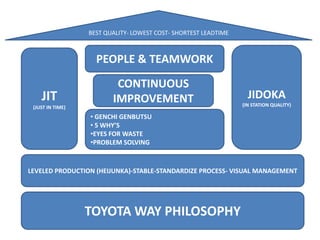
BEST QUALITY- LOWEST COST- SHORTEST LEADTIME


                    PEOPLE & TEAMWORK
                          CONTINUOUS
    JIT                  IMPROVEMENT                               JIDOKA
 (JUST IN TIME)                                                  (IN STATION QUALITY)

                  • GENCHI GENBUTSU
                  • 5 WHY’S
                  •EYES FOR WASTE
                  •PROBLEM SOLVING


LEVELED PRODUCTION (HEIJUNKA)-STABLE-STANDARDIZE PROCESS- VISUAL MANAGEMENT


                  TOYOTA WAY PHILOSOPHY
• Never be satisfied with inaction

• Question and redefine your purpose to attain
  progress

• 5S facilitates teamwork

• Sensei- mentors

• Total Budget Control System
• Muri- no value added beyond capability

• Mura- unevenness

  “most businesses are 90% waste (muda) and
             10% value added work”
Benefits of one piece flow
•   Builds in quality
•   Creates real flexibility
•   Creates higher productivity
•   Frees up floor space
•   Improves safety
•   Improves morale
•   Reduces cost of inventory
TPS- Thinking Production System
•   Pull system
•   Flow where you can pull, where you must
•   Learning to see
•   Heijunka- level out the workload
•   Andon- light signaling system
•   Jidoka- autonomation
•   Standard work chart
•   Fit customer demand into leveled schedule and
    establish standard times for delivering different
    types of service
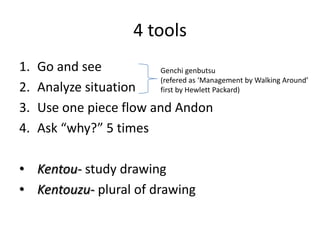
4 tools
1.   Go and see           Genchi genbutsu
                          (refered as ‘Management by Walking Around’
2.   Analyze situation    first by Hewlett Packard)

3.   Use one piece flow and Andon
4.   Ask “why?” 5 times

• Kentou- study drawing
• Kentouzu- plural of drawing
Standardized work
• Takt time
• Sequence of process
• Inventory required
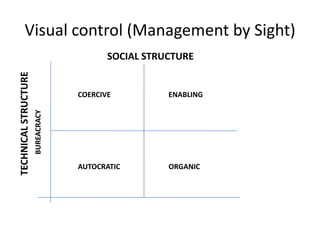
Visual control (Management by Sight)
                                          SOCIAL STRUCTURE
TECHNICAL STRUCTURE


                                   COERCIVE          ENABLING
                      BUREACRACY


                                   AUTOCRATIC        ORGANIC
A3 reports
•   State problem
•   Document current situation
•   Determine the root cause
•   Suggest alternate solution
•   Suggest recommended solution
•   Cost-benefit analysis
TPS- Respect for Humanity System
• Recruiting is 96% employees, 92% employers,
  84% yellow pages, 47% personal contact
• Team development process (Blanchard)
  1.   Orientation
  2.   Dissatisfaction
  3.   Integration
  4.   Production
• Jishuken- voluntary study groups

• Hoshin kanri- policy deployment

• Horensu- to report, give updates periodically
  (a form of micro management)

• Thorough consideration in decision making
• Nemawashi- decision making to all options
  and rapid implementation

• Integrity and excellence

• Kozokeikaku- structure plan (K4)

     “a picture is worth a thousand words”
“Meeting”
• Clear objectives prior to the meeting
• The right people at the meeting
• Prepared participants
• Effective use of visual aids
• Separate information sharing from problem
  solving
• The meeting starts and ends on time
• Hansei (relentless reflection) + kaizen (continuous
  improvement)= learning organization

• Pareto- the only statistical tool used in toyota
  technical center

• Point of cause (POC)

• Toyota Practical Problem Solving Process (20%
  tools, 80% thinking)
3 types of measures at TOYOTA
• Global performance
• Operational performance
• Stretch improvement metrics

“process orientation”

Hoshin kanri (policy deployment process) for
 stretching the improvement goals
Adapt-Develop-Sustain
• Value Stream Mapping- Material and Information Flow
  Diagram (Mike Rother and John Shook, 1999)

• Project review events (Hansei)

• Box- process, triangle- inventory

• Task time- TT, Time in System- TIS, Value Ratio- VR

• Core Value Stream
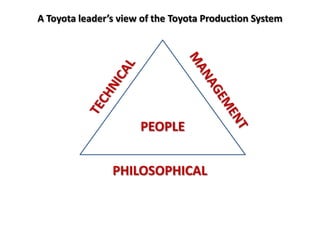
A Toyota leader’s view of the Toyota Production System


                      PEOPLE


                PHILOSOPHICAL
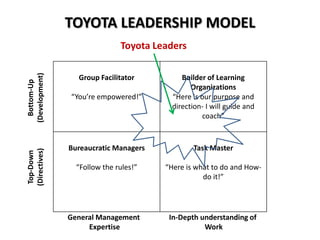
TOYOTA LEADERSHIP MODEL
                               Toyota Leaders
(Development)


                  Group Facilitator          Builder of Learning
  Bottom-Up


                                                Organizations
                “You’re empowered!”       “Here is our purpose and
                                          direction- I will guide and
                                                   coach”


                Bureaucratic Managers            Task Master
(Directives)
 Top-Down


                  “Follow the rules!”   “Here is what to do and How-
                                                   do it!”


                General Management       In-Depth understanding of
                     Expertise                     Work
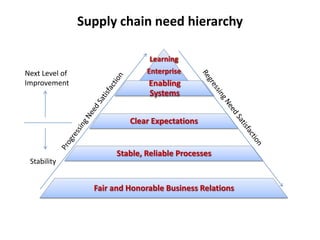
Supply chain need hierarchy

                                 Learning
Next Level of                   Enterprise
Improvement                     Enabling
                                Systems


                           Clear Expectations


                        Stable, Reliable Processes
 Stability


                  Fair and Honorable Business Relations
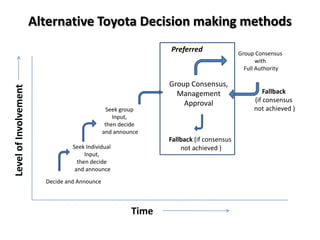
Alternative Toyota Decision making methods
                                                               Preferred                Group Consensus
                                                                                               with
                                                                                          Full Authority

                                                               Group Consensus,
Level of Involvement


                                                                 Management                      Fallback
                                                                   Approval                  (if consensus
                                                Seek group                                   not achieved )
                                                   Input,
                                                then decide
                                               and announce
                                                               Fallback (if consensus
                                  Seek Individual                  not achieved )
                                       Input,
                                    then decide
                                   and announce
                         Decide and Announce


                                                        Time
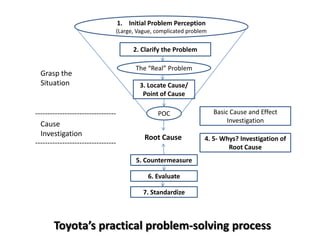
1. Initial Problem Perception
                                (Large, Vague, complicated problem


                                         2. Clarify the Problem

                                          The “Real” Problem
  Grasp the
  Situation                                3. Locate Cause/
                                            Point of Cause

---------------------------------                POC                 Basic Cause and Effect
                                                                          Investigation
  Cause
  Investigation                              Root Cause           4. 5- Whys? Investigation of
---------------------------------
                                                                          Root Cause
                                          5. Countermeasure

                                              6. Evaluate

                                            7. Standardize


       Toyota’s practical problem-solving process
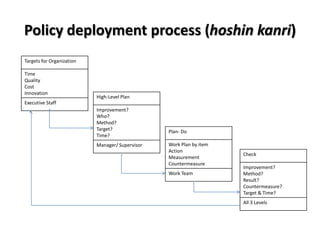
Policy deployment process (hoshin kanri)
Targets for Organization

Time
Quality
Cost
Innovation
                           High-Level Plan
Executive Staff
                           Improvement?
                           Who?
                           Method?
                           Target?               Plan- Do
                           Time?
                           Manager/ Supervisor   Work Plan by item
                                                 Action
                                                                     Check
                                                 Measurement
                                                 Countermeasure
                                                                     Improvement?
                                                 Work Team           Method?
                                                                     Result?
                                                                     Countermeasure?
                                                                     Target & Time?
                                                                     All 3 Levels
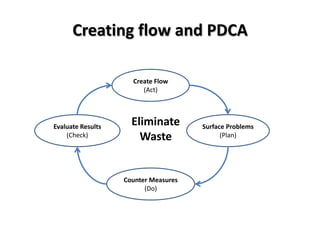
Creating flow and PDCA

                     Create Flow
                        (Act)


Evaluate Results
                     Eliminate        Surface Problems
    (Check)            Waste                (Plan)


                   Counter Measures
                         (Do)
Kaizen workshops
• Phase I
• Phase II
• Phase III
Phase I- Preparation for the workshop
1.   Clearly define the scope
2.   Set objectives
3.   Create preliminary current state map
4.   Collect all relevant documents
5.   Post a preliminary current state map in the
     team room
Phase II- The Kaizen Workshop
1. Who is the customer?
2. Analyze the current state
    -   Valued added
    -   Non-Value added. What is pure waste?
    -   Non-Value added, but Required (incidental work)
3. Develop future state vision
4. Implementation
5. Evaluate: measuring performance
Phase III- After the workshop- Sustaining
     and Continuous Improvement
• Review the status of action items
• Review process metrics
• Discuss additional opportunities for
  improvements
• Continue to improve the process
Factors influencing Top Leaders in
                 Lean vision
1.   Ownership structure
2.   Promote from within
3.   Environmental pressures
4.   Experience with lean
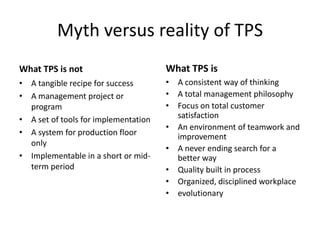
Myth versus reality of TPS
What TPS is not                       What TPS is
• A tangible recipe for success       • A consistent way of thinking
• A management project or             • A total management philosophy
  program                             • Focus on total customer
• A set of tools for implementation     satisfaction
                                      • An environment of teamwork and
• A system for production floor         improvement
  only
                                      • A never ending search for a
• Implementable in a short or mid-      better way
  term period                         • Quality built in process
                                      • Organized, disciplined workplace
                                      • evolutionary
Why Changing Culture is so Difficult?
• Tip of the iceberg- Kanban, 5S, Charts, Teams,
                        Andon, Slogans, Value Stream Maps


• Immersed iceberg- Culture Change
                        (Involve people in continuous
                         improvement to eliminate waste
                          through the Toyota Way)
13 Tips for Transitioning Your Company to a
            Lean Enterprise
1. Start with action in the technical system;
   follow quickly with cultural change
2. Learn by doing first and training second
3. Start with value stream pilots to demonstrate
   lean as a system and provide a “go see”
   model
4. Use value stream mapping to develop future
   state visions and help “learn to see”
5. Use kaizen workshops to teach and make
   rapid changes
6. Organize around value streams
7. Make it mandatory
8. A crisis may prompt a lean movement, but
   may not be necessary to turn a company
   around
9. Be opportunistic in identifying opportunities
   for big financial impacts
10.Realign metrics with a value stream
   perspective
11.Build on your company’s roots to develop
   your own way
12.Hire or develop lean leaders and develop a
   succession system
13.Use experts for teaching and getting quick
   results
Thank you…..!

The toyota way

  • 1.
    THE TOYOTA WAY 14 MANAGEMENT PRINCIPLES FROM THE WORLD’S GREATEST MANUFACTURER JEFFREY K. LIKER
  • 2.
    CHALLENGE EVERYTHING…. • “Allelements to be practiced everyday in a very consistent manner, not in spurts”
  • 3.
    PROBLEM SOLVING (Continuous Improvement and Learning) PEOPLE and PARTNERS (Respect, Challenge, and Grow Them) PROCESS (Eliminate Waste) PHILOSOPHY (Long- Term Thinking) The Business of Principles- The TOYATA WAY
  • 4.
    Organizational learning… • Philosophy • Process right • People and partners building • Problem solving “operational excellence” as strategic weapon…
  • 5.
    5 step ‘LeanManufacturing’ 1. Defining customer value 2. Defining value stream 3. Making it flow 4. Pulling from the customer back 5. Striving for excellence Cost, quality and service to be the BEST
  • 6.
    Founders’ thoughts • Kingof inventors of Japan- Sakichi Toyoda • Toyota way- genchi genbutsu (1926) • Toyota conglomerate- Keiretsu • Automation with a human touch and mistake proofing- Jidoka/ autonomation • Hard work, perseverance, discipline- James Watt • Management by Facts…
  • 7.
    Kiichiro Toyoda • “everyoneshould tackle some great project at least once in their life” • Education from Tokyo Imperial University • Learning by Doing • Pillars of the Toyota Production System- jidoka, just-in-time • Creativity, challenge, courage, commitment and patience
  • 8.
    Taichi Ohno • Onepiece flow • Pull system • Kanban • “Shortening lead time by eliminating waste in each step of a process leads to best quality and lowest cost, while improving safety and morale” • Spirit of challenge- the acceptance of responsibility to meet the challenge
  • 9.
    • “we acceptchallenges with a creative spirit and the courage to realize our own dreams without losing drive or energy. We approach our work vigorously, with optimism and a sincere belief in the value of our contribution” • “we strive to decide our own fate. We act with self reliance, trusting on our own abilities. We accept responsibility for our conduct and for maintaining and improving the skills that enable us to produce added value”
  • 10.
    • Kaizen- changefor the better • Kaikaiku- major revolutionary change • Walk the actual path- to construct the value stream • Takt- German word for ‘meter’ • Total Productive Maintenance- always a sense of urgency
  • 11.
    Framework • Quality • Cost • Delivery • Safety • Morale
  • 12.
    BEST QUALITY- LOWESTCOST- SHORTEST LEADTIME PEOPLE & TEAMWORK CONTINUOUS JIT IMPROVEMENT JIDOKA (JUST IN TIME) (IN STATION QUALITY) • GENCHI GENBUTSU • 5 WHY’S •EYES FOR WASTE •PROBLEM SOLVING LEVELED PRODUCTION (HEIJUNKA)-STABLE-STANDARDIZE PROCESS- VISUAL MANAGEMENT TOYOTA WAY PHILOSOPHY
  • 13.
    • Never besatisfied with inaction • Question and redefine your purpose to attain progress • 5S facilitates teamwork • Sensei- mentors • Total Budget Control System
  • 14.
    • Muri- novalue added beyond capability • Mura- unevenness “most businesses are 90% waste (muda) and 10% value added work”
  • 15.
    Benefits of onepiece flow • Builds in quality • Creates real flexibility • Creates higher productivity • Frees up floor space • Improves safety • Improves morale • Reduces cost of inventory
  • 16.
    TPS- Thinking ProductionSystem • Pull system • Flow where you can pull, where you must • Learning to see • Heijunka- level out the workload • Andon- light signaling system • Jidoka- autonomation • Standard work chart • Fit customer demand into leveled schedule and establish standard times for delivering different types of service
  • 17.
    4 tools 1. Go and see Genchi genbutsu (refered as ‘Management by Walking Around’ 2. Analyze situation first by Hewlett Packard) 3. Use one piece flow and Andon 4. Ask “why?” 5 times • Kentou- study drawing • Kentouzu- plural of drawing
  • 18.
    Standardized work • Takttime • Sequence of process • Inventory required
  • 19.
    Visual control (Managementby Sight) SOCIAL STRUCTURE TECHNICAL STRUCTURE COERCIVE ENABLING BUREACRACY AUTOCRATIC ORGANIC
  • 20.
    A3 reports • State problem • Document current situation • Determine the root cause • Suggest alternate solution • Suggest recommended solution • Cost-benefit analysis
  • 21.
    TPS- Respect forHumanity System • Recruiting is 96% employees, 92% employers, 84% yellow pages, 47% personal contact • Team development process (Blanchard) 1. Orientation 2. Dissatisfaction 3. Integration 4. Production
  • 22.
    • Jishuken- voluntarystudy groups • Hoshin kanri- policy deployment • Horensu- to report, give updates periodically (a form of micro management) • Thorough consideration in decision making
  • 23.
    • Nemawashi- decisionmaking to all options and rapid implementation • Integrity and excellence • Kozokeikaku- structure plan (K4) “a picture is worth a thousand words”
  • 24.
    “Meeting” • Clear objectivesprior to the meeting • The right people at the meeting • Prepared participants • Effective use of visual aids • Separate information sharing from problem solving • The meeting starts and ends on time
  • 25.
    • Hansei (relentlessreflection) + kaizen (continuous improvement)= learning organization • Pareto- the only statistical tool used in toyota technical center • Point of cause (POC) • Toyota Practical Problem Solving Process (20% tools, 80% thinking)
  • 26.
    3 types ofmeasures at TOYOTA • Global performance • Operational performance • Stretch improvement metrics “process orientation” Hoshin kanri (policy deployment process) for stretching the improvement goals
  • 27.
    Adapt-Develop-Sustain • Value StreamMapping- Material and Information Flow Diagram (Mike Rother and John Shook, 1999) • Project review events (Hansei) • Box- process, triangle- inventory • Task time- TT, Time in System- TIS, Value Ratio- VR • Core Value Stream
  • 28.
    A Toyota leader’sview of the Toyota Production System PEOPLE PHILOSOPHICAL
  • 29.
    TOYOTA LEADERSHIP MODEL Toyota Leaders (Development) Group Facilitator Builder of Learning Bottom-Up Organizations “You’re empowered!” “Here is our purpose and direction- I will guide and coach” Bureaucratic Managers Task Master (Directives) Top-Down “Follow the rules!” “Here is what to do and How- do it!” General Management In-Depth understanding of Expertise Work
  • 30.
    Supply chain needhierarchy Learning Next Level of Enterprise Improvement Enabling Systems Clear Expectations Stable, Reliable Processes Stability Fair and Honorable Business Relations
  • 31.
    Alternative Toyota Decisionmaking methods Preferred Group Consensus with Full Authority Group Consensus, Level of Involvement Management Fallback Approval (if consensus Seek group not achieved ) Input, then decide and announce Fallback (if consensus Seek Individual not achieved ) Input, then decide and announce Decide and Announce Time
  • 32.
    1. Initial ProblemPerception (Large, Vague, complicated problem 2. Clarify the Problem The “Real” Problem Grasp the Situation 3. Locate Cause/ Point of Cause --------------------------------- POC Basic Cause and Effect Investigation Cause Investigation Root Cause 4. 5- Whys? Investigation of --------------------------------- Root Cause 5. Countermeasure 6. Evaluate 7. Standardize Toyota’s practical problem-solving process
  • 33.
    Policy deployment process(hoshin kanri) Targets for Organization Time Quality Cost Innovation High-Level Plan Executive Staff Improvement? Who? Method? Target? Plan- Do Time? Manager/ Supervisor Work Plan by item Action Check Measurement Countermeasure Improvement? Work Team Method? Result? Countermeasure? Target & Time? All 3 Levels
  • 34.
    Creating flow andPDCA Create Flow (Act) Evaluate Results Eliminate Surface Problems (Check) Waste (Plan) Counter Measures (Do)
  • 35.
    Kaizen workshops • PhaseI • Phase II • Phase III
  • 36.
    Phase I- Preparationfor the workshop 1. Clearly define the scope 2. Set objectives 3. Create preliminary current state map 4. Collect all relevant documents 5. Post a preliminary current state map in the team room
  • 37.
    Phase II- TheKaizen Workshop 1. Who is the customer? 2. Analyze the current state - Valued added - Non-Value added. What is pure waste? - Non-Value added, but Required (incidental work) 3. Develop future state vision 4. Implementation 5. Evaluate: measuring performance
  • 38.
    Phase III- Afterthe workshop- Sustaining and Continuous Improvement • Review the status of action items • Review process metrics • Discuss additional opportunities for improvements • Continue to improve the process
  • 39.
    Factors influencing TopLeaders in Lean vision 1. Ownership structure 2. Promote from within 3. Environmental pressures 4. Experience with lean
  • 40.
    Myth versus realityof TPS What TPS is not What TPS is • A tangible recipe for success • A consistent way of thinking • A management project or • A total management philosophy program • Focus on total customer • A set of tools for implementation satisfaction • An environment of teamwork and • A system for production floor improvement only • A never ending search for a • Implementable in a short or mid- better way term period • Quality built in process • Organized, disciplined workplace • evolutionary
  • 41.
    Why Changing Cultureis so Difficult? • Tip of the iceberg- Kanban, 5S, Charts, Teams, Andon, Slogans, Value Stream Maps • Immersed iceberg- Culture Change (Involve people in continuous improvement to eliminate waste through the Toyota Way)
  • 42.
    13 Tips forTransitioning Your Company to a Lean Enterprise 1. Start with action in the technical system; follow quickly with cultural change 2. Learn by doing first and training second 3. Start with value stream pilots to demonstrate lean as a system and provide a “go see” model 4. Use value stream mapping to develop future state visions and help “learn to see”
  • 43.
    5. Use kaizenworkshops to teach and make rapid changes 6. Organize around value streams 7. Make it mandatory 8. A crisis may prompt a lean movement, but may not be necessary to turn a company around 9. Be opportunistic in identifying opportunities for big financial impacts
  • 44.
    10.Realign metrics witha value stream perspective 11.Build on your company’s roots to develop your own way 12.Hire or develop lean leaders and develop a succession system 13.Use experts for teaching and getting quick results
  • 45.