OER and associated practices
– opportunities and challenges
Gráinne Conole,
The Open University, UK
g.c.conole@open.ac.uk
OER Panel, EDEN Research Workshop
Budapest, 26th October 2010
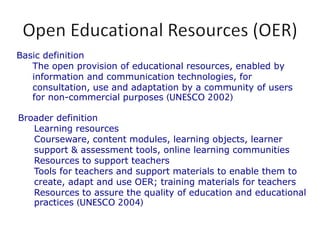
Basic definition
The open provision of educational resources, enabled by
information and communication technologies, for
consultation, use and adaptation by a community of users
for non-commercial purposes (UNESCO 2002)
Broader definition
Learning resources
Courseware, content modules, learning objects, learner
support & assessment tools, online learning communities
Resources to support teachers
Tools for teachers and support materials to enable them to
create, adapt and use OER; training materials for teachers
Resources to assure the quality of education and educational
practices (UNESCO 2004)
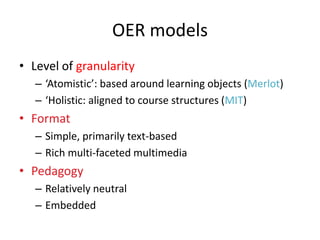
• Level of granularity
– ‘Atomistic’: based around learning objects (Merlot)
– ‘Holistic: aligned to course structures (MIT)
• Format
– Simple, primarily text-based
– Rich multi-faceted multimedia
• Pedagogy
– Relatively neutral
– Embedded
OER models
OER - a vision of transformation
Beyond content – focus on activity and use
Learners as self-directed and autonomous
More of a focus on sharing, refinement,
iteration, critical reflection
OER as a potential catalyst to transforming
educational practice
Improvements in social inclusion, quality and
innovation
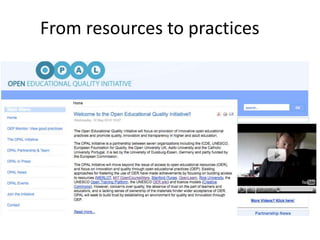
From resources to practices
The OPAL vision
6
Open Educational Resource Practice
OEP constitute the range of practices around the
creation, use and management of OER with the intent
to improve quality and innovate education.
Focus on the practice around OER rather than the
resources
Better understanding will lead to improvements in the
quality of OER and more innovation
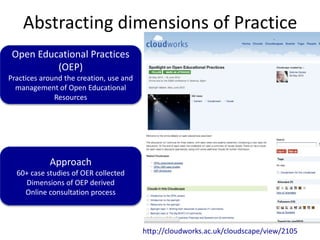
Abstracting dimensions of Practice
Open Educational Practices
(OEP)
Practices around the creation, use and
management of Open Educational
Resources
Approach
60+ case studies of OER collected
Dimensions of OEP derived
Online consultation process
http://cloudworks.ac.uk/cloudscape/view/2105
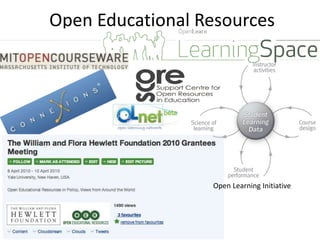
Open Educational Resources
Open Learning Initiative
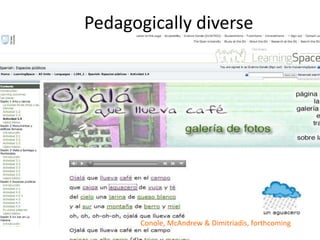
Pedagogically diverse
Conole, McAndrew & Dimitriadis, forthcoming
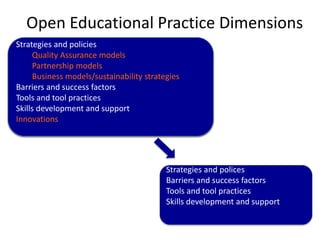
Open Educational Practice Dimensions
Strategies and policies
Quality Assurance models
Partnership models
Business models/sustainability strategies
Barriers and success factors
Tools and tool practices
Skills development and support
Innovations
Strategies and polices
Barriers and success factors
Tools and tool practices
Skills development and support
Strategies and policies
Quality Assurance models
Partnership models
Business models/sustainability strategies
Barriers and success factors
Tools and tool practices
Skills development and support
Innovations
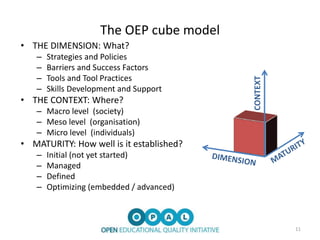
The OEP cube model
• THE DIMENSION: What?
– Strategies and Policies
– Barriers and Success Factors
– Tools and Tool Practices
– Skills Development and Support
• THE CONTEXT: Where?
– Macro level (society)
– Meso level (organisation)
– Micro level (individuals)
• MATURITY: How well is it established?
– Initial (not yet started)
– Managed
– Defined
– Optimizing (embedded / advanced)
CONTEXT
11
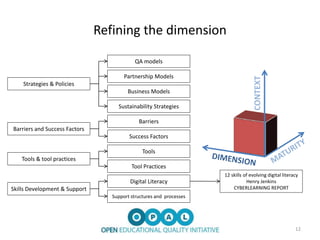
Refining the dimension
12
Strategies & Policies
Barriers and Success Factors
Tools & tool practices
Skills Development & Support
QA models
Partnership Models
Business Models
Sustainability Strategies
Barriers
Success Factors
Tools
Tool Practices
Digital Literacy
Support structures and processes
12 skills of evolving digital literacy
Henry Jenkins
CYBERLEARNING REPORT
CONTEXT
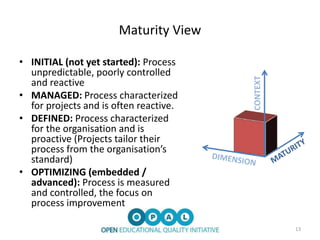
Maturity View
• INITIAL (not yet started): Process
unpredictable, poorly controlled
and reactive
• MANAGED: Process characterized
for projects and is often reactive.
• DEFINED: Process characterized
for the organisation and is
proactive (Projects tailor their
process from the organisation’s
standard)
• OPTIMIZING (embedded /
advanced): Process is measured
and controlled, the focus on
process improvement
13
CONTEXT
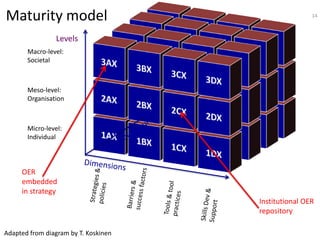
Maturity model 14
Macro-level:
Societal
Meso-level:
Organisation
Micro-level:
Individual
Levels
OER
embedded
in strategy
Institutional OER
repository
Adapted from diagram by T. Koskinen
Uses and benefits
• Three uses
– Benchmarking
– Guidance
– Reflection and comparison
• Benefits
– Guides users in understanding how to think about
the key issues.
– Flexible enough to cover the multiple stakeholders
– Sub-cubes provide practical illustrative examples
– Useful as a mechanism for institutions to self-
benchmark
15
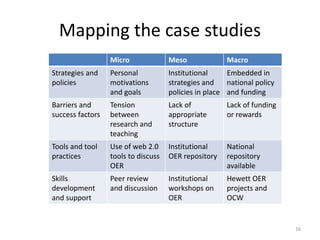
Mapping the case studies
16
Micro Meso Macro
Strategies and
policies
Personal
motivations
and goals
Institutional
strategies and
policies in place
Embedded in
national policy
and funding
Barriers and
success factors
Tension
between
research and
teaching
Lack of
appropriate
structure
Lack of funding
or rewards
Tools and tool
practices
Use of web 2.0
tools to discuss
OER
Institutional
OER repository
National
repository
available
Skills
development
and support
Peer review
and discussion
Institutional
workshops on
OER
Hewett OER
projects and
OCW
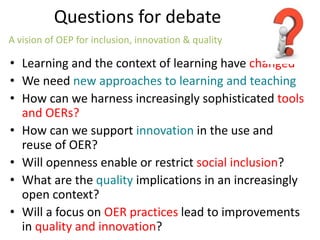
Questions for debate
• Learning and the context of learning have changed
• We need new approaches to learning and teaching
• How can we harness increasingly sophisticated tools
and OERs?
• How can we support innovation in the use and
reuse of OER?
• Will openness enable or restrict social inclusion?
• What are the quality implications in an increasingly
open context?
• Will a focus on OER practices lead to improvements
in quality and innovation?
A vision of OEP for inclusion, innovation & quality

Oer panel

  • 1.
    OER and associatedpractices – opportunities and challenges Gráinne Conole, The Open University, UK g.c.conole@open.ac.uk OER Panel, EDEN Research Workshop Budapest, 26th October 2010
  • 2.
    Basic definition The openprovision of educational resources, enabled by information and communication technologies, for consultation, use and adaptation by a community of users for non-commercial purposes (UNESCO 2002) Broader definition Learning resources Courseware, content modules, learning objects, learner support & assessment tools, online learning communities Resources to support teachers Tools for teachers and support materials to enable them to create, adapt and use OER; training materials for teachers Resources to assure the quality of education and educational practices (UNESCO 2004)
  • 3.
    • Level ofgranularity – ‘Atomistic’: based around learning objects (Merlot) – ‘Holistic: aligned to course structures (MIT) • Format – Simple, primarily text-based – Rich multi-faceted multimedia • Pedagogy – Relatively neutral – Embedded OER models
  • 4.
    OER - avision of transformation Beyond content – focus on activity and use Learners as self-directed and autonomous More of a focus on sharing, refinement, iteration, critical reflection OER as a potential catalyst to transforming educational practice Improvements in social inclusion, quality and innovation
  • 5.
  • 6.
    The OPAL vision 6 OpenEducational Resource Practice OEP constitute the range of practices around the creation, use and management of OER with the intent to improve quality and innovate education. Focus on the practice around OER rather than the resources Better understanding will lead to improvements in the quality of OER and more innovation
  • 7.
    Abstracting dimensions ofPractice Open Educational Practices (OEP) Practices around the creation, use and management of Open Educational Resources Approach 60+ case studies of OER collected Dimensions of OEP derived Online consultation process http://cloudworks.ac.uk/cloudscape/view/2105
  • 8.
  • 9.
    Pedagogically diverse Conole, McAndrew& Dimitriadis, forthcoming
  • 10.
    Open Educational PracticeDimensions Strategies and policies Quality Assurance models Partnership models Business models/sustainability strategies Barriers and success factors Tools and tool practices Skills development and support Innovations Strategies and polices Barriers and success factors Tools and tool practices Skills development and support Strategies and policies Quality Assurance models Partnership models Business models/sustainability strategies Barriers and success factors Tools and tool practices Skills development and support Innovations
  • 11.
    The OEP cubemodel • THE DIMENSION: What? – Strategies and Policies – Barriers and Success Factors – Tools and Tool Practices – Skills Development and Support • THE CONTEXT: Where? – Macro level (society) – Meso level (organisation) – Micro level (individuals) • MATURITY: How well is it established? – Initial (not yet started) – Managed – Defined – Optimizing (embedded / advanced) CONTEXT 11
  • 12.
    Refining the dimension 12 Strategies& Policies Barriers and Success Factors Tools & tool practices Skills Development & Support QA models Partnership Models Business Models Sustainability Strategies Barriers Success Factors Tools Tool Practices Digital Literacy Support structures and processes 12 skills of evolving digital literacy Henry Jenkins CYBERLEARNING REPORT CONTEXT
  • 13.
    Maturity View • INITIAL(not yet started): Process unpredictable, poorly controlled and reactive • MANAGED: Process characterized for projects and is often reactive. • DEFINED: Process characterized for the organisation and is proactive (Projects tailor their process from the organisation’s standard) • OPTIMIZING (embedded / advanced): Process is measured and controlled, the focus on process improvement 13 CONTEXT
  • 14.
    Maturity model 14 Macro-level: Societal Meso-level: Organisation Micro-level: Individual Levels OER embedded instrategy Institutional OER repository Adapted from diagram by T. Koskinen
  • 15.
    Uses and benefits •Three uses – Benchmarking – Guidance – Reflection and comparison • Benefits – Guides users in understanding how to think about the key issues. – Flexible enough to cover the multiple stakeholders – Sub-cubes provide practical illustrative examples – Useful as a mechanism for institutions to self- benchmark 15
  • 16.
    Mapping the casestudies 16 Micro Meso Macro Strategies and policies Personal motivations and goals Institutional strategies and policies in place Embedded in national policy and funding Barriers and success factors Tension between research and teaching Lack of appropriate structure Lack of funding or rewards Tools and tool practices Use of web 2.0 tools to discuss OER Institutional OER repository National repository available Skills development and support Peer review and discussion Institutional workshops on OER Hewett OER projects and OCW
  • 17.
    Questions for debate •Learning and the context of learning have changed • We need new approaches to learning and teaching • How can we harness increasingly sophisticated tools and OERs? • How can we support innovation in the use and reuse of OER? • Will openness enable or restrict social inclusion? • What are the quality implications in an increasingly open context? • Will a focus on OER practices lead to improvements in quality and innovation? A vision of OEP for inclusion, innovation & quality