Research-teaching relationshipsand HE professional practiceProfessor Simon HaslettDean, School of STEMPresented at the Higher Education Academy Wales Research-Teaching Nexus Action Set MeetingAberystwyth University, 10th February 2011
ContentsContext and ResourcesScholarship of Learning and TeachingPedagogic ResearchResearch-informed TeachingResearch-Teaching NexusUndergraduate ResearchCase study: the Newport CELTExamples from my own practice
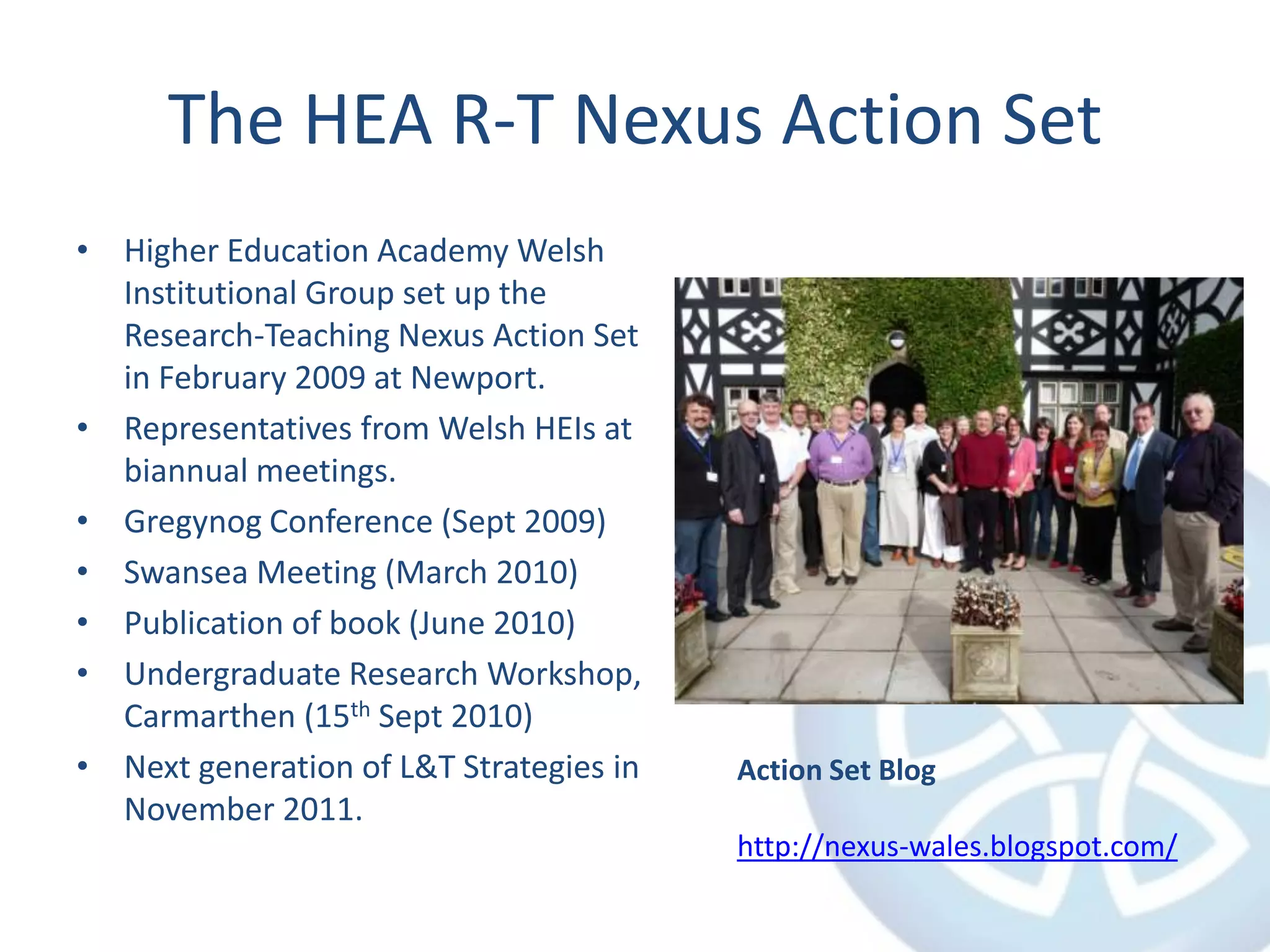
The HEA R-T Nexus Action SetHigher Education Academy Welsh Institutional Group set up the Research-Teaching Nexus Action Set in February 2009 at Newport.Representatives from Welsh HEIs at biannual meetings.Gregynog Conference (Sept 2009)Swansea Meeting (March 2010)Publication of book (June 2010)Undergraduate Research Workshop, Carmarthen (15th Sept 2010)Next generation of L&T Strategies in November 2011.Action Set Bloghttp://nexus-wales.blogspot.com/
2004www.heacademy.ac.uk/resources/detail/a_guide_to_the_research_evidence
2005www.heacademy.ac.uk/assets/York/documents/ourwork/research/Institutional_strategies.pdf
2007www.heacademy.ac.uk/assets/York/documents/LinkingTeachingAndResearch_April07.pdf
2009www.heacademy.ac.uk/assets/York/documents/resources/publications/DevelopingUndergraduate_Final.pdf
2010http://www.heacademy.ac.uk/assets/York/documents/ourwork/nations/wales/WalesRandTNexusENGLISH_Jun10.pdf
‘Future shape of the HE sector in Wales’ Each "region [in Wales] should have research intensive (in which we will increasingly focus our QR funding in support of sustainable excellence and relevance to Welsh Assembly Government objectives) and strong community/widening access focused provision“ (HEFCW, Dec 2010).This implies that each region should comprise one research intensive and one access (teaching?) focused institution.
Scholarship of Teaching and Learningindividually-focused scholarship for personal use;internally-focused scholarship for local (e.g. departmental, institutional) use;externally-focused scholarship, such as defined by the Research Assessment Exercise (RAE, 2005, p. 34) as “the creation, development and maintenance of the intellectual infrastructure of subjects and disciplines”; andresearch for external dissemination at conferences and in publications (i.e. pedagogic research).Where does your SoTL sit?(from Haslett, 2009, based on Ashwin and Trigwell, 2004; RAE, 2005)
Scholarship of Teaching & Learning and Pedagogic ResearchWhy do/would you do it?Strategic e.g. research-informed teachingContractual e.g. teaching-led researchPersonal professional updating/reflection and careerDisseminate examples of practiceWhat do/would you research?Generic issues e.g. student engagementCase studies e.g. examples of teachingHow do/would you do it?Individually or collaboratively?Funding for research and publication e.g. grants?Output types e.g. books, articles, conferences?Time and space to undertake research and writing?
Learning and TeachingScholarship and ResearchEncourage staff to become active members of L&T communities of practice.Participate in internal L&T schemes.Apply for Fellowship of the Higher Education Academy (HEA) (map against Professional Standards)Membership of the Society for Research into Higher Education (SRHE): Annual Conference at Newport 2009, 2010, and again in 2011?Membership of the International Society for the Scholarship of Teaching and Learning (ISSoTL):Annual Conference was in Liverpool (October 2010)
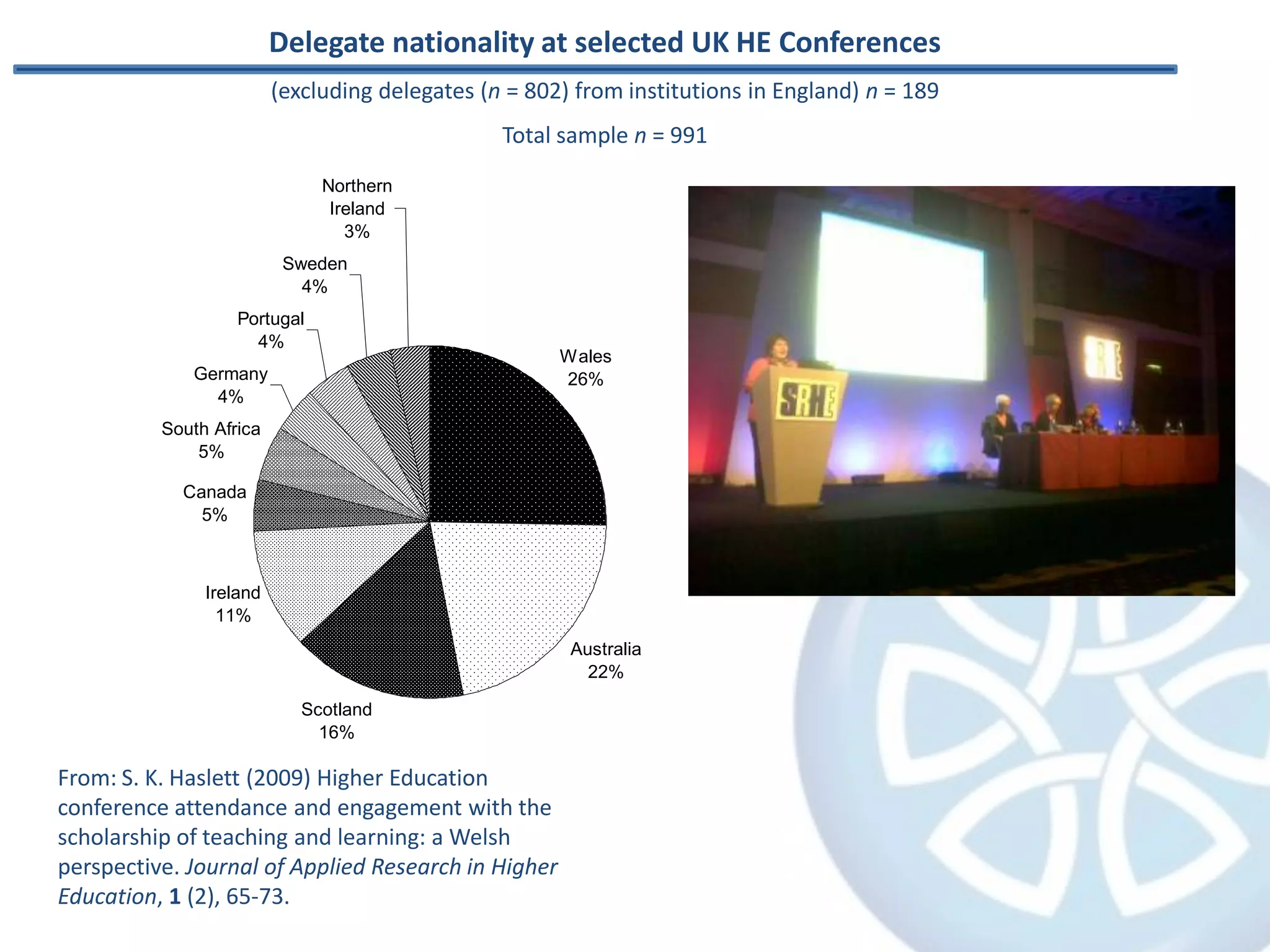
Delegate nationality at selected UK HE Conferences(excluding delegates (n = 802) from institutions in England) n = 189Total sample n = 991From: S. K. Haslett (2009) Higher Education conference attendance and engagement with the scholarship of teaching and learning: a Welsh perspective. Journal of Applied Research in Higher Education, 1 (2), 65-73.
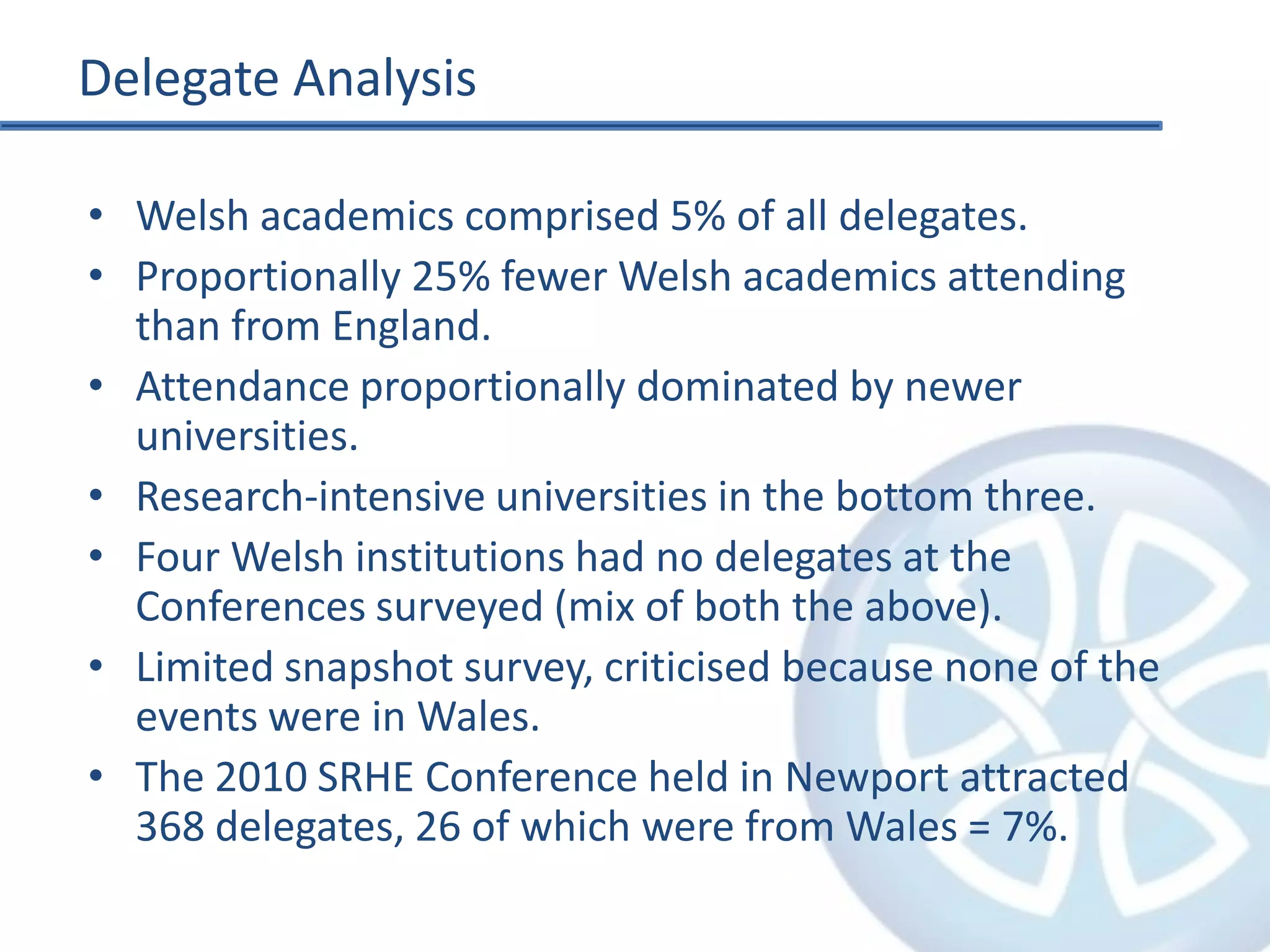
Delegate AnalysisWelsh academics comprised 5% of all delegates.Proportionally 25% fewer Welsh academics attending than from England.Attendance proportionally dominated by newer universities.Research-intensive universities in the bottom three.Four Welsh institutions had no delegates at the Conferences surveyed (mix of both the above).Limited snapshot survey, criticised because none of the events were in Wales.The 2010 SRHE Conference held in Newport attracted 368 delegates, 26 of which were from Wales = 7%.
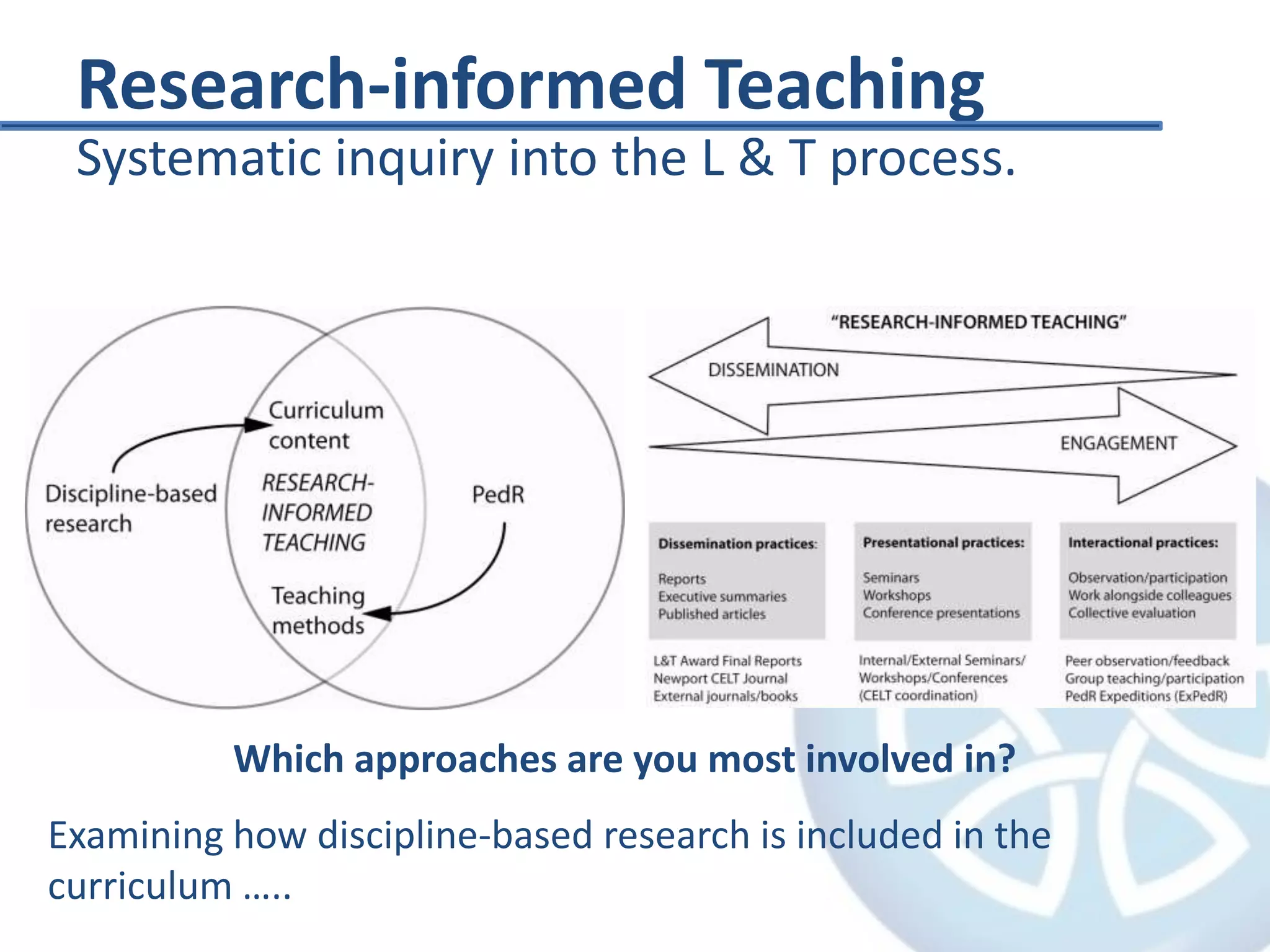
Research-informed TeachingSystematic inquiry into the L & T process.Which approaches are you most involved in?Examining how discipline-based research is included in the curriculum …..
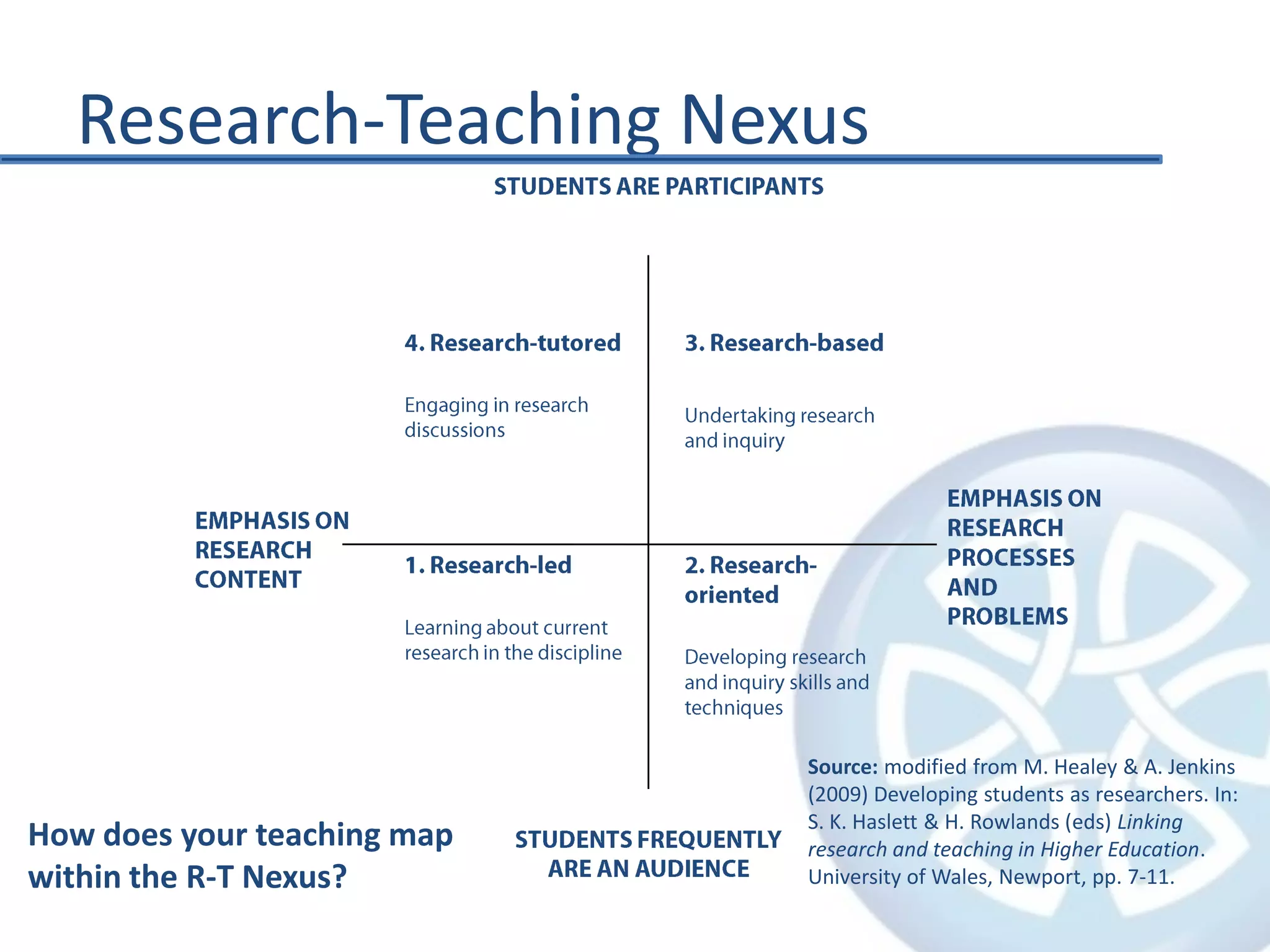
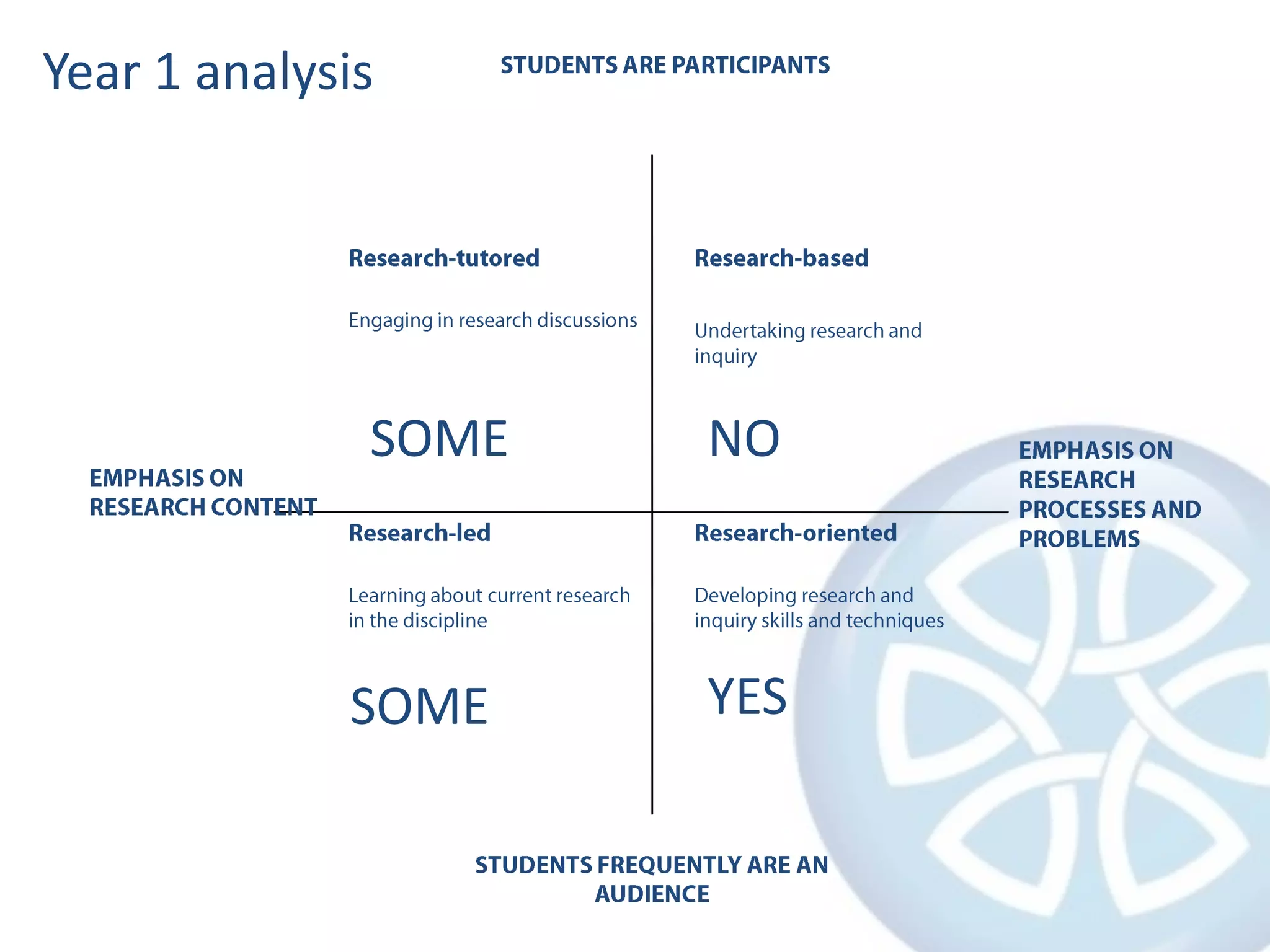
Research-Teaching NexusSTUDENTS ARE PARTICIPANTS4. Research-tutoredEngaging in research discussions3. Research-basedUndertaking research and inquiryEMPHASIS ON RESEARCHPROCESSES AND PROBLEMSEMPHASIS ON RESEARCH CONTENT1. Research-ledLearning about current research in the discipline2. Research-orientedDeveloping research and inquiry skills and techniquesSTUDENTS FREQUENTLY ARE AN AUDIENCESource:modified from M. Healey & A. Jenkins (2009) Developing students as researchers. In: S. K. Haslett & H. Rowlands (eds) Linking research and teaching in Higher Education. University of Wales, Newport, pp. 7-11. How does your teaching map within the R-T Nexus?
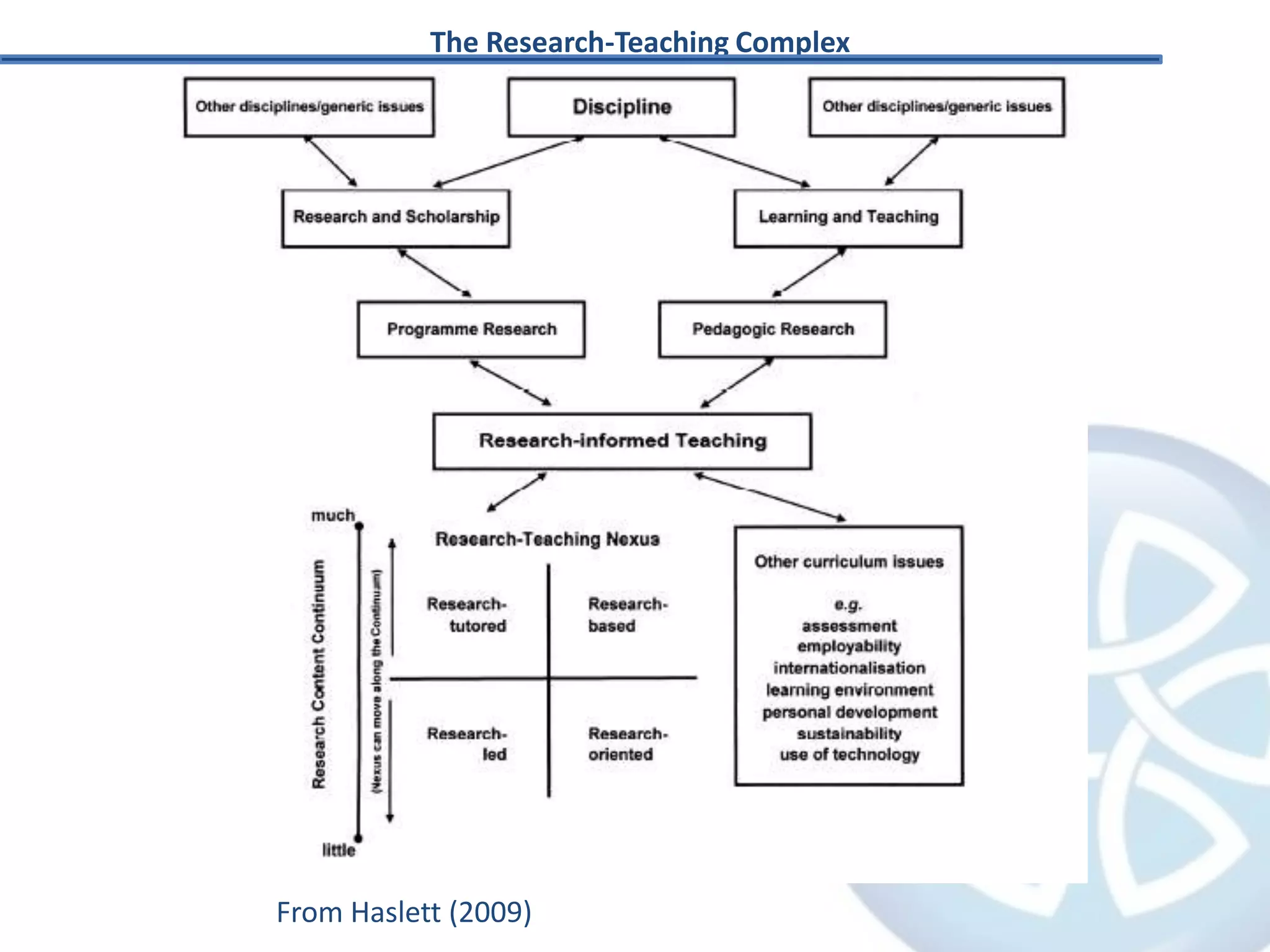
The Research-Teaching ComplexFrom Haslett (2009)
Undergraduate ResearchUniversity of Central Lancashire, 19th-20th April 2011
Case study - the Newport CELTLearning and Teaching Strategy 2007-2010“To establish a University-wide research cluster to lead development in pedagogy”. “It is recognised that the institution needs such initiatives to be driven from a Centre and to this end a University-wide Research Centre for Excellence in Learning and Teaching (CELT) will be established”.
Emphasis on Dissemination“the record of dissemination of good [L&T] practice outside the institution has been relatively low compared to the level of activity”“The University is therefore placing a greater emphasis on encouraging its staff to not only develop, but to disseminate the many examples of good practice in learning and teaching both within and outside the University”
The CELT as a Research Centre with its main function to assist staff in:Devising pedagogic research projects;Presenting papers at conferences; andWriting and disseminating published outcomes.
UmbrellaCELT drew together existing PedR activity across the institution.BeaconCELT as a beacon of SoLT and PedR, and teaching excellence in the HE landscape.Early Stats (Dec 08 – June 09)Total CELT contacts: 733Conference delegates: 180 (up 50%)Conference papers: 62Proceedings papers: 20CELT Journal papers: 14CELT Launch & Workshops: 198
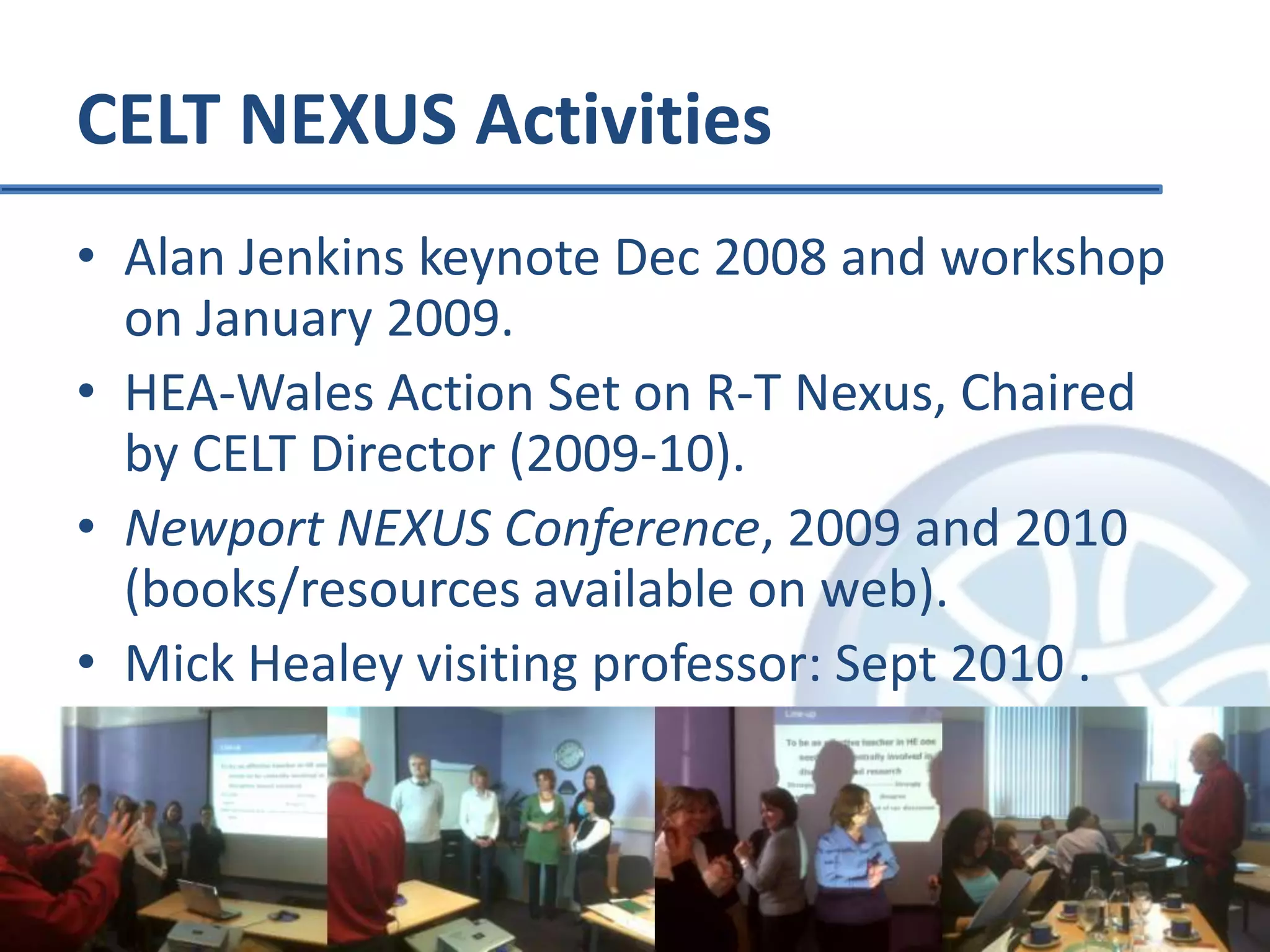
CELT NEXUS ActivitiesAlan Jenkins keynote Dec 2008 and workshop on January 2009.HEA-Wales Action Set on R-T Nexus, Chaired by CELT Director (2009-10).Newport NEXUS Conference, 2009 and 2010 (books/resources available on web).Mick Healey visiting professor: Sept 2010 .
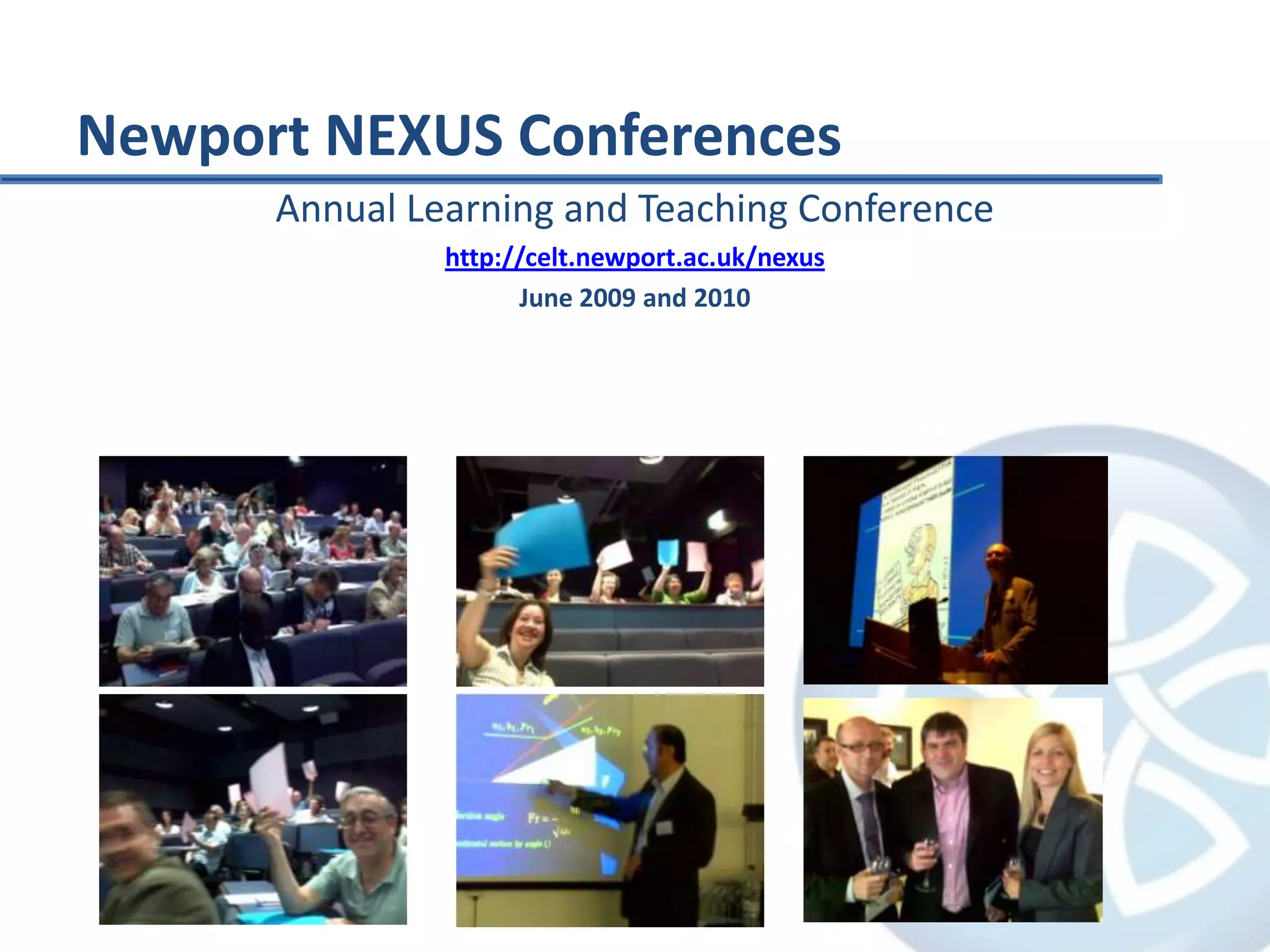
Newport NEXUS ConferencesAnnual Learning and Teaching Conferencehttp://celt.newport.ac.uk/nexusJune 2009 and 2010
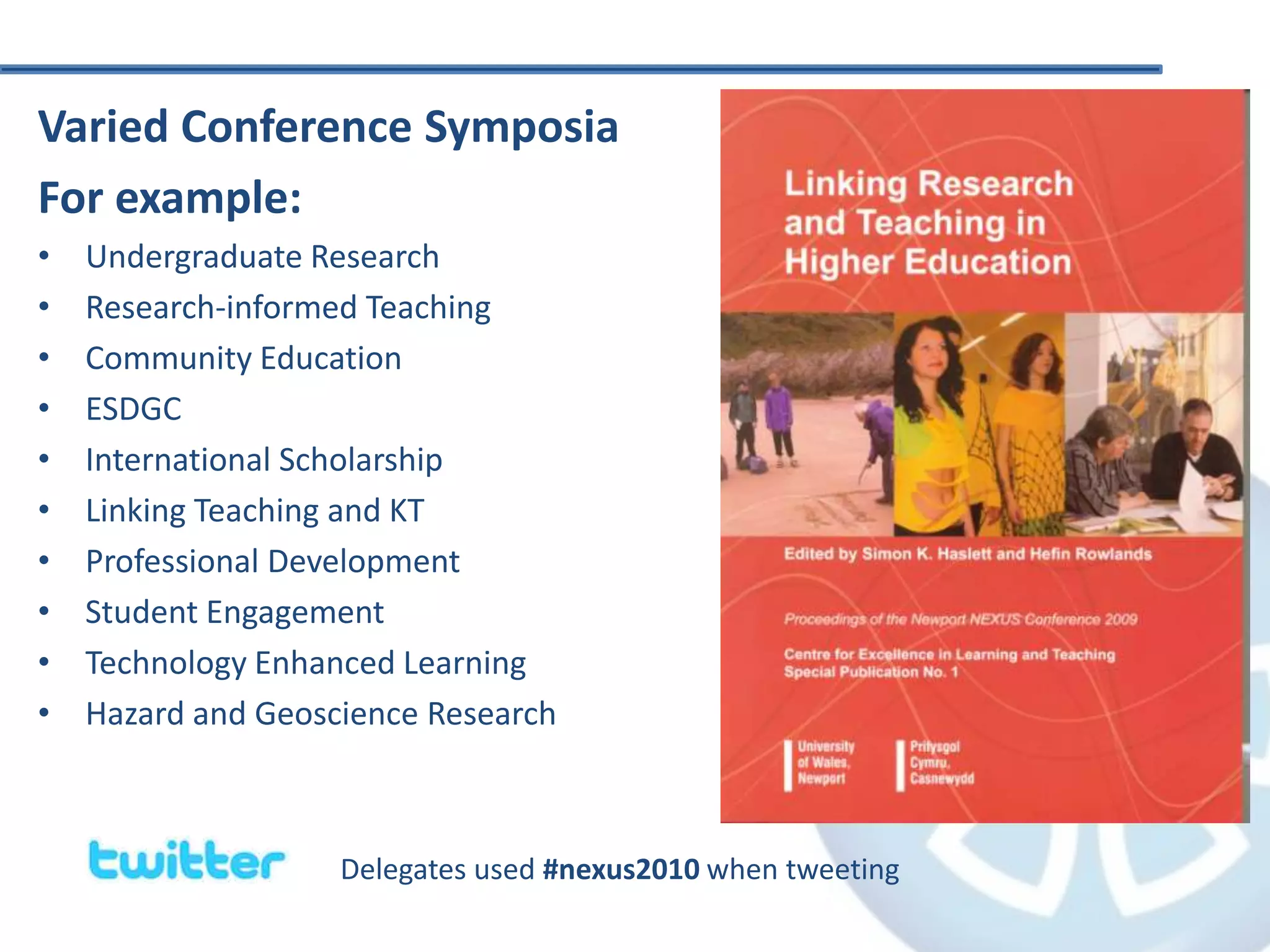
Varied Conference SymposiaFor example:Undergraduate ResearchResearch-informed TeachingCommunity EducationESDGCInternational ScholarshipLinking Teaching and KTProfessional DevelopmentStudent EngagementTechnology Enhanced LearningHazard and Geoscience ResearchDelegates used #nexus2010 when tweeting
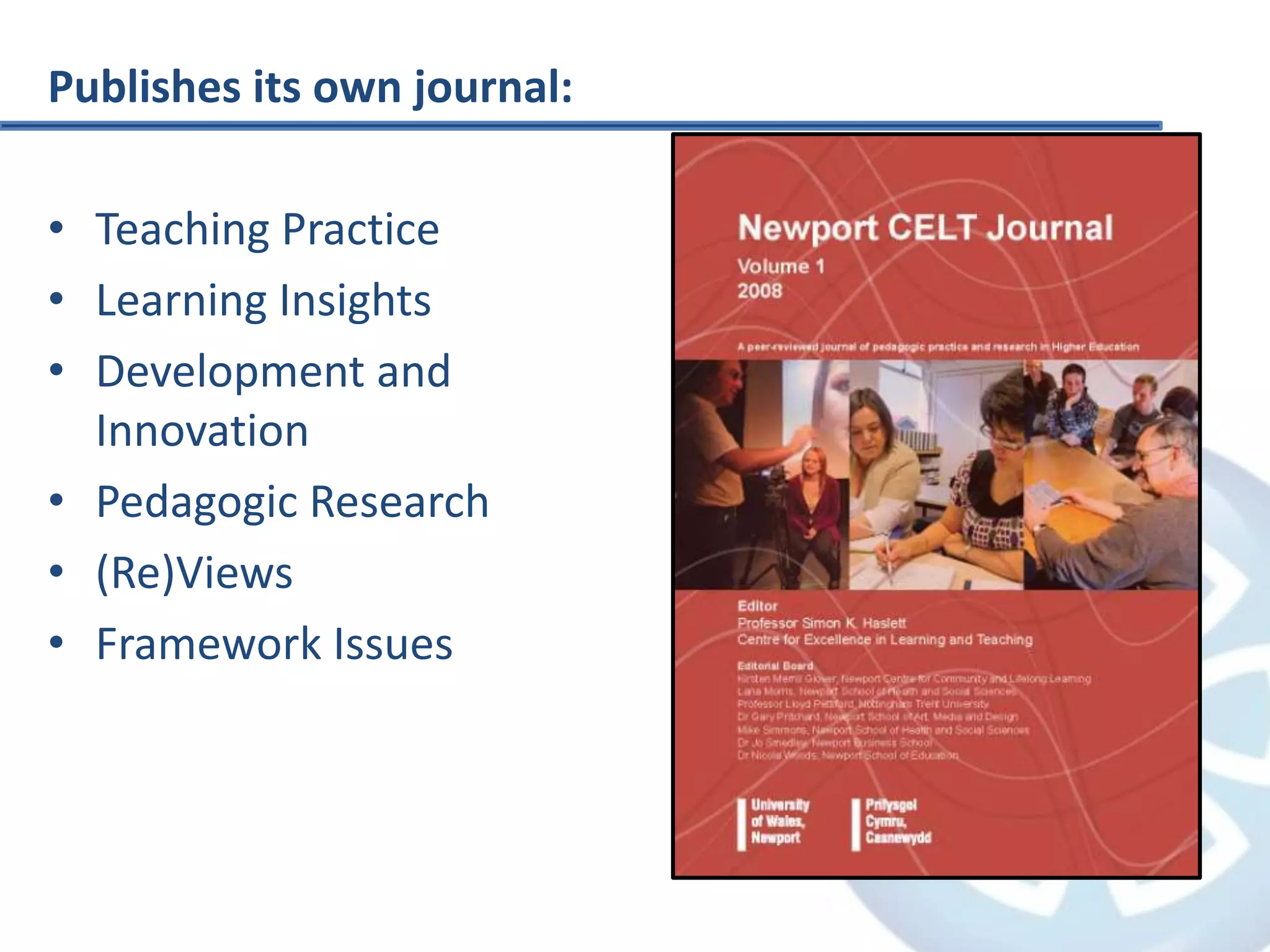
Publishes its own journal:Teaching PracticeLearning InsightsDevelopment and InnovationPedagogic Research(Re)ViewsFramework Issues
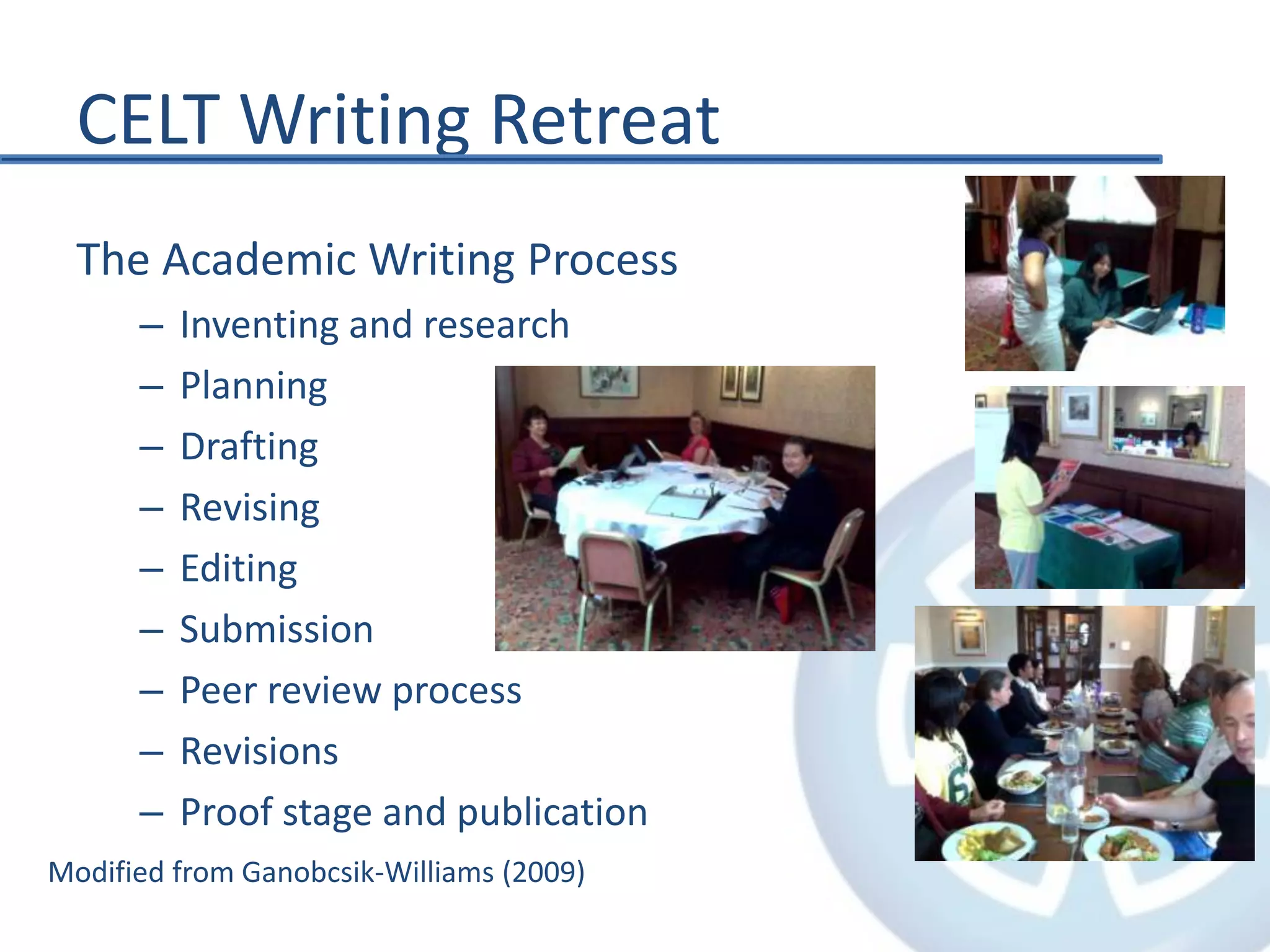
CELT Writing RetreatThe Academic Writing ProcessInventing and researchPlanningDraftingRevisingEditingSubmissionPeer review processRevisionsProof stage and publicationModified from Ganobcsik-Williams (2009)
CoordinatorsPhD StudentsCELT Research ProgrammesTechnology Enhanced Learning (TEL);Education for Sustainable Development and Global Citizenship (ESDGC);Flexible Learning in Employer and Community Scenarios (FLECS).
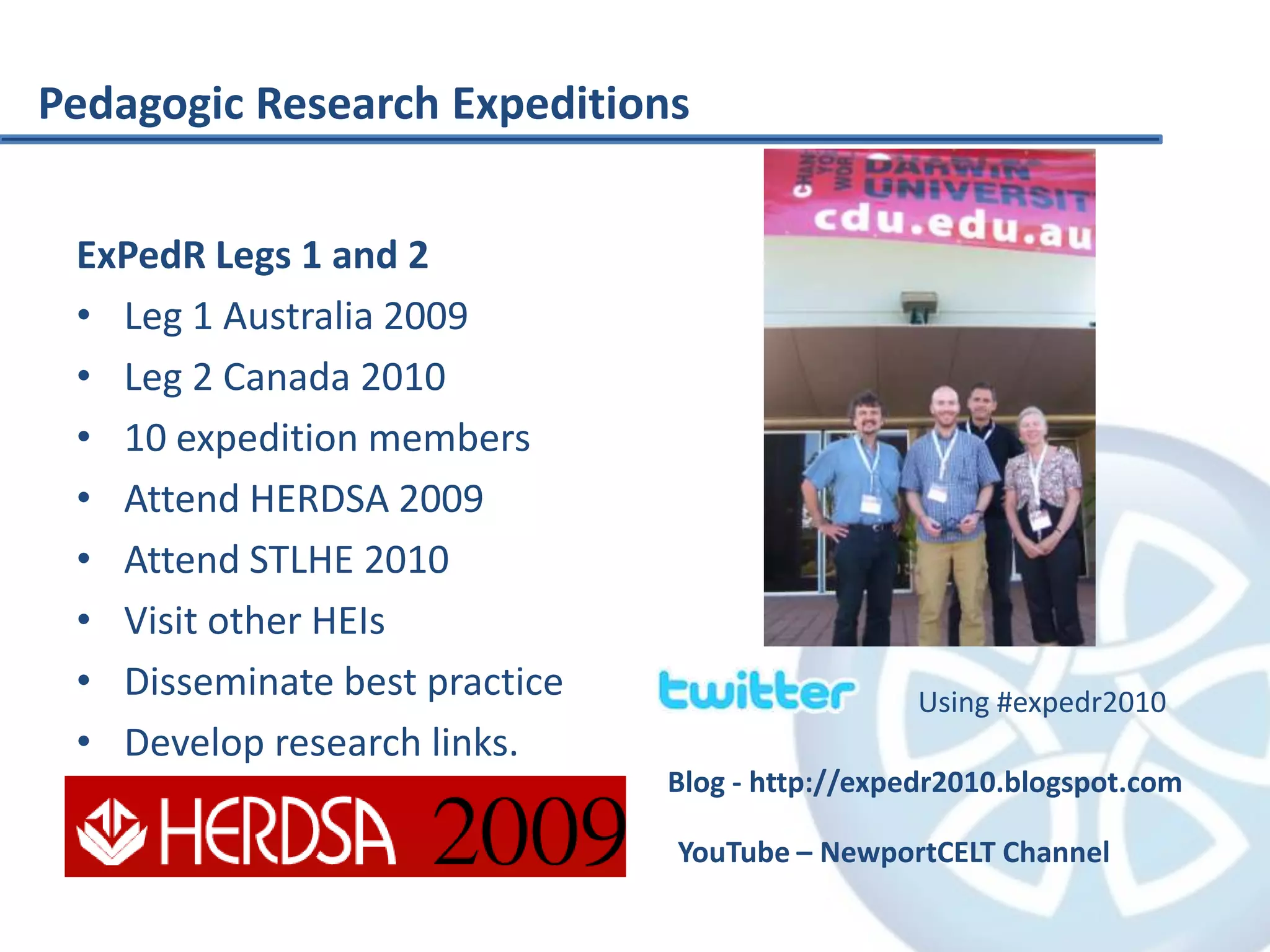
Pedagogic Research ExpeditionsExPedR Legs 1 and 2Leg 1 Australia 2009Leg 2 Canada 201010 expedition membersAttend HERDSA 2009Attend STLHE 2010Visit other HEIsDisseminate best practiceDevelop research links.Using #expedr2010Blog - http://expedr2010.blogspot.comYouTube – NewportCELT Channel
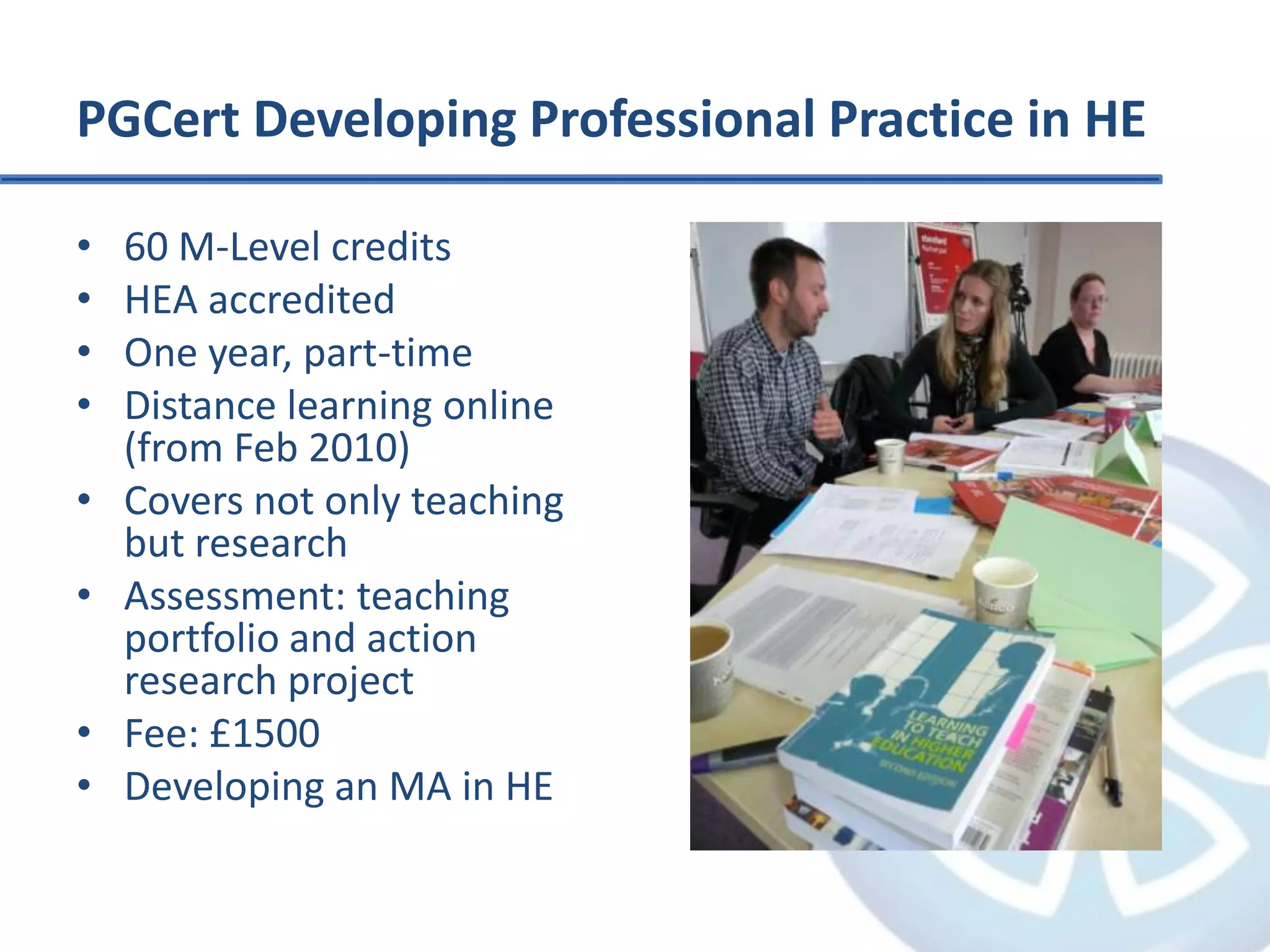
PGCert Developing Professional Practice in HE60 M-Level creditsHEA accreditedOne year, part-timeDistance learning online (from Feb 2010)Covers not only teaching but researchAssessment: teaching portfolio and action research projectFee: £1500Developing an MA in HE
University of Wales ActivityUniversity of Wales Alliance Thematic Group on Learning and Teaching, and Research
Develop a shared calendar of staff development events
Themed conference on ‘Research-informed Teaching’
Identify themes for workshops
Provide discipline-specific L&T support
Use UW Global Campus website to archive and disseminate materials
UW Teaching Fellows: Problem-based Learning
A UW Academy of L&T Award Winners
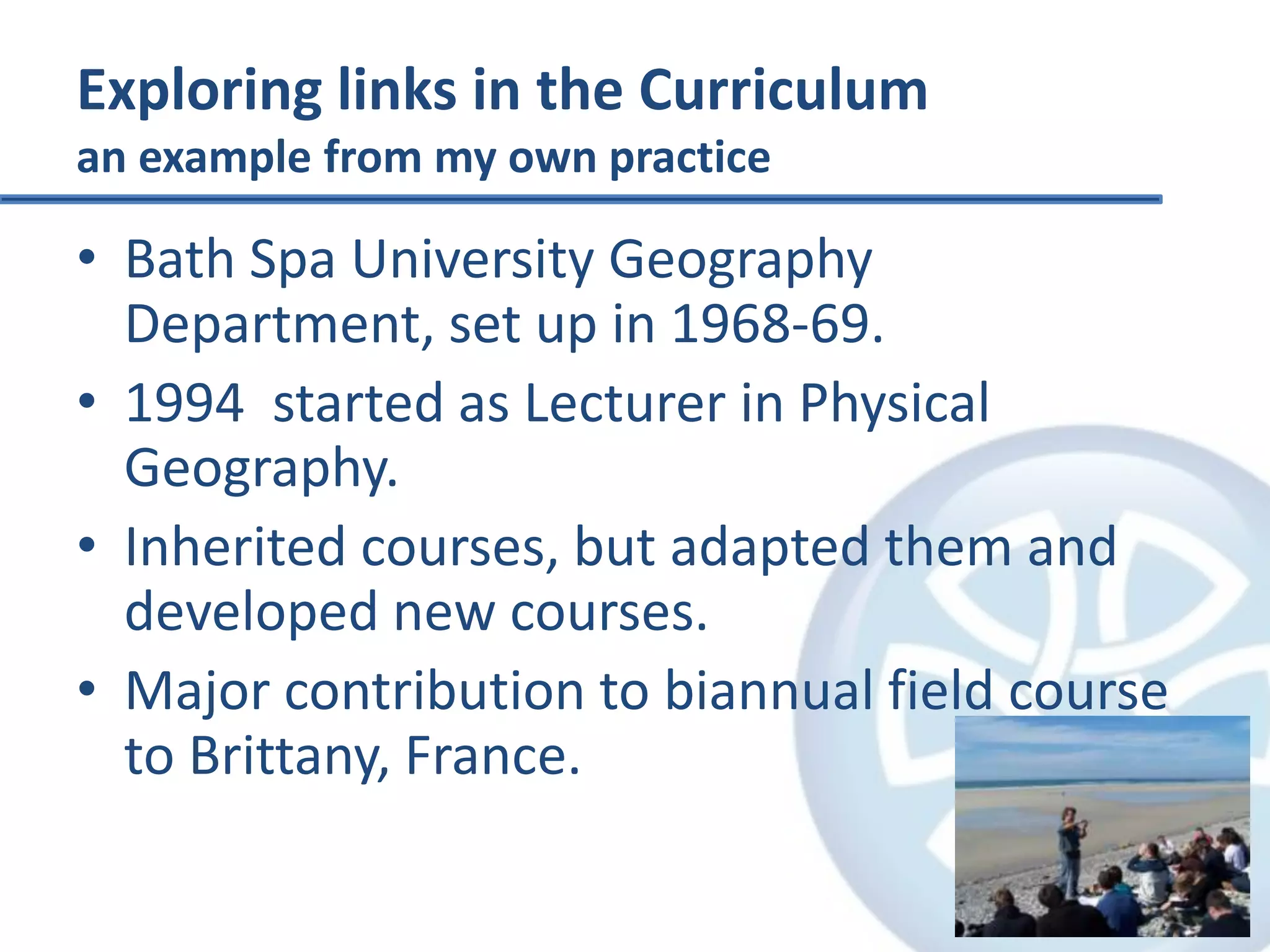
New Learning and Teaching CommitteeExploring links in the Curriculuman example from my own practiceBath Spa University Geography Department, set up in 1968-69.1994  started as Lecturer in Physical Geography.Inherited courses, but adapted them and developed new courses.Major contribution to biannual field course to Brittany, France.
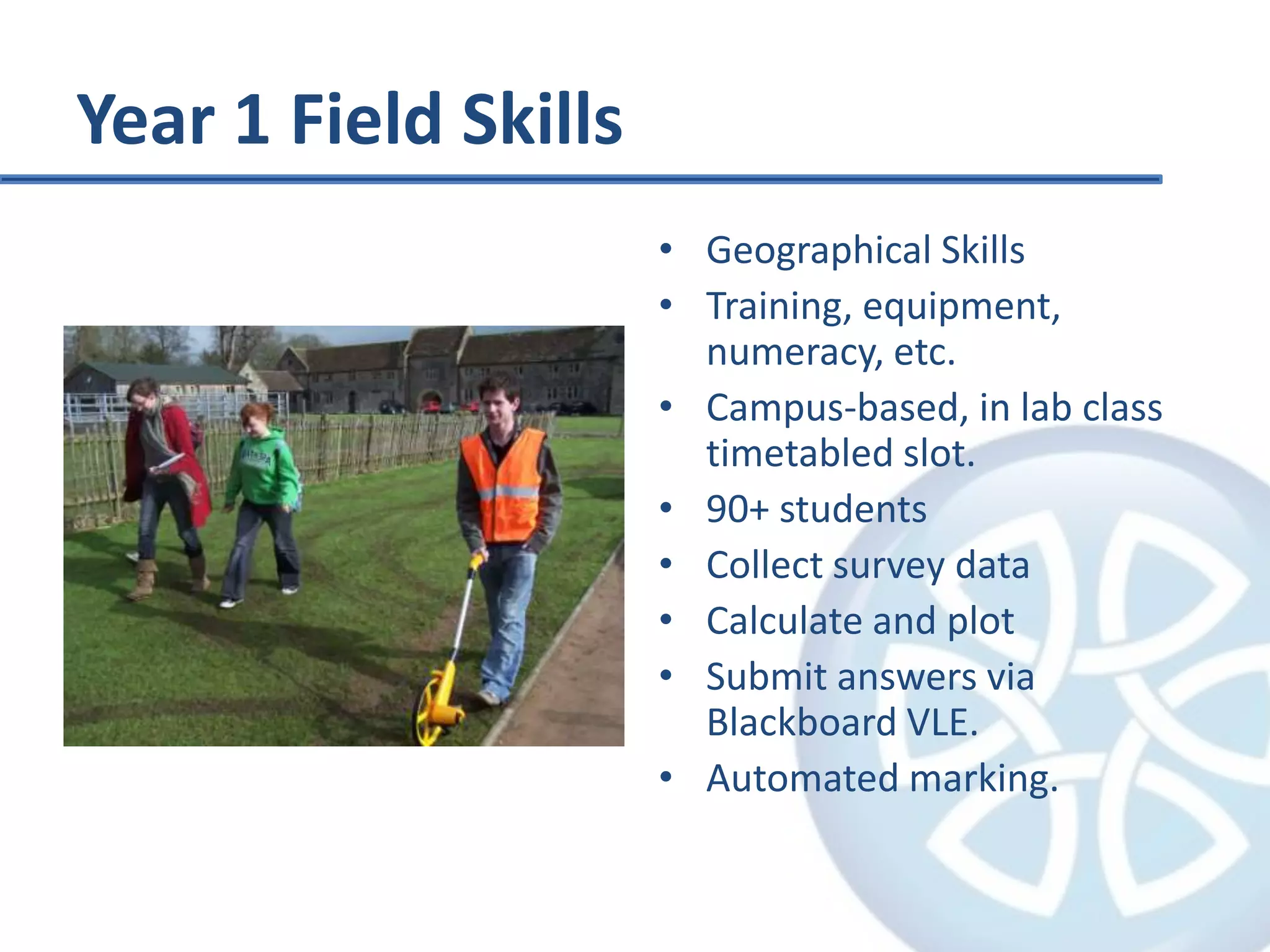
Year 1 Field SkillsGeographical SkillsTraining, equipment, numeracy, etc.Campus-based, in lab class timetabled slot.90+ studentsCollect survey dataCalculate and plotSubmit answers via Blackboard VLE.Automated marking.
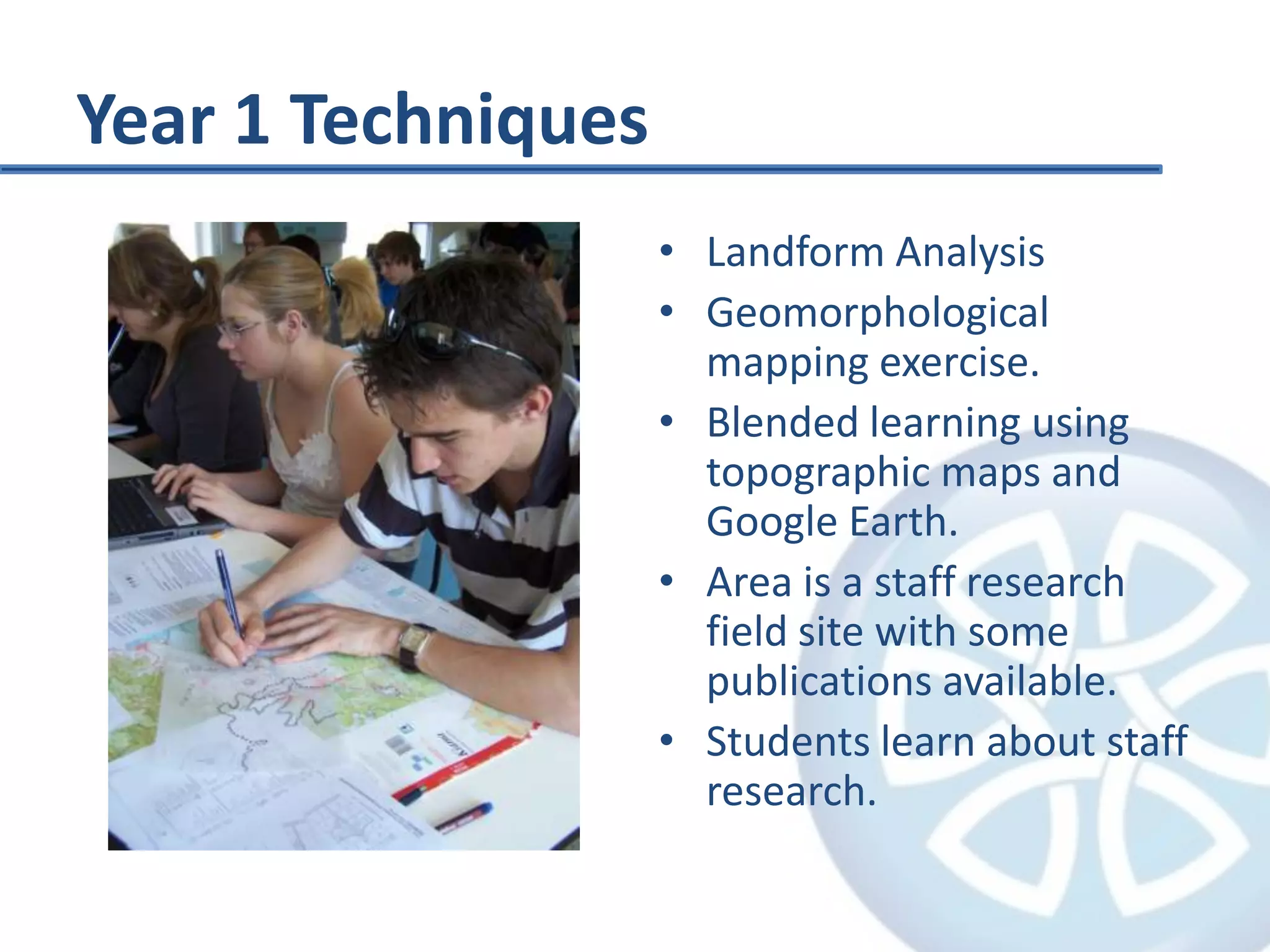
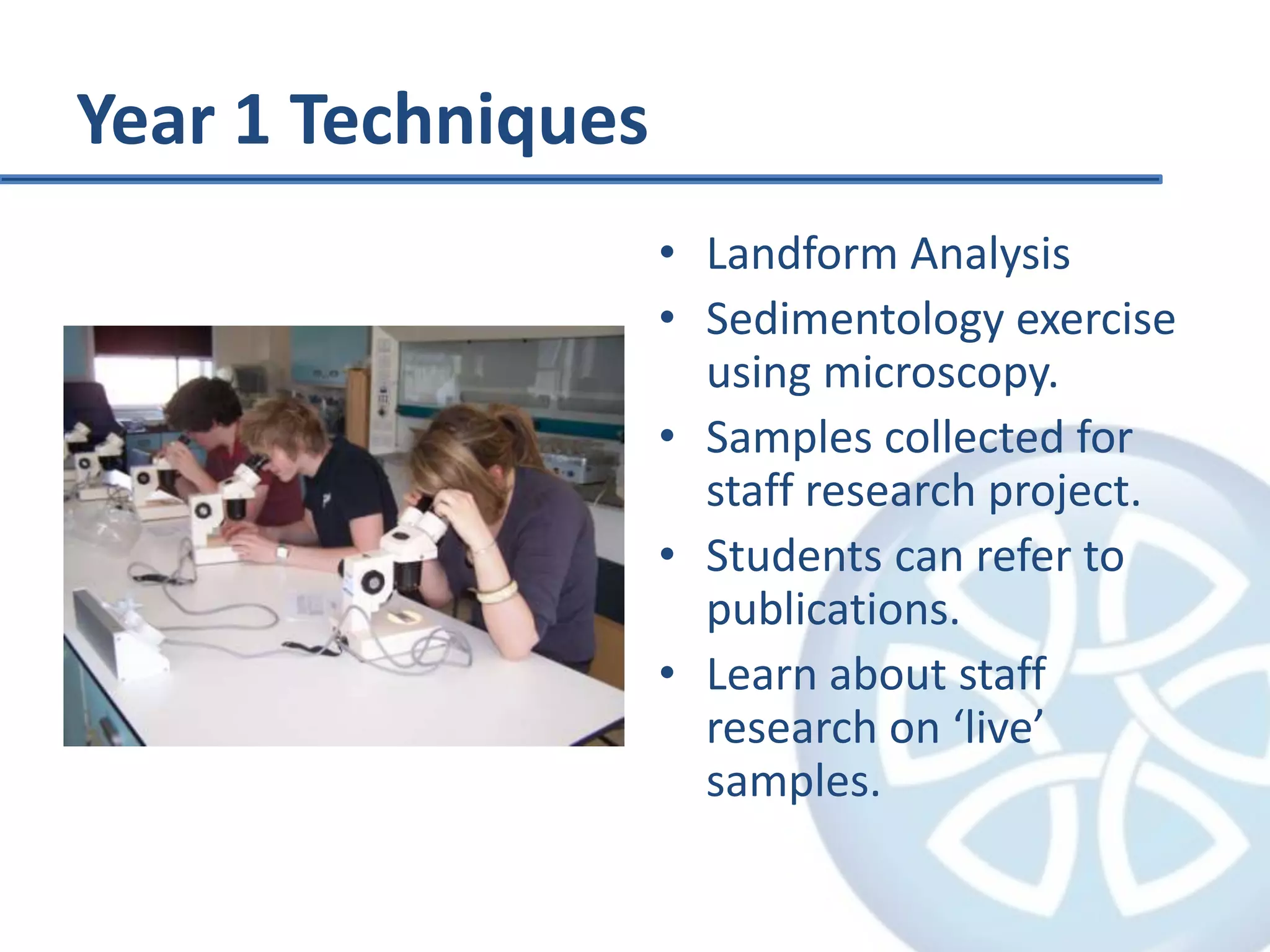
Year 1 TechniquesLandform AnalysisGeomorphological mapping exercise.Blended learning using topographic maps and Google Earth.Area is a staff research field site with some publications available.Students learn about staff research.
Year 1 TechniquesLandform AnalysisSedimentology exercise using microscopy.Samples collected for staff research project.Students can refer to publications.Learn about staff research on ‘live’ samples.
STUDENTS ARE PARTICIPANTSResearch-tutoredEngaging in research discussionsResearch-basedUndertaking research and inquiryEMPHASIS ON RESEARCHPROCESSES AND PROBLEMSEMPHASIS ON RESEARCH CONTENTResearch-ledLearning about current research in the disciplineResearch-orientedDeveloping research and inquiry skills and techniquesSTUDENTS FREQUENTLY ARE AN AUDIENCEYear 1 analysisNOSOMEYESSOME
Year 2 Field ResearchThe Brittany field course began in late 1970’s or early 1980’s, with good links with University of Brest, including some collaborative research.1998-2001: Staff published research to underpin teaching in Brittany.Until 2001 was not an assessed course.2001-2004: part of a Yr 2 Geographical Research Methods module – emphasis on field skills.After 2004: emphasis on preparation for Honours dissertation.
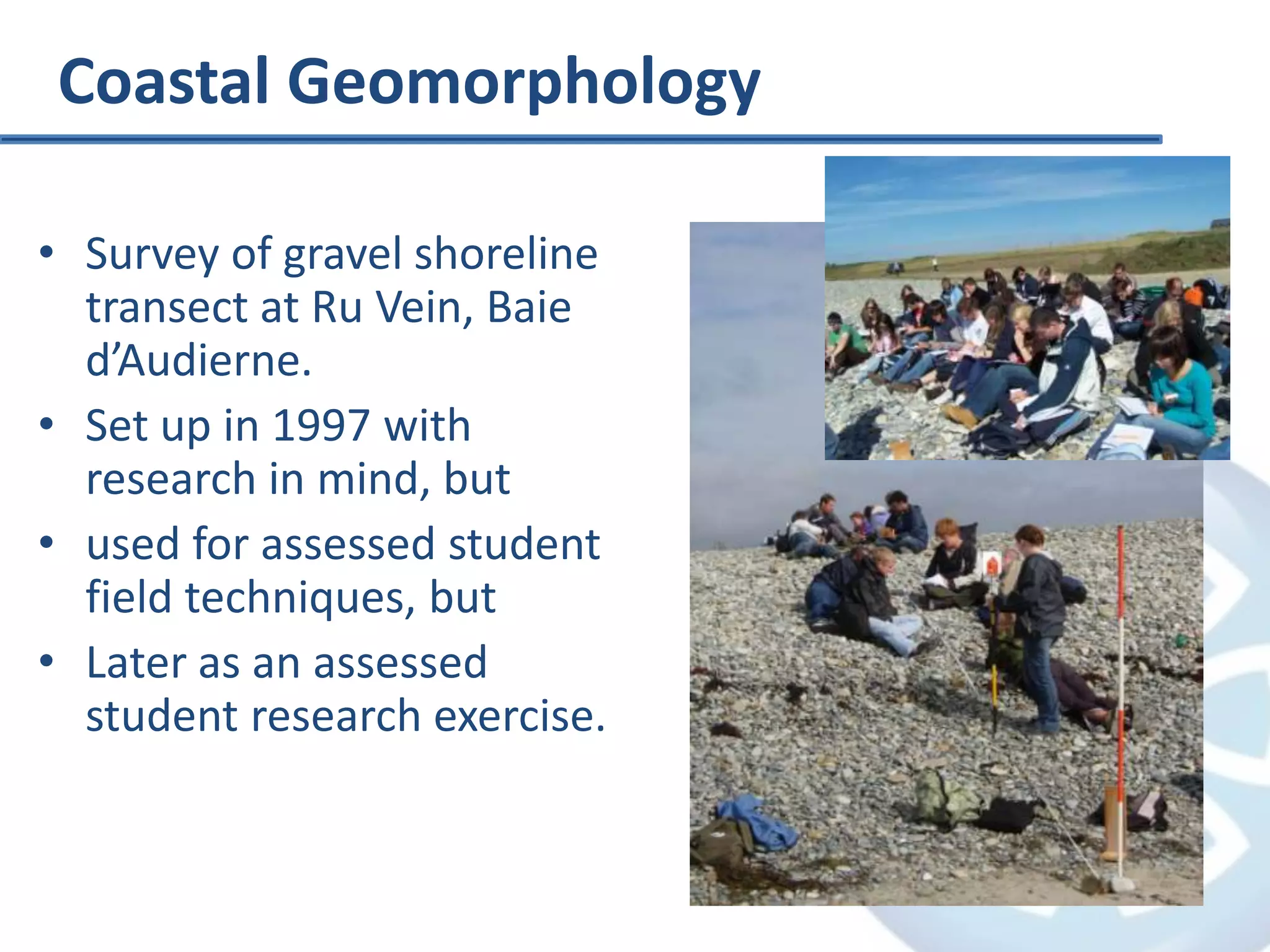
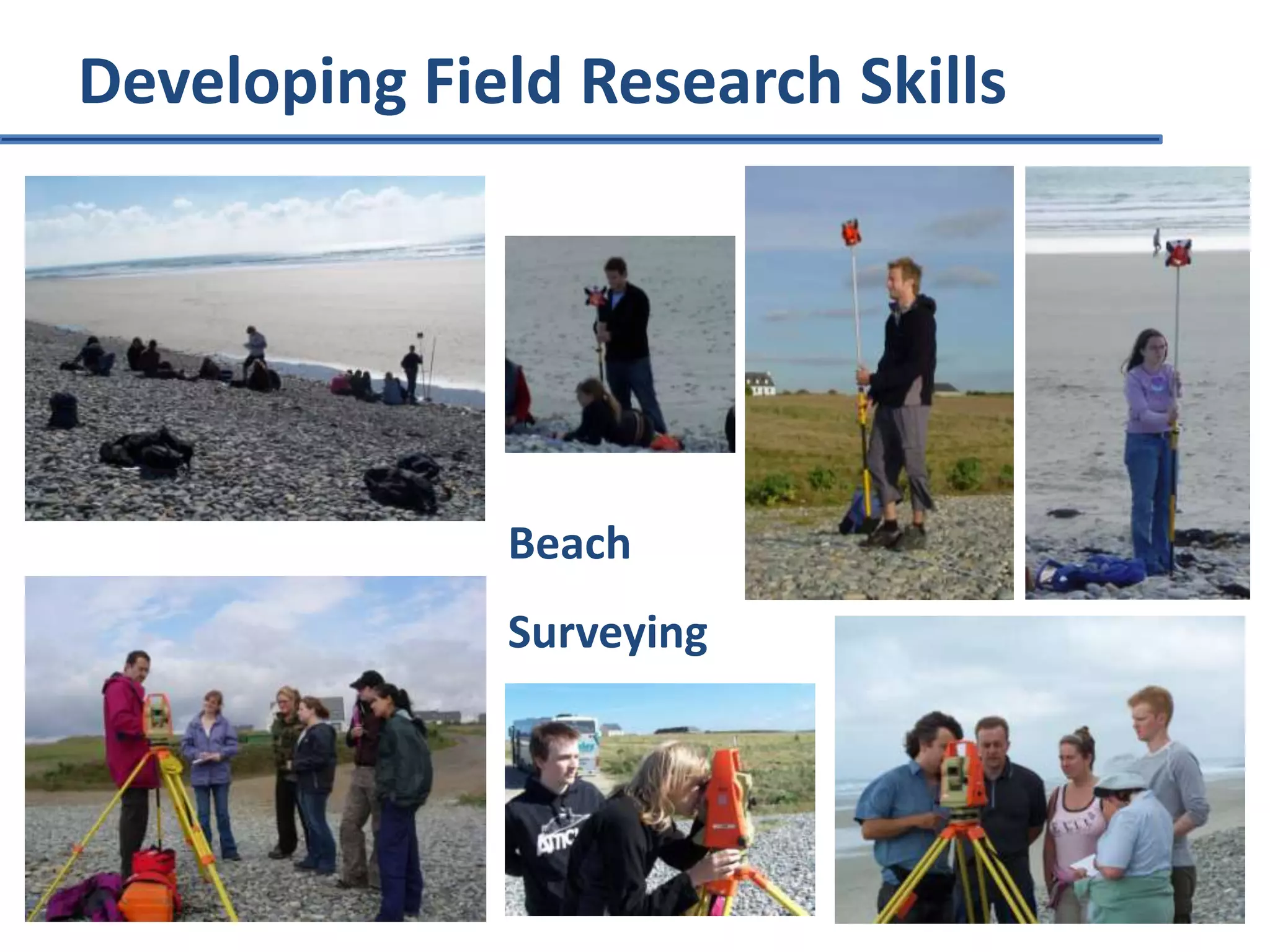
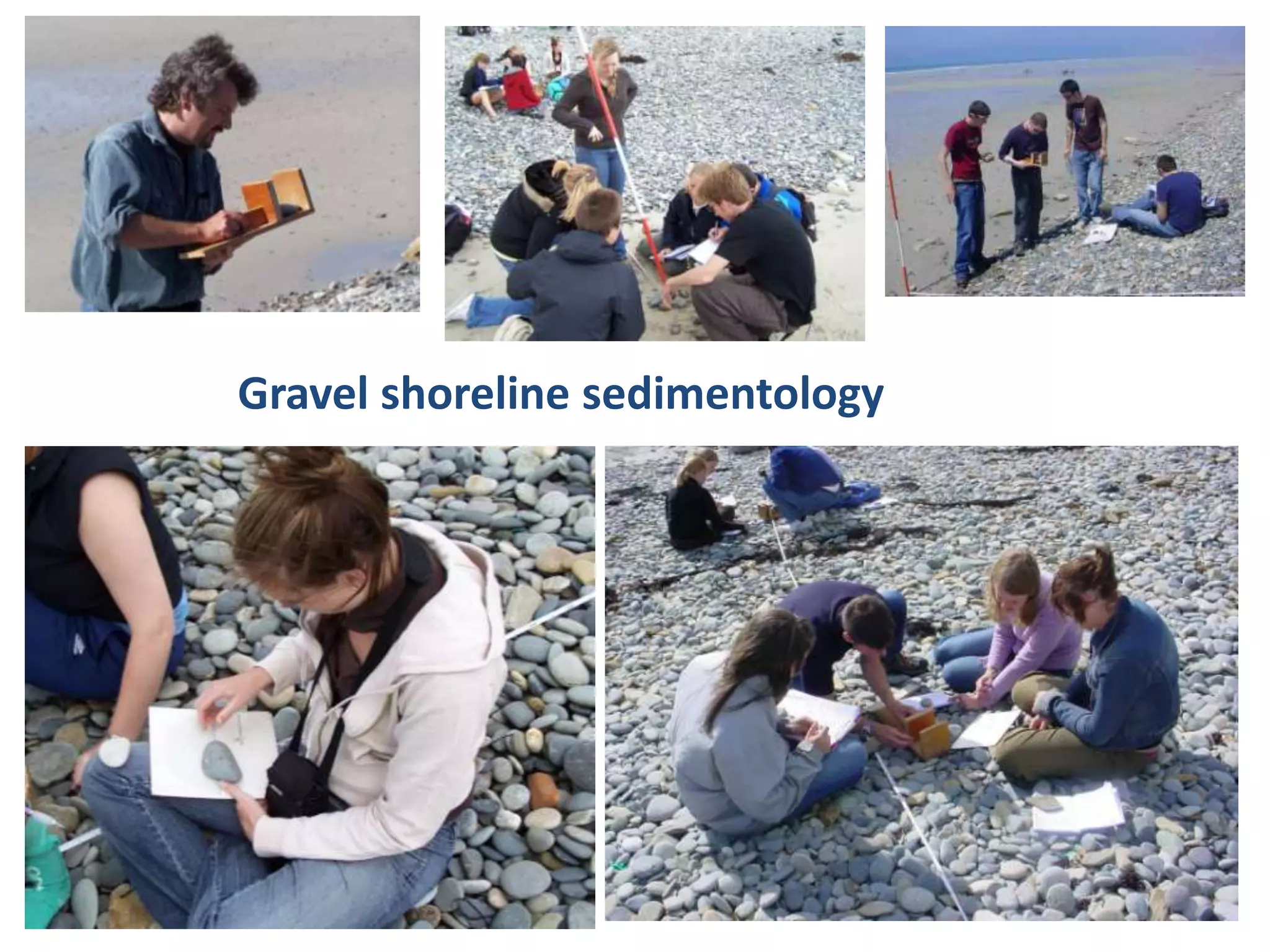
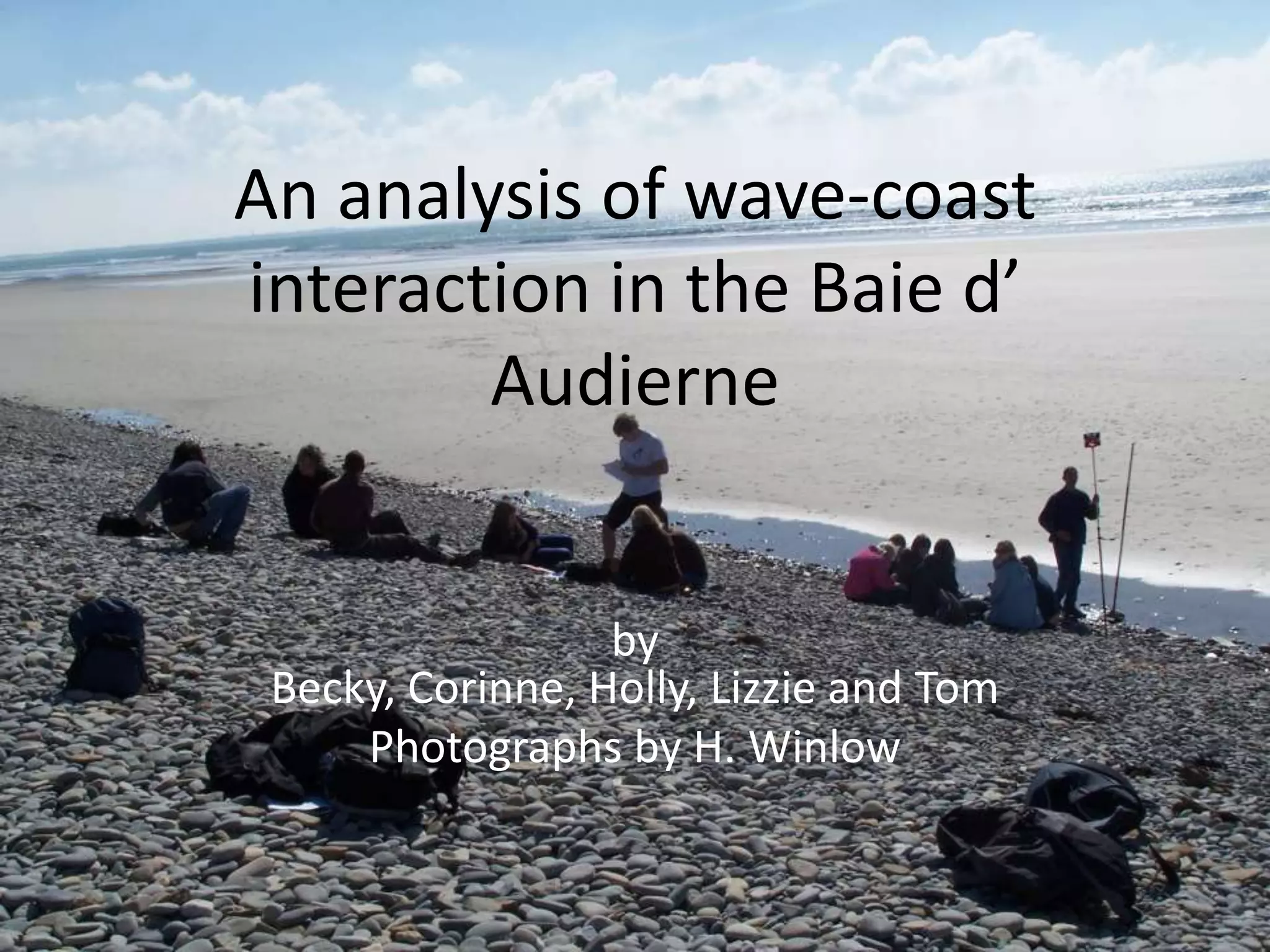
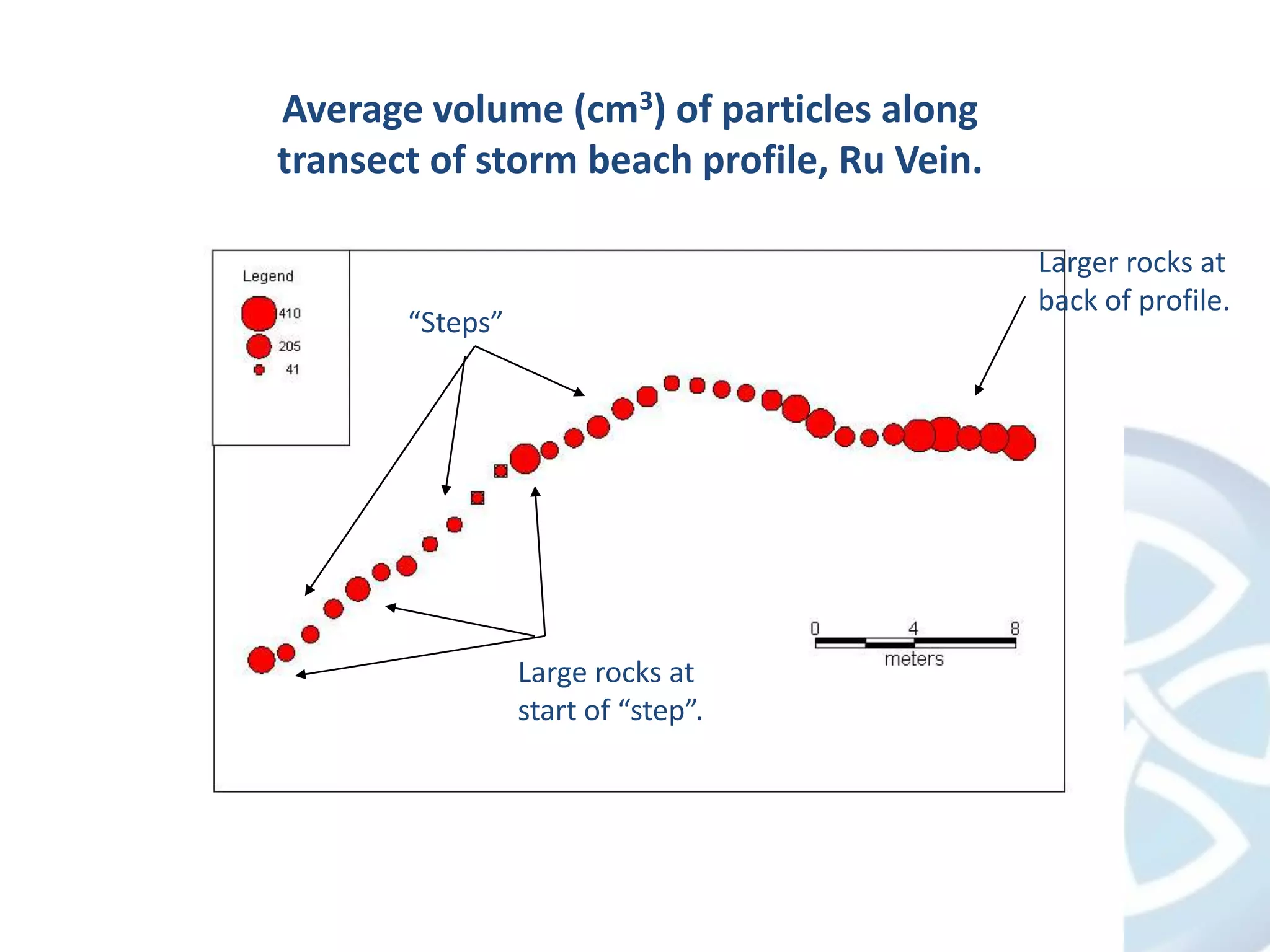
Coastal GeomorphologySurvey of gravel shoreline transect at Ru Vein, Baied’Audierne.Set up in 1997 with research in mind, butused for assessed student field techniques, butLater as an assessed student research exercise.
Developing Field Research SkillsBeachSurveying
Gravel shoreline sedimentology
An analysis of wave-coast interaction in the Baie d’ AudiernebyBecky, Corinne, Holly, Lizzie and TomPhotographs by H. Winlow
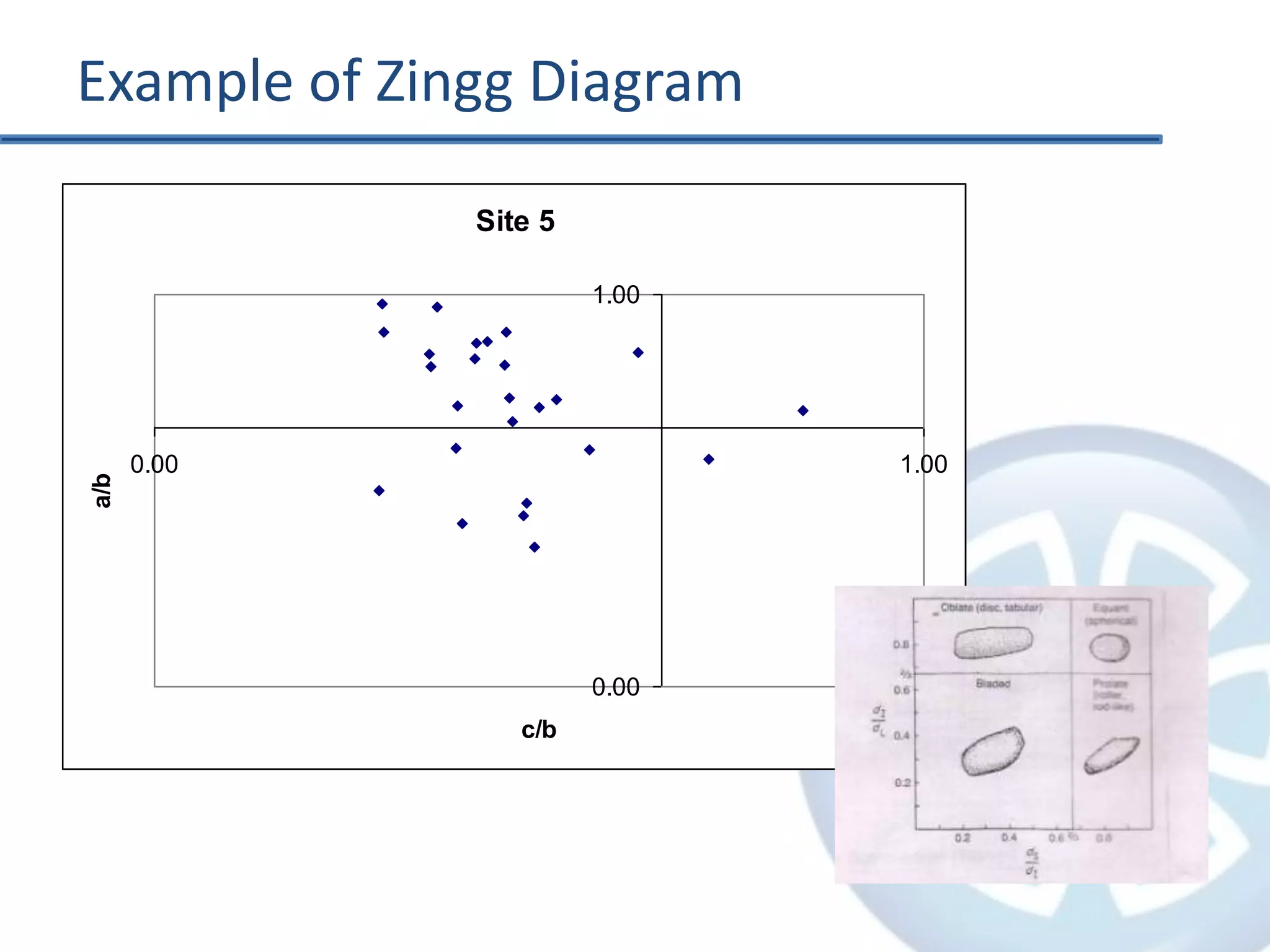
Example of Zingg Diagram
Average volume (cm3) of particles along transect of storm beach profile, Ru Vein.Larger rocks at back of profile.“Steps”Large rocks at start of “step”.
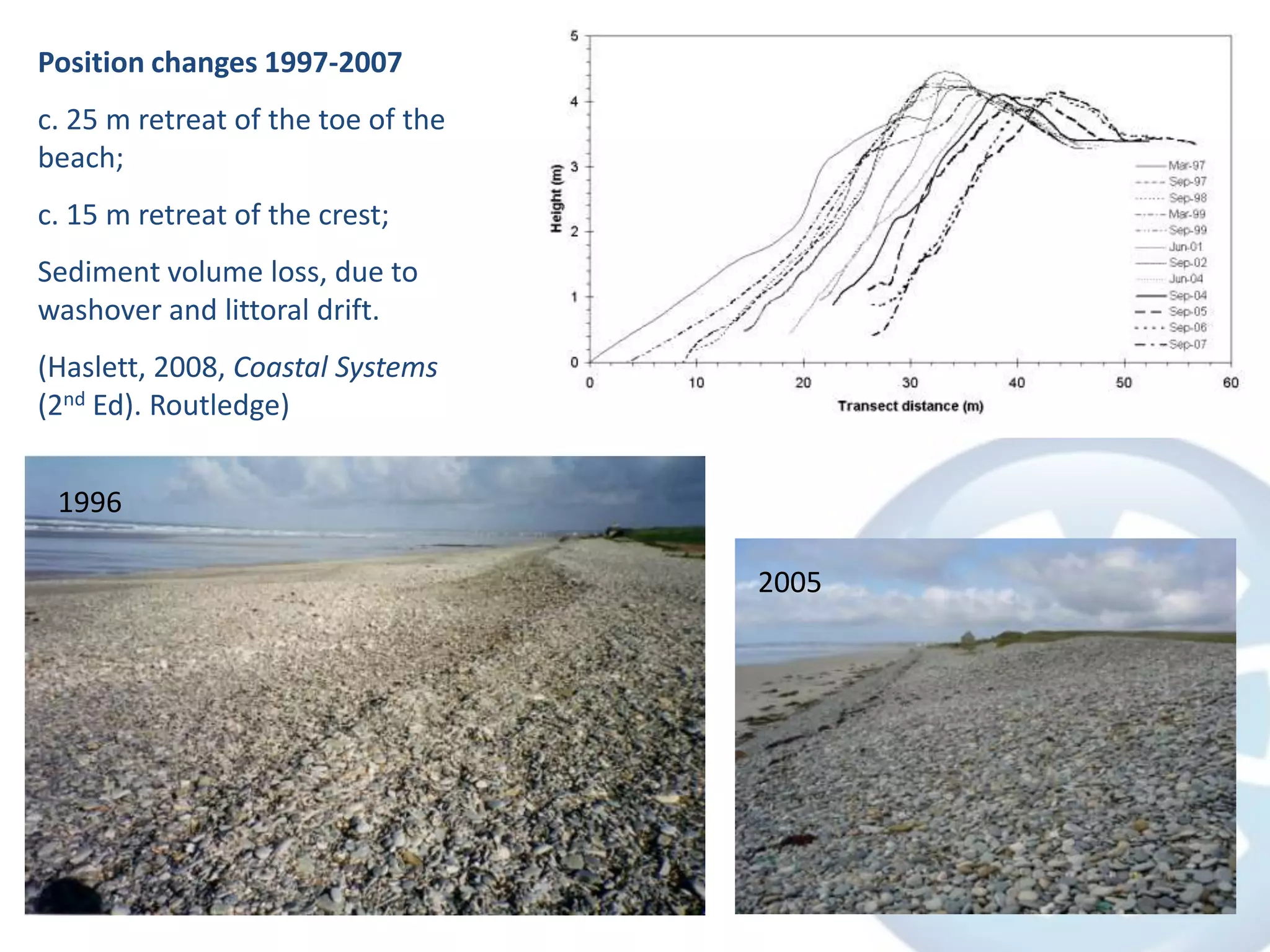
Position changes 1997-2007c. 25 m retreat of the toe of the beach;c. 15 m retreat of the crest;Sediment volume loss, due to washover and littoral drift.(Haslett, 2008, Coastal Systems (2nd Ed). Routledge)19962005
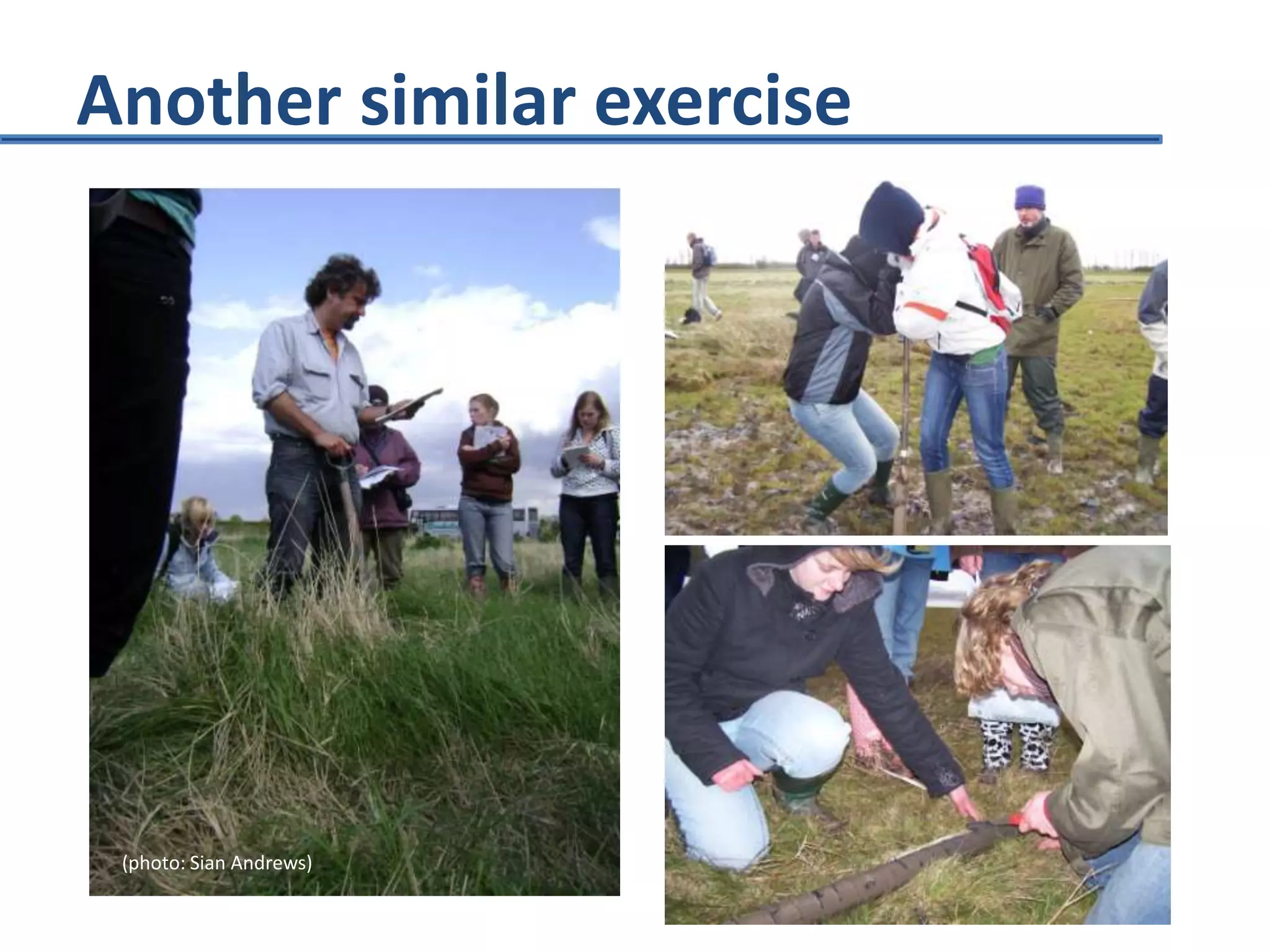
Another similar exercise(photo: Sian Andrews)

Research-teaching relationships and HE professional practice

  • 1.
    Research-teaching relationshipsand HEprofessional practiceProfessor Simon HaslettDean, School of STEMPresented at the Higher Education Academy Wales Research-Teaching Nexus Action Set MeetingAberystwyth University, 10th February 2011
  • 2.
    ContentsContext and ResourcesScholarshipof Learning and TeachingPedagogic ResearchResearch-informed TeachingResearch-Teaching NexusUndergraduate ResearchCase study: the Newport CELTExamples from my own practice
  • 3.
    The HEA R-TNexus Action SetHigher Education Academy Welsh Institutional Group set up the Research-Teaching Nexus Action Set in February 2009 at Newport.Representatives from Welsh HEIs at biannual meetings.Gregynog Conference (Sept 2009)Swansea Meeting (March 2010)Publication of book (June 2010)Undergraduate Research Workshop, Carmarthen (15th Sept 2010)Next generation of L&T Strategies in November 2011.Action Set Bloghttp://nexus-wales.blogspot.com/
  • 4.
  • 5.
  • 6.
  • 7.
  • 8.
  • 9.
    ‘Future shape ofthe HE sector in Wales’ Each "region [in Wales] should have research intensive (in which we will increasingly focus our QR funding in support of sustainable excellence and relevance to Welsh Assembly Government objectives) and strong community/widening access focused provision“ (HEFCW, Dec 2010).This implies that each region should comprise one research intensive and one access (teaching?) focused institution.
  • 10.
    Scholarship of Teachingand Learningindividually-focused scholarship for personal use;internally-focused scholarship for local (e.g. departmental, institutional) use;externally-focused scholarship, such as defined by the Research Assessment Exercise (RAE, 2005, p. 34) as “the creation, development and maintenance of the intellectual infrastructure of subjects and disciplines”; andresearch for external dissemination at conferences and in publications (i.e. pedagogic research).Where does your SoTL sit?(from Haslett, 2009, based on Ashwin and Trigwell, 2004; RAE, 2005)
  • 11.
    Scholarship of Teaching& Learning and Pedagogic ResearchWhy do/would you do it?Strategic e.g. research-informed teachingContractual e.g. teaching-led researchPersonal professional updating/reflection and careerDisseminate examples of practiceWhat do/would you research?Generic issues e.g. student engagementCase studies e.g. examples of teachingHow do/would you do it?Individually or collaboratively?Funding for research and publication e.g. grants?Output types e.g. books, articles, conferences?Time and space to undertake research and writing?
  • 12.
    Learning and TeachingScholarshipand ResearchEncourage staff to become active members of L&T communities of practice.Participate in internal L&T schemes.Apply for Fellowship of the Higher Education Academy (HEA) (map against Professional Standards)Membership of the Society for Research into Higher Education (SRHE): Annual Conference at Newport 2009, 2010, and again in 2011?Membership of the International Society for the Scholarship of Teaching and Learning (ISSoTL):Annual Conference was in Liverpool (October 2010)
  • 13.
    Delegate nationality atselected UK HE Conferences(excluding delegates (n = 802) from institutions in England) n = 189Total sample n = 991From: S. K. Haslett (2009) Higher Education conference attendance and engagement with the scholarship of teaching and learning: a Welsh perspective. Journal of Applied Research in Higher Education, 1 (2), 65-73.
  • 14.
    Delegate AnalysisWelsh academicscomprised 5% of all delegates.Proportionally 25% fewer Welsh academics attending than from England.Attendance proportionally dominated by newer universities.Research-intensive universities in the bottom three.Four Welsh institutions had no delegates at the Conferences surveyed (mix of both the above).Limited snapshot survey, criticised because none of the events were in Wales.The 2010 SRHE Conference held in Newport attracted 368 delegates, 26 of which were from Wales = 7%.
  • 15.
    Research-informed TeachingSystematic inquiryinto the L & T process.Which approaches are you most involved in?Examining how discipline-based research is included in the curriculum …..
  • 16.
    Research-Teaching NexusSTUDENTS AREPARTICIPANTS4. Research-tutoredEngaging in research discussions3. Research-basedUndertaking research and inquiryEMPHASIS ON RESEARCHPROCESSES AND PROBLEMSEMPHASIS ON RESEARCH CONTENT1. Research-ledLearning about current research in the discipline2. Research-orientedDeveloping research and inquiry skills and techniquesSTUDENTS FREQUENTLY ARE AN AUDIENCESource:modified from M. Healey & A. Jenkins (2009) Developing students as researchers. In: S. K. Haslett & H. Rowlands (eds) Linking research and teaching in Higher Education. University of Wales, Newport, pp. 7-11. How does your teaching map within the R-T Nexus?
  • 17.
  • 18.
    Undergraduate ResearchUniversity ofCentral Lancashire, 19th-20th April 2011
  • 19.
    Case study -the Newport CELTLearning and Teaching Strategy 2007-2010“To establish a University-wide research cluster to lead development in pedagogy”. “It is recognised that the institution needs such initiatives to be driven from a Centre and to this end a University-wide Research Centre for Excellence in Learning and Teaching (CELT) will be established”.
  • 20.
    Emphasis on Dissemination“therecord of dissemination of good [L&T] practice outside the institution has been relatively low compared to the level of activity”“The University is therefore placing a greater emphasis on encouraging its staff to not only develop, but to disseminate the many examples of good practice in learning and teaching both within and outside the University”
  • 21.
    The CELT asa Research Centre with its main function to assist staff in:Devising pedagogic research projects;Presenting papers at conferences; andWriting and disseminating published outcomes.
  • 22.
    UmbrellaCELT drew togetherexisting PedR activity across the institution.BeaconCELT as a beacon of SoLT and PedR, and teaching excellence in the HE landscape.Early Stats (Dec 08 – June 09)Total CELT contacts: 733Conference delegates: 180 (up 50%)Conference papers: 62Proceedings papers: 20CELT Journal papers: 14CELT Launch & Workshops: 198
  • 23.
    CELT NEXUS ActivitiesAlanJenkins keynote Dec 2008 and workshop on January 2009.HEA-Wales Action Set on R-T Nexus, Chaired by CELT Director (2009-10).Newport NEXUS Conference, 2009 and 2010 (books/resources available on web).Mick Healey visiting professor: Sept 2010 .
  • 24.
    Newport NEXUS ConferencesAnnualLearning and Teaching Conferencehttp://celt.newport.ac.uk/nexusJune 2009 and 2010
  • 25.
    Varied Conference SymposiaForexample:Undergraduate ResearchResearch-informed TeachingCommunity EducationESDGCInternational ScholarshipLinking Teaching and KTProfessional DevelopmentStudent EngagementTechnology Enhanced LearningHazard and Geoscience ResearchDelegates used #nexus2010 when tweeting
  • 26.
    Publishes its ownjournal:Teaching PracticeLearning InsightsDevelopment and InnovationPedagogic Research(Re)ViewsFramework Issues
  • 27.
    CELT Writing RetreatTheAcademic Writing ProcessInventing and researchPlanningDraftingRevisingEditingSubmissionPeer review processRevisionsProof stage and publicationModified from Ganobcsik-Williams (2009)
  • 28.
    CoordinatorsPhD StudentsCELT ResearchProgrammesTechnology Enhanced Learning (TEL);Education for Sustainable Development and Global Citizenship (ESDGC);Flexible Learning in Employer and Community Scenarios (FLECS).
  • 29.
    Pedagogic Research ExpeditionsExPedRLegs 1 and 2Leg 1 Australia 2009Leg 2 Canada 201010 expedition membersAttend HERDSA 2009Attend STLHE 2010Visit other HEIsDisseminate best practiceDevelop research links.Using #expedr2010Blog - http://expedr2010.blogspot.comYouTube – NewportCELT Channel
  • 30.
    PGCert Developing ProfessionalPractice in HE60 M-Level creditsHEA accreditedOne year, part-timeDistance learning online (from Feb 2010)Covers not only teaching but researchAssessment: teaching portfolio and action research projectFee: £1500Developing an MA in HE
  • 31.
    University of WalesActivityUniversity of Wales Alliance Thematic Group on Learning and Teaching, and Research
  • 32.
    Develop a sharedcalendar of staff development events
  • 33.
    Themed conference on‘Research-informed Teaching’
  • 34.
  • 35.
  • 36.
    Use UW GlobalCampus website to archive and disseminate materials
  • 37.
    UW Teaching Fellows:Problem-based Learning
  • 38.
    A UW Academyof L&T Award Winners
  • 39.
    New Learning andTeaching CommitteeExploring links in the Curriculuman example from my own practiceBath Spa University Geography Department, set up in 1968-69.1994 started as Lecturer in Physical Geography.Inherited courses, but adapted them and developed new courses.Major contribution to biannual field course to Brittany, France.
  • 40.
    Year 1 FieldSkillsGeographical SkillsTraining, equipment, numeracy, etc.Campus-based, in lab class timetabled slot.90+ studentsCollect survey dataCalculate and plotSubmit answers via Blackboard VLE.Automated marking.
  • 41.
    Year 1 TechniquesLandformAnalysisGeomorphological mapping exercise.Blended learning using topographic maps and Google Earth.Area is a staff research field site with some publications available.Students learn about staff research.
  • 42.
    Year 1 TechniquesLandformAnalysisSedimentology exercise using microscopy.Samples collected for staff research project.Students can refer to publications.Learn about staff research on ‘live’ samples.
  • 43.
    STUDENTS ARE PARTICIPANTSResearch-tutoredEngagingin research discussionsResearch-basedUndertaking research and inquiryEMPHASIS ON RESEARCHPROCESSES AND PROBLEMSEMPHASIS ON RESEARCH CONTENTResearch-ledLearning about current research in the disciplineResearch-orientedDeveloping research and inquiry skills and techniquesSTUDENTS FREQUENTLY ARE AN AUDIENCEYear 1 analysisNOSOMEYESSOME
  • 44.
    Year 2 FieldResearchThe Brittany field course began in late 1970’s or early 1980’s, with good links with University of Brest, including some collaborative research.1998-2001: Staff published research to underpin teaching in Brittany.Until 2001 was not an assessed course.2001-2004: part of a Yr 2 Geographical Research Methods module – emphasis on field skills.After 2004: emphasis on preparation for Honours dissertation.
  • 45.
    Coastal GeomorphologySurvey ofgravel shoreline transect at Ru Vein, Baied’Audierne.Set up in 1997 with research in mind, butused for assessed student field techniques, butLater as an assessed student research exercise.
  • 46.
    Developing Field ResearchSkillsBeachSurveying
  • 47.
  • 48.
    An analysis ofwave-coast interaction in the Baie d’ AudiernebyBecky, Corinne, Holly, Lizzie and TomPhotographs by H. Winlow
  • 49.
  • 50.
    Average volume (cm3)of particles along transect of storm beach profile, Ru Vein.Larger rocks at back of profile.“Steps”Large rocks at start of “step”.
  • 51.
    Position changes 1997-2007c.25 m retreat of the toe of the beach;c. 15 m retreat of the crest;Sediment volume loss, due to washover and littoral drift.(Haslett, 2008, Coastal Systems (2nd Ed). Routledge)19962005
  • 52.
  • 53.
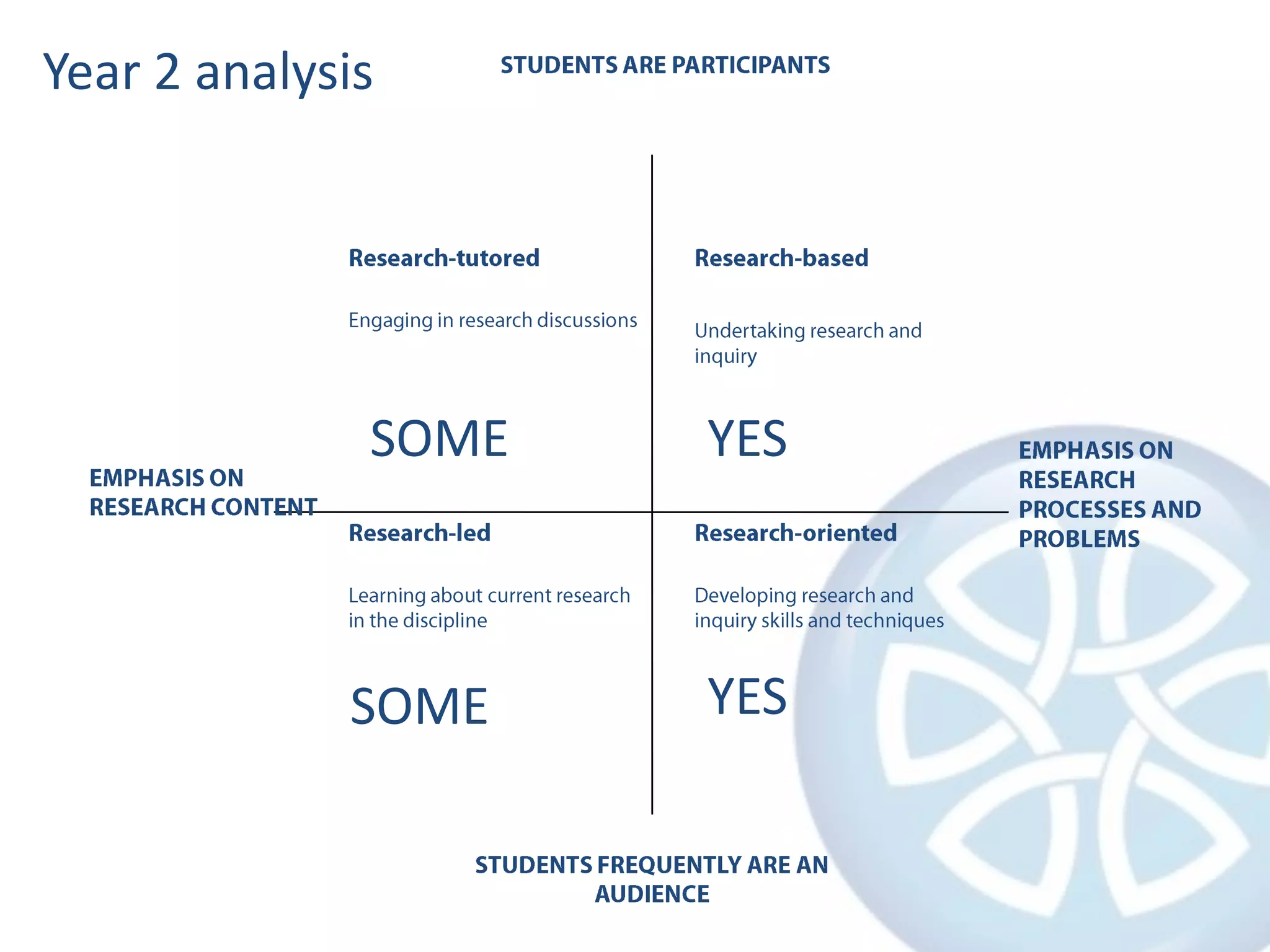
    STUDENTS ARE PARTICIPANTSResearch-tutoredEngagingin research discussionsResearch-basedUndertaking research and inquiryEMPHASIS ON RESEARCHPROCESSES AND PROBLEMSEMPHASIS ON RESEARCH CONTENTResearch-ledLearning about current research in the disciplineResearch-orientedDeveloping research and inquiry skills and techniquesSTUDENTS FREQUENTLY ARE AN AUDIENCEYear 2 analysisYESSOMEYESSOME
  • 54.
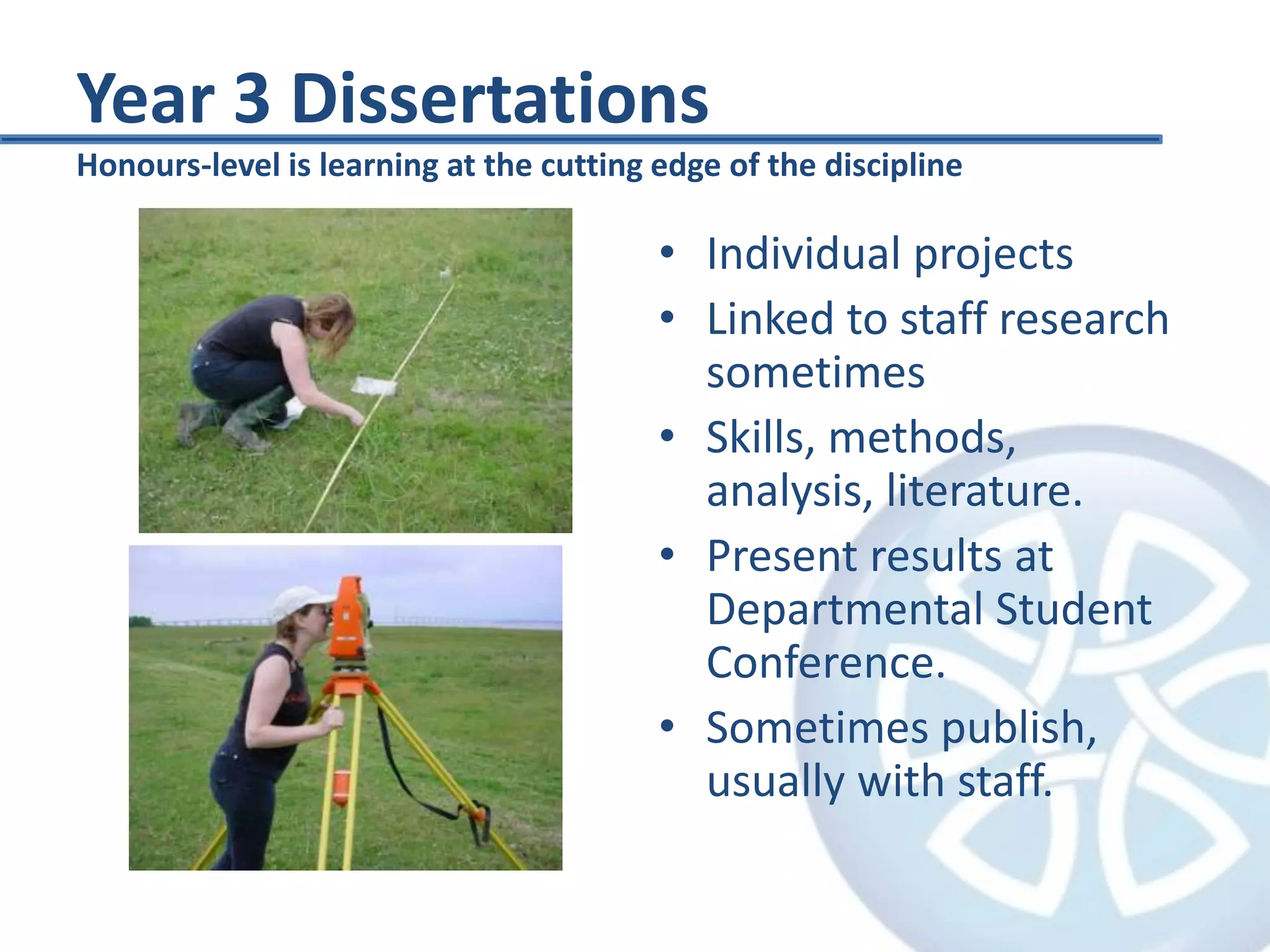
    Year 3 DissertationsHonours-levelis learning at the cutting edge of the disciplineIndividual projectsLinked to staff research sometimesSkills, methods, analysis, literature.Present results at Departmental Student Conference.Sometimes publish, usually with staff.
  • 55.
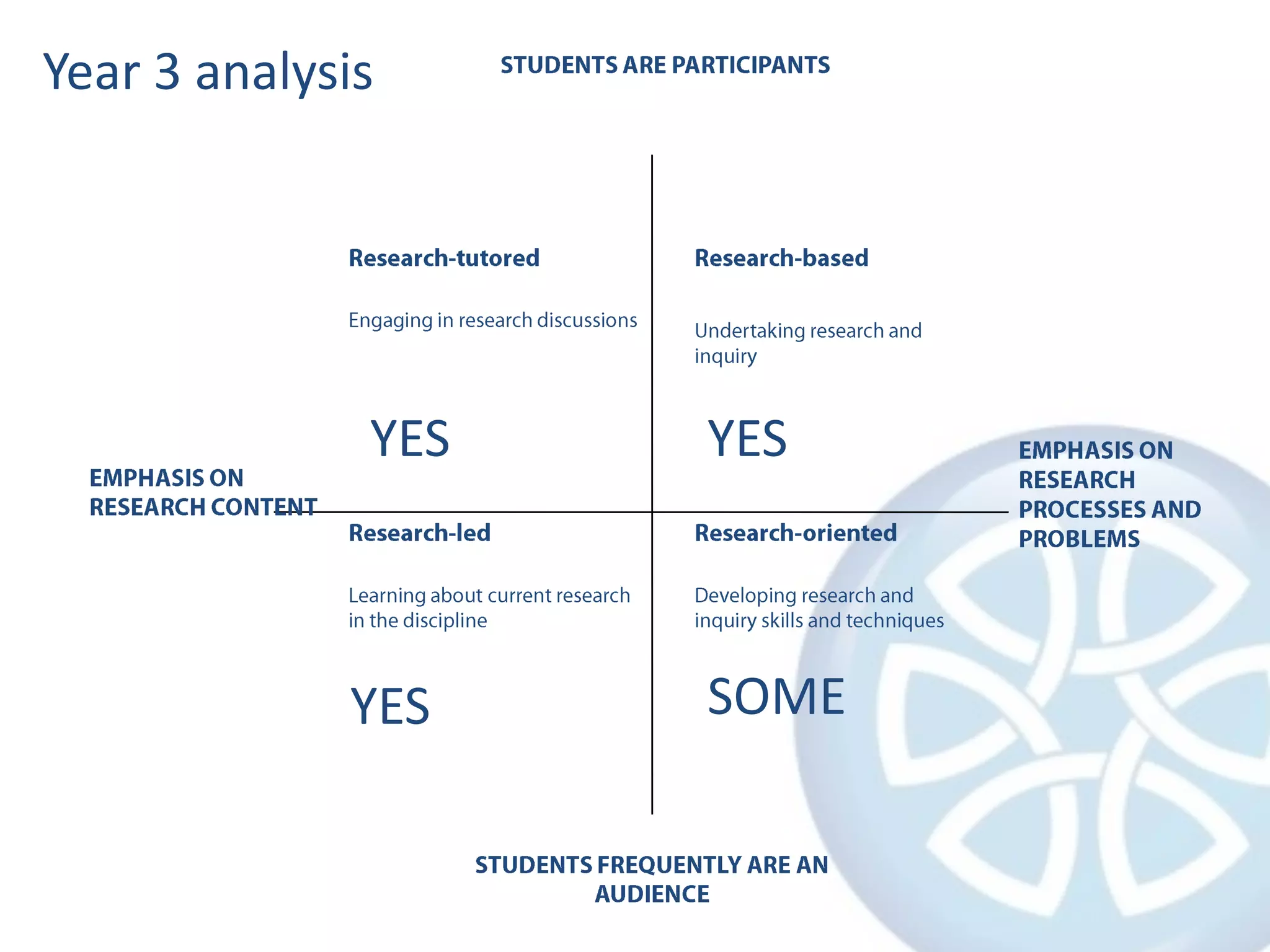
    STUDENTS ARE PARTICIPANTSResearch-tutoredEngagingin research discussionsResearch-basedUndertaking research and inquiryEMPHASIS ON RESEARCHPROCESSES AND PROBLEMSEMPHASIS ON RESEARCH CONTENTResearch-ledLearning about current research in the disciplineResearch-orientedDeveloping research and inquiry skills and techniquesSTUDENTS FREQUENTLY ARE AN AUDIENCEYear 3 analysisYESYESSOMEYES
  • 56.
    Research Content ContinuumYear1: students frequently are an audience of research, but are trained in basic skills.Year 2: emphasis on research processes and problems with students as participants and audience (more skills training and methods).Year 3: students are participants, undertaking their own research projects.
  • 57.
    Your approach?Do youthink this notion of a research content continuum could help you enhance the teaching-research nexus in your curricula?In groups discuss examples where you could at different undergraduate levels:Change/adapt existing courses (give specific examples);Introduce new ideas to strengthen research-teaching links in the curriculum.
  • 58.
    Evaluating CurriculumAudit modulesannually to ensure they are supported and informed by recent (within last three years) research and scholarship, both in terms of curriculum and teaching.As a course team, to obtain an overview, map all module provision using the R-T Nexus grid and place in the context of the research content continuum.
  • 59.
    Thank youFor furtherinformation, please consult the references cited in the presentation, and:Join the HEA R-T Nexus Blog: http://nexus-wales.blogspot.ac.ukLook at and comment on (in the blog) the case studies in:Linking research and teaching in Wales (2010) edited by Simon K Haslett http://www.heacademy.ac.uk/assets/York/documents/ourwork/nations/wales/WalesRandTNexusENGLISH_Jun10.pdfRegister for the British Conference for Undergraduate Research: http://www.bcur.orgConsider the implications of the HEFCW statement: http://www.hefcw.ac.uk/documents/news/press_releases/2010%20Press%20Releases/Full%20Statement%20on%20the%20Future%20Shape%20of%20the%20Sector%20211210.pdfStrengthen Research-Teaching Links in your institutional strategies.