Sustaining research-informed teaching:
institutional and individual approaches.
Professor Simon Haslett
Associate Pro Vice-Chancellor
Collective Address presented 4th April 2014
Higher Education Academy Awards Day
Open University, Cardiff
@ProfSHaslett
The R-T Nexus Action Set
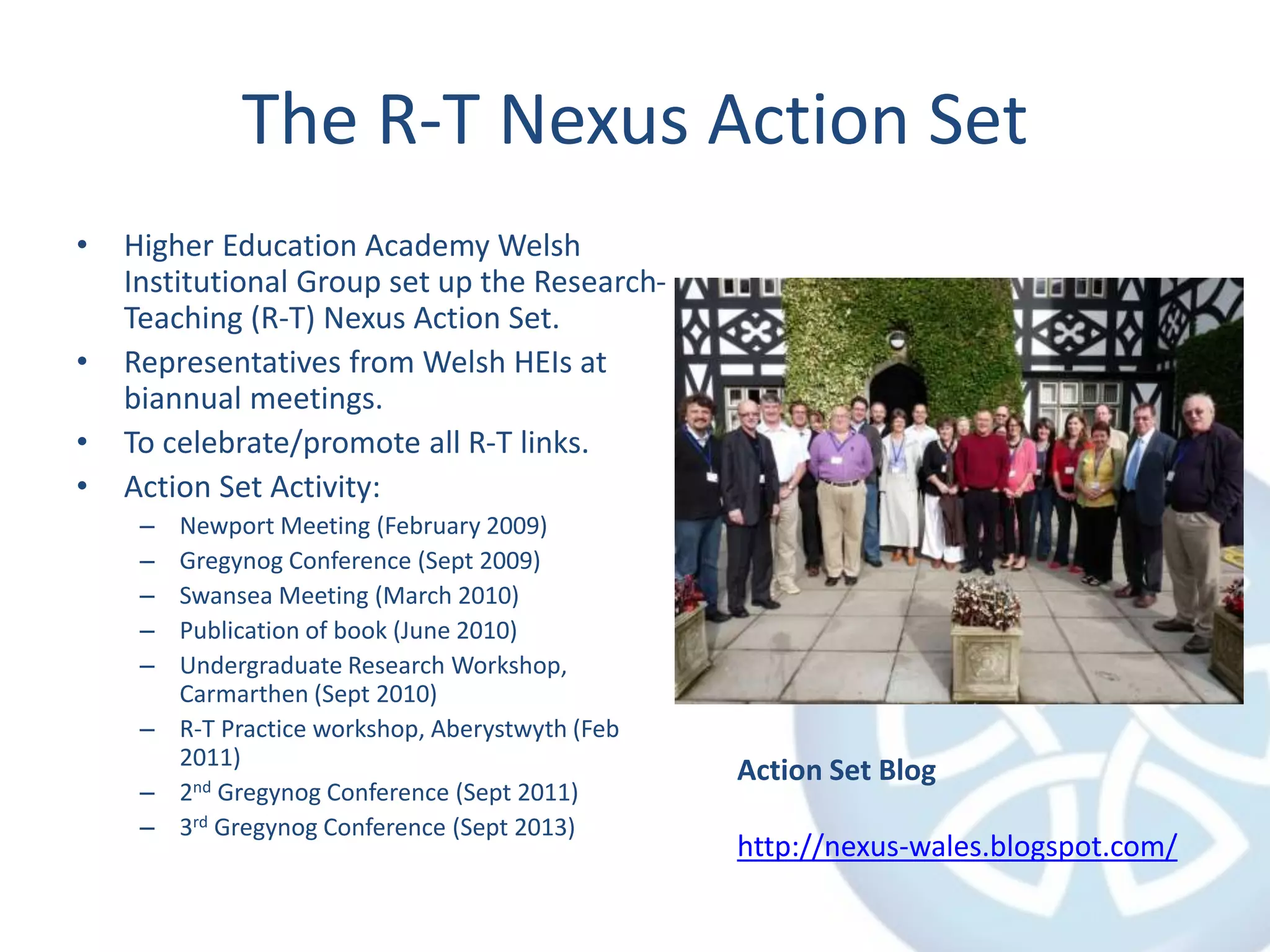
• Higher Education Academy Welsh
Institutional Group set up the Research-
Teaching (R-T) Nexus Action Set.
• Representatives from Welsh HEIs at
biannual meetings.
• To celebrate/promote all R-T links.
• Action Set Activity:
– Newport Meeting (February 2009)
– Gregynog Conference (Sept 2009)
– Swansea Meeting (March 2010)
– Publication of book (June 2010)
– Undergraduate Research Workshop,
Carmarthen (Sept 2010)
– R-T Practice workshop, Aberystwyth (Feb
2011)
– 2nd Gregynog Conference (Sept 2011)
– 3rd Gregynog Conference (Sept 2013)
Action Set Blog
http://nexus-wales.blogspot.com/
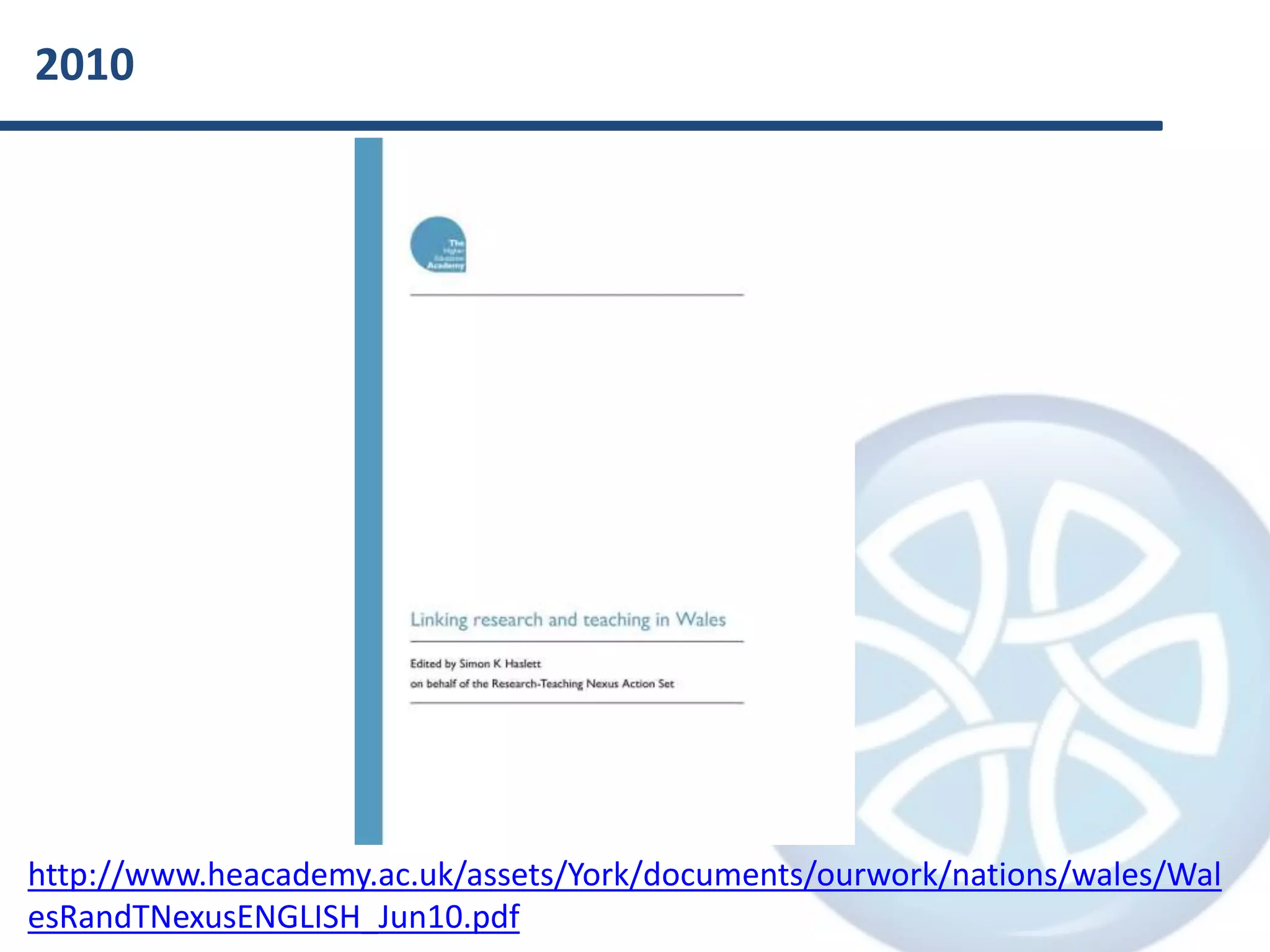
2010
http://www.heacademy.ac.uk/assets/York/documents/ourwork/nations/wales/Wal
esRandTNexusENGLISH_Jun10.pdf
Demystifying R-T Links
• Scholarship of Learning and Teaching (SoLT)
• Scholarship of Teaching and Learning (SoTL)
• Pedagogic Research (PedR)
• Research-informed Teaching (RiT)
• Research-Teaching Nexus (R-T Nexus)
• Undergraduate Research
• Research-Teaching Complex (R-T Complex)
SoLT and PedR
Scholarship is keeping up-to-date through, including,
academic reading, attending workshops and
conferences, training, and perhaps dissemination
(writing, speaking, training, mentoring).
• individually-focused scholarship for personal use;
• internally-focused scholarship for ‘local’ (e.g.
departmental, institutional, community) use;
• research for external dissemination at conferences
and in publications (i.e. pedagogic research).
(from Haslett, 2009, based on Ashwin and Trigwell, 2004; RAE, 2005)
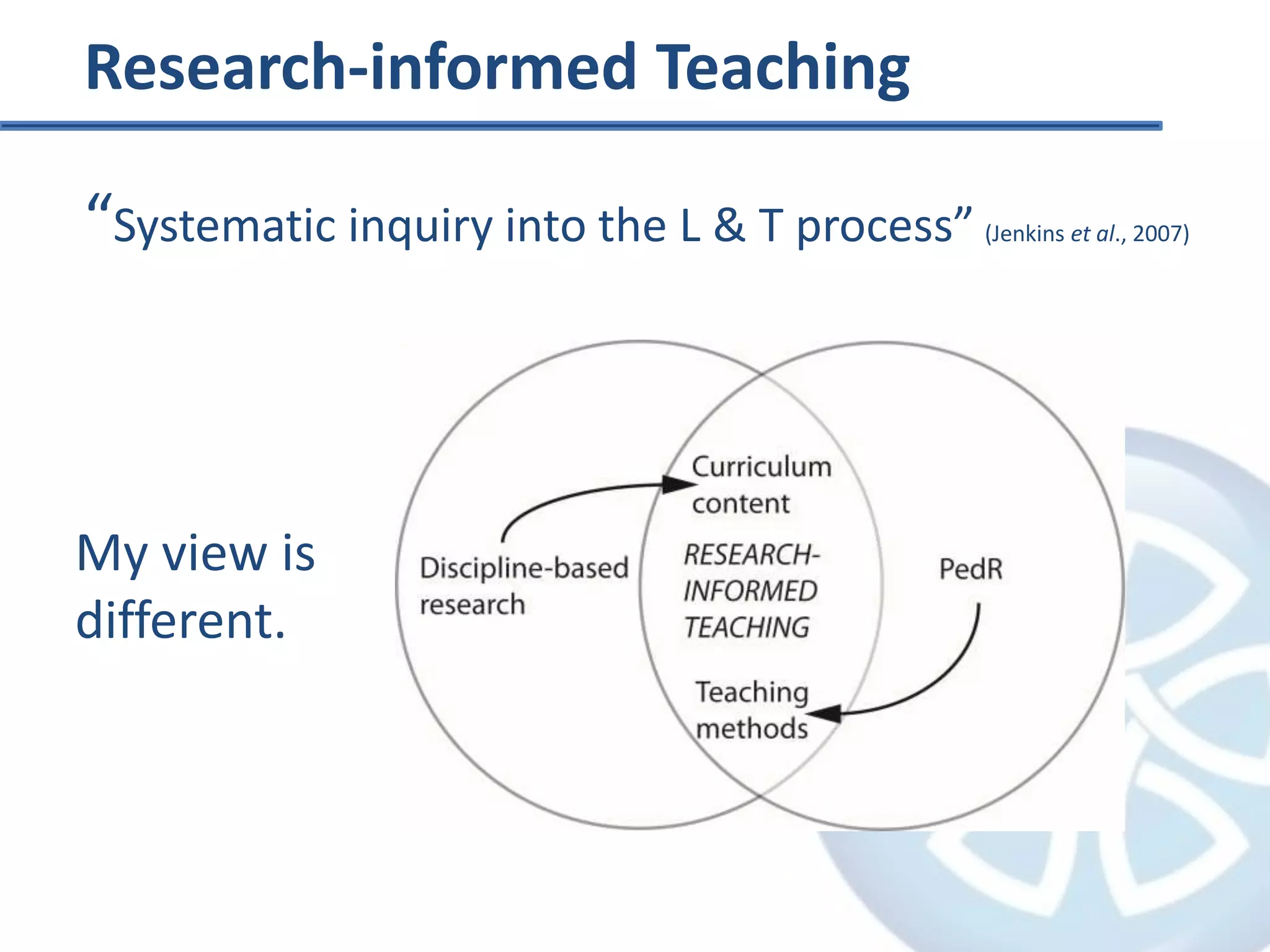
Research-informed Teaching
“Systematic inquiry into the L & T process” (Jenkins et al., 2007)
My view is
different.
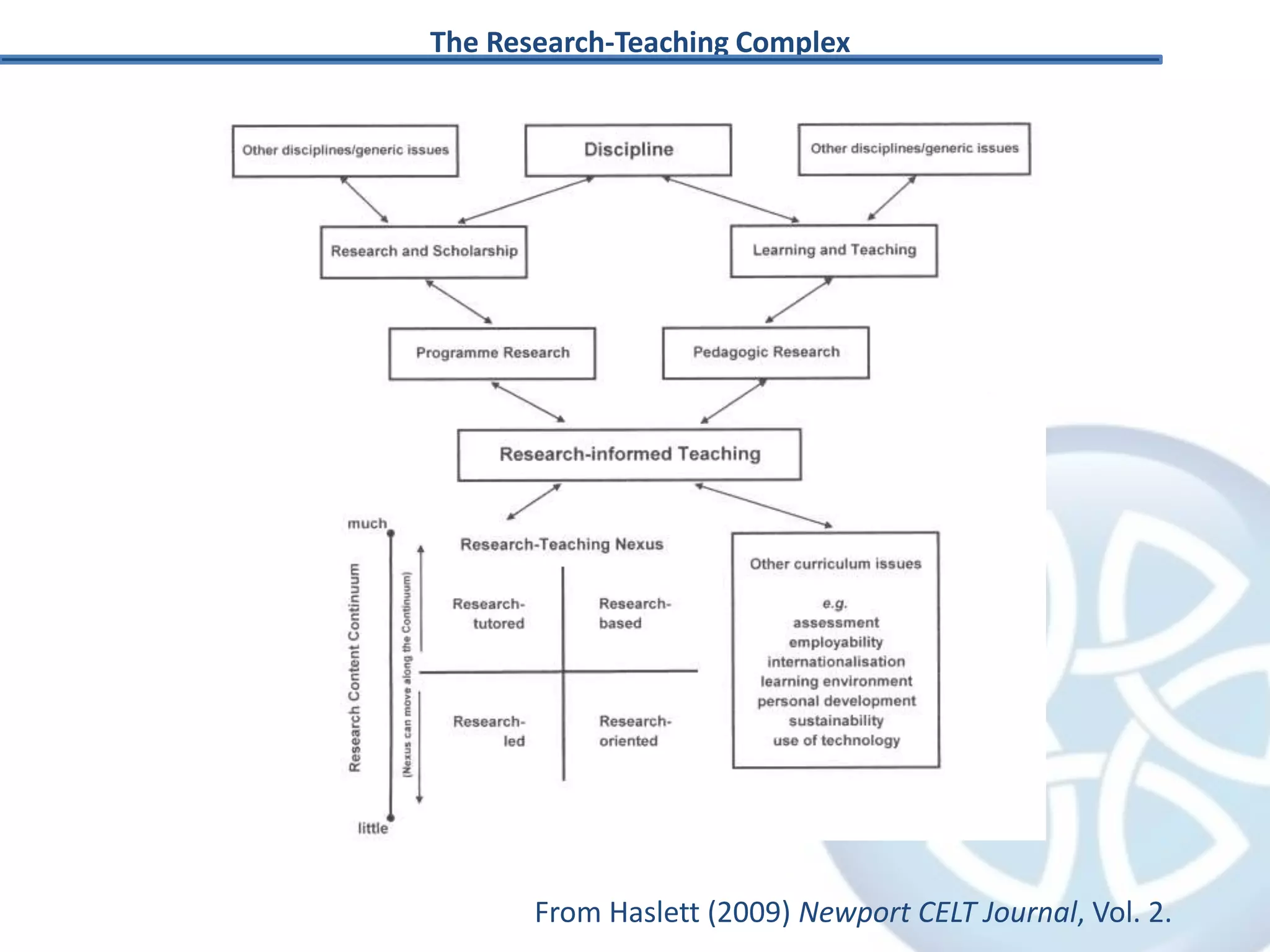
From Haslett (2009) Newport CELT Journal, Vol. 2.
The Research-Teaching Complex
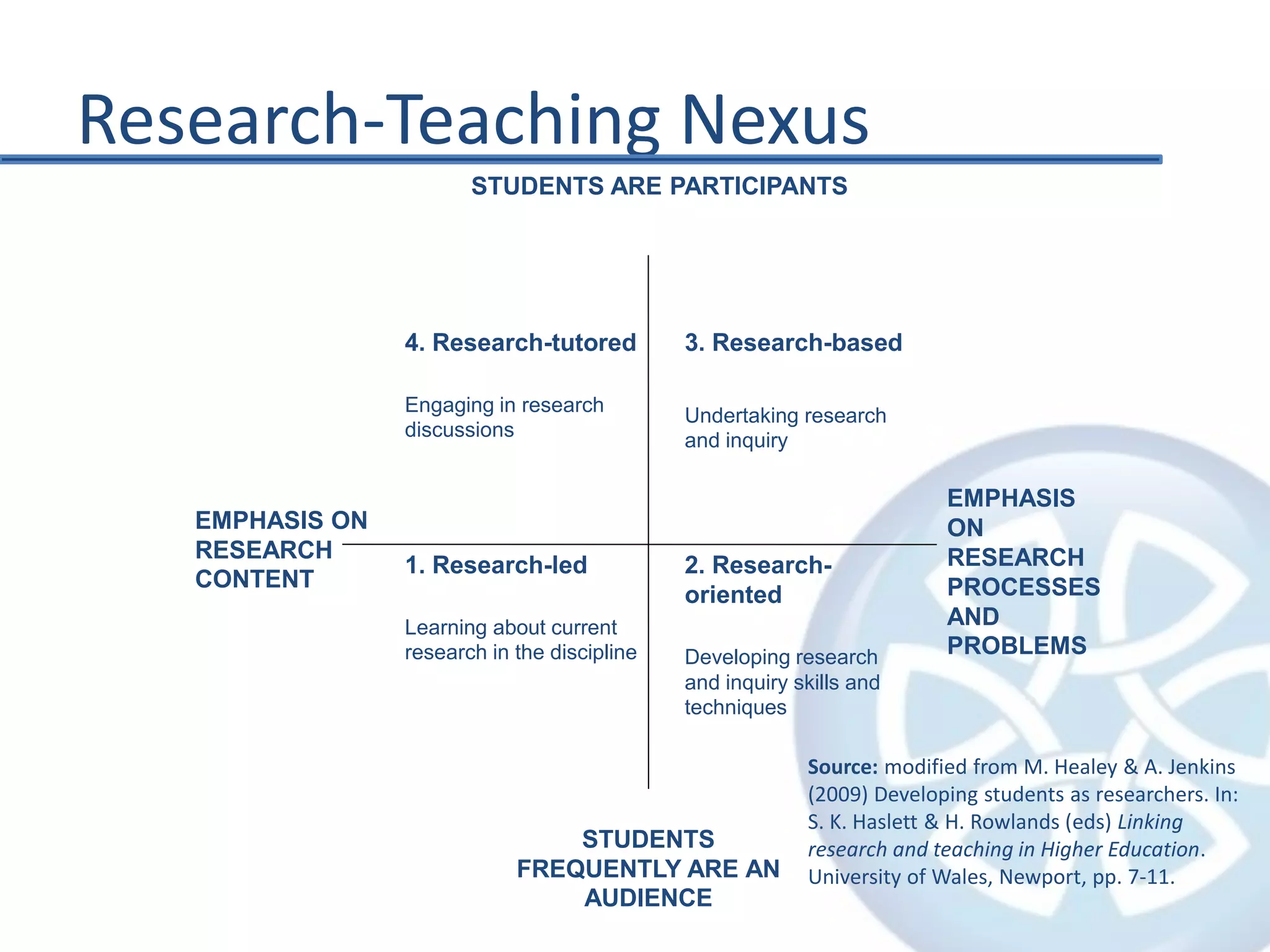
Research-Teaching Nexus
4. Research-tutored
Engaging in research
discussions
3. Research-based
Undertaking research
and inquiry
1. Research-led
Learning about current
research in the discipline
2. Research-
oriented
Developing research
and inquiry skills and
techniques
STUDENTS ARE PARTICIPANTS
EMPHASIS ON
RESEARCH
CONTENT
EMPHASIS
ON
RESEARCH
PROCESSES
AND
PROBLEMS
STUDENTS
FREQUENTLY ARE AN
AUDIENCE
Source: modified from M. Healey & A. Jenkins
(2009) Developing students as researchers. In:
S. K. Haslett & H. Rowlands (eds) Linking
research and teaching in Higher Education.
University of Wales, Newport, pp. 7-11.
Undergraduate Research
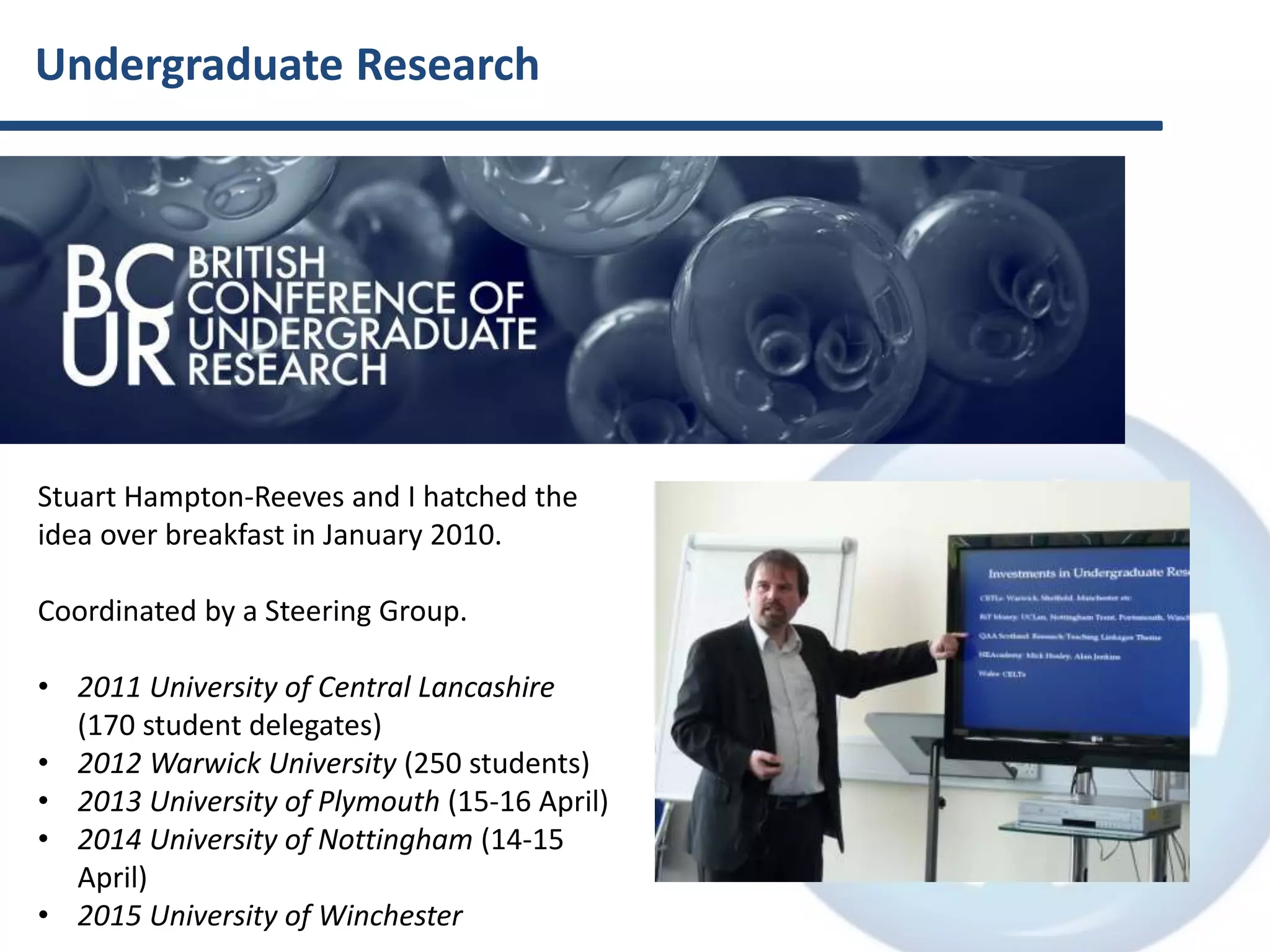
Stuart Hampton-Reeves and I hatched the
idea over breakfast in January 2010.
Coordinated by a Steering Group.
• 2011 University of Central Lancashire
(170 student delegates)
• 2012 Warwick University (250 students)
• 2013 University of Plymouth (15-16 April)
• 2014 University of Nottingham (14-15
April)
• 2015 University of Winchester
Why, what and how?
• Why do/would you do it?
– Strategic e.g. research-informed teaching
– Contractual e.g. teaching-led research
– Personal professional updating/reflection and career
– Disseminate examples of practice
• What do/would you research?
– Generic issues e.g. student engagement
– Case studies e.g. examples of teaching
• How do/would you do it?
– Individually or collaboratively?
– Funding for research and publication e.g. grants?
– Output types e.g. books, articles, conferences?
– Time and space to undertake research and writing?
Institutional Case Study
University of Wales, Newport
• Learning and Teaching Strategy 2007-2010
• “To establish a University-wide research cluster to
lead development in pedagogy”.
• Centre for Excellence in Learning and Teaching
• Develop a sustainable culture in SoLT and PedR.
• Main function of CELT to assist staff in:
– Promoting scholarship of learning and teaching;
– Devising pedagogic research projects;
– Presenting papers at conferences; and
– Writing and disseminating published outcomes.
Promoting SoLT and PedR
• Encourage staff to become active members of L&T
communities of practice.
• Participate in internal L&T activities/schemes.
• Apply for Fellowship of the Higher Education
Academy (map against UK Professional Standards)
• Membership of the Society for Research into Higher
Education (SRHE): Annual Conference at Newport
2009, 2010, 2011, 2012, 2013 and again in 2014?
• Membership of the International Society for the
Scholarship of Teaching and Learning (ISSoTL).
Future Directions
• Owned by the Welsh HE sector, planned and directed by
the Future Directions Steering Group which is
coordinated by the HEA
• encompasses the quality enhancement work being
carried out in the Welsh HE sector
• aims to enhance specific areas of the student learning
experience
• encourages academic and support staff and students
collectively to share current good practice
• generates ideas and models for innovation in learning
and teaching
• Inaugural Conference at Glyndwr University, 2012
• Second Conference at Aberystwyth University, 2014
• Current enhancement theme Global Graduates:
Enabling Flexible Learning
• Three new work strands: (1) Distinctive Graduates, (2)
Inspiring Teaching, (3) Learner Journeys
• http://www.heacademy.ac.uk/wales/future-directions
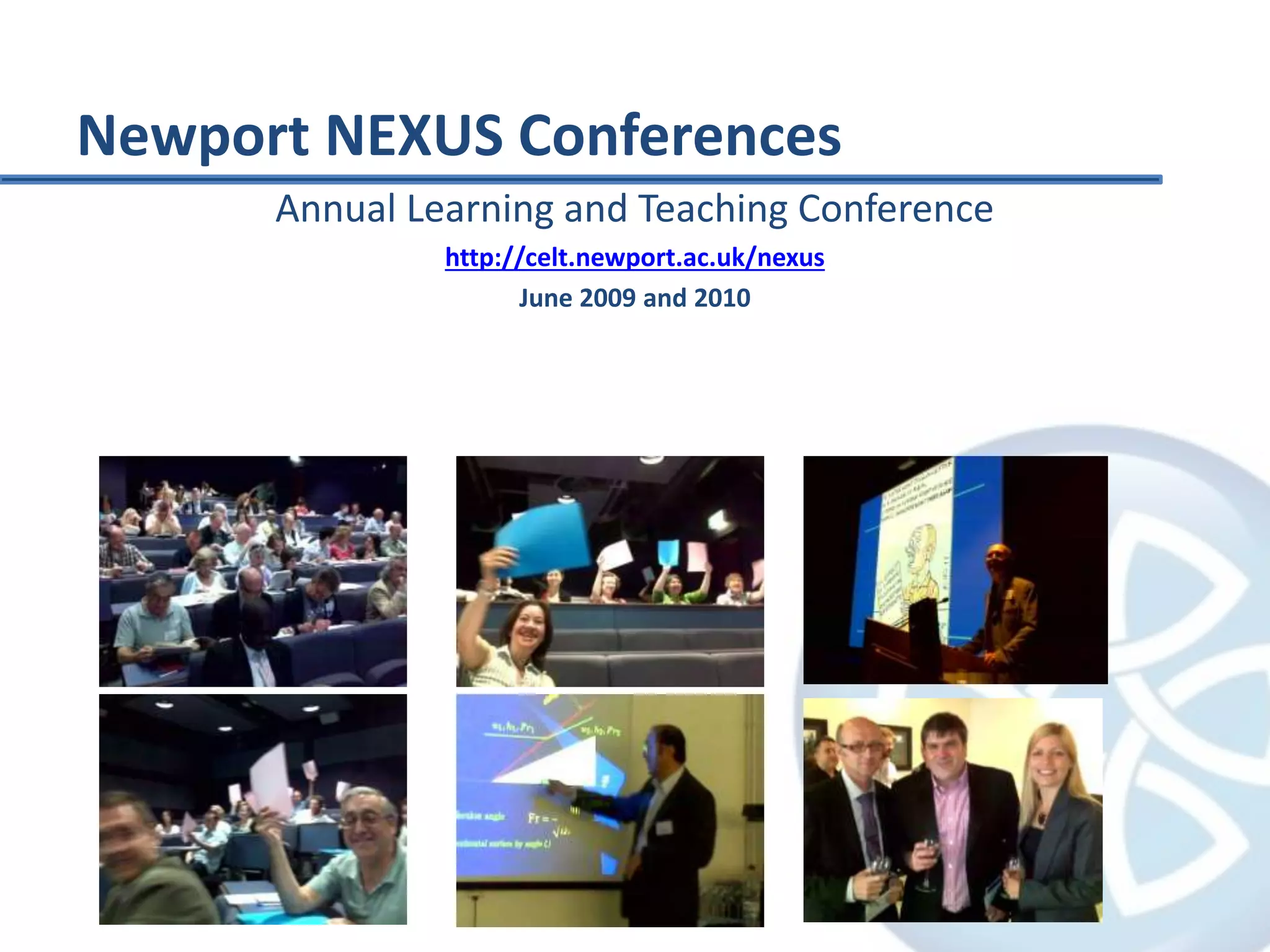
Newport NEXUS Conferences
Annual Learning and Teaching Conference
http://celt.newport.ac.uk/nexus
June 2009 and 2010
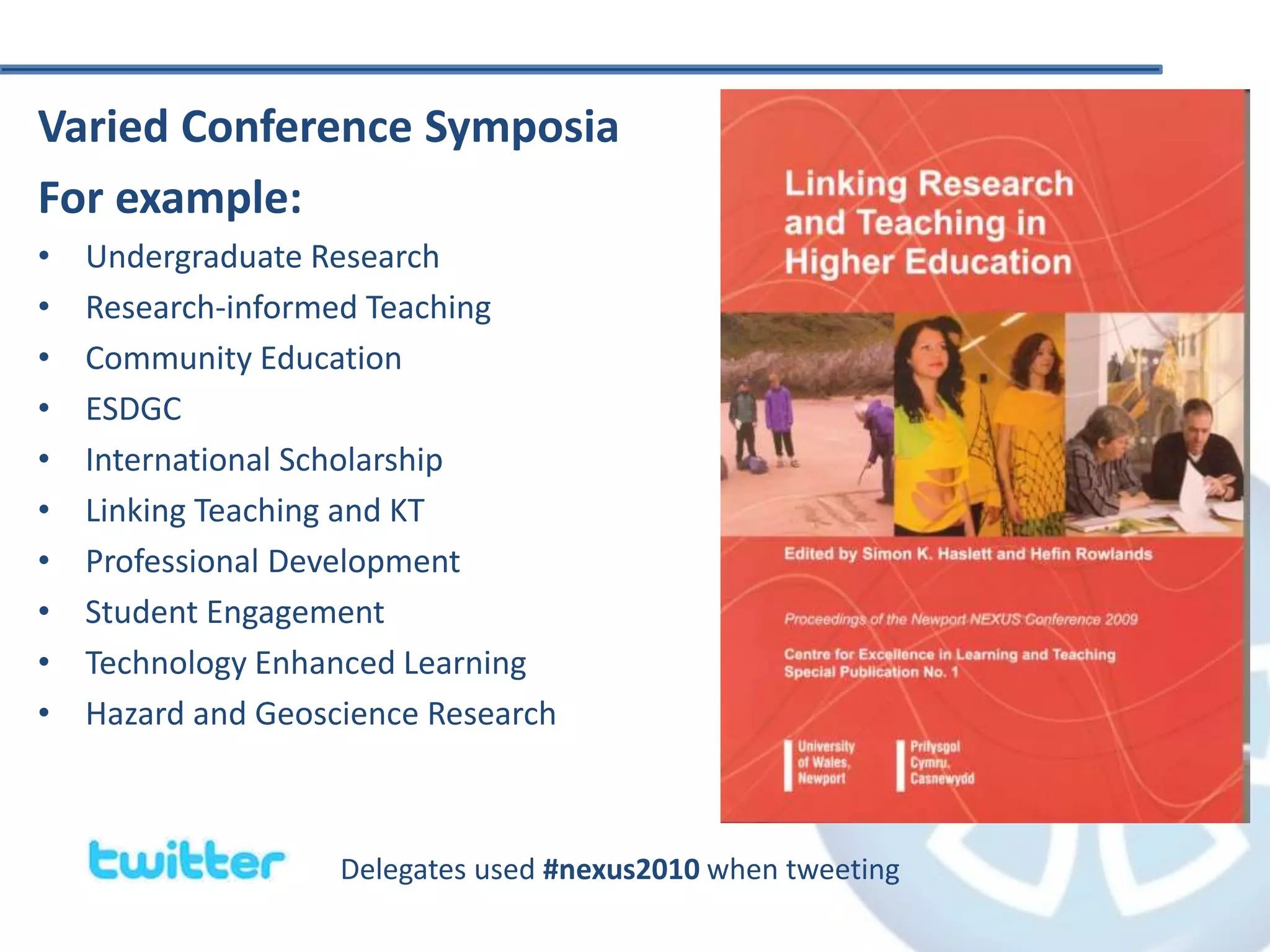
Varied Conference Symposia
For example:
• Undergraduate Research
• Research-informed Teaching
• Community Education
• ESDGC
• International Scholarship
• Linking Teaching and KT
• Professional Development
• Student Engagement
• Technology Enhanced Learning
• Hazard and Geoscience Research
Delegates used #nexus2010 when tweeting
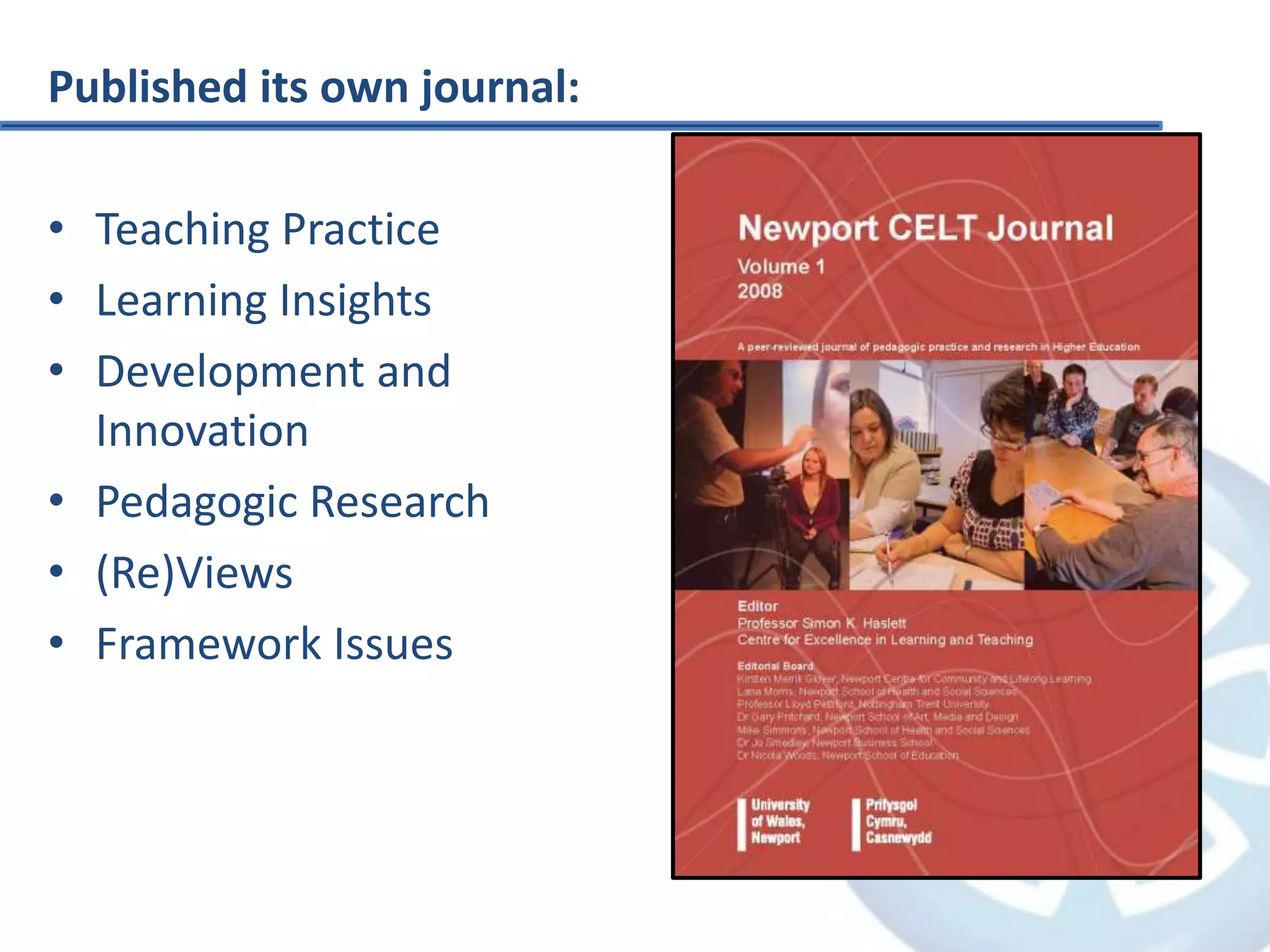
Published its own journal:
• Teaching Practice
• Learning Insights
• Development and
Innovation
• Pedagogic Research
• (Re)Views
• Framework Issues
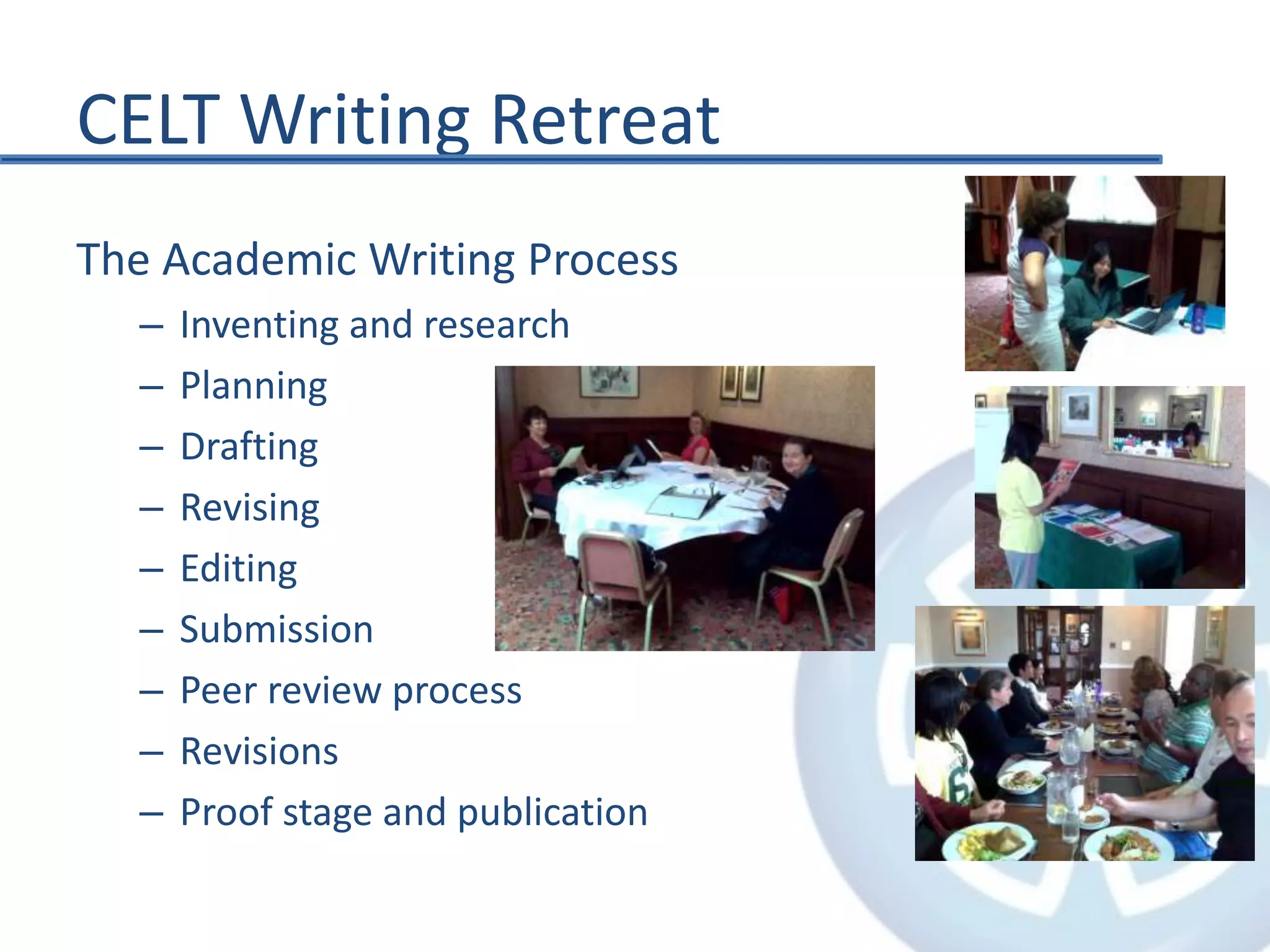
CELT Writing Retreat
The Academic Writing Process
– Inventing and research
– Planning
– Drafting
– Revising
– Editing
– Submission
– Peer review process
– Revisions
– Proof stage and publication
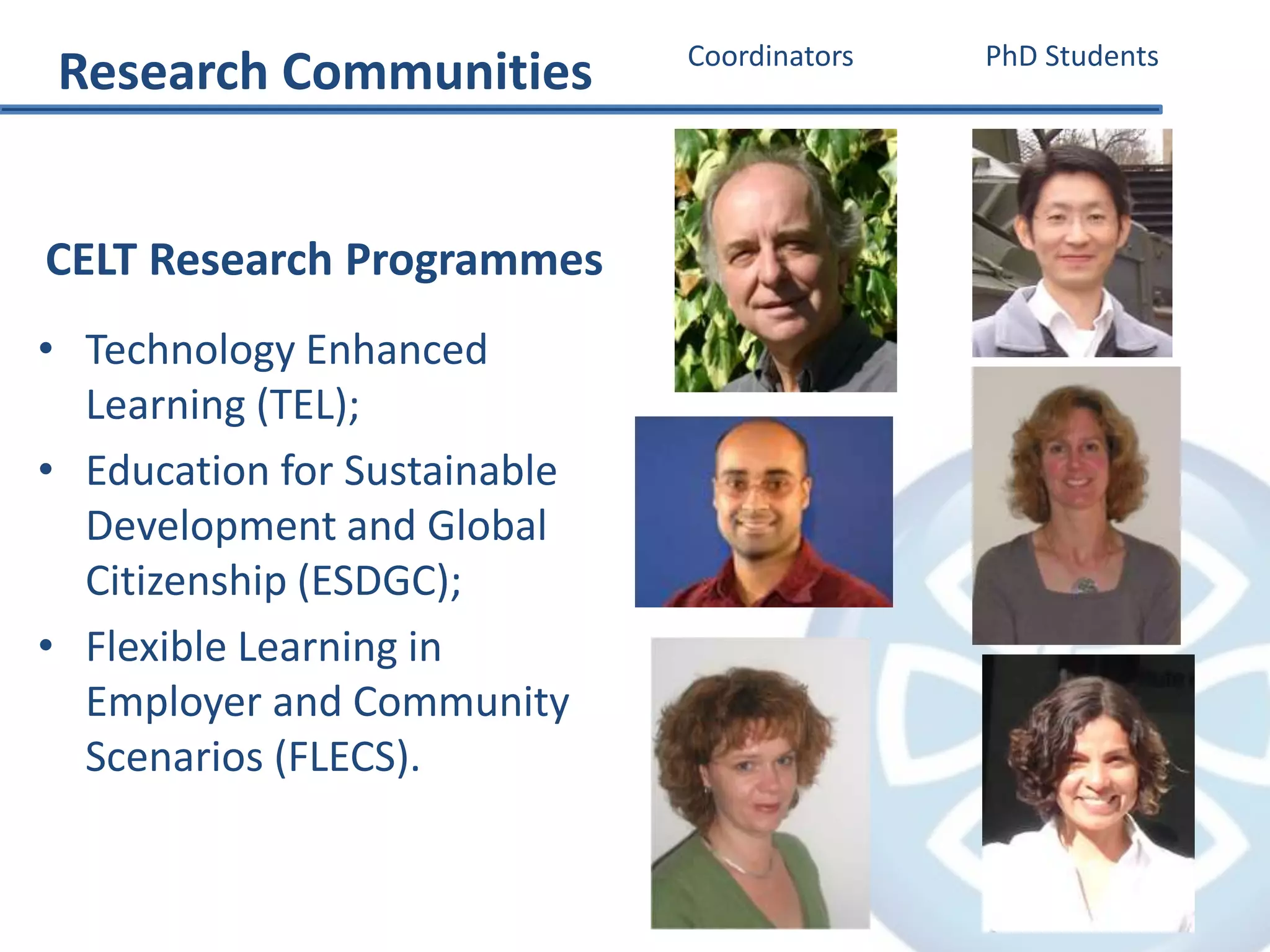
CELT Research Programmes
• Technology Enhanced
Learning (TEL);
• Education for Sustainable
Development and Global
Citizenship (ESDGC);
• Flexible Learning in
Employer and Community
Scenarios (FLECS).
Coordinators PhD Students
Research Communities
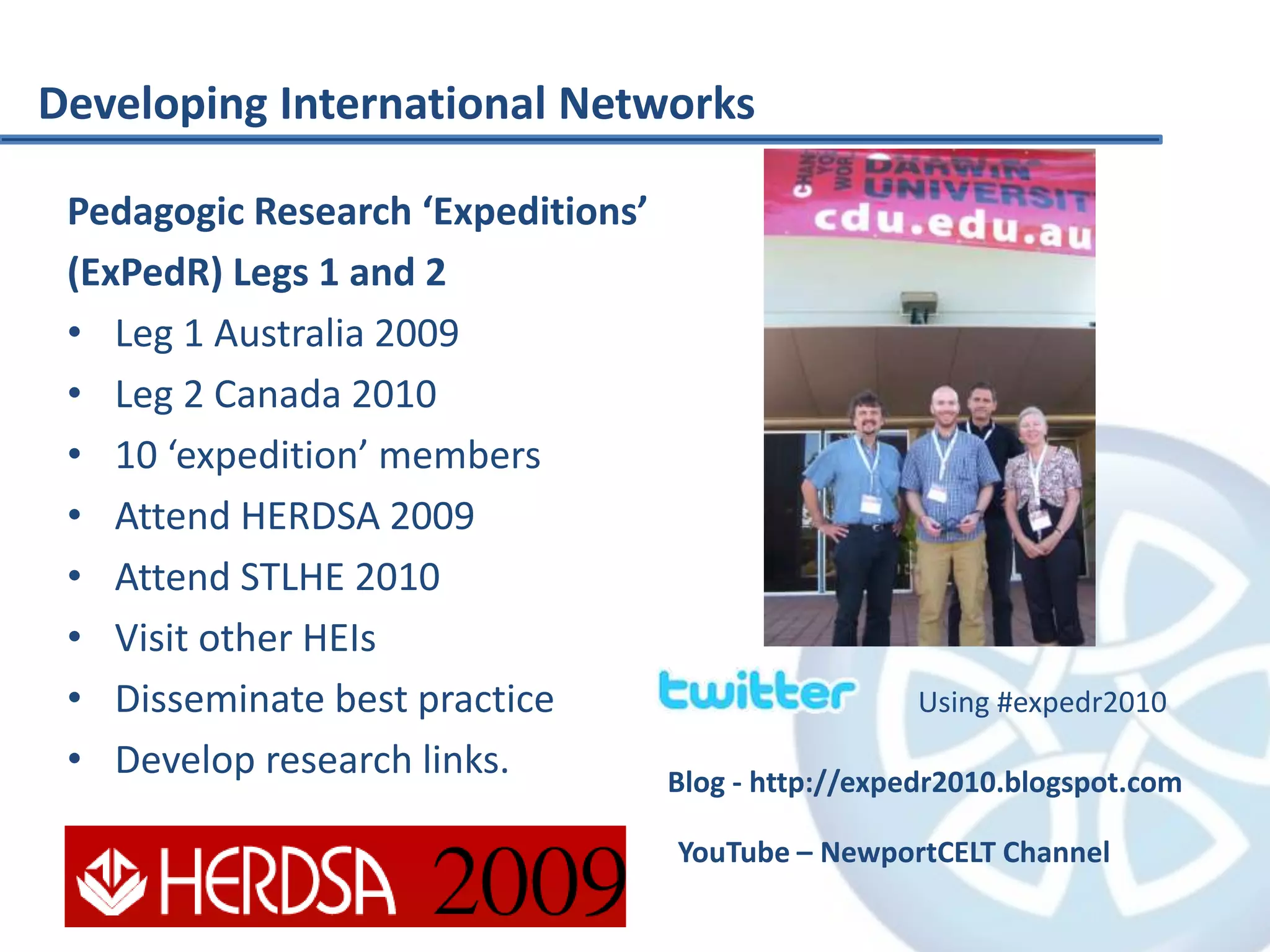
Pedagogic Research ‘Expeditions’
(ExPedR) Legs 1 and 2
• Leg 1 Australia 2009
• Leg 2 Canada 2010
• 10 ‘expedition’ members
• Attend HERDSA 2009
• Attend STLHE 2010
• Visit other HEIs
• Disseminate best practice
• Develop research links.
Using #expedr2010
Blog - http://expedr2010.blogspot.com
YouTube – NewportCELT Channel
Developing International Networks
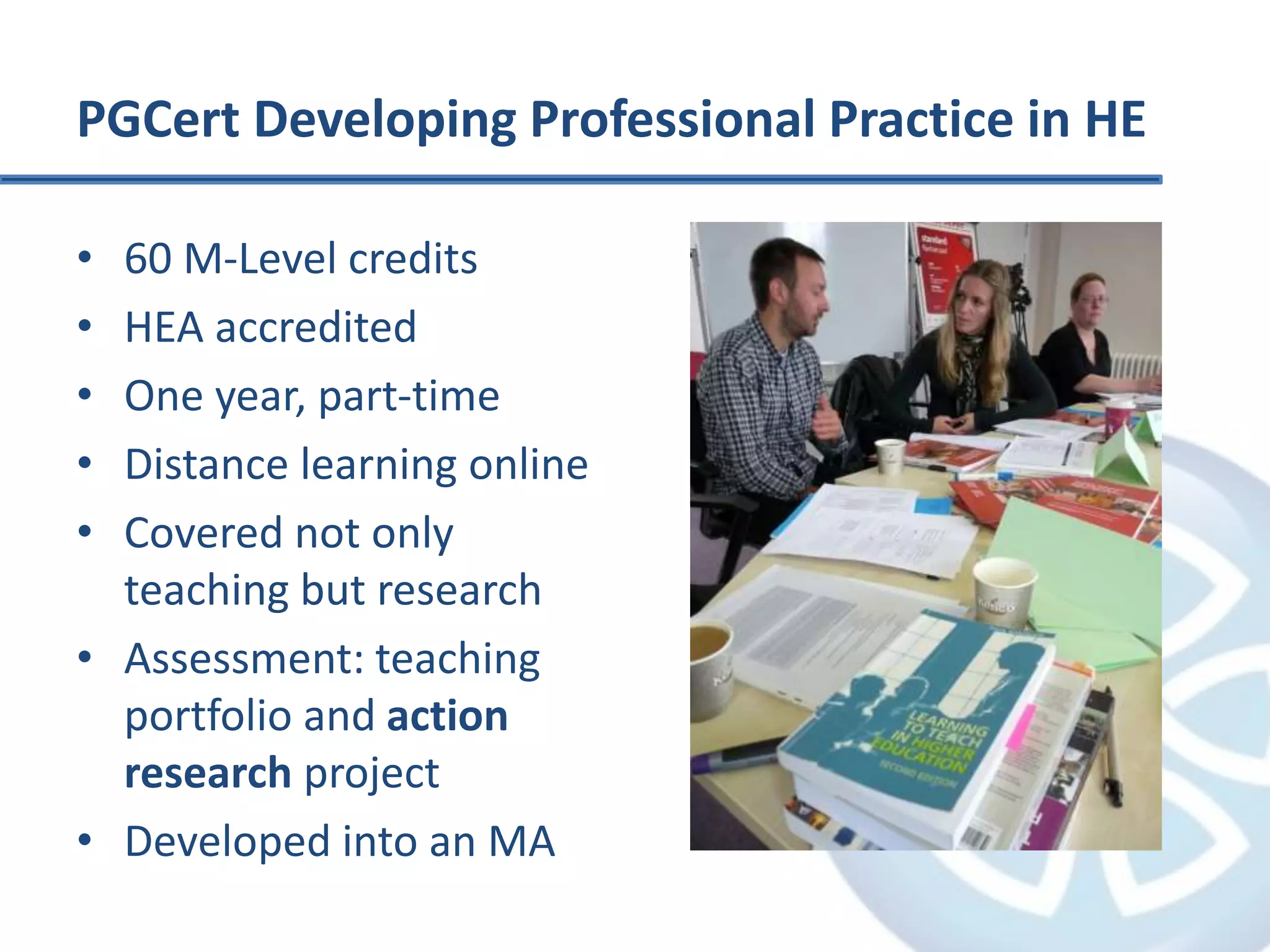
PGCert Developing Professional Practice in HE
• 60 M-Level credits
• HEA accredited
• One year, part-time
• Distance learning online
• Covered not only
teaching but research
• Assessment: teaching
portfolio and action
research project
• Developed into an MA
An Individual Approach
an example from my own curriculum
• Bath Spa University Geography
Department, set up in 1968-69.
• 1994 started as Lecturer in Physical
Geography: teaching and research.
• Inherited courses, but adapted them and
developed new courses.
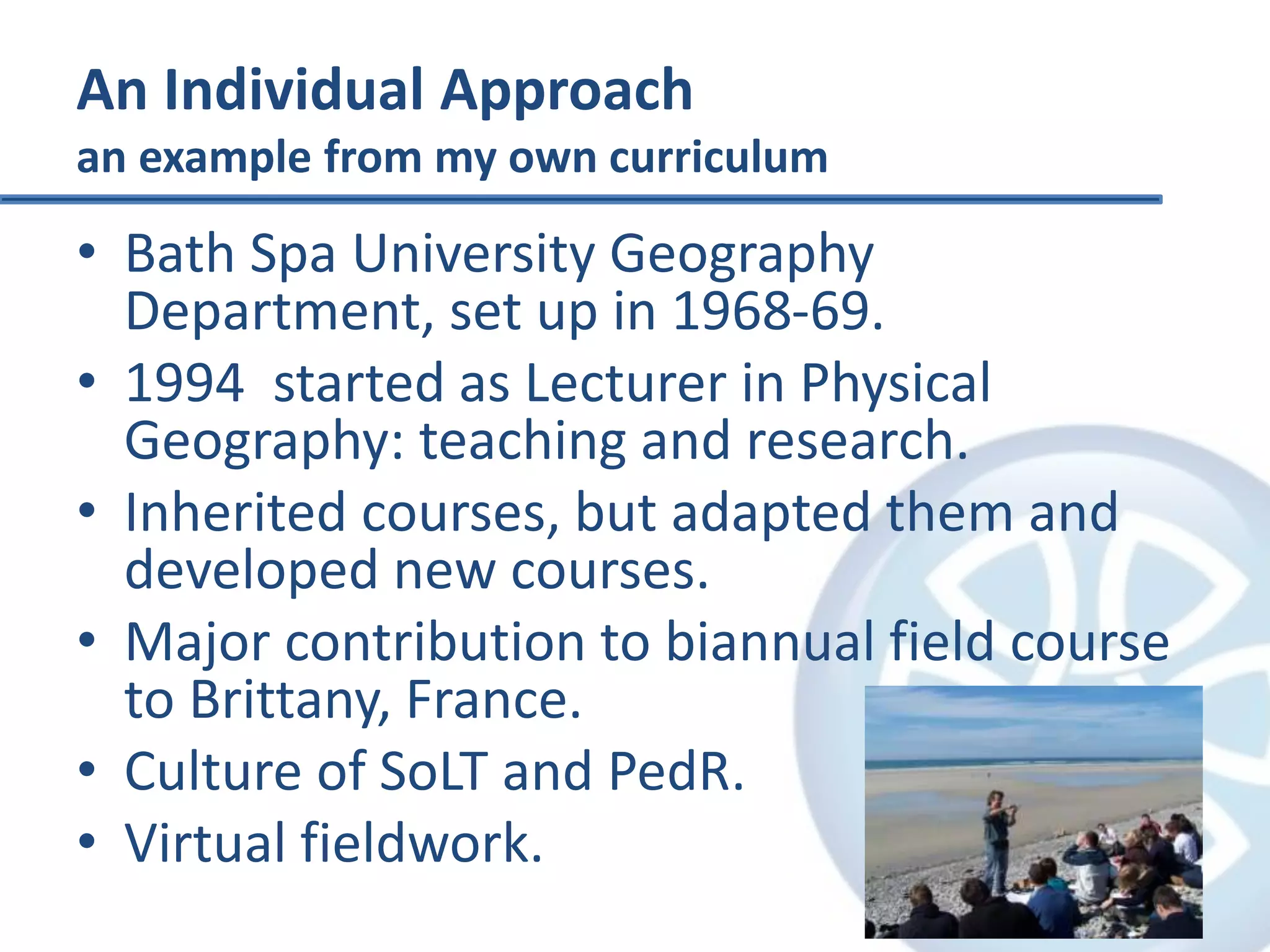
• Major contribution to biannual field course
to Brittany, France.
• Culture of SoLT and PedR.
• Virtual fieldwork.
Google Earth Research
• Geographers are quick
to explore
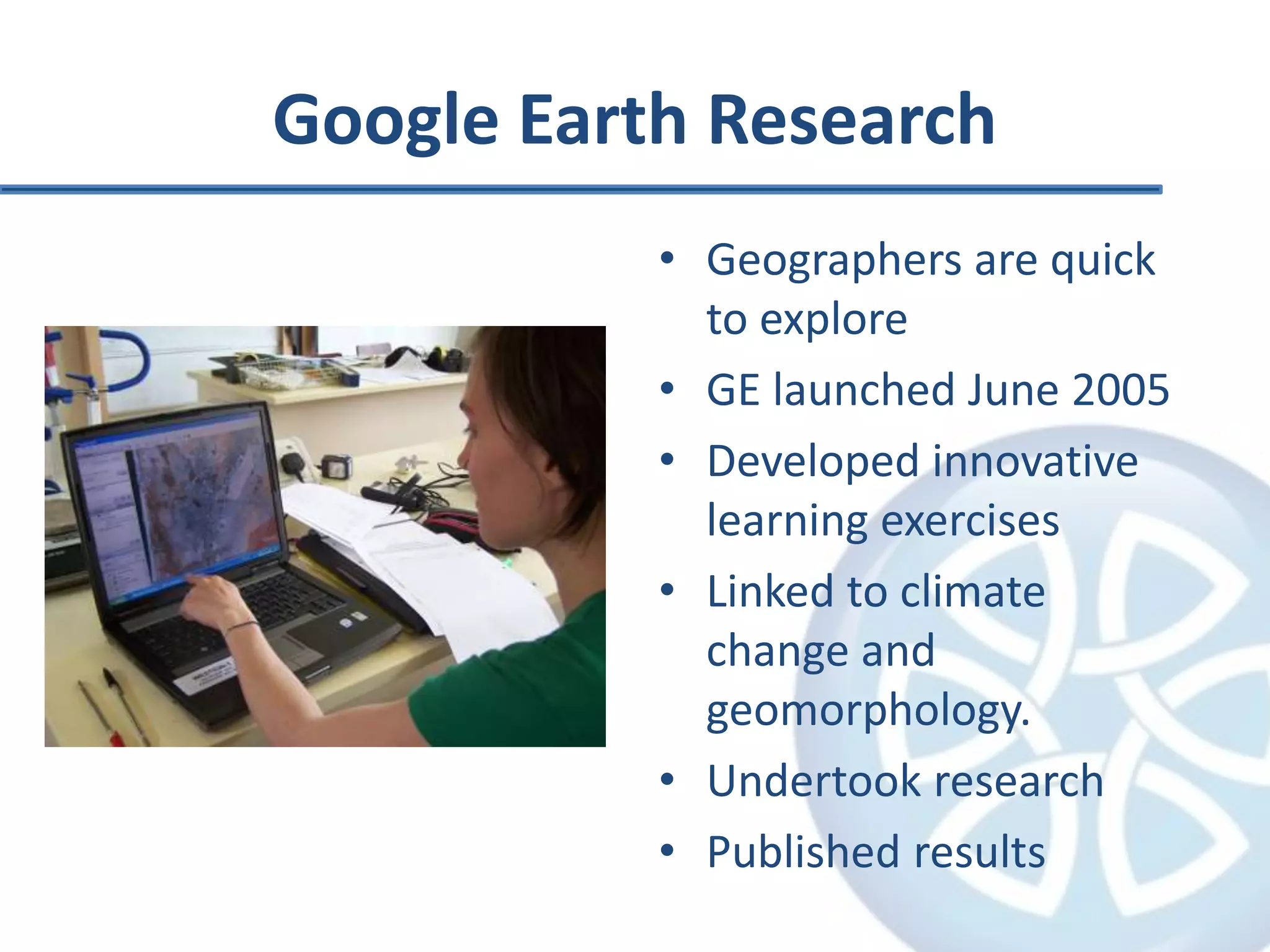
• GE launched June 2005
• Developed innovative
learning exercises
• Linked to climate
change and
geomorphology.
• Undertook research
• Published results
Google Earth Research
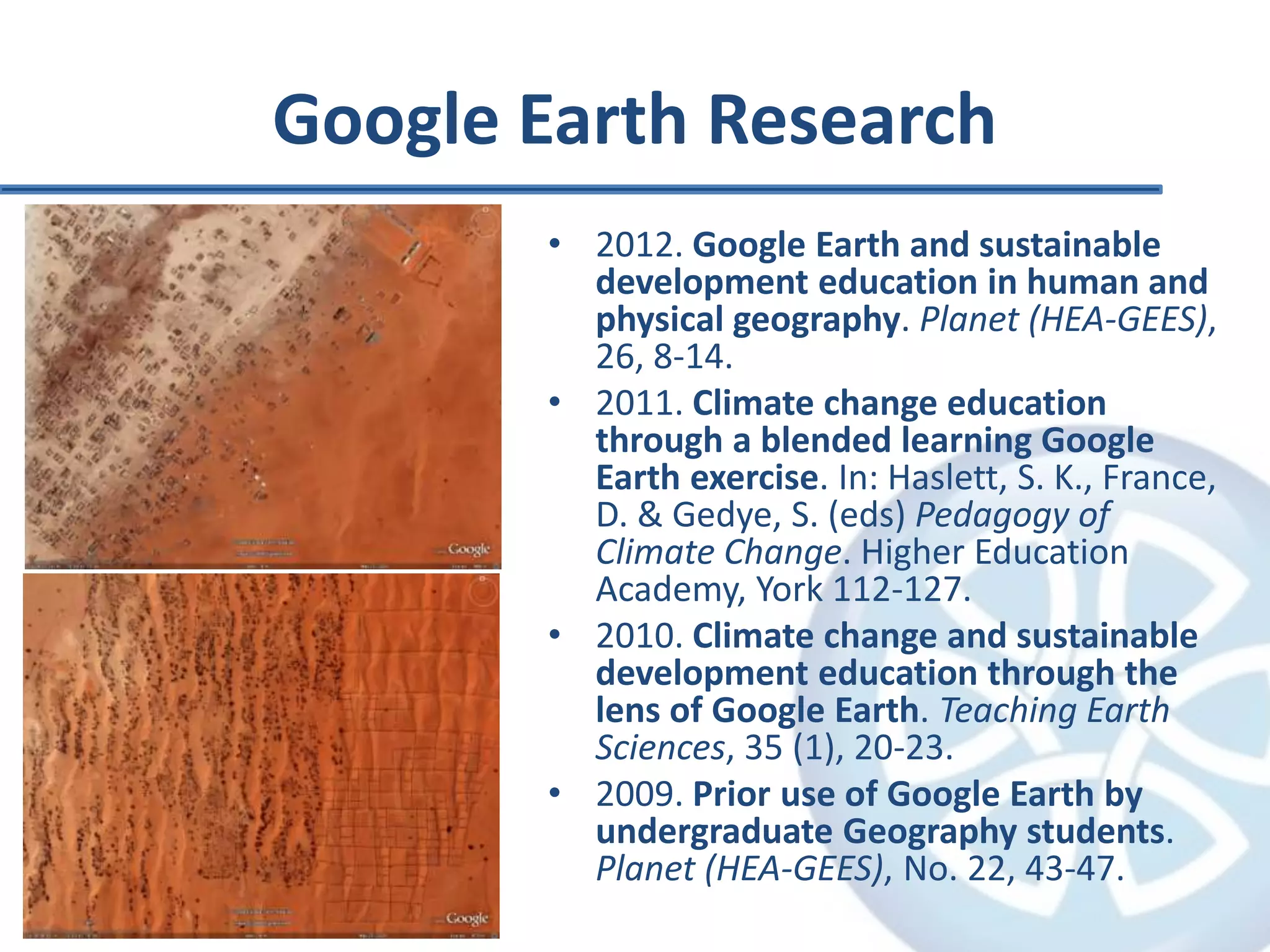
• 2012. Google Earth and sustainable
development education in human and
physical geography. Planet (HEA-GEES),
26, 8-14.
• 2011. Climate change education
through a blended learning Google
Earth exercise. In: Haslett, S. K., France,
D. & Gedye, S. (eds) Pedagogy of
Climate Change. Higher Education
Academy, York 112-127.
• 2010. Climate change and sustainable
development education through the
lens of Google Earth. Teaching Earth
Sciences, 35 (1), 20-23.
• 2009. Prior use of Google Earth by
undergraduate Geography students.
Planet (HEA-GEES), No. 22, 43-47.
Pedagogy of Climate Change
• Topic broadened
• Community developed
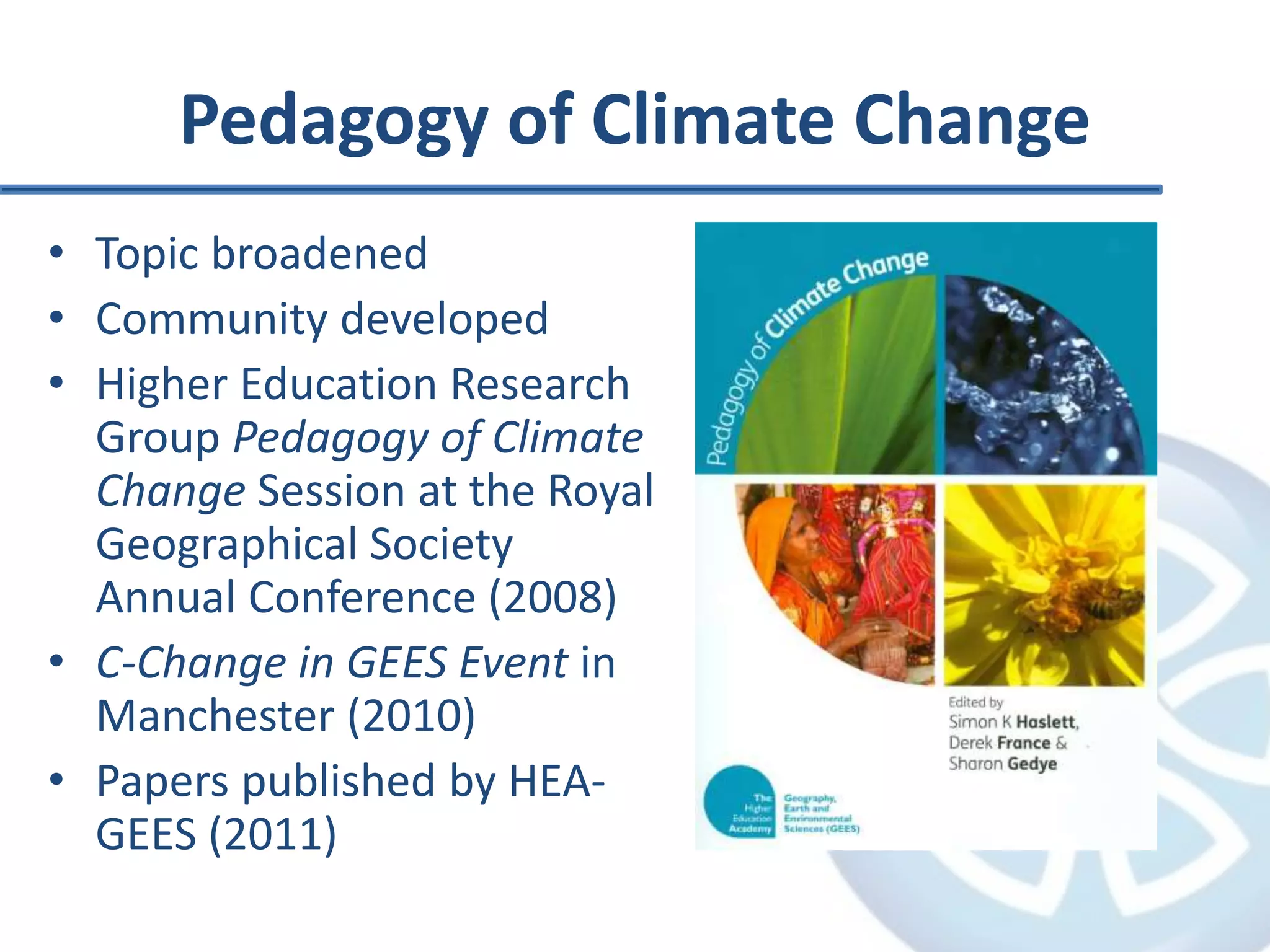
• Higher Education Research
Group Pedagogy of Climate
Change Session at the Royal
Geographical Society
Annual Conference (2008)
• C-Change in GEES Event in
Manchester (2010)
• Papers published by HEA-
GEES (2011)
Summary – Sustaining RiT
• Research-informed teaching =
curriculum + pedagogy
– Discipline-based research
– SoLT and PedR
• Promote and embed at
institutional level
• Develop departmental and
individual approaches
• Be innovative, try new things
• Involve others and join or
develop communities
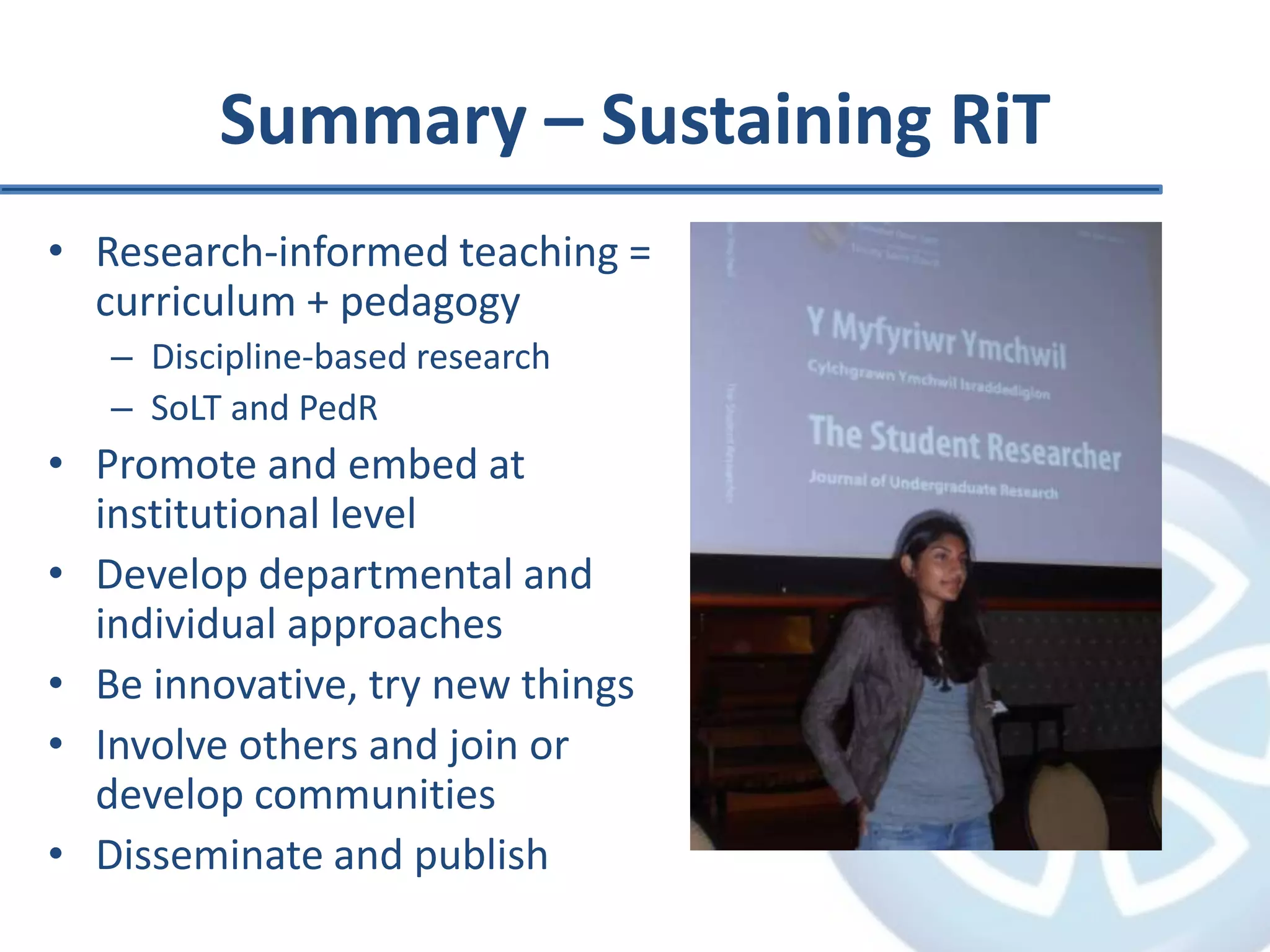
• Disseminate and publish
Thank you
For further information:
• Join the HEA R-T Nexus Blog http://nexus-wales.blogspot.ac.uk
• Linking research and teaching in Wales (2010) S. K. Haslett (ed.)
http://www.heacademy.ac.uk/assets/York/documents/ourwork/
nations/wales/WalesRandTNexusENGLISH_Jun10.pdf
• Future Directions http://www.heacademy.ac.uk/wales/future-
directions
• British Conference for Undergraduate Research (BCUR)
http://www.bcur.org
• The Student Researcher http://www.uwtsd.ac.uk/library/the-
student-researcher/
• Strengthen Research-Teaching Links in your institutional
strategies.

Sustaining research-informed teaching: institutional and individual approaches.

  • 1.
    Sustaining research-informed teaching: institutionaland individual approaches. Professor Simon Haslett Associate Pro Vice-Chancellor Collective Address presented 4th April 2014 Higher Education Academy Awards Day Open University, Cardiff @ProfSHaslett
  • 2.
    The R-T NexusAction Set • Higher Education Academy Welsh Institutional Group set up the Research- Teaching (R-T) Nexus Action Set. • Representatives from Welsh HEIs at biannual meetings. • To celebrate/promote all R-T links. • Action Set Activity: – Newport Meeting (February 2009) – Gregynog Conference (Sept 2009) – Swansea Meeting (March 2010) – Publication of book (June 2010) – Undergraduate Research Workshop, Carmarthen (Sept 2010) – R-T Practice workshop, Aberystwyth (Feb 2011) – 2nd Gregynog Conference (Sept 2011) – 3rd Gregynog Conference (Sept 2013) Action Set Blog http://nexus-wales.blogspot.com/
  • 3.
  • 4.
    Demystifying R-T Links •Scholarship of Learning and Teaching (SoLT) • Scholarship of Teaching and Learning (SoTL) • Pedagogic Research (PedR) • Research-informed Teaching (RiT) • Research-Teaching Nexus (R-T Nexus) • Undergraduate Research • Research-Teaching Complex (R-T Complex)
  • 5.
    SoLT and PedR Scholarshipis keeping up-to-date through, including, academic reading, attending workshops and conferences, training, and perhaps dissemination (writing, speaking, training, mentoring). • individually-focused scholarship for personal use; • internally-focused scholarship for ‘local’ (e.g. departmental, institutional, community) use; • research for external dissemination at conferences and in publications (i.e. pedagogic research). (from Haslett, 2009, based on Ashwin and Trigwell, 2004; RAE, 2005)
  • 6.
    Research-informed Teaching “Systematic inquiryinto the L & T process” (Jenkins et al., 2007) My view is different.
  • 7.
    From Haslett (2009)Newport CELT Journal, Vol. 2. The Research-Teaching Complex
  • 8.
    Research-Teaching Nexus 4. Research-tutored Engagingin research discussions 3. Research-based Undertaking research and inquiry 1. Research-led Learning about current research in the discipline 2. Research- oriented Developing research and inquiry skills and techniques STUDENTS ARE PARTICIPANTS EMPHASIS ON RESEARCH CONTENT EMPHASIS ON RESEARCH PROCESSES AND PROBLEMS STUDENTS FREQUENTLY ARE AN AUDIENCE Source: modified from M. Healey & A. Jenkins (2009) Developing students as researchers. In: S. K. Haslett & H. Rowlands (eds) Linking research and teaching in Higher Education. University of Wales, Newport, pp. 7-11.
  • 9.
    Undergraduate Research Stuart Hampton-Reevesand I hatched the idea over breakfast in January 2010. Coordinated by a Steering Group. • 2011 University of Central Lancashire (170 student delegates) • 2012 Warwick University (250 students) • 2013 University of Plymouth (15-16 April) • 2014 University of Nottingham (14-15 April) • 2015 University of Winchester
  • 10.
    Why, what andhow? • Why do/would you do it? – Strategic e.g. research-informed teaching – Contractual e.g. teaching-led research – Personal professional updating/reflection and career – Disseminate examples of practice • What do/would you research? – Generic issues e.g. student engagement – Case studies e.g. examples of teaching • How do/would you do it? – Individually or collaboratively? – Funding for research and publication e.g. grants? – Output types e.g. books, articles, conferences? – Time and space to undertake research and writing?
  • 11.
    Institutional Case Study Universityof Wales, Newport • Learning and Teaching Strategy 2007-2010 • “To establish a University-wide research cluster to lead development in pedagogy”. • Centre for Excellence in Learning and Teaching • Develop a sustainable culture in SoLT and PedR. • Main function of CELT to assist staff in: – Promoting scholarship of learning and teaching; – Devising pedagogic research projects; – Presenting papers at conferences; and – Writing and disseminating published outcomes.
  • 12.
    Promoting SoLT andPedR • Encourage staff to become active members of L&T communities of practice. • Participate in internal L&T activities/schemes. • Apply for Fellowship of the Higher Education Academy (map against UK Professional Standards) • Membership of the Society for Research into Higher Education (SRHE): Annual Conference at Newport 2009, 2010, 2011, 2012, 2013 and again in 2014? • Membership of the International Society for the Scholarship of Teaching and Learning (ISSoTL).
  • 13.
    Future Directions • Ownedby the Welsh HE sector, planned and directed by the Future Directions Steering Group which is coordinated by the HEA • encompasses the quality enhancement work being carried out in the Welsh HE sector • aims to enhance specific areas of the student learning experience • encourages academic and support staff and students collectively to share current good practice • generates ideas and models for innovation in learning and teaching • Inaugural Conference at Glyndwr University, 2012 • Second Conference at Aberystwyth University, 2014 • Current enhancement theme Global Graduates: Enabling Flexible Learning • Three new work strands: (1) Distinctive Graduates, (2) Inspiring Teaching, (3) Learner Journeys • http://www.heacademy.ac.uk/wales/future-directions
  • 14.
    Newport NEXUS Conferences AnnualLearning and Teaching Conference http://celt.newport.ac.uk/nexus June 2009 and 2010
  • 15.
    Varied Conference Symposia Forexample: • Undergraduate Research • Research-informed Teaching • Community Education • ESDGC • International Scholarship • Linking Teaching and KT • Professional Development • Student Engagement • Technology Enhanced Learning • Hazard and Geoscience Research Delegates used #nexus2010 when tweeting
  • 16.
    Published its ownjournal: • Teaching Practice • Learning Insights • Development and Innovation • Pedagogic Research • (Re)Views • Framework Issues
  • 17.
    CELT Writing Retreat TheAcademic Writing Process – Inventing and research – Planning – Drafting – Revising – Editing – Submission – Peer review process – Revisions – Proof stage and publication
  • 18.
    CELT Research Programmes •Technology Enhanced Learning (TEL); • Education for Sustainable Development and Global Citizenship (ESDGC); • Flexible Learning in Employer and Community Scenarios (FLECS). Coordinators PhD Students Research Communities
  • 19.
    Pedagogic Research ‘Expeditions’ (ExPedR)Legs 1 and 2 • Leg 1 Australia 2009 • Leg 2 Canada 2010 • 10 ‘expedition’ members • Attend HERDSA 2009 • Attend STLHE 2010 • Visit other HEIs • Disseminate best practice • Develop research links. Using #expedr2010 Blog - http://expedr2010.blogspot.com YouTube – NewportCELT Channel Developing International Networks
  • 20.
    PGCert Developing ProfessionalPractice in HE • 60 M-Level credits • HEA accredited • One year, part-time • Distance learning online • Covered not only teaching but research • Assessment: teaching portfolio and action research project • Developed into an MA
  • 21.
    An Individual Approach anexample from my own curriculum • Bath Spa University Geography Department, set up in 1968-69. • 1994 started as Lecturer in Physical Geography: teaching and research. • Inherited courses, but adapted them and developed new courses. • Major contribution to biannual field course to Brittany, France. • Culture of SoLT and PedR. • Virtual fieldwork.
  • 22.
    Google Earth Research •Geographers are quick to explore • GE launched June 2005 • Developed innovative learning exercises • Linked to climate change and geomorphology. • Undertook research • Published results
  • 23.
    Google Earth Research •2012. Google Earth and sustainable development education in human and physical geography. Planet (HEA-GEES), 26, 8-14. • 2011. Climate change education through a blended learning Google Earth exercise. In: Haslett, S. K., France, D. & Gedye, S. (eds) Pedagogy of Climate Change. Higher Education Academy, York 112-127. • 2010. Climate change and sustainable development education through the lens of Google Earth. Teaching Earth Sciences, 35 (1), 20-23. • 2009. Prior use of Google Earth by undergraduate Geography students. Planet (HEA-GEES), No. 22, 43-47.
  • 24.
    Pedagogy of ClimateChange • Topic broadened • Community developed • Higher Education Research Group Pedagogy of Climate Change Session at the Royal Geographical Society Annual Conference (2008) • C-Change in GEES Event in Manchester (2010) • Papers published by HEA- GEES (2011)
  • 25.
    Summary – SustainingRiT • Research-informed teaching = curriculum + pedagogy – Discipline-based research – SoLT and PedR • Promote and embed at institutional level • Develop departmental and individual approaches • Be innovative, try new things • Involve others and join or develop communities • Disseminate and publish
  • 26.
    Thank you For furtherinformation: • Join the HEA R-T Nexus Blog http://nexus-wales.blogspot.ac.uk • Linking research and teaching in Wales (2010) S. K. Haslett (ed.) http://www.heacademy.ac.uk/assets/York/documents/ourwork/ nations/wales/WalesRandTNexusENGLISH_Jun10.pdf • Future Directions http://www.heacademy.ac.uk/wales/future- directions • British Conference for Undergraduate Research (BCUR) http://www.bcur.org • The Student Researcher http://www.uwtsd.ac.uk/library/the- student-researcher/ • Strengthen Research-Teaching Links in your institutional strategies.