Security
in the
Software
Development
Life
Cycle
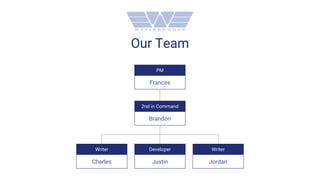
Our Team
PM
Frances
2nd in Command
Brandon
Writer
Charles
Developer
Justin
Writer
Jordan
Phase 1
Frances
❖ Planning
❖ Analyzing Risk
❖ Cost Analysis
❖ Security Requirements
[1][2][3][4][5]
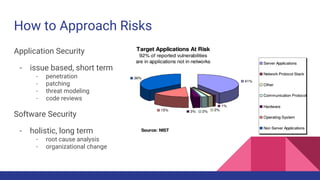
How to Approach Risks
Application Security
- issue based, short term
- penetration
- patching
- threat modeling
- code reviews
Software Security
- holistic, long term
- root cause analysis
- organizational change
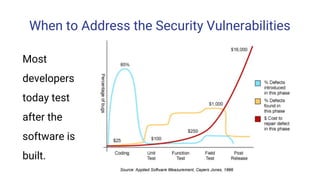
When to Address the Security Vulnerabilities
Most
developers
today test
after the
software is
built.
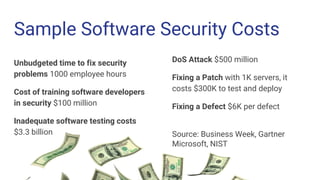
Sample Software Security Costs
Unbudgeted time to fix security
problems 1000 employee hours
Cost of training software developers
in security $100 million
Inadequate software testing costs
$3.3 billion
DoS Attack $500 million
Fixing a Patch with 1K servers, it
costs $300K to test and deploy
Fixing a Defect $6K per defect
Source: Business Week, Gartner
Microsoft, NIST
So how do we do it?
● define roadmaps for
software security
● define entry scenarios
● define strategic activity
tracks
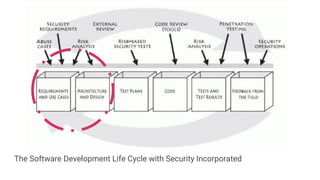
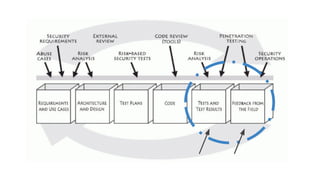
The Software Development Life Cycle with Security Incorporated
Phase 2
Brandon
❖ Designing Securely
❖ Integration of
Security
❖ Implementation
Designing Securely
Influence
- Establish and follow best practices
- best time to implement a security plan is early in
the life cycle
- threat modeling must be completed during this
phase
- Security Requirements
- security design review with an advisor for a project
- Privacy Requirements
- complete detailed privacy analysis
- have a privacy subject matter expert
Integration of Security
Recommendations
- Functional and Design Spec
- section dedicated to impacts on security
- Security architecture document
- provides a description of security on a software
project
- Attack surface Measurement
- Product structure
- Minimize default attack surface
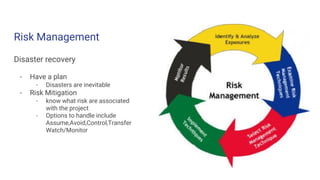
Risk Management
Disaster recovery
- Have a plan
- Disasters are inevitable
- Risk Mitigation
- know what risk are associated
with the project
- Options to handle include
Assume,Avoid,Control,Transfer
Watch/Monitor
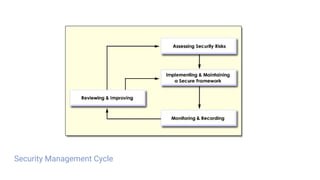
Security Management Cycle
Steps for Creating a Secure
Design
● Making sure proper security protocols are defined
● Having a solid Security Plan and Disaster Recovery Plan
● Review Security protocols with experts in security
Phase 3
Charles
❖ Implementation
Phase
❖ Securing the
Implementation
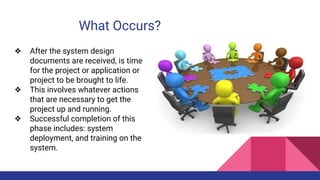
What Occurs?
❖ After the system design
documents are received, is time
for the project or application or
project to be brought to life.
❖ This involves whatever actions
that are necessary to get the
project up and running.
❖ Successful completion of this
phase includes: system
deployment, and training on the
system.
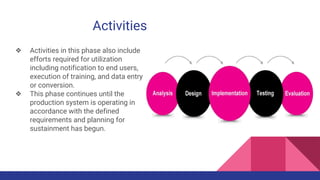
Activities
❖ Activities in this phase also include
efforts required for utilization
including notification to end users,
execution of training, and data entry
or conversion.
❖ This phase continues until the
production system is operating in
accordance with the defined
requirements and planning for
sustainment has begun.
Security in the Implementation
Phase
❖ When security comes into play
in this phase there are several
actions that must be taken.
❖ One must create and maintain a
list of recommended software
frameworks, services and other
software components.
Security (cont.)
❖ In addition, one must develop a
list of guiding security principles
as a checklist against detailed
designs.
❖ Also, one must distribute,
promote and apply the design
principles to the project that is
in development.
Reviewing
❖ The reviewing and analysis of
the software’s code is also
required to ensure security.
❖ It is essential to review the code
for the software being
developed not only amongst
yourself, but amongst your
peers as well.
❖ This portion of the phase is
essential to the success of the
project.
Security in the
Testing Phase
Justin
❖ Security testing in software.
❖ Types of Software Testing
❖ What it means to have
secure software.
What is Security Testing in Software
❖ Security Testing in software is the process of
revealing possible vulnerabilities in the
system.
❖ Ensuring software quality
➢ Reliability: All functions within the
software works.
➢ Resiliency: Software that can withstand
attempts of attackers.
➢ Recoverability: Software that can be
restored if something goes wrong with
a function or its resiliency.
How to approach Security Testing
❖ Thinking outside the box
➢ Think like an attacker in some cases
from a user’s perspective, and it other
cases from a developer’s perspective.
❖ Must have a passion for technology
➢ Stay up to date with new technologies
and adjust to new attack strategies.
➢ More than 317 million new pieces of
malware was created in 2014.
Types of Software Testing
❖ Functional testing
➢ Unit testing breaks the software into smaller parts and tests
each part individually
➢ Logic testing validates the accuracy of the software’s process
logic
❖ Performance testing
➢ How the software performs when subjected to large volumes of
data
➢ How the software performs when the peak load is exceeded
❖ Security testing
➢ Ensures the software is designed and developed in a way that
reduces the risk of exploitation
➢ Black Box/White Box Testing
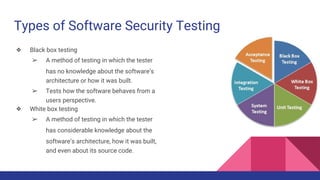
Types of Software Security Testing
❖ Black box testing
➢ A method of testing in which the tester
has no knowledge about the software’s
architecture or how it was built.
➢ Tests how the software behaves from a
users perspective.
❖ White box testing
➢ A method of testing in which the tester
has considerable knowledge about the
software’s architecture, how it was built,
and even about its source code.
What is means to have secure software
❖ Successfully testing software
means to have quality software and
achieve software assurance.
❖ Can we adequately secure software
through testing?
Phase 5
Jordan
❖ Maintenance Phase
Maintenance Phase
❖ According to ithandbook.ffiec.gov, The Maintenance Phase involves making
changes to hardware, software, and documentation to support its operational
effectiveness
❖ This includes making changes to improve a system’s performance, enhance
security, correct problems, and/or address user requirements
❖ Establishing appropriate change management standards and procedures
helps to ensure mods do not disrupt operations or negatively affects a
system’s security or performance.
Maintenance Phase
❖ Systems and Products are put in place and operating enhancements are developed and
tested, also hardware and software components are added or replaced.
❖ Configuration Management and control activities should be conducted to document any
proposed or actual changes in security plan of the system.
❖ Documenting information system modifications and evaluating the impact of these
changes on the security of a system are ideal when trying to prevent lapses in the system
security accreditation
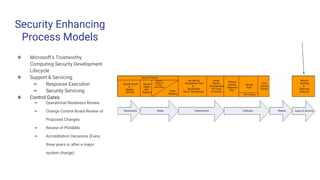
Security Enhancing
Process Models
❖ Microsoft’s Trustworthy
Computing Security Development
Lifecycle
❖ Support & Servicing
➢ Response Execution
➢ Security Servicing
❖ Control Gates
➢ Operational Readiness Review
➢ Change Control Board Review of
Proposed Changes
➢ Review of POA&Ms
➢ Accreditation Decisions (Every
three years or after a major
system change)
Key Security Activities
❖ Conduct an Operational Readiness Review
➢ Many times when a system transitions to a
production environment, unplanned modifications
to the system occur;should be considered to help
mitigate risk and efficiently address last-minute
surprises.
❖ Manage the Configuration of the system
➢ An effective agency configuration management and
control policy and associated procedures are essential to
ensure adequate consideration of the potential security
impacts due to specific changes to an information
system or its surrounding environment.
➢ Establishing an initial baseline of hardware, software, and
firmware components for the information system and
also for controlling and maintaining an accurate
inventory of any changes to the system.
❖ Institute processes and procedures for
assured operations and continuous
monitoring of the information system’s
security controls
➢ The ultimate objective is to determine if the security controls in
the information system continue to be effective over time in light
of the inevitable changes that occur in the system as well as the
environment in which the system operates.
➢ Can be done in many ways such as security reviews, self-
assessments, configuration management, antivirus
management, patch management, security testing and
evaluation, or audits
❖ Perform Reauthorization as required
➢ The static, single point-in-time risk determination and
risk acceptance decision that occurs after initial
authorization
Steps to Improve Development Methodology
❖ Assigning a security team to every development project
➢ Make it known that they are a big part of the team
❖ Educate developers about security and the attack surface;
➢ The developers should understand the importance of security and all points of exposure
❖ Evaluate policies and procedures
➢ Review existing policies and procedures and in certain cases create new policies and
procedures focused on security
❖ Measure Success
➢ Building security into the SDLC reduces errors, reduces costs and creates a more secure
application
References
[1] R. Baskerville. Information systems security design methods: Implications for information systems development. ACM Computing
Surveys, 25(4):375–414, Dec. 1993.
[2] G. Brose. A typed access control model for CORBA. In F. Cuppens, Y. Deswarte, D. Gollmann, and M. Weidner, editors, Proc.
European Symposium on Research in Computer Security (ESORICS), LNCS 1895, pages 88–105. Springer, 2000.
[3] G. Brose. Access Control Management in Distributed Object Systems. PhD thesis, Freie Universität Berlin, 2001.
[4] The Ten Best Practices for Secure Software Development: https://www.isc2.org/uploadedfiles/(isc)
2_public_content/certification_programs/csslp/isc2_wpiv.pdf
[5] Processes to Produce Secure Software: https://www.cigital.com/papers/download/secure_software_process.pdf
[6] Risk Mitigation Planning, Implementation, and Progress Monitoring: http://www.mitre.org/publications/systems-engineering-
guide/acquisition-systems-engineering/risk-management/risk-mitigation-planning-implementation-and-progress-monitoring
[7] Disaster Recovery:Best Practices: http://www.cisco.com/en/US/technologies/collateral/tk869/tk769/white_paper_c11-
453495.html
[8] Eternal Sunshine Of The IS Mind: https://eternalsunshineoftheismind.wordpress.com/2013/03/10/sdlc-phase-5-maintenance/
[9] On Point : http://www.onpointcorp.com/uploads/1385/doc/SecurityandtheSystemDevelopmentLifestyle_TimSmith_OnPoint0.
pdf
[10] Nearly 1 million new malware attacks every day: http://money.cnn.com/2015/04/14/technology/security/cyber-attack-hacks-
security/
[11] Software Security Testing: https://www.cs.purdue.edu/homes/xyzhang/fall07/Papers/sw-test.pdf
[12] Assuring Software Security Through Testing: https://www.isc2.org/uploadedfiles/(isc)
2_public_content/certification_programs/csslp/software%20security%20through%20testing.pdf
[13] Operation/Maintenance Phase: http://www.fedramp.net/operation-maintenance-phase
References
Thanks for listening!
Any questions, comments, or
concerns?

Security in the Software Development Life Cycle (SDLC)

  • 1.
  • 2.
    Our Team PM Frances 2nd inCommand Brandon Writer Charles Developer Justin Writer Jordan
  • 3.
    Phase 1 Frances ❖ Planning ❖Analyzing Risk ❖ Cost Analysis ❖ Security Requirements [1][2][3][4][5]
  • 4.
    How to ApproachRisks Application Security - issue based, short term - penetration - patching - threat modeling - code reviews Software Security - holistic, long term - root cause analysis - organizational change
  • 5.
    When to Addressthe Security Vulnerabilities Most developers today test after the software is built.
  • 6.
    Sample Software SecurityCosts Unbudgeted time to fix security problems 1000 employee hours Cost of training software developers in security $100 million Inadequate software testing costs $3.3 billion DoS Attack $500 million Fixing a Patch with 1K servers, it costs $300K to test and deploy Fixing a Defect $6K per defect Source: Business Week, Gartner Microsoft, NIST
  • 7.
    So how dowe do it? ● define roadmaps for software security ● define entry scenarios ● define strategic activity tracks
  • 8.
    The Software DevelopmentLife Cycle with Security Incorporated
  • 9.
    Phase 2 Brandon ❖ DesigningSecurely ❖ Integration of Security ❖ Implementation
  • 10.
    Designing Securely Influence - Establishand follow best practices - best time to implement a security plan is early in the life cycle - threat modeling must be completed during this phase - Security Requirements - security design review with an advisor for a project - Privacy Requirements - complete detailed privacy analysis - have a privacy subject matter expert
  • 11.
    Integration of Security Recommendations -Functional and Design Spec - section dedicated to impacts on security - Security architecture document - provides a description of security on a software project - Attack surface Measurement - Product structure - Minimize default attack surface
  • 12.
    Risk Management Disaster recovery -Have a plan - Disasters are inevitable - Risk Mitigation - know what risk are associated with the project - Options to handle include Assume,Avoid,Control,Transfer Watch/Monitor
  • 13.
  • 14.
    Steps for Creatinga Secure Design ● Making sure proper security protocols are defined ● Having a solid Security Plan and Disaster Recovery Plan ● Review Security protocols with experts in security
  • 15.
  • 16.
    What Occurs? ❖ Afterthe system design documents are received, is time for the project or application or project to be brought to life. ❖ This involves whatever actions that are necessary to get the project up and running. ❖ Successful completion of this phase includes: system deployment, and training on the system.
  • 17.
    Activities ❖ Activities inthis phase also include efforts required for utilization including notification to end users, execution of training, and data entry or conversion. ❖ This phase continues until the production system is operating in accordance with the defined requirements and planning for sustainment has begun.
  • 18.
    Security in theImplementation Phase ❖ When security comes into play in this phase there are several actions that must be taken. ❖ One must create and maintain a list of recommended software frameworks, services and other software components.
  • 19.
    Security (cont.) ❖ Inaddition, one must develop a list of guiding security principles as a checklist against detailed designs. ❖ Also, one must distribute, promote and apply the design principles to the project that is in development.
  • 20.
    Reviewing ❖ The reviewingand analysis of the software’s code is also required to ensure security. ❖ It is essential to review the code for the software being developed not only amongst yourself, but amongst your peers as well. ❖ This portion of the phase is essential to the success of the project.
  • 21.
    Security in the TestingPhase Justin ❖ Security testing in software. ❖ Types of Software Testing ❖ What it means to have secure software.
  • 22.
    What is SecurityTesting in Software ❖ Security Testing in software is the process of revealing possible vulnerabilities in the system. ❖ Ensuring software quality ➢ Reliability: All functions within the software works. ➢ Resiliency: Software that can withstand attempts of attackers. ➢ Recoverability: Software that can be restored if something goes wrong with a function or its resiliency.
  • 23.
    How to approachSecurity Testing ❖ Thinking outside the box ➢ Think like an attacker in some cases from a user’s perspective, and it other cases from a developer’s perspective. ❖ Must have a passion for technology ➢ Stay up to date with new technologies and adjust to new attack strategies. ➢ More than 317 million new pieces of malware was created in 2014.
  • 24.
    Types of SoftwareTesting ❖ Functional testing ➢ Unit testing breaks the software into smaller parts and tests each part individually ➢ Logic testing validates the accuracy of the software’s process logic ❖ Performance testing ➢ How the software performs when subjected to large volumes of data ➢ How the software performs when the peak load is exceeded ❖ Security testing ➢ Ensures the software is designed and developed in a way that reduces the risk of exploitation ➢ Black Box/White Box Testing
  • 25.
    Types of SoftwareSecurity Testing ❖ Black box testing ➢ A method of testing in which the tester has no knowledge about the software’s architecture or how it was built. ➢ Tests how the software behaves from a users perspective. ❖ White box testing ➢ A method of testing in which the tester has considerable knowledge about the software’s architecture, how it was built, and even about its source code.
  • 26.
    What is meansto have secure software ❖ Successfully testing software means to have quality software and achieve software assurance. ❖ Can we adequately secure software through testing?
  • 27.
  • 28.
    Maintenance Phase ❖ Accordingto ithandbook.ffiec.gov, The Maintenance Phase involves making changes to hardware, software, and documentation to support its operational effectiveness ❖ This includes making changes to improve a system’s performance, enhance security, correct problems, and/or address user requirements ❖ Establishing appropriate change management standards and procedures helps to ensure mods do not disrupt operations or negatively affects a system’s security or performance.
  • 29.
    Maintenance Phase ❖ Systemsand Products are put in place and operating enhancements are developed and tested, also hardware and software components are added or replaced. ❖ Configuration Management and control activities should be conducted to document any proposed or actual changes in security plan of the system. ❖ Documenting information system modifications and evaluating the impact of these changes on the security of a system are ideal when trying to prevent lapses in the system security accreditation
  • 31.
    Security Enhancing Process Models ❖Microsoft’s Trustworthy Computing Security Development Lifecycle ❖ Support & Servicing ➢ Response Execution ➢ Security Servicing ❖ Control Gates ➢ Operational Readiness Review ➢ Change Control Board Review of Proposed Changes ➢ Review of POA&Ms ➢ Accreditation Decisions (Every three years or after a major system change)
  • 32.
    Key Security Activities ❖Conduct an Operational Readiness Review ➢ Many times when a system transitions to a production environment, unplanned modifications to the system occur;should be considered to help mitigate risk and efficiently address last-minute surprises. ❖ Manage the Configuration of the system ➢ An effective agency configuration management and control policy and associated procedures are essential to ensure adequate consideration of the potential security impacts due to specific changes to an information system or its surrounding environment. ➢ Establishing an initial baseline of hardware, software, and firmware components for the information system and also for controlling and maintaining an accurate inventory of any changes to the system. ❖ Institute processes and procedures for assured operations and continuous monitoring of the information system’s security controls ➢ The ultimate objective is to determine if the security controls in the information system continue to be effective over time in light of the inevitable changes that occur in the system as well as the environment in which the system operates. ➢ Can be done in many ways such as security reviews, self- assessments, configuration management, antivirus management, patch management, security testing and evaluation, or audits ❖ Perform Reauthorization as required ➢ The static, single point-in-time risk determination and risk acceptance decision that occurs after initial authorization
  • 33.
    Steps to ImproveDevelopment Methodology ❖ Assigning a security team to every development project ➢ Make it known that they are a big part of the team ❖ Educate developers about security and the attack surface; ➢ The developers should understand the importance of security and all points of exposure ❖ Evaluate policies and procedures ➢ Review existing policies and procedures and in certain cases create new policies and procedures focused on security ❖ Measure Success ➢ Building security into the SDLC reduces errors, reduces costs and creates a more secure application
  • 34.
    References [1] R. Baskerville.Information systems security design methods: Implications for information systems development. ACM Computing Surveys, 25(4):375–414, Dec. 1993. [2] G. Brose. A typed access control model for CORBA. In F. Cuppens, Y. Deswarte, D. Gollmann, and M. Weidner, editors, Proc. European Symposium on Research in Computer Security (ESORICS), LNCS 1895, pages 88–105. Springer, 2000. [3] G. Brose. Access Control Management in Distributed Object Systems. PhD thesis, Freie Universität Berlin, 2001. [4] The Ten Best Practices for Secure Software Development: https://www.isc2.org/uploadedfiles/(isc) 2_public_content/certification_programs/csslp/isc2_wpiv.pdf [5] Processes to Produce Secure Software: https://www.cigital.com/papers/download/secure_software_process.pdf [6] Risk Mitigation Planning, Implementation, and Progress Monitoring: http://www.mitre.org/publications/systems-engineering- guide/acquisition-systems-engineering/risk-management/risk-mitigation-planning-implementation-and-progress-monitoring
  • 35.
    [7] Disaster Recovery:BestPractices: http://www.cisco.com/en/US/technologies/collateral/tk869/tk769/white_paper_c11- 453495.html [8] Eternal Sunshine Of The IS Mind: https://eternalsunshineoftheismind.wordpress.com/2013/03/10/sdlc-phase-5-maintenance/ [9] On Point : http://www.onpointcorp.com/uploads/1385/doc/SecurityandtheSystemDevelopmentLifestyle_TimSmith_OnPoint0. pdf [10] Nearly 1 million new malware attacks every day: http://money.cnn.com/2015/04/14/technology/security/cyber-attack-hacks- security/ [11] Software Security Testing: https://www.cs.purdue.edu/homes/xyzhang/fall07/Papers/sw-test.pdf [12] Assuring Software Security Through Testing: https://www.isc2.org/uploadedfiles/(isc) 2_public_content/certification_programs/csslp/software%20security%20through%20testing.pdf [13] Operation/Maintenance Phase: http://www.fedramp.net/operation-maintenance-phase References
  • 36.
    Thanks for listening! Anyquestions, comments, or concerns?