Objectives
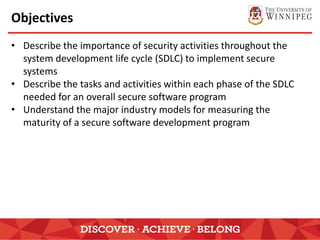
• Describe theimportance of security activities throughout the
system development life cycle (SDLC) to implement secure
systems
• Describe the tasks and activities within each phase of the SDLC
needed for an overall secure software program
• Understand the major industry models for measuring the
maturity of a secure software development program
4.
Overview
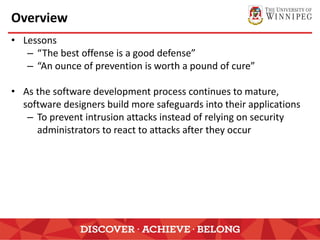
• Lessons
– “Thebest offense is a good defense”
– “An ounce of prevention is worth a pound of cure”
• As the software development process continues to mature,
software designers build more safeguards into their applications
– To prevent intrusion attacks instead of relying on security
administrators to react to attacks after they occur
5.
The Practice ofSoftware Engineering
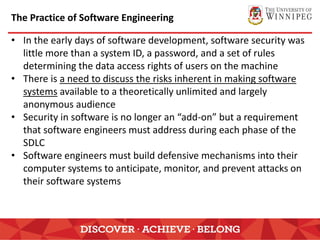
• In the early days of software development, software security was
little more than a system ID, a password, and a set of rules
determining the data access rights of users on the machine
• There is a need to discuss the risks inherent in making software
systems available to a theoretically unlimited and largely
anonymous audience
• Security in software is no longer an “add-on” but a requirement
that software engineers must address during each phase of the
SDLC
• Software engineers must build defensive mechanisms into their
computer systems to anticipate, monitor, and prevent attacks on
their software systems
6.
Software Development LifeCycle
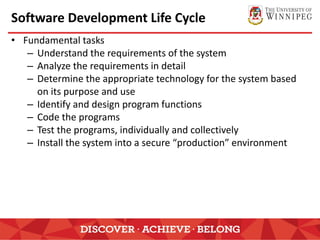
• Fundamental tasks
– Understand the requirements of the system
– Analyze the requirements in detail
– Determine the appropriate technology for the system based
on its purpose and use
– Identify and design program functions
– Code the programs
– Test the programs, individually and collectively
– Install the system into a secure “production” environment
Software Development LifeCycle
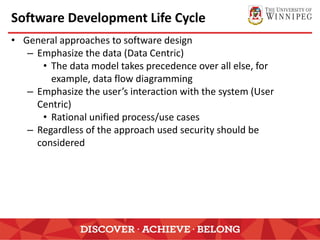
• General approaches to software design
– Emphasize the data (Data Centric)
• The data model takes precedence over all else, for
example, data flow diagramming
– Emphasize the user’s interaction with the system (User
Centric)
• Rational unified process/use cases
– Regardless of the approach used security should be
considered
9.
Software Development LifeCycle
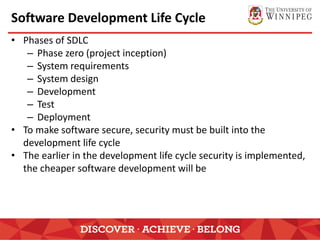
• Phases of SDLC
– Phase zero (project inception)
– System requirements
– System design
– Development
– Test
– Deployment
• To make software secure, security must be built into the
development life cycle
• The earlier in the development life cycle security is implemented,
the cheaper software development will be
10.
Software Development LifeCycle
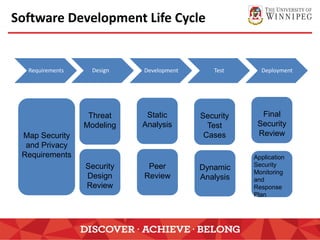
Requirements Design Development Test Deployment
Map Security
and Privacy
Requirements
Threat
Modeling
Security
Design
Review
Static
Analysis
Peer
Review
Security
Test
Cases
Dynamic
Analysis
Final
Security
Review
Application
Security
Monitoring
and
Response
Plan
11.
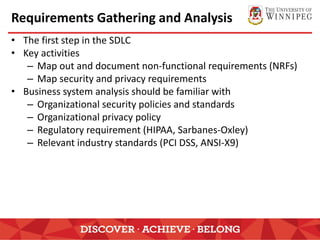
Requirements Gathering andAnalysis
• The first step in the SDLC
• Key activities
– Map out and document non-functional requirements (NRFs)
– Map security and privacy requirements
• Business system analysis should be familiar with
– Organizational security policies and standards
– Organizational privacy policy
– Regulatory requirement (HIPAA, Sarbanes-Oxley)
– Relevant industry standards (PCI DSS, ANSI-X9)
12.
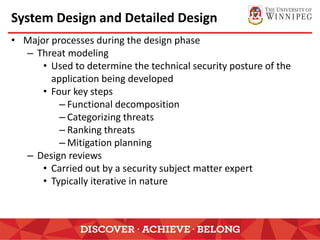
System Design andDetailed Design
• Major processes during the design phase
– Threat modeling
• Used to determine the technical security posture of the
application being developed
• Four key steps
– Functional decomposition
– Categorizing threats
– Ranking threats
– Mitigation planning
– Design reviews
• Carried out by a security subject matter expert
• Typically iterative in nature
13.
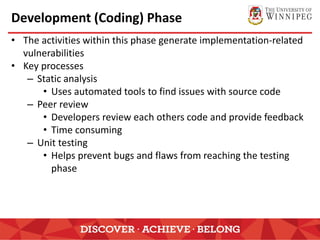
Development (Coding) Phase
•The activities within this phase generate implementation-related
vulnerabilities
• Key processes
– Static analysis
• Uses automated tools to find issues with source code
– Peer review
• Developers review each others code and provide feedback
• Time consuming
– Unit testing
• Helps prevent bugs and flaws from reaching the testing
phase
14.
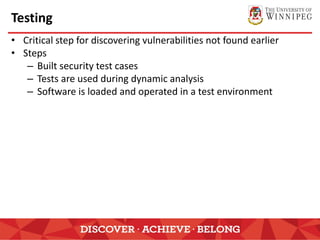
Testing
• Critical stepfor discovering vulnerabilities not found earlier
• Steps
– Built security test cases
– Tests are used during dynamic analysis
– Software is loaded and operated in a test environment
15.
Deployment
• The finalphase of SDLC
• Software is installed and configured in production environment
• Key activities
– Final security review
– Creating application security monitoring and response plan
• Security training is a prerequisite for anyone involved in the
software development
16.
Measuring the SecureDevelopment Program
• Two software security maturity measurement models
– Open Software Assurance Maturity Model (OpenSAMM)
– Building Security in Maturity Model (BSIMM)
17.
Measuring the SecureDevelopment Program
Open Software Assurance Maturity Model (OpenSAMM)
– Evaluating an organization’s existing software security
practices
– Building a balanced software security assurance program in
well-defined iterations
– Demonstrating concrete improvements to a security assurance
program
– Defining and measuring security-related activities throughout
an organization
– For more information - https://opensamm.org
18.
Measuring the SecureDevelopment Program
Building Security in Maturity Model (BSIMM)
• Has four domains
– Governance - help organize, manage, and measure a software
security initiative
– Intelligence - Collections of corporate knowledge used in
carrying out software security activities throughout the
organization.
– SSDL Touchpoints - Practices associated with analysis and
assurance of particular software development artifacts and
processes.
– Deployment - Practices that interface with traditional network
security and software maintenance organizations
– For more information - https://www.bsimm.com
19.
Summary
• It’s essentialthat security is built into all phases of the SDLC
• The SDLC consists of the following five phases: colleting
requirements, design, development, testing, and deployment
• Secure applications do not come by accident but through careful
planning and deliberate actions to incorporate security in all
stages of the SDLC