S-SDLC FRAMEWORK
UNKNOWN
Rishi Kant
AGENDA
About me
Pre requirements & Business expectation
General DAST Process
Effectiveness of AppSec Program
AppSec quality improvement approach
S-SDLC | Type 1 | Waterfall
S-SDLC | Type 2 | Agile
S-SDLC | Type 3 | CI/CD
Comparison of all 2 approach
ABOUT ME!
I am Rishi Kant
I am a Security professional with 11+ years of corporate experience in the field of Cyber Security,
Information Security, Digital Forensics, GRC, IT Administration, Secure Software Development,
Training, and company operations. I worked in various industry verticals such as Utilities, IT/ITES, E-
Commerce, Government, BFSI and law-enforcement agencies.
https://www.linkedin.com/in/hrishikant
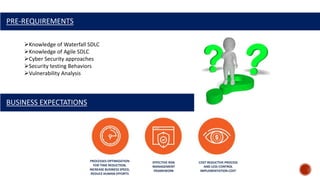
PRE-REQUIREMENTS
Knowledge of Waterfall SDLC
Knowledge of Agile SDLC
Cyber Security approaches
Security testing Behaviors
Vulnerability Analysis
BUSINESS EXPECTATIONS
PROCESSES OPTIMIZATION
FOR TIME REDUCTION,
INCREASE BUSINESS SPEED,
REDUCE HUMAN EFFORTS
EFFECTIVE RISK
MANAGEMENT
FRAMEWORK
COST REDUCTIVE PROCESS
AND LESS CONTROL
IMPLEMENTATION COST
GENERAL PROCESS IN TYPICAL ORGANIZATION
TIMELINES
2/3 DAYS 10/15 DAYS 1/2 DAYS
1 DAY BUT
CYCLIC
Understanding
the scope
Perform tests as
per the scope
Report generation and
clearing the doubts
Cyclic phase for re check
the issues
RISK
SOFTWARE PROJECT PROGRESS
IDENTIFY
CONTROL
IMPLEMEN
T CONTROL
VALIDATE
CONTROL
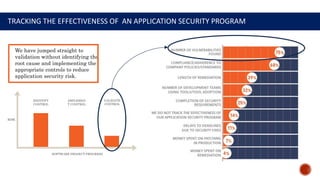
We have jumped straight to
validation without identifying the
root cause and implementing the
appropriate controls to reduce
application security risk.
TRACKING THE EFFECTIVENESS OF AN APPLICATION SECURITY PROGRAM
46% OF APPLICATION-LEVEL RISKS ARE NOT COVERED BY SAST & DAST TOOLS
Source Code SAST & DAST
Remediation
30% of total risks found & fixed
average time to remediation = 316 days*
54% of risks found*
46% of risks are not
found
70% of risks unaddressed
24% of risks found, not fixed
54% remediation rate*
*Adapted from:
National Institute of Standards and Technology. “Report on the Static Analysis Tool Exposition IV”.
Gartner for Technical Professionals. “Application Security Think Big and Start with What Matters”.
Veracode. “State of Software Security”, 2016.
WhiteHat Security. “Web Applications Security Statistics Report”.
Source Code SAST & DAST
Remediation
30% of total risks found & fixed
average time to remediation = 316 days*
54% of risks found*
46%of
risks are
not found
70% of risks unaddressed
24% of risks found, not fixed
54% remediation rate*
*Adapted from:
National Institute of Standards and Technology. “Report on the Static Analysis Tool Exposition IV”.
Gartner for Technical Professionals. “Application Security Think Big and Start with What Matters”.
Veracode. “State of Software Security”, 2016.
WhiteHat Security. “Web Applications Security Statistics Report”.
46% OF APPLICATION-LEVEL RISKS ARE NOT COVERED BY SAST & DAST TOOLS
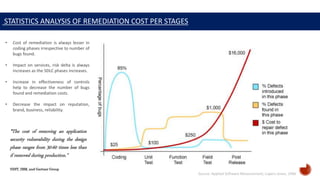
Source: Applied Software Measurement, Capers Jones, 1996
• Cost of remediation is always lesser in
coding phases irrespective to number of
bugs found.
• Impact on services, risk delta is always
increases as the SDLC phases increases.
• Increase in effectiveness of controls
help to decrease the number of bugs
found and remediation costs.
• Decrease the impact on reputation,
brand, business, reliability.
STATISTICS ANALYSIS OF REMEDIATION COST PER STAGES
“The cost of removing an application
security vulnerability during the design
phase ranges from 30-60 times less than
if removed during production.”
NIST, IBM, and Gartner Group
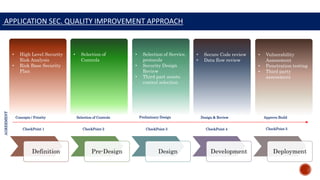
APPLICATION SEC. QUALITY IMPROVEMENT APPROACH
Definition Pre-Design Design Development Deployment
CheckPoint 1 CheckPoint 2 CheckPoint 3 CheckPoint 4 CheckPoint 5
Concepts / Priority Selection of Controls Preliminary Design
AGREEMENT
Design & Review Approve Build
• High Level Security
Risk Analysis
• Risk Base Security
Plan
• Selection of
Controls
• Selection of Service,
protocols
• Security Design
Review
• Third part assets
control selection
• Secure Code review
• Data flow review
• Vulnerability
Assessment
• Penetration testing
• Third party
assessment
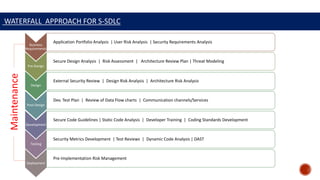
WATERFALL APPROACH FOR S-SDLC
Business
Requirements
Application Portfolio Analysis | User Risk Analysis | Security Requirements Analysis
Pre-Design
Secure Design Analysis | Risk Assessment | Architecture Review Plan | Threat Modeling
Design
External Security Review | Design Risk Analysis | Architecture Risk Analysis
Post-Design
Dev. Test Plan | Review of Data Flow charts | Communication channels/Services
Development
Secure Code Guidelines | Static Code Analysis | Developer Training | Coding Standards Development
Testing
Security Metrics Development | Test Reviews | Dynamic Code Analysis | DAST
Deployment
Pre-Implementation Risk Management
Maintenance
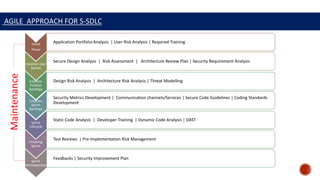
AGILE APPROACH FOR S-SDLC
Initial
Phase
Application Portfolio Analysis | User Risk Analysis | Required Training
Creation User
Stories
Secure Design Analysis | Risk Assessment | Architecture Review Plan | Security Requirement Analysis
Creation
Product
Backlogs
Design Risk Analysis | Architecture Risk Analysis | Threat Modelling
Creation
Sprint
Backlogs
Security Metrics Development | Communication channels/Services | Secure Code Guidelines | Coding Standards
Development
Sprint
Lifecycle
Static Code Analysis | Developer Training | Dynamic Code Analysis | DAST
Finishing
Sprint
Test Reviews | Pre-Implementation Risk Management
Sprint
Retrospective
Feedbacks | Security Improvement Plan
Maintenance
GENERAL AGILE SDLC
Client
Product
Owner
Sprint Plan
Meeting
DevOps Team
User Stories
Sprint Backlog
Sprint Life Cycle
Product Backlog
Finish of Sprint
Sprint Review
Sprint Retrospective
Feedbacks
• Product owner accept the inputs from the Client to conclude the user stories for product backlog.
• Every product backlog further divided into sprint backlog as per the group of same type of functionalities.
• Every Sprint backlog have the cycle of Coding and testing aligned with daily follow-up scrum meeting with scrum master, product owner, developers.
• Scrum meeting is on daily basis for better analysis the growth of the project.
• On the finish of Sprint, we need to review followed by Sprint retrospective for feedback to product owner likely for gaps evaluation.
CI/CD APPROACH S-SDLC
Continuous Delivery
Continuous Integration
PRO UAT QA DEV
Version Control
Developer 1 Developer 1Scrum
Master
Service
Desk
1
2
3 4
5
6
7
Check 4 Changes
Fetch Changes
Notify issues
Send Backlog
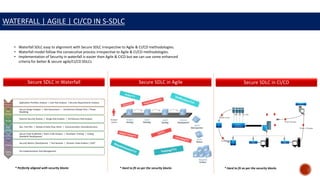
WATERFALL | AGILE | CI/CD IN S-SDLC
• Waterfall SDLC easy to alignment with Secure SDLC irrespective to Agile & CI/CD methodologies.
• Waterfall model follow the consecutive process irrespective to Agile & CI/CD methodologies.
• Implementation of Security in waterfall is easier then Agile & CICD but we can use some enhanced
criteria for better & secure agile/CI/CD SDLCs
Business
Require
ments
Application Portfolio Analysis | User Risk Analysis | Security Requirements Analysis
Pre-
Design
Secure Design Analysis | Risk Assessment | Architecture Review Plan | Threat
Modeling
Design
External Security Review | Design Risk Analysis | Architecture Risk Analysis
Post-
Design
Dev. Test Plan | Review of Data Flow charts | Communication channels/Services
Develop
ment
Secure Code Guidelines | Static Code Analysis | Developer Training | Coding
Standards Development
Testing
Security Metrics Development | Test Reviews | Dynamic Code Analysis | DAST
Deploy
ment
Pre-Implementation Risk Management
Secure SDLC in Waterfall Secure SDLC in Agile Secure SDLC in CI/CD
* Perfectly aligned with security blocks * Hard to fit as per the security blocks
Continuous
Delivery
Continuous
Integration
PRO UAT QA DEV
Version
Control
Deve
lope
r 1
Deve
lope
r 1
S
c
r
u
m
M
a
s
t
e
r
S
e
r
v
i
c
e
D
e
s
k
1
2
3 4
5
6
7
Check 4 Changes
Fetch Changes
Notify issues
Send Backlog
* Hard to fit as per the security blocks
THANK YOU!
Any questions?
You can also find me at rishi-kant@live.in for any further questions

Secure SDLC Framework

  • 1.
  • 2.
    AGENDA About me Pre requirements& Business expectation General DAST Process Effectiveness of AppSec Program AppSec quality improvement approach S-SDLC | Type 1 | Waterfall S-SDLC | Type 2 | Agile S-SDLC | Type 3 | CI/CD Comparison of all 2 approach
  • 3.
    ABOUT ME! I amRishi Kant I am a Security professional with 11+ years of corporate experience in the field of Cyber Security, Information Security, Digital Forensics, GRC, IT Administration, Secure Software Development, Training, and company operations. I worked in various industry verticals such as Utilities, IT/ITES, E- Commerce, Government, BFSI and law-enforcement agencies. https://www.linkedin.com/in/hrishikant
  • 4.
    PRE-REQUIREMENTS Knowledge of WaterfallSDLC Knowledge of Agile SDLC Cyber Security approaches Security testing Behaviors Vulnerability Analysis BUSINESS EXPECTATIONS PROCESSES OPTIMIZATION FOR TIME REDUCTION, INCREASE BUSINESS SPEED, REDUCE HUMAN EFFORTS EFFECTIVE RISK MANAGEMENT FRAMEWORK COST REDUCTIVE PROCESS AND LESS CONTROL IMPLEMENTATION COST
  • 5.
    GENERAL PROCESS INTYPICAL ORGANIZATION TIMELINES 2/3 DAYS 10/15 DAYS 1/2 DAYS 1 DAY BUT CYCLIC Understanding the scope Perform tests as per the scope Report generation and clearing the doubts Cyclic phase for re check the issues
  • 6.
    RISK SOFTWARE PROJECT PROGRESS IDENTIFY CONTROL IMPLEMEN TCONTROL VALIDATE CONTROL We have jumped straight to validation without identifying the root cause and implementing the appropriate controls to reduce application security risk. TRACKING THE EFFECTIVENESS OF AN APPLICATION SECURITY PROGRAM
  • 7.
    46% OF APPLICATION-LEVELRISKS ARE NOT COVERED BY SAST & DAST TOOLS Source Code SAST & DAST Remediation 30% of total risks found & fixed average time to remediation = 316 days* 54% of risks found* 46% of risks are not found 70% of risks unaddressed 24% of risks found, not fixed 54% remediation rate* *Adapted from: National Institute of Standards and Technology. “Report on the Static Analysis Tool Exposition IV”. Gartner for Technical Professionals. “Application Security Think Big and Start with What Matters”. Veracode. “State of Software Security”, 2016. WhiteHat Security. “Web Applications Security Statistics Report”.
  • 8.
    Source Code SAST& DAST Remediation 30% of total risks found & fixed average time to remediation = 316 days* 54% of risks found* 46%of risks are not found 70% of risks unaddressed 24% of risks found, not fixed 54% remediation rate* *Adapted from: National Institute of Standards and Technology. “Report on the Static Analysis Tool Exposition IV”. Gartner for Technical Professionals. “Application Security Think Big and Start with What Matters”. Veracode. “State of Software Security”, 2016. WhiteHat Security. “Web Applications Security Statistics Report”. 46% OF APPLICATION-LEVEL RISKS ARE NOT COVERED BY SAST & DAST TOOLS
  • 9.
    Source: Applied SoftwareMeasurement, Capers Jones, 1996 • Cost of remediation is always lesser in coding phases irrespective to number of bugs found. • Impact on services, risk delta is always increases as the SDLC phases increases. • Increase in effectiveness of controls help to decrease the number of bugs found and remediation costs. • Decrease the impact on reputation, brand, business, reliability. STATISTICS ANALYSIS OF REMEDIATION COST PER STAGES “The cost of removing an application security vulnerability during the design phase ranges from 30-60 times less than if removed during production.” NIST, IBM, and Gartner Group
  • 10.
    APPLICATION SEC. QUALITYIMPROVEMENT APPROACH Definition Pre-Design Design Development Deployment CheckPoint 1 CheckPoint 2 CheckPoint 3 CheckPoint 4 CheckPoint 5 Concepts / Priority Selection of Controls Preliminary Design AGREEMENT Design & Review Approve Build • High Level Security Risk Analysis • Risk Base Security Plan • Selection of Controls • Selection of Service, protocols • Security Design Review • Third part assets control selection • Secure Code review • Data flow review • Vulnerability Assessment • Penetration testing • Third party assessment
  • 11.
    WATERFALL APPROACH FORS-SDLC Business Requirements Application Portfolio Analysis | User Risk Analysis | Security Requirements Analysis Pre-Design Secure Design Analysis | Risk Assessment | Architecture Review Plan | Threat Modeling Design External Security Review | Design Risk Analysis | Architecture Risk Analysis Post-Design Dev. Test Plan | Review of Data Flow charts | Communication channels/Services Development Secure Code Guidelines | Static Code Analysis | Developer Training | Coding Standards Development Testing Security Metrics Development | Test Reviews | Dynamic Code Analysis | DAST Deployment Pre-Implementation Risk Management Maintenance
  • 12.
    AGILE APPROACH FORS-SDLC Initial Phase Application Portfolio Analysis | User Risk Analysis | Required Training Creation User Stories Secure Design Analysis | Risk Assessment | Architecture Review Plan | Security Requirement Analysis Creation Product Backlogs Design Risk Analysis | Architecture Risk Analysis | Threat Modelling Creation Sprint Backlogs Security Metrics Development | Communication channels/Services | Secure Code Guidelines | Coding Standards Development Sprint Lifecycle Static Code Analysis | Developer Training | Dynamic Code Analysis | DAST Finishing Sprint Test Reviews | Pre-Implementation Risk Management Sprint Retrospective Feedbacks | Security Improvement Plan Maintenance
  • 13.
    GENERAL AGILE SDLC Client Product Owner SprintPlan Meeting DevOps Team User Stories Sprint Backlog Sprint Life Cycle Product Backlog Finish of Sprint Sprint Review Sprint Retrospective Feedbacks • Product owner accept the inputs from the Client to conclude the user stories for product backlog. • Every product backlog further divided into sprint backlog as per the group of same type of functionalities. • Every Sprint backlog have the cycle of Coding and testing aligned with daily follow-up scrum meeting with scrum master, product owner, developers. • Scrum meeting is on daily basis for better analysis the growth of the project. • On the finish of Sprint, we need to review followed by Sprint retrospective for feedback to product owner likely for gaps evaluation.
  • 14.
    CI/CD APPROACH S-SDLC ContinuousDelivery Continuous Integration PRO UAT QA DEV Version Control Developer 1 Developer 1Scrum Master Service Desk 1 2 3 4 5 6 7 Check 4 Changes Fetch Changes Notify issues Send Backlog
  • 15.
    WATERFALL | AGILE| CI/CD IN S-SDLC • Waterfall SDLC easy to alignment with Secure SDLC irrespective to Agile & CI/CD methodologies. • Waterfall model follow the consecutive process irrespective to Agile & CI/CD methodologies. • Implementation of Security in waterfall is easier then Agile & CICD but we can use some enhanced criteria for better & secure agile/CI/CD SDLCs Business Require ments Application Portfolio Analysis | User Risk Analysis | Security Requirements Analysis Pre- Design Secure Design Analysis | Risk Assessment | Architecture Review Plan | Threat Modeling Design External Security Review | Design Risk Analysis | Architecture Risk Analysis Post- Design Dev. Test Plan | Review of Data Flow charts | Communication channels/Services Develop ment Secure Code Guidelines | Static Code Analysis | Developer Training | Coding Standards Development Testing Security Metrics Development | Test Reviews | Dynamic Code Analysis | DAST Deploy ment Pre-Implementation Risk Management Secure SDLC in Waterfall Secure SDLC in Agile Secure SDLC in CI/CD * Perfectly aligned with security blocks * Hard to fit as per the security blocks Continuous Delivery Continuous Integration PRO UAT QA DEV Version Control Deve lope r 1 Deve lope r 1 S c r u m M a s t e r S e r v i c e D e s k 1 2 3 4 5 6 7 Check 4 Changes Fetch Changes Notify issues Send Backlog * Hard to fit as per the security blocks
  • 16.
    THANK YOU! Any questions? Youcan also find me at rishi-kant@live.in for any further questions