Software Security Engineering and Risk Management Processes to Build Secure Web Applications Marco Morana OWASP Chapter Lead Rochester Security Summit 29-30 October 2008 Cincinnati Chapter Meetings
Agenda Software Security Awareness: Business Cases Approaches To Application Security Software Security Roadmap (CMM, S-SDLCs) Software Security Activities And Artifacts Security Requirements and Abuse Cases Threat Modeling Secure Design Guidelines Secure Coding Standards and Reviews Security Tests Secure Configuration and Deployment Metrics and Measurements Business Cases
Software Security Awareness Business Cases
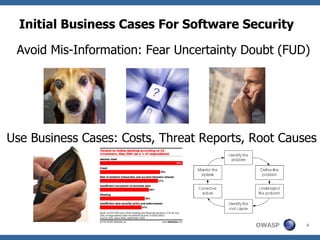
Initial Business Cases For Software Security Avoid Mis-Information: Fear Uncertainty Doubt (FUD) Use Business Cases: Costs, Threat Reports, Root Causes
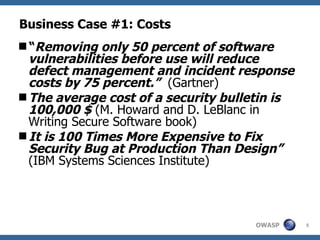
Business Case #1: Costs “ Removing only 50 percent of software vulnerabilities before use will reduce defect management and incident response costs by 75 percent.”   (Gartner) The average cost of a security bulletin is 100,000 $  (M. Howard and D. LeBlanc in Writing Secure Software book) It is 100 Times More Expensive to Fix Security Bug at Production Than Design”  (IBM Systems Sciences Institute)
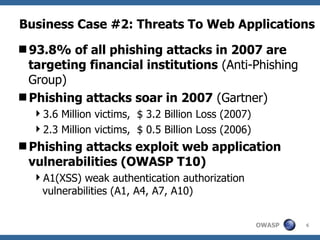
Business Case #2: Threats To Web Applications 93.8% of all phishing attacks in 2007 are targeting financial institutions  (Anti-Phishing Group) Phishing attacks soar in 2007  (Gartner) 3.6 Million victims,  $ 3.2 Billion Loss (2007) 2.3 Million victims,  $ 0.5 Billion Loss (2006) Phishing attacks exploit web application vulnerabilities (OWASP T10) A1(XSS) weak authentication authorization vulnerabilities (A1, A4, A7, A10)
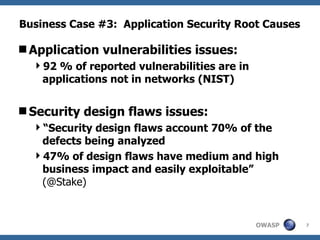
Business Case #3:  Application Security Root Causes Application vulnerabilities issues: 92 % of reported vulnerabilities are in applications not in networks (NIST) Security design flaws issues: “ Security design flaws account 70% of the defects being analyzed 47% of design flaws have medium and high business impact and easily exploitable”  (@Stake)
Approaches To Application Security
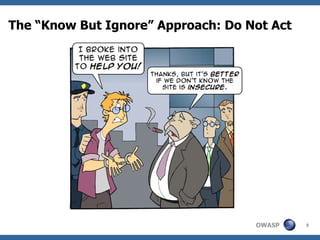
The “Know But Ignore” Approach: Do Not Act
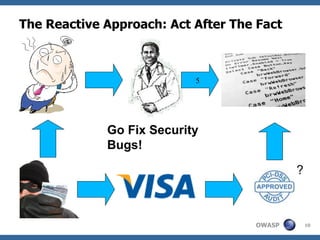
The Reactive Approach: Act After The Fact 5 Go Fix Security Bugs! ? ?
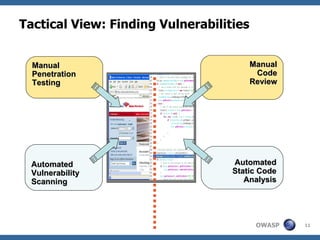
Tactical View:  Finding Vulnerabilities Automated Vulnerability Scanning Automated Static Code Analysis Manual Penetration Testing Manual Code Review
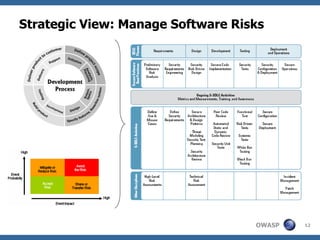
Strategic View: Manage Software Risks
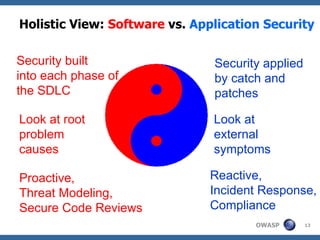
Holistic View:  Software  vs.  Application   Security Security applied by catch and patches Security built  into each phase of the SDLC Look at root  problem  causes Look at  external symptoms Reactive,  Incident Response, Compliance Proactive,  Threat Modeling,  Secure Code Reviews
Software Security Roadmap
Software Security Roadmap Assess the maturity  of the organization software security development processes, people and tools Define the software security process:  security enhanced SDLCs, frameworks and checkpoints Implement software security activities Security Requirements Secure Design and Threat Modeling Secure Coding Guidelines and Security Code Review Security Testing  Secure Deployment Collect metrics and measurements Create business cases and set objectives
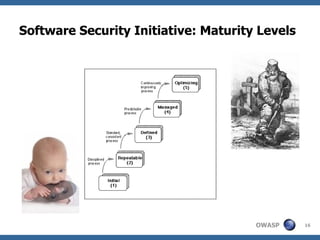
Software Security Initiative : Maturity Levels
Software Security Initiative: Maturity Levels Maturity Innocence (CMM 0-1) No formal security requirements Issues addressed with penetration testing and incidents Penetrate and patch and reactive approach Maturity Awareness (CMM 2-3) All applications have penetration tests done before going into production Secure coding standards are adopted as well as source code reviews Maturity Enlightenment (CCM 4-5) Threat analysis in each phase of the SDLC Risk metrics and vulnerability measurements are used for security activity decision making
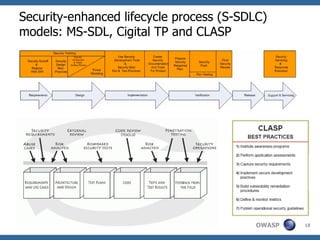
Security-enhanced lifecycle process (S-SDLC) models: MS-SDL, Cigital TP and CLASP
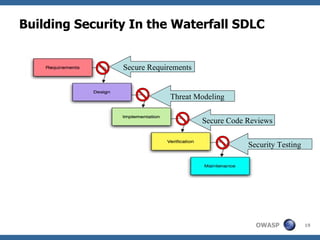
Building Security In the Waterfall SDLC Threat Modeling Secure Requirements Secure Code Reviews Security Testing
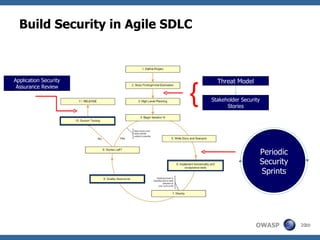
Build Security in Agile SDLC Periodic Security Sprints Threat Model Stakeholder Security Stories Application Security Assurance Review Periodic Security Sprints {
Security Requirements and Abuse Cases
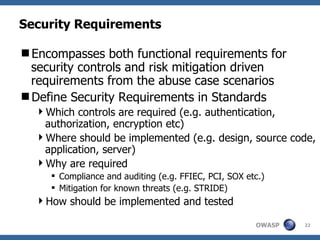
Security Requirements Encompasses both functional requirements for security controls and risk mitigation driven requirements from the abuse case scenarios Define Security Requirements in Standards Which controls are required (e.g. authentication, authorization, encryption etc) Where should be implemented (e.g. design, source code, application, server) Why are required Compliance and auditing (e.g. FFIEC, PCI, SOX etc.) Mitigation for known threats (e.g. STRIDE) How should be implemented and tested
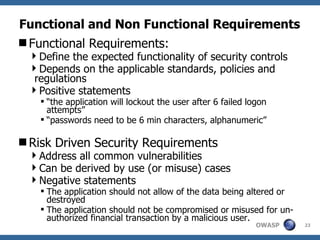
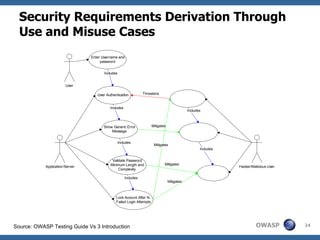
Functional and Non Functional Requirements   Functional Requirements: Define the expected functionality of security controls Depends on the applicable standards, policies and regulations  Positive statements “the application will lockout the user after 6 failed logon attempts”  “passwords need to be 6 min characters, alphanumeric” Risk Driven Security Requirements Address all common vulnerabilities Can be derived by use (or misuse) cases Negative statements The application should not allow of the data being altered or destroyed The application should not be compromised or misused for un-authorized financial transaction by a malicious user.
Security Requirements Derivation Through Use and Misuse Cases   Source: OWASP Testing Guide Vs 3 Introduction
Threat Modeling
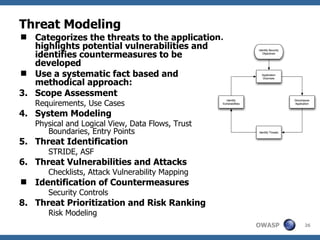
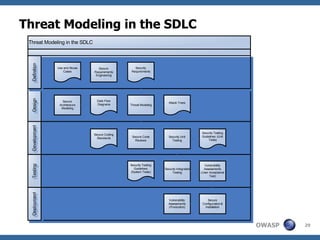
Threat Modeling Categorizes the threats to the application, highlights potential vulnerabilities and identifies countermeasures to be developed Use a systematic fact based and methodical approach: Scope Assessment Requirements, Use Cases System Modeling Physical and Logical View, Data Flows, Trust Boundaries, Entry Points Threat Identification STRIDE, ASF Threat Vulnerabilities and Attacks Checklists, Attack Vulnerability Mapping Identification of Countermeasures   Security Controls Threat Prioritization and Risk Ranking Risk Modeling
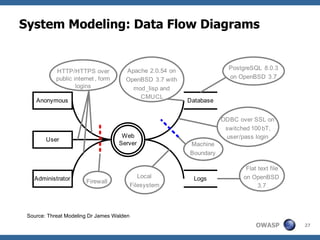
System Modeling: Data Flow Diagrams Source: Threat Modeling Dr James Walden
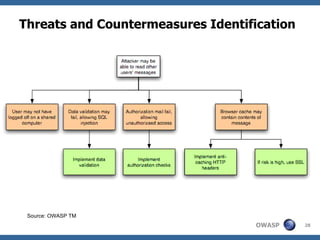
Threats and Countermeasures Identification Source: OWASP TM
Threat Modeling in the SDLC
Secure Design Guidelines
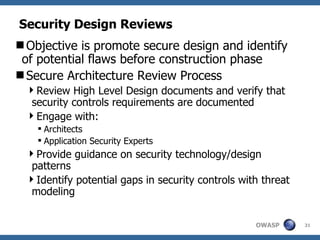
Security Design Reviews Objective is promote secure design and identify of potential flaws before construction phase Secure Architecture Review Process Review High Level Design documents and verify that security controls requirements are documented Engage with: Architects Application Security Experts  Provide guidance on security technology/design patterns Identify potential gaps in security controls with threat modeling
Secure Coding Standards and Secure Code Reviews
Secure Coding Standards/Guidelines   Describe secure coding requirement in terms of: The common vulnerabilities  (e.g. OWASP T10) The issue type  (e.g. Application Security Frame) The security threat or how can be exploited The in-secure code root cause  of the vulnerability The “How to” find the vulnerability  with black box and white box testing  The secure coding requirement/recommendation The risk rating  (e.g. STRIDE/DREAD, OWASP)
Example SQL Injection - Secure coding requirements Use SQL parameterized queries, avoid dynamic SQL generation :  SELECT * FROM users WHERE username=?  JAVA EE use strongly typed “PreparedStatement”  in .NET use “SqlCommand” with “SqlParameters” Sanitize input ,  remove special characters :   ' &quot;  ` ; * % _ =&\|*?~<>^()[]{}$\n\r Use custom error messages: No SQL exception information in error messages
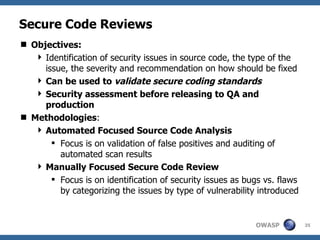
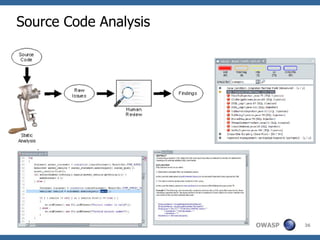
Secure Code Reviews Objectives: Identification of security issues in source code, the type of the issue, the severity and recommendation on how should be fixed Can be used to  validate secure coding standards Security assessment before releasing to QA and production Methodologies : Automated Focused Source Code Analysis Focus is on validation of false positives and auditing of automated scan results Manually Focused Secure Code Review Focus is on identification of security issues as bugs vs. flaws by categorizing the issues by type of vulnerability introduced
Source Code Analysis
Security Tests
Security Testing Develop security test cases Positive functional security test cases Negative test cases (from use and misuse cases) Common vulnerabilities exposure Integrate Tests in Developers and Testers Workflows Static and Dynamic Testing, Unit Tests Integrated System Tests and Operational Tests Analyze and report test data Defect Management Root Cause Identification
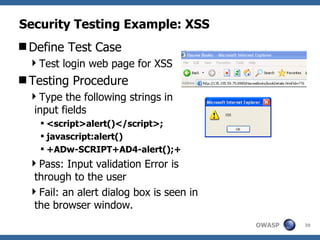
Security Testing Example: XSS Define Test Case Test login web page for XSS Testing Procedure Type the following strings in input fields <script>alert()</script>; javascript:alert()   +ADw-SCRIPT+AD4-alert();+   Pass: Input validation Error is through to the user Fail: an alert dialog box is seen in the browser window.
Testing Tools Categorization and Examples Vulnerability Scanning ISS, Foundscan, Nessus, Nikto Fault Injection Testing (Black Box Testing) Webinspect, Appscan, Hailstorm, Paros, Peach Binary Analysis IDA Pro, @stake SmartRisk Source Code Analysis Fortify, Klockworks, Parasoft, Free Tools (e.g. FindBugs) Threat Modeling MS TAM, TRIKE, PTA Technologies Rootkit BackDoor Analysis ootkits.org and rootkit.nl
Secure Configuration And Deployment
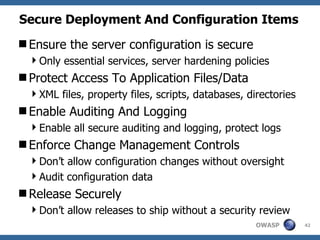
Secure Deployment And Configuration Items Ensure the server configuration is secure Only essential services, server hardening policies Protect Access To Application Files/Data XML files, property files, scripts, databases, directories Enable Auditing And Logging Enable all secure auditing and logging, protect logs  Enforce Change Management Controls Don’t allow configuration changes without oversight Audit configuration data Release Securely Don’t allow releases to ship without a security review
Metrics And Measurements
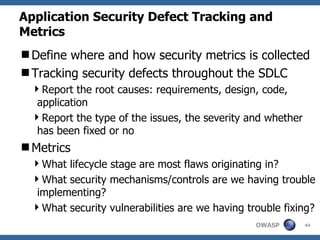
Application Security Defect Tracking and Metrics Define where and how security metrics is collected  Tracking security defects throughout the SDLC Report the root causes: requirements, design, code, application Report the type of the issues, the severity and whether has been fixed or no Metrics What lifecycle stage are most flaws originating in? What security mechanisms/controls are we having trouble implementing? What security vulnerabilities are we having trouble fixing?
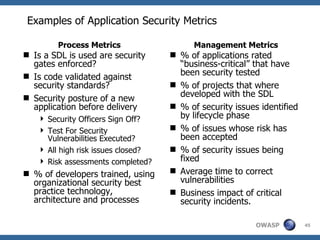
Examples of Application Security Metrics Process Metrics Is a SDL is used are security gates enforced? Is code validated against security standards? Security posture of a new application before delivery Security Officers Sign Off? Test For Security Vulnerabilities Executed? All high risk issues closed? Risk assessments completed? % of developers trained, using organizational security best practice technology, architecture and processes Management Metrics % of applications rated “business-critical” that have been security tested % of projects that where developed with the SDL % of security issues identified  by lifecycle phase % of issues whose risk has been accepted % of security issues being fixed Average time to correct vulnerabilities Business impact of critical security incidents.
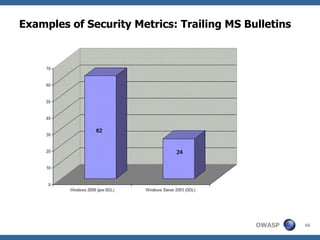
Examples of Security Metrics: Trailing MS Bulletins
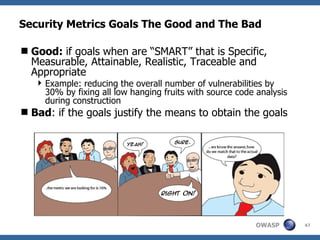
Security Metrics Goals The Good and The Bad Good:  if goals when are “SMART” that is Specific, Measurable, Attainable, Realistic, Traceable and Appropriate  Example: reducing the overall number of vulnerabilities by 30% by fixing all low hanging fruits with source code analysis during construction  Bad : if the goals justify the means to obtain the goals
Business Case
Business Cases for Your Organization Tie the metrics to the business cases and support the project stakeholders agendas: Developer Leads :  show that software can be build more securely and efficiently Project Managers :  shows that projects are on schedule and moving on target for the delivery dates and are getting better during tests  Information Security Officers:  provides a level of assurance that security standard compliance is addressed through the security review processes within the organization. Benefits: Cost savings Risk measurement and reduction Compliance reporting
Business Cases And Software Security Strategy Be realistic on what can be achieved Organization is  not yet ready  (e.g. mature) Engineers are  not trained  in software security There are  no tools available Adapt the strategy to reality Build upon your   company strenghts Get stakeholders buy in  (CIOs, ISOs, PM, Developers, Architects) Set achieveable goals:  reduce 30% of vulnerabilities found through ethical hacking via source code analysys Perform a gap analysis and proceed with process improvement cycles: Tailor to the initiative to the company culture Be risk management driven Introduce metrics and prove results

Software Security Engineering

  • 1.
    Software Security Engineeringand Risk Management Processes to Build Secure Web Applications Marco Morana OWASP Chapter Lead Rochester Security Summit 29-30 October 2008 Cincinnati Chapter Meetings
  • 2.
    Agenda Software SecurityAwareness: Business Cases Approaches To Application Security Software Security Roadmap (CMM, S-SDLCs) Software Security Activities And Artifacts Security Requirements and Abuse Cases Threat Modeling Secure Design Guidelines Secure Coding Standards and Reviews Security Tests Secure Configuration and Deployment Metrics and Measurements Business Cases
  • 3.
  • 4.
    Initial Business CasesFor Software Security Avoid Mis-Information: Fear Uncertainty Doubt (FUD) Use Business Cases: Costs, Threat Reports, Root Causes
  • 5.
    Business Case #1:Costs “ Removing only 50 percent of software vulnerabilities before use will reduce defect management and incident response costs by 75 percent.” (Gartner) The average cost of a security bulletin is 100,000 $ (M. Howard and D. LeBlanc in Writing Secure Software book) It is 100 Times More Expensive to Fix Security Bug at Production Than Design” (IBM Systems Sciences Institute)
  • 6.
    Business Case #2:Threats To Web Applications 93.8% of all phishing attacks in 2007 are targeting financial institutions (Anti-Phishing Group) Phishing attacks soar in 2007 (Gartner) 3.6 Million victims, $ 3.2 Billion Loss (2007) 2.3 Million victims, $ 0.5 Billion Loss (2006) Phishing attacks exploit web application vulnerabilities (OWASP T10) A1(XSS) weak authentication authorization vulnerabilities (A1, A4, A7, A10)
  • 7.
    Business Case #3: Application Security Root Causes Application vulnerabilities issues: 92 % of reported vulnerabilities are in applications not in networks (NIST) Security design flaws issues: “ Security design flaws account 70% of the defects being analyzed 47% of design flaws have medium and high business impact and easily exploitable” (@Stake)
  • 8.
  • 9.
    The “Know ButIgnore” Approach: Do Not Act
  • 10.
    The Reactive Approach:Act After The Fact 5 Go Fix Security Bugs! ? ?
  • 11.
    Tactical View: Finding Vulnerabilities Automated Vulnerability Scanning Automated Static Code Analysis Manual Penetration Testing Manual Code Review
  • 12.
    Strategic View: ManageSoftware Risks
  • 13.
    Holistic View: Software vs. Application Security Security applied by catch and patches Security built into each phase of the SDLC Look at root problem causes Look at external symptoms Reactive, Incident Response, Compliance Proactive, Threat Modeling, Secure Code Reviews
  • 14.
  • 15.
    Software Security RoadmapAssess the maturity of the organization software security development processes, people and tools Define the software security process: security enhanced SDLCs, frameworks and checkpoints Implement software security activities Security Requirements Secure Design and Threat Modeling Secure Coding Guidelines and Security Code Review Security Testing Secure Deployment Collect metrics and measurements Create business cases and set objectives
  • 16.
  • 17.
    Software Security Initiative:Maturity Levels Maturity Innocence (CMM 0-1) No formal security requirements Issues addressed with penetration testing and incidents Penetrate and patch and reactive approach Maturity Awareness (CMM 2-3) All applications have penetration tests done before going into production Secure coding standards are adopted as well as source code reviews Maturity Enlightenment (CCM 4-5) Threat analysis in each phase of the SDLC Risk metrics and vulnerability measurements are used for security activity decision making
  • 18.
    Security-enhanced lifecycle process(S-SDLC) models: MS-SDL, Cigital TP and CLASP
  • 19.
    Building Security Inthe Waterfall SDLC Threat Modeling Secure Requirements Secure Code Reviews Security Testing
  • 20.
    Build Security inAgile SDLC Periodic Security Sprints Threat Model Stakeholder Security Stories Application Security Assurance Review Periodic Security Sprints {
  • 21.
  • 22.
    Security Requirements Encompassesboth functional requirements for security controls and risk mitigation driven requirements from the abuse case scenarios Define Security Requirements in Standards Which controls are required (e.g. authentication, authorization, encryption etc) Where should be implemented (e.g. design, source code, application, server) Why are required Compliance and auditing (e.g. FFIEC, PCI, SOX etc.) Mitigation for known threats (e.g. STRIDE) How should be implemented and tested
  • 23.
    Functional and NonFunctional Requirements Functional Requirements: Define the expected functionality of security controls Depends on the applicable standards, policies and regulations Positive statements “the application will lockout the user after 6 failed logon attempts” “passwords need to be 6 min characters, alphanumeric” Risk Driven Security Requirements Address all common vulnerabilities Can be derived by use (or misuse) cases Negative statements The application should not allow of the data being altered or destroyed The application should not be compromised or misused for un-authorized financial transaction by a malicious user.
  • 24.
    Security Requirements DerivationThrough Use and Misuse Cases Source: OWASP Testing Guide Vs 3 Introduction
  • 25.
  • 26.
    Threat Modeling Categorizesthe threats to the application, highlights potential vulnerabilities and identifies countermeasures to be developed Use a systematic fact based and methodical approach: Scope Assessment Requirements, Use Cases System Modeling Physical and Logical View, Data Flows, Trust Boundaries, Entry Points Threat Identification STRIDE, ASF Threat Vulnerabilities and Attacks Checklists, Attack Vulnerability Mapping Identification of Countermeasures Security Controls Threat Prioritization and Risk Ranking Risk Modeling
  • 27.
    System Modeling: DataFlow Diagrams Source: Threat Modeling Dr James Walden
  • 28.
    Threats and CountermeasuresIdentification Source: OWASP TM
  • 29.
  • 30.
  • 31.
    Security Design ReviewsObjective is promote secure design and identify of potential flaws before construction phase Secure Architecture Review Process Review High Level Design documents and verify that security controls requirements are documented Engage with: Architects Application Security Experts Provide guidance on security technology/design patterns Identify potential gaps in security controls with threat modeling
  • 32.
    Secure Coding Standardsand Secure Code Reviews
  • 33.
    Secure Coding Standards/Guidelines Describe secure coding requirement in terms of: The common vulnerabilities (e.g. OWASP T10) The issue type (e.g. Application Security Frame) The security threat or how can be exploited The in-secure code root cause of the vulnerability The “How to” find the vulnerability with black box and white box testing The secure coding requirement/recommendation The risk rating (e.g. STRIDE/DREAD, OWASP)
  • 34.
    Example SQL Injection- Secure coding requirements Use SQL parameterized queries, avoid dynamic SQL generation : SELECT * FROM users WHERE username=? JAVA EE use strongly typed “PreparedStatement” in .NET use “SqlCommand” with “SqlParameters” Sanitize input , remove special characters : ' &quot; ` ; * % _ =&\|*?~<>^()[]{}$\n\r Use custom error messages: No SQL exception information in error messages
  • 35.
    Secure Code ReviewsObjectives: Identification of security issues in source code, the type of the issue, the severity and recommendation on how should be fixed Can be used to validate secure coding standards Security assessment before releasing to QA and production Methodologies : Automated Focused Source Code Analysis Focus is on validation of false positives and auditing of automated scan results Manually Focused Secure Code Review Focus is on identification of security issues as bugs vs. flaws by categorizing the issues by type of vulnerability introduced
  • 36.
  • 37.
  • 38.
    Security Testing Developsecurity test cases Positive functional security test cases Negative test cases (from use and misuse cases) Common vulnerabilities exposure Integrate Tests in Developers and Testers Workflows Static and Dynamic Testing, Unit Tests Integrated System Tests and Operational Tests Analyze and report test data Defect Management Root Cause Identification
  • 39.
    Security Testing Example:XSS Define Test Case Test login web page for XSS Testing Procedure Type the following strings in input fields <script>alert()</script>; javascript:alert() +ADw-SCRIPT+AD4-alert();+ Pass: Input validation Error is through to the user Fail: an alert dialog box is seen in the browser window.
  • 40.
    Testing Tools Categorizationand Examples Vulnerability Scanning ISS, Foundscan, Nessus, Nikto Fault Injection Testing (Black Box Testing) Webinspect, Appscan, Hailstorm, Paros, Peach Binary Analysis IDA Pro, @stake SmartRisk Source Code Analysis Fortify, Klockworks, Parasoft, Free Tools (e.g. FindBugs) Threat Modeling MS TAM, TRIKE, PTA Technologies Rootkit BackDoor Analysis ootkits.org and rootkit.nl
  • 41.
  • 42.
    Secure Deployment AndConfiguration Items Ensure the server configuration is secure Only essential services, server hardening policies Protect Access To Application Files/Data XML files, property files, scripts, databases, directories Enable Auditing And Logging Enable all secure auditing and logging, protect logs Enforce Change Management Controls Don’t allow configuration changes without oversight Audit configuration data Release Securely Don’t allow releases to ship without a security review
  • 43.
  • 44.
    Application Security DefectTracking and Metrics Define where and how security metrics is collected Tracking security defects throughout the SDLC Report the root causes: requirements, design, code, application Report the type of the issues, the severity and whether has been fixed or no Metrics What lifecycle stage are most flaws originating in? What security mechanisms/controls are we having trouble implementing? What security vulnerabilities are we having trouble fixing?
  • 45.
    Examples of ApplicationSecurity Metrics Process Metrics Is a SDL is used are security gates enforced? Is code validated against security standards? Security posture of a new application before delivery Security Officers Sign Off? Test For Security Vulnerabilities Executed? All high risk issues closed? Risk assessments completed? % of developers trained, using organizational security best practice technology, architecture and processes Management Metrics % of applications rated “business-critical” that have been security tested % of projects that where developed with the SDL % of security issues identified by lifecycle phase % of issues whose risk has been accepted % of security issues being fixed Average time to correct vulnerabilities Business impact of critical security incidents.
  • 46.
    Examples of SecurityMetrics: Trailing MS Bulletins
  • 47.
    Security Metrics GoalsThe Good and The Bad Good: if goals when are “SMART” that is Specific, Measurable, Attainable, Realistic, Traceable and Appropriate Example: reducing the overall number of vulnerabilities by 30% by fixing all low hanging fruits with source code analysis during construction Bad : if the goals justify the means to obtain the goals
  • 48.
  • 49.
    Business Cases forYour Organization Tie the metrics to the business cases and support the project stakeholders agendas: Developer Leads : show that software can be build more securely and efficiently Project Managers : shows that projects are on schedule and moving on target for the delivery dates and are getting better during tests Information Security Officers: provides a level of assurance that security standard compliance is addressed through the security review processes within the organization. Benefits: Cost savings Risk measurement and reduction Compliance reporting
  • 50.
    Business Cases AndSoftware Security Strategy Be realistic on what can be achieved Organization is not yet ready (e.g. mature) Engineers are not trained in software security There are no tools available Adapt the strategy to reality Build upon your company strenghts Get stakeholders buy in (CIOs, ISOs, PM, Developers, Architects) Set achieveable goals: reduce 30% of vulnerabilities found through ethical hacking via source code analysys Perform a gap analysis and proceed with process improvement cycles: Tailor to the initiative to the company culture Be risk management driven Introduce metrics and prove results