CGSC 1001
Mysteries of the Mind
by Jim Davies
jim@jimdavies.org
1
400 BCE: Ancient Greek philosophers
made theories of mind
• At this time science had not yet been invented.
• Little was known about the world; these guys
philosophized about a whole lot.
• This is also the pre-history of all disciplines.
Philosophers dominated the pre-history
until about 1800.
2
Psychophysics: relationships between
perception and stimuli
1875: Wilhelm Wundt opened the first
psychology laboratory
Ebbinghaus did some of the first
experiments in memory
1890s: Freud and the case-study
technique, William James published
“Principles of Psychology” which is still
often quoted today
3
1908: Pavlov’s salivating dogs experiment
1913: John Watson’s manifesto for
behaviourism published.
• Held that we cannot directly study mental
processes, only stimulus and behaviour
• In response to case studies and introspection
• Tried to make a psychology like physics
4
1930: Jean Piaget
Problems helping pilots who were already
experts
Behaviourism started to try to explain
difficult things, such as language…
5
Analog brain modeling (pre-computer)
Inspired by collaboration of psychologists
working with engineers and
communications people in war efforts
Was killed by artificial intelligence, but
made a bit of a comeback with neural
networks
6
Charles Babbage
• 1821: Difference Engine. Mechanical calculations
• Analytical Engine (never built)
7
Turing test
Satisficing
1955: Birth of Artificial Intelligence
Part of why AI was needed for the birth of
cognitivism was because before we had
computer programs it was hard to imagine
how information processors could work
8
1957: Noam Chomsky’s review of B.F.
Skinner’s Verbal Behavior.
• A book review more famous than the book it was
reviewing
Introduced concepts such as
• Poverty of the stimulus
• Universal grammar
Chomsky is still alive and working– he
came to speak at Carleton in 2010.
9
Miller, Galanter, Pribram1960 book Plans
and the Structure of Behavior
Test, Operate, Test, Exit
• Iterative problem solving strategy
10
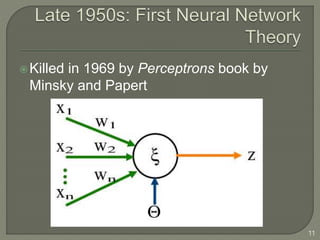
Killed in 1969 by Perceptrons book by
Minsky and Papert
11
Developmental and computational
linguistics
Fodor’s The Language of Thought
Robots
12
Expert systems, case based reasoning
Brain imaging (fMRI, PET)
Neural net revival with backpropogation
13
AI getting more mathematical
Psychology’s “Decade of the Brain”
Philosophy paying more attention to
empirical research
Expert systems decline
Embodied and situated cognition
14
Strong Cognitive Science society.
Conference is growing in size
Handful of Cognitive Science departments
in the world, many more interdisciplinary
programs
Carleton has the only one in Canada
Neuroscience a big player.
Lots of subdisciplines breaking off
15
http://youtu.be/IfbOyw3CT6A
(22 min)
16
17
18
19
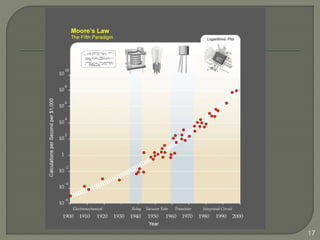
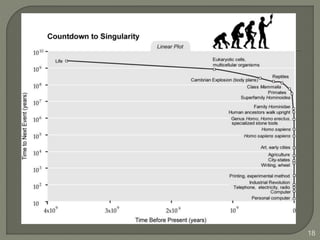
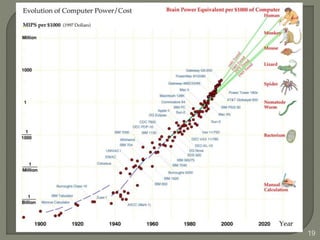
Believes computer programs will be
smarter than people around 2045
Kurzweil has a very optimistic view of the
future of brain understanding and AI.
Brain imaging, processing, memory, and
nanotech are all accelerating at an
exponential rate.
Bill Joy is as optimistic about tech
progress, but has a dystopian view of what
it will do to society
20
Where will these nanobots get their
energy?
The bots would have to be too big
Etc.
If you’re interested in Kurzweil’s theory,
read The Singularity Is Near
It’s called the singularity because we
cannot predict what would happen beyond
it.
21
 Scientific progress: incommensurability is
when one scientific paradigm cannot be
understood in terms of another
 Solipsism: the belief that you are the only
conscious, real agent in the universe and all
else is an illusion
 Ethical patient: something that deserves to be
treated ethically
 Singularity
 Domestication
 Precocious and altricious development
 Self-domestication
22
If you have some feedback about how this
class could be better, please email me.
What did you think of the midterms?
Thank you!
23

Cognitive Science, Past, Present, and Future

  • 1.
    CGSC 1001 Mysteries ofthe Mind by Jim Davies jim@jimdavies.org 1
  • 2.
    400 BCE: AncientGreek philosophers made theories of mind • At this time science had not yet been invented. • Little was known about the world; these guys philosophized about a whole lot. • This is also the pre-history of all disciplines. Philosophers dominated the pre-history until about 1800. 2
  • 3.
    Psychophysics: relationships between perceptionand stimuli 1875: Wilhelm Wundt opened the first psychology laboratory Ebbinghaus did some of the first experiments in memory 1890s: Freud and the case-study technique, William James published “Principles of Psychology” which is still often quoted today 3
  • 4.
    1908: Pavlov’s salivatingdogs experiment 1913: John Watson’s manifesto for behaviourism published. • Held that we cannot directly study mental processes, only stimulus and behaviour • In response to case studies and introspection • Tried to make a psychology like physics 4
  • 5.
    1930: Jean Piaget Problemshelping pilots who were already experts Behaviourism started to try to explain difficult things, such as language… 5
  • 6.
    Analog brain modeling(pre-computer) Inspired by collaboration of psychologists working with engineers and communications people in war efforts Was killed by artificial intelligence, but made a bit of a comeback with neural networks 6
  • 7.
    Charles Babbage • 1821:Difference Engine. Mechanical calculations • Analytical Engine (never built) 7
  • 8.
    Turing test Satisficing 1955: Birthof Artificial Intelligence Part of why AI was needed for the birth of cognitivism was because before we had computer programs it was hard to imagine how information processors could work 8
  • 9.
    1957: Noam Chomsky’sreview of B.F. Skinner’s Verbal Behavior. • A book review more famous than the book it was reviewing Introduced concepts such as • Poverty of the stimulus • Universal grammar Chomsky is still alive and working– he came to speak at Carleton in 2010. 9
  • 10.
    Miller, Galanter, Pribram1960book Plans and the Structure of Behavior Test, Operate, Test, Exit • Iterative problem solving strategy 10
  • 11.
    Killed in 1969by Perceptrons book by Minsky and Papert 11
  • 12.
  • 13.
    Expert systems, casebased reasoning Brain imaging (fMRI, PET) Neural net revival with backpropogation 13
  • 14.
    AI getting moremathematical Psychology’s “Decade of the Brain” Philosophy paying more attention to empirical research Expert systems decline Embodied and situated cognition 14
  • 15.
    Strong Cognitive Sciencesociety. Conference is growing in size Handful of Cognitive Science departments in the world, many more interdisciplinary programs Carleton has the only one in Canada Neuroscience a big player. Lots of subdisciplines breaking off 15
  • 16.
  • 17.
  • 18.
  • 19.
  • 20.
    Believes computer programswill be smarter than people around 2045 Kurzweil has a very optimistic view of the future of brain understanding and AI. Brain imaging, processing, memory, and nanotech are all accelerating at an exponential rate. Bill Joy is as optimistic about tech progress, but has a dystopian view of what it will do to society 20
  • 21.
    Where will thesenanobots get their energy? The bots would have to be too big Etc. If you’re interested in Kurzweil’s theory, read The Singularity Is Near It’s called the singularity because we cannot predict what would happen beyond it. 21
  • 22.
     Scientific progress:incommensurability is when one scientific paradigm cannot be understood in terms of another  Solipsism: the belief that you are the only conscious, real agent in the universe and all else is an illusion  Ethical patient: something that deserves to be treated ethically  Singularity  Domestication  Precocious and altricious development  Self-domestication 22
  • 23.
    If you havesome feedback about how this class could be better, please email me. What did you think of the midterms? Thank you! 23

Editor's Notes

  • #2 Tobacco Hornworm, found in Urbana, Illinois, USA. From Wikimedia Commons.