

CGSC 1001
Mysteries of the Mind
by Jim Davies
jim@jimdavies.org
1
U-shaped grammar curve
• Went, goed, went
Universal Grammar theory
• The mind has a bunch of switches that get set
when you learn a language as a child
• E.g., “subject omission switch”
 In Spanish you can omit the subject of a sentence, but
in English you cannot.
2
 During this time children learn 2-4 new words
per day to their productive vocabulary, and
twice that for understanding.
 That’s 1 every one or two hours awake for
years.
 They are learning words that they don’t hear
that day.
 How is this possible?
• Recall suddenly understanding a joke you heard years
ago
3
https://www.youtube.com/playlist?list=PL8
648B2E5C69EF71F
One is repeated (conservation task), so
skip it.
9 minutes
4
BBC baby synapse connection
https://www.youtube.com/watch?v=8J-
JflThHks
http://www.phonetics.ucla.edu/vowels/chap
ter12/hindi.html
5
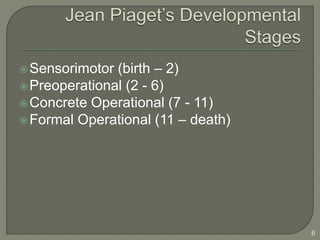
Sensorimotor (birth – 2)
Preoperational (2 - 6)
Concrete Operational (7 - 11)
Formal Operational (11 – death)
6
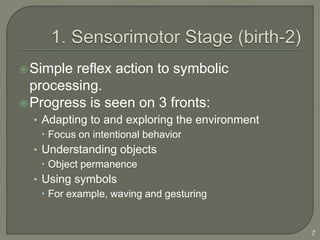
Simple reflex action to symbolic
processing.
Progress is seen on 3 fronts:
• Adapting to and exploring the environment
 Focus on intentional behavior
• Understanding objects
 Object permanence
• Using symbols
 For example, waving and gesturing
7
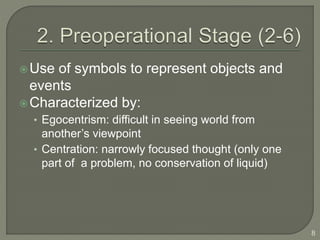
Use of symbols to represent objects and
events
Characterized by:
• Egocentrism: difficult in seeing world from
another’s viewpoint
• Centration: narrowly focused thought (only one
part of a problem, no conservation of liquid)
8
Mental operations to solve problems and
reason: e.g., induction
Problems thinking abstractly and
hypothetically
9
Can apply mental operations to abstract
entities
Abstract and hypothetical thinking
10
The study of cognitive development at all
Constructivism: that children are active
participants in their own development
Counterintuitive discoveries, puzzles that
other scientists needed to solve
11
Underestimates infants, overestimates
adolescents
Vague on processes and change
mechanisms
Does not account for variability (stages are
not that clear cut)
Underestimates social and cultural
influences
12
Focus on social and cultural
Intersubjectivity: shared understanding
among participants of an activity
Guided participation: cognitive growth
results from childrens’ involvement in
structured activities with others who are
more skilled
Zone of proximal development: the
difference between what a child can do
alone from with help
13
Scaffolding: teaching style that matches
the amount of assistance to the learner’s
needs.
Private Speech: comments not directed to
others but intended to help children
regulate on their own
Inner speech: thought, internalized private
speech, serving the same function
14
The Marshmallow Test
http://youtu.be/6EjJsPylEOY
The kids who could pass it were the ones
good at distracting themselves.
They turned out to be more successful in
the future.
Related to discounting the future?
15
Children improve in the following ways:
• Better strategies
• Increased working memory
• Better inhibitory and executive functioning
• Increased automatic processing
• Increased speed of processing
16
Distinctive domains of knowledge, some of
which are acquired early
Explains why kids learn language but not
calculus easily
Against the general intelligence approach
to development and cognition
Suggestions: language, objects, people,
living things
17
4.5 month olds have object permanence
http://youtu.be/lKZ9IPRKkkU
Objects move in continuous paths
Objects can’t move through other objects
18
12-5 mo. Can tell the difference between
animate and inanimate objects
Movement
Growth
• But they don’t consider plants to be alive until 7 or
8 years of age
Internal parts
Inheritance
Illness
healing
19
Naïve psychology
Theory of mind at 2-5 yoa
20
Still face (2:49)
http://youtu.be/apzXGEbZht0
21

The Cognitive Science of cognitive development

  • 1.
    CGSC 1001 Mysteries ofthe Mind by Jim Davies jim@jimdavies.org 1
  • 2.
    U-shaped grammar curve •Went, goed, went Universal Grammar theory • The mind has a bunch of switches that get set when you learn a language as a child • E.g., “subject omission switch”  In Spanish you can omit the subject of a sentence, but in English you cannot. 2
  • 3.
     During thistime children learn 2-4 new words per day to their productive vocabulary, and twice that for understanding.  That’s 1 every one or two hours awake for years.  They are learning words that they don’t hear that day.  How is this possible? • Recall suddenly understanding a joke you heard years ago 3
  • 4.
  • 5.
    BBC baby synapseconnection https://www.youtube.com/watch?v=8J- JflThHks http://www.phonetics.ucla.edu/vowels/chap ter12/hindi.html 5
  • 6.
    Sensorimotor (birth –2) Preoperational (2 - 6) Concrete Operational (7 - 11) Formal Operational (11 – death) 6
  • 7.
    Simple reflex actionto symbolic processing. Progress is seen on 3 fronts: • Adapting to and exploring the environment  Focus on intentional behavior • Understanding objects  Object permanence • Using symbols  For example, waving and gesturing 7
  • 8.
    Use of symbolsto represent objects and events Characterized by: • Egocentrism: difficult in seeing world from another’s viewpoint • Centration: narrowly focused thought (only one part of a problem, no conservation of liquid) 8
  • 9.
    Mental operations tosolve problems and reason: e.g., induction Problems thinking abstractly and hypothetically 9
  • 10.
    Can apply mentaloperations to abstract entities Abstract and hypothetical thinking 10
  • 11.
    The study ofcognitive development at all Constructivism: that children are active participants in their own development Counterintuitive discoveries, puzzles that other scientists needed to solve 11
  • 12.
    Underestimates infants, overestimates adolescents Vagueon processes and change mechanisms Does not account for variability (stages are not that clear cut) Underestimates social and cultural influences 12
  • 13.
    Focus on socialand cultural Intersubjectivity: shared understanding among participants of an activity Guided participation: cognitive growth results from childrens’ involvement in structured activities with others who are more skilled Zone of proximal development: the difference between what a child can do alone from with help 13
  • 14.
    Scaffolding: teaching stylethat matches the amount of assistance to the learner’s needs. Private Speech: comments not directed to others but intended to help children regulate on their own Inner speech: thought, internalized private speech, serving the same function 14
  • 15.
    The Marshmallow Test http://youtu.be/6EjJsPylEOY Thekids who could pass it were the ones good at distracting themselves. They turned out to be more successful in the future. Related to discounting the future? 15
  • 16.
    Children improve inthe following ways: • Better strategies • Increased working memory • Better inhibitory and executive functioning • Increased automatic processing • Increased speed of processing 16
  • 17.
    Distinctive domains ofknowledge, some of which are acquired early Explains why kids learn language but not calculus easily Against the general intelligence approach to development and cognition Suggestions: language, objects, people, living things 17
  • 18.
    4.5 month oldshave object permanence http://youtu.be/lKZ9IPRKkkU Objects move in continuous paths Objects can’t move through other objects 18
  • 19.
    12-5 mo. Cantell the difference between animate and inanimate objects Movement Growth • But they don’t consider plants to be alive until 7 or 8 years of age Internal parts Inheritance Illness healing 19
  • 20.
  • 21.

Editor's Notes

  • #2 Mola Mola, or Ocean Sunfish. From Wikimedia Commons
  • #5 Piaget – Stage 2 – Preoperational – Lack of Conservation Piaget – Stage 1 – Sensorimotor, Object Permenence Piaget – Stage 4 – Formal – Deductive Reasoning Formal operational child Conservation task egocentrism