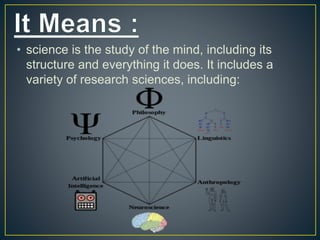
• science is the study of the mind, including its
structure and everything it does. It includes a
variety of research sciences, including:
• Man has tried to understand his own mind since the
beginning of time.
• The earliest writers spoke of wisdom, foolishness, and
the wonder of thought.
• Biblical authors spoke of both the clever and the wise,
including aspects of education, psychology, philosophy,
linguistics, and anthropology.
• As the science of psychology began to develop in the
1800s .
• In more recent times, beginning early in the 1900s,
scientists began projecting the idea that there is much
more to the human mind than merely programmed
responses.
• In more recent times, beginning early in the 1900s,
scientists began projecting the idea that there is much
more to the human mind than merely programmed
responses.
• Philosophy, the study of knowledge, reality, and
existence
• Psychology, the study of behavior and the mind
• Anthropology, the general study of the human
society and culture
• Linguistics, the study of language
• Neuroscience, the study of the nervous system
• Artificial intelligence, the study of thinking
machines and systems .
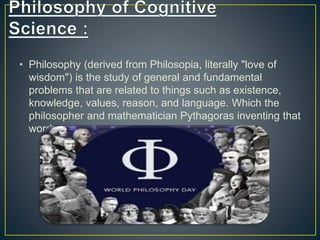
• Philosophy (derived from Philosopia, literally "love of
wisdom") is the study of general and fundamental
problems that are related to things such as existence,
knowledge, values, reason, and language. Which the
philosopher and mathematician Pythagoras inventing that
word.
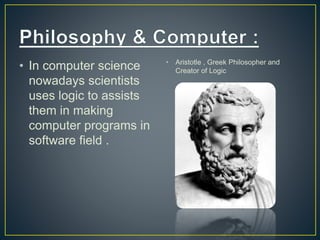
• In computer science
nowadays scientists
uses logic to assists
them in making
computer programs in
software field .
• Aristotle , Greek Philosopher and
Creator of Logic
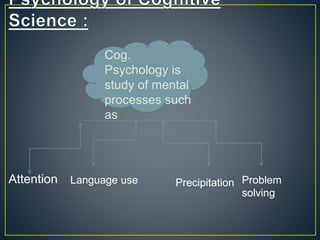
Cog.
Psychology is
study of mental
processes such
as
Attention Language use Precipitation Problem
solving
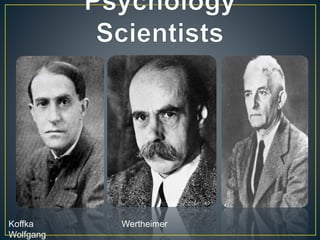
Koffka Wertheimer
Wolfgang
• Cognitive anthropology is an approach within cultural
anthropology in which scholars seek to explain patterns
of shared knowledge.
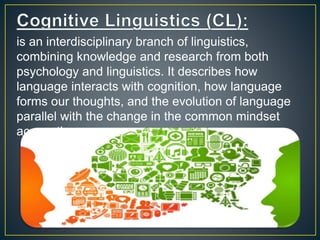
is an interdisciplinary branch of linguistics,
combining knowledge and research from both
psychology and linguistics. It describes how
language interacts with cognition, how language
forms our thoughts, and the evolution of language
parallel with the change in the common mindset
across time.
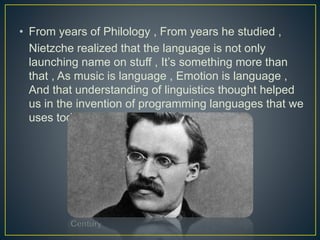
• From years of Philology , From years he studied ,
Nietzche realized that the language is not only
launching name on stuff , It’s something more than
that , As music is language , Emotion is language ,
And that understanding of linguistics thought helped
us in the invention of programming languages that we
uses today .
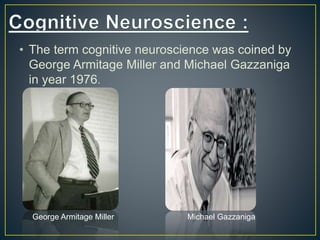
• The term cognitive neuroscience was coined by
George Armitage Miller and Michael Gazzaniga
in year 1976.
George Armitage Miller Michael Gazzaniga
• Artificial intelligence (AI), sometimes
called machine intelligence,
is intelligence demonstrated by machines, in
contrast to the natural intelligence displayed by
humans and other animals.
• Wikipedia
• Stanford encyclopedia of philosophy
• Oxford University press.
• Trends in Cognitive Sciences by Millier
G.A.
• Mohamed Abd El-Rahman Ahmed Ahmed Radwan
• Mohamed Amr Mahmoud Mohamed Ibrahim
• Mohamed Ali Hussein Ali Mekawy
• Class: 17

Cognitive science presentation

  • 3.
    • science isthe study of the mind, including its structure and everything it does. It includes a variety of research sciences, including:
  • 5.
    • Man hastried to understand his own mind since the beginning of time. • The earliest writers spoke of wisdom, foolishness, and the wonder of thought. • Biblical authors spoke of both the clever and the wise, including aspects of education, psychology, philosophy, linguistics, and anthropology. • As the science of psychology began to develop in the 1800s .
  • 6.
    • In morerecent times, beginning early in the 1900s, scientists began projecting the idea that there is much more to the human mind than merely programmed responses. • In more recent times, beginning early in the 1900s, scientists began projecting the idea that there is much more to the human mind than merely programmed responses.
  • 7.
    • Philosophy, thestudy of knowledge, reality, and existence • Psychology, the study of behavior and the mind • Anthropology, the general study of the human society and culture • Linguistics, the study of language • Neuroscience, the study of the nervous system • Artificial intelligence, the study of thinking machines and systems .
  • 8.
    • Philosophy (derivedfrom Philosopia, literally "love of wisdom") is the study of general and fundamental problems that are related to things such as existence, knowledge, values, reason, and language. Which the philosopher and mathematician Pythagoras inventing that word.
  • 9.
    • In computerscience nowadays scientists uses logic to assists them in making computer programs in software field . • Aristotle , Greek Philosopher and Creator of Logic
  • 10.
    Cog. Psychology is study ofmental processes such as Attention Language use Precipitation Problem solving
  • 11.
  • 12.
    • Cognitive anthropologyis an approach within cultural anthropology in which scholars seek to explain patterns of shared knowledge.
  • 15.
    is an interdisciplinarybranch of linguistics, combining knowledge and research from both psychology and linguistics. It describes how language interacts with cognition, how language forms our thoughts, and the evolution of language parallel with the change in the common mindset across time.
  • 16.
    • From yearsof Philology , From years he studied , Nietzche realized that the language is not only launching name on stuff , It’s something more than that , As music is language , Emotion is language , And that understanding of linguistics thought helped us in the invention of programming languages that we uses today .
  • 17.
    • The termcognitive neuroscience was coined by George Armitage Miller and Michael Gazzaniga in year 1976. George Armitage Miller Michael Gazzaniga
  • 19.
    • Artificial intelligence(AI), sometimes called machine intelligence, is intelligence demonstrated by machines, in contrast to the natural intelligence displayed by humans and other animals.
  • 21.
    • Wikipedia • Stanfordencyclopedia of philosophy • Oxford University press. • Trends in Cognitive Sciences by Millier G.A.
  • 23.
    • Mohamed AbdEl-Rahman Ahmed Ahmed Radwan • Mohamed Amr Mahmoud Mohamed Ibrahim • Mohamed Ali Hussein Ali Mekawy • Class: 17