CGSC 1001
Mysteries of the Mind
by Jim Davies
jim@jimdavies.org
1
Across fields, it’s a representation of
something that excludes unimportant detail
and information
• A scale model of a home made of cardboard
• A categorization scheme for the students in my
class
• A simulation of a hurricane
2
Typically, it’s a computer program that
models some aspect of thought.
For example, it might model how people
do categorization, or how a mouse learns
to navigate a maze
The model makes predictions that can
then be compared to data
If the predictions match the data, it
supports the theory underlying the model
3
A programming environment or set of tools
for making cognitive models
Typically, it includes constraints on how
cognition works in all people– speed of
learning, memory retrieval, etc., ignoring
cultural and other learned aspects.
Making a model in an architecture is easier
in some ways and harder in others.
4
Symbolic
• Operates at the level of discrete symbols
Sub-symbolic
• Operates using number representations, which in
aggregate constitute symbols (we’ll have
examples later
Hybrid symbolic/subsymbolic
Brain
• Models cognition at the level of biology, but speak
to cognitive issues
5
Production systems
For example (assuming words beginning
with capital letters are variables, and other
words are constants):
if [Person, age, Number] &
[Person, employment, none] &
[Number, greater_than, 18] &
[Number, less_than, 65]
then [Person, can_claim,
unemployment_benefit].
6
Declarative/procedural memory distinction
• Justifications: HM and other brain damaged
patients
• Our inability to consciously retrieve and reflect on
procedural memories.
Goals are subset of declarative memory
Production compilation models
automatization
7
8
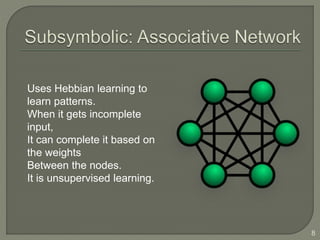
Uses Hebbian learning to
learn patterns.
When it gets incomplete
input,
It can complete it based on
the weights
Between the nodes.
It is unsupervised learning.
9
10
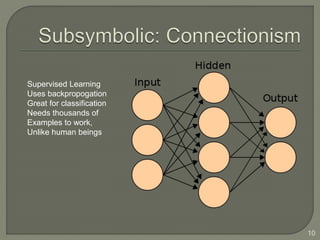
Supervised Learning
Uses backpropogation
Great for classification
Needs thousands of
Examples to work,
Unlike human beings
Nengo and Spaun
http://nengo.ca/build-a-brain/spaunvideos
11

Cognitive architectures

  • 1.
    CGSC 1001 Mysteries ofthe Mind by Jim Davies jim@jimdavies.org 1
  • 2.
    Across fields, it’sa representation of something that excludes unimportant detail and information • A scale model of a home made of cardboard • A categorization scheme for the students in my class • A simulation of a hurricane 2
  • 3.
    Typically, it’s acomputer program that models some aspect of thought. For example, it might model how people do categorization, or how a mouse learns to navigate a maze The model makes predictions that can then be compared to data If the predictions match the data, it supports the theory underlying the model 3
  • 4.
    A programming environmentor set of tools for making cognitive models Typically, it includes constraints on how cognition works in all people– speed of learning, memory retrieval, etc., ignoring cultural and other learned aspects. Making a model in an architecture is easier in some ways and harder in others. 4
  • 5.
    Symbolic • Operates atthe level of discrete symbols Sub-symbolic • Operates using number representations, which in aggregate constitute symbols (we’ll have examples later Hybrid symbolic/subsymbolic Brain • Models cognition at the level of biology, but speak to cognitive issues 5
  • 6.
    Production systems For example(assuming words beginning with capital letters are variables, and other words are constants): if [Person, age, Number] & [Person, employment, none] & [Number, greater_than, 18] & [Number, less_than, 65] then [Person, can_claim, unemployment_benefit]. 6
  • 7.
    Declarative/procedural memory distinction •Justifications: HM and other brain damaged patients • Our inability to consciously retrieve and reflect on procedural memories. Goals are subset of declarative memory Production compilation models automatization 7
  • 8.
    8 Uses Hebbian learningto learn patterns. When it gets incomplete input, It can complete it based on the weights Between the nodes. It is unsupervised learning.
  • 9.
  • 10.
    10 Supervised Learning Uses backpropogation Greatfor classification Needs thousands of Examples to work, Unlike human beings
  • 11.

Editor's Notes

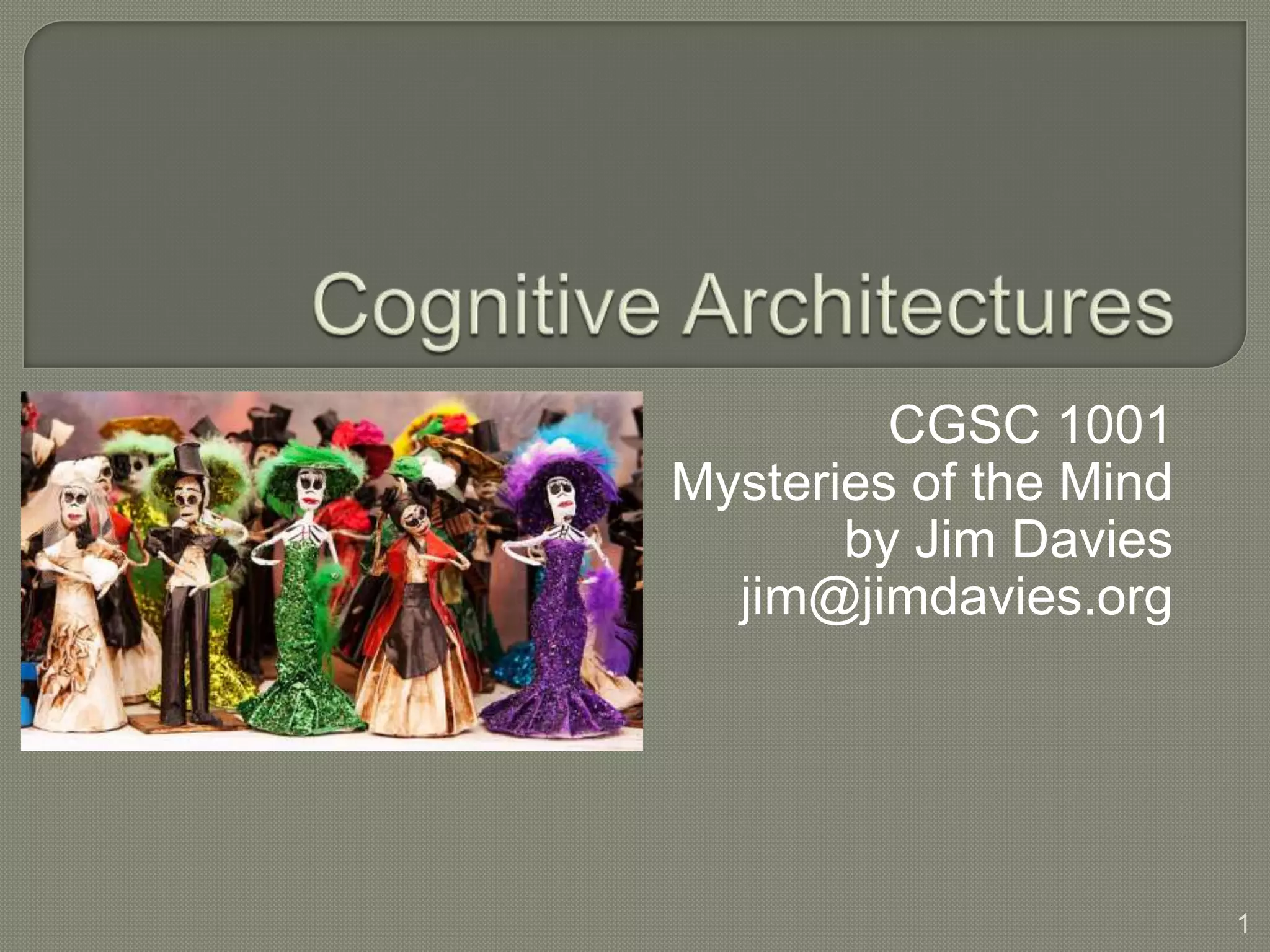
  • #2 Pictured: Catrinas, traditions figures of day of the dead celebrations in Mexico. From wikimedia commons.