
CGSC 1001
Mysteries of the Mind
by Jim Davies
jim@jimdavies.org
With special thanks
to Andy Brook
Presented by Ted Lougheed
1
Jim Davies is away due to illness and
asked me to step in for him
Background:
• PhD in Cognitive Science, Carleton University
• Thesis: Self-consciousness and the Self as
Subject
• B.A. and M.A. in Philosophy
2
Awake
• Not asleep
Conscious of something
• Awareness of an oncoming car
• We are aware of much less than we think
Conscious of self
• Descartes's “I think therefore I am”
• Awareness of what is doing the action or having the
experience
We will be discussing consciousness of the latter two
types. It is possible to be conscious in the latter
sense whilst not being awake (i.e., dreaming).
3
As we get better at things, they become
easier to do, and faster, and we can think
about other things while we do them.
Driving is a good example.
We become less conscious of the activity.
It gets so fast that making yourself
conscious of it will mess up performance.
Perhaps babies are more conscious than
we are, because they are habituated to
nothing.
4
Much of what the brain/mind does is not
available to consciousness, or does not
require consciousness.
It is like an iceberg – only a small part of the
mind is available to reflect on or control
AI has the potential to do all kinds of stuff
without consciousness.
We just don’t know enough about it to know.
Another possibility – the rest of the brain is
conscious but not available to “us” – we see
that this is possible in the case of split-brain
patients.
5
When we perceive or decide or believe
something without having a notion of how
the idea came about.
Can be caused by automatization.
We have genetic and learned intuitions.
We cannot tell the difference.
When can we trust it?
Old brain processes are mostly
impenetrable.
Video: Neuroscience and Free Will (6m)
http://youtu.be/N6S9OidmNZM
6
7
The “qualities” of consciousness – “what it
is like” to see, hear, taste, etc.
An example of a “quale” (plural qualia):
What the colour red looks like, or what
pain feels like.
There is a debate in philosophy regarding
whether qualia are reducible to physical
processes and states.
8
Blindsight (ability to guess above chance
aspects of visual stimuli in absence of
perception)
Hemisphere neglect (damage to the brain
causing deficit of awareness of one side of
space)
Severed corpus collosum (split-brain or
commisurotomy)
Thought alienation (believing that the
thoughts in your head are not your own)
9
In philosophy, a zombie is a being that is like
a human but has no conscious experience.
Behavioural Zombie: behaves just like a
human
Neurological Zombie: a behavioural zombie,
the brain states of which are indistinguishable
from a human
If zombies are possible, then perhaps some
form of dualism is correct.
Dualism is the belief that there is some kind
of mental substance that is not physical.
10
11
Consciousness highlights certain parts of
memory, that are viewable by other
processes.
Similar to a “blackboard architecture” in AI.
12
There are multiple processes in the mind
that interpret things. These are like multiple
drafts of the same story, such as picking
up a glass of water.
They compete for control over other parts
of your mind.
There is no set point at which something
becomes conscious.
http://youtu.be/qYYFQiN052c
13

The Cognitive Science of consciousness

  • 1.
    CGSC 1001 Mysteries ofthe Mind by Jim Davies jim@jimdavies.org With special thanks to Andy Brook Presented by Ted Lougheed 1
  • 2.
    Jim Davies isaway due to illness and asked me to step in for him Background: • PhD in Cognitive Science, Carleton University • Thesis: Self-consciousness and the Self as Subject • B.A. and M.A. in Philosophy 2
  • 3.
    Awake • Not asleep Consciousof something • Awareness of an oncoming car • We are aware of much less than we think Conscious of self • Descartes's “I think therefore I am” • Awareness of what is doing the action or having the experience We will be discussing consciousness of the latter two types. It is possible to be conscious in the latter sense whilst not being awake (i.e., dreaming). 3
  • 4.
    As we getbetter at things, they become easier to do, and faster, and we can think about other things while we do them. Driving is a good example. We become less conscious of the activity. It gets so fast that making yourself conscious of it will mess up performance. Perhaps babies are more conscious than we are, because they are habituated to nothing. 4
  • 5.
    Much of whatthe brain/mind does is not available to consciousness, or does not require consciousness. It is like an iceberg – only a small part of the mind is available to reflect on or control AI has the potential to do all kinds of stuff without consciousness. We just don’t know enough about it to know. Another possibility – the rest of the brain is conscious but not available to “us” – we see that this is possible in the case of split-brain patients. 5
  • 6.
    When we perceiveor decide or believe something without having a notion of how the idea came about. Can be caused by automatization. We have genetic and learned intuitions. We cannot tell the difference. When can we trust it? Old brain processes are mostly impenetrable. Video: Neuroscience and Free Will (6m) http://youtu.be/N6S9OidmNZM 6
  • 7.
  • 8.
    The “qualities” ofconsciousness – “what it is like” to see, hear, taste, etc. An example of a “quale” (plural qualia): What the colour red looks like, or what pain feels like. There is a debate in philosophy regarding whether qualia are reducible to physical processes and states. 8
  • 9.
    Blindsight (ability toguess above chance aspects of visual stimuli in absence of perception) Hemisphere neglect (damage to the brain causing deficit of awareness of one side of space) Severed corpus collosum (split-brain or commisurotomy) Thought alienation (believing that the thoughts in your head are not your own) 9
  • 10.
    In philosophy, azombie is a being that is like a human but has no conscious experience. Behavioural Zombie: behaves just like a human Neurological Zombie: a behavioural zombie, the brain states of which are indistinguishable from a human If zombies are possible, then perhaps some form of dualism is correct. Dualism is the belief that there is some kind of mental substance that is not physical. 10
  • 11.
  • 12.
    Consciousness highlights certainparts of memory, that are viewable by other processes. Similar to a “blackboard architecture” in AI. 12
  • 13.
    There are multipleprocesses in the mind that interpret things. These are like multiple drafts of the same story, such as picking up a glass of water. They compete for control over other parts of your mind. There is no set point at which something becomes conscious. http://youtu.be/qYYFQiN052c 13

Editor's Notes

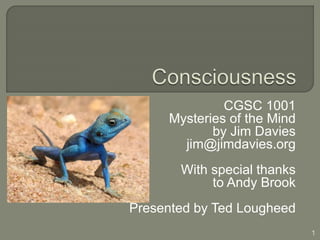
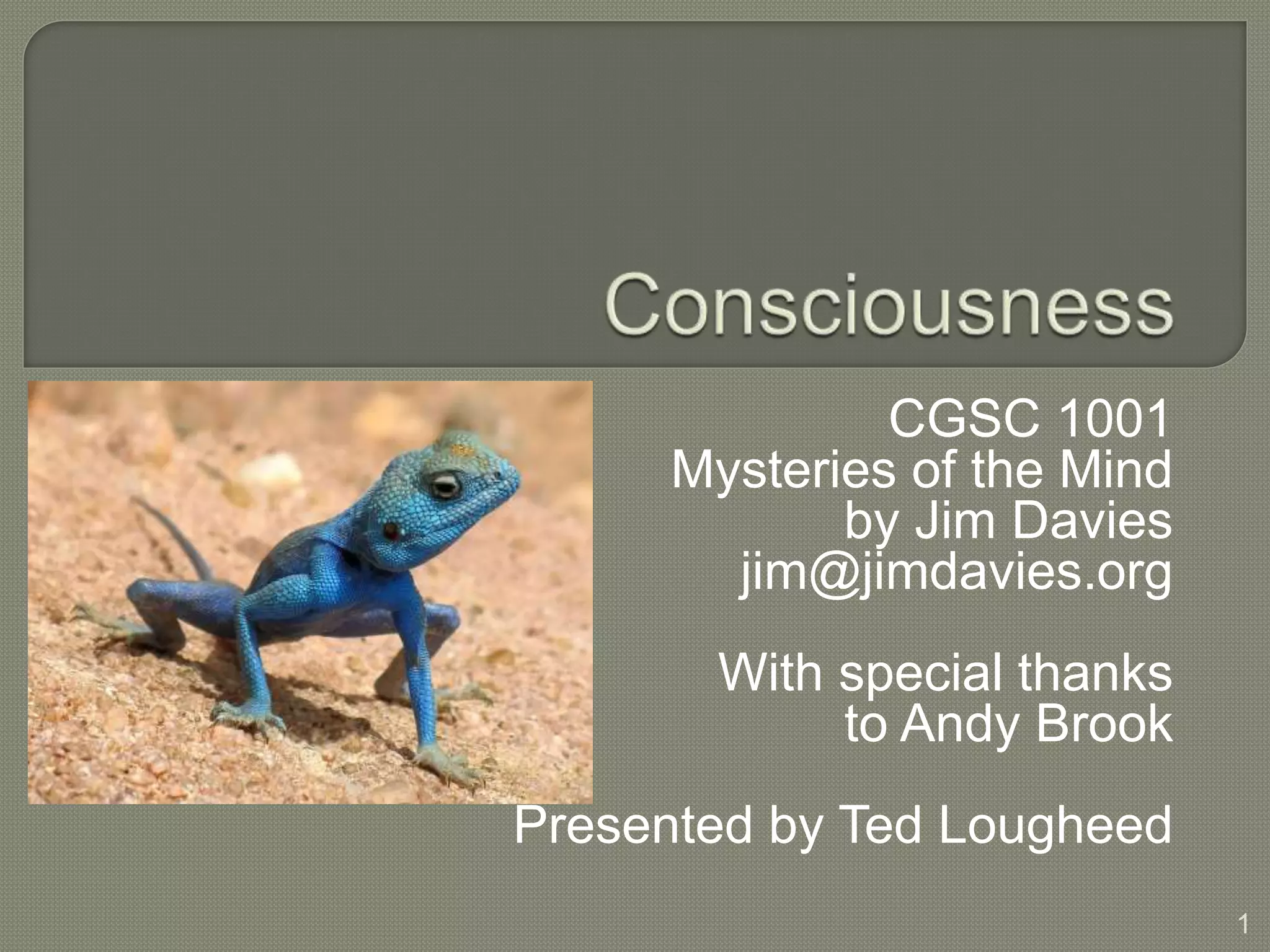
  • #2 Pictured: agama sinaita, Jordan. Males turn blue to attract females. Creative Commons image from wikimedia commons.
  • #12 Image by Greg Nirshberg from http://cognitivephilosophy.net/consciousness/human-cognition-and-the-chinese-room/
  • #13 http://en.wikipedia.org/wiki/Global_Workspace_Theory
  • #14 http://en.wikipedia.org/wiki/Multiple_drafts_model