Introduction
Syed Ali Raza
Lecturer
Department Of Computer Science
GC University Lahore
Cognitive Psychology?
•Behaviorists:
•“What happens when I press Alt-Tab? Cool! It switched to my last open application!!” But
how does that work?
•Neurobiologists:
•“Check this out, the harddrive and the RAM are both connected to the motherboard!” But
what does that mean?
•Cognitive Psychologists:
•“Pressing Alt-Tab switches me between applications, and I know that Windows uses STM…
Let’s propose a model of Windows where it stores which apps are open in STM, and when a
user hits Alt-Tab, it switches between open apps.”
Cognitive Psychology?
•Cognitive Psychology versus Artificial Intelligence (AI)
•AI: what’s the best way to do this?
•Cognitive Psych: how do humans do this?
•Both try to model some form of mind
•The difference is fidelity
• Brain is optimal: If AI truly wants to find optimality they should study
Cognitive Psychology.
Why study Cognitive Psychology
•Understanding the mind
•Education
•Medicine
•Therapy
•Artificial Intelligence
•Tool/Interface Design
•Gaming/Entertainment
•Etc.
Cognition
The word cognition is derived from the Latin word cognoscere, meaning “to know” or “to come to know”.
Cognition is therefore the activities and processes concerned with the acquisition, storage, retrieval and
processing of knowledge.
Psychology:
1. Science it is considered science because psychologist attempt to understand people
through careful and controlled observation.
2. Behavior refers to all of person’s overt actions that others can directly observe and
measure.
3. Mental process refers to the private thoughts (thinking), emotions, feelings and
motives that others cannot directly observe.
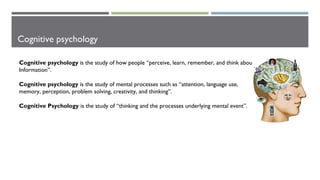
Cognitive psychology
Cognitive psychology is the study of how people “perceive, learn, remember, and think about
Information”.
Cognitive psychology is the study of mental processes such as “attention, language use,
memory, perception, problem solving, creativity, and thinking”.
Cognitive Psychology is the study of “thinking and the processes underlying mental event”.
Example
How people perceive various shapes
Why they remember some facts and forget others
How they learn language
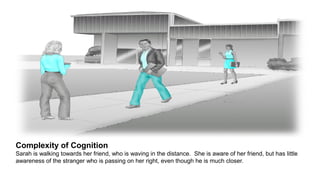
Complexity of Cognition
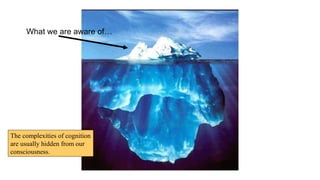
Sarah is walking towards her friend, who is waving in the distance. She is aware of her friend, but has little
awareness of the stranger who is passing on her right, even though he is much closer.
What we are aware of…
The complexities of cognition
are usually hidden from our
consciousness.
Philosophical Antecedents of Psychology
PLATO (ca. 428-348 B.C) – Rationalism
Nature of reality
Reality resides not in the concrete objects we perceive but in the abstract forms that
these objects represent
How to investigate reality
Observation is misleading
The route to knowledge is through logical analysis
Doesn't it seem that mathematical and logical truths are true not
because of our five senses, but because of reason's ability to connect
ideas?
Philosophical Antecedents of Psychology
ARISTOTLE (ca. 384-322 B.C) – Empiricism
Nature of reality
Reality lies only in the concrete world of objects that our bodies sense
How to investigate reality
The route to knowledge is through empirical evidence, obtained through experience and
observation
Observations of the external world are the only means to arrive at truth
 How would you know what the color blue looks like if you were born blind?
Philosophical Antecedents of Psychology
RENE DESCARTES(1596-1650) – Rationalism“Cogito ergo sum”
Innate ideas
Mental representations
Agreed with Plato & Socrates; attempted to figure out how mind and body communicate.
Descartes raised, directly or indirectly, virtually all the significant issues related to the
foundations of the science of the mind
Descartes proposed that the body operates mechanically via reflex actions, similar to
machinery.
 Reflexes are activated by stimuli in the environment.
 A reflex connects a stimulus (S) with a response (R).
Descartes proposed that the mind could overrule the action of bodily reflexes.
Philosophical Antecedents of Psychology
JOHN LOCKE (1632-1704)– Empiricism
“tabula rasa” (“blank slate”)
both sighted and blind people ought to be able to learn the meanings of words like statue
and feel but the blind ought to be unable to acquire words like picture and see…
Learning
Humans are born without knowledge
No innate ideas
Philosophical Antecedents of Psychology
JOHN LOCKE (1632-1704)– Empiricism
 Knowledge is built up from sense impressions combined to form complex ideas.
Associations bind these impressions together.
Complexity is built from simple parts
Example of the apple – sweetness, redness, roundness, associated with taste, smell to form
the idea (concept) of an “apple.”
Psychological Antecedents of Cognitive Psychology
WILHELM WUNDT (1832–1920), Edward Titchener(1867–1927)- Structuralism
Goal of psychology
To understand the structure of the mind and its perceptions by analyzing those
perceptions into their constituent components
Method
Introspection – looking inward at pieces of information passing through
consciousness
Psychological Antecedents of Cognitive Psychology

William James (1842– 1910)-Functionalism
Goal of psychology
To study the processes of mind rather than its contents
Method
Various methods – introspection, observation, experiment
Psychological Antecedents of Cognitive Psychology
Hermann Ebbinghaus(1850 – 1909)- Associationism
 Goal of psychology
 Elements of the mind, like events or ideas, can become associated with one another
in the mind to result in a form of learning.
 Method
 contiguity (associating things that tend to occur together at about the same time)
 similarity (associating things with similar features or properties)
 contrast (associating things that show polarities, such as hot/cold, light/dark,
day/night).
Psychological Antecedents of Cognitive Psychology
John Watson (1878 – 1958)-Behaviorism
Goal of psychology
To study observable behavior
Any hypotheses about internal thoughts and ways of thinking are nothing more than
speculation
We can not say anything meaningful about cognition
Method
Animal experiments, conditioning experiments
Psychological Antecedents of Cognitive Psychology
Gestalt Psychology
Goal of psychology
To understand psychological phenomena as organized, structured wholes
The whole differs from the sum of its parts
Method
Various methods – experiment, observation
Emergence of Cognitive Psychology
Karl Lashley (1890-1958)
Psychobiological arguments against behaviorism
Playing piano
On a behaviorist, stimulus-response account, an activity such as rapidly playing a
correct sequence of notes from memory on an instrument would involve an
associative chain of stimuli and responses
Such associative chains can not explain the behavior; input is never put into a static
system, but always into a system which is actively organized
Emergence of Cognitive Psychology
Noam Chomsky
Linguistic arguments against behaviorism
Arguments from language acquisition
Behaviorists can not explain how children can produce novel sentences they never
heard
Infinite number of sentences we can produce can not be learned by reinforcement
– there must be a cognitive algorithmic structure in our mind underlying language
Emergence of Cognitive Psychology
Alan Turing
Analogy between computers and human minds
Hardware (brain), Software (mind)
Thinking can be described in terms of algorithmic manipulation of some information
These ideas gave rise to the information processing paradigm in psychology –
cognitive psychology
Intelligence
Intelligence is the capacity to learn from experience, using metacognitive processes to
enhance learning, and the ability to adapt to the surrounding environment.
Models for intelligence
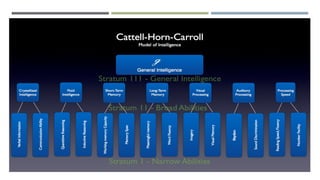
Carroll: Three-Stratum Model of Intelligence
Stratum I includes many narrow, specific abilities (e.g., spelling ability, speed of reasoning).
Stratum II includes various broad abilities (e.g., fluid intelligence, crystallized intelligence, short-term memory, long-
term storage and retrieval, information-processing speed).
Stratum III is just a single general intelligence (sometimes called g).
Models for intelligence
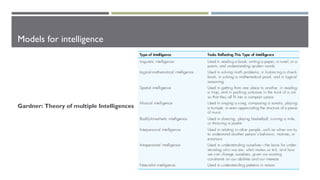
Gardner: Theory of multiple Intelligences
Models for intelligence
Sternberg: The Triarchic Theory of Intelligence
Creative abilities are used to generate novel ideas.
Analytical abilities ascertain whether your ideas (and those of others) are good ones.
Practical abilities are used to implement the ideas and persuade others of their value.

Introduction

  • 1.
    Introduction Syed Ali Raza Lecturer DepartmentOf Computer Science GC University Lahore
  • 2.
    Cognitive Psychology? •Behaviorists: •“What happenswhen I press Alt-Tab? Cool! It switched to my last open application!!” But how does that work? •Neurobiologists: •“Check this out, the harddrive and the RAM are both connected to the motherboard!” But what does that mean? •Cognitive Psychologists: •“Pressing Alt-Tab switches me between applications, and I know that Windows uses STM… Let’s propose a model of Windows where it stores which apps are open in STM, and when a user hits Alt-Tab, it switches between open apps.”
  • 3.
    Cognitive Psychology? •Cognitive Psychologyversus Artificial Intelligence (AI) •AI: what’s the best way to do this? •Cognitive Psych: how do humans do this? •Both try to model some form of mind •The difference is fidelity • Brain is optimal: If AI truly wants to find optimality they should study Cognitive Psychology.
  • 4.
    Why study CognitivePsychology •Understanding the mind •Education •Medicine •Therapy •Artificial Intelligence •Tool/Interface Design •Gaming/Entertainment •Etc.
  • 5.
    Cognition The word cognitionis derived from the Latin word cognoscere, meaning “to know” or “to come to know”. Cognition is therefore the activities and processes concerned with the acquisition, storage, retrieval and processing of knowledge.
  • 6.
    Psychology: 1. Science itis considered science because psychologist attempt to understand people through careful and controlled observation. 2. Behavior refers to all of person’s overt actions that others can directly observe and measure. 3. Mental process refers to the private thoughts (thinking), emotions, feelings and motives that others cannot directly observe.
  • 7.
    Cognitive psychology Cognitive psychologyis the study of how people “perceive, learn, remember, and think about Information”. Cognitive psychology is the study of mental processes such as “attention, language use, memory, perception, problem solving, creativity, and thinking”. Cognitive Psychology is the study of “thinking and the processes underlying mental event”.
  • 8.
    Example How people perceivevarious shapes Why they remember some facts and forget others How they learn language
  • 9.
    Complexity of Cognition Sarahis walking towards her friend, who is waving in the distance. She is aware of her friend, but has little awareness of the stranger who is passing on her right, even though he is much closer.
  • 10.
    What we areaware of… The complexities of cognition are usually hidden from our consciousness.
  • 12.
    Philosophical Antecedents ofPsychology PLATO (ca. 428-348 B.C) – Rationalism Nature of reality Reality resides not in the concrete objects we perceive but in the abstract forms that these objects represent How to investigate reality Observation is misleading The route to knowledge is through logical analysis
  • 13.
    Doesn't it seemthat mathematical and logical truths are true not because of our five senses, but because of reason's ability to connect ideas?
  • 14.
    Philosophical Antecedents ofPsychology ARISTOTLE (ca. 384-322 B.C) – Empiricism Nature of reality Reality lies only in the concrete world of objects that our bodies sense How to investigate reality The route to knowledge is through empirical evidence, obtained through experience and observation Observations of the external world are the only means to arrive at truth
  • 15.
     How wouldyou know what the color blue looks like if you were born blind?
  • 16.
    Philosophical Antecedents ofPsychology RENE DESCARTES(1596-1650) – Rationalism“Cogito ergo sum” Innate ideas Mental representations Agreed with Plato & Socrates; attempted to figure out how mind and body communicate. Descartes raised, directly or indirectly, virtually all the significant issues related to the foundations of the science of the mind Descartes proposed that the body operates mechanically via reflex actions, similar to machinery.  Reflexes are activated by stimuli in the environment.  A reflex connects a stimulus (S) with a response (R). Descartes proposed that the mind could overrule the action of bodily reflexes.
  • 17.
    Philosophical Antecedents ofPsychology JOHN LOCKE (1632-1704)– Empiricism “tabula rasa” (“blank slate”) both sighted and blind people ought to be able to learn the meanings of words like statue and feel but the blind ought to be unable to acquire words like picture and see… Learning Humans are born without knowledge No innate ideas
  • 18.
    Philosophical Antecedents ofPsychology JOHN LOCKE (1632-1704)– Empiricism  Knowledge is built up from sense impressions combined to form complex ideas. Associations bind these impressions together. Complexity is built from simple parts Example of the apple – sweetness, redness, roundness, associated with taste, smell to form the idea (concept) of an “apple.”
  • 19.
    Psychological Antecedents ofCognitive Psychology WILHELM WUNDT (1832–1920), Edward Titchener(1867–1927)- Structuralism Goal of psychology To understand the structure of the mind and its perceptions by analyzing those perceptions into their constituent components Method Introspection – looking inward at pieces of information passing through consciousness
  • 20.
    Psychological Antecedents ofCognitive Psychology  William James (1842– 1910)-Functionalism Goal of psychology To study the processes of mind rather than its contents Method Various methods – introspection, observation, experiment
  • 21.
    Psychological Antecedents ofCognitive Psychology Hermann Ebbinghaus(1850 – 1909)- Associationism  Goal of psychology  Elements of the mind, like events or ideas, can become associated with one another in the mind to result in a form of learning.  Method  contiguity (associating things that tend to occur together at about the same time)  similarity (associating things with similar features or properties)  contrast (associating things that show polarities, such as hot/cold, light/dark, day/night).
  • 22.
    Psychological Antecedents ofCognitive Psychology John Watson (1878 – 1958)-Behaviorism Goal of psychology To study observable behavior Any hypotheses about internal thoughts and ways of thinking are nothing more than speculation We can not say anything meaningful about cognition Method Animal experiments, conditioning experiments
  • 23.
    Psychological Antecedents ofCognitive Psychology Gestalt Psychology Goal of psychology To understand psychological phenomena as organized, structured wholes The whole differs from the sum of its parts Method Various methods – experiment, observation
  • 24.
    Emergence of CognitivePsychology Karl Lashley (1890-1958) Psychobiological arguments against behaviorism Playing piano On a behaviorist, stimulus-response account, an activity such as rapidly playing a correct sequence of notes from memory on an instrument would involve an associative chain of stimuli and responses Such associative chains can not explain the behavior; input is never put into a static system, but always into a system which is actively organized
  • 25.
    Emergence of CognitivePsychology Noam Chomsky Linguistic arguments against behaviorism Arguments from language acquisition Behaviorists can not explain how children can produce novel sentences they never heard Infinite number of sentences we can produce can not be learned by reinforcement – there must be a cognitive algorithmic structure in our mind underlying language
  • 26.
    Emergence of CognitivePsychology Alan Turing Analogy between computers and human minds Hardware (brain), Software (mind) Thinking can be described in terms of algorithmic manipulation of some information These ideas gave rise to the information processing paradigm in psychology – cognitive psychology
  • 27.
    Intelligence Intelligence is thecapacity to learn from experience, using metacognitive processes to enhance learning, and the ability to adapt to the surrounding environment.
  • 28.
    Models for intelligence Carroll:Three-Stratum Model of Intelligence Stratum I includes many narrow, specific abilities (e.g., spelling ability, speed of reasoning). Stratum II includes various broad abilities (e.g., fluid intelligence, crystallized intelligence, short-term memory, long- term storage and retrieval, information-processing speed). Stratum III is just a single general intelligence (sometimes called g).
  • 30.
    Models for intelligence Gardner:Theory of multiple Intelligences
  • 31.
    Models for intelligence Sternberg:The Triarchic Theory of Intelligence Creative abilities are used to generate novel ideas. Analytical abilities ascertain whether your ideas (and those of others) are good ones. Practical abilities are used to implement the ideas and persuade others of their value.