CGSC 1001
Mysteries of the Mind
by Jim Davies
jim@jimdavies.org
1
We use all of our brains.
If any part of your brain gets damaged, you
will suffer deficits.
Evolution would not “waste” energy
building vast parts of your brain you don’t
use.
2
Availability Cascade
Wishful Thinking
• People like to believe in the paranormal
People want to make money from you
3
People can lose whole hemispheres and
still function relatively normally
• The brain has redundancy
If we removed 70% of your neurons
randomly, we’re not sure how badly off
you’d be.
4
Unfortunately, it’s not.
Recommended: Susan Blackmore’s book
Adventures of a Parapsychologist
There are several cognitive biases that
make us believe that it’s real.
• Confirmation bias
• Neglect of negative results
• Wishful thinking
5
We believe it because we hope it’s true
The effect is small, short term, and only
based on arousal.
You can get the same effect from hearing a
scary passage from a Stephen King book.
6
If they were biased, they would
underpredict later success for certain
groups, and overpredict for others. This
does not happen.
Huge panels of scientists with widely
varying viewpoints concluded that they are
not biased.
Item analysis is used to identify bad test
questions.
7
 Money and Happiness
• Money correlates with happiness until you’re making about
$75k per year (in our society), then it levels off.
 Life events don’t affect happiness much
• Winners of lotteries and people who become paraplegic
have happiness changes that only last months
• Things that do affect us: divorce, getting fired
 Much of your happiness (roughly 60%) is genetic
 There are two kinds of happiness:
• Pleasure, day-to-day
• Life satisfaction
8
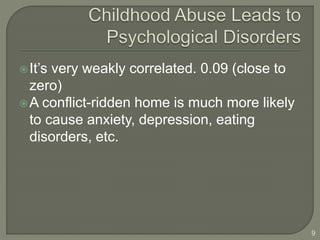
It’s very weakly correlated. 0.09 (close to
zero)
A conflict-ridden home is much more likely
to cause anxiety, depression, eating
disorders, etc.
9
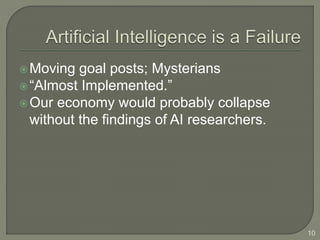
Moving goal posts; Mysterians
“Almost Implemented.”
Our economy would probably collapse
without the findings of AI researchers.
10
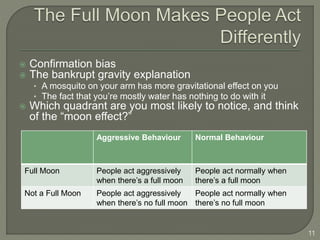
 Confirmation bias
 The bankrupt gravity explanation
• A mosquito on your arm has more gravitational effect on you
• The fact that you’re mostly water has nothing to do with it
 Which quadrant are you most likely to notice, and think
of the “moon effect?”
11
Aggressive Behaviour Normal Behaviour
Full Moon People act aggressively
when there’s a full moon
People act normally when
there’s a full moon
Not a Full Moon People act aggressively
when there’s no full moon
People act normally when
there’s no full moon
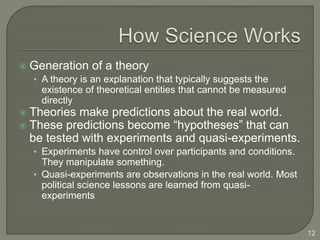
 Generation of a theory
• A theory is an explanation that typically suggests the
existence of theoretical entities that cannot be measured
directly
 Theories make predictions about the real world.
 These predictions become “hypotheses” that can
be tested with experiments and quasi-experiments.
• Experiments have control over participants and conditions.
They manipulate something.
• Quasi-experiments are observations in the real world. Most
political science lessons are learned from quasi-
experiments
12
Hypotheses and Falsifiability
Significant means probably not due to
chance. <0.05 is the typical threshold or
“alpha level”
• This means that 1 out of 20 experiments will turn
out finding significance just by chance!
We can’t look at a huge list of numbers
and know if they are different. That’s why
we need statistics.
13
Replicability
Science’s self-correcting nature
• Publishing makes it public
• Other scientists will attempt to disprove your
theory. This is good.
Science as an epistemology
• No other knowledge-generating enterprise (e.g.,
religion) has a rigorous, self-correcting mechanism
14
http://www.ted.com/talks/dan_gilbert_asks
_why_are_we_happy.html
Also recommended is Gilbert’s book
Stumbling on Happiness.
15

Myths of Cognitive Science and Psychology

  • 1.
    CGSC 1001 Mysteries ofthe Mind by Jim Davies jim@jimdavies.org 1
  • 2.
    We use allof our brains. If any part of your brain gets damaged, you will suffer deficits. Evolution would not “waste” energy building vast parts of your brain you don’t use. 2
  • 3.
    Availability Cascade Wishful Thinking •People like to believe in the paranormal People want to make money from you 3
  • 4.
    People can losewhole hemispheres and still function relatively normally • The brain has redundancy If we removed 70% of your neurons randomly, we’re not sure how badly off you’d be. 4
  • 5.
    Unfortunately, it’s not. Recommended:Susan Blackmore’s book Adventures of a Parapsychologist There are several cognitive biases that make us believe that it’s real. • Confirmation bias • Neglect of negative results • Wishful thinking 5
  • 6.
    We believe itbecause we hope it’s true The effect is small, short term, and only based on arousal. You can get the same effect from hearing a scary passage from a Stephen King book. 6
  • 7.
    If they werebiased, they would underpredict later success for certain groups, and overpredict for others. This does not happen. Huge panels of scientists with widely varying viewpoints concluded that they are not biased. Item analysis is used to identify bad test questions. 7
  • 8.
     Money andHappiness • Money correlates with happiness until you’re making about $75k per year (in our society), then it levels off.  Life events don’t affect happiness much • Winners of lotteries and people who become paraplegic have happiness changes that only last months • Things that do affect us: divorce, getting fired  Much of your happiness (roughly 60%) is genetic  There are two kinds of happiness: • Pleasure, day-to-day • Life satisfaction 8
  • 9.
    It’s very weaklycorrelated. 0.09 (close to zero) A conflict-ridden home is much more likely to cause anxiety, depression, eating disorders, etc. 9
  • 10.
    Moving goal posts;Mysterians “Almost Implemented.” Our economy would probably collapse without the findings of AI researchers. 10
  • 11.
     Confirmation bias The bankrupt gravity explanation • A mosquito on your arm has more gravitational effect on you • The fact that you’re mostly water has nothing to do with it  Which quadrant are you most likely to notice, and think of the “moon effect?” 11 Aggressive Behaviour Normal Behaviour Full Moon People act aggressively when there’s a full moon People act normally when there’s a full moon Not a Full Moon People act aggressively when there’s no full moon People act normally when there’s no full moon
  • 12.
     Generation ofa theory • A theory is an explanation that typically suggests the existence of theoretical entities that cannot be measured directly  Theories make predictions about the real world.  These predictions become “hypotheses” that can be tested with experiments and quasi-experiments. • Experiments have control over participants and conditions. They manipulate something. • Quasi-experiments are observations in the real world. Most political science lessons are learned from quasi- experiments 12
  • 13.
    Hypotheses and Falsifiability Significantmeans probably not due to chance. <0.05 is the typical threshold or “alpha level” • This means that 1 out of 20 experiments will turn out finding significance just by chance! We can’t look at a huge list of numbers and know if they are different. That’s why we need statistics. 13
  • 14.
    Replicability Science’s self-correcting nature •Publishing makes it public • Other scientists will attempt to disprove your theory. This is good. Science as an epistemology • No other knowledge-generating enterprise (e.g., religion) has a rigorous, self-correcting mechanism 14
  • 15.

Editor's Notes

  • #2 Picture: Dharmaraya Swamy Temple Bangalore By Muhammad Mahdi Karim (www.micro2macro.net) Facebook (Own work) [GFDL 1.2 (www.gnu.org/licenses/old-licenses/fdl-1.2.html)], via Wikimedia Commons
  • #5 Lilienfeld, S. O., Lynn, S. J., Ruscio, J. & Beyerstein, B. L. (2010). 50 Great Myths of Popular Psychology. Wiley-Blackwell. West Sussex: United Kingdom. Page 41
  • #7 Lilienfeld, S. O., Lynn, S. J., Ruscio, J. & Beyerstein, B. L. (2010). 50 Great Myths of Popular Psychology. Wiley-Blackwell. West Sussex: United Kingdom. Page 48
  • #8 Lilienfeld, S. O., Lynn, S. J., Ruscio, J. & Beyerstein, B. L. (2010). 50 Great Myths of Popular Psychology. Wiley-Blackwell. West Sussex: United Kingdom. Page 86
  • #9 I highly recommend Gilbert’s talk on happiness: http://www.ted.com/talks/dan_gilbert_asks_why_are_we_happy.html