CGSC 1001
Mysteries of the Mind
by Jim Davies
jim@jimdavies.org
with assistance
from Deirdre Kelly
1
They evolved to help us take care of the
other people in our groups. But not so
much people outside our groups.
2
 Self-interest: I care about myself and my family.
• All animals have instincts for gene-preservation (with exceptions)
 Friendship: I care for historical cooperation partners
• Shared with chimps
• Sharing food used to be a life-and-death matter for us
 Tribalism: I care about us, but not them.
• Tragedy of the commons
• Evolved morals in humans took care of this.
• Anthropological survey shows that ethnocentrism is universal
 I care about all people or creatures that can have
positive or negative experiences.
• The tragedy of commonsense morality
• Requires abstract reasoning and values.
3
In general, evolved and well-learned
behaviours work faster than deliberate
ones.
When you force people to play a prisoner’s
dilemma game quickly, they are more likely
to cooperate.
4
Trolley 1
Trolley 2
5
Greene’s experiment reveals that there are
two competing systems for our moral
considerations:
• The first is some kind of rational, utilitarian
calculus which makes switch cases permissible.
• The second is an emotional reaction caused by a
dislike of “getting our hands dirty”
• Utilitarianism vs. deontology
6
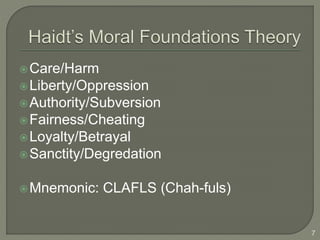
Care/Harm
Liberty/Oppression
Authority/Subversion
Fairness/Cheating
Loyalty/Betrayal
Sanctity/Degredation
Mnemonic: CLAFLS (Chah-fuls)
7
A man brings buys a ready-to-cook
chicken, brings it home, has sexual
intercourse with it, then cooks and eats it.
Did he do something morally wrong?
Most people say yes, but can’t really
explain why.
8
People look to their feelings to judge
whether something is moral or not.
You can make people think something is
more immoral with bad smells or bitter
drinks.
Feeling vs. principles
9
Right-wing people tend to have all six
moral foundations fairly strong.
Left-wing people tend to have only
car/harm and liberty/oppression strong.
Libertarians tend to only have
liberty/oppression strong.
This is mostly genetic, which means your
politics is mostly genetic.
10
 Full 20 Minute TED talk, Frans de Waal:
Moral behavior in animals:
• http://www.youtube.com/watch?v=GcJxRqTs5nk
 Excerpt (3 minutes):
• http://www.youtube.com/watch?v=meiU6TxysCg
 Prosociality
 Empathy and Condolence
 Fairness, Reciprocity, friendship in chimps
• Chimps will kiss and embrace after a fight.
11

The Cognitive Science of morality

  • 1.
    CGSC 1001 Mysteries ofthe Mind by Jim Davies jim@jimdavies.org with assistance from Deirdre Kelly 1
  • 2.
    They evolved tohelp us take care of the other people in our groups. But not so much people outside our groups. 2
  • 3.
     Self-interest: Icare about myself and my family. • All animals have instincts for gene-preservation (with exceptions)  Friendship: I care for historical cooperation partners • Shared with chimps • Sharing food used to be a life-and-death matter for us  Tribalism: I care about us, but not them. • Tragedy of the commons • Evolved morals in humans took care of this. • Anthropological survey shows that ethnocentrism is universal  I care about all people or creatures that can have positive or negative experiences. • The tragedy of commonsense morality • Requires abstract reasoning and values. 3
  • 4.
    In general, evolvedand well-learned behaviours work faster than deliberate ones. When you force people to play a prisoner’s dilemma game quickly, they are more likely to cooperate. 4
  • 5.
  • 6.
    Greene’s experiment revealsthat there are two competing systems for our moral considerations: • The first is some kind of rational, utilitarian calculus which makes switch cases permissible. • The second is an emotional reaction caused by a dislike of “getting our hands dirty” • Utilitarianism vs. deontology 6
  • 7.
  • 8.
    A man bringsbuys a ready-to-cook chicken, brings it home, has sexual intercourse with it, then cooks and eats it. Did he do something morally wrong? Most people say yes, but can’t really explain why. 8
  • 9.
    People look totheir feelings to judge whether something is moral or not. You can make people think something is more immoral with bad smells or bitter drinks. Feeling vs. principles 9
  • 10.
    Right-wing people tendto have all six moral foundations fairly strong. Left-wing people tend to have only car/harm and liberty/oppression strong. Libertarians tend to only have liberty/oppression strong. This is mostly genetic, which means your politics is mostly genetic. 10
  • 11.
     Full 20Minute TED talk, Frans de Waal: Moral behavior in animals: • http://www.youtube.com/watch?v=GcJxRqTs5nk  Excerpt (3 minutes): • http://www.youtube.com/watch?v=meiU6TxysCg  Prosociality  Empathy and Condolence  Fairness, Reciprocity, friendship in chimps • Chimps will kiss and embrace after a fight. 11

Editor's Notes

  • #2 Pictured: SEM image of Tradescantia pollen and stamens. From Wikimedia Commons.
  • #3 Greene, J. (2013). Moral tribes: Emotion, reason, and the gap between us and them. The Penguin Press, HC. Kindle Location 379.
  • #4 Greene location 419. Friendship: Greene loc 541 Anthropological survey: Donald Brown, cited in Greene loc 766
  • #8 Haidt, J. (2012). The righteous mind: Why good people are divided by politics and religion.  New York, NY: Pantheon Books.
  • #12 Reciprocity: Greene loc 520