
The study of energy changes that take
place in a chemical reaction
At the end of the lesson you should be able to:
1. describe energy changes in bond formation and bond breaking
2. distinguish between exothermic and endothermic reactions in
terms of energy
3. explain energy diagrams representing endothermic and
exothermic reactions
4. explain the following terms: activation energy, enthalpy change
5. define heat of solution
6. calculate the heat of solution from experiments or from
experimental data
7. define heat of neutralisation
8. calculate the heat of neutralisation from experiments or from
experimental data
To break a bond, energy (heat)
has to be absorbed.
When a bond is formed, energy
(heat) is released.
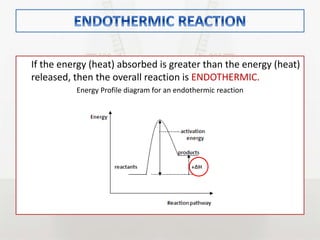
If the energy (heat) absorbed is greater than the energy (heat)
released, then the overall reaction is ENDOTHERMIC.
Energy Profile diagram for an endothermic reaction
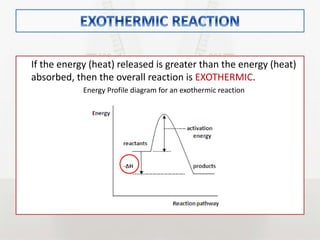
If the energy (heat) released is greater than the energy (heat)
absorbed, then the overall reaction is EXOTHERMIC.
Energy Profile diagram for an exothermic reaction
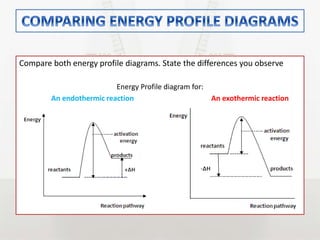
Compare both energy profile diagrams. State the differences you observe
Energy Profile diagram for:
An endothermic reaction An exothermic reaction
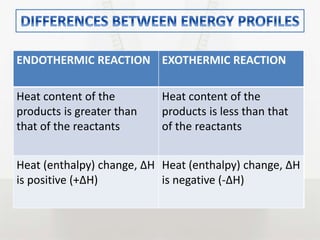
ENDOTHERMIC REACTION EXOTHERMIC REACTION
Heat content of the
products is greater than
that of the reactants
Heat content of the
products is less than that
of the reactants
Heat (enthalpy) change, ∆H
is positive (+∆H)
Heat (enthalpy) change, ∆H
is negative (-∆H)
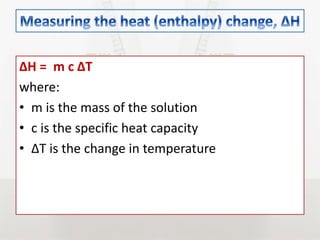
∆H = m c ∆T
where:
• m is the mass of the solution
• c is the specific heat capacity
• ∆T is the change in temperature
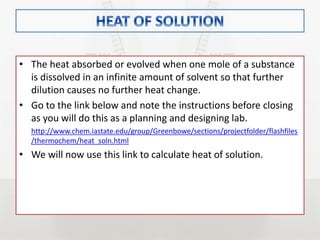
• The heat absorbed or evolved when one mole of a substance
is dissolved in an infinite amount of solvent so that further
dilution causes no further heat change.
• Go to the link below and note the instructions before closing
as you will do this as a planning and designing lab.
http://www.chem.iastate.edu/group/Greenbowe/sections/projectfolder/flashfiles
/thermochem/heat_soln.html
• We will now use this link to calculate heat of solution.
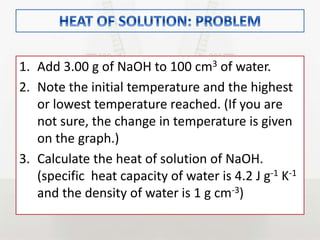
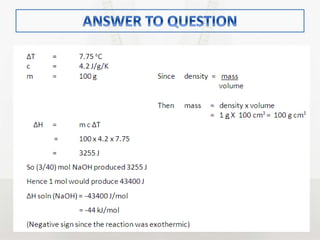
1. Add 3.00 g of NaOH to 100 cm3 of water.
2. Note the initial temperature and the highest
or lowest temperature reached. (If you are
not sure, the change in temperature is given
on the graph.)
3. Calculate the heat of solution of NaOH.
(specific heat capacity of water is 4.2 J g-1 K-1
and the density of water is 1 g cm-3)
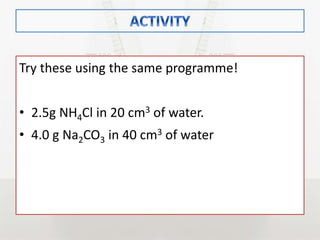
Try these using the same programme!
• 2.5g NH4Cl in 20 cm3 of water.
• 4.0 g Na2CO3 in 40 cm3 of water
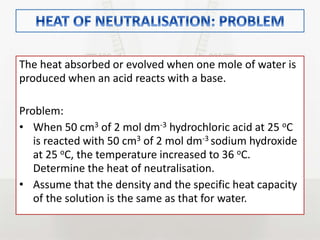
The heat absorbed or evolved when one mole of water is
produced when an acid reacts with a base.
Problem:
• When 50 cm3 of 2 mol dm-3 hydrochloric acid at 25 oC
is reacted with 50 cm3 of 2 mol dm-3 sodium hydroxide
at 25 oC, the temperature increased to 36 oC.
Determine the heat of neutralisation.
• Assume that the density and the specific heat capacity
of the solution is the same as that for water.
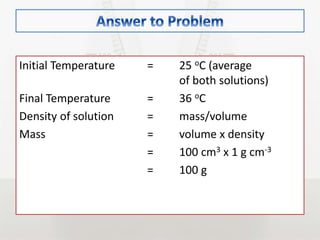
Initial Temperature = 25 oC (average
of both solutions)
Final Temperature = 36 oC
Density of solution = mass/volume
Mass = volume x density
= 100 cm3 x 1 g cm-3
= 100 g
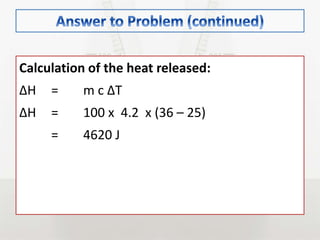
Calculation of the heat released:
∆H = m c ∆T
∆H = 100 x 4.2 x (36 – 25)
= 4620 J
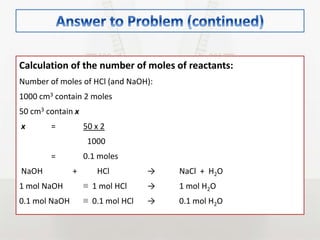
Calculation of the number of moles of reactants:
Number of moles of HCl (and NaOH):
1000 cm3 contain 2 moles
50 cm3 contain x
x = 50 x 2
1000
= 0.1 moles
NaOH + HCl → NaCl + H2O
1 mol NaOH ≡ 1 mol HCl → 1 mol H2O
0.1 mol NaOH ≡ 0.1 mol HCl → 0.1 mol H2O
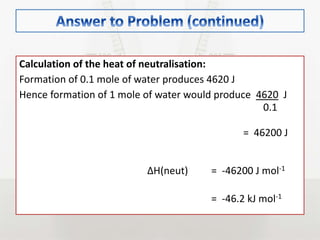
Calculation of the heat of neutralisation:
Formation of 0.1 mole of water produces 4620 J
Hence formation of 1 mole of water would produce 4620 J
0.1
= 46200 J
∆H(neut) = -46200 J mol-1
= -46.2 kJ mol-1

Chemistry M4 Energetics

  • 1.
    The study ofenergy changes that take place in a chemical reaction
  • 2.
    At the endof the lesson you should be able to: 1. describe energy changes in bond formation and bond breaking 2. distinguish between exothermic and endothermic reactions in terms of energy 3. explain energy diagrams representing endothermic and exothermic reactions 4. explain the following terms: activation energy, enthalpy change 5. define heat of solution 6. calculate the heat of solution from experiments or from experimental data 7. define heat of neutralisation 8. calculate the heat of neutralisation from experiments or from experimental data
  • 3.
    To break abond, energy (heat) has to be absorbed.
  • 4.
    When a bondis formed, energy (heat) is released.
  • 5.
    If the energy(heat) absorbed is greater than the energy (heat) released, then the overall reaction is ENDOTHERMIC. Energy Profile diagram for an endothermic reaction
  • 6.
    If the energy(heat) released is greater than the energy (heat) absorbed, then the overall reaction is EXOTHERMIC. Energy Profile diagram for an exothermic reaction
  • 7.
    Compare both energyprofile diagrams. State the differences you observe Energy Profile diagram for: An endothermic reaction An exothermic reaction
  • 8.
    ENDOTHERMIC REACTION EXOTHERMICREACTION Heat content of the products is greater than that of the reactants Heat content of the products is less than that of the reactants Heat (enthalpy) change, ∆H is positive (+∆H) Heat (enthalpy) change, ∆H is negative (-∆H)
  • 9.
    ∆H = mc ∆T where: • m is the mass of the solution • c is the specific heat capacity • ∆T is the change in temperature
  • 10.
    • The heatabsorbed or evolved when one mole of a substance is dissolved in an infinite amount of solvent so that further dilution causes no further heat change. • Go to the link below and note the instructions before closing as you will do this as a planning and designing lab. http://www.chem.iastate.edu/group/Greenbowe/sections/projectfolder/flashfiles /thermochem/heat_soln.html • We will now use this link to calculate heat of solution.
  • 11.
    1. Add 3.00g of NaOH to 100 cm3 of water. 2. Note the initial temperature and the highest or lowest temperature reached. (If you are not sure, the change in temperature is given on the graph.) 3. Calculate the heat of solution of NaOH. (specific heat capacity of water is 4.2 J g-1 K-1 and the density of water is 1 g cm-3)
  • 13.
    Try these usingthe same programme! • 2.5g NH4Cl in 20 cm3 of water. • 4.0 g Na2CO3 in 40 cm3 of water
  • 14.
    The heat absorbedor evolved when one mole of water is produced when an acid reacts with a base. Problem: • When 50 cm3 of 2 mol dm-3 hydrochloric acid at 25 oC is reacted with 50 cm3 of 2 mol dm-3 sodium hydroxide at 25 oC, the temperature increased to 36 oC. Determine the heat of neutralisation. • Assume that the density and the specific heat capacity of the solution is the same as that for water.
  • 15.
    Initial Temperature =25 oC (average of both solutions) Final Temperature = 36 oC Density of solution = mass/volume Mass = volume x density = 100 cm3 x 1 g cm-3 = 100 g
  • 16.
    Calculation of theheat released: ∆H = m c ∆T ∆H = 100 x 4.2 x (36 – 25) = 4620 J
  • 17.
    Calculation of thenumber of moles of reactants: Number of moles of HCl (and NaOH): 1000 cm3 contain 2 moles 50 cm3 contain x x = 50 x 2 1000 = 0.1 moles NaOH + HCl → NaCl + H2O 1 mol NaOH ≡ 1 mol HCl → 1 mol H2O 0.1 mol NaOH ≡ 0.1 mol HCl → 0.1 mol H2O
  • 18.
    Calculation of theheat of neutralisation: Formation of 0.1 mole of water produces 4620 J Hence formation of 1 mole of water would produce 4620 J 0.1 = 46200 J ∆H(neut) = -46200 J mol-1 = -46.2 kJ mol-1