Chapter 17
Honors Chemistry


Thermochemistry


     Copyright©2000 by Houghton           1
  Mifflin Company. All rights reserved.
. Section 17.3

Heat in Changes of State


         Copyright©2000 by Houghton           2
      Mifflin Company. All rights reserved.
Heats of Fusion and
        Solidification

   How does the quantity of heat
    absorbed by a melting solid
  compare to the quantity of heat
released when the liquid solidifies?

             Copyright©2000 by Houghton           3
          Mifflin Company. All rights reserved.
The molar heat of fusion (∆Hfus)
 is the heat absorbed by one mole
of a solid substance as it melts to a
      liquid at a constant temp.


             Copyright©2000 by Houghton           4
          Mifflin Company. All rights reserved.
The molar heat of solidification
(∆Hsolid) is the heat lost when one
  mole of a liquid solidifies at a
     constant temperature.


            Copyright©2000 by Houghton           5
         Mifflin Company. All rights reserved.
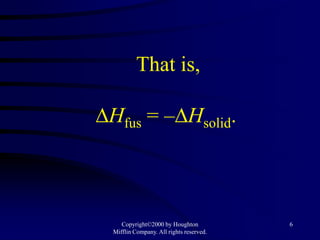
That is,

∆Hfus = –∆Hsolid.


     Copyright©2000 by Houghton           6
  Mifflin Company. All rights reserved.
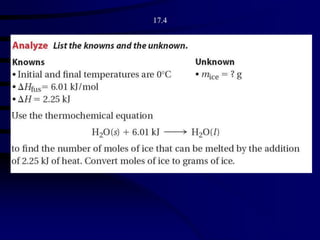
17.4
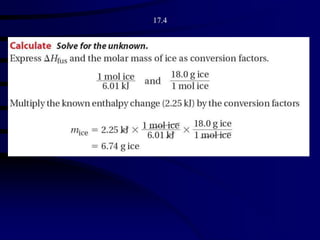
17.4
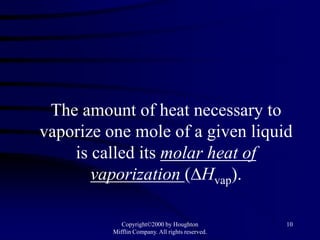
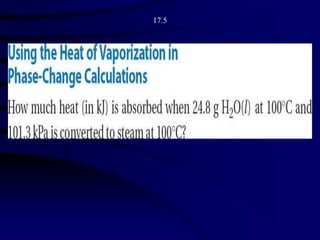
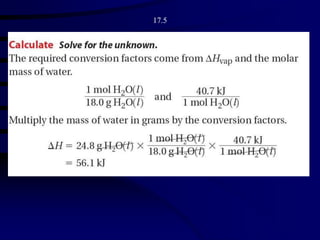
The amount of heat necessary to
vaporize one mole of a given liquid
    is called its molar heat of
       vaporization (∆Hvap).

             Copyright©2000 by Houghton           10
          Mifflin Company. All rights reserved.
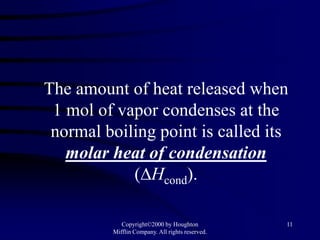
The amount of heat released when
 1 mol of vapor condenses at the
 normal boiling point is called its
   molar heat of condensation
            (∆Hcond).

            Copyright©2000 by Houghton           11
         Mifflin Company. All rights reserved.
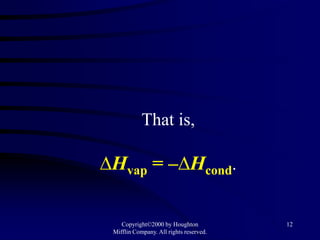
That is,

∆Hvap = –∆Hcond.

    Copyright©2000 by Houghton           12
 Mifflin Company. All rights reserved.
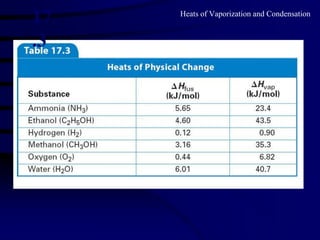
17   Heats of Vaporization and Condensation


.3
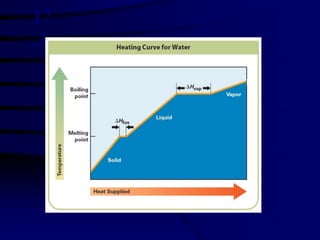
–Observe the phase changes as
 ice is converted to steam when
 heat is added.
17
.3
17.5
17.5
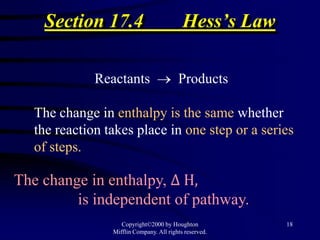
Section 17.4                           Hess’s Law

             Reactants                   Products

  The change in enthalpy is the same whether
  the reaction takes place in one step or a series
  of steps.

The change in enthalpy, Δ H,
         is independent of pathway.
                   Copyright©2000 by Houghton           18
                Mifflin Company. All rights reserved.
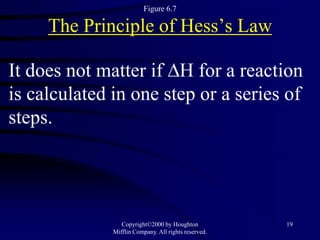
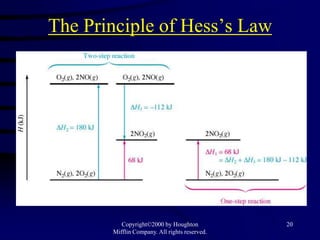
Figure 6.7

     The Principle of Hess’s Law

It does not matter if H for a reaction
is calculated in one step or a series of
steps.


                 Copyright©2000 by Houghton           19
              Mifflin Company. All rights reserved.
The Principle of Hess’s Law


          Copyright©2000 by Houghton           20
       Mifflin Company. All rights reserved.
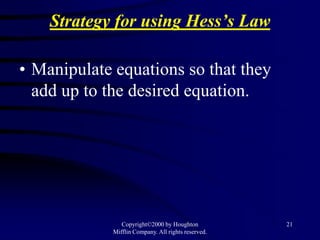
Strategy for using Hess’s Law

• Manipulate equations so that they
  add up to the desired equation.


                Copyright©2000 by Houghton           21
             Mifflin Company. All rights reserved.
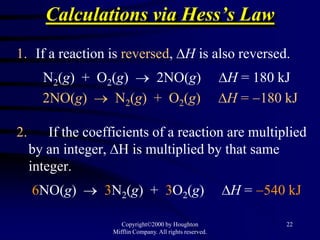
Calculations via Hess’s Law
1. If a reaction is reversed, H is also reversed.
       N2(g) + O2(g)    2NO(g)                              H = 180 kJ
       2NO(g)     N2(g) + O2(g)                             H = 180 kJ

2.       If the coefficients of a reaction are multiplied
     by an integer, H is multiplied by that same
     integer.
     6NO(g)        3N2(g) + 3O2(g)                          H = 540 kJ

                       Copyright©2000 by Houghton                   22
                    Mifflin Company. All rights reserved.
3. Focus on the reactants and products
of the required reaction.


Let’s do some Practice Problems


               Copyright©2000 by Houghton           23
            Mifflin Company. All rights reserved.
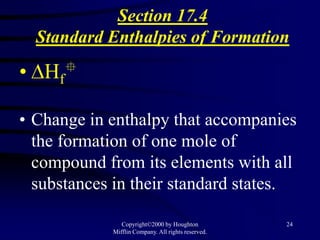
Section 17.4
  Standard Enthalpies of Formation

• Hf   


• Change in enthalpy that accompanies
  the formation of one mole of
  compound from its elements with all
  substances in their standard states.

               Copyright©2000 by Houghton           24
            Mifflin Company. All rights reserved.
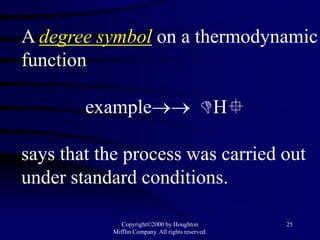
A degree symbol on a thermodynamic
function

        example                              H

says that the process was carried out
under standard conditions.

              Copyright©2000 by Houghton           25
           Mifflin Company. All rights reserved.
Standard States
Compound
    For a gas, pressure is exactly 1 atmosphere.
    For a solution, concentration is exactly
      1 molar.
    Pure substance (liquid or solid), it is the pure
     liquid or solid.
Element
    The form [N2(g), K(s)] in which it exists at
      1 atm and 25°C.

                    Copyright©2000 by Houghton           26
                 Mifflin Company. All rights reserved.
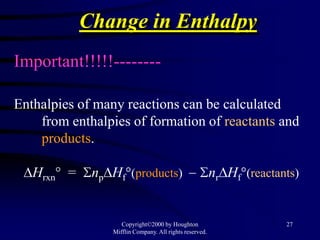
Change in Enthalpy
Important!!!!!--------

Enthalpies of many reactions can be calculated
    from enthalpies of formation of reactants and
    products.

   Hrxn° =    np Hf (products)                           nr Hf (reactants)


                    Copyright©2000 by Houghton                         27
                 Mifflin Company. All rights reserved.
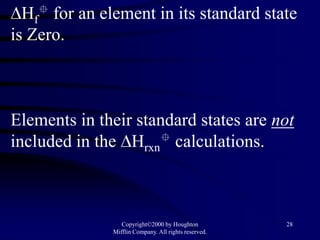
Hf for an element in its standard state
is Zero.


Elements in their standard states are not
included in the Hrxn calculations.


                  Copyright©2000 by Houghton           28
               Mifflin Company. All rights reserved.

Chapter 17 thermochemistry sections 17.3 & 17.4

  • 1.
    Chapter 17 Honors Chemistry Thermochemistry Copyright©2000 by Houghton 1 Mifflin Company. All rights reserved.
  • 2.
    . Section 17.3 Heatin Changes of State Copyright©2000 by Houghton 2 Mifflin Company. All rights reserved.
  • 3.
    Heats of Fusionand Solidification How does the quantity of heat absorbed by a melting solid compare to the quantity of heat released when the liquid solidifies? Copyright©2000 by Houghton 3 Mifflin Company. All rights reserved.
  • 4.
    The molar heatof fusion (∆Hfus) is the heat absorbed by one mole of a solid substance as it melts to a liquid at a constant temp. Copyright©2000 by Houghton 4 Mifflin Company. All rights reserved.
  • 5.
    The molar heatof solidification (∆Hsolid) is the heat lost when one mole of a liquid solidifies at a constant temperature. Copyright©2000 by Houghton 5 Mifflin Company. All rights reserved.
  • 6.
    That is, ∆Hfus =–∆Hsolid. Copyright©2000 by Houghton 6 Mifflin Company. All rights reserved.
  • 8.
  • 9.
  • 10.
    The amount ofheat necessary to vaporize one mole of a given liquid is called its molar heat of vaporization (∆Hvap). Copyright©2000 by Houghton 10 Mifflin Company. All rights reserved.
  • 11.
    The amount ofheat released when 1 mol of vapor condenses at the normal boiling point is called its molar heat of condensation (∆Hcond). Copyright©2000 by Houghton 11 Mifflin Company. All rights reserved.
  • 12.
    That is, ∆Hvap =–∆Hcond. Copyright©2000 by Houghton 12 Mifflin Company. All rights reserved.
  • 13.
    17 Heats of Vaporization and Condensation .3
  • 14.
    –Observe the phasechanges as ice is converted to steam when heat is added.
  • 15.
  • 16.
  • 17.
  • 18.
    Section 17.4 Hess’s Law Reactants Products The change in enthalpy is the same whether the reaction takes place in one step or a series of steps. The change in enthalpy, Δ H, is independent of pathway. Copyright©2000 by Houghton 18 Mifflin Company. All rights reserved.
  • 19.
    Figure 6.7 The Principle of Hess’s Law It does not matter if H for a reaction is calculated in one step or a series of steps. Copyright©2000 by Houghton 19 Mifflin Company. All rights reserved.
  • 20.
    The Principle ofHess’s Law Copyright©2000 by Houghton 20 Mifflin Company. All rights reserved.
  • 21.
    Strategy for usingHess’s Law • Manipulate equations so that they add up to the desired equation. Copyright©2000 by Houghton 21 Mifflin Company. All rights reserved.
  • 22.
    Calculations via Hess’sLaw 1. If a reaction is reversed, H is also reversed. N2(g) + O2(g) 2NO(g) H = 180 kJ 2NO(g) N2(g) + O2(g) H = 180 kJ 2. If the coefficients of a reaction are multiplied by an integer, H is multiplied by that same integer. 6NO(g) 3N2(g) + 3O2(g) H = 540 kJ Copyright©2000 by Houghton 22 Mifflin Company. All rights reserved.
  • 23.
    3. Focus onthe reactants and products of the required reaction. Let’s do some Practice Problems Copyright©2000 by Houghton 23 Mifflin Company. All rights reserved.
  • 24.
    Section 17.4 Standard Enthalpies of Formation • Hf  • Change in enthalpy that accompanies the formation of one mole of compound from its elements with all substances in their standard states. Copyright©2000 by Houghton 24 Mifflin Company. All rights reserved.
  • 25.
    A degree symbolon a thermodynamic function example H says that the process was carried out under standard conditions. Copyright©2000 by Houghton 25 Mifflin Company. All rights reserved.
  • 26.
    Standard States Compound For a gas, pressure is exactly 1 atmosphere. For a solution, concentration is exactly 1 molar. Pure substance (liquid or solid), it is the pure liquid or solid. Element The form [N2(g), K(s)] in which it exists at 1 atm and 25°C. Copyright©2000 by Houghton 26 Mifflin Company. All rights reserved.
  • 27.
    Change in Enthalpy Important!!!!!-------- Enthalpiesof many reactions can be calculated from enthalpies of formation of reactants and products. Hrxn° = np Hf (products) nr Hf (reactants) Copyright©2000 by Houghton 27 Mifflin Company. All rights reserved.
  • 28.
    Hf for anelement in its standard state is Zero. Elements in their standard states are not included in the Hrxn calculations. Copyright©2000 by Houghton 28 Mifflin Company. All rights reserved.