PEOPLE, PLACE, & OPPORTUNITY Planning for the Commonwealth’s Economic Rebound January 12, 2009 Massachusetts State House john a. powell Executive Director The Kirwan Institute for the Study of Race & Ethnicity The Ohio State University [email_address]   Funded by Massachusetts Legal Services Programs
Overview  What are the costs of opportunity isolation? Where do we go from here? What narratives should be rethought, challenged? How do we seize this time of crisis to advocate for sustainable, transformative change?
What are the costs of opportunity isolation?  Individual/family costs Living in “concentrated disadvantage” reduces student IQ by 4 points, roughly the equivalent to missing one year of school (Sampson 2007) Societal cost Neighborhoods of concentrated poverty suppress property values by nearly 400 billion nationwide (Galster et al 2007)
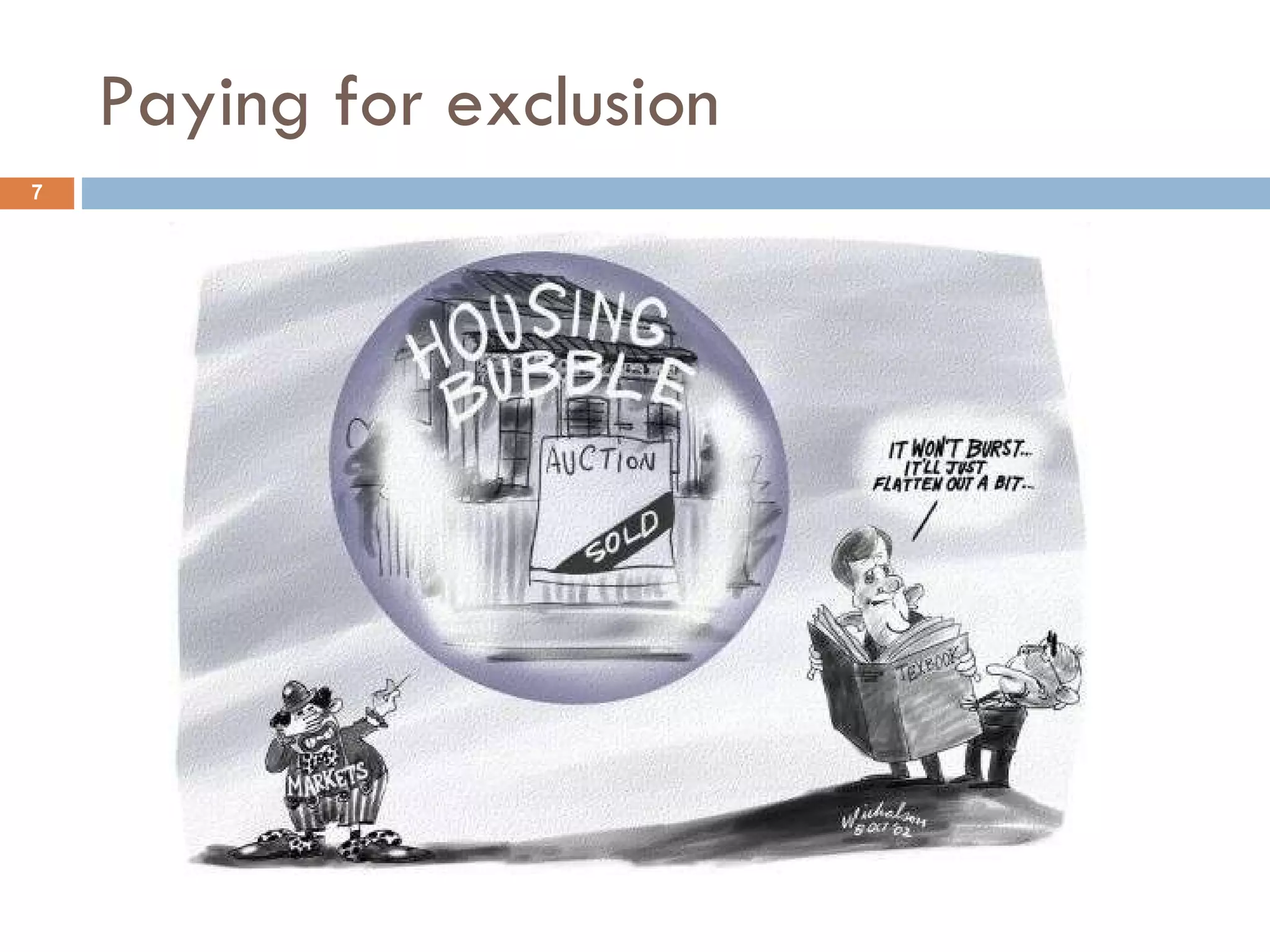
Racial Isolation & Segregation Depress Overall Well-Being: Societal Cost Wasted Creative Capacity   The wasted creative capacity associated with a lack of social, economic and educational opportunity drags down competitive strength. Fragmented Economic Voice   To attract investment in the global economy, regions must act collectively to promote themselves, and they must align key infrastructure and assets to be more innovative, efficient and competitive Paying for Exclusion   Residential segregation is fueled by exclusionary housing policies, but these policies come at a price for all residents Inefficient Infrastructure and Government Services   Regions that are highly fragmented into hundreds of local governments are often inefficient (redundant) with respect to infrastructure and government services
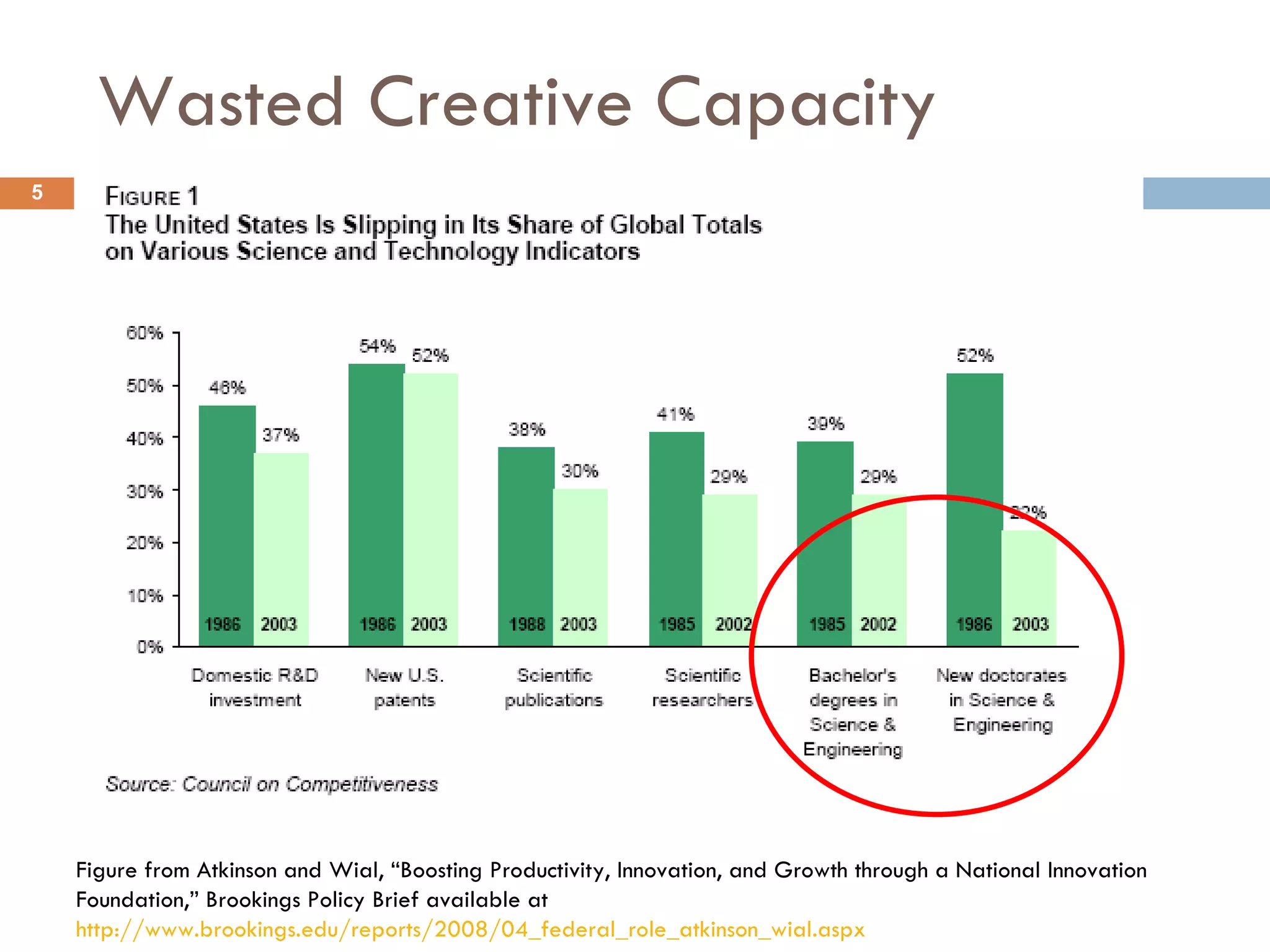
Wasted Creative Capacity Figure from Atkinson and Wial, “Boosting Productivity, Innovation, and Growth through a National Innovation Foundation,” Brookings Policy Brief available at  http://www.brookings.edu/reports/2008/04_federal_role_atkinson_wial.aspx
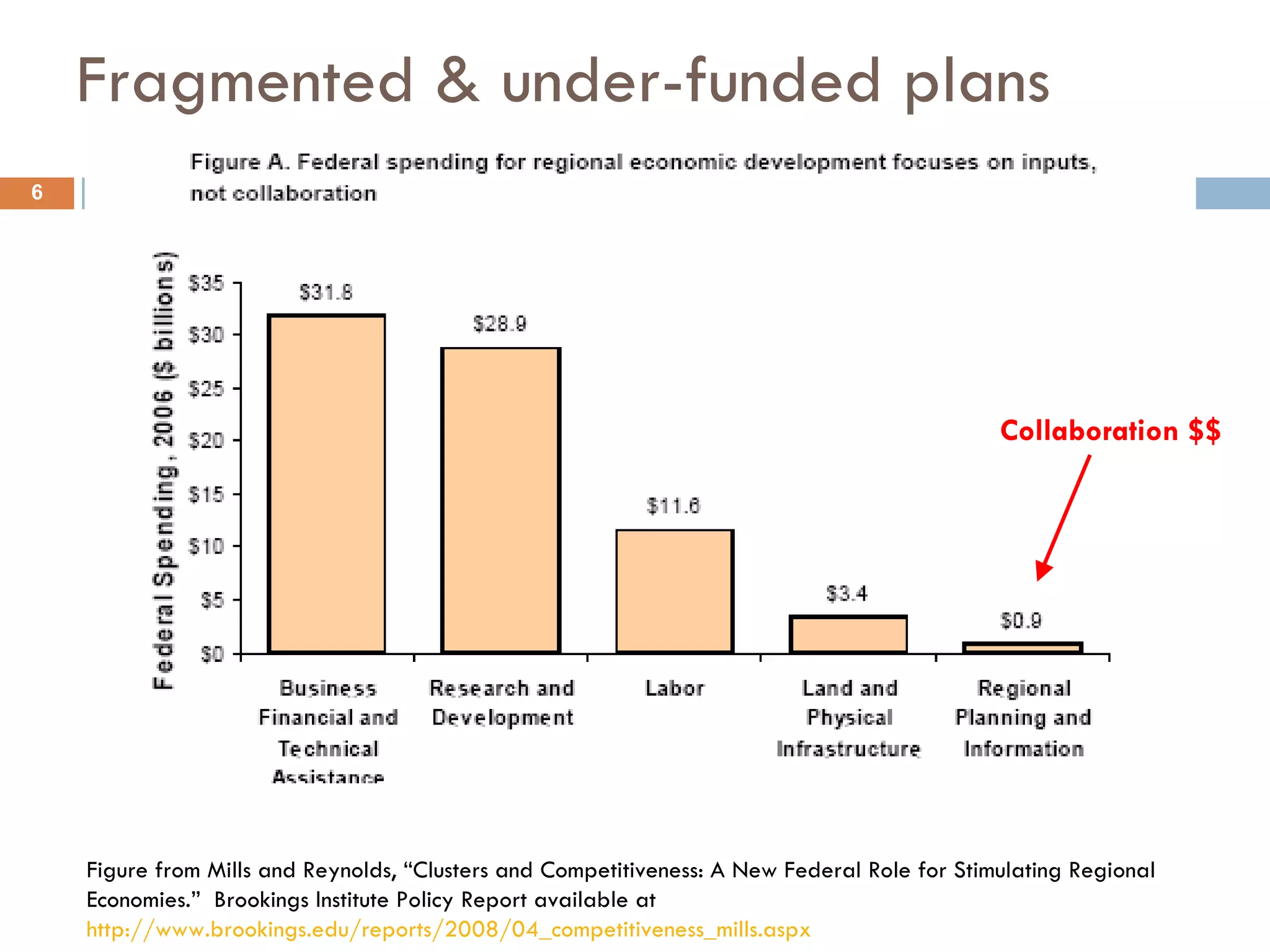
Fragmented & under-funded plans Figure from Mills and Reynolds, “Clusters and Competitiveness: A New Federal Role for Stimulating Regional Economies.”  Brookings Institute Policy Report available at  http://www.brookings.edu/reports/2008/04_competitiveness_mills.aspx   Collaboration $$
Paying for exclusion
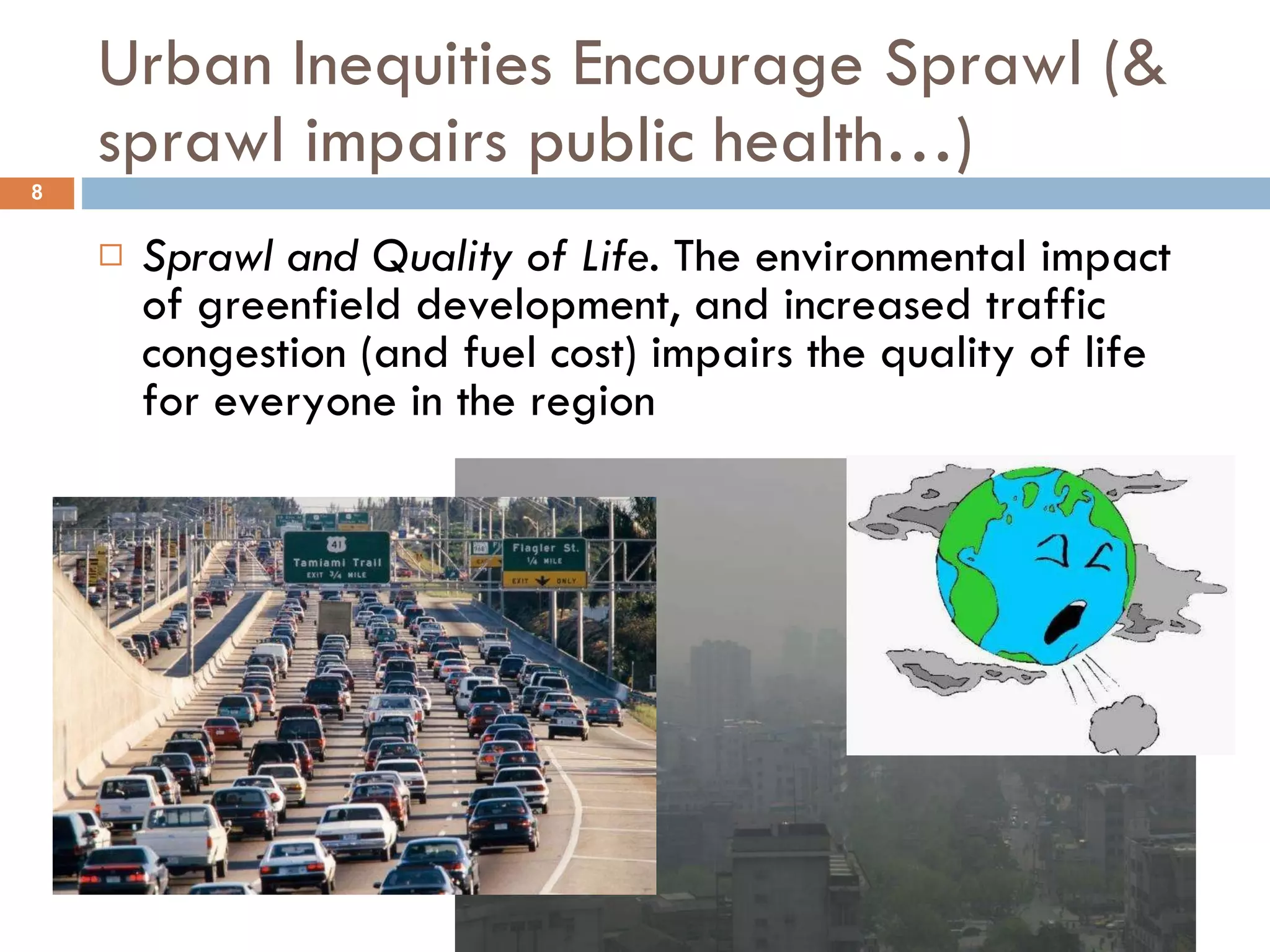
Urban Inequities Encourage Sprawl (& sprawl impairs public health…) Sprawl and Quality of Life . The environmental impact of greenfield development, and increased traffic congestion (and fuel cost) impairs the quality of life for everyone in the region
Opening pathways to opportunity… What happens when we affirmatively connect people to opportunity?  After implementing economically diverse magnets schools in Wake County, NC, African American student test scores doubled Children in public housing who moved to the suburbs as part of Chicago’s Gautreaux program were twice as likely to attend college (in comparison to their urban peers) (Rosenbaum) Despite the flaws in the implementation of MTO (Moving to Opportunity), many participants experience substantial psychological benefits Moving to opportunity for boys resulted in a 25% decline in depressive/anxiety or dependency problems (2005)
Where do we go from here?  Crisis and transformation Opportune time to create new paradigms Rethinking narratives (including the definition of opportunity) Global, financial market regulation Role of government  Expertise … and democratic norms Redesigning institutions Fair Housing / Fannie & Freddie Credit Community Development
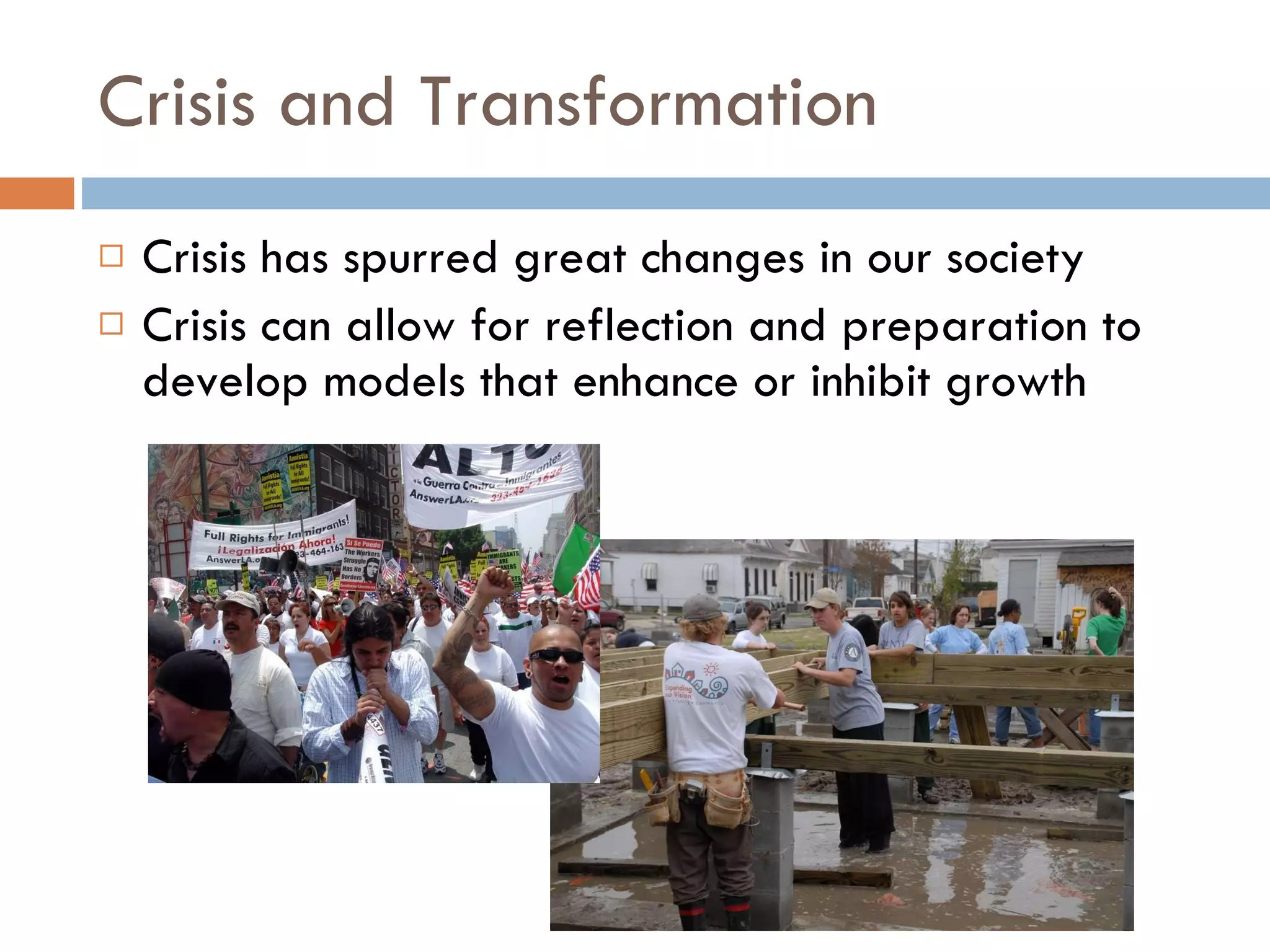
Crisis and Transformation Crisis has spurred great changes in our society Crisis can allow for reflection and preparation to develop models that enhance or inhibit growth
Crisis…transformative change A paradigm shift from a transactional approach to transformative change Crisis often indicates that the system itself is breaking down, and that it cannot be addressed by incremental transactional moves The global economic crisis (and globalization) illustrates the importance of relationships and systems in understanding our interconnected and dynamic world We must focus on being goal-oriented and on interactions and relationships which impact our communities
This moment is an opening At this moment in history, everything is being rethought Including free market – government relations Greenspan acknowledged under questioning that he had made a “mistake” in believing that banks, operating in their own self-interest, would do what was necessary to protect their shareholders and institutions. Greenspan called that “a flaw in the model ... that defines how the world works.” (AP Report 10/23/08) This is a critical moment to “rewrite the rules” Institutions and rules should be ordered to serve everyone No one should be left out Start with the “canaries” Ensuring that all participate  DEMOCRACY
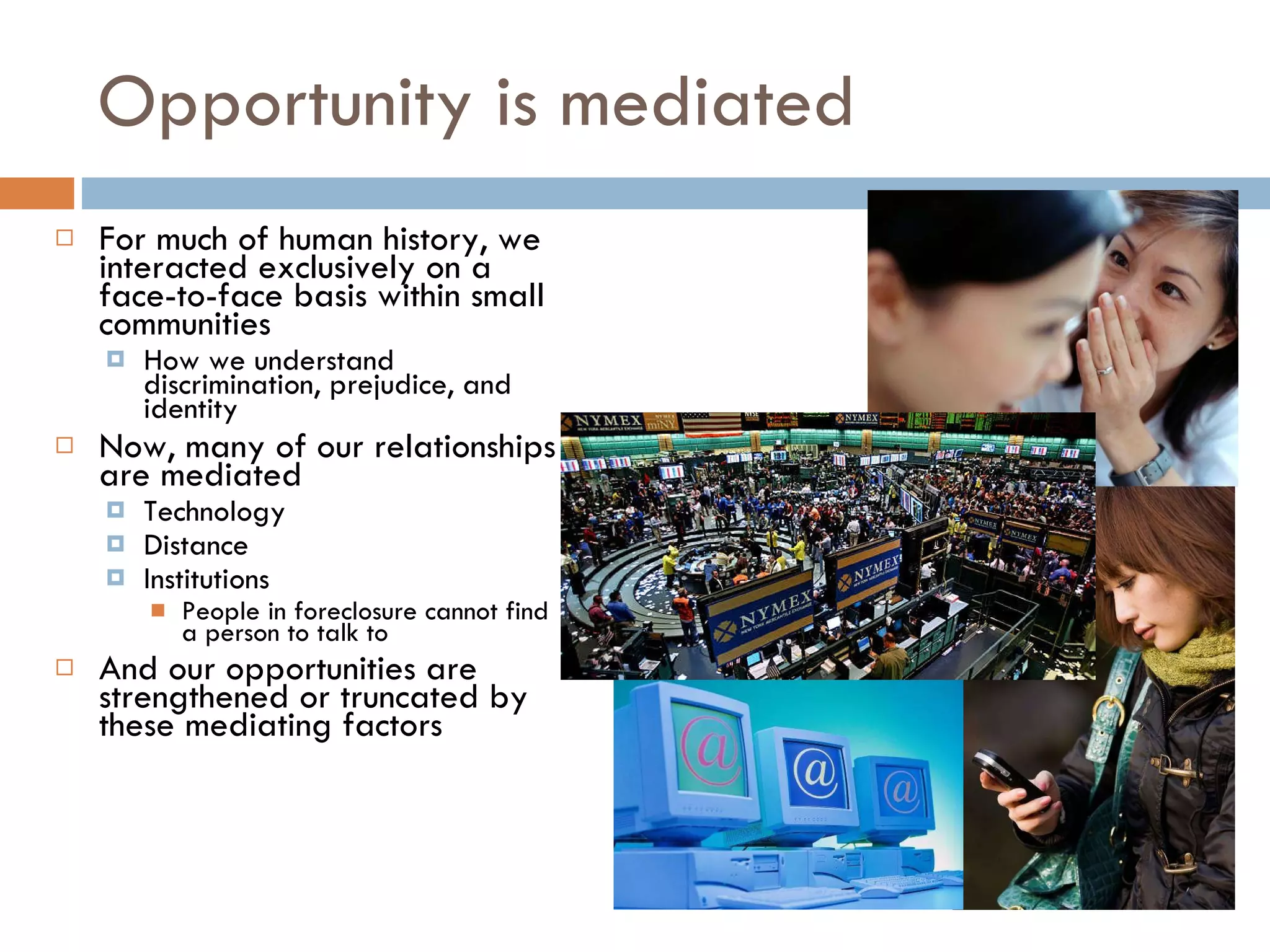
Opportunity is mediated For much of human history, we interacted exclusively on a face-to-face basis within small communities How we understand discrimination, prejudice, and identity Now, many of our relationships are mediated Technology Distance Institutions People in foreclosure cannot find a person to talk to And our opportunities are strengthened or truncated by these mediating factors
Opp’y is differential… How can we be sensitive to inter- and intra-group differences? How do the ladders or pathways of opportunities differ for different people? Every institution has built in assumptions, i.e. “stairways” are a pathway – but not for people in wheelchairs, baby strollers, etc.
Redesigning institutions Sustainable economic development Fair Housing Credit
Fair Housing Law …Beyond Enforcement Title VIII has largely been tort approach Reactive Best hope: effective remedial action (i.e. structured mobility) Meanwhile, fragmented regions with decentralized housing markets support and structure a segregated landscape Why not try to build differently? Proactive  Carrots  and  sticks Use housing and tax policies to affirmatively link people to opp’y Remove tax benefits from segregated communities (Boger)
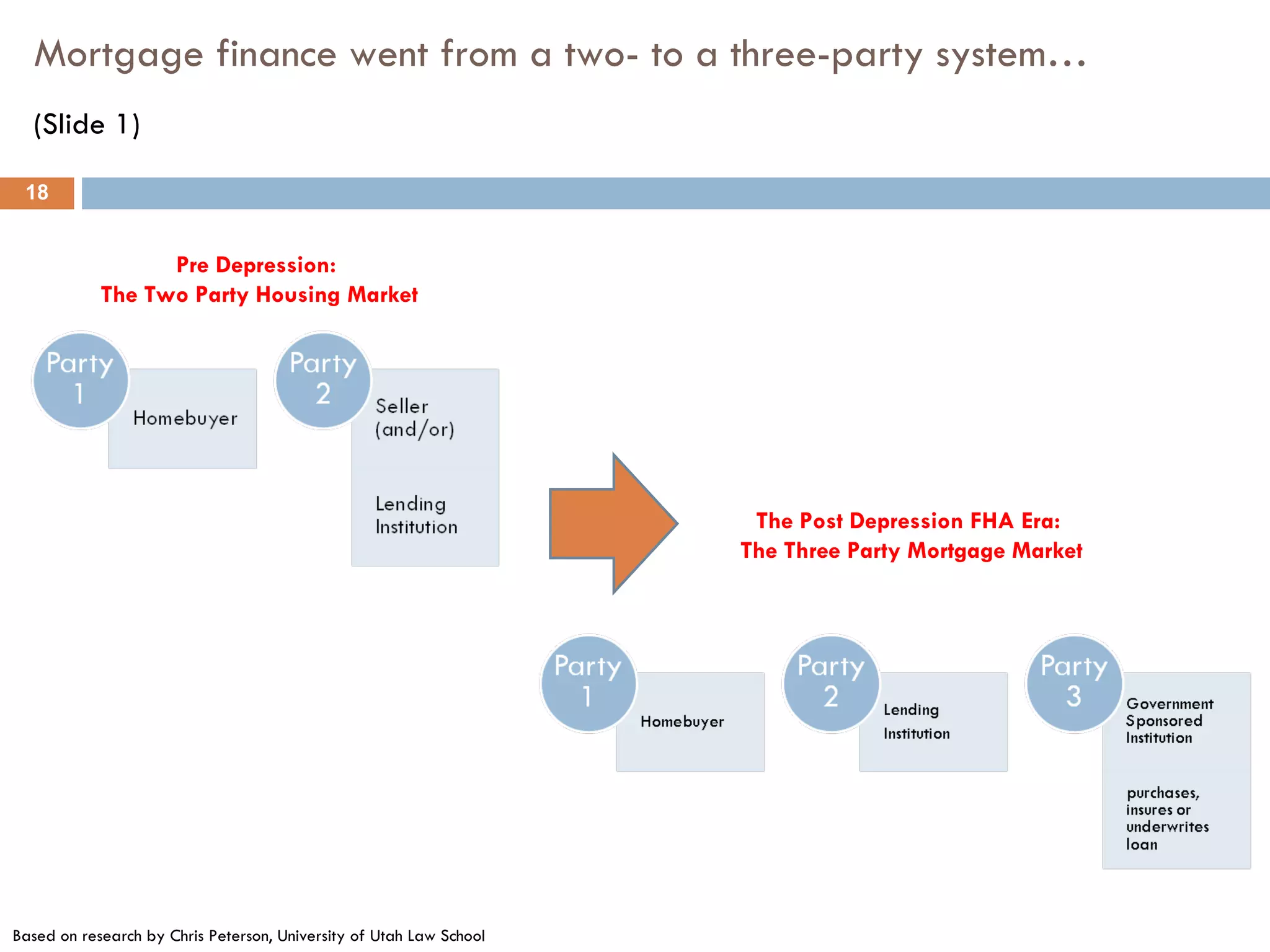
Mortgage finance went from a two- to a three-party system… (Slide 1)  The Post Depression FHA Era:  The Three Party Mortgage Market Pre Depression:  The Two Party Housing Market Based on research by Chris Peterson, University of Utah Law School
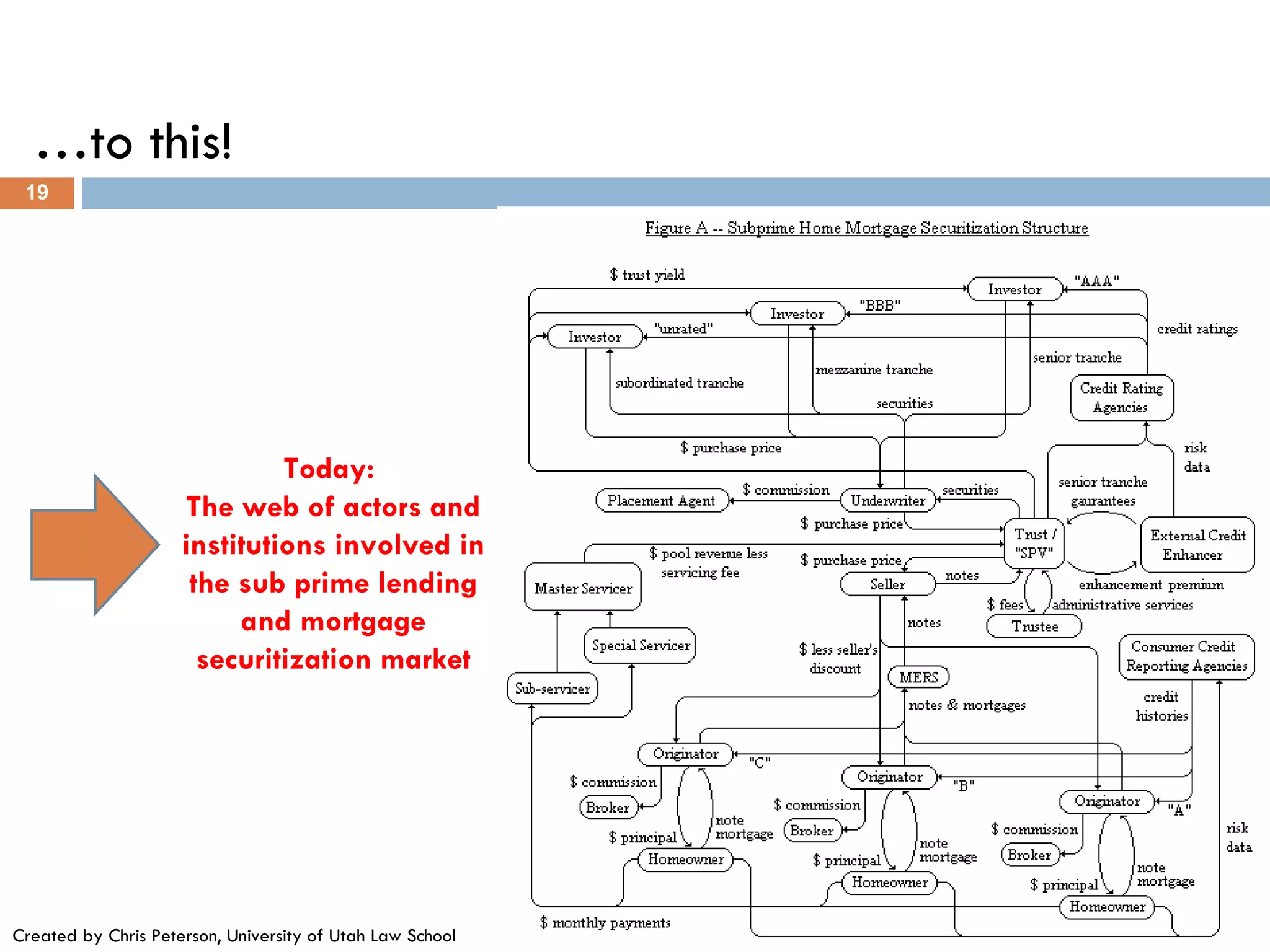
Created by Chris Peterson, University of Utah Law School … to this! Today:  The web of actors and institutions involved in the sub prime lending and mortgage securitization market
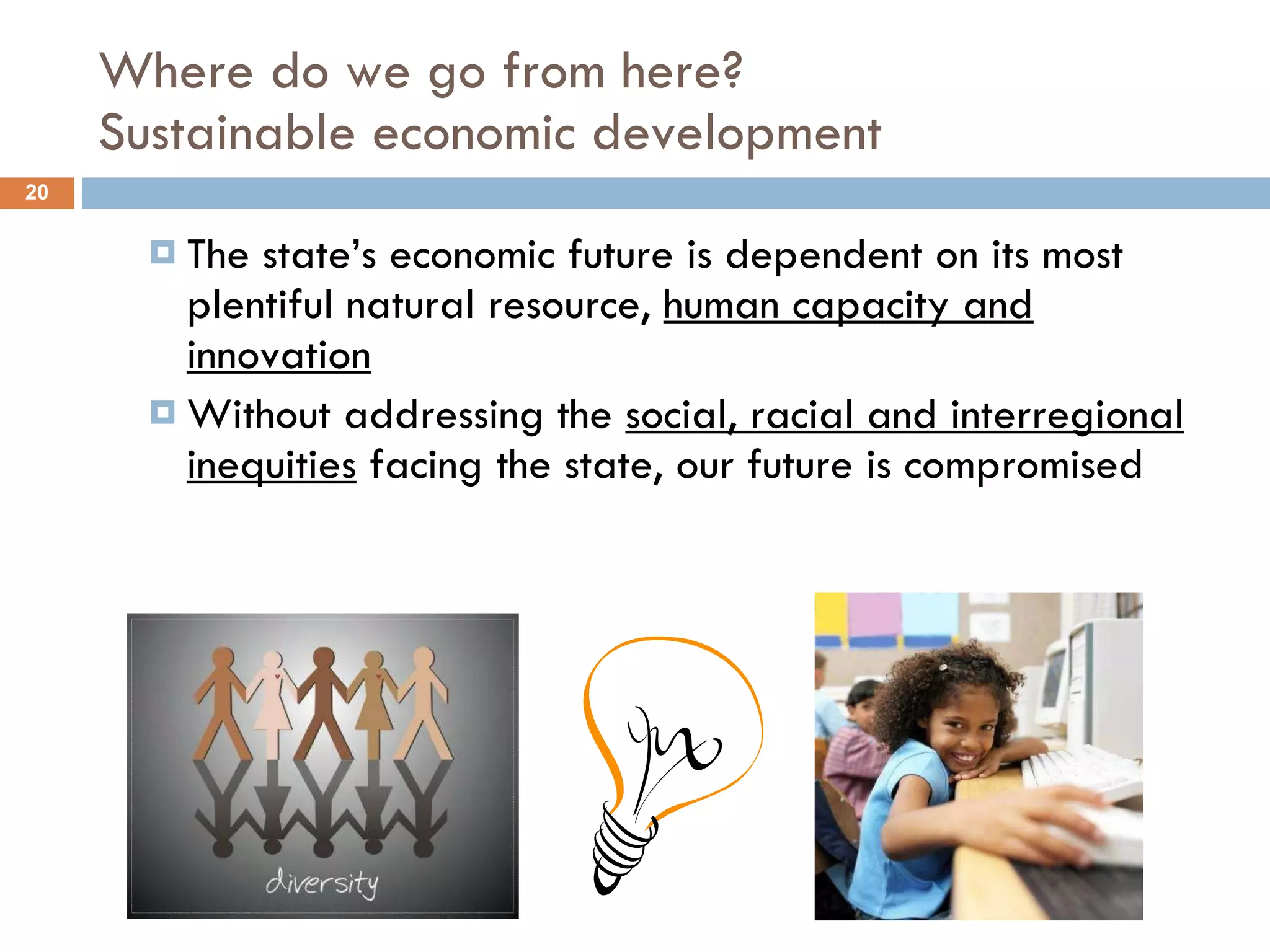
Where do we go from here?  Sustainable economic development  The state’s economic future is dependent on its most plentiful natural resource,  human capacity and innovation   Without addressing the  social, racial and interregional inequities  facing the state, our future is compromised
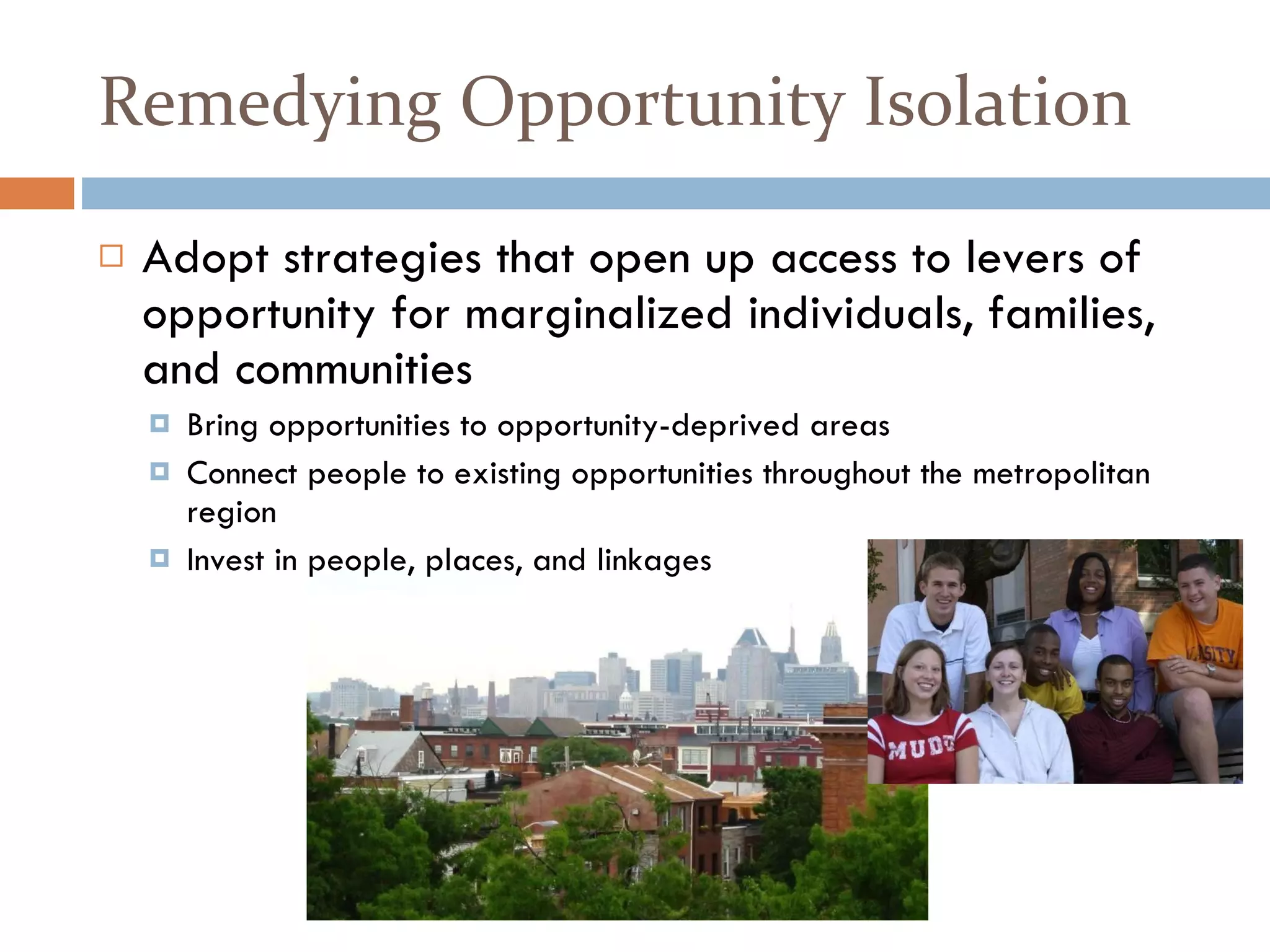
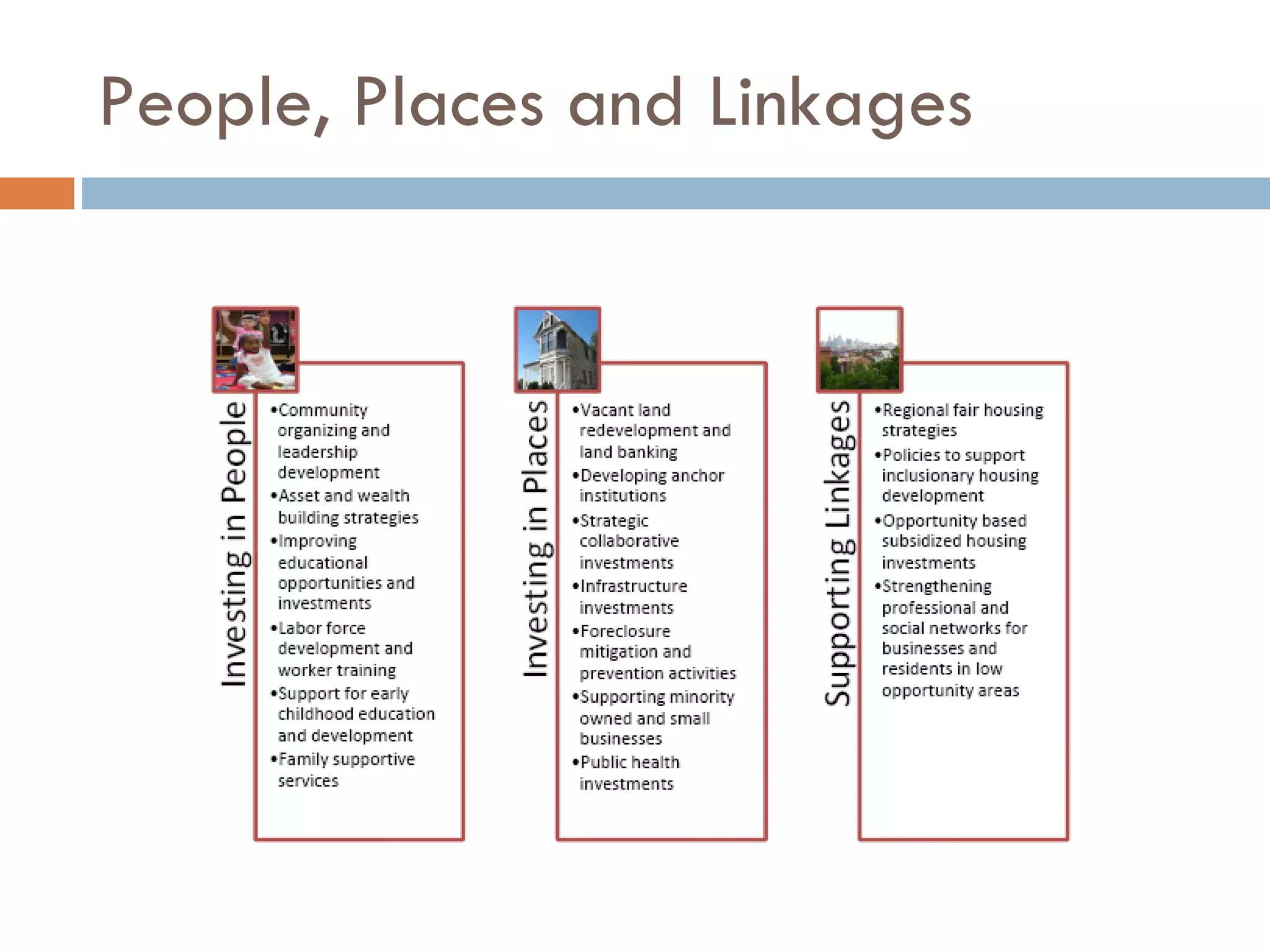
Remedying Opportunity Isolation Adopt strategies that open up access to levers of opportunity for marginalized individuals, families, and communities Bring opportunities to opportunity-deprived areas Connect people to existing opportunities throughout the metropolitan region Invest in people, places, and linkages Section 4
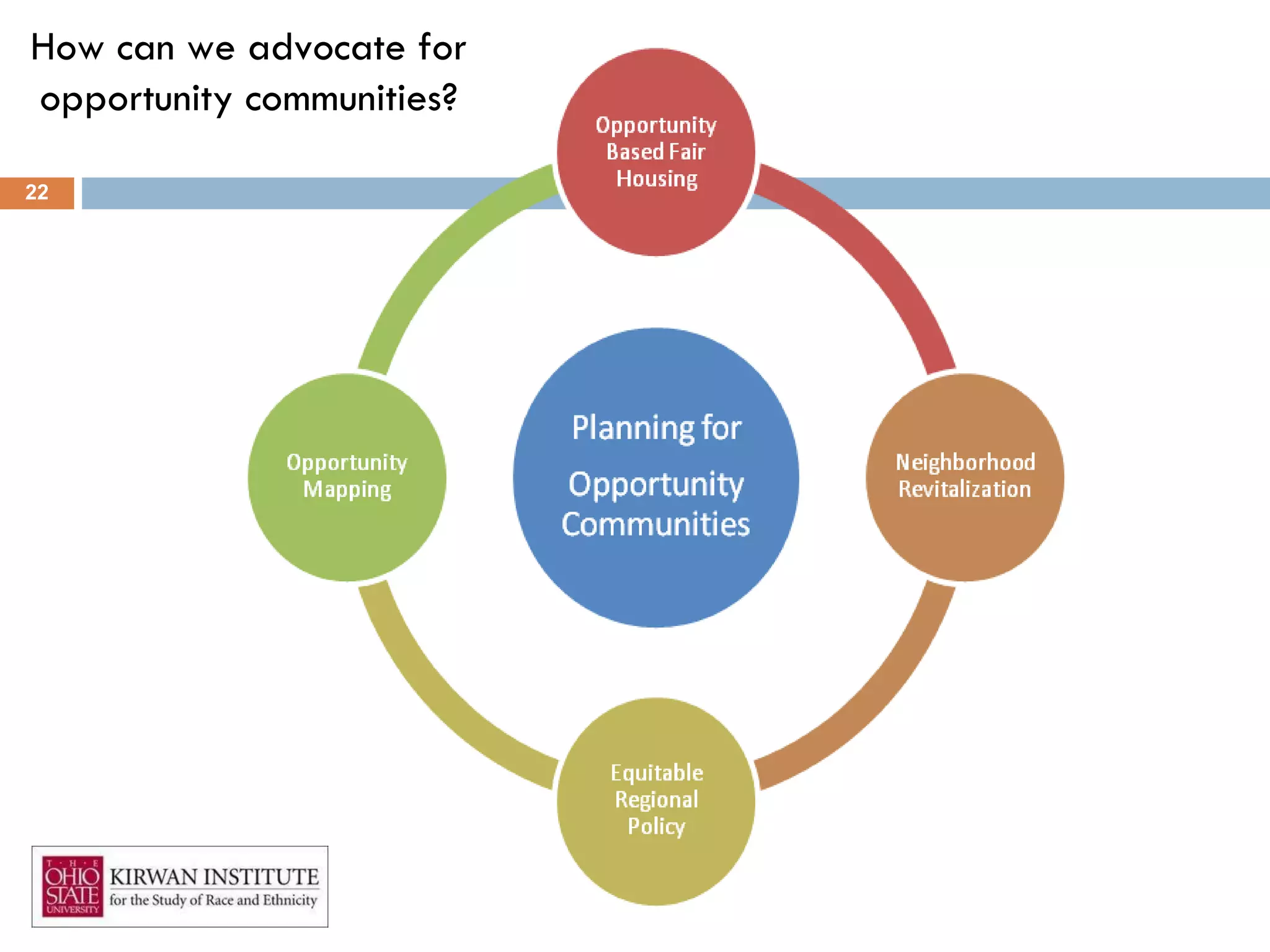
How can we advocate for opportunity communities?
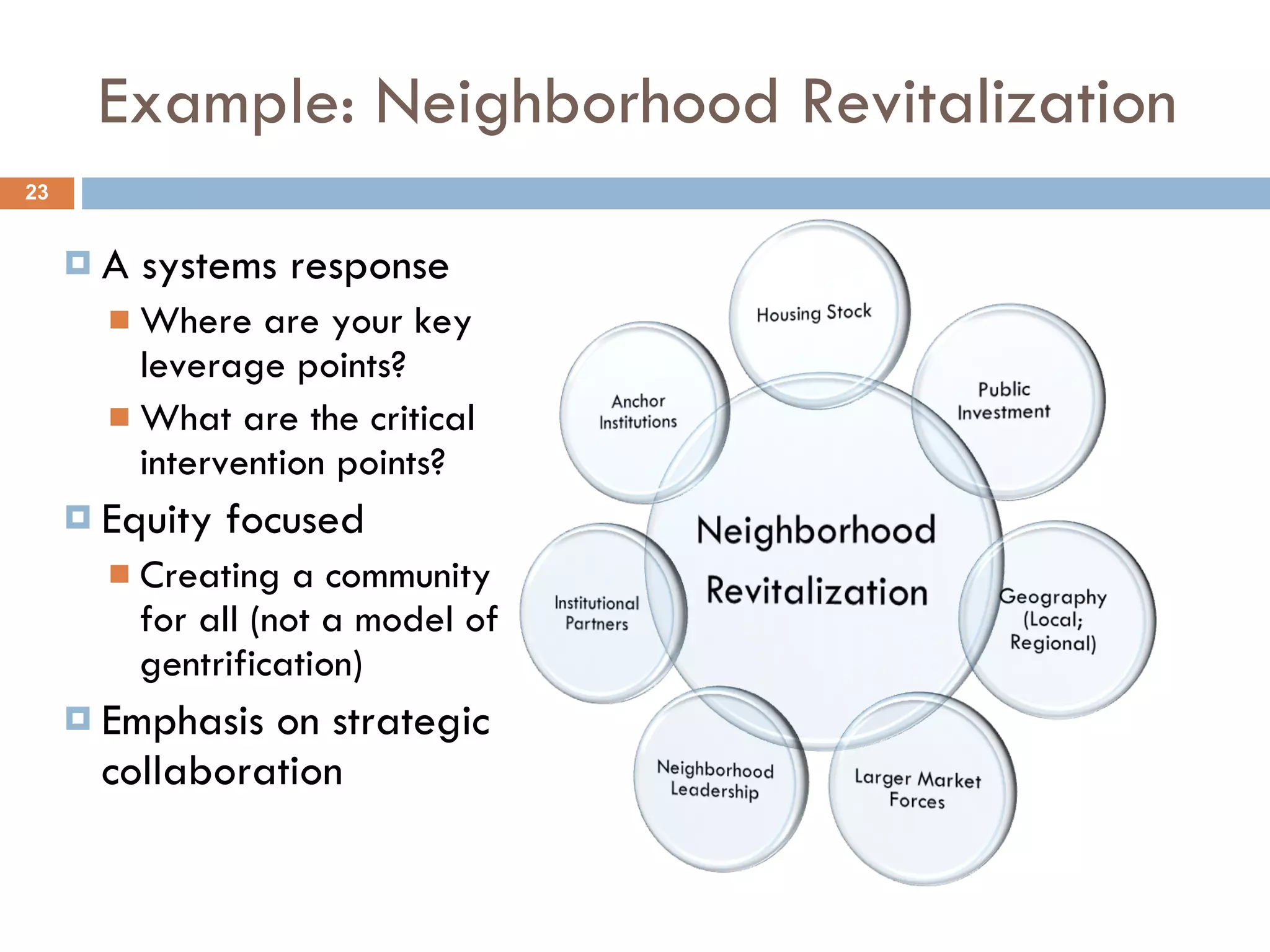
Example: Neighborhood Revitalization A systems response Where are your key leverage points? What are the critical intervention points? Equity focused Creating a community for all (not a model of gentrification) Emphasis on strategic collaboration
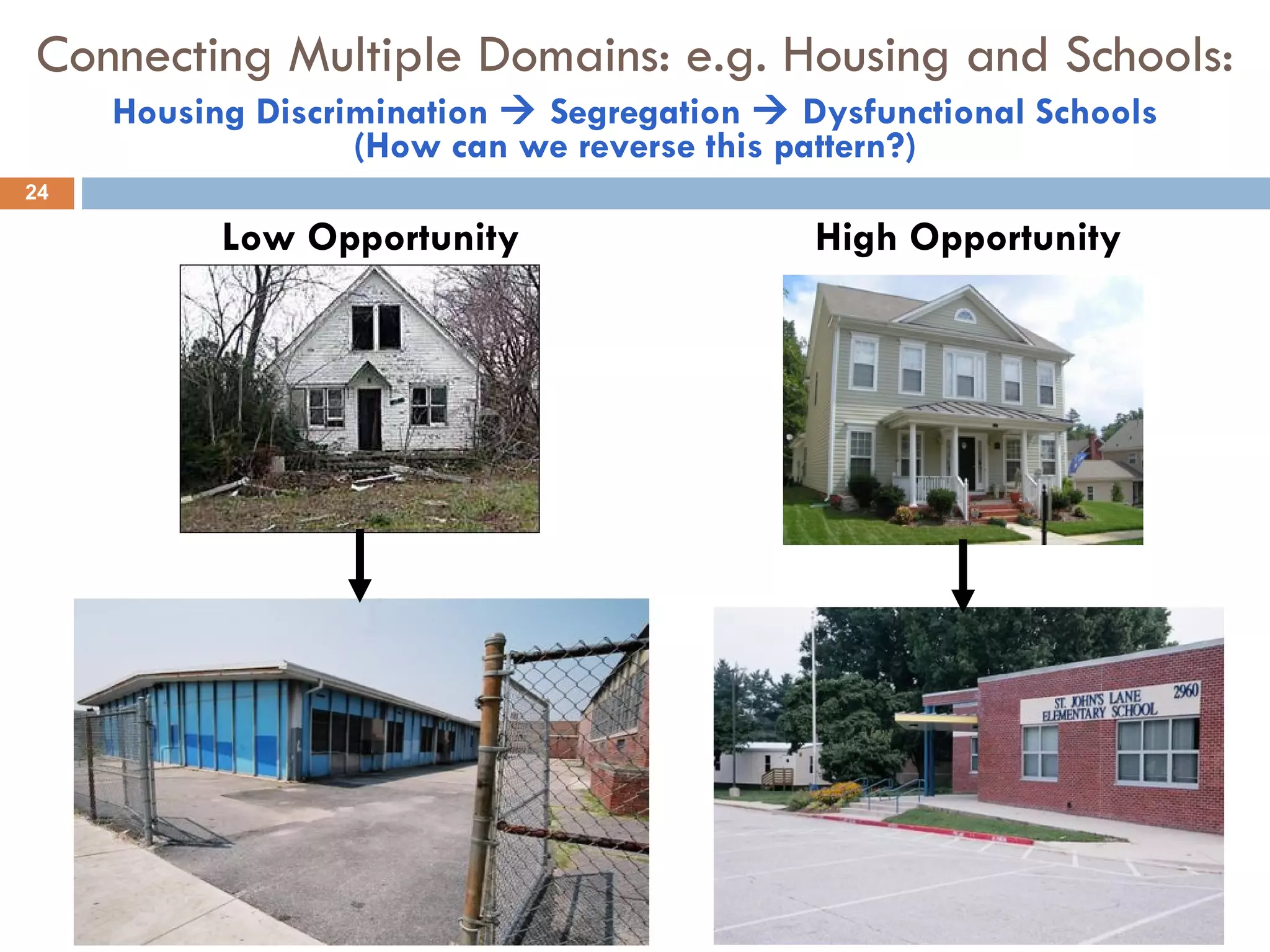
Connecting Multiple Domains: e.g. Housing and Schools: Housing Discrimination    Segregation    Dysfunctional Schools (How can we reverse this pattern?) High Opportunity Low Opportunity
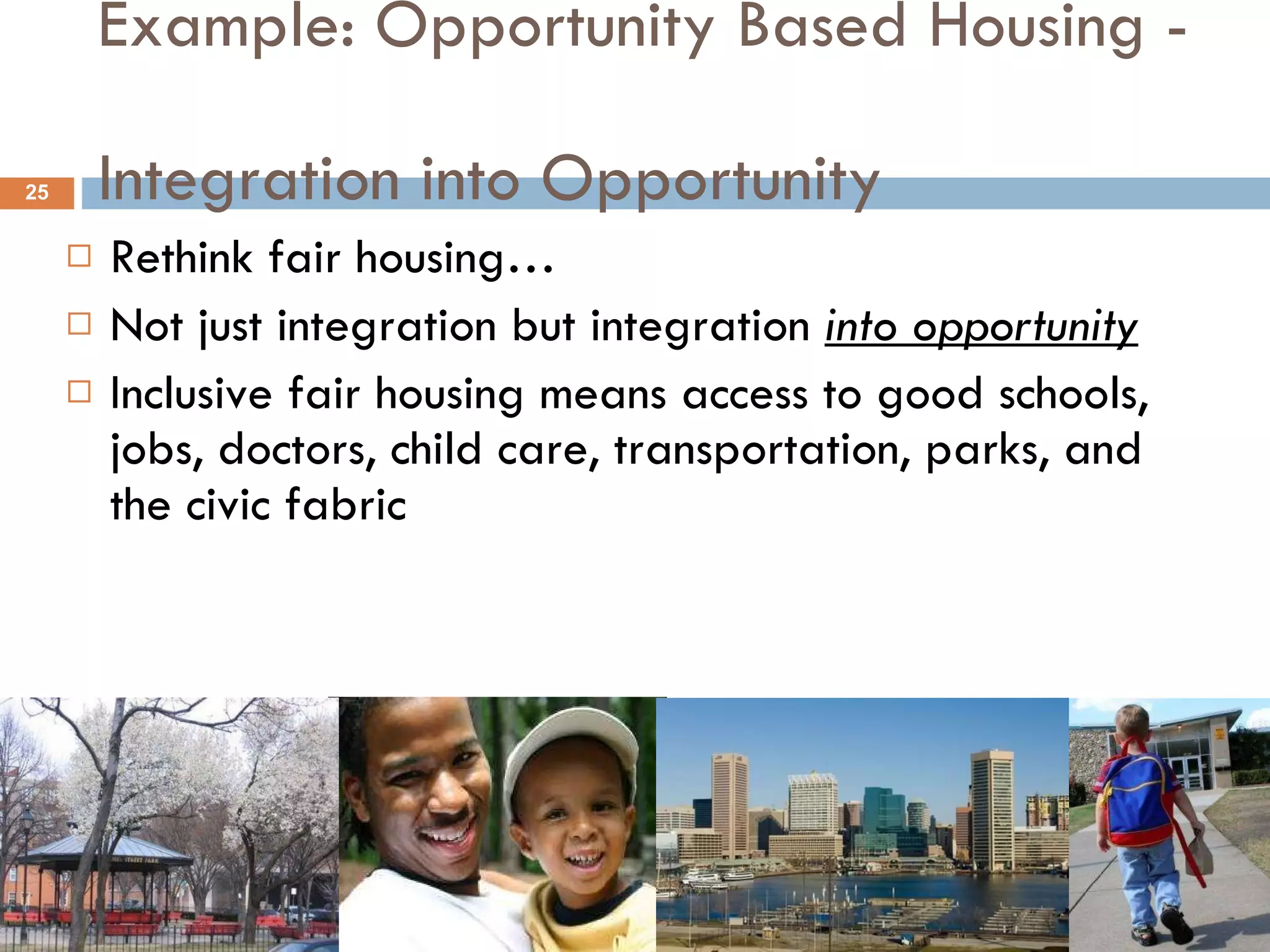
Example: Opportunity Based Housing -  Integration into Opportunity Rethink fair housing… Not just integration but integration  into opportunity Inclusive fair housing means access to good schools, jobs, doctors, child care, transportation, parks, and the civic fabric
People, Places and Linkages
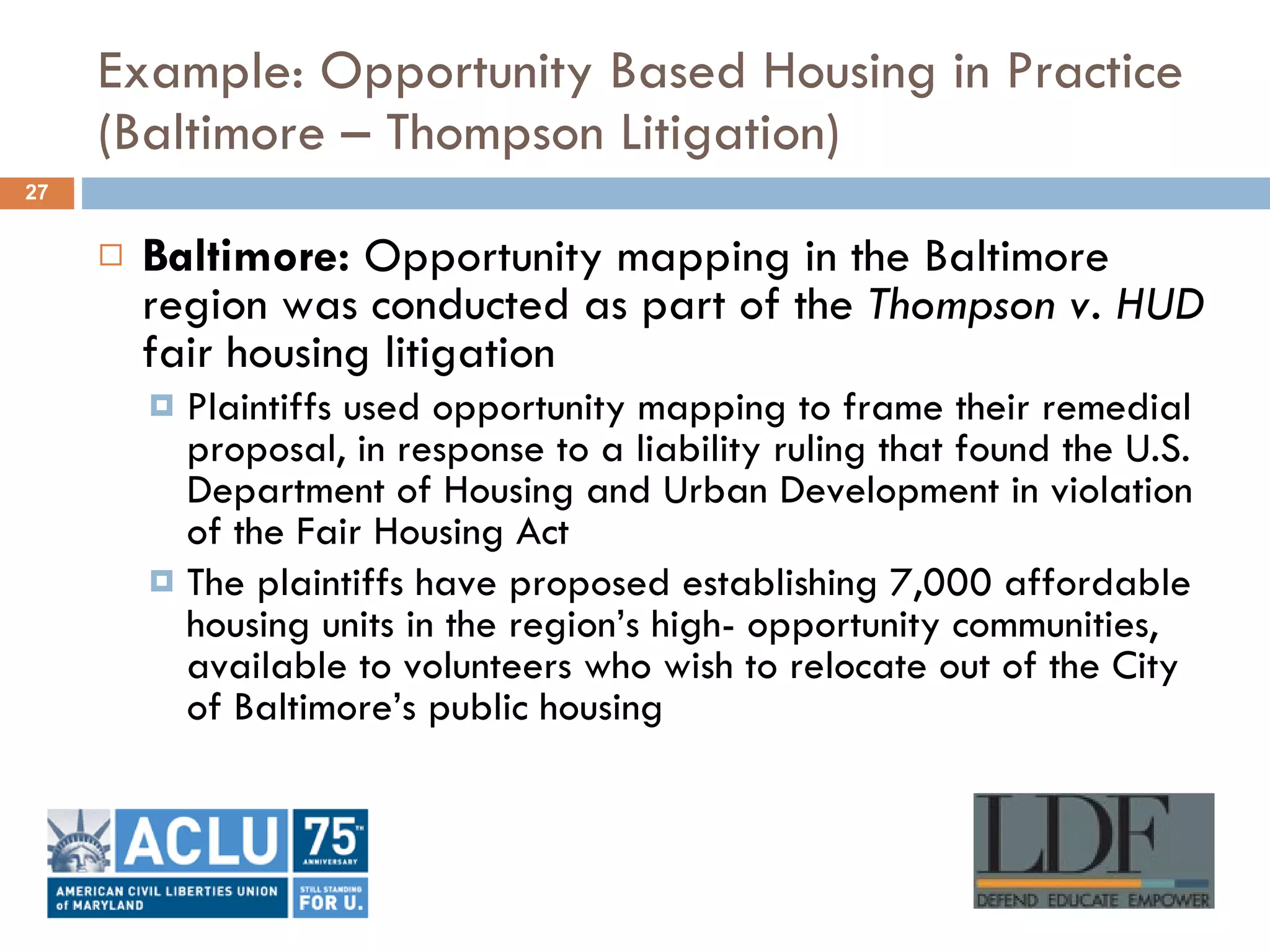
Example: Opportunity Based Housing in Practice (Baltimore – Thompson Litigation) Baltimore:  Opportunity mapping in the Baltimore region was conducted as part of the  Thompson v. HUD  fair housing litigation Plaintiffs used opportunity mapping to frame their remedial proposal, in response to a liability ruling that found the U.S. Department of Housing and Urban Development in violation of the Fair Housing Act  The plaintiffs have proposed establishing 7,000 affordable housing units in the region’s high- opportunity communities, available to volunteers who wish to relocate out of the City of Baltimore’s public housing
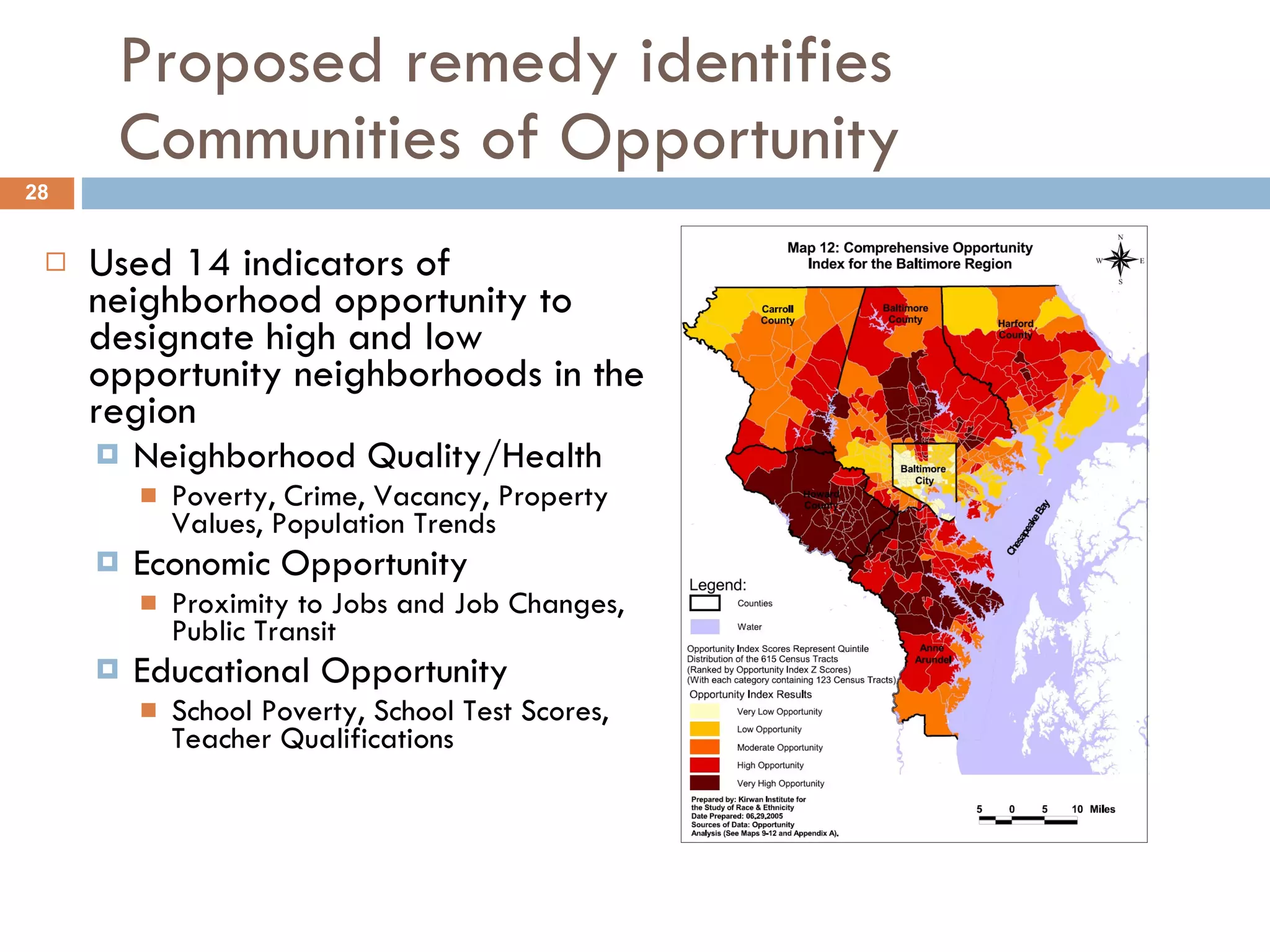
Proposed remedy identifies Communities of Opportunity  Used 14 indicators of neighborhood opportunity to designate high and low opportunity neighborhoods in the region Neighborhood Quality/Health Poverty, Crime, Vacancy, Property Values, Population Trends Economic Opportunity  Proximity to Jobs and Job Changes, Public Transit Educational Opportunity School Poverty, School Test Scores, Teacher Qualifications
Minimize depth of exposure Decrease the cost of membership in a democratic society  Current estimate for family of four: $48,778*  Over three times as many families fall below family budget thresholds as fall below the official poverty line  Decrease how far you fall (children in extreme poverty, skyrocketing bankruptcy rates, family homelessness?) Work to ensure that all neighborhoods are neighborhoods of sustainable opportunity What are you financing? Is it just a house? * James Lin and Jared Bernstein , What we need to get by. October 29, 2008 | EPI Briefing Paper #224
Intervention Strategies for Building Opportunity Communities Strategies for community-activists, policy-makers, and researchers Adopt an opportunity-based approach to community development Adopt an opportunity-based approach to housing advocacy Support both in-place and mobility-based strategies to affirmatively provide access to opportunity Adopt a multi-disciplinary, collaborative approach to advocacy  Address not only personal and institutional racism, but also structural racism and  racialization Section 5
Strategic Opportunities for Change Design strategies that are sensitive to the unique challenges and strategic opportunities of each community e.g. strategies for an undercapitalized city might focus on vacant property while strategies in a hot market city might focus on regional affordable housing
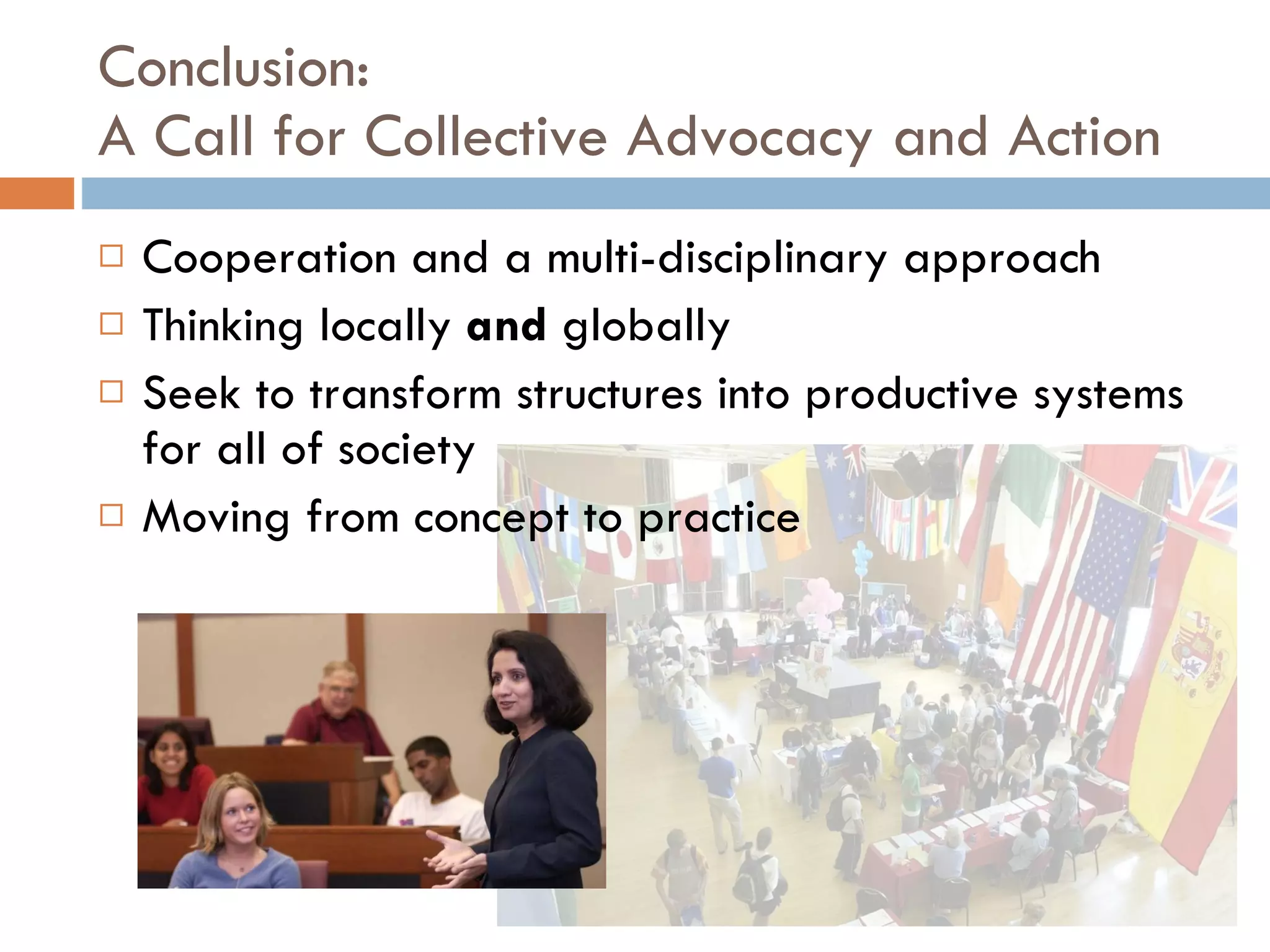
Conclusion: A Call for Collective Advocacy and Action  Cooperation and a multi-disciplinary approach Thinking locally  and  globally Seek to transform structures into productive systems for all of society Moving from concept to practice

Planning for the Commonwealth’s Economic Rebound

  • 1.
    PEOPLE, PLACE, &OPPORTUNITY Planning for the Commonwealth’s Economic Rebound January 12, 2009 Massachusetts State House john a. powell Executive Director The Kirwan Institute for the Study of Race & Ethnicity The Ohio State University [email_address] Funded by Massachusetts Legal Services Programs
  • 2.
    Overview Whatare the costs of opportunity isolation? Where do we go from here? What narratives should be rethought, challenged? How do we seize this time of crisis to advocate for sustainable, transformative change?
  • 3.
    What are thecosts of opportunity isolation? Individual/family costs Living in “concentrated disadvantage” reduces student IQ by 4 points, roughly the equivalent to missing one year of school (Sampson 2007) Societal cost Neighborhoods of concentrated poverty suppress property values by nearly 400 billion nationwide (Galster et al 2007)
  • 4.
    Racial Isolation &Segregation Depress Overall Well-Being: Societal Cost Wasted Creative Capacity The wasted creative capacity associated with a lack of social, economic and educational opportunity drags down competitive strength. Fragmented Economic Voice To attract investment in the global economy, regions must act collectively to promote themselves, and they must align key infrastructure and assets to be more innovative, efficient and competitive Paying for Exclusion Residential segregation is fueled by exclusionary housing policies, but these policies come at a price for all residents Inefficient Infrastructure and Government Services Regions that are highly fragmented into hundreds of local governments are often inefficient (redundant) with respect to infrastructure and government services
  • 5.
    Wasted Creative CapacityFigure from Atkinson and Wial, “Boosting Productivity, Innovation, and Growth through a National Innovation Foundation,” Brookings Policy Brief available at http://www.brookings.edu/reports/2008/04_federal_role_atkinson_wial.aspx
  • 6.
    Fragmented & under-fundedplans Figure from Mills and Reynolds, “Clusters and Competitiveness: A New Federal Role for Stimulating Regional Economies.” Brookings Institute Policy Report available at http://www.brookings.edu/reports/2008/04_competitiveness_mills.aspx Collaboration $$
  • 7.
  • 8.
    Urban Inequities EncourageSprawl (& sprawl impairs public health…) Sprawl and Quality of Life . The environmental impact of greenfield development, and increased traffic congestion (and fuel cost) impairs the quality of life for everyone in the region
  • 9.
    Opening pathways toopportunity… What happens when we affirmatively connect people to opportunity? After implementing economically diverse magnets schools in Wake County, NC, African American student test scores doubled Children in public housing who moved to the suburbs as part of Chicago’s Gautreaux program were twice as likely to attend college (in comparison to their urban peers) (Rosenbaum) Despite the flaws in the implementation of MTO (Moving to Opportunity), many participants experience substantial psychological benefits Moving to opportunity for boys resulted in a 25% decline in depressive/anxiety or dependency problems (2005)
  • 10.
    Where do wego from here? Crisis and transformation Opportune time to create new paradigms Rethinking narratives (including the definition of opportunity) Global, financial market regulation Role of government Expertise … and democratic norms Redesigning institutions Fair Housing / Fannie & Freddie Credit Community Development
  • 11.
    Crisis and TransformationCrisis has spurred great changes in our society Crisis can allow for reflection and preparation to develop models that enhance or inhibit growth
  • 12.
    Crisis…transformative change Aparadigm shift from a transactional approach to transformative change Crisis often indicates that the system itself is breaking down, and that it cannot be addressed by incremental transactional moves The global economic crisis (and globalization) illustrates the importance of relationships and systems in understanding our interconnected and dynamic world We must focus on being goal-oriented and on interactions and relationships which impact our communities
  • 13.
    This moment isan opening At this moment in history, everything is being rethought Including free market – government relations Greenspan acknowledged under questioning that he had made a “mistake” in believing that banks, operating in their own self-interest, would do what was necessary to protect their shareholders and institutions. Greenspan called that “a flaw in the model ... that defines how the world works.” (AP Report 10/23/08) This is a critical moment to “rewrite the rules” Institutions and rules should be ordered to serve everyone No one should be left out Start with the “canaries” Ensuring that all participate DEMOCRACY
  • 14.
    Opportunity is mediatedFor much of human history, we interacted exclusively on a face-to-face basis within small communities How we understand discrimination, prejudice, and identity Now, many of our relationships are mediated Technology Distance Institutions People in foreclosure cannot find a person to talk to And our opportunities are strengthened or truncated by these mediating factors
  • 15.
    Opp’y is differential…How can we be sensitive to inter- and intra-group differences? How do the ladders or pathways of opportunities differ for different people? Every institution has built in assumptions, i.e. “stairways” are a pathway – but not for people in wheelchairs, baby strollers, etc.
  • 16.
    Redesigning institutions Sustainableeconomic development Fair Housing Credit
  • 17.
    Fair Housing Law…Beyond Enforcement Title VIII has largely been tort approach Reactive Best hope: effective remedial action (i.e. structured mobility) Meanwhile, fragmented regions with decentralized housing markets support and structure a segregated landscape Why not try to build differently? Proactive Carrots and sticks Use housing and tax policies to affirmatively link people to opp’y Remove tax benefits from segregated communities (Boger)
  • 18.
    Mortgage finance wentfrom a two- to a three-party system… (Slide 1) The Post Depression FHA Era: The Three Party Mortgage Market Pre Depression: The Two Party Housing Market Based on research by Chris Peterson, University of Utah Law School
  • 19.
    Created by ChrisPeterson, University of Utah Law School … to this! Today: The web of actors and institutions involved in the sub prime lending and mortgage securitization market
  • 20.
    Where do wego from here? Sustainable economic development The state’s economic future is dependent on its most plentiful natural resource, human capacity and innovation Without addressing the social, racial and interregional inequities facing the state, our future is compromised
  • 21.
    Remedying Opportunity IsolationAdopt strategies that open up access to levers of opportunity for marginalized individuals, families, and communities Bring opportunities to opportunity-deprived areas Connect people to existing opportunities throughout the metropolitan region Invest in people, places, and linkages Section 4
  • 22.
    How can weadvocate for opportunity communities?
  • 23.
    Example: Neighborhood RevitalizationA systems response Where are your key leverage points? What are the critical intervention points? Equity focused Creating a community for all (not a model of gentrification) Emphasis on strategic collaboration
  • 24.
    Connecting Multiple Domains:e.g. Housing and Schools: Housing Discrimination  Segregation  Dysfunctional Schools (How can we reverse this pattern?) High Opportunity Low Opportunity
  • 25.
    Example: Opportunity BasedHousing - Integration into Opportunity Rethink fair housing… Not just integration but integration into opportunity Inclusive fair housing means access to good schools, jobs, doctors, child care, transportation, parks, and the civic fabric
  • 26.
  • 27.
    Example: Opportunity BasedHousing in Practice (Baltimore – Thompson Litigation) Baltimore: Opportunity mapping in the Baltimore region was conducted as part of the Thompson v. HUD fair housing litigation Plaintiffs used opportunity mapping to frame their remedial proposal, in response to a liability ruling that found the U.S. Department of Housing and Urban Development in violation of the Fair Housing Act The plaintiffs have proposed establishing 7,000 affordable housing units in the region’s high- opportunity communities, available to volunteers who wish to relocate out of the City of Baltimore’s public housing
  • 28.
    Proposed remedy identifiesCommunities of Opportunity Used 14 indicators of neighborhood opportunity to designate high and low opportunity neighborhoods in the region Neighborhood Quality/Health Poverty, Crime, Vacancy, Property Values, Population Trends Economic Opportunity Proximity to Jobs and Job Changes, Public Transit Educational Opportunity School Poverty, School Test Scores, Teacher Qualifications
  • 29.
    Minimize depth ofexposure Decrease the cost of membership in a democratic society Current estimate for family of four: $48,778* Over three times as many families fall below family budget thresholds as fall below the official poverty line Decrease how far you fall (children in extreme poverty, skyrocketing bankruptcy rates, family homelessness?) Work to ensure that all neighborhoods are neighborhoods of sustainable opportunity What are you financing? Is it just a house? * James Lin and Jared Bernstein , What we need to get by. October 29, 2008 | EPI Briefing Paper #224
  • 30.
    Intervention Strategies forBuilding Opportunity Communities Strategies for community-activists, policy-makers, and researchers Adopt an opportunity-based approach to community development Adopt an opportunity-based approach to housing advocacy Support both in-place and mobility-based strategies to affirmatively provide access to opportunity Adopt a multi-disciplinary, collaborative approach to advocacy Address not only personal and institutional racism, but also structural racism and racialization Section 5
  • 31.
    Strategic Opportunities forChange Design strategies that are sensitive to the unique challenges and strategic opportunities of each community e.g. strategies for an undercapitalized city might focus on vacant property while strategies in a hot market city might focus on regional affordable housing
  • 32.
    Conclusion: A Callfor Collective Advocacy and Action Cooperation and a multi-disciplinary approach Thinking locally and globally Seek to transform structures into productive systems for all of society Moving from concept to practice