Facing Race,
 Facing Our Humanity

Andrew Grant-Thomas
Deputy Director, Kirwan Institute for the Study of Race and Ethnicity

Ohio Council of Churches
2011 Ohio Ministries Convocation - “Faith and Race: New Opportunities”
January 24-25, 2011
Crowne Plaza, Columbus North Hotel
The Dancing Girl Illusion


http://www.moillusions.com/2007/06/spinning-sihouette-optical-illusion.html   2
Awareness Test


    http://www.youtube.com/watch?v=yrqrkihlw-s


                                                 3
Our Unconscious Networks
•   What colors are the following lines of text?


                                                   4
Our Unconscious Networks
•   What colors are the following lines of text?


                                                   5
Our Unconscious Networks
•   What colors are the following lines of text?


                                                   6
Our Unconscious Networks
•   What colors are the following lines of text?


                                                   7
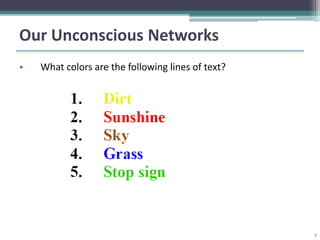
Our Unconscious Networks
•   What colors are the following lines of text?


                                                   8
Whoa!
10

Implicit Association Test – Part 1 (abbreviated)


                     European                        African
                     American                       American


                    Say “Left”                     Say “Right”
11

Implicit Association Test – Part 2 (abbreviated)


                        Bad                          Good
                       words                         words


                    Say “Left”                     Say “Right”
12

Implicit Association Test – Part 3 (abbreviated)


                     European                        African
                    American or                    American or
                     Bad words                     Good words


                     Say “Left”                    Say “Right”
African American - European American IAT

          Strong preference for Blacks            2%


       Moderate preference for Blacks                  4%


              Slight preference for Blacks                  6%


                   Little to no preference                                    17%


              Slight preference for Whites                                   16%


      Moderate preference for Whites                                                           27%


         Strong preference for Whites                                                          27%

                                             0%        5%        10%   15%         20%   25%     30%

N = 732,881                                                                                            13
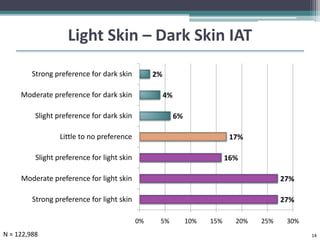
Light Skin – Dark Skin IAT

         Strong preference for dark skin          2%

     Moderate preference for dark skin                 4%

          Slight preference for dark skin                   6%

                  Little to no preference                                     17%

          Slight preference for light skin                                   16%

     Moderate preference for light skin                                                    27%

         Strong preference for light skin                                                  27%

                                             0%    5%            10%   15%     20%   25%    30%
N = 122,988                                                                                       14
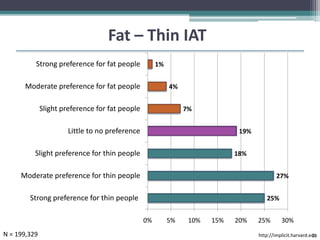
Fat – Thin IAT
          Strong preference for fat people            1%


      Moderate preference for fat people                   4%


              Slight preference for fat people                  7%


                       Little to no preference                                19%


          Slight preference for thin people                                  18%


     Moderate preference for thin people                                                    27%


        Strong preference for thin people                                              25%


                                                 0%        5%    10%   15%   20%    25%       30%
N = 199,329                                                                         http://implicit.harvard.edu
                                                                                                             15
“Maleness” – Career IAT
      Strong association of Male with Family         0%

   Moderate association of Male with Family           2%

       Slight association of Male with Family             4%

                      Little to no preference                              17%

       Slight association of Male with Career                                20%

   Moderate association of Male with Career                                                     32%

      Strong association of Male with Career                                       24%

                                                0%        5%   10%   15%   20%   25%     30%      35%

N = 83,084                                                                         http://implicit.harvard.edu
                                                                                                            16
What Would You Do?


                     17
Some behavioral implications
         • In “shooter game,” mistakes follow clear pattern: people
             shoot more unarmed blacks and fail to shoot armed whites
         • Doctors’ implicit racial attitudes  unequal treatment for
           Latinos and Blacks compared to Whites
         • Resumes with “white-sounding” names (Emily, Greg, Jill,
           Todd) receive 50% more call-backs than those with “black-
           sounding” (Jamaal, Latoya, Tyrone, Lakesha) names.
         • Neighborhoods with White-only residents evaluated much
           more favorably than same neighborhoods with black
           residents or racially mixed residents
         • More or less implicit bias corresponds to comfort level and
           body language in interracial interactions
“Emergency Treatment May Only Be Skin Deep.” Science Daily 11 Aug. 2007   18
Possible interventions


          •         Talk about race
                      When we don’t talk about race, our unconscious/
                       hidden ways of thinking can operate without the
                       “discipline” of our fairer explicit frames.
                      Give your “better angels” a chance!


The Art of Happiness in a Troubled World. By the Dalai Lama and Howard Cutler. (2009). p. 70   19
% Hispanic in Ohio


                                    1990

                                                       2007
http://www.socialexplorer.com/pub/maps/map3.aspx?g=0          20
% Foreign born in Ohio


                                          1990

                                                       2007
http://www.socialexplorer.com/pub/maps/map3.aspx?g=0          21
Concluding Thoughts
• We unconsciously think about race even when we do
  not explicitly discuss it.
• We probably hold racial/ethnic biases even when our
  explicit attitudes are sincerely egalitarian
• You can’t avoid bias by avoiding
  race; it does not work
• Conversations about race are not
  easy, but they are vital.


                                      Source: Lester, Julius. Let’s Talk About Race 22
www.race-talk.org


KirwanInstitute
       on:


                    23

Facing Race, Facing Our Humanity

  • 1.
    Facing Race, FacingOur Humanity Andrew Grant-Thomas Deputy Director, Kirwan Institute for the Study of Race and Ethnicity Ohio Council of Churches 2011 Ohio Ministries Convocation - “Faith and Race: New Opportunities” January 24-25, 2011 Crowne Plaza, Columbus North Hotel
  • 2.
    The Dancing GirlIllusion http://www.moillusions.com/2007/06/spinning-sihouette-optical-illusion.html 2
  • 3.
    Awareness Test http://www.youtube.com/watch?v=yrqrkihlw-s 3
  • 4.
    Our Unconscious Networks • What colors are the following lines of text? 4
  • 5.
    Our Unconscious Networks • What colors are the following lines of text? 5
  • 6.
    Our Unconscious Networks • What colors are the following lines of text? 6
  • 7.
    Our Unconscious Networks • What colors are the following lines of text? 7
  • 8.
    Our Unconscious Networks • What colors are the following lines of text? 8
  • 9.
  • 10.
    10 Implicit Association Test– Part 1 (abbreviated) European African American American Say “Left” Say “Right”
  • 11.
    11 Implicit Association Test– Part 2 (abbreviated) Bad Good words words Say “Left” Say “Right”
  • 12.
    12 Implicit Association Test– Part 3 (abbreviated) European African American or American or Bad words Good words Say “Left” Say “Right”
  • 13.
    African American -European American IAT Strong preference for Blacks 2% Moderate preference for Blacks 4% Slight preference for Blacks 6% Little to no preference 17% Slight preference for Whites 16% Moderate preference for Whites 27% Strong preference for Whites 27% 0% 5% 10% 15% 20% 25% 30% N = 732,881 13
  • 14.
    Light Skin –Dark Skin IAT Strong preference for dark skin 2% Moderate preference for dark skin 4% Slight preference for dark skin 6% Little to no preference 17% Slight preference for light skin 16% Moderate preference for light skin 27% Strong preference for light skin 27% 0% 5% 10% 15% 20% 25% 30% N = 122,988 14
  • 15.
    Fat – ThinIAT Strong preference for fat people 1% Moderate preference for fat people 4% Slight preference for fat people 7% Little to no preference 19% Slight preference for thin people 18% Moderate preference for thin people 27% Strong preference for thin people 25% 0% 5% 10% 15% 20% 25% 30% N = 199,329 http://implicit.harvard.edu 15
  • 16.
    “Maleness” – CareerIAT Strong association of Male with Family 0% Moderate association of Male with Family 2% Slight association of Male with Family 4% Little to no preference 17% Slight association of Male with Career 20% Moderate association of Male with Career 32% Strong association of Male with Career 24% 0% 5% 10% 15% 20% 25% 30% 35% N = 83,084 http://implicit.harvard.edu 16
  • 17.
  • 18.
    Some behavioral implications • In “shooter game,” mistakes follow clear pattern: people shoot more unarmed blacks and fail to shoot armed whites • Doctors’ implicit racial attitudes  unequal treatment for Latinos and Blacks compared to Whites • Resumes with “white-sounding” names (Emily, Greg, Jill, Todd) receive 50% more call-backs than those with “black- sounding” (Jamaal, Latoya, Tyrone, Lakesha) names. • Neighborhoods with White-only residents evaluated much more favorably than same neighborhoods with black residents or racially mixed residents • More or less implicit bias corresponds to comfort level and body language in interracial interactions “Emergency Treatment May Only Be Skin Deep.” Science Daily 11 Aug. 2007 18
  • 19.
    Possible interventions • Talk about race  When we don’t talk about race, our unconscious/ hidden ways of thinking can operate without the “discipline” of our fairer explicit frames.  Give your “better angels” a chance! The Art of Happiness in a Troubled World. By the Dalai Lama and Howard Cutler. (2009). p. 70 19
  • 20.
    % Hispanic inOhio 1990 2007 http://www.socialexplorer.com/pub/maps/map3.aspx?g=0 20
  • 21.
    % Foreign bornin Ohio 1990 2007 http://www.socialexplorer.com/pub/maps/map3.aspx?g=0 21
  • 22.
    Concluding Thoughts • Weunconsciously think about race even when we do not explicitly discuss it. • We probably hold racial/ethnic biases even when our explicit attitudes are sincerely egalitarian • You can’t avoid bias by avoiding race; it does not work • Conversations about race are not easy, but they are vital. Source: Lester, Julius. Let’s Talk About Race 22
  • 23.