Does Place Really Matter?
Broadband Availability, Race and
            Income
                                    Presentation by
                                      Ying Li, Ph.D.
                                   Research Analyst
                    Joint Center for Political and Economic Studies
                                           And
                                 Mikyung Baek, Ph. D.
                           Research and Technical Associate
                 Kirwan Institute for the Study of Race and Ethnicity
                              The Ohio State University

                                        At
       The National Broadband Map: Early Results from Social Science Research
                                 Washington, DC
                             Tuesday, March 22, 2011
Research Questions
• Explore the relationships between broadband
  availability and race & ethnicity, income, and
  place
  – To what extent is broadband readily available in
    low-income communities, especially those where
    minorities are more concentrated?
  – To what extent do urban and rural penetration
    rates show dramatic difference in broadband
    service deployment?
Three Case Studies
• Los Angeles
  – majority-minority city with large Asian and
    Hispanic populations
• Chicago
  – almost equal numbers of whites, African
    Americans and Hispanics
• South Carolina
  – large low-income, rural and black populations
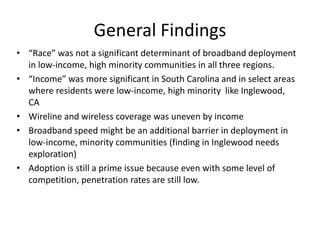
General Findings
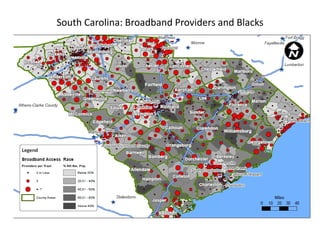
• “Race” was not a significant determinant of broadband deployment
  in low-income, high minority communities in all three regions.
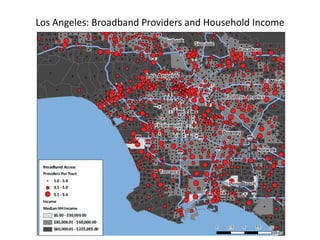
• “Income” was more significant in South Carolina and in select areas
  where residents were low-income, high minority like Inglewood,
  CA
• Wireline and wireless coverage was uneven by income
• Broadband speed might be an additional barrier in deployment in
  low-income, minority communities (finding in Inglewood needs
  exploration)
• Adoption is still a prime issue because even with some level of
  competition, penetration rates are still low.
Wireline vs. Wireless
Los Angeles: Broadband Providers and Population Density
Los Angeles: Broadband Providers and Household Income
Los Angeles: Broadband Providers and Minorities
Los Angeles: Broadband Providers and Blacks
Los Angeles: Broadband Providers and Hispanics
Los Angeles: Broadband Providers and Asians
Chicago: Broadband Providers and Blacks
South Carolina: Broadband Providers and Population Density
South Carolina: Broadband Providers and Household Income
South Carolina: Broadband Providers and Blacks
Regression Analysis
• Dependent Variable: broadband providers in
  South Carolina
• Explaining Variables
  – Model 1: Race and Income, Adjusted R2 = 0.0388
  – Subsequent models with more variables,
    urban/rural, pop. density, even lower Adj. R2
• Need for more in-depth analysis, possibly
  using GWR, Geographic Weighted Regression
Data and Technical Issues
• Dataset size – time/resource intensive
• Availability of datasets by each geographical
  unit
• Availability of residential subscription data
• Wireless coverage data in GIS format
• Problem with census block ID, inconsistent
  with concatenation of ST, CTY, Tract, BG, and
  Block IDs (e.g., New York data)
Going Forward
• Availability <> Adoption, Why?
• Cost
• Type of service: wireline/wireless in relation to
  demographics
• Speed
Inglewood, CA: Broadband Speed and Blacks
Research Team
• Ying Li
  yli@jointcenter.org
• Nicol Turner-Lee
  nturner-lee@jointcenter.org
• Samir Gambhir
  Gambhir.2@osu.edu
• Mikyung Baek
  baek.7@osu.edu
Thank You!

Does Place Really Matter? Broadband Availability, Race and Income

  • 1.
    Does Place ReallyMatter? Broadband Availability, Race and Income Presentation by Ying Li, Ph.D. Research Analyst Joint Center for Political and Economic Studies And Mikyung Baek, Ph. D. Research and Technical Associate Kirwan Institute for the Study of Race and Ethnicity The Ohio State University At The National Broadband Map: Early Results from Social Science Research Washington, DC Tuesday, March 22, 2011
  • 2.
    Research Questions • Explorethe relationships between broadband availability and race & ethnicity, income, and place – To what extent is broadband readily available in low-income communities, especially those where minorities are more concentrated? – To what extent do urban and rural penetration rates show dramatic difference in broadband service deployment?
  • 3.
    Three Case Studies •Los Angeles – majority-minority city with large Asian and Hispanic populations • Chicago – almost equal numbers of whites, African Americans and Hispanics • South Carolina – large low-income, rural and black populations
  • 4.
    General Findings • “Race”was not a significant determinant of broadband deployment in low-income, high minority communities in all three regions. • “Income” was more significant in South Carolina and in select areas where residents were low-income, high minority like Inglewood, CA • Wireline and wireless coverage was uneven by income • Broadband speed might be an additional barrier in deployment in low-income, minority communities (finding in Inglewood needs exploration) • Adoption is still a prime issue because even with some level of competition, penetration rates are still low.
  • 5.
  • 6.
    Los Angeles: BroadbandProviders and Population Density
  • 7.
    Los Angeles: BroadbandProviders and Household Income
  • 8.
    Los Angeles: BroadbandProviders and Minorities
  • 9.
    Los Angeles: BroadbandProviders and Blacks
  • 10.
    Los Angeles: BroadbandProviders and Hispanics
  • 11.
    Los Angeles: BroadbandProviders and Asians
  • 12.
  • 13.
  • 14.
    South Carolina: BroadbandProviders and Population Density
  • 15.
    South Carolina: BroadbandProviders and Household Income
  • 16.
    South Carolina: BroadbandProviders and Blacks
  • 17.
    Regression Analysis • DependentVariable: broadband providers in South Carolina • Explaining Variables – Model 1: Race and Income, Adjusted R2 = 0.0388 – Subsequent models with more variables, urban/rural, pop. density, even lower Adj. R2 • Need for more in-depth analysis, possibly using GWR, Geographic Weighted Regression
  • 18.
    Data and TechnicalIssues • Dataset size – time/resource intensive • Availability of datasets by each geographical unit • Availability of residential subscription data • Wireless coverage data in GIS format • Problem with census block ID, inconsistent with concatenation of ST, CTY, Tract, BG, and Block IDs (e.g., New York data)
  • 19.
    Going Forward • Availability<> Adoption, Why? • Cost • Type of service: wireline/wireless in relation to demographics • Speed
  • 20.
    Inglewood, CA: BroadbandSpeed and Blacks
  • 21.
    Research Team • YingLi yli@jointcenter.org • Nicol Turner-Lee nturner-lee@jointcenter.org • Samir Gambhir Gambhir.2@osu.edu • Mikyung Baek baek.7@osu.edu
  • 22.