john a. powell
Executive Director, Kirwan Institute for the Study of
                 Race and Ethnicity
          Williams Chair in Civil Rights & Civil
          Liberties, Moritz College of Law


                           November 13, 2010
                           Consumer Rights Litigation Conference
                           Boston , MA
   What is ‘Home’? What is opportunity?
   Creation of Dual Housing and Credit Markets
   What’s on the horizon?
       Unfair (and fair) housing and credit are entwined
       What is a fair and just economic & financial system?
       Principles for Reform
Health
                     Employment
Childcare
            Housing
 Effective             Education
Participation
           Transportation
   Opportunity structures are
    critical to opening pathways to
    success:
       High-quality education
       Healthy and safe environment
       Stable housing
       Sustainable employment
       Political empowerment
       Outlets for wealth-building
       Positive social networks
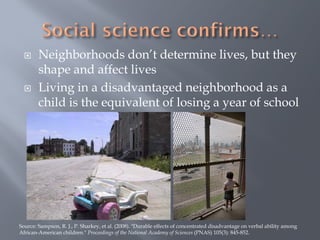
     Neighborhoods don’t determine lives, but they
        shape and affect lives
       Living in a disadvantaged neighborhood as a
        child is the equivalent of losing a year of school


Source: Sampson, R. J., P. Sharkey, et al. (2008). "Durable effects of concentrated disadvantage on verbal ability among
African-American children." Proceedings of the National Academy of Sciences (PNAS) 105(3): 845-852.
7


                            … correlates with
    … generates              children having levels
     unhealthy levels of     of lead in their blood
     stress hormones in      9 times above
     children, which         average; linked to
     impairs their neural    ADD and irreversible
     development             loss of cognitive
                             functioning


    … links to higher        … is highly correlated
    levels of violent         with childhood
    offending among           aggression and social
    juveniles                 maladjustment
•   In 1960, African-
    American families in        School
    poverty were 3.8 times   Segregation &
                                               Lower
                                             Educational
    more likely to be        Concentrated
                                Poverty
                                              Outcomes
    concentrated in high-
    poverty neighborhoods
    than poor whites.

•   In 2000, they were 7.3                    Increased
                             Neighborhood       Flight
    times more likely.        Segregation    of Affluent
                                               Families
   Lack of low-cost credit options
   Few preventative care doctors
   High-cost grocery stores that lack fresh
    produce
   Concentrated poverty schools
                                 Policies need to both
                                 bring more sustainable
                                 choices to
                                 neighborhoods and
                                 allow people more
                                 choices on where they
                                 and their families live
…BUT NOT FOR EVERYONE: THE STORY OF UNFAIR
HOUSING AND CREDIT MARKETS
   For every $1 in assets held by African Americans, Whites hold $9
   This disparity is primarily due to differences in home equity


Source: “Net Worth and Asset Ownership 1998-2000”. Household Economic Studies. U.S. Census Bureau
(2003)
The Creation
of Dual
Housing and
Credit
Systems
Separate and
unequal
“If a neighborhood is to retain stability, it is necessary that
     properties shall continue to be occupied by the same
     social and racial classes. A change in social or racial
     occupancy generally contributes to instability and a
     decline in values.”
     –Excerpt from the 1947 FHA underwriting manual


                                                                  14
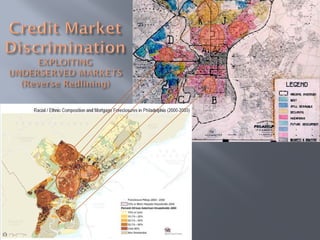
J. Hernandez shows how
areas in Sacramento with
racially restrictive
covenants in the past had
the fewest loan denials
today…shows where prime
credit was steered.
Pre-Depression:
The Two Party Housing                              Post New Deal:
       Market                                 The Three Party Mortgage
                                                       Market
                 Party                                                 Party
                                               Party                     2
  Party            2                             1
    1                                                              Lending
              Seller
              (and/or)
                                             Homebuyer             Institution
Homebuyer     Lending
              Institution
                                                           Party
                                                             3
                                                         Government
                                                         Sponsored
                   This becomes very big business,       Enterprise
                                                         purchases ,
                   i.e. F/F $800 Billion EACH            sells/holds
                   portfolio in 2009                     or insures
                                                         mortgages
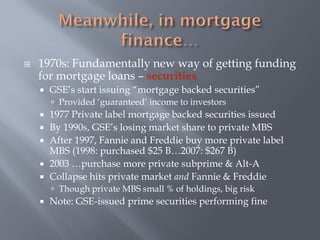
   1970s: Fundamentally new way of getting funding
    for mortgage loans – securities
       GSE’s start issuing “mortgage backed securities”
         Provided ‘guaranteed’ income to investors
       1977 Private label mortgage backed securities issued
       By 1990s, GSE’s losing market share to private MBS
       After 1997, Fannie and Freddie buy more private label
        MBS (1998: purchased $25 B…2007: $267 B)
       2003 …purchase more private subprime & Alt-A
       Collapse hits private market and Fannie & Freddie
         Though private MBS small % of holdings, big risk
       Note: GSE-issued prime securities performing fine
Source: Chris
Peterson, U. of
Utah Law School
“Wall Street has gotten a lot of mileage out of the accusation
              that the political system simply doesn't understand how
              Wall Street works…The problem is that Wall Street also
              doesn't understand how Wall Street works… Bankers didn't
              understand the tail risk of collateralized debt obligations.
              Ratings agencies didn't understand the subprime mortgage
              market. Alan Greenspan didn't understand the risks posed
              by derivatives. Robert Rubin, the former co-chair of
              Goldman Sachs and one of Citigroup's directors, told the
              Financial Crisis Inquiry Commission that "all of us in the
              industry failed to see the potential for this serious crisis."
Ezra Klein, “Wall Street says Washington doesn't understand finance. Well, neither does Wall Street.” The Washington Post, April
19, 2010.
   CRL estimates that from 1998 – 2006, only 9%
    of all subprime loans went to first time
    homebuyers
       Majority were refinance loans
       Refinance loans disproportionately marketed to
        African American neighborhoods


                                            Photo and story
                                            credit:
                                            Baltimore Finds
                                            Subprime Crisis
                                            Snags Women
                                            --New York Times
                                            1/15/08
   Estimated cost of subprime lending to all
    homeowners: $2.7 trillion
   Loss of accumulated wealth in home equity
    over generations…????
                                 WHAT WILL THE EFFECTS
                                 BE ON ALREADY LOW
                                 OPPORTUNITY
                                 NEIGHBORHOODS?
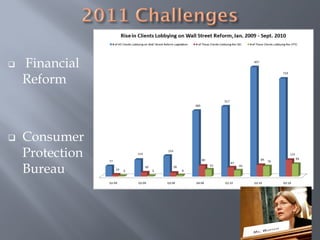
   Financial
    Reform


   Consumer
    Protection
    Bureau
“the whole financial
system has been
rigged
against lower income
communities in
general
and communities of
color in particular”
             Source: Pastor et. al, Program for Environmental and Regional Equity
“if we are going to turn the
                                    financial industry back into
                                    something that benefits the
“our financial                      consumer … WE HAVE TO
system has a                        SHIFT THE UNDERLYING
distinctly racial                   BALANCE OF POWER”
character, one that
requires a response
rooted in racial and
social justice”


                 Source: Pastor et. al, Program for Environmental and Regional Equity
“… the focus should not
            be simply on
Need for    foreclosure relief, but
social      on a new financial
movements   frame that has at its
for         heart the restoration of
financial   opportunity for all”
equity
   Federal housing finance policy must align with
    and support longstanding federal housing goals
    to protect against discrimination.
   The federal government has a responsibility to
    ensure that the secondary market serves all
    borrowers in a fair and equitable manner and to
    foster the equalization of homeownership rates.
   A reformed housing finance system must
    eliminate the dual credit market.
   Regulatory oversight of the housing finance
    system must be rigorous and comprehensive and
    must include effective fair lending enforcement.
   Secondary market transactions must be
    transparent and accountable to the public.
   The system must have an affirmative obligation
    to offer capital and credit in communities
    devastated by the foreclosure crisis and offer
    access to families who were targeted for
    inappropriate and unsustainable mortgages.
   The housing finance system must provide capital
    for sustainable rental and ownership
    development in all communities.
   The housing finance system must support
    product flexibility and sustainable innovation
    and offer access to institutions of all sizes and in
    all geographic areas.
www.KirwanInstitute.org

                          www.race-talk.org

                          KirwanInstitute
                          on:
Kirwan’s Fair Housing and Fair Credit work
   Unequal credit markets and segregated housing
    happened together.
       Fair credit and fair housing will only happen together.
   Global finance has evolved against – and plays out
    in – racially and economically segregated
    neighborhoods.
       Advocates need to know more about banking and finance
   Fair housing and fair credit is an issue for all of us,
    but attention needs to be targeted to marginalized
    communities.
       Otherwise, policies miss key opportunities and challenges
        and miss those most affected by the crisis.
AFTER THE SUBPRIME LENDING CRISIS…WHAT DO
WE DO FROM HERE?
   Summary Findings
       Fair housing and fair credit are about local places,
        people, relationships, and histories

       Federal policy must support (and not undercut) both
        anti-discrimination efforts and affirmative
        commitments to fair housing and fair credit

       What is a fair and just 21st Century economic system,
        and what kind of financial system is needed to
        support it?
   Recognize that the paths to fair credit and fair housing will
    differ according to regional context and local history. Take
    local impediments to fair housing and fair credit – racially
    discriminatory history, proliferation of predatory credit,
    resistance to mainstream institutions – seriously.
   Assist local and regional fair housing and community
    reinvestment activists in their efforts to organize, mobilize,
    and lobby.
   Promote local, multi-partner pilot projects that are mission
    driven to affirmatively promote fair credit (like the National
    League of Cities’ “Bank On Cities” initiative).
   Connect fair housing, fair lending, community reinvestment,
    civil rights and other advocacy groups (financial reform,
    faith-based, labor, etc.)
   Support the creation of a Consumer Protection
    Financial Agency and give it adequate resources and
    enforcement power.
   Promote regulatory reform of the product, rather than
    the institution.
   Recognize and enforce the duty to affirmatively further
    fair housing in relevant federal agencies and programs.
   Press for better and more comprehensive data for all
    federal spending programs, including stimulus
    funding. Expand HMDA data reporting requirements
    to include loan term information.
   Enact a comprehensive, nationwide plan to protect
    renters from foreclosure.
   Contribute to a national communications effort
    around the danger of excluding a majority of
    American workers from a solid financial future.
   Explore the potential for fundamental changes to
    regulation and financial incentives. Current
    incentives are perverse – they promote credit
    products inherently more likely to fail or result in
    punitive fees to those least able to manage them.
   Support the national networks of fair housing,
    community reinvestment, fair lending and
    financial reform movements.

Housing, Credit and Opportunity

  • 1.
    john a. powell ExecutiveDirector, Kirwan Institute for the Study of Race and Ethnicity Williams Chair in Civil Rights & Civil Liberties, Moritz College of Law November 13, 2010 Consumer Rights Litigation Conference Boston , MA
  • 2.
    What is ‘Home’? What is opportunity?  Creation of Dual Housing and Credit Markets  What’s on the horizon?  Unfair (and fair) housing and credit are entwined  What is a fair and just economic & financial system?  Principles for Reform
  • 4.
    Health Employment Childcare Housing Effective Education Participation Transportation
  • 5.
    Opportunity structures are critical to opening pathways to success:  High-quality education  Healthy and safe environment  Stable housing  Sustainable employment  Political empowerment  Outlets for wealth-building  Positive social networks
  • 6.
    Neighborhoods don’t determine lives, but they shape and affect lives  Living in a disadvantaged neighborhood as a child is the equivalent of losing a year of school Source: Sampson, R. J., P. Sharkey, et al. (2008). "Durable effects of concentrated disadvantage on verbal ability among African-American children." Proceedings of the National Academy of Sciences (PNAS) 105(3): 845-852.
  • 7.
    7 … correlates with … generates children having levels unhealthy levels of of lead in their blood stress hormones in 9 times above children, which average; linked to impairs their neural ADD and irreversible development loss of cognitive functioning … links to higher … is highly correlated levels of violent with childhood offending among aggression and social juveniles maladjustment
  • 8.
    In 1960, African- American families in School poverty were 3.8 times Segregation & Lower Educational more likely to be Concentrated Poverty Outcomes concentrated in high- poverty neighborhoods than poor whites. • In 2000, they were 7.3 Increased Neighborhood Flight times more likely. Segregation of Affluent Families
  • 9.
    Lack of low-cost credit options  Few preventative care doctors  High-cost grocery stores that lack fresh produce  Concentrated poverty schools Policies need to both bring more sustainable choices to neighborhoods and allow people more choices on where they and their families live
  • 10.
    …BUT NOT FOREVERYONE: THE STORY OF UNFAIR HOUSING AND CREDIT MARKETS
  • 11.
    For every $1 in assets held by African Americans, Whites hold $9  This disparity is primarily due to differences in home equity Source: “Net Worth and Asset Ownership 1998-2000”. Household Economic Studies. U.S. Census Bureau (2003)
  • 12.
    The Creation of Dual Housingand Credit Systems Separate and unequal
  • 14.
    “If a neighborhoodis to retain stability, it is necessary that properties shall continue to be occupied by the same social and racial classes. A change in social or racial occupancy generally contributes to instability and a decline in values.” –Excerpt from the 1947 FHA underwriting manual 14
  • 15.
    J. Hernandez showshow areas in Sacramento with racially restrictive covenants in the past had the fewest loan denials today…shows where prime credit was steered.
  • 16.
    Pre-Depression: The Two PartyHousing Post New Deal: Market The Three Party Mortgage Market Party Party Party 2 Party 2 1 1 Lending Seller (and/or) Homebuyer Institution Homebuyer Lending Institution Party 3 Government Sponsored This becomes very big business, Enterprise purchases , i.e. F/F $800 Billion EACH sells/holds portfolio in 2009 or insures mortgages
  • 17.
    1970s: Fundamentally new way of getting funding for mortgage loans – securities  GSE’s start issuing “mortgage backed securities”  Provided ‘guaranteed’ income to investors  1977 Private label mortgage backed securities issued  By 1990s, GSE’s losing market share to private MBS  After 1997, Fannie and Freddie buy more private label MBS (1998: purchased $25 B…2007: $267 B)  2003 …purchase more private subprime & Alt-A  Collapse hits private market and Fannie & Freddie  Though private MBS small % of holdings, big risk  Note: GSE-issued prime securities performing fine
  • 18.
    Source: Chris Peterson, U.of Utah Law School
  • 21.
    “Wall Street hasgotten a lot of mileage out of the accusation that the political system simply doesn't understand how Wall Street works…The problem is that Wall Street also doesn't understand how Wall Street works… Bankers didn't understand the tail risk of collateralized debt obligations. Ratings agencies didn't understand the subprime mortgage market. Alan Greenspan didn't understand the risks posed by derivatives. Robert Rubin, the former co-chair of Goldman Sachs and one of Citigroup's directors, told the Financial Crisis Inquiry Commission that "all of us in the industry failed to see the potential for this serious crisis." Ezra Klein, “Wall Street says Washington doesn't understand finance. Well, neither does Wall Street.” The Washington Post, April 19, 2010.
  • 23.
    CRL estimates that from 1998 – 2006, only 9% of all subprime loans went to first time homebuyers  Majority were refinance loans  Refinance loans disproportionately marketed to African American neighborhoods Photo and story credit: Baltimore Finds Subprime Crisis Snags Women --New York Times 1/15/08
  • 24.
    Estimated cost of subprime lending to all homeowners: $2.7 trillion  Loss of accumulated wealth in home equity over generations…???? WHAT WILL THE EFFECTS BE ON ALREADY LOW OPPORTUNITY NEIGHBORHOODS?
  • 25.
    Financial Reform  Consumer Protection Bureau
  • 26.
    “the whole financial systemhas been rigged against lower income communities in general and communities of color in particular” Source: Pastor et. al, Program for Environmental and Regional Equity
  • 27.
    “if we aregoing to turn the financial industry back into something that benefits the “our financial consumer … WE HAVE TO system has a SHIFT THE UNDERLYING distinctly racial BALANCE OF POWER” character, one that requires a response rooted in racial and social justice” Source: Pastor et. al, Program for Environmental and Regional Equity
  • 28.
    “… the focusshould not be simply on Need for foreclosure relief, but social on a new financial movements frame that has at its for heart the restoration of financial opportunity for all” equity
  • 29.
    Federal housing finance policy must align with and support longstanding federal housing goals to protect against discrimination.  The federal government has a responsibility to ensure that the secondary market serves all borrowers in a fair and equitable manner and to foster the equalization of homeownership rates.  A reformed housing finance system must eliminate the dual credit market.  Regulatory oversight of the housing finance system must be rigorous and comprehensive and must include effective fair lending enforcement.
  • 30.
    Secondary market transactions must be transparent and accountable to the public.  The system must have an affirmative obligation to offer capital and credit in communities devastated by the foreclosure crisis and offer access to families who were targeted for inappropriate and unsustainable mortgages.  The housing finance system must provide capital for sustainable rental and ownership development in all communities.  The housing finance system must support product flexibility and sustainable innovation and offer access to institutions of all sizes and in all geographic areas.
  • 31.
    www.KirwanInstitute.org www.race-talk.org KirwanInstitute on:
  • 32.
    Kirwan’s Fair Housingand Fair Credit work
  • 34.
    Unequal credit markets and segregated housing happened together.  Fair credit and fair housing will only happen together.  Global finance has evolved against – and plays out in – racially and economically segregated neighborhoods.  Advocates need to know more about banking and finance  Fair housing and fair credit is an issue for all of us, but attention needs to be targeted to marginalized communities.  Otherwise, policies miss key opportunities and challenges and miss those most affected by the crisis.
  • 35.
    AFTER THE SUBPRIMELENDING CRISIS…WHAT DO WE DO FROM HERE?
  • 36.
    Summary Findings  Fair housing and fair credit are about local places, people, relationships, and histories  Federal policy must support (and not undercut) both anti-discrimination efforts and affirmative commitments to fair housing and fair credit  What is a fair and just 21st Century economic system, and what kind of financial system is needed to support it?
  • 38.
    Recognize that the paths to fair credit and fair housing will differ according to regional context and local history. Take local impediments to fair housing and fair credit – racially discriminatory history, proliferation of predatory credit, resistance to mainstream institutions – seriously.  Assist local and regional fair housing and community reinvestment activists in their efforts to organize, mobilize, and lobby.  Promote local, multi-partner pilot projects that are mission driven to affirmatively promote fair credit (like the National League of Cities’ “Bank On Cities” initiative).  Connect fair housing, fair lending, community reinvestment, civil rights and other advocacy groups (financial reform, faith-based, labor, etc.)
  • 39.
    Support the creation of a Consumer Protection Financial Agency and give it adequate resources and enforcement power.  Promote regulatory reform of the product, rather than the institution.  Recognize and enforce the duty to affirmatively further fair housing in relevant federal agencies and programs.  Press for better and more comprehensive data for all federal spending programs, including stimulus funding. Expand HMDA data reporting requirements to include loan term information.  Enact a comprehensive, nationwide plan to protect renters from foreclosure.
  • 40.
    Contribute to a national communications effort around the danger of excluding a majority of American workers from a solid financial future.  Explore the potential for fundamental changes to regulation and financial incentives. Current incentives are perverse – they promote credit products inherently more likely to fail or result in punitive fees to those least able to manage them.  Support the national networks of fair housing, community reinvestment, fair lending and financial reform movements.