By: prachi chaudhary
 Learning styles are the different ways people
interpret, organize and represent information.
 Learning Styles are based on the idea that people
learn in different ways, and that each individual
has a natural or preferred way of learning.
 Classically, our learning style is forced upon us
through life like this: In grades kindergarten to
third, new information is presented to us
kinesthetically; grades 4 to 8 are visually
presented; while grades 9 to college, information
is presented to us mostly through auditory means,
such as lectures.
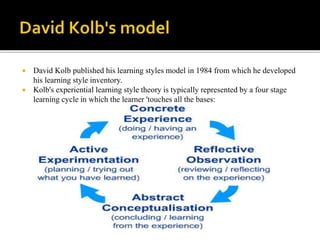
 David Kolb published his learning styles model in 1984 from which he developed
his learning style inventory.
 Kolb's experiential learning style theory is typically represented by a four stage
learning cycle in which the learner 'touches all the bases:
 1. Concrete Experience - (a new experience of
situation is encountered, or a reinterpretation of
existing experience).
 2. Reflective Observation (of the new experience.
Of particular importance are any inconsistencies
between experience and understanding).
 3. Abstract Conceptualization (Reflection gives
rise to a new idea, or a modification of an existing
abstract concept).
 4. Active Experimentation (the learner applies them
to the world around them to see what results).
 Peter Honey and Alan Mumford developed
learning styles based upon the work of Kolb.
 They identified four distinct learning styles or
preferences:
1. Activist
2. Theorist
3. Reflector
4. Pragmatist
 Walter Burke Barbe and colleagues proposed
three learning modalities (often identified
as VAK):
1. Visualizing modality
2. Auditory modality
3. Kinesthetic modality
 Barbe and colleagues reported that learning
modality strengths can occur independently or
in combination, they can change over time,
and they become integrated with age.
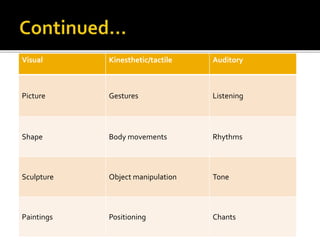
Visual Kinesthetic/tactile Auditory
Picture Gestures Listening
Shape Body movements Rhythms
Sculpture Object manipulation Tone
Paintings Positioning Chants
 Neil Fleming's VARK model is expanded upon
the VAK model of Barbe and colleagues, and was
proposed in 1992
 The VARK model of learning styles suggests that
there are four main types of learners. These four
key types are:
1. Visual learners
2. Auditory learners
3. Reading / writing learners
4. Kinesthetic learners
 Visual Learners - Visual learners learn best by
seeing. Graphic displays such as charts, diagrams,
illustrations, handouts, and videos are all helpful
learning tools for visual learners. People who
prefer this type of learning would rather see
information presented in a visual rather than in
written form.
 Auditory learners - Aural (or auditory) learners
learn best by hearing information. They tend to
get a great deal out of lectures and are good at
remembering things they are told.
 Reading and Writing Learners - Reading
and writing learners prefer to take in
information displayed as words. Learning
materials that are primarily text-based are
strongly preferred by these learners.
 Kinesthetic Learners - Kinesthetic (or
tactile) learners learn best by touching and
doing. Hands-on experience is important to
kinesthetic learners.
Learning styles