.
Educational Measurement and
Evaluation
Course Code : 6507
Unit 1
Measurement and Evaluation: An
Introduction
Prepared By
Gulnaz Akbar
Objectives
 After this presentation students will be able to:
 Describe the concept of educational evaluation and
measurement
 Differentiate between evaluation and measurement
 Describe the major types of evaluation
 Explain the role of evaluation and measurement in teaching
process
The Nature of Evaluation and
Measurement
 Concept of Evaluation
 Concept of Measurement
 Concept of Test
 Relationship of Measurement and Evaluation
Concept of Evaluation
 Evaluation is a systematic determination of a subject's merit,
worth and significance, using criteria governed by a set of
standards.
 It gives the value judgment to the numerical value. It includes
both tangible and intangible qualities.
Concept of Measurement
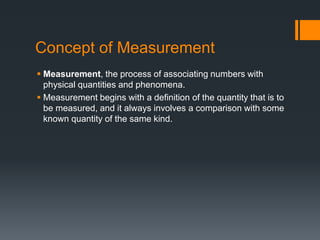
 Measurement, the process of associating numbers with
physical quantities and phenomena.
 Measurement begins with a definition of the quantity that is to
be measured, and it always involves a comparison with some
known quantity of the same kind.
Concept of Test
 Test definition, the means by which the presence, quality, or
genuineness of anything is determined; a means of trial.
 A test is a deliberate action or experiment to find out how
well something works.
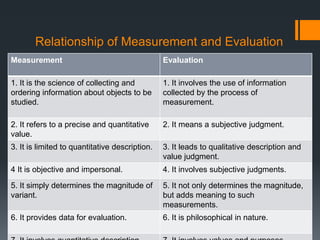
Relationship of Measurement and Evaluation
Measurement Evaluation
1. It is the science of collecting and
ordering information about objects to be
studied.
1. It involves the use of information
collected by the process of
measurement.
2. It refers to a precise and quantitative
value.
2. It means a subjective judgment.
3. It is limited to quantitative description. 3. It leads to qualitative description and
value judgment.
4 It is objective and impersonal. 4. It involves subjective judgments.
5. It simply determines the magnitude of
variant.
5. It not only determines the magnitude,
but adds meaning to such
measurements.
6. It provides data for evaluation. 6. It is philosophical in nature.
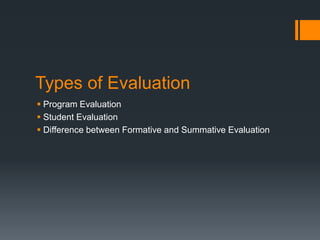
Types of Evaluation
 Program Evaluation
 Student Evaluation
 Difference between Formative and Summative Evaluation
Program Evaluation
 Program evaluation is a systematic method for:
 collecting
 analyzing
 and using information to answer questions about projects,
policies and programs, particularly about their effectiveness
and efficiency.
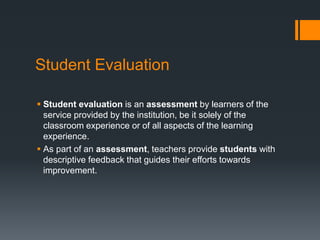
Student Evaluation
 Student evaluation is an assessment by learners of the
service provided by the institution, be it solely of the
classroom experience or of all aspects of the learning
experience.
 As part of an assessment, teachers provide students with
descriptive feedback that guides their efforts towards
improvement.
Difference between Formative and
Summative Evaluation
Formative Evaluation Summative Evaluation
Formative evaluation is typically
conducted during the development or
improvement of a program or course.
Summative evaluation involves making
judgments about the efficacy of a
program or course at its conclusion.
Formative evaluation is developmental in
nature.
Summative evaluation is terminal in
nature. Its purpose is to evaluate
student’s achievement.
Generally teacher made tests are used
for this purpose.
The tests items are prepared from the
whole content area.
It helps to know to what extent the
instructional objectives has been
achieved.
Generally standardized tests are used
for the purpose.
It provides feed-back to the teacher to
modify the methods and to prescribe
remedial works.
It is not regular and continuous process.
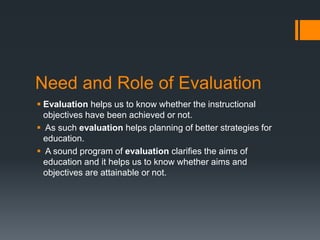
Need and Role of Evaluation
 Evaluation helps us to know whether the instructional
objectives have been achieved or not.
 As such evaluation helps planning of better strategies for
education.
 A sound program of evaluation clarifies the aims of
education and it helps us to know whether aims and
objectives are attainable or not.
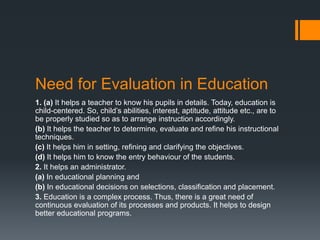
Need for Evaluation in Education
1. (a) It helps a teacher to know his pupils in details. Today, education is
child-centered. So, child’s abilities, interest, aptitude, attitude etc., are to
be properly studied so as to arrange instruction accordingly.
(b) It helps the teacher to determine, evaluate and refine his instructional
techniques.
(c) It helps him in setting, refining and clarifying the objectives.
(d) It helps him to know the entry behaviour of the students.
2. It helps an administrator.
(a) In educational planning and
(b) In educational decisions on selections, classification and placement.
3. Education is a complex process. Thus, there is a great need of
continuous evaluation of its processes and products. It helps to design
better educational programs.
Nature of Measurement
 Maximum Performance Test
 Typical Performance Test
Use in Classroom Instruction
 Placement Evaluation
 Formative Evaluation
 Diagnostics Evaluation
 Summative Evaluation
Methods of Interpreting Results
 Norm Referenced
 Criterion Referenced
Self Assessment Questions
 Describe the meaning of test, measurement and evaluation
 How will you distinguish between measurement sand
evaluation
 What is formative evaluation?
 What is summative evaluation?
 Discuss the role of measurement and evaluation in education
process.
.
Any
Question???

UNIT 1.pptx

  • 2.
  • 3.
    Unit 1 Measurement andEvaluation: An Introduction Prepared By Gulnaz Akbar
  • 4.
    Objectives  After thispresentation students will be able to:  Describe the concept of educational evaluation and measurement  Differentiate between evaluation and measurement  Describe the major types of evaluation  Explain the role of evaluation and measurement in teaching process
  • 5.
    The Nature ofEvaluation and Measurement  Concept of Evaluation  Concept of Measurement  Concept of Test  Relationship of Measurement and Evaluation
  • 6.
    Concept of Evaluation Evaluation is a systematic determination of a subject's merit, worth and significance, using criteria governed by a set of standards.  It gives the value judgment to the numerical value. It includes both tangible and intangible qualities.
  • 7.
    Concept of Measurement Measurement, the process of associating numbers with physical quantities and phenomena.  Measurement begins with a definition of the quantity that is to be measured, and it always involves a comparison with some known quantity of the same kind.
  • 8.
    Concept of Test Test definition, the means by which the presence, quality, or genuineness of anything is determined; a means of trial.  A test is a deliberate action or experiment to find out how well something works.
  • 9.
    Relationship of Measurementand Evaluation Measurement Evaluation 1. It is the science of collecting and ordering information about objects to be studied. 1. It involves the use of information collected by the process of measurement. 2. It refers to a precise and quantitative value. 2. It means a subjective judgment. 3. It is limited to quantitative description. 3. It leads to qualitative description and value judgment. 4 It is objective and impersonal. 4. It involves subjective judgments. 5. It simply determines the magnitude of variant. 5. It not only determines the magnitude, but adds meaning to such measurements. 6. It provides data for evaluation. 6. It is philosophical in nature.
  • 10.
    Types of Evaluation Program Evaluation  Student Evaluation  Difference between Formative and Summative Evaluation
  • 11.
    Program Evaluation  Programevaluation is a systematic method for:  collecting  analyzing  and using information to answer questions about projects, policies and programs, particularly about their effectiveness and efficiency.
  • 12.
    Student Evaluation  Studentevaluation is an assessment by learners of the service provided by the institution, be it solely of the classroom experience or of all aspects of the learning experience.  As part of an assessment, teachers provide students with descriptive feedback that guides their efforts towards improvement.
  • 13.
    Difference between Formativeand Summative Evaluation Formative Evaluation Summative Evaluation Formative evaluation is typically conducted during the development or improvement of a program or course. Summative evaluation involves making judgments about the efficacy of a program or course at its conclusion. Formative evaluation is developmental in nature. Summative evaluation is terminal in nature. Its purpose is to evaluate student’s achievement. Generally teacher made tests are used for this purpose. The tests items are prepared from the whole content area. It helps to know to what extent the instructional objectives has been achieved. Generally standardized tests are used for the purpose. It provides feed-back to the teacher to modify the methods and to prescribe remedial works. It is not regular and continuous process.
  • 14.
    Need and Roleof Evaluation  Evaluation helps us to know whether the instructional objectives have been achieved or not.  As such evaluation helps planning of better strategies for education.  A sound program of evaluation clarifies the aims of education and it helps us to know whether aims and objectives are attainable or not.
  • 15.
    Need for Evaluationin Education 1. (a) It helps a teacher to know his pupils in details. Today, education is child-centered. So, child’s abilities, interest, aptitude, attitude etc., are to be properly studied so as to arrange instruction accordingly. (b) It helps the teacher to determine, evaluate and refine his instructional techniques. (c) It helps him in setting, refining and clarifying the objectives. (d) It helps him to know the entry behaviour of the students. 2. It helps an administrator. (a) In educational planning and (b) In educational decisions on selections, classification and placement. 3. Education is a complex process. Thus, there is a great need of continuous evaluation of its processes and products. It helps to design better educational programs.
  • 16.
    Nature of Measurement Maximum Performance Test  Typical Performance Test
  • 17.
    Use in ClassroomInstruction  Placement Evaluation  Formative Evaluation  Diagnostics Evaluation  Summative Evaluation
  • 18.
    Methods of InterpretingResults  Norm Referenced  Criterion Referenced
  • 19.
    Self Assessment Questions Describe the meaning of test, measurement and evaluation  How will you distinguish between measurement sand evaluation  What is formative evaluation?  What is summative evaluation?  Discuss the role of measurement and evaluation in education process.
  • 20.