By
IRSHAD HUSSAIN
 The Education system in Pakistan suffers
from multiple deficiencies, and shortcomings
of different nature. Most of our schools,
particularly in rural areas, do not have proper
learning and physical facilities. Teacher
absenteeism coupled with harsh treatment by
school teachers encourages drop-out which
affects seriously the whole education system
in the country
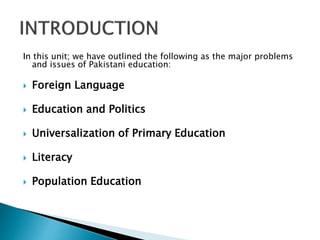
In this unit; we have outlined the following as the major problems
and issues of Pakistani education:
 Foreign Language
 Education and Politics
 Universalization of Primary Education
 Literacy
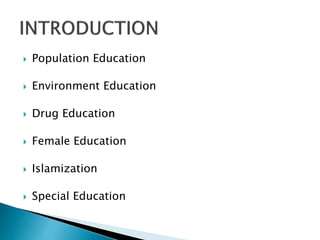
 Population Education
 Environment Education
 Drug Education
 Female Education
 Islamization
 Special Education
 It may sound very strange, but the fact is that
our problem with English is that we are
having too much of it. We are caught in a
deluge of English. Consequently, all our
energies, efforts and talent are going waste.
The output is a mere fraction of the input.
 90% wastage is itself a major reason of
deterioration in standards, since it makes the
whole activity appear so meaningless.
 The study of English as a second language is
necessary to keep in touch with the modem
knowledge. At present there is a serious
shortage of books written in Urdu in scientific
and professional fields. Immediate adoption
of Urdu as the medium of instructions at all
levels would in fact become nearly impossible
for students of medicine, engineering and
similar other professions.
 We have yet to determine the status of
English in our system of education. Our need
is to have good and sufficient English rather
than a meager and meaningless mass
exercise. A system of education has four
major components: duration of the course,
syllabus, teaching method and evaluation. All
previous experiments in the teaching of
English failed because they attempted merely
coverage of the syllabus.
Conclusion
 To conclude, English is our need and must be-
taught and taught in all earnest, with the
maximum possible proficiency. We must also use
it as a window to the world. But it must not be
inflicted on those who .are not prepared to take
it up, or who find no use for it. It must be an
elective subject at the degree level. In this way
we can also have a better teacher-students ratio
in our colleges, which will very much help in
improving the Stamford of instruction
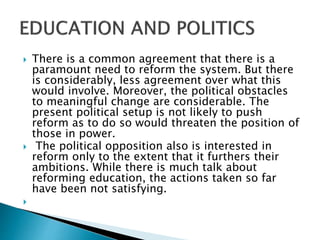
 There is a common agreement that there is a
paramount need to reform the system. But there
is considerably, less agreement over what this
would involve. Moreover, the political obstacles
to meaningful change are considerable. The
present political setup is not likely to push
reform as to do so would threaten the position of
those in power.
 The political opposition also is interested in
reform only to the extent that it furthers their
ambitions. While there is much talk about
reforming education, the actions taken so far
have been not satisfying.

 The rate of economic development is
generally higher in countries which have
higher proportion of literate population.
 Educational policies assigned priority to
universalization of primary education. The
targets fixed by the policies make interesting
reading as we-went on shifting these to
longer periods.
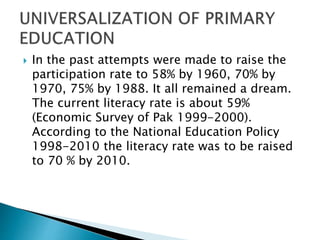
 In the past attempts were made to raise the
participation rate to 58% by 1960, 70% by
1970, 75% by 1988. It all remained a dream.
The current literacy rate is about 59%
(Economic Survey of Pak 1999-2000).
According to the National Education Policy
1998-2010 the literacy rate was to be raised
to 70 % by 2010.
 Due to lack of resources ,poor attitude
toward education, political inconsistency ,
lack of school and also lack of commitment
from the government side is the major
problem in achieving universal primary
education goal.
 1981 census definitions of literacy
emphasized both ‘reading’ and ‘writing’
abilities which consequently suppressed
literacy rates.
 In 1951 literacy rate was 16.4%.
 In 1981 it was 26.4% where as in 2020 it is
59% lowed in the Asia.
 Regional variations deserve special
consideration in developing future strategies
for the promotion of literacy in the country.
As long as backward regions are not brought
at par with the developed and male and
female disparities are not reversed. It is
inconceivable to have balanced socio-
economic development and political stability.
 Population education is a response of
educational community to the population
situation at a given point of time and place.
 According to UNESCO “The consequences of
population development for the socio-
economic and natural environment and vice-
versa are of such significance that the new
generations of young people need to be
aware of them’
 Population education is basically an educational
process whereby individuals learn the causes and
consequences of population phenomenon for
themselves, communities and environment.
Through population education it is possible to
provide basic information and create awareness
of possible and effective means by which the
society as a whole and individuals in particular
can-respond to population implications and
eventually make rational and informed decisions
in order to enhance the quality of life.
 There is no sufficient material developed on
population education. The problem stems from,
the fact that population phenomena affect so
many aspects of life at so many different levels
political relations, resources, the environment,
health, social services education; employment,
human rights that national, regions, and
individuals have different viewpoints about
population questions. These range along a
continuum from those who see population
growth as a crisis as the primary cause of all
other social problems, to those who seek to
encourage population growth to help solve social
problems.
 During the past ten years we have seen a
remarkable growth of interest in our
environment and in the need for people,
especially young people, to learn about it. In
Pakistan and many other countries inclination
of environmental education.
 The cornerstone of environmental education
is the identification of individual with
environment, as inseparable and
interdependent parts of a single entity.
 Environmental education is concerned with the
quality of the human environment for healthy
development as well as for healthy life.

 Environmental education should therefore aim to
improve the quality of the realized perceptual
environment, develop understanding of the
influences which restrict or modify it, by raising
the quality of information improve the capacity of
acting responsibly within it, and, by heightening
aesthetic awareness, improve sensitivity to its
less tangible qualities and develop creative
responsiveness.

 The purpose of drug education is to use it as
a prevention strategy for school children.
 The curriculum of drug education approaches
the subject from the view point of health and
healthy living as a development objective.
Drug education focuses on imparting factual
knowledge on drugs, their effects, physical,
psychological, social and economic on the
individual, family and society. It also uses
religion to warn students against drug abuse.
 The major purpose of drug education is to
sensitize the learner to the need and
importance of health & healthy living and in
this context demonstrate the harmful effects
of drug abuse-physical, moral, psychological,
social and economic for the individual, the
family and society at large.
 Despite the fact that Islam provides equal
opportunities for the education of men and
women, female education in Pakistan has
been grossly neglected.
 In Pakistan only 5-10% of the women are
reported to be working though education is
much more widespread among women today,
than it was a few years ago but the number of
the educated still constitutes a very negligible
percentage.
 It is the economic dependence of women
which is at the root of most of their
problems. It holds them back, keeping them
under a subjugation of the male, destroying
their freedom and their self-confidence. Our
women must learn to be economically
independent and most of the things will
follow.

 Female education in Pakistan faces a
fundamental dilemma. Traditional social
values do not allow for the full integration
and participation of women in social and
economic activities
 . This situation makes it very difficult and
perhaps impossible in many cases for
education to overcome the barriers of
isolation. Proposals to create separate
women’s facilities add enormously to costs.
 Since its inception in 1947, Pakistan has
defined itself in the language of Islam: In all
the three constitutions, Pakistan is described
as an Islamic state
 Under the rule of Zia-ul-Haq concept of
Islamization was prominent. He embraced the
idea that Pakistan can survive and prosper
only if every effort is made to fashion all
institutions on the teachings of Islam
 Concerted efforts to bring social institutions
and practice into conformity with Islam
actually began during the Bhutto regime.
Islamyat became the compulsory subject up
to 10th standard.
 Islamiyat is widely criticized for being
redundant; a college graduate could, take 14
or even more years of formal instruction in
Islam. At the level of general instruction this
necessarily entails a great deal of repetition.
 Education, treatment, institutional care and
rehabilitation of the disabled and the
handicapped are one of our moral and
religious obligations. Very little attention has
been paid to the education of this
unfortunate segment of our population which
is estimated to be nearly 4% of the total
population of our country.
 Four major disabilities commonly found are:-

 The Physically Handicapped

 The Deaf and Dumb

 The Mentally Retarded

 The Blind
 The main purpose of educating special children
is to make them as independent as possible so
that if they cannot become active and productive
members of society, at least they should become
self-sufficient in caring for themselves.
 Special educational required for some children
with severe or complex disabilities who need
special facilities that it would be impracticable to
provide in ordinary schools. Their need may be
for a period of their school life. Some of them
may need to attend a special school and
sheltered workshop throughout their life
 In Pakistan special school were set up to
provide education to the special children but
due to unprofessional staff, lack of facilities
and social behavior toward these children and
school is great hindrance in the achievement.
Thank YOU

UNIT-.pptx

  • 1.
  • 2.
     The Educationsystem in Pakistan suffers from multiple deficiencies, and shortcomings of different nature. Most of our schools, particularly in rural areas, do not have proper learning and physical facilities. Teacher absenteeism coupled with harsh treatment by school teachers encourages drop-out which affects seriously the whole education system in the country
  • 3.
    In this unit;we have outlined the following as the major problems and issues of Pakistani education:  Foreign Language  Education and Politics  Universalization of Primary Education  Literacy  Population Education
  • 4.
     Population Education Environment Education  Drug Education  Female Education  Islamization  Special Education
  • 6.
     It maysound very strange, but the fact is that our problem with English is that we are having too much of it. We are caught in a deluge of English. Consequently, all our energies, efforts and talent are going waste. The output is a mere fraction of the input.  90% wastage is itself a major reason of deterioration in standards, since it makes the whole activity appear so meaningless.
  • 7.
     The studyof English as a second language is necessary to keep in touch with the modem knowledge. At present there is a serious shortage of books written in Urdu in scientific and professional fields. Immediate adoption of Urdu as the medium of instructions at all levels would in fact become nearly impossible for students of medicine, engineering and similar other professions.
  • 8.
     We haveyet to determine the status of English in our system of education. Our need is to have good and sufficient English rather than a meager and meaningless mass exercise. A system of education has four major components: duration of the course, syllabus, teaching method and evaluation. All previous experiments in the teaching of English failed because they attempted merely coverage of the syllabus.
  • 9.
    Conclusion  To conclude,English is our need and must be- taught and taught in all earnest, with the maximum possible proficiency. We must also use it as a window to the world. But it must not be inflicted on those who .are not prepared to take it up, or who find no use for it. It must be an elective subject at the degree level. In this way we can also have a better teacher-students ratio in our colleges, which will very much help in improving the Stamford of instruction
  • 10.
     There isa common agreement that there is a paramount need to reform the system. But there is considerably, less agreement over what this would involve. Moreover, the political obstacles to meaningful change are considerable. The present political setup is not likely to push reform as to do so would threaten the position of those in power.  The political opposition also is interested in reform only to the extent that it furthers their ambitions. While there is much talk about reforming education, the actions taken so far have been not satisfying. 
  • 11.
     The rateof economic development is generally higher in countries which have higher proportion of literate population.  Educational policies assigned priority to universalization of primary education. The targets fixed by the policies make interesting reading as we-went on shifting these to longer periods.
  • 12.
     In thepast attempts were made to raise the participation rate to 58% by 1960, 70% by 1970, 75% by 1988. It all remained a dream. The current literacy rate is about 59% (Economic Survey of Pak 1999-2000). According to the National Education Policy 1998-2010 the literacy rate was to be raised to 70 % by 2010.
  • 13.
     Due tolack of resources ,poor attitude toward education, political inconsistency , lack of school and also lack of commitment from the government side is the major problem in achieving universal primary education goal.
  • 14.
     1981 censusdefinitions of literacy emphasized both ‘reading’ and ‘writing’ abilities which consequently suppressed literacy rates.  In 1951 literacy rate was 16.4%.  In 1981 it was 26.4% where as in 2020 it is 59% lowed in the Asia.
  • 15.
     Regional variationsdeserve special consideration in developing future strategies for the promotion of literacy in the country. As long as backward regions are not brought at par with the developed and male and female disparities are not reversed. It is inconceivable to have balanced socio- economic development and political stability.
  • 16.
     Population educationis a response of educational community to the population situation at a given point of time and place.  According to UNESCO “The consequences of population development for the socio- economic and natural environment and vice- versa are of such significance that the new generations of young people need to be aware of them’
  • 17.
     Population educationis basically an educational process whereby individuals learn the causes and consequences of population phenomenon for themselves, communities and environment. Through population education it is possible to provide basic information and create awareness of possible and effective means by which the society as a whole and individuals in particular can-respond to population implications and eventually make rational and informed decisions in order to enhance the quality of life.
  • 18.
     There isno sufficient material developed on population education. The problem stems from, the fact that population phenomena affect so many aspects of life at so many different levels political relations, resources, the environment, health, social services education; employment, human rights that national, regions, and individuals have different viewpoints about population questions. These range along a continuum from those who see population growth as a crisis as the primary cause of all other social problems, to those who seek to encourage population growth to help solve social problems.
  • 19.
     During thepast ten years we have seen a remarkable growth of interest in our environment and in the need for people, especially young people, to learn about it. In Pakistan and many other countries inclination of environmental education.  The cornerstone of environmental education is the identification of individual with environment, as inseparable and interdependent parts of a single entity.
  • 20.
     Environmental educationis concerned with the quality of the human environment for healthy development as well as for healthy life.   Environmental education should therefore aim to improve the quality of the realized perceptual environment, develop understanding of the influences which restrict or modify it, by raising the quality of information improve the capacity of acting responsibly within it, and, by heightening aesthetic awareness, improve sensitivity to its less tangible qualities and develop creative responsiveness. 
  • 21.
     The purposeof drug education is to use it as a prevention strategy for school children.  The curriculum of drug education approaches the subject from the view point of health and healthy living as a development objective. Drug education focuses on imparting factual knowledge on drugs, their effects, physical, psychological, social and economic on the individual, family and society. It also uses religion to warn students against drug abuse.
  • 22.
     The majorpurpose of drug education is to sensitize the learner to the need and importance of health & healthy living and in this context demonstrate the harmful effects of drug abuse-physical, moral, psychological, social and economic for the individual, the family and society at large.
  • 23.
     Despite thefact that Islam provides equal opportunities for the education of men and women, female education in Pakistan has been grossly neglected.  In Pakistan only 5-10% of the women are reported to be working though education is much more widespread among women today, than it was a few years ago but the number of the educated still constitutes a very negligible percentage.
  • 24.
     It isthe economic dependence of women which is at the root of most of their problems. It holds them back, keeping them under a subjugation of the male, destroying their freedom and their self-confidence. Our women must learn to be economically independent and most of the things will follow. 
  • 25.
     Female educationin Pakistan faces a fundamental dilemma. Traditional social values do not allow for the full integration and participation of women in social and economic activities  . This situation makes it very difficult and perhaps impossible in many cases for education to overcome the barriers of isolation. Proposals to create separate women’s facilities add enormously to costs.
  • 26.
     Since itsinception in 1947, Pakistan has defined itself in the language of Islam: In all the three constitutions, Pakistan is described as an Islamic state  Under the rule of Zia-ul-Haq concept of Islamization was prominent. He embraced the idea that Pakistan can survive and prosper only if every effort is made to fashion all institutions on the teachings of Islam
  • 27.
     Concerted effortsto bring social institutions and practice into conformity with Islam actually began during the Bhutto regime. Islamyat became the compulsory subject up to 10th standard.  Islamiyat is widely criticized for being redundant; a college graduate could, take 14 or even more years of formal instruction in Islam. At the level of general instruction this necessarily entails a great deal of repetition.
  • 28.
     Education, treatment,institutional care and rehabilitation of the disabled and the handicapped are one of our moral and religious obligations. Very little attention has been paid to the education of this unfortunate segment of our population which is estimated to be nearly 4% of the total population of our country.
  • 29.
     Four majordisabilities commonly found are:-   The Physically Handicapped   The Deaf and Dumb   The Mentally Retarded   The Blind
  • 30.
     The mainpurpose of educating special children is to make them as independent as possible so that if they cannot become active and productive members of society, at least they should become self-sufficient in caring for themselves.  Special educational required for some children with severe or complex disabilities who need special facilities that it would be impracticable to provide in ordinary schools. Their need may be for a period of their school life. Some of them may need to attend a special school and sheltered workshop throughout their life
  • 31.
     In Pakistanspecial school were set up to provide education to the special children but due to unprofessional staff, lack of facilities and social behavior toward these children and school is great hindrance in the achievement.
  • 32.