Prehistoric Art
Paleolithic through Neolithic
Prehistoric or Stone Age art is the first known
period of prehistoric human culture, during which
work was done with stone tools. The period began
with the earliest human development, about 2
million years ago. It is divided into three periods:
Prehistory- Time period before
writing
1. Paleolithic – Old Stone Age
2. Mesolithic – Middle Stone Age
3. Neolithic – New Stone Age
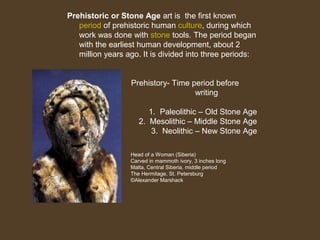
Head of a Woman (Siberia)
Carved in mammoth ivory, 3 inches long
Malta, Central Siberia, middle period
The Hermitage, St. Petersburg
©Alexander Marshack
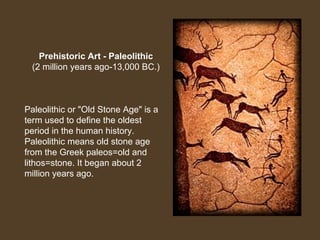
Prehistoric Art - Paleolithic
(2 million years ago-13,000 BC.)

Paleolithic or "Old Stone Age" is a
term used to define the oldest
period in the human history.
Paleolithic means old stone age
from the Greek paleos=old and
lithos=stone. It began about 2
million years ago.
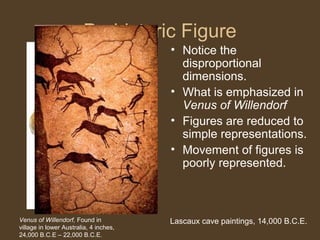
Prehistoric Figure
• Notice the
disproportional
dimensions.
• What is emphasized in
Venus of Willendorf
• Figures are reduced to
simple representations.
• Movement of figures is
poorly represented.

Venus of Willendorf, Found in
village in lower Australia, 4 inches,
24,000 B.C.E – 22,000 B.C.E.

Lascaux cave paintings, 14,000 B.C.E.
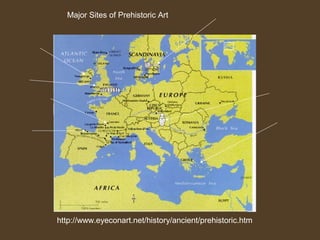
Major Sites of Prehistoric Art

http://www.eyeconart.net/history/ancient/prehistoric.htm
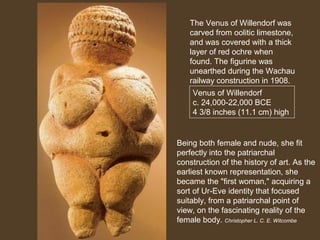
The Venus of Willendorf was
carved from oolitic limestone,
and was covered with a thick
layer of red ochre when
found. The figurine was
unearthed during the Wachau
railway construction in 1908.
Venus of Willendorf
c. 24,000-22,000 BCE
4 3/8 inches (11.1 cm) high

Being both female and nude, she fit
perfectly into the patriarchal
construction of the history of art. As the
earliest known representation, she
became the "first woman," acquiring a
sort of Ur-Eve identity that focused
suitably, from a patriarchal point of
view, on the fascinating reality of the
female body. Christopher L. C. E. Witcombe
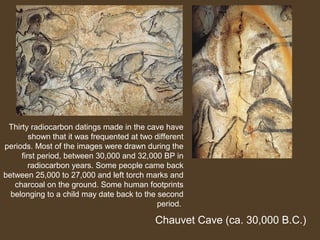
Thirty radiocarbon datings made in the cave have
shown that it was frequented at two different
periods. Most of the images were drawn during the
first period, between 30,000 and 32,000 BP in
radiocarbon years. Some people came back
between 25,000 to 27,000 and left torch marks and
charcoal on the ground. Some human footprints
belonging to a child may date back to the second
period.

Chauvet Cave (ca. 30,000 B.C.)
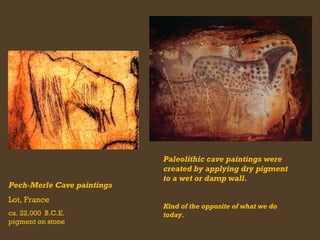
Pech-Merle Cave paintings
Lot, France
ca. 22,000 B.C.E.
pigment on stone

Paleolithic cave paintings were
created by applying dry pigment
to a wet or damp wall.
Kind of the opposite of what we do
today.
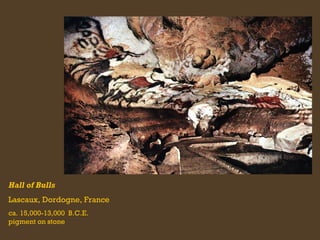
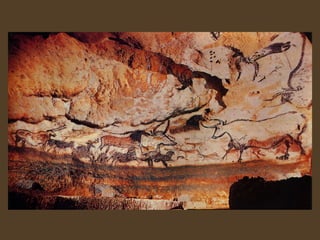
Hall of Bulls
Lascaux, Dordogne, France
ca. 15,000-13,000 B.C.E.
pigment on stone
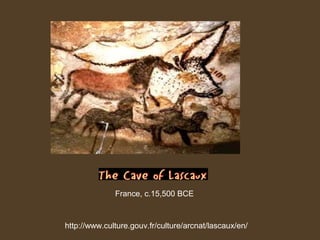
France, c.15,500 BCE

http://www.culture.gouv.fr/culture/arcnat/lascaux/en/
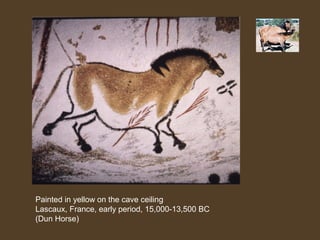
Painted in yellow on the cave ceiling
Lascaux, France, early period, 15,000-13,500 BC
(Dun Horse)
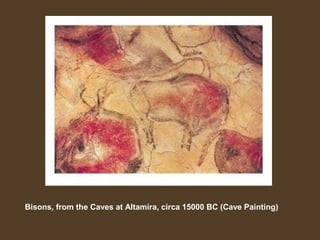
Bisons, from the Caves at Altamira, circa 15000 BC (Cave Painting)
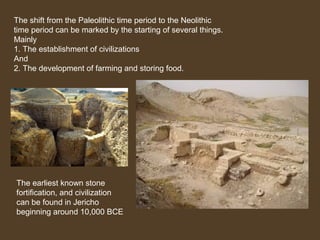
The shift from the Paleolithic time period to the Neolithic
time period can be marked by the starting of several things.
Mainly
1. The establishment of civilizations
And
2. The development of farming and storing food.

The earliest known stone
fortification, and civilization
can be found in Jericho
beginning around 10,000 BCE
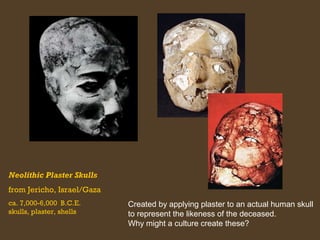
Neolithic Plaster Skulls
from Jericho, Israel/Gaza
ca. 7,000-6,000 B.C.E.
skulls, plaster, shells

Created by applying plaster to an actual human skull
to represent the likeness of the deceased.
Why might a culture create these?
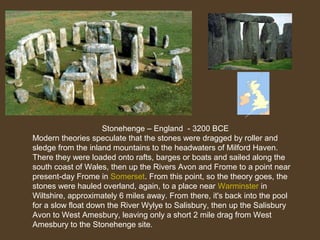
Stonehenge – England - 3200 BCE
Modern theories speculate that the stones were dragged by roller and
sledge from the inland mountains to the headwaters of Milford Haven.
There they were loaded onto rafts, barges or boats and sailed along the
south coast of Wales, then up the Rivers Avon and Frome to a point near
present-day Frome in Somerset. From this point, so the theory goes, the
stones were hauled overland, again, to a place near Warminster in
Wiltshire, approximately 6 miles away. From there, it's back into the pool
for a slow float down the River Wylye to Salisbury, then up the Salisbury
Avon to West Amesbury, leaving only a short 2 mile drag from West
Amesbury to the Stonehenge site.
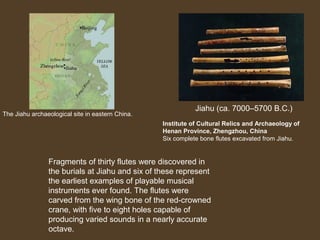
The Jiahu archaeological site in eastern China.

Jiahu (ca. 7000–5700 B.C.)
Institute of Cultural Relics and Archaeology of
Henan Province, Zhengzhou, China
Six complete bone flutes excavated from Jiahu.

Fragments of thirty flutes were discovered in
the burials at Jiahu and six of these represent
the earliest examples of playable musical
instruments ever found. The flutes were
carved from the wing bone of the red-crowned
crane, with five to eight holes capable of
producing varied sounds in a nearly accurate
octave.
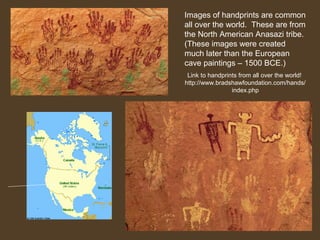
Images of handprints are common
all over the world. These are from
the North American Anasazi tribe.
(These images were created
much later than the European
cave paintings – 1500 BCE.)
Link to handprints from all over the world!
http://www.bradshawfoundation.com/hands/
index.php
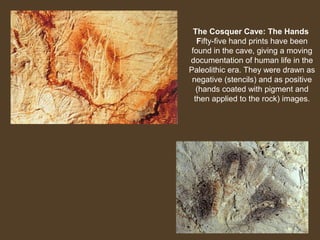
The Cosquer Cave: The Hands
Fifty-five hand prints have been
found in the cave, giving a moving
documentation of human life in the
Paleolithic era. They were drawn as
negative (stencils) and as positive
(hands coated with pigment and
then applied to the rock) images.
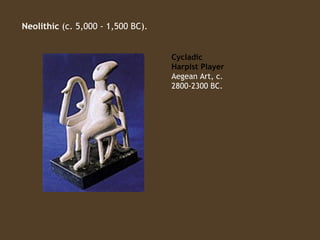
Neolithic (c. 5,000 - 1,500 BC).


Cycladic
Harpist Player
Aegean Art, c.
2800-2300 BC.
                                          
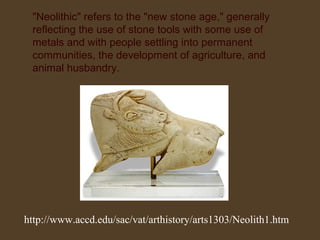
"Neolithic" refers to the "new stone age," generally
reflecting the use of stone tools with some use of
metals and with people settling into permanent
communities, the development of agriculture, and
animal husbandry.

http://www.accd.edu/sac/vat/arthistory/arts1303/Neolith1.htm
What are the key characteristics of Neolithic art?
• It was still, almost without exception, created for some
functional purpose.
• There were more images of humans than animals, and
the humans looked more, well, human.
• It began to be used for ornamentation.
• In the cases of architecture and megalithic constructions,
art was now created in fixed locations. This was
significant. Where temples, sanctuaries and stone rings
were built, gods and goddesses were provided with known
destinations. Additionally, the emergence of tombs
provided unmoving, "visit-able" resting places for the
dearly departed - another first.
Painting, in Western Europe
and the Near East, left the caves
and cliffs for good, and became
a purely decorative element.
The finds of Çatal Hüyük, an
ancient village in modern
Turkey, show lovely wall
paintings (including the world's
earliest known landscape),
dating from c. 6150 BC.
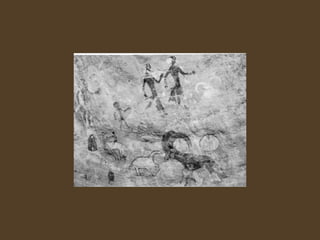
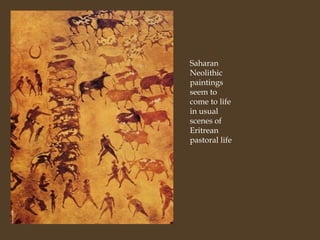
Saharan
Neolithic
paintings
seem to
come to life
in usual
scenes of
Eritrean
pastoral life
Statuary (primarily statuettes), made a big comeback after
having been largely absent during the Mesolithic age. Its
Neolithic theme dwelt primarily on the female/fertility, or
"Mother Goddess" imagery (quite in keeping with
agriculture, this). There were still animal statuettes,
however these weren't lavished with the detail the
goddesses enjoyed. They are often found broken into bits perhaps indicating that they were used symbolically in
hunting rituals.
Additionally, sculpture was no longer created strictly by
carving something. In the Near East, in particular,
figurines were now fashioned out of clay and baked.
Archaeological digs at Jericho turned up a marvelous
human skull (c. 7,000 BC) overlaid with delicate, sculpted
plaster features.
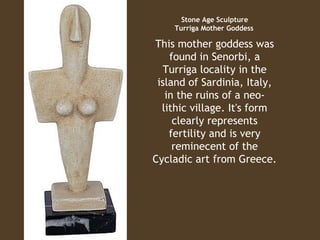
Stone Age Sculpture
Turriga Mother Goddess
 

This mother goddess was
found in Senorbi, a
Turriga locality in the
island of Sardinia, Italy,
in the ruins of a neolithic village. It's form
clearly represents
fertility and is very
reminecent of the
Cycladic art from Greece.
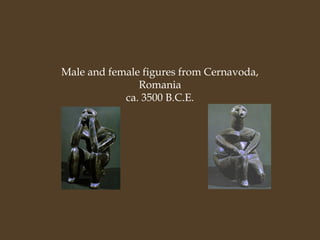
Male and female figures from Cernavoda,
Romania
ca. 3500 B.C.E.
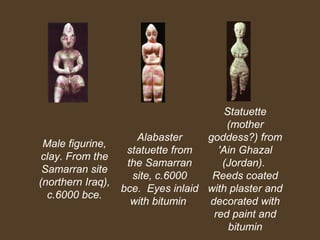
Male figurine,
clay. From the
Samarran site
(northern Iraq),
c.6000 bce.

Statuette
(mother
Alabaster
goddess?) from
statuette from
'Ain Ghazal
the Samarran
(Jordan).
site, c.6000
Reeds coated
bce. Eyes inlaid with plaster and
with bitumin.
decorated with
red paint and
bitumin
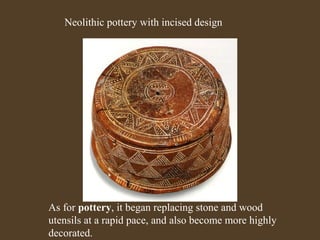
Neolithic pottery with incised design

As for pottery, it began replacing stone and wood
utensils at a rapid pace, and also become more highly
decorated.
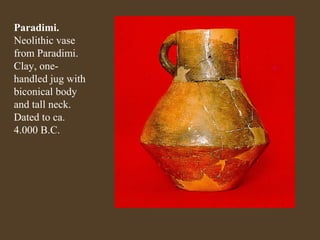
Paradimi.
Neolithic vase
from Paradimi.
Clay, onehandled jug with
biconical body
and tall neck.
Dated to ca.
4.000 B.C.
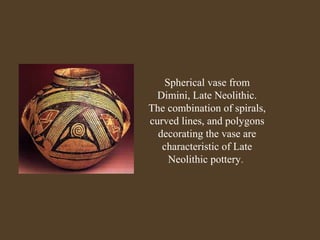
Spherical vase from
Dimini, Late Neolithic.
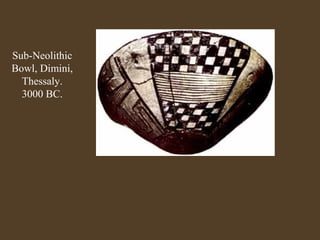
The combination of spirals,
curved lines, and polygons
decorating the vase are
characteristic of Late
Neolithic pottery.
Sub-Neolithic
Bowl, Dimini,
Thessaly.
3000 BC.
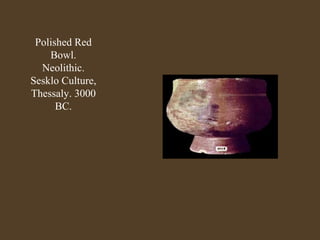
Polished Red
Bowl.
Neolithic.
Sesklo Culture,
Thessaly. 3000
BC.
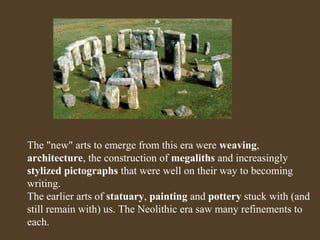
The "new" arts to emerge from this era were weaving,
architecture, the construction of megaliths and increasingly
stylized pictographs that were well on their way to becoming
writing.
The earlier arts of statuary, painting and pottery stuck with (and
still remain with) us. The Neolithic era saw many refinements to
each.
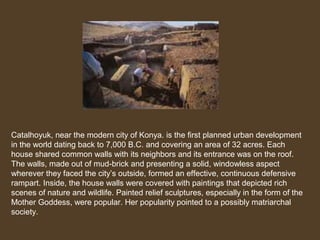
Catalhoyuk, near the modern city of Konya. is the first planned urban development
in the world dating back to 7,000 B.C. and covering an area of 32 acres. Each
house shared common walls with its neighbors and its entrance was on the roof.
The walls, made out of mud-brick and presenting a solid, windowless aspect
wherever they faced the city’s outside, formed an effective, continuous defensive
rampart. Inside, the house walls were covered with paintings that depicted rich
scenes of nature and wildlife. Painted relief sculptures, especially in the form of the
Mother Goddess, were popular. Her popularity pointed to a possibly matriarchal
society.
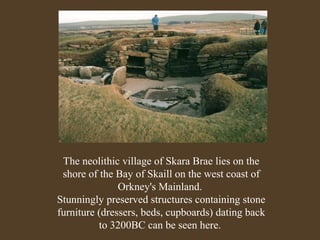
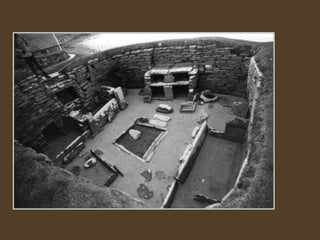
The neolithic village of Skara Brae lies on the
shore of the Bay of Skaill on the west coast of
Orkney's Mainland.
Stunningly preserved structures containing stone
furniture (dressers, beds, cupboards) dating back
to 3200BC can be seen here.
“Art history" typically begins to follow a prescribed course: Iron and
bronze are discovered. Ancient civilizations in Mesopotamia and
Egypt arise, make art, and are followed by art in the classical
civilizations of Greece and Rome. After this, we hang out in Europe
for the next thousand years, eventually moving on to the New World,
which subsequently shares artistic honors with Europe. This route is
commonly known as "Western Art", and is often the focus of any art
history/art appreciation syllabus. It is both acceptable (if not ideal)
and the route we will take here - for the time being.
However, the sort of art that has been described in this article as
"Neolithic" (i.e.: Stone age; that of pre-literate peoples who hadn't
yet discovered how to smelt metals) continued to flourish in the
Americas, Africa, Australia and, in particular, Oceania. In some
instances, it was still thriving in the previous (20th) century. So
noted. There are many terms for this kind of art, non-western being
the most predominant. I prefer ethnographic, a less frequently used
term, but one that is more respectful and accurate.
Vocabulary:
1.
2.
3.
4.

petroglyph - a design chiseled or chipped out of a rock surface
pictograph - a design painted on a rock surface
rock art panel - a group of pictograph and/or pictograph figures
nomadic - having no fixed home and wanders from place to place in search of
food
5. ritual - set form or way of conducting a ceremony
6. prehistoric - before written history
7. murals - picture painted on a wall
8. excavations - holes made by digging or hollowing out
9. polychrome - decorated in a variety of colors
10. incised - carved or engraved
11. hominid - member of a family of two-footed, erect mammals, of which modern
man is the only survivor
12. Homo sapiens - scientific name for modern humans
13. Paleolithic - period of early human culture in which chipped or flaked stone
tools were made and used
14. Pleistocene - most recent ice age
15. Neanderthal - extinct species of prehistoric man who lived in caves in Europe,
North Africa, and western and central Asia

2 prehistoric art 1

  • 1.
  • 2.
    Prehistoric or StoneAge art is the first known period of prehistoric human culture, during which work was done with stone tools. The period began with the earliest human development, about 2 million years ago. It is divided into three periods: Prehistory- Time period before writing 1. Paleolithic – Old Stone Age 2. Mesolithic – Middle Stone Age 3. Neolithic – New Stone Age Head of a Woman (Siberia) Carved in mammoth ivory, 3 inches long Malta, Central Siberia, middle period The Hermitage, St. Petersburg ©Alexander Marshack
  • 3.
    Prehistoric Art -Paleolithic (2 million years ago-13,000 BC.) Paleolithic or "Old Stone Age" is a term used to define the oldest period in the human history. Paleolithic means old stone age from the Greek paleos=old and lithos=stone. It began about 2 million years ago.
  • 4.
    Prehistoric Figure • Noticethe disproportional dimensions. • What is emphasized in Venus of Willendorf • Figures are reduced to simple representations. • Movement of figures is poorly represented. Venus of Willendorf, Found in village in lower Australia, 4 inches, 24,000 B.C.E – 22,000 B.C.E. Lascaux cave paintings, 14,000 B.C.E.
  • 5.
    Major Sites ofPrehistoric Art http://www.eyeconart.net/history/ancient/prehistoric.htm
  • 6.
    The Venus ofWillendorf was carved from oolitic limestone, and was covered with a thick layer of red ochre when found. The figurine was unearthed during the Wachau railway construction in 1908. Venus of Willendorf c. 24,000-22,000 BCE 4 3/8 inches (11.1 cm) high Being both female and nude, she fit perfectly into the patriarchal construction of the history of art. As the earliest known representation, she became the "first woman," acquiring a sort of Ur-Eve identity that focused suitably, from a patriarchal point of view, on the fascinating reality of the female body. Christopher L. C. E. Witcombe
  • 7.
    Thirty radiocarbon datingsmade in the cave have shown that it was frequented at two different periods. Most of the images were drawn during the first period, between 30,000 and 32,000 BP in radiocarbon years. Some people came back between 25,000 to 27,000 and left torch marks and charcoal on the ground. Some human footprints belonging to a child may date back to the second period. Chauvet Cave (ca. 30,000 B.C.)
  • 8.
    Pech-Merle Cave paintings Lot,France ca. 22,000 B.C.E. pigment on stone Paleolithic cave paintings were created by applying dry pigment to a wet or damp wall. Kind of the opposite of what we do today.
  • 9.
    Hall of Bulls Lascaux,Dordogne, France ca. 15,000-13,000 B.C.E. pigment on stone
  • 11.
  • 12.
    Painted in yellowon the cave ceiling Lascaux, France, early period, 15,000-13,500 BC (Dun Horse)
  • 13.
    Bisons, from theCaves at Altamira, circa 15000 BC (Cave Painting)
  • 14.
    The shift fromthe Paleolithic time period to the Neolithic time period can be marked by the starting of several things. Mainly 1. The establishment of civilizations And 2. The development of farming and storing food. The earliest known stone fortification, and civilization can be found in Jericho beginning around 10,000 BCE
  • 15.
    Neolithic Plaster Skulls fromJericho, Israel/Gaza ca. 7,000-6,000 B.C.E. skulls, plaster, shells Created by applying plaster to an actual human skull to represent the likeness of the deceased. Why might a culture create these?
  • 16.
    Stonehenge – England- 3200 BCE Modern theories speculate that the stones were dragged by roller and sledge from the inland mountains to the headwaters of Milford Haven. There they were loaded onto rafts, barges or boats and sailed along the south coast of Wales, then up the Rivers Avon and Frome to a point near present-day Frome in Somerset. From this point, so the theory goes, the stones were hauled overland, again, to a place near Warminster in Wiltshire, approximately 6 miles away. From there, it's back into the pool for a slow float down the River Wylye to Salisbury, then up the Salisbury Avon to West Amesbury, leaving only a short 2 mile drag from West Amesbury to the Stonehenge site.
  • 17.
    The Jiahu archaeologicalsite in eastern China. Jiahu (ca. 7000–5700 B.C.) Institute of Cultural Relics and Archaeology of Henan Province, Zhengzhou, China Six complete bone flutes excavated from Jiahu. Fragments of thirty flutes were discovered in the burials at Jiahu and six of these represent the earliest examples of playable musical instruments ever found. The flutes were carved from the wing bone of the red-crowned crane, with five to eight holes capable of producing varied sounds in a nearly accurate octave.
  • 18.
    Images of handprintsare common all over the world. These are from the North American Anasazi tribe. (These images were created much later than the European cave paintings – 1500 BCE.) Link to handprints from all over the world! http://www.bradshawfoundation.com/hands/ index.php
  • 19.
    The Cosquer Cave:The Hands Fifty-five hand prints have been found in the cave, giving a moving documentation of human life in the Paleolithic era. They were drawn as negative (stencils) and as positive (hands coated with pigment and then applied to the rock) images.
  • 20.
    Neolithic (c. 5,000- 1,500 BC).   Cycladic Harpist Player Aegean Art, c. 2800-2300 BC.                                           
  • 21.
    "Neolithic" refers tothe "new stone age," generally reflecting the use of stone tools with some use of metals and with people settling into permanent communities, the development of agriculture, and animal husbandry. http://www.accd.edu/sac/vat/arthistory/arts1303/Neolith1.htm
  • 22.
    What are thekey characteristics of Neolithic art? • It was still, almost without exception, created for some functional purpose. • There were more images of humans than animals, and the humans looked more, well, human. • It began to be used for ornamentation. • In the cases of architecture and megalithic constructions, art was now created in fixed locations. This was significant. Where temples, sanctuaries and stone rings were built, gods and goddesses were provided with known destinations. Additionally, the emergence of tombs provided unmoving, "visit-able" resting places for the dearly departed - another first.
  • 23.
    Painting, in WesternEurope and the Near East, left the caves and cliffs for good, and became a purely decorative element. The finds of Çatal Hüyük, an ancient village in modern Turkey, show lovely wall paintings (including the world's earliest known landscape), dating from c. 6150 BC.
  • 25.
    Saharan Neolithic paintings seem to come tolife in usual scenes of Eritrean pastoral life
  • 26.
    Statuary (primarily statuettes),made a big comeback after having been largely absent during the Mesolithic age. Its Neolithic theme dwelt primarily on the female/fertility, or "Mother Goddess" imagery (quite in keeping with agriculture, this). There were still animal statuettes, however these weren't lavished with the detail the goddesses enjoyed. They are often found broken into bits perhaps indicating that they were used symbolically in hunting rituals. Additionally, sculpture was no longer created strictly by carving something. In the Near East, in particular, figurines were now fashioned out of clay and baked. Archaeological digs at Jericho turned up a marvelous human skull (c. 7,000 BC) overlaid with delicate, sculpted plaster features.
  • 27.
    Stone Age Sculpture TurrigaMother Goddess   This mother goddess was found in Senorbi, a Turriga locality in the island of Sardinia, Italy, in the ruins of a neolithic village. It's form clearly represents fertility and is very reminecent of the Cycladic art from Greece.
  • 28.
    Male and femalefigures from Cernavoda, Romania ca. 3500 B.C.E.
  • 29.
    Male figurine, clay. Fromthe Samarran site (northern Iraq), c.6000 bce. Statuette (mother Alabaster goddess?) from statuette from 'Ain Ghazal the Samarran (Jordan). site, c.6000 Reeds coated bce. Eyes inlaid with plaster and with bitumin. decorated with red paint and bitumin
  • 30.
    Neolithic pottery withincised design As for pottery, it began replacing stone and wood utensils at a rapid pace, and also become more highly decorated.
  • 31.
    Paradimi. Neolithic vase from Paradimi. Clay,onehandled jug with biconical body and tall neck. Dated to ca. 4.000 B.C.
  • 32.
    Spherical vase from Dimini,Late Neolithic. The combination of spirals, curved lines, and polygons decorating the vase are characteristic of Late Neolithic pottery.
  • 33.
  • 34.
  • 35.
    The "new" artsto emerge from this era were weaving, architecture, the construction of megaliths and increasingly stylized pictographs that were well on their way to becoming writing. The earlier arts of statuary, painting and pottery stuck with (and still remain with) us. The Neolithic era saw many refinements to each.
  • 36.
    Catalhoyuk, near themodern city of Konya. is the first planned urban development in the world dating back to 7,000 B.C. and covering an area of 32 acres. Each house shared common walls with its neighbors and its entrance was on the roof. The walls, made out of mud-brick and presenting a solid, windowless aspect wherever they faced the city’s outside, formed an effective, continuous defensive rampart. Inside, the house walls were covered with paintings that depicted rich scenes of nature and wildlife. Painted relief sculptures, especially in the form of the Mother Goddess, were popular. Her popularity pointed to a possibly matriarchal society.
  • 37.
    The neolithic villageof Skara Brae lies on the shore of the Bay of Skaill on the west coast of Orkney's Mainland. Stunningly preserved structures containing stone furniture (dressers, beds, cupboards) dating back to 3200BC can be seen here.
  • 39.
    “Art history" typicallybegins to follow a prescribed course: Iron and bronze are discovered. Ancient civilizations in Mesopotamia and Egypt arise, make art, and are followed by art in the classical civilizations of Greece and Rome. After this, we hang out in Europe for the next thousand years, eventually moving on to the New World, which subsequently shares artistic honors with Europe. This route is commonly known as "Western Art", and is often the focus of any art history/art appreciation syllabus. It is both acceptable (if not ideal) and the route we will take here - for the time being. However, the sort of art that has been described in this article as "Neolithic" (i.e.: Stone age; that of pre-literate peoples who hadn't yet discovered how to smelt metals) continued to flourish in the Americas, Africa, Australia and, in particular, Oceania. In some instances, it was still thriving in the previous (20th) century. So noted. There are many terms for this kind of art, non-western being the most predominant. I prefer ethnographic, a less frequently used term, but one that is more respectful and accurate.
  • 40.
    Vocabulary: 1. 2. 3. 4. petroglyph - adesign chiseled or chipped out of a rock surface pictograph - a design painted on a rock surface rock art panel - a group of pictograph and/or pictograph figures nomadic - having no fixed home and wanders from place to place in search of food 5. ritual - set form or way of conducting a ceremony 6. prehistoric - before written history 7. murals - picture painted on a wall 8. excavations - holes made by digging or hollowing out 9. polychrome - decorated in a variety of colors 10. incised - carved or engraved 11. hominid - member of a family of two-footed, erect mammals, of which modern man is the only survivor 12. Homo sapiens - scientific name for modern humans 13. Paleolithic - period of early human culture in which chipped or flaked stone tools were made and used 14. Pleistocene - most recent ice age 15. Neanderthal - extinct species of prehistoric man who lived in caves in Europe, North Africa, and western and central Asia

Editor's Notes

  • #9 Slide concept by William V. Ganis, PhD FOR EDUCATIONAL USE ONLY For publication, reproduction or transmission of images, please contact individual artists, estates, photographers and exhibiting institutions for permissions and rights.
  • #10 Slide concept by William V. Ganis, PhD FOR EDUCATIONAL USE ONLY For publication, reproduction or transmission of images, please contact individual artists, estates, photographers and exhibiting institutions for permissions and rights.
  • #11 Slide concept by William V. Ganis, PhD FOR EDUCATIONAL USE ONLY For publication, reproduction or transmission of images, please contact individual artists, estates, photographers and exhibiting institutions for permissions and rights.
  • #16 Slide concept by William V. Ganis, PhD FOR EDUCATIONAL USE ONLY For publication, reproduction or transmission of images, please contact individual artists, estates, photographers and exhibiting institutions for permissions and rights.