PREPARED BY : MISHA SANGHVI (0943)
GUIDED BY : MISS. ADITI JOSHI
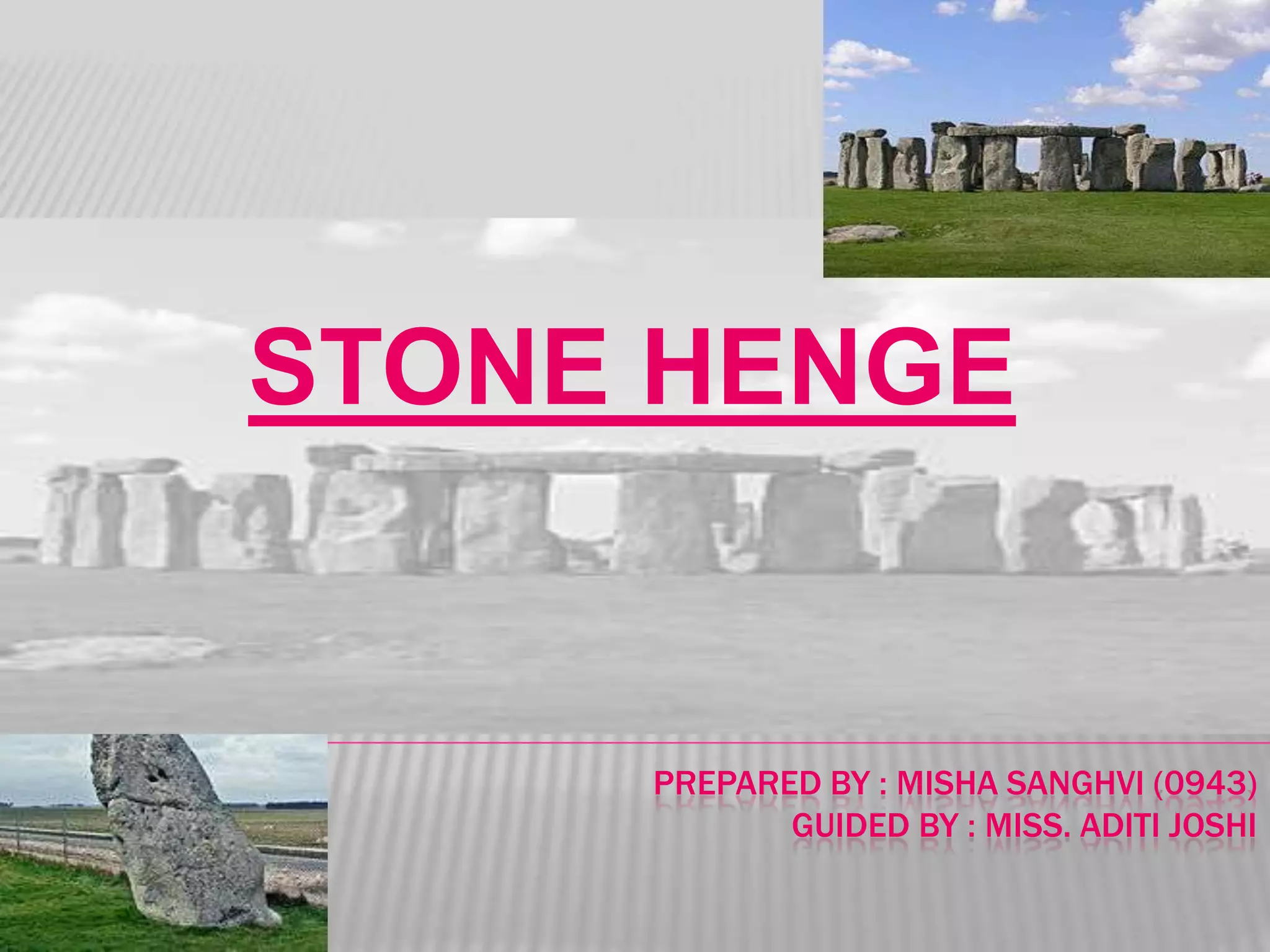
STONE HENGE
HISTORY OF STONE HENGE:
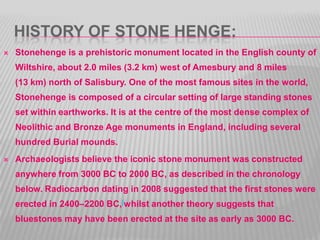
 Stonehenge is a prehistoric monument located in the English county of
Wiltshire, about 2.0 miles (3.2 km) west of Amesbury and 8 miles
(13 km) north of Salisbury. One of the most famous sites in the world,
Stonehenge is composed of a circular setting of large standing stones
set within earthworks. It is at the centre of the most dense complex of
Neolithic and Bronze Age monuments in England, including several
hundred Burial mounds.
 Archaeologists believe the iconic stone monument was constructed
anywhere from 3000 BC to 2000 BC, as described in the chronology
below. Radiocarbon dating in 2008 suggested that the first stones were
erected in 2400–2200 BC,[whilst another theory suggests that
bluestones may have been erected at the site as early as 3000 BC.
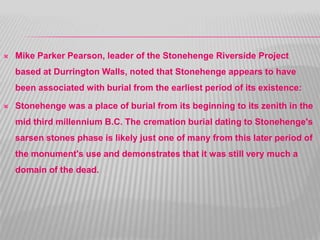
 Mike Parker Pearson, leader of the Stonehenge Riverside Project
based at Durrington Walls, noted that Stonehenge appears to have
been associated with burial from the earliest period of its existence:
 Stonehenge was a place of burial from its beginning to its zenith in the
mid third millennium B.C. The cremation burial dating to Stonehenge's
sarsen stones phase is likely just one of many from this later period of
the monument's use and demonstrates that it was still very much a
domain of the dead.
PROCESS OF CONSTRUCTION :
FIRST STAGE :
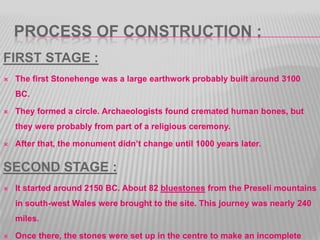
 The first Stonehenge was a large earthwork probably built around 3100
BC.
 They formed a circle. Archaeologists found cremated human bones, but
they were probably from part of a religious ceremony.
 After that, the monument didn’t change until 1000 years later.
SECOND STAGE :
 It started around 2150 BC. About 82 bluestones from the Preseli mountains
in south-west Wales were brought to the site. This journey was nearly 240
miles.
 Once there, the stones were set up in the centre to make an incomplete
THIRD STAGE :
 It started in 2000 BC. The Sarsen stones that they used were probably
brought from the Marlborough Downs area near Avebury, about 25
miles north of Stonehenge.
 These were placed in an outer circle. Inside the circle, there were also
five trilithons, that still remain today.
FINAL STAGE :
 After 1500 BC the bluestones were moved into the horseshoe and
circle that we see today.
 Most of the bluestones have been removed or broken.
POSSIBLE THEORIES ABOUT STONE
HENGE :
 Stonehenge was an astronomical observatory :
They could predict eclipses, lunar phases and seasons. Nevertheless, it
was possible that it was not the original function because it took more
than 1000 years to finish it.
 Stonehenge was a cemetery :
Scientists found human bones buried there.
 Stonehenge was a religious temple
People went there because the Druids could give them magic power
and cure their illnesses.
INCREDIBLE THEORIES :
 Stonehenge was built by Apollo’s followers who lived in the north of
Europe and were documented in Greek mythology.
 Stonehenge was a place where UFOs landed.
 Stonehenge was created in the first years of the XX century to attract
tourists.
 Stonehenge was built by the wizard Merlin. He made it himself by
raising the stones with his magical power.
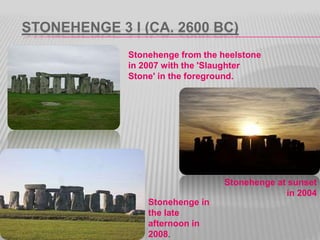
STONEHENGE 3 I (CA. 2600 BC)
Stonehenge from the heelstone
in 2007 with the 'Slaughter
Stone' in the foreground.
Stonehenge at sunset
in 2004
Stonehenge in
the late
afternoon in
2008.
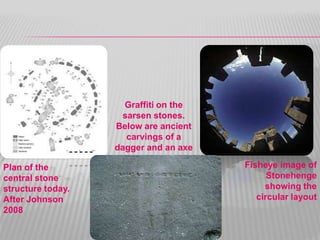
Plan of the
central stone
structure today.
After Johnson
2008
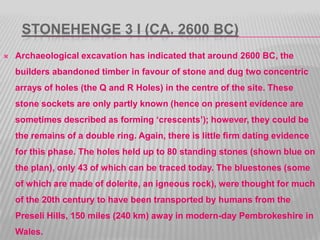
Fisheye image of
Stonehenge
showing the
circular layout
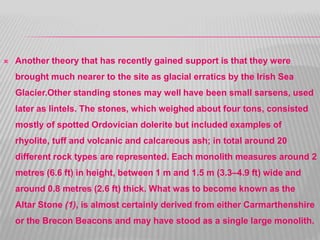
Graffiti on the
sarsen stones.
Below are ancient
carvings of a
dagger and an axe
STONEHENGE 3 I (CA. 2600 BC)
 Archaeological excavation has indicated that around 2600 BC, the
builders abandoned timber in favour of stone and dug two concentric
arrays of holes (the Q and R Holes) in the centre of the site. These
stone sockets are only partly known (hence on present evidence are
sometimes described as forming ‘crescents’); however, they could be
the remains of a double ring. Again, there is little firm dating evidence
for this phase. The holes held up to 80 standing stones (shown blue on
the plan), only 43 of which can be traced today. The bluestones (some
of which are made of dolerite, an igneous rock), were thought for much
of the 20th century to have been transported by humans from the
Preseli Hills, 150 miles (240 km) away in modern-day Pembrokeshire in
Wales.
 Another theory that has recently gained support is that they were
brought much nearer to the site as glacial erratics by the Irish Sea
Glacier.Other standing stones may well have been small sarsens, used
later as lintels. The stones, which weighed about four tons, consisted
mostly of spotted Ordovician dolerite but included examples of
rhyolite, tuff and volcanic and calcareous ash; in total around 20
different rock types are represented. Each monolith measures around 2
metres (6.6 ft) in height, between 1 m and 1.5 m (3.3–4.9 ft) wide and
around 0.8 metres (2.6 ft) thick. What was to become known as the
Altar Stone (1), is almost certainly derived from either Carmarthenshire
or the Brecon Beacons and may have stood as a single large monolith.

Stone age

  • 1.
    PREPARED BY :MISHA SANGHVI (0943) GUIDED BY : MISS. ADITI JOSHI STONE HENGE
  • 2.
    HISTORY OF STONEHENGE:  Stonehenge is a prehistoric monument located in the English county of Wiltshire, about 2.0 miles (3.2 km) west of Amesbury and 8 miles (13 km) north of Salisbury. One of the most famous sites in the world, Stonehenge is composed of a circular setting of large standing stones set within earthworks. It is at the centre of the most dense complex of Neolithic and Bronze Age monuments in England, including several hundred Burial mounds.  Archaeologists believe the iconic stone monument was constructed anywhere from 3000 BC to 2000 BC, as described in the chronology below. Radiocarbon dating in 2008 suggested that the first stones were erected in 2400–2200 BC,[whilst another theory suggests that bluestones may have been erected at the site as early as 3000 BC.
  • 3.
     Mike ParkerPearson, leader of the Stonehenge Riverside Project based at Durrington Walls, noted that Stonehenge appears to have been associated with burial from the earliest period of its existence:  Stonehenge was a place of burial from its beginning to its zenith in the mid third millennium B.C. The cremation burial dating to Stonehenge's sarsen stones phase is likely just one of many from this later period of the monument's use and demonstrates that it was still very much a domain of the dead.
  • 4.
    PROCESS OF CONSTRUCTION: FIRST STAGE :  The first Stonehenge was a large earthwork probably built around 3100 BC.  They formed a circle. Archaeologists found cremated human bones, but they were probably from part of a religious ceremony.  After that, the monument didn’t change until 1000 years later. SECOND STAGE :  It started around 2150 BC. About 82 bluestones from the Preseli mountains in south-west Wales were brought to the site. This journey was nearly 240 miles.  Once there, the stones were set up in the centre to make an incomplete
  • 5.
    THIRD STAGE : It started in 2000 BC. The Sarsen stones that they used were probably brought from the Marlborough Downs area near Avebury, about 25 miles north of Stonehenge.  These were placed in an outer circle. Inside the circle, there were also five trilithons, that still remain today. FINAL STAGE :  After 1500 BC the bluestones were moved into the horseshoe and circle that we see today.  Most of the bluestones have been removed or broken.
  • 6.
    POSSIBLE THEORIES ABOUTSTONE HENGE :  Stonehenge was an astronomical observatory : They could predict eclipses, lunar phases and seasons. Nevertheless, it was possible that it was not the original function because it took more than 1000 years to finish it.  Stonehenge was a cemetery : Scientists found human bones buried there.  Stonehenge was a religious temple People went there because the Druids could give them magic power and cure their illnesses.
  • 7.
    INCREDIBLE THEORIES : Stonehenge was built by Apollo’s followers who lived in the north of Europe and were documented in Greek mythology.  Stonehenge was a place where UFOs landed.  Stonehenge was created in the first years of the XX century to attract tourists.  Stonehenge was built by the wizard Merlin. He made it himself by raising the stones with his magical power.
  • 8.
    STONEHENGE 3 I(CA. 2600 BC) Stonehenge from the heelstone in 2007 with the 'Slaughter Stone' in the foreground. Stonehenge at sunset in 2004 Stonehenge in the late afternoon in 2008.
  • 9.
    Plan of the centralstone structure today. After Johnson 2008 Fisheye image of Stonehenge showing the circular layout Graffiti on the sarsen stones. Below are ancient carvings of a dagger and an axe
  • 10.
    STONEHENGE 3 I(CA. 2600 BC)  Archaeological excavation has indicated that around 2600 BC, the builders abandoned timber in favour of stone and dug two concentric arrays of holes (the Q and R Holes) in the centre of the site. These stone sockets are only partly known (hence on present evidence are sometimes described as forming ‘crescents’); however, they could be the remains of a double ring. Again, there is little firm dating evidence for this phase. The holes held up to 80 standing stones (shown blue on the plan), only 43 of which can be traced today. The bluestones (some of which are made of dolerite, an igneous rock), were thought for much of the 20th century to have been transported by humans from the Preseli Hills, 150 miles (240 km) away in modern-day Pembrokeshire in Wales.
  • 11.
     Another theorythat has recently gained support is that they were brought much nearer to the site as glacial erratics by the Irish Sea Glacier.Other standing stones may well have been small sarsens, used later as lintels. The stones, which weighed about four tons, consisted mostly of spotted Ordovician dolerite but included examples of rhyolite, tuff and volcanic and calcareous ash; in total around 20 different rock types are represented. Each monolith measures around 2 metres (6.6 ft) in height, between 1 m and 1.5 m (3.3–4.9 ft) wide and around 0.8 metres (2.6 ft) thick. What was to become known as the Altar Stone (1), is almost certainly derived from either Carmarthenshire or the Brecon Beacons and may have stood as a single large monolith.