The Renaissance in Venice
1470 - 1570
The Queen of the Adriatic
 Venice was in many ways quite different to
Rome and Florence
 At the crossroads of commercial trade
between east and west it became a very
prosperous and splendid city in the 16th
century
 This also meant it had an exciting mix of
exotic cultures
Painting in Venice
Characteristics
 Colour and light characterise Venetian painting
 It is known for a very distinctive style of loose
brushwork and a smooth, velvety texture
 Blurry edges and soft light is found particularly
in landscape landscape painting and this tends
to create a gentle slightly mysterious
atmosphere
Techniques
 The damp atmosphere in Venice made
fresco painting on plastered walls impossible
 Artists developed the technique of oil
painting on canvas.
 Canvas was stretched over large wooden
frames to hang on walls
 Primed with white gesso the light glowed
through layers of oily paint and glazes.
Artists of Venice
•Giovanni Bellini 1430 – 1516
•Giorgione 1477- 1510
•Titian (Tiziano Vecelli) 1485-1576
Giovanni Bellini
 Bellini was from a family of painters
 They are thought to have brought Renaissance
"style" to Venetian painting in the mid to late
15th century
 Bellini perfected the new technique oil painting
 His realistic and sensitive work brought
Renaissance painting in Venice to the same
level as Florence and Rome.

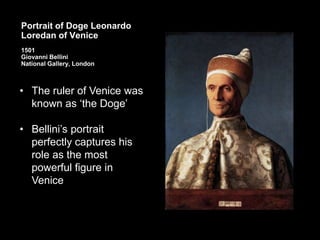
Portrait of Doge Leonardo
Loredan of Venice
1501
Giovanni Bellini
National Gallery, London
• The ruler of Venice was
known as ‘the Doge’
• Bellini’s portrait
perfectly captures his
role as the most
powerful figure in
Venice
Giorgione 1477- 1510
 The name means ‘big Giorgio’
 Giorgione died at a young age and not much is known of his life
 His paintings are dreamlike and mysterious
 They brought the new word 'poesie' meaning visual poetry to
Renaissance art.
 They are linked with particular style of poetry called the ‘Arcadia’.
 Arcadia was a fantasy landscape of peace and romantic love
 His most famous pupil was the artist Titian
 Titian probably finished several of his paintings
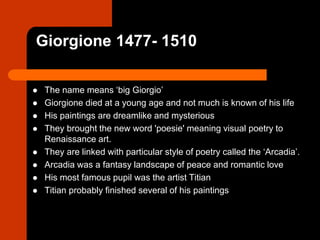
The Tempest
Giorgione
Accademia, Venice
•This is one of Giorgione’s
few works
•No one is sure of its exact
meaning
•The strange atmosphere
comes from the vibrant
brightness of a single flash of
lightening just before a storm
•The mother with her child
under the trees may
represent shelter
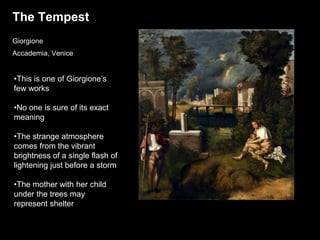
Concert Champêtre1508-09
Giorgione and Titian
Musée du Louvre, Paris
•This is another mysterious
painting of mythological
figures in a dreamy
landscape
•For a long time it was
thought to be by Giorgione
but was probably painted
or at least finished, by
Titian
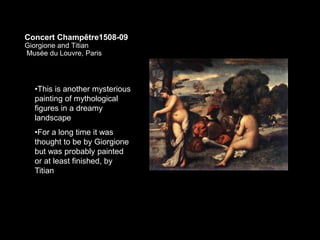
Sleeping Venus c. 1510 Giorgione Gemäldegalerie, Dresden
•Giorgione was the first to paint the goddess sleeping beneath a tree seemingly
unaware of her nakedness
•The soft afternoon sunlight brings the landscape and girl together in a picture of
the poetic beauty
•The subject became very popular after that
Titian 1485-1576
 After Bellini's death, Titian became the
foremost painter in Venice
 He had gained great technical skills and new
methods of working from Giorgione
 He was the most expressive painter of his time
 His rich colours and soft painterly technique
were widely imitated.
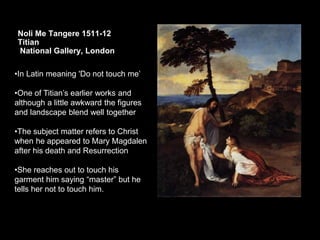
Noli Me Tangere 1511-12
Titian
National Gallery, London
•In Latin meaning 'Do not touch me’
•One of Titian’s earlier works and
although a little awkward the figures
and landscape blend well together
•The subject matter refers to Christ
when he appeared to Mary Magdalen
after his death and Resurrection
•She reaches out to touch his
garment him saying “master” but he
tells her not to touch him.
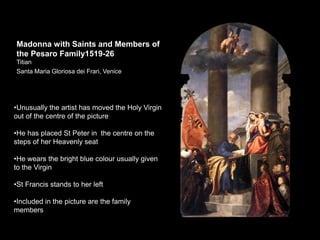
Madonna with Saints and Members of
the Pesaro Family1519-26
Titian
Santa Maria Gloriosa dei Frari, Venice
•Unusually the artist has moved the Holy Virgin
out of the centre of the picture
•He has placed St Peter in the centre on the
steps of her Heavenly seat
•He wears the bright blue colour usually given
to the Virgin
•St Francis stands to her left
•Included in the picture are the family
members
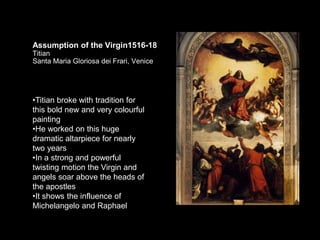
Assumption of the Virgin1516-18
Titian
Santa Maria Gloriosa dei Frari, Venice
•Titian broke with tradition for
this bold new and very colourful
painting
•He worked on this huge
dramatic altarpiece for nearly
two years
•In a strong and powerful
twisting motion the Virgin and
angels soar above the heads of
the apostles
•It shows the influence of
Michelangelo and Raphael
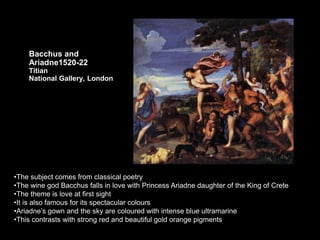
Bacchus and
Ariadne1520-22
Titian
National Gallery, London
•The subject comes from classical poetry
•The wine god Bacchus falls in love with Princess Ariadne daughter of the King of Crete
•The theme is love at first sight
•It is also famous for its spectacular colours
•Ariadne’s gown and the sky are coloured with intense blue ultramarine
•This contrasts with strong red and beautiful gold orange pigments
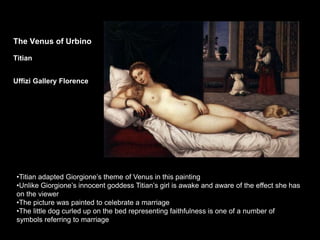
The Venus of Urbino
Titian
Uffizi Gallery Florence
•Titian adapted Giorgione’s theme of Venus in this painting
•Unlike Giorgione’s innocent goddess Titian’s girl is awake and aware of the effect she has
on the viewer
•The picture was painted to celebrate a marriage
•The little dog curled up on the bed representing faithfulness is one of a number of
symbols referring to marriage
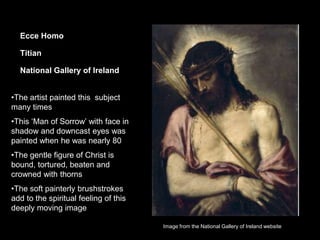
Ecce Homo
Titian
National Gallery of Ireland
•The artist painted this subject
many times
•This ‘Man of Sorrow’ with face in
shadow and downcast eyes was
painted when he was nearly 80
•The gentle figure of Christ is
bound, tortured, beaten and
crowned with thorns
•The soft painterly brushstrokes
add to the spiritual feeling of this
deeply moving image
Image from the National Gallery of Ireland website
Images from Web Gallery of Art www.wga.hu
Acknowledgements
Art Associates
Maria Moore
Margaret O’Shea
Local Facilitator Team
Aine Andrews
Joe Caslin
Jane Campbell
Siobhan Campbell
Niamh O’Donoghue
Niamh O’Neill
Keith O’Rahilly
Sheena McKeon
Tony Morrissey
Monica White
Many thanks to the following for their invaluable contribution to the European
Art History and Appreciation series of workshops and resource materials.
PDST Professional Development Service for Teachers
The PDST is funded by the
Department of Education and
Skills under the National
Development Plan 2007 -
2013
Cultural & Environmental Education
Professional Development Service for Teachers (PDST)
Dublin West Education Centre,
Old Blessington Road,
Tallaght,
Dublin 24
National Co-ordinator
Conor Harrison
Mobile: 087 240 5710
E-mail: conorharrison@pdst.ie
Administrator
Angie Grogan
Tel: 014528018 Fax: 014528010
E-mail: angiegrogan@pdst.ie.

8. renaissance in venice

  • 1.
    The Renaissance inVenice 1470 - 1570
  • 2.
    The Queen ofthe Adriatic  Venice was in many ways quite different to Rome and Florence  At the crossroads of commercial trade between east and west it became a very prosperous and splendid city in the 16th century  This also meant it had an exciting mix of exotic cultures
  • 3.
    Painting in Venice Characteristics Colour and light characterise Venetian painting  It is known for a very distinctive style of loose brushwork and a smooth, velvety texture  Blurry edges and soft light is found particularly in landscape landscape painting and this tends to create a gentle slightly mysterious atmosphere
  • 4.
    Techniques  The dampatmosphere in Venice made fresco painting on plastered walls impossible  Artists developed the technique of oil painting on canvas.  Canvas was stretched over large wooden frames to hang on walls  Primed with white gesso the light glowed through layers of oily paint and glazes.
  • 5.
    Artists of Venice •GiovanniBellini 1430 – 1516 •Giorgione 1477- 1510 •Titian (Tiziano Vecelli) 1485-1576
  • 6.
    Giovanni Bellini  Belliniwas from a family of painters  They are thought to have brought Renaissance "style" to Venetian painting in the mid to late 15th century  Bellini perfected the new technique oil painting  His realistic and sensitive work brought Renaissance painting in Venice to the same level as Florence and Rome.

  • 7.
    Portrait of DogeLeonardo Loredan of Venice 1501 Giovanni Bellini National Gallery, London • The ruler of Venice was known as ‘the Doge’ • Bellini’s portrait perfectly captures his role as the most powerful figure in Venice
  • 8.
    Giorgione 1477- 1510 The name means ‘big Giorgio’  Giorgione died at a young age and not much is known of his life  His paintings are dreamlike and mysterious  They brought the new word 'poesie' meaning visual poetry to Renaissance art.  They are linked with particular style of poetry called the ‘Arcadia’.  Arcadia was a fantasy landscape of peace and romantic love  His most famous pupil was the artist Titian  Titian probably finished several of his paintings
  • 9.
    The Tempest Giorgione Accademia, Venice •Thisis one of Giorgione’s few works •No one is sure of its exact meaning •The strange atmosphere comes from the vibrant brightness of a single flash of lightening just before a storm •The mother with her child under the trees may represent shelter
  • 10.
    Concert Champêtre1508-09 Giorgione andTitian Musée du Louvre, Paris •This is another mysterious painting of mythological figures in a dreamy landscape •For a long time it was thought to be by Giorgione but was probably painted or at least finished, by Titian
  • 11.
    Sleeping Venus c.1510 Giorgione Gemäldegalerie, Dresden •Giorgione was the first to paint the goddess sleeping beneath a tree seemingly unaware of her nakedness •The soft afternoon sunlight brings the landscape and girl together in a picture of the poetic beauty •The subject became very popular after that
  • 12.
    Titian 1485-1576  AfterBellini's death, Titian became the foremost painter in Venice  He had gained great technical skills and new methods of working from Giorgione  He was the most expressive painter of his time  His rich colours and soft painterly technique were widely imitated.
  • 13.
    Noli Me Tangere1511-12 Titian National Gallery, London •In Latin meaning 'Do not touch me’ •One of Titian’s earlier works and although a little awkward the figures and landscape blend well together •The subject matter refers to Christ when he appeared to Mary Magdalen after his death and Resurrection •She reaches out to touch his garment him saying “master” but he tells her not to touch him.
  • 14.
    Madonna with Saintsand Members of the Pesaro Family1519-26 Titian Santa Maria Gloriosa dei Frari, Venice •Unusually the artist has moved the Holy Virgin out of the centre of the picture •He has placed St Peter in the centre on the steps of her Heavenly seat •He wears the bright blue colour usually given to the Virgin •St Francis stands to her left •Included in the picture are the family members
  • 15.
    Assumption of theVirgin1516-18 Titian Santa Maria Gloriosa dei Frari, Venice •Titian broke with tradition for this bold new and very colourful painting •He worked on this huge dramatic altarpiece for nearly two years •In a strong and powerful twisting motion the Virgin and angels soar above the heads of the apostles •It shows the influence of Michelangelo and Raphael
  • 16.
    Bacchus and Ariadne1520-22 Titian National Gallery,London •The subject comes from classical poetry •The wine god Bacchus falls in love with Princess Ariadne daughter of the King of Crete •The theme is love at first sight •It is also famous for its spectacular colours •Ariadne’s gown and the sky are coloured with intense blue ultramarine •This contrasts with strong red and beautiful gold orange pigments
  • 17.
    The Venus ofUrbino Titian Uffizi Gallery Florence •Titian adapted Giorgione’s theme of Venus in this painting •Unlike Giorgione’s innocent goddess Titian’s girl is awake and aware of the effect she has on the viewer •The picture was painted to celebrate a marriage •The little dog curled up on the bed representing faithfulness is one of a number of symbols referring to marriage
  • 18.
    Ecce Homo Titian National Galleryof Ireland •The artist painted this subject many times •This ‘Man of Sorrow’ with face in shadow and downcast eyes was painted when he was nearly 80 •The gentle figure of Christ is bound, tortured, beaten and crowned with thorns •The soft painterly brushstrokes add to the spiritual feeling of this deeply moving image Image from the National Gallery of Ireland website
  • 19.
    Images from WebGallery of Art www.wga.hu
  • 20.
    Acknowledgements Art Associates Maria Moore MargaretO’Shea Local Facilitator Team Aine Andrews Joe Caslin Jane Campbell Siobhan Campbell Niamh O’Donoghue Niamh O’Neill Keith O’Rahilly Sheena McKeon Tony Morrissey Monica White Many thanks to the following for their invaluable contribution to the European Art History and Appreciation series of workshops and resource materials. PDST Professional Development Service for Teachers
  • 21.
    PDST Professional DevelopmentService for Teachers The PDST is funded by the Department of Education and Skills under the National Development Plan 2007 - 2013 Cultural & Environmental Education Professional Development Service for Teachers (PDST) Dublin West Education Centre, Old Blessington Road, Tallaght, Dublin 24 National Co-ordinator Conor Harrison Mobile: 087 240 5710 E-mail: conorharrison@pdst.ie Administrator Angie Grogan Tel: 014528018 Fax: 014528010 E-mail: angiegrogan@pdst.ie.