
Introduction to Humanities
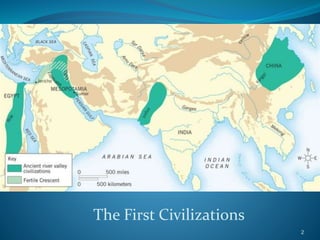
The First Civilizations
2
“Prehistory” may be defined as
that period prior to written
records.
Prehistoric Culture
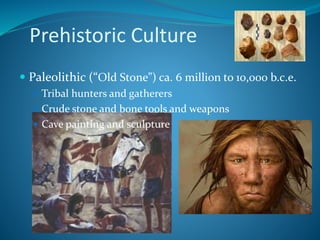
 Paleolithic (“Old Stone”) ca. 6 million to 10,000 b.c.e.
 Tribal hunters and gatherers
 Crude stone and bone tools and weapons
 Cave painting and sculpture
 Neolithic (“New Stone”) ca. 8,000 to 4,000 b.c.e.
 Farming and food production
 Polished stone and bone tools and weapons
 Architecture
 Pottery and weaving
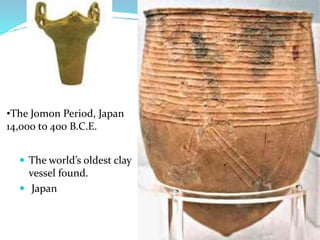
 The world’s oldest clay
vessel found.
 Japan
•The Jomon Period, Japan
14,000 to 400 B.C.E.hoto:
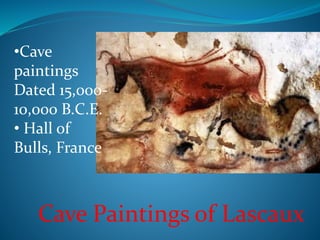
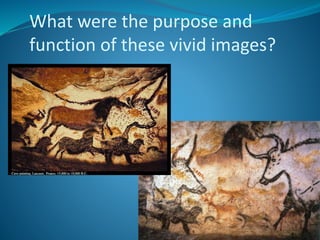
Cave Paintings of Lascaux
•Cave
paintings
Dated 15,000-
10,000 B.C.E.
• Hall of
Bulls, France
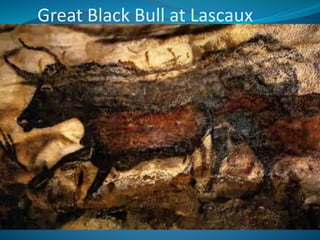
Great Black Bull at Lascaux
 long-extinct animals - hairy mammoth and
woolly rhinoceros.
Chauvet cave art depicting a Woolly rhino
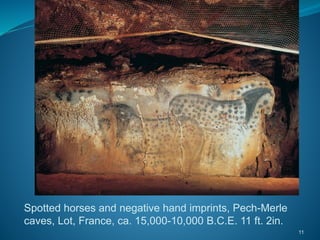
Spotted horses and negative hand imprints, Pech-Merle
caves, Lot, France, ca. 15,000-10,000 B.C.E. 11 ft. 2in.
11
What were the purpose and
function of these vivid images?
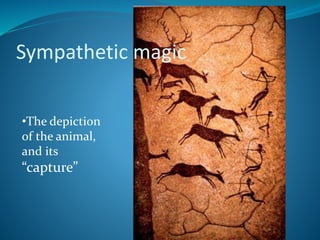
•The depiction
of the animal,
and its
“capture”
Sympathetic magic
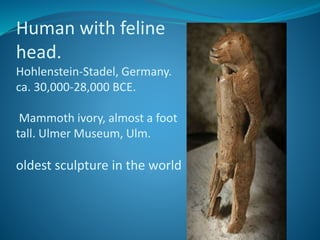
Human with feline
head.
Hohlenstein-Stadel, Germany.
ca. 30,000-28,000 BCE.
Mammoth ivory, almost a foot
tall. Ulmer Museum, Ulm.
oldest sculpture in the world
Two Bison, reliefs, 15000-10000
B.C.E Le Tuc d'Audoubert cave. Ariege, France.
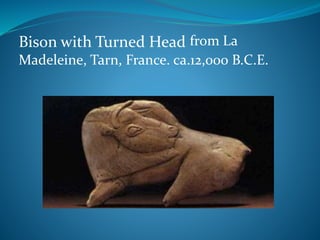
Bison with Turned Head from La
Madeleine, Tarn, France. ca.12,000 B.C.E.
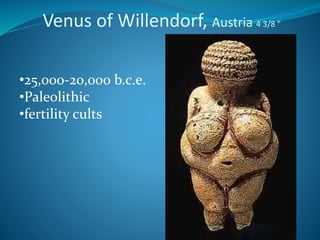
Venus of Willendorf, Austria 4 3/8 ”
•25,000-20,000 b.c.e.
•Paleolithic
•fertility cults
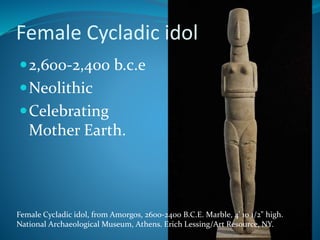
2,600-2,400 b.c.e
Neolithic
Celebrating
Mother Earth.
Female Cycladic idol, from Amorgos, 2600-2400 B.C.E. Marble, 4' 10 1/2" high.
National Archaeological Museum, Athens. Erich Lessing/Art Resource, NY.
Female Cycladic idol
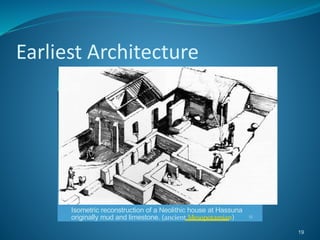
Earliest Architecture
Isometric reconstruction of a Neolithic house at Hassuna
originally mud and limestone. (ancient Mesopotamian) 12
19
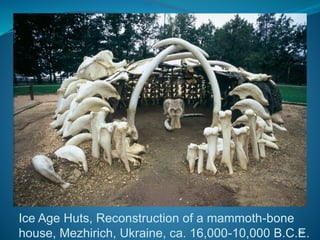
Ice Age Huts, Reconstruction of a mammoth-bone
house, Mezhirich, Ukraine, ca. 16,000-10,000 B.C.E.20
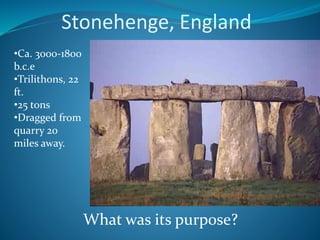
Stonehenge, England
•Ca. 3000-1800
b.c.e
•Trilithons, 22
ft.
•25 tons
•Dragged from
quarry 20
miles away.
What was its purpose?
22
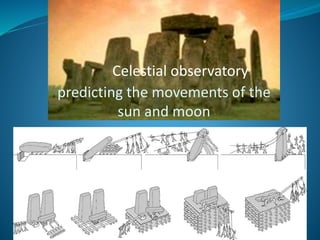
Celestial observatory
predicting the movements of the
sun and moon
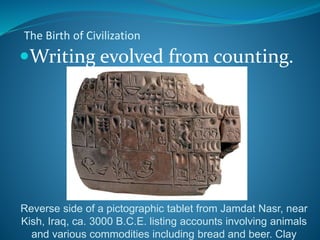
The Birth of Civilization
Writing evolved from counting.
Reverse side of a pictographic tablet from Jamdat Nasr, near
Kish, Iraq, ca. 3000 B.C.E. listing accounts involving animals
and various commodities including bread and beer. Clay
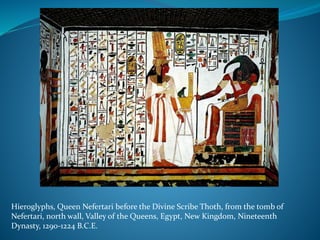
Hieroglyphs, Queen Nefertari before the Divine Scribe Thoth, from the tomb of
Nefertari, north wall, Valley of the Queens, Egypt, New Kingdom, Nineteenth
Dynasty, 1290-1224 B.C.E.
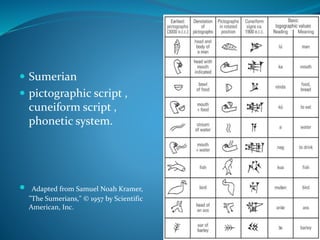
 Sumerian
 pictographic script ,
cuneiform script ,
phonetic system.
 Adapted from Samuel Noah Kramer,
"The Sumerians," © 1957 by Scientific
American, Inc.
26
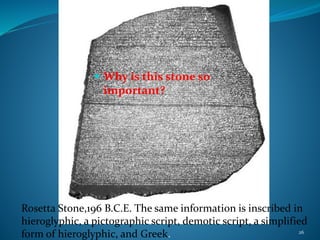
Rosetta Stone,196 B.C.E. The same information is inscribed in
hieroglyphic, a pictographic script, demotic script, a simplified
form of hieroglyphic, and Greek.
 Why is this stone so
important?
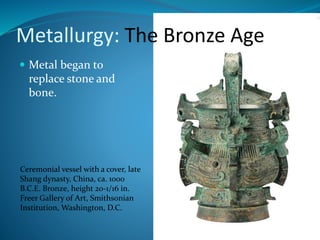
 Metal began to
replace stone and
bone.
Ceremonial vessel with a cover, late
Shang dynasty, China, ca. 1000
B.C.E. Bronze, height 20-1/16 in.
Freer Gallery of Art, Smithsonian
Institution, Washington, D.C.
Metallurgy: The Bronze Age
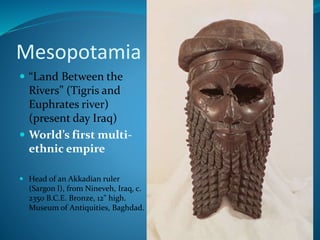
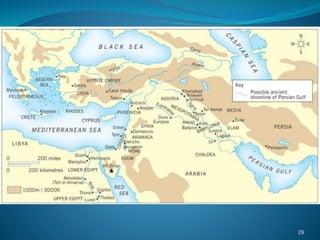
Mesopotamia
 “Land Between the
Rivers” (Tigris and
Euphrates river)
(present day Iraq)
 World’s first multi-
ethnic empire
 Head of an Akkadian ruler
(Sargon l), from Nineveh, Iraq, c.
2350 B.C.E. Bronze, 12" high.
Museum of Antiquities, Baghdad.
. 29
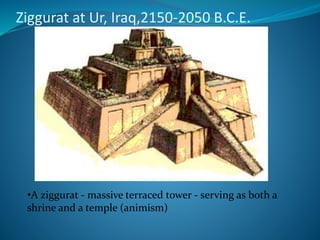
Ziggurat at Ur, Iraq,2150-2050 B.C.E.
•A ziggurat - massive terraced tower - serving as both a
shrine and a temple (animism)
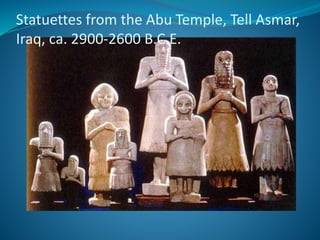
Statuettes from the Abu Temple, Tell Asmar,
Iraq, ca. 2900-2600 B.C.E.
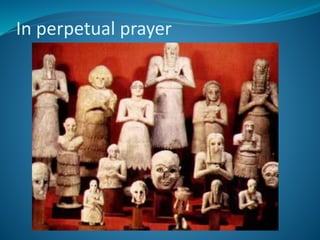
In perpetual prayer
. 33
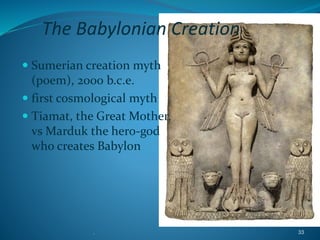
The Babylonian Creation
 Sumerian creation myth
(poem), 2000 b.c.e.
 first cosmological myth
 Tiamat, the Great Mother,
vs Marduk the hero-god
who creates Babylon
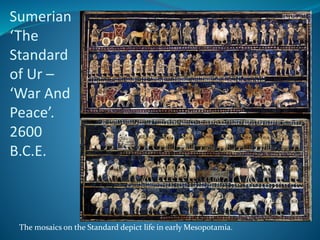
Sumerian
‘The
Standard
of Ur –
‘War And
Peace’.
2600
B.C.E.
The mosaics on the Standard depict life in early Mesopotamia.
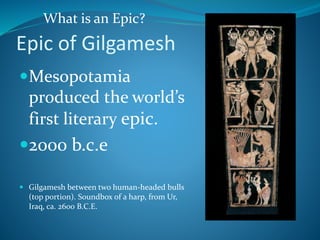
Epic of Gilgamesh
Mesopotamia
produced the world’s
first literary epic.
2000 b.c.e
 Gilgamesh between two human-headed bulls
(top portion). Soundbox of a harp, from Ur,
Iraq, ca. 2600 B.C.E.
What is an Epic?
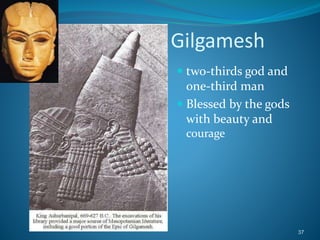
Gilgamesh
 two-thirds god and
one-third man
 Blessed by the gods
with beauty and
courage
37
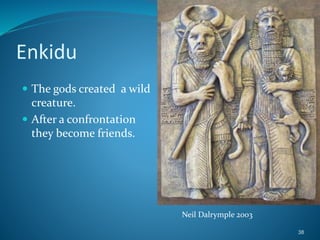
Enkidu
 The gods created a wild
creature.
 After a confrontation
they become friends.
38
Neil Dalrymple 2003
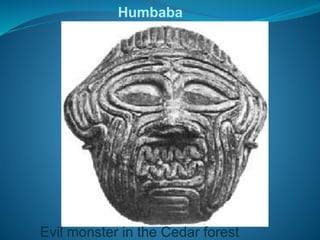
Humbaba
Evil monster in the Cedar forest
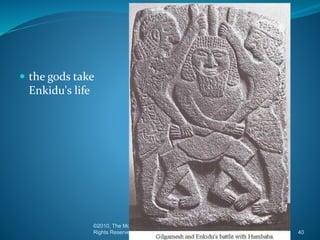
 the gods take
Enkidu's life
©2010, The McGraw-Hill Companies, Inc. All
Rights Reserved. 40
41
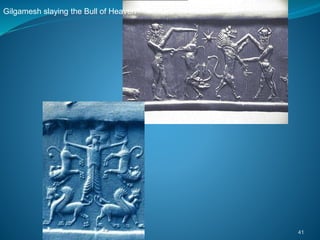
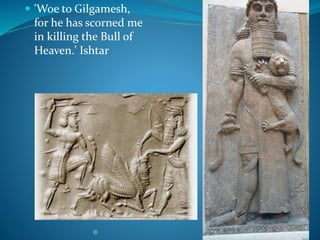
Gilgamesh slaying the Bull of Heaven
 'Woe to Gilgamesh,
for he has scorned me
in killing the Bull of
Heaven.' Ishtar
© 42
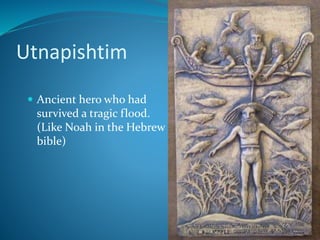
Utnapishtim
 Ancient hero who had
survived a tragic flood.
(Like Noah in the Hebrew
bible)
43
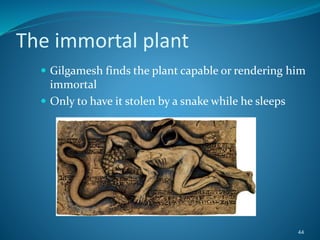
The immortal plant
 Gilgamesh finds the plant capable or rendering him
immortal
 Only to have it stolen by a snake while he sleeps
44
45
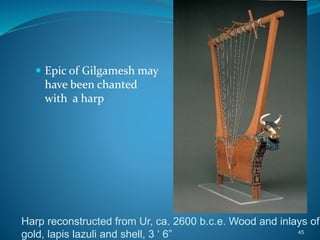
 Epic of Gilgamesh may
have been chanted
with a harp
Harp reconstructed from Ur, ca. 2600 b.c.e. Wood and inlays of
gold, lapis lazuli and shell, 3 ‘ 6”
Babylon:
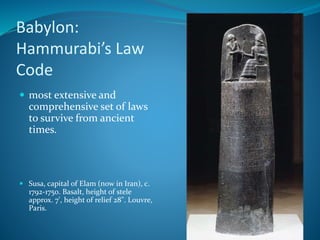
Hammurabi’s Law
Code
 most extensive and
comprehensive set of laws
to survive from ancient
times.
 Susa, capital of Elam (now in Iran), c.
1792-1750. Basalt, height of stele
approx. 7', height of relief 28". Louvre,
Paris.
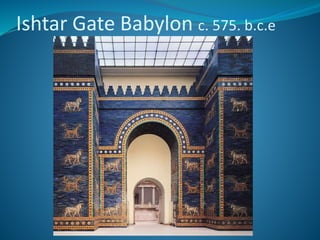
Ishtar Gate Babylon c. 575. b.c.e
Iron Technology
King Assurnasirpal ll hunting lions (Lion Hunt), from Nimrud,
Iraq, c. 883-859 B.C.E. Alabaster relief, 3' 3" x 8' 4".
 Iron was introduced by the Hittites.
 Cheaper to produce and more durable then bronze.
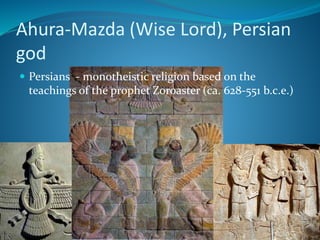
Ahura-Mazda (Wise Lord), Persian
god
©2010, The McGraw-Hill Companies, Inc. All
Rights Reserved. 49
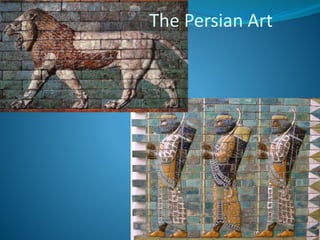
 Persians - monotheistic religion based on the
teachings of the prophet Zoroaster (ca. 628-551 b.c.e.)
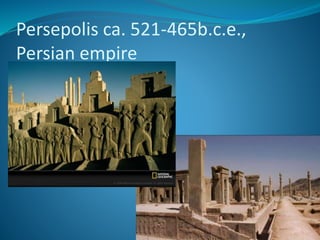
Persepolis ca. 521-465b.c.e.,
Persian empire
50
51
The Persian Art
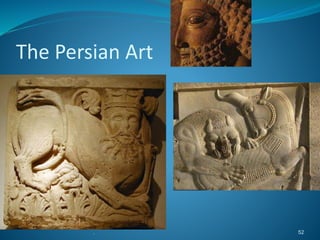
The Persian Art
. 52
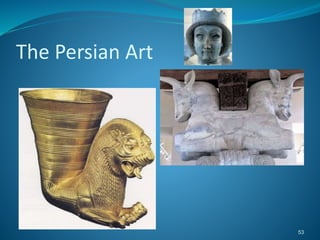
The Persian Art
53
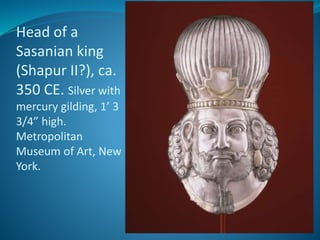
Head of a
Sasanian king
(Shapur II?), ca.
350 CE. Silver with
mercury gilding, 1’ 3
3/4” high.
Metropolitan
Museum of Art, New
York.
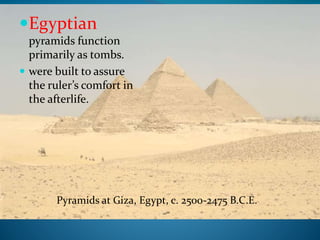
Egyptian
pyramids function
primarily as tombs.
 were built to assure
the ruler’s comfort in
the afterlife.
Pyramids at Giza, Egypt, c. 2500-2475 B.C.E.
©2010, The McGraw-Hill Companies, Inc. All
Rights Reserved. 56
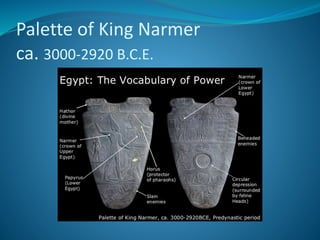
Palette of King Narmer
ca. 3000-2920 B.C.E.
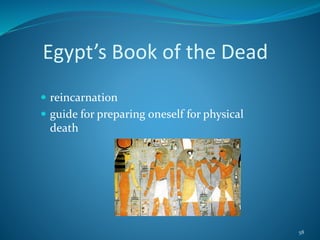
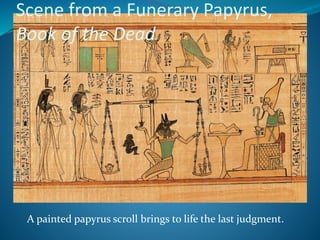
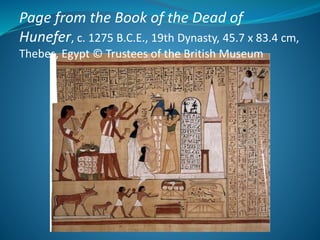
Egypt’s Book of the Dead
 reincarnation
 guide for preparing oneself for physical
death
58
Scene from a Funerary Papyrus,
Book of the Dead
A painted papyrus scroll brings to life the last judgment.
Page from the Book of the Dead of Ani,
c. 1275 B.C.E., 19th Dynasty, 44.5 x
30.7 cm, Thebes, Egypt © Trustees of
the British Museum
Page from the Book of the Dead of
Hunefer, c. 1275 B.C.E., 19th Dynasty, 45.7 x 83.4 cm,
Thebes, Egypt © Trustees of the British Museum
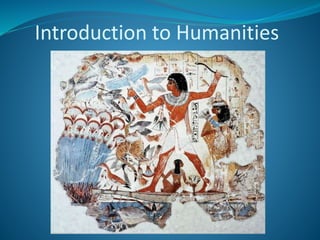
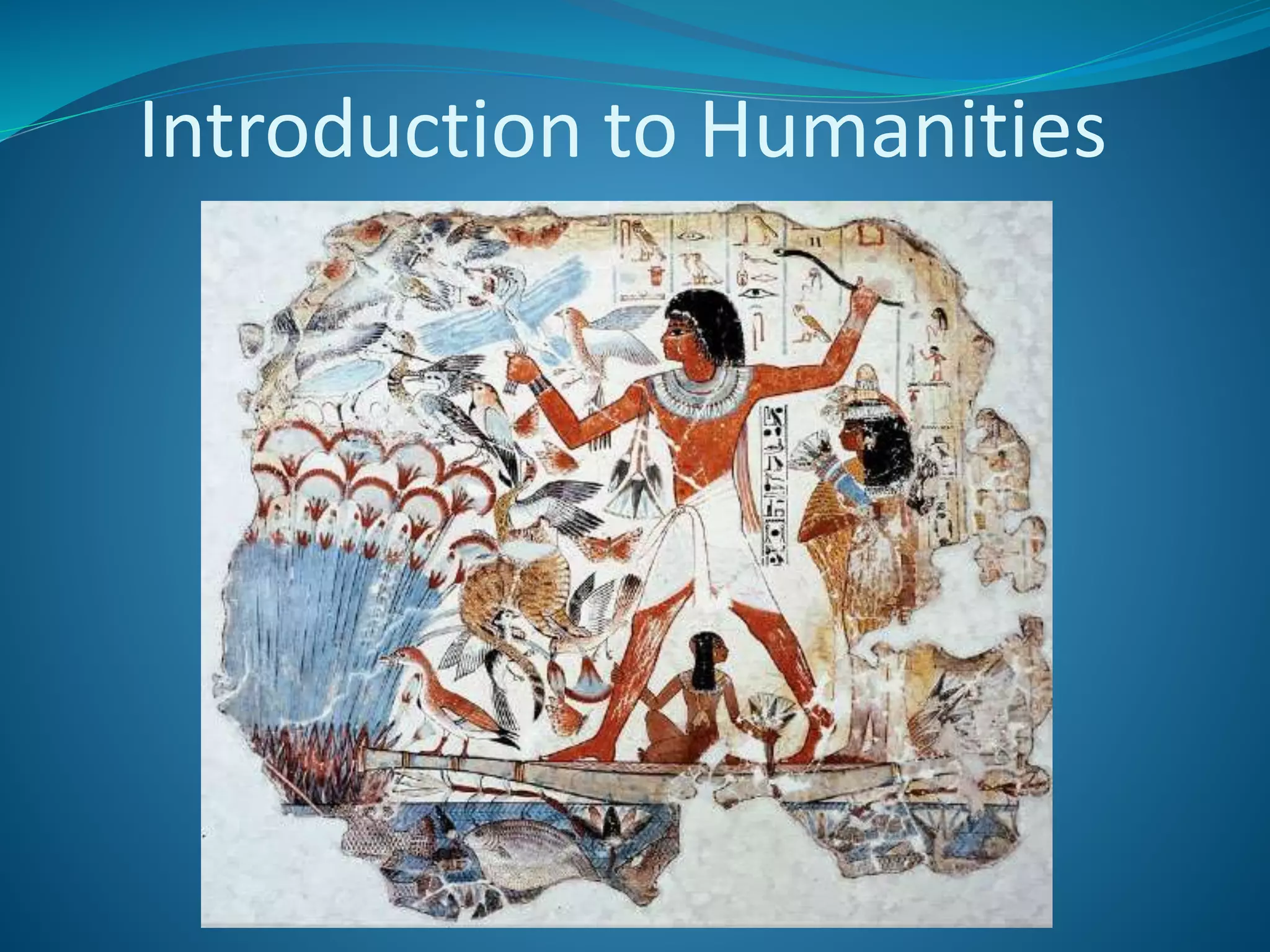
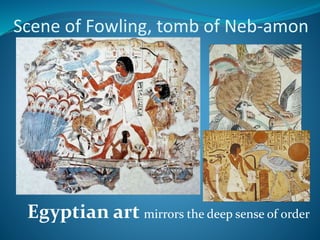
Scene of Fowling, tomb of Neb-amon
Egyptian art mirrors the deep sense of order
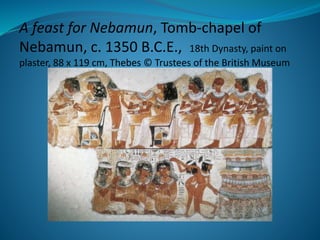
A feast for Nebamun, Tomb-chapel of
Nebamun, c. 1350 B.C.E., 18th Dynasty, paint on
plaster, 88 x 119 cm, Thebes © Trustees of the British Museum
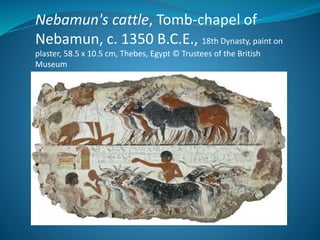
Nebamun's cattle, Tomb-chapel of
Nebamun, c. 1350 B.C.E., 18th Dynasty, paint on
plaster, 58.5 x 10.5 cm, Thebes, Egypt © Trustees of the British
Museum
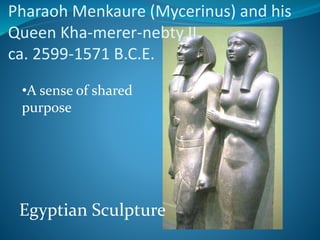
Pharaoh Menkaure (Mycerinus) and his
Queen Kha-merer-nebty II
ca. 2599-1571 B.C.E.
•A sense of shared
purpose
Egyptian Sculpture
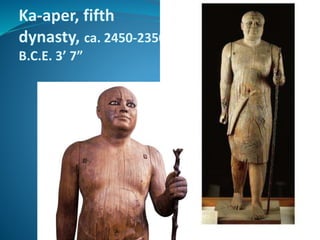
Ka-aper, fifth
dynasty, ca. 2450-2350
B.C.E. 3’ 7”
Egyptian Women•all property was
inherited
through the
female line.
•economic
independence
•civil rights and
privileges.
Procession of female musicians with instruments, including a harp, double pipes, and a
lyre, Tomb of Djeserkarasneb, Thebes, ca. 1580-1314 B.C.E.
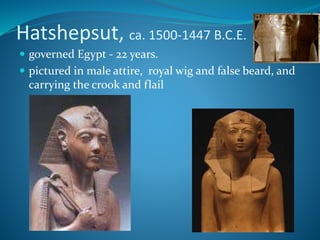
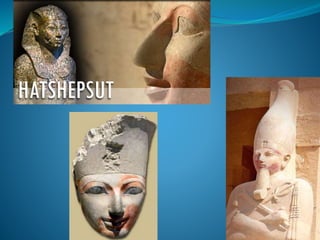
Hatshepsut, ca. 1500-1447 B.C.E.
 governed Egypt - 22 years.
 pictured in male attire, royal wig and false beard, and
carrying the crook and flail
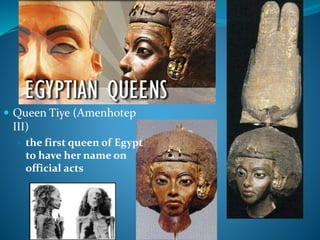
 Queen Tiye (Amenhotep
III)
 the first queen of Egypt
to have her name on
official acts
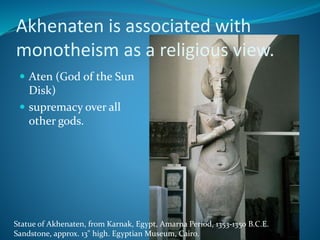
Akhenaten is associated with
monotheism as a religious view.
 Aten (God of the Sun
Disk)
 supremacy over all
other gods.
Statue of Akhenaten, from Karnak, Egypt, Amarna Period, 1353-1350 B.C.E.
Sandstone, approx. 13" high. Egyptian Museum, Cairo.
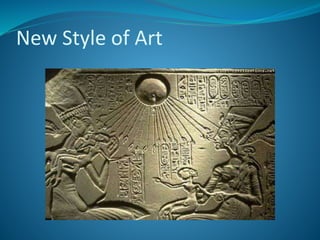
New Style of Art
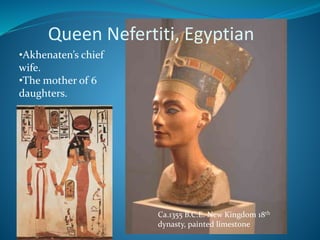
•Akhenaten’s chief
wife.
•The mother of 6
daughters.
Ca.1355 B.C.E. New Kingdom 18th
dynasty, painted limestone
Queen Nefertiti, Egyptian
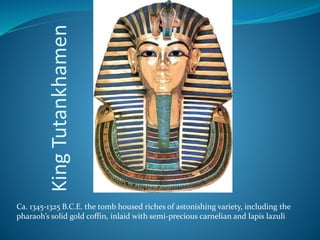
KingTutankhamen
Ca. 1345-1325 B.C.E. the tomb housed riches of astonishing variety, including the
pharaoh’s solid gold coffin, inlaid with semi-precious carnelian and lapis lazuli
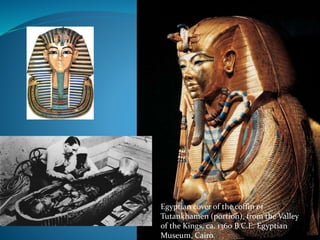
Egyptian cover of the coffin of
Tutankhamen (portion), from the Valley
of the Kings, ca. 1360 B.C.E. Egyptian
Museum, Cairo.
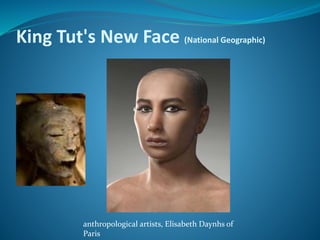
King Tut's New Face (National Geographic)
anthropological artists, Elisabeth Daynhs of
Paris
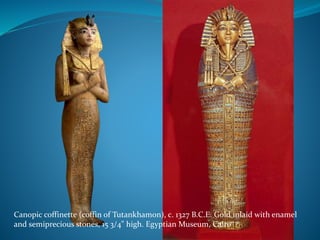
Canopic coffinette (coffin of Tutankhamon), c. 1327 B.C.E. Gold inlaid with enamel
and semiprecious stones, 15 3/4" high. Egyptian Museum, Cairo
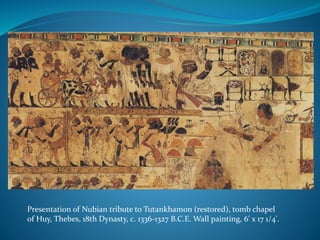
Presentation of Nubian tribute to Tutankhamon (restored), tomb chapel
of Huy, Thebes, 18th Dynasty, c. 1336-1327 B.C.E. Wall painting, 6' x 17 1/4'.
King Tut’s pyramid
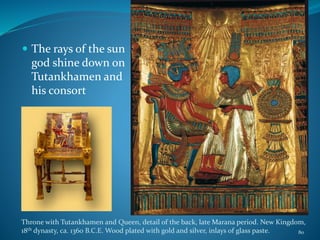
 The rays of the sun
god shine down on
Tutankhamen and
his consort
Throne with Tutankhamen and Queen, detail of the back, late Marana period. New Kingdom,
18th dynasty, ca. 1360 B.C.E. Wood plated with gold and silver, inlays of glass paste. 80
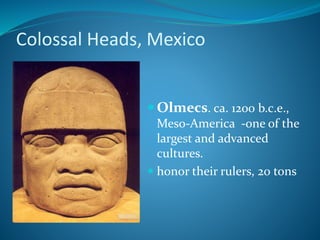
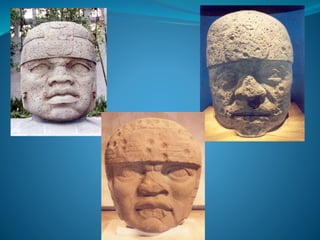
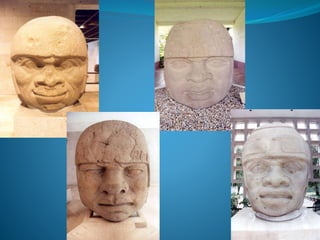
Colossal Heads, Mexico
 Olmecs. ca. 1200 b.c.e.,
Meso-America -one of the
largest and advanced
cultures.
 honor their rulers, 20 tons
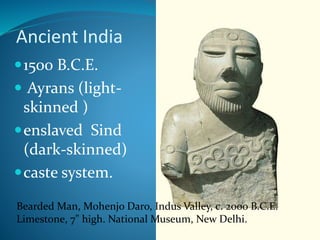
Ancient India
Bearded Man, Mohenjo Daro, Indus Valley, c. 2000 B.C.E.
Limestone, 7" high. National Museum, New Delhi.
1500 B.C.E.
 Ayrans (light-
skinned )
enslaved Sind
(dark-skinned)
caste system.
 earliest known
sculpture of sub-
Saharan Africa.
Africa : Western Sudan
Head, Nok culture, ca. 500 B.C.E.-200 C.E.
Terracotta, height 14-3/16 in. National
Museum, Lagos/Bridgeman.
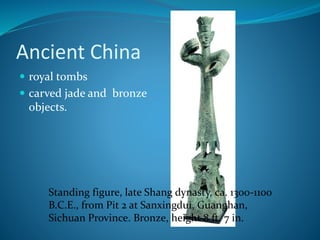
Ancient China
 royal tombs
 carved jade and bronze
objects.
Standing figure, late Shang dynasty, ca. 1300-1100
B.C.E., from Pit 2 at Sanxingdui, Guanghan,
Sichuan Province. Bronze, height 8 ft. 7 in.
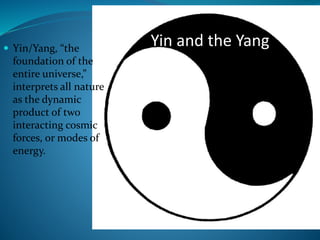
Yin and the Yang Yin/Yang, “the
foundation of the
entire universe,”
interprets all nature
as the dynamic
product of two
interacting cosmic
forces, or modes of
energy.
 The End.
Epic of Gilgamesh Essay
In your own words answer the following questions about
the Epic of Gilgamesh:
Who was Gilgamesh? What was he searching for and
why? How does this epic reflect the ideals of
Mesopotamian culture? What makes Gilgamesh an epic
hero? Are there any comparable figures in
contemporary literature of life?
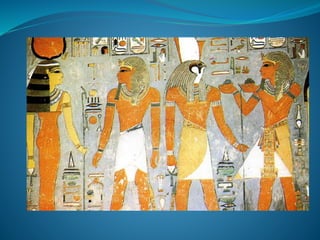
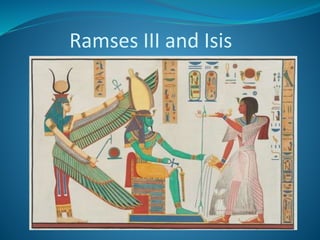
Ramses III and Isis

Chapter 1 cave paintings to egyptians

  • 1.
  • 2.
  • 3.
    “Prehistory” may bedefined as that period prior to written records.
  • 4.
    Prehistoric Culture  Paleolithic(“Old Stone”) ca. 6 million to 10,000 b.c.e.  Tribal hunters and gatherers  Crude stone and bone tools and weapons  Cave painting and sculpture
  • 5.
     Neolithic (“NewStone”) ca. 8,000 to 4,000 b.c.e.  Farming and food production  Polished stone and bone tools and weapons  Architecture  Pottery and weaving
  • 6.
     The world’soldest clay vessel found.  Japan •The Jomon Period, Japan 14,000 to 400 B.C.E.hoto:
  • 7.
    Cave Paintings ofLascaux •Cave paintings Dated 15,000- 10,000 B.C.E. • Hall of Bulls, France
  • 8.
    Great Black Bullat Lascaux
  • 9.
     long-extinct animals- hairy mammoth and woolly rhinoceros. Chauvet cave art depicting a Woolly rhino
  • 10.
    Spotted horses andnegative hand imprints, Pech-Merle caves, Lot, France, ca. 15,000-10,000 B.C.E. 11 ft. 2in. 11
  • 11.
    What were thepurpose and function of these vivid images?
  • 12.
    •The depiction of theanimal, and its “capture” Sympathetic magic
  • 13.
    Human with feline head. Hohlenstein-Stadel,Germany. ca. 30,000-28,000 BCE. Mammoth ivory, almost a foot tall. Ulmer Museum, Ulm. oldest sculpture in the world
  • 14.
    Two Bison, reliefs,15000-10000 B.C.E Le Tuc d'Audoubert cave. Ariege, France.
  • 15.
    Bison with TurnedHead from La Madeleine, Tarn, France. ca.12,000 B.C.E.
  • 16.
    Venus of Willendorf,Austria 4 3/8 ” •25,000-20,000 b.c.e. •Paleolithic •fertility cults
  • 17.
    2,600-2,400 b.c.e Neolithic Celebrating Mother Earth. FemaleCycladic idol, from Amorgos, 2600-2400 B.C.E. Marble, 4' 10 1/2" high. National Archaeological Museum, Athens. Erich Lessing/Art Resource, NY. Female Cycladic idol
  • 18.
    Earliest Architecture Earliest Architecture Isometricreconstruction of a Neolithic house at Hassuna originally mud and limestone. (ancient Mesopotamian) 12 19
  • 19.
    Ice Age Huts,Reconstruction of a mammoth-bone house, Mezhirich, Ukraine, ca. 16,000-10,000 B.C.E.20
  • 20.
    Stonehenge, England •Ca. 3000-1800 b.c.e •Trilithons,22 ft. •25 tons •Dragged from quarry 20 miles away. What was its purpose?
  • 21.
    22 Celestial observatory predicting themovements of the sun and moon
  • 22.
    The Birth ofCivilization Writing evolved from counting. Reverse side of a pictographic tablet from Jamdat Nasr, near Kish, Iraq, ca. 3000 B.C.E. listing accounts involving animals and various commodities including bread and beer. Clay
  • 23.
    Hieroglyphs, Queen Nefertaribefore the Divine Scribe Thoth, from the tomb of Nefertari, north wall, Valley of the Queens, Egypt, New Kingdom, Nineteenth Dynasty, 1290-1224 B.C.E.
  • 24.
     Sumerian  pictographicscript , cuneiform script , phonetic system.  Adapted from Samuel Noah Kramer, "The Sumerians," © 1957 by Scientific American, Inc.
  • 25.
    26 Rosetta Stone,196 B.C.E.The same information is inscribed in hieroglyphic, a pictographic script, demotic script, a simplified form of hieroglyphic, and Greek.  Why is this stone so important?
  • 26.
     Metal beganto replace stone and bone. Ceremonial vessel with a cover, late Shang dynasty, China, ca. 1000 B.C.E. Bronze, height 20-1/16 in. Freer Gallery of Art, Smithsonian Institution, Washington, D.C. Metallurgy: The Bronze Age
  • 27.
    Mesopotamia  “Land Betweenthe Rivers” (Tigris and Euphrates river) (present day Iraq)  World’s first multi- ethnic empire  Head of an Akkadian ruler (Sargon l), from Nineveh, Iraq, c. 2350 B.C.E. Bronze, 12" high. Museum of Antiquities, Baghdad.
  • 28.
  • 29.
    Ziggurat at Ur,Iraq,2150-2050 B.C.E. •A ziggurat - massive terraced tower - serving as both a shrine and a temple (animism)
  • 30.
    Statuettes from theAbu Temple, Tell Asmar, Iraq, ca. 2900-2600 B.C.E.
  • 31.
  • 32.
    . 33 The BabylonianCreation  Sumerian creation myth (poem), 2000 b.c.e.  first cosmological myth  Tiamat, the Great Mother, vs Marduk the hero-god who creates Babylon
  • 33.
    Sumerian ‘The Standard of Ur – ‘WarAnd Peace’. 2600 B.C.E. The mosaics on the Standard depict life in early Mesopotamia.
  • 34.
    Epic of Gilgamesh Mesopotamia producedthe world’s first literary epic. 2000 b.c.e  Gilgamesh between two human-headed bulls (top portion). Soundbox of a harp, from Ur, Iraq, ca. 2600 B.C.E. What is an Epic?
  • 35.
    Gilgamesh  two-thirds godand one-third man  Blessed by the gods with beauty and courage 37
  • 36.
    Enkidu  The godscreated a wild creature.  After a confrontation they become friends. 38 Neil Dalrymple 2003
  • 37.
    Humbaba Evil monster inthe Cedar forest
  • 38.
     the godstake Enkidu's life ©2010, The McGraw-Hill Companies, Inc. All Rights Reserved. 40
  • 39.
  • 40.
     'Woe toGilgamesh, for he has scorned me in killing the Bull of Heaven.' Ishtar © 42
  • 41.
    Utnapishtim  Ancient herowho had survived a tragic flood. (Like Noah in the Hebrew bible) 43
  • 42.
    The immortal plant Gilgamesh finds the plant capable or rendering him immortal  Only to have it stolen by a snake while he sleeps 44
  • 43.
    45  Epic ofGilgamesh may have been chanted with a harp Harp reconstructed from Ur, ca. 2600 b.c.e. Wood and inlays of gold, lapis lazuli and shell, 3 ‘ 6”
  • 44.
    Babylon: Hammurabi’s Law Code  mostextensive and comprehensive set of laws to survive from ancient times.  Susa, capital of Elam (now in Iran), c. 1792-1750. Basalt, height of stele approx. 7', height of relief 28". Louvre, Paris.
  • 45.
    Ishtar Gate Babylonc. 575. b.c.e
  • 46.
    Iron Technology King Assurnasirpalll hunting lions (Lion Hunt), from Nimrud, Iraq, c. 883-859 B.C.E. Alabaster relief, 3' 3" x 8' 4".  Iron was introduced by the Hittites.  Cheaper to produce and more durable then bronze.
  • 47.
    Ahura-Mazda (Wise Lord),Persian god ©2010, The McGraw-Hill Companies, Inc. All Rights Reserved. 49  Persians - monotheistic religion based on the teachings of the prophet Zoroaster (ca. 628-551 b.c.e.)
  • 48.
  • 49.
  • 50.
  • 51.
  • 52.
    Head of a Sasanianking (Shapur II?), ca. 350 CE. Silver with mercury gilding, 1’ 3 3/4” high. Metropolitan Museum of Art, New York.
  • 53.
    Egyptian pyramids function primarily astombs.  were built to assure the ruler’s comfort in the afterlife. Pyramids at Giza, Egypt, c. 2500-2475 B.C.E.
  • 54.
    ©2010, The McGraw-HillCompanies, Inc. All Rights Reserved. 56
  • 55.
    Palette of KingNarmer ca. 3000-2920 B.C.E.
  • 56.
    Egypt’s Book ofthe Dead  reincarnation  guide for preparing oneself for physical death 58
  • 57.
    Scene from aFunerary Papyrus, Book of the Dead A painted papyrus scroll brings to life the last judgment.
  • 58.
    Page from theBook of the Dead of Ani, c. 1275 B.C.E., 19th Dynasty, 44.5 x 30.7 cm, Thebes, Egypt © Trustees of the British Museum
  • 59.
    Page from theBook of the Dead of Hunefer, c. 1275 B.C.E., 19th Dynasty, 45.7 x 83.4 cm, Thebes, Egypt © Trustees of the British Museum
  • 60.
    Scene of Fowling,tomb of Neb-amon Egyptian art mirrors the deep sense of order
  • 61.
    A feast forNebamun, Tomb-chapel of Nebamun, c. 1350 B.C.E., 18th Dynasty, paint on plaster, 88 x 119 cm, Thebes © Trustees of the British Museum
  • 62.
    Nebamun's cattle, Tomb-chapelof Nebamun, c. 1350 B.C.E., 18th Dynasty, paint on plaster, 58.5 x 10.5 cm, Thebes, Egypt © Trustees of the British Museum
  • 63.
    Pharaoh Menkaure (Mycerinus)and his Queen Kha-merer-nebty II ca. 2599-1571 B.C.E. •A sense of shared purpose Egyptian Sculpture
  • 64.
    Ka-aper, fifth dynasty, ca.2450-2350 B.C.E. 3’ 7”
  • 65.
    Egyptian Women•all propertywas inherited through the female line. •economic independence •civil rights and privileges. Procession of female musicians with instruments, including a harp, double pipes, and a lyre, Tomb of Djeserkarasneb, Thebes, ca. 1580-1314 B.C.E.
  • 66.
    Hatshepsut, ca. 1500-1447B.C.E.  governed Egypt - 22 years.  pictured in male attire, royal wig and false beard, and carrying the crook and flail
  • 68.
     Queen Tiye(Amenhotep III)  the first queen of Egypt to have her name on official acts
  • 69.
    Akhenaten is associatedwith monotheism as a religious view.  Aten (God of the Sun Disk)  supremacy over all other gods. Statue of Akhenaten, from Karnak, Egypt, Amarna Period, 1353-1350 B.C.E. Sandstone, approx. 13" high. Egyptian Museum, Cairo.
  • 70.
  • 71.
    •Akhenaten’s chief wife. •The motherof 6 daughters. Ca.1355 B.C.E. New Kingdom 18th dynasty, painted limestone Queen Nefertiti, Egyptian
  • 72.
    KingTutankhamen Ca. 1345-1325 B.C.E.the tomb housed riches of astonishing variety, including the pharaoh’s solid gold coffin, inlaid with semi-precious carnelian and lapis lazuli
  • 73.
    Egyptian cover ofthe coffin of Tutankhamen (portion), from the Valley of the Kings, ca. 1360 B.C.E. Egyptian Museum, Cairo.
  • 74.
    King Tut's NewFace (National Geographic) anthropological artists, Elisabeth Daynhs of Paris
  • 75.
    Canopic coffinette (coffinof Tutankhamon), c. 1327 B.C.E. Gold inlaid with enamel and semiprecious stones, 15 3/4" high. Egyptian Museum, Cairo
  • 76.
    Presentation of Nubiantribute to Tutankhamon (restored), tomb chapel of Huy, Thebes, 18th Dynasty, c. 1336-1327 B.C.E. Wall painting, 6' x 17 1/4'.
  • 77.
  • 78.
     The raysof the sun god shine down on Tutankhamen and his consort Throne with Tutankhamen and Queen, detail of the back, late Marana period. New Kingdom, 18th dynasty, ca. 1360 B.C.E. Wood plated with gold and silver, inlays of glass paste. 80
  • 79.
    Colossal Heads, Mexico Olmecs. ca. 1200 b.c.e., Meso-America -one of the largest and advanced cultures.  honor their rulers, 20 tons
  • 82.
    Ancient India Bearded Man,Mohenjo Daro, Indus Valley, c. 2000 B.C.E. Limestone, 7" high. National Museum, New Delhi. 1500 B.C.E.  Ayrans (light- skinned ) enslaved Sind (dark-skinned) caste system.
  • 83.
     earliest known sculptureof sub- Saharan Africa. Africa : Western Sudan Head, Nok culture, ca. 500 B.C.E.-200 C.E. Terracotta, height 14-3/16 in. National Museum, Lagos/Bridgeman.
  • 84.
    Ancient China  royaltombs  carved jade and bronze objects. Standing figure, late Shang dynasty, ca. 1300-1100 B.C.E., from Pit 2 at Sanxingdui, Guanghan, Sichuan Province. Bronze, height 8 ft. 7 in.
  • 85.
    Yin and theYang Yin/Yang, “the foundation of the entire universe,” interprets all nature as the dynamic product of two interacting cosmic forces, or modes of energy.
  • 86.
  • 87.
    Epic of GilgameshEssay In your own words answer the following questions about the Epic of Gilgamesh: Who was Gilgamesh? What was he searching for and why? How does this epic reflect the ideals of Mesopotamian culture? What makes Gilgamesh an epic hero? Are there any comparable figures in contemporary literature of life?
  • 89.