Temporal Databases
ADBMS
By:
Dabbal S. Mahara
2018
Introduction
 Typically, databases model only one state - the current state- of the
real world, and do not store information about past states, except
perhaps as audit trails.
 When the state of the real world changes, the database gets updated,
and information about the old state gets lost.
 Applications usually require the knowledge of the information’s
evolution, implying the storage of different states of information,
including past values and future previews.
 For example, a patient database must store information about the
medical history of a patient.
2
Introduction
 A factory monitoring system may store information about current and
past readings of sensors in the factory, for analysis.
 This led to the development of researches concerning temporal aspects
in information systems.
 Databases that store information about states of the real world across
time are called temporal databases.
 Temporal databases, in the broadest sense, encompass all database
applications that require some aspect of time when organizing their
information.
3
 There are many other examples of applications (reservation systems,
scientific databases, company database, university database etc.)
where some aspect of time is needed to maintain the information in a
database.
 Insurance, where claims and accident histories are required as well as
information about the times when insurance policies are in effect;
 Reservation systems in general (hotel, airline, car rental, train, and so
on), where information on the dates and times when reservations are in
effect are required;
 Scientific databases, where data collected from experiments includes
the time when each data is measured; and so on.
4
Introduction
Introduction
 In the COMPANY database, we may wish to keep SALARY, JOB, and
PROJECT histories on each employee.
 In the UNIVERSITY database, time is already included in the
SEMESTER and YEAR of each SECTION of a COURSE, the grade
history of a STUDENT, and the information on research grants.
 In fact, it is realistic to conclude that the majority of database
applications have some temporal information.
 However, users often attempt to simplify or ignore temporal aspects
because of the complexity that they add to their applications.
5
Introduction
 Temporal databases allow the storage and the recovery of all the
states assumed by an object during its lifetime, thus recording its
evolution with time.
 When considering the issue of time in database systems, we must
distinguish between time as measured by the system and time as
observed in the real world.
 The valid time for a fact is the set of time intervals during which the
fact is true in the real world.
 The transaction time for a fact is the time interval during which the fact
is current within the database system.
6
 This latter time is based on the transaction serialization order and is
generated automatically by the system.
 Note that valid-time intervals, being a real-world concept, cannot be
generated automatically and must be provided to the system.
 A temporal relation is one where each tuple has an associated time
when it is true; the time may be either valid time or transaction time.
 When both timestamps are used the result is a bitemporal relation.
7
Introduction
Time Representation
 For temporal databases, time is considered to be an ordered sequence
of points in some granularity that is determined by the application.
 Temporal database researchers have used the term chronon instead of
point to describe the minimal granularity for a particular application.
 A calendar organizes time into different time units for convenience.
 Various calendars are used by various cultures (such as Gregorian
(western), Chinese, Islamic, Hindu, Jewish, Coptic etc.).
8
Time Representation in SQL
 In SQL2, temporal data types include DATE, TIME, TIMESTAMP,
INTERVAL, and PERIOD.
 DATE: The type date contains four digits for the year (1–9999), two
digits for the month (1–12), and two digits for the date (1–31) and
provided specifying Year, Month, and Day as YYYY-MM-DD),
 TIME: The type time contains two digits for the hour, two digits for the
minute, and two digits for the second, plus optional fractional digits and
provided specifying Hour, Minute, and Second as HH:MM:SS,
 TIMESTAMP: The type timestamp contains the fields of date and
time, with six fractional digits for the seconds field. (specifying a
Date/Time combination, with options for including sub second divisions
if they are needed),
9
 Since different places in the world have different local times, there is
often a need for specifying the time zone along with the time.
 The Universal Coordinated Time (UTC) is a standard reference point
for specifying time, with local times defined as offsets from UTC. (The
standard abbreviation is UTC, rather than UCT, since it is an abbreviation of
“Universal Coordinated Time” written in French as universel temps coordonne ´.)
 INTERVAL (a relative time duration, such as 10 days or 250 minutes),
 PERIOD (an anchored time duration with a fixed starting point, such
as the 10-day period from January 1, 2009, to January 10, 2009,
inclusive).
10Time Representation in SQL
Event Information Versus Duration (or State)
Information
 A temporal database will store information concerning when
certain events occur, or when certain facts are considered to
be true.
 There are several different types of temporal information.
 Point events or facts are typically associated in the database
with a single time point in some granularity;
 For example, bank deposit, total monthly sales associated
with particular month (say, February 2010).
 This type of information is often represented as time series
data
11
Event Information Versus Duration (or State)
Information
 Duration events or facts are associated with a specific time
period in the database;
 A time period is represented by its start time and end time
points;
 Time period is often interpreted as the set of all time points from
start-time to end-time inclusive in the specified granularity;
 For example, employee worked in a company in a company
from August 15, 2003 until November 20, 2008.
 The above period is represented as [2003-08-15, 2008-11-20].
12
Valid Time and Transaction Time Dimensions
 Given a particular event or fact that is associated with a particular
time point or time period in the database, the association may be
interpreted to mean different things.
 The most natural interpretation is that the associated time is the
time that the event occurred, or the period during which the fact
was considered to be true in the real world.
 The associated time that the event occurred, or the period during
which the fact was considered to be true is called valid time;
 The database using this interpretation is called valid time database
13
Valid Time and Transaction Time Dimensions
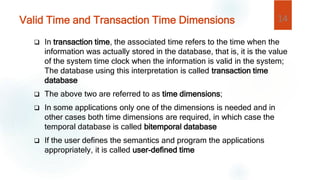
 In transaction time, the associated time refers to the time when the
information was actually stored in the database, that is, it is the value
of the system time clock when the information is valid in the system;
The database using this interpretation is called transaction time
database
 The above two are referred to as time dimensions;
 In some applications only one of the dimensions is needed and in
other cases both time dimensions are required, in which case the
temporal database is called bitemporal database
 If the user defines the semantics and program the applications
appropriately, it is called user-defined time
14
Incorporating Time in Relational Databases
Using Tuple Versioning
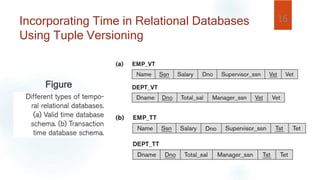
 Let us now see how the different types of temporal databases may
be represented in the relational model.
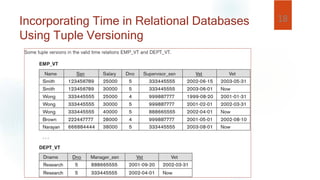
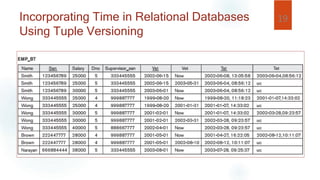
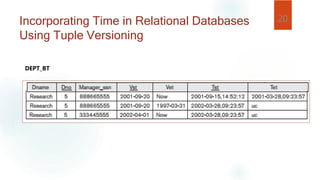
 Valid Time Relations – We convert the relations into valid time
relations by adding the attributes valid start time and valid end time
 Transaction Time Relations – We convert the relations into
transaction time relations by adding the attributes transaction start
time and transaction end time
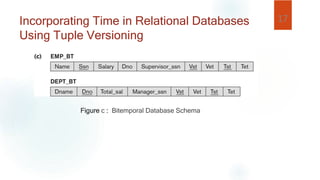
 Bitemporal Relations – We convert the relations into bitemporal
relations by adding the attributes valid start time, valid end time,
transaction start time, and transaction end time
15
Incorporating Time in Relational Databases
Using Tuple Versioning
16
Figure
17Incorporating Time in Relational Databases
Using Tuple Versioning
Incorporating Time in Relational Databases
Using Tuple Versioning
Figure c : Bitemporal Database Schema
Incorporating Time in Relational Databases
Using Tuple Versioning
18
Incorporating Time in Relational Databases
Using Tuple Versioning
19
20Incorporating Time in Relational Databases
Using Tuple Versioning
DEPT_BT
Incorporating Time in Relational Databases
Using Tuple Versioning
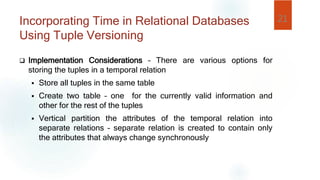
 Implementation Considerations – There are various options for
storing the tuples in a temporal relation
 Store all tuples in the same table
 Create two table – one for the currently valid information and
other for the rest of the tuples
 Vertical partition the attributes of the temporal relation into
separate relations – separate relation is created to contain only
the attributes that always change synchronously
21
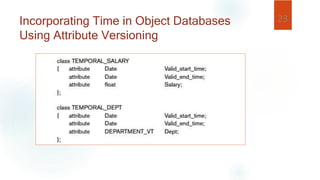
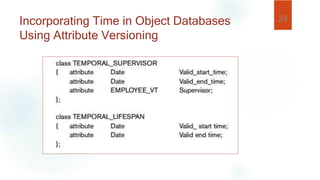
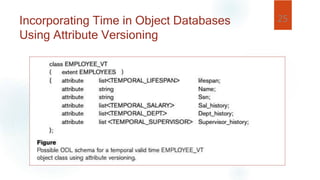
Incorporating Time in Object Databases
Using Attribute Versioning
 A single complex object is used to store all the temporal changes
of object
 Each attribute that changes over time is called a time-varying
attribute (e.g., age), and it has its values versioned over time by
adding temporal periods to the attribute
 The temporal periods may represent valid time, transaction time,
or bitemporal, depending on the application requirement
 Attributes that do not change are called non-time-varying (e.g.,
date of birth)and are not associated with the temporal periods
 Time varying attribute is represented as a collection type
22
23Incorporating Time in Object Databases
Using Attribute Versioning
24Incorporating Time in Object Databases
Using Attribute Versioning
Incorporating Time in Object Databases
Using Attribute Versioning
25
Time Series Data
 Time series data are the data values that are recorded according to
a specific predefined sequence of time periods.
 They are special type of valid event data, where the event time
points are predetermined according to a fixed calendar.
 Example: closing daily stock prices of a particular Stock Exchange
Company. The granularity here is day.
 Typical queries on time series involve temporal aggregation over
higher granularity levels.
 For example, finding the average or maximum weekly closing stock
price or the maximum and minimum monthly closing stock price
from the daily information.
26
Time Series Data
 As another example, consider the daily sales dollar amount at each
store of a chain of stores owned by a particular company.
 Again, typical temporal aggregates would be retrieving the weekly,
monthly, or yearly sales from the daily sales information (using the
sum aggregate function), or comparing same store monthly sales
with previous monthly sales, and so on.
 Because of the specialized nature of time series data and the lack of
support for it in older DBMSs, it has been common to use
specialized time series management systems rather than general-
purpose DBMSs for managing such information.
27
Time Series Data
 In such systems, it has been common to store time series values in
sequential order in a file, and apply specialized time series
procedures to analyze the information.
 The problem with this approach is that the full power of high-level
querying in languages such as SQL will not be available in such
systems.
 More recently, some commercial DBMS packages are offering time
series extensions, such as the Oracle time cartridge and the time
series data blade of Informix Universal Server.
 In addition, the TSQL2 language provides some support for time
series in the form of event tables.
28
29

Temporal databases

  • 1.
  • 2.
    Introduction  Typically, databasesmodel only one state - the current state- of the real world, and do not store information about past states, except perhaps as audit trails.  When the state of the real world changes, the database gets updated, and information about the old state gets lost.  Applications usually require the knowledge of the information’s evolution, implying the storage of different states of information, including past values and future previews.  For example, a patient database must store information about the medical history of a patient. 2
  • 3.
    Introduction  A factorymonitoring system may store information about current and past readings of sensors in the factory, for analysis.  This led to the development of researches concerning temporal aspects in information systems.  Databases that store information about states of the real world across time are called temporal databases.  Temporal databases, in the broadest sense, encompass all database applications that require some aspect of time when organizing their information. 3
  • 4.
     There aremany other examples of applications (reservation systems, scientific databases, company database, university database etc.) where some aspect of time is needed to maintain the information in a database.  Insurance, where claims and accident histories are required as well as information about the times when insurance policies are in effect;  Reservation systems in general (hotel, airline, car rental, train, and so on), where information on the dates and times when reservations are in effect are required;  Scientific databases, where data collected from experiments includes the time when each data is measured; and so on. 4 Introduction
  • 5.
    Introduction  In theCOMPANY database, we may wish to keep SALARY, JOB, and PROJECT histories on each employee.  In the UNIVERSITY database, time is already included in the SEMESTER and YEAR of each SECTION of a COURSE, the grade history of a STUDENT, and the information on research grants.  In fact, it is realistic to conclude that the majority of database applications have some temporal information.  However, users often attempt to simplify or ignore temporal aspects because of the complexity that they add to their applications. 5
  • 6.
    Introduction  Temporal databasesallow the storage and the recovery of all the states assumed by an object during its lifetime, thus recording its evolution with time.  When considering the issue of time in database systems, we must distinguish between time as measured by the system and time as observed in the real world.  The valid time for a fact is the set of time intervals during which the fact is true in the real world.  The transaction time for a fact is the time interval during which the fact is current within the database system. 6
  • 7.
     This lattertime is based on the transaction serialization order and is generated automatically by the system.  Note that valid-time intervals, being a real-world concept, cannot be generated automatically and must be provided to the system.  A temporal relation is one where each tuple has an associated time when it is true; the time may be either valid time or transaction time.  When both timestamps are used the result is a bitemporal relation. 7 Introduction
  • 8.
    Time Representation  Fortemporal databases, time is considered to be an ordered sequence of points in some granularity that is determined by the application.  Temporal database researchers have used the term chronon instead of point to describe the minimal granularity for a particular application.  A calendar organizes time into different time units for convenience.  Various calendars are used by various cultures (such as Gregorian (western), Chinese, Islamic, Hindu, Jewish, Coptic etc.). 8
  • 9.
    Time Representation inSQL  In SQL2, temporal data types include DATE, TIME, TIMESTAMP, INTERVAL, and PERIOD.  DATE: The type date contains four digits for the year (1–9999), two digits for the month (1–12), and two digits for the date (1–31) and provided specifying Year, Month, and Day as YYYY-MM-DD),  TIME: The type time contains two digits for the hour, two digits for the minute, and two digits for the second, plus optional fractional digits and provided specifying Hour, Minute, and Second as HH:MM:SS,  TIMESTAMP: The type timestamp contains the fields of date and time, with six fractional digits for the seconds field. (specifying a Date/Time combination, with options for including sub second divisions if they are needed), 9
  • 10.
     Since differentplaces in the world have different local times, there is often a need for specifying the time zone along with the time.  The Universal Coordinated Time (UTC) is a standard reference point for specifying time, with local times defined as offsets from UTC. (The standard abbreviation is UTC, rather than UCT, since it is an abbreviation of “Universal Coordinated Time” written in French as universel temps coordonne ´.)  INTERVAL (a relative time duration, such as 10 days or 250 minutes),  PERIOD (an anchored time duration with a fixed starting point, such as the 10-day period from January 1, 2009, to January 10, 2009, inclusive). 10Time Representation in SQL
  • 11.
    Event Information VersusDuration (or State) Information  A temporal database will store information concerning when certain events occur, or when certain facts are considered to be true.  There are several different types of temporal information.  Point events or facts are typically associated in the database with a single time point in some granularity;  For example, bank deposit, total monthly sales associated with particular month (say, February 2010).  This type of information is often represented as time series data 11
  • 12.
    Event Information VersusDuration (or State) Information  Duration events or facts are associated with a specific time period in the database;  A time period is represented by its start time and end time points;  Time period is often interpreted as the set of all time points from start-time to end-time inclusive in the specified granularity;  For example, employee worked in a company in a company from August 15, 2003 until November 20, 2008.  The above period is represented as [2003-08-15, 2008-11-20]. 12
  • 13.
    Valid Time andTransaction Time Dimensions  Given a particular event or fact that is associated with a particular time point or time period in the database, the association may be interpreted to mean different things.  The most natural interpretation is that the associated time is the time that the event occurred, or the period during which the fact was considered to be true in the real world.  The associated time that the event occurred, or the period during which the fact was considered to be true is called valid time;  The database using this interpretation is called valid time database 13
  • 14.
    Valid Time andTransaction Time Dimensions  In transaction time, the associated time refers to the time when the information was actually stored in the database, that is, it is the value of the system time clock when the information is valid in the system; The database using this interpretation is called transaction time database  The above two are referred to as time dimensions;  In some applications only one of the dimensions is needed and in other cases both time dimensions are required, in which case the temporal database is called bitemporal database  If the user defines the semantics and program the applications appropriately, it is called user-defined time 14
  • 15.
    Incorporating Time inRelational Databases Using Tuple Versioning  Let us now see how the different types of temporal databases may be represented in the relational model.  Valid Time Relations – We convert the relations into valid time relations by adding the attributes valid start time and valid end time  Transaction Time Relations – We convert the relations into transaction time relations by adding the attributes transaction start time and transaction end time  Bitemporal Relations – We convert the relations into bitemporal relations by adding the attributes valid start time, valid end time, transaction start time, and transaction end time 15
  • 16.
    Incorporating Time inRelational Databases Using Tuple Versioning 16 Figure
  • 17.
    17Incorporating Time inRelational Databases Using Tuple Versioning Incorporating Time in Relational Databases Using Tuple Versioning Figure c : Bitemporal Database Schema
  • 18.
    Incorporating Time inRelational Databases Using Tuple Versioning 18
  • 19.
    Incorporating Time inRelational Databases Using Tuple Versioning 19
  • 20.
    20Incorporating Time inRelational Databases Using Tuple Versioning DEPT_BT
  • 21.
    Incorporating Time inRelational Databases Using Tuple Versioning  Implementation Considerations – There are various options for storing the tuples in a temporal relation  Store all tuples in the same table  Create two table – one for the currently valid information and other for the rest of the tuples  Vertical partition the attributes of the temporal relation into separate relations – separate relation is created to contain only the attributes that always change synchronously 21
  • 22.
    Incorporating Time inObject Databases Using Attribute Versioning  A single complex object is used to store all the temporal changes of object  Each attribute that changes over time is called a time-varying attribute (e.g., age), and it has its values versioned over time by adding temporal periods to the attribute  The temporal periods may represent valid time, transaction time, or bitemporal, depending on the application requirement  Attributes that do not change are called non-time-varying (e.g., date of birth)and are not associated with the temporal periods  Time varying attribute is represented as a collection type 22
  • 23.
    23Incorporating Time inObject Databases Using Attribute Versioning
  • 24.
    24Incorporating Time inObject Databases Using Attribute Versioning
  • 25.
    Incorporating Time inObject Databases Using Attribute Versioning 25
  • 26.
    Time Series Data Time series data are the data values that are recorded according to a specific predefined sequence of time periods.  They are special type of valid event data, where the event time points are predetermined according to a fixed calendar.  Example: closing daily stock prices of a particular Stock Exchange Company. The granularity here is day.  Typical queries on time series involve temporal aggregation over higher granularity levels.  For example, finding the average or maximum weekly closing stock price or the maximum and minimum monthly closing stock price from the daily information. 26
  • 27.
    Time Series Data As another example, consider the daily sales dollar amount at each store of a chain of stores owned by a particular company.  Again, typical temporal aggregates would be retrieving the weekly, monthly, or yearly sales from the daily sales information (using the sum aggregate function), or comparing same store monthly sales with previous monthly sales, and so on.  Because of the specialized nature of time series data and the lack of support for it in older DBMSs, it has been common to use specialized time series management systems rather than general- purpose DBMSs for managing such information. 27
  • 28.
    Time Series Data In such systems, it has been common to store time series values in sequential order in a file, and apply specialized time series procedures to analyze the information.  The problem with this approach is that the full power of high-level querying in languages such as SQL will not be available in such systems.  More recently, some commercial DBMS packages are offering time series extensions, such as the Oracle time cartridge and the time series data blade of Informix Universal Server.  In addition, the TSQL2 language provides some support for time series in the form of event tables. 28
  • 29.

Editor's Notes

  • #3 Non temporal databases are Classified as snapshot databases. Store only a single state of the real world, usually the most recent state.
  • #7 To add these temporal features to the database the transaction time (TT – moment when the information is stored in the database) and/or the validity time (VT – time when the information is valid in the application)are attached to the data.
  • #9 For example, suppose that some temporal application never requires time units that are less than one second. Then, each time point represents one second using this granularity. In reality, each second is a (short) time duration, not a point, since it may be further divided into milliseconds, microseconds, and so on.