Database Applications (15-415)
DBMS Internals- Part XII
Lecture 25, April 19, 2020
Mohammad Hammoud
Today…
 Last Two Sessions:
 DBMS Internals- Part XI
 Transaction Management
 Today’s Session:
 Transaction Management (Continue)
 Announcement:
 PS5 is now posted. It is due on Thursday, April 23
DBMS Layers
Query Optimization
and Execution
Relational Operators
Files and Access Methods
Buffer Management
Disk Space Management
DB
Queries
Transaction
Manager
Lock
Manager
Recovery
Manager
Outline
A Brief Primer on Transaction
Management
Anomalies Due to Concurrency
2PL and Strict 2PL Locking Protocols
Schedules with Aborted Transactions

Locking Protocols
 WR, RW and WW anomalies can be avoided using a
locking protocol
 A locking protocol:
 Is a set of rules to be followed by each transaction to ensure that
only serializable schedules are allowed (extended later)
 Associates a lock with each database object, which could be of
different types (e.g., shared or exclusive)
 Grants and denies locks to transactions according to the specified
rules
 The part of the DBMS that keeps track of locks is called the lock
manager
Lock Managers
 Usually, a lock manager in a DBMS maintains three types of data
structures:
 A queue, Q, for each lock, L,
to hold its pending requests
 A lock table, which keeps for
each L associated with
each object, O, a record R
that contains:
 The type of L (e.g., shared or exclusive)
 The number of transactions currently holding L on O
 A pointer to Q
 A transaction table, which maintains for each transaction, T, a pointer to a
list of locks held by T
Lock Queue 1
(Q1)
Object Lock # Type # of Trx Q
O L S 1 Q1
Lock Table
Transaction List 1 (LS1)
Trx List
T1 LS1
Transaction Table
Two-Phase Locking
 A widely used locking protocol, called Two-Phase
Locking (2PL), has two rules:
 Rule 1: if a transaction T wants to read (or write) an
object O, it first requests the lock manager for a shared
(or exclusive) lock on O
T0 T1 T2
Lock
Manager
Read Request
on Object O
“Shared”
Lock Granted
Queue
T0 T1 T2
Lock
Manager
Write Request
on Object O
Lock Denied
Queue
T0 T1 T2
Lock
Manager
Read
Request
on Object O
“Shared”
Lock Granted
Queue
2
Time
t0 t1 t2
Two-Phase Locking
 A widely used locking protocol, called Two-Phase
Locking (2PL), has two rules:
 Rule 1: if a transaction T wants to read (or write) an
object O, it first requests the lock manager for a shared
(or exclusive) lock on O
T0 T1 T2
Lock
Manager
Release Lock
on Object O
Queue
T0 T1 T2
Lock
Manager
“Exclusive” Lock
Granted
Queue
T0 T1 T2
Lock
Manager
Release Lock
on Object O
Queue
2
Time
t3 t4 t5
2 2
Two-Phase Locking
 A widely used locking protocol, called Two-Phase
Locking (2PL), has two rules:
 Rule 1: if a transaction T wants to read (or write) an
object O, it first requests the lock manager for a shared
(or exclusive) lock on O
T0 T1 T2
Lock
Manager
Queue
T0 T1 T2
Lock
Manager
Queue
T0 T1 T2
Lock
Manager
Queue
Time
Read Request
on Object O
Lock Denied
1
Read
Request
on Object O
Lock Denied
0
Release Lock
on Object O
t6 t7 t8
1
0
1
Two-Phase Locking
 A widely used locking protocol, called Two-Phase
Locking (2PL), has two rules:
 Rule 1: if a transaction T wants to read (or write) an
object O, it first requests the lock manager for a shared
(or exclusive) lock on O
T0 T1 T2
Lock
Manager
Queue
T0 T1 T2
Lock
Manager
Queue
T0 T1 T2
Lock
Manager
Queue
Time
1
0
“Shared”
Lock Granted
“Shared”
Lock Granted
t9 t9
Write Request
on Object O
Lock Denied
2
t10
0
Two-Phase Locking
 A widely used locking protocol, called Two-Phase Locking
(2PL), has two rules:
 Rule 2: T can release locks before it commits or aborts, and
cannot request additional locks once it releases any lock
 Thus, every transaction has a “growing” phase in which it
acquires locks, followed by a “shrinking” phase in which it
releases locks
# locks
growing phase shrinking phase
Two-Phase Locking
 A widely used locking protocol, called Two-Phase Locking
(2PL), has two rules:
 Rule 2: T can release locks before it commits or aborts, and
cannot request additional locks once it releases any lock
 Thus, every transaction has a “growing” phase in which it
acquires locks, followed by a “shrinking” phase in which it
releases locks
# locks
violation of 2PL
Resolving RW Conflicts Using 2PL
 Suppose that T1 and T2 actions are interleaved as follows:
 T1 reads A
 T2 reads A, decrements A and commits
 T1 tries to decrement A
 T1 and T2 can be represented by the following schedule:
T1 T2
R(A)
W(A)
Commit
R(A)
W(A)
Commit
Exposes RW Anomaly
T1 T2
EXCLUSIVE(A)
R(A)
W(A)
Commit
EXCLUSIVE(A)
R(A)
W(A)
Commit
Lock(A)
Wait
RW
Conflict
Resolved!
Resolving RW Conflicts Using 2PL
 Suppose that T1 and T2 actions are interleaved as follows:
 T1 reads A
 T2 reads A, decrements A and commits
 T1 tries to decrement A
 T1 and T2 can be represented by the following schedule:
T1 T2
R(A)
W(A)
Commit
R(A)
W(A)
Commit
Exposes RW Anomaly
T1 T2
EXCLUSIVE(A)
R(A)
W(A)
Commit
Lock(A)
Wait
But, it can
limit
parallelism!
EXCLUSIVE(A)
R(A)
W(A)
Commit
Resolving WW Conflicts Using 2PL
 Suppose that T1 and T2 actions are interleaved as follows:
 T1 sets Mohammad’s Salary to $1000
 T2 sets Ahmad’s Salary to $2000
 T1 sets Ahmad’s Salary to $1000
 T2 sets Mohammad’s Salary to $2000
 T1 and T2 can be represented by the following schedule:
T1 T2
W(MS)
W(AS)
Commit
W(AS)
W(MS)
Commit
Exposes WW Anomaly
(assuming, MS & AS must be kept equal)
T1 T2
EXCLUSIVE(MS)
EXCLUSIVE(AS)
W(MS)
W(AS)
Commit
EXCLUSIVE(AS)
EXCLUSIVE(MS)
W(AS)
W(MS)
Commit
Lock(AS)
Wait
WW
Conflict
Resolved!
Resolving WW Conflicts Using 2PL
 Suppose that T1 and T2 actions are interleaved as follows:
 T1 sets Mohammad’s Salary to $1000
 T2 sets Ahmad’s Salary to $2000
 T1 sets Ahmad’s Salary to $1000
 T2 sets Mohammad’s Salary to $2000
 T1 and T2 can be represented by the following schedule:
T1 T2
W(MS)
W(AS)
Commit
W(AS)
W(MS)
Commit
Exposes WW Anomaly
(assuming, MS & AS must be kept equal)
T1 T2
EXCLUSIVE(MS)
W(MS)
Lock(AS)
EXCLUSIVE(AS)
W(AS)
Lock(MS)
Wait
Deadlock!
Wait
Resolving WR Conflicts
 Suppose that T1 and T2 actions are interleaved as follows:
 T1 deducts $100 from account A
 T2 adds 6% interest to accounts A and B
 T1 credits $100 to account B
 T1 and T2 can be represented by the following schedule:
T1 T2
R(A)
W(A)
R(B)
W(B)
Commit
R(A)
W(A)
R(B)
W(B)
Commit
Exposes WR Anomaly
T1 T2
EXCLUSIVE(A)
EXCLUSIVE(B)
R(A)
W(A)
R(B)
W(B)
Commit EXCLUSIVE(A)
EXCLUSIVE(B)
R(A)
W(A)
R(B)
W(B)
Commit
Lock(A)
Wait
Lock(B)
WR
Conflict
Resolved!
Resolving WR Conflicts
 Suppose that T1 and T2 actions are interleaved as follows:
 T1 deducts $100 from account A
 T2 adds 6% interest to accounts A and B
 T1 credits $100 to account B
 T1 and T2 can be represented by the following schedule:
T1 T2
R(A)
W(A)
R(B)
W(B)
Commit
R(A)
W(A)
R(B)
W(B)
Commit
Exposes WR Anomaly
T1 T2
EXCLUSIVE(A)
EXCLUSIVE(B)
R(A)
W(A)
RELEASE(A)
R(B)
W(B)
Commit
EXCLUSIVE(A)
R(A)
W(A)
EXCLUSIVE(B)
R(B)
W(B)
Commit
Lock(A)
Wait
Lock(B)
WR
Conflict is
NOT
Resolved!
How can
we solve
this?
Strict Two-Phase Locking
 WR conflicts (as well as RW & WW) can be solved by
making 2PL stricter
 In particular, Rule 2 in 2PL can be modified
as follows:
 Rule 2: locks of a transaction T can only be released
after T completes (i.e., commits or aborts)
 This version of 2PL is called Strict Two-Phase Locking
Resolving WR Conflicts: Revisit
 Suppose that T1 and T2 actions are interleaved as follows:
 T1 deducts $100 from account A
 T2 adds 6% interest to accounts A and B
 T1 credits $100 to account B
 T1 and T2 can be represented by the following schedule:
T1 T2
R(A)
W(A)
R(B)
W(B)
Commit
R(A)
W(A)
R(B)
W(B)
Commit
Exposes WR Anomaly
T1 T2
EXCLUSIVE(A)
EXCLUSIVE(B)
R(A)
W(A)
RELEASE(A)
R(B)
W(B)
Commit
EXCLUSIVE(A)
R(A)
W(A)
EXCLUSIVE(B)
R(B)
W(B)
Commit
Lock(A)
Wait
Lock(B)
Not allowed with strict 2PL
Resolving WR Conflicts: Revisit
 Suppose that T1 and T2 actions are interleaved as follows:
 T1 deducts $100 from account A
 T2 adds 6% interest to accounts A and B
 T1 credits $100 to account B
 T1 and T2 can be represented by the following schedule:
T1 T2
R(A)
W(A)
R(B)
W(B)
Commit
R(A)
W(A)
R(B)
W(B)
Commit
Exposes WR Anomaly
T1 T2
EXCLUSIVE(A)
EXCLUSIVE(B)
R(A)
W(A)
R(B)
W(B)
Commit
EXCLUSIVE(A)
EXCLUSIVE(B)
R(A)
W(A)
R(B)
W(B)
Commit
Lock(A)
Wait
Lock(B)
WR Conflict
is Resolved!
But,
parallelism
is limited
more!
2PL vs. Strict 2PL
 Two-Phase Locking (2PL):
 Limits concurrency
 May lead to deadlocks
 May have ‘dirty reads’
 Strict 2PL:
 Limits concurrency more
(but, actions of different
transactions can still be interleaved)
 May still lead to deadlocks
 Avoids ‘dirty reads’
T1 T2
SHARED(A)
R(A)
EXCLUSIVE(C)
R(C)
W(C)
Commit
SHARED(A)
R(A)
EXECLUSIVE(B)
R(B)
W(B)
Commit
A Schedule with Strict 2PL
and Interleaved Actions
Performance of Locking
 Locking comes with delays mainly from blocking
 Usually, the first few transactions are unlikely to conflict
 Throughput can rise in proportion to the number of active
transactions
 As more transactions are executed concurrently, the likelihood of
blocking increases
 Throughput will increase more slowly with the number of active
transactions
 There comes a point when adding another active transaction will
actually decrease throughput
 When the system thrashes!
Performance of Locking (Cont’d)
 If a database begins to thrash, the DBA should
reduce the number of active transactions
 Empirically, thrashing is seen to occur when
30% of active transactions are blocked!
# of Active Transactions
Throughput
Thrashing
Outline
A Brief Primer on Transaction
Management
Anomalies Due to Concurrency
2PL and Strict 2PL Locking Protocols
Schedules with Aborted Transactions 
Schedules with Aborted Transactions
 Suppose that T1 and T2 actions are interleaved as follows:
 T1 deducts $100 from account A
 T2 adds 6% interest to accounts A and B, and commits
 T1 is aborted
 T1 and T2 can be represented by the following schedule:
T1 T2
R(A)
W(A)
Abort
R(A)
W(A)
R(B)
W(B)
Commit
T2 read a value for A that should have never been there!
How can we deal with the situation, assuming T2
had not yet committed?
Schedules with Aborted Transactions
 Suppose that T1 and T2 actions are interleaved as follows:
 T1 deducts $100 from account A
 T2 adds 6% interest to accounts A and B, and commits
 T1 is aborted
 T1 and T2 can be represented by the following schedule:
T1 T2
R(A)
W(A)
Abort
R(A)
W(A)
R(B)
W(B)
Commit
We can cascade the abort of T1 by aborting T2 as well!
This “cascading process” can be recursively applied to
any transaction that read A written by T1
T2 read a value for A that should have never been there!
Schedules with Aborted Transactions
 Suppose that T1 and T2 actions are interleaved as follows:
 T1 deducts $100 from account A
 T2 adds 6% interest to accounts A and B, and commits
 T1 is aborted
 T1 and T2 can be represented by the following schedule:
T1 T2
R(A)
W(A)
Abort
R(A)
W(A)
R(B)
W(B)
Commit
How can we deal with the situation, assuming T2
had actually committed?
The schedule is indeed unrecoverable!
T2 read a value for A that should have never been there!
Schedules with Aborted Transactions
 Suppose that T1 and T2 actions are interleaved as follows:
 T1 deducts $100 from account A
 T2 adds 6% interest to accounts A and B, and commits
 T1 is aborted
 T1 and T2 can be represented by the following schedule:
T1 T2
R(A)
W(A)
Abort
R(A)
W(A)
R(B)
W(B)
Commit
For a schedule to be recoverable, transactions
should commit only after all transactions whose
changes they read commit!
“Recoverable schedules” avoid cascading aborts!
T2 read a value for A that should have never been there!
Schedules with Aborted Transactions
 Suppose that T1 and T2 actions are interleaved as follows:
 T1 deducts $100 from account A
 T2 adds 6% interest to accounts A and B, and commits
 T1 is aborted
 T1 and T2 can be represented by the following schedule:
T1 T2
R(A)
W(A)
Abort
R(A)
W(A)
R(B)
W(B)
Commit
How can we ensure “recoverable schedules”?
By using Strict 2PL!
T2 read a value for A that should have never been there!
Schedules with Aborted Transactions
 Suppose that T1 and T2 actions are interleaved as follows:
 T1 deducts $100 from account A
 T2 adds 6% interest to accounts A and B, and commits
 T1 is aborted
 T1 and T2 can be represented by the following schedule:
T1 T2
R(A)
W(A)
Abort
R(A)
W(A)
R(B)
W(B)
Commit
T1 T2
EXCLUSIVE(A)
R(A)
W(A)
Abort
UNDO(T1) EXCLUSIVE(A)
R(A)
W(A)
EXCLUSIVE(B)
R(B)
W(B)
Commit
Lock(A)
Wait
Cascaded
aborts are
avoided!
Serializable Schedules: Redefined
 Two schedules are said to be equivalent if for any database
state, the effect of executing the 1st schedule is identical to
the effect of executing the 2nd schedule
 Previously: a serializable schedule is a schedule that is
equivalent to a serial schedule
 Now: a serializable schedule is a schedule that is equivalent to
a serial schedule over a set of committed transactions
 This definition captures serializability as well as recoverability
Now…
Lock Conversions
Dealing with Deadlocks
Dynamic Databases and the Phantom
Problem
Concurrency Control in B+ Trees

Lock Conversions
 A transaction may need to change the lock it
already acquires on an object
 From Shared to Exclusive
 This is referred to as lock upgrade
 From Exclusive to Shared
 This is referred to as lock downgrade
 For example, an SQL update statement might
acquire a Shared lock on each row, R, in a table and
if R satisfies the condition (in the WHERE clause), an
Exclusive lock must be obtained for R
Lock Upgrades
 A lock upgrade request from a transaction T on object O must
be handled specially by:
 Granting an Exclusive lock to T immediately if no other
transaction holds a lock on O
 Otherwise, queuing T at the front of O’s queue
(i.e., T is favored)
 T is favored because it already holds a Shared lock on O
 Queuing T in front of another transaction T’ that holds no lock
on O, but requested an Exclusive lock on O averts a deadlock!
 However, if T and T’ hold a Shared lock on O, and both request
upgrades to an Exclusive lock, a deadlock will arise regardless!
Lock Downgrades
 Lock upgrades can be entirely avoided by obtaining Exclusive locks
initially, and downgrade them to Shared locks once needed
 Would this violate any 2PL requirement?
 On the surface yes; since the transaction (say, T) may need to
upgrade later
 This is a special case as T conservatively obtained an Exclusive lock,
and did nothing but read the object that it downgraded
 2PL can be safely extended to allow lock downgrades in the growing
phase, provided that the transaction has not modified the object
Outline
Lock Conversions
Dealing with Deadlocks
Dynamic Databases and the Phantom
Problem
Concurrency Control in B+ Trees

Deadlock Detection
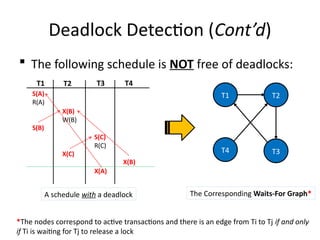
 The lock manager maintains a structure called a waits-for graph to
periodically detect deadlocks
 In a waits-for graph:
 The nodes correspond to active transactions
 There is an edge from Ti to Tj if and only if Ti is waiting for Tj to
release a lock
 The lock manager adds and removes edges to and from a waits-for
graph when it queues and grants lock requests, respectively
 A deadlock is detected when a cycle in the waits-for graph is found
Deadlock Detection (Cont’d)
 The following schedule is free of deadlocks:
T1 T2
S(A)
R(A)
S(B)
X(B)
W(B)
X(C)
S(C)
R(C)
X(B)
T3 T4
T1 T2
T4 T3
*The nodes correspond to active transactions and there is an edge from Ti to Tj if and only
if Ti is waiting for Tj to release a lock
The Corresponding Waits-For Graph*
A schedule without a deadlock
No cycles; hence, no deadlocks!
Deadlock Detection (Cont’d)
 The following schedule is NOT free of deadlocks:
T1 T2
S(A)
R(A)
S(B)
X(B)
W(B)
X(C)
S(C)
R(C)
X(A)
X(B)
T3 T4
T1 T2
T4 T3
*The nodes correspond to active transactions and there is an edge from Ti to Tj if and only
if Ti is waiting for Tj to release a lock
The Corresponding Waits-For Graph*
A schedule with a deadlock
Deadlock Detection (Cont’d)
 The following schedule is NOT free of deadlocks:
T1 T2
S(A)
R(A)
S(B)
X(B)
W(B)
X(C)
S(C)
R(C)
X(A)
X(B)
T3 T4
T1 T2
T4 T3
*The nodes correspond to active transactions and there is an edge from Ti to Tj if and only
if Ti is waiting for Tj to release a lock
The Corresponding Waits-For Graph*
A schedule with a deadlock
Cycle detected; hence, a deadlock!
Resolving Deadlocks
 A deadlock is resolved by aborting a transaction that is on a
cycle and releasing its locks
 This allows some of the waiting transactions to proceed
 The choice of which transaction to abort can be made using
different criteria:
 The one with the fewest locks
 Or the one that has done the least work
 Or the one that is farthest from completion (more accurate)
 Caveat: a transaction that was aborted in the past, should be
favored subsequently and not aborted upon a deadlock
detection!
Deadlock Prevention
 Studies indicate that deadlocks are relatively
infrequent and detection-based schemes work well in
practice
 However, if there is a high level of contention for locks,
prevention-based schemes could perform better
 Deadlocks can be averted by giving each transaction a
priority and ensuring that lower-priority transactions
are not allowed to wait for higher-priority ones
(or vice versa)
Deadlock Prevention (Cont’d)
 One way to assign priorities is to give each transaction a
timestamp when it is started
 Thus, the lower the timestamp, the higher is the
transaction’s priority
 If a transaction Ti requests a lock and a transaction Tj
holds a conflicting lock, the lock manager can use one
of the following policies:
 Wound-Wait: If Ti has higher priority, Tj is aborted;
otherwise, Ti waits
 Wait-Die: If Ti has higher priority, it is allowed to wait;
otherwise, it is aborted
Reissuing Timestamps
 A subtle point is that we must ensure that no transaction is
perennially aborted because it never had a sufficiently high
priority
 To avoid that, when a transaction is aborted and restarted,
it should be given the same timestamp it had originally
 This policy is referred to as reissuing timestamps
 Reissuing timestamps ensures that each transaction will
eventually become the oldest and accordingly get all the
locks it requires!
Outline
Lock Conversions
Dealing with Deadlocks
Dynamic Databases and the Phantom
Problem
Concurrency Control in B+ Trees

Dynamic Databases
 Thus far, we have assumed static databases
 We now relax that condition and assume dynamic
databases (i.e., databases that grow and shrink)
 To study locking protocols for dynamic databases,
we consider the following:
 A Sailors relation S
 A transaction T1 which only scans S to find the oldest Sailor
for specific rating levels
 A transaction T2 which updates Sailor while T1 is running
A Possible Scenario
 Assume a scenario whereby the actions of T1 and T2 are
interleaved as follows:
 T1 identifies all pages containing Sailors with rating 1 (say, pages
A and B)
 T1 finds the age of the oldest Sailor with rating 1 (say, 71)
 T2 inserts a new Sailor with rating 1 and age 96 (perhaps into
page C which does not contain any Sailor with rating 1)
 T2 locates the page containing the oldest Sailor with rating 2 (say,
page D) and deletes this Sailor (whose age is, say, 80)
 T2 commits
 T1 identifies all pages containing Sailors with rating 2 (say pages D
and E), and finds the age of the oldest such Sailor (which is, say,
63)
 T1 commits
A Possible Scenario (Cont’d)
 We can apply strict 2PL to the given interleaved actions
of T1 and T2 as follows (S = Shared; X = Exclusive):
T1 T2
R(A)
R(B)
R(D)
R(E)
Commit
R(C)
W(C)
R(D)
W(D)
Commit
T1 T2
S(A)
R(A)
S(B)
R(B)
S(D)
R(D)
S(E)
R(E)
Commit
E(C)
R(C)
W(C)
E(D)
R(D)
W(D)
Commit
A Possible Scenario (Cont’d)
 We can apply strict 2PL to the given interleaved actions
of T1 and T2 as follows (S = Shared; X = Exclusive):
T1 T2
R(A)
R(B)
R(D)
R(E)
Commit
R(C)
W(C)
R(D)
W(D)
Commit
T1 T2
S(A)
R(A)
S(B)
R(B)
S(D)
R(D)
S(E)
R(E)
Commit
E(C)
R(C)
W(C)
E(D)
R(D)
W(D)
Commit
A tuple with
rating 1 and
age 71 is
returned A tuple with rating 1
and age 96 is inserted
A tuple with rating 2
and age 80 is deleted
A tuple with
rating 2 and
age 63 is
returned
A Possible Scenario (Cont’d)
 One possible serial execution of T1 and T2 is as follows
(S = Shared; X = Exclusive):
T1 T2
R(A)
R(B)
R(D)
R(E)
Commit
R(C)
W(C)
R(D)
W(D)
Commit
T1 T2
S(A)
R(A)
S(B)
R(B)
S(D)
R(D)
S(E)
R(E)
Commit
E(C)
R(C)
W(C)
E(D)
R(D)
W(D)
Commit
A tuple with
rating 1 and
age 71 is
returned
A tuple with rating 1
and age 96 is inserted
A tuple with rating 2
and age 80 is deleted
A tuple with
rating 2 and
age 80 is
returned
A Possible Scenario (Cont’d)
 Another possible serial execution of T1 and T2 is as
follows (S = Shared; X = Exclusive):
T1 T2
R(A)
R(B)
R(D)
R(E)
Commit
R(C)
W(C)
R(D)
W(D)
Commit
T1 T2
S(A)
R(A)
S(B)
R(B)
S(C)
R(C)
S(D)
R(D)
S(E)
R(E)
Commit
E(C)
R(C)
W(C)
E(D)
R(D)
W(D)
Commit
A tuple with
rating 1 and
age 96 is
returned
A tuple with rating 1
and age 96 is inserted
A tuple with rating 2
and age 80 is deleted
A tuple with
rating 2 and
age 63 is
returned
A Possible Scenario: Revisit
 We can apply strict 2PL to the given interleaved actions
of T1 and T2 as follows (S = Shared; X = Exclusive):
T1 T2
R(A)
R(B)
R(D)
R(E)
Commit
R(C)
W(C)
R(D)
W(D)
Commit
T1 T2
S(A)
R(A)
S(B)
R(B)
S(D)
R(D)
S(E)
R(E)
Commit
E(C)
R(C)
W(C)
E(D)
R(D)
W(D)
Commit
A tuple with
rating 1 and
age 71 is
returned A tuple with rating 1
and age 96 is inserted
A tuple with rating 2
and age 80 is deleted
A tuple with
rating 2 and
age 63 is
returned
This schedule is not
identical to any serial
execution of T1 and T2!
The Phantom Problem
 The problem is that T1 assumes that it has locked “all” the
pages which contain Sailors records with rating 1
 This assumption is violated when T2 inserts a new Sailor record
with rating 1 on a different page
 Hence, locking pages at any given time does not prevent new
phantom records from being added on other pages!
 This is commonly known as the “Phantom Problem”
 The Phantom Problem is caused, not because of a flaw in the
Strict 2PL protocol, but because of T1’s unrealistic assumptions
How Can We Solve the
Phantom Problem?
 If there is no index on rating and all pages in Sailors
must be scanned, T1 should somehow ensure that no
new pages are inserted to the Sailors relation
 This has to do with the locking granularity
 If there is an index on rating, T1 can lock the index
entries and the data pages which involve the targeted
ratings, and accordingly prevent new insertions
 This technique is known as index locking
Next Class
Query Optimization
and Execution
Relational Operators
Files and Access Methods
Buffer Management
Disk Space Management
DB
Queries
Transaction
Manager
Lock
Manager
Recovery
Manager
Continue…

Transaction Management in Database Processing

  • 1.
    Database Applications (15-415) DBMSInternals- Part XII Lecture 25, April 19, 2020 Mohammad Hammoud
  • 2.
    Today…  Last TwoSessions:  DBMS Internals- Part XI  Transaction Management  Today’s Session:  Transaction Management (Continue)  Announcement:  PS5 is now posted. It is due on Thursday, April 23
  • 3.
    DBMS Layers Query Optimization andExecution Relational Operators Files and Access Methods Buffer Management Disk Space Management DB Queries Transaction Manager Lock Manager Recovery Manager
  • 4.
    Outline A Brief Primeron Transaction Management Anomalies Due to Concurrency 2PL and Strict 2PL Locking Protocols Schedules with Aborted Transactions 
  • 5.
    Locking Protocols  WR,RW and WW anomalies can be avoided using a locking protocol  A locking protocol:  Is a set of rules to be followed by each transaction to ensure that only serializable schedules are allowed (extended later)  Associates a lock with each database object, which could be of different types (e.g., shared or exclusive)  Grants and denies locks to transactions according to the specified rules  The part of the DBMS that keeps track of locks is called the lock manager
  • 6.
    Lock Managers  Usually,a lock manager in a DBMS maintains three types of data structures:  A queue, Q, for each lock, L, to hold its pending requests  A lock table, which keeps for each L associated with each object, O, a record R that contains:  The type of L (e.g., shared or exclusive)  The number of transactions currently holding L on O  A pointer to Q  A transaction table, which maintains for each transaction, T, a pointer to a list of locks held by T Lock Queue 1 (Q1) Object Lock # Type # of Trx Q O L S 1 Q1 Lock Table Transaction List 1 (LS1) Trx List T1 LS1 Transaction Table
  • 7.
    Two-Phase Locking  Awidely used locking protocol, called Two-Phase Locking (2PL), has two rules:  Rule 1: if a transaction T wants to read (or write) an object O, it first requests the lock manager for a shared (or exclusive) lock on O T0 T1 T2 Lock Manager Read Request on Object O “Shared” Lock Granted Queue T0 T1 T2 Lock Manager Write Request on Object O Lock Denied Queue T0 T1 T2 Lock Manager Read Request on Object O “Shared” Lock Granted Queue 2 Time t0 t1 t2
  • 8.
    Two-Phase Locking  Awidely used locking protocol, called Two-Phase Locking (2PL), has two rules:  Rule 1: if a transaction T wants to read (or write) an object O, it first requests the lock manager for a shared (or exclusive) lock on O T0 T1 T2 Lock Manager Release Lock on Object O Queue T0 T1 T2 Lock Manager “Exclusive” Lock Granted Queue T0 T1 T2 Lock Manager Release Lock on Object O Queue 2 Time t3 t4 t5 2 2
  • 9.
    Two-Phase Locking  Awidely used locking protocol, called Two-Phase Locking (2PL), has two rules:  Rule 1: if a transaction T wants to read (or write) an object O, it first requests the lock manager for a shared (or exclusive) lock on O T0 T1 T2 Lock Manager Queue T0 T1 T2 Lock Manager Queue T0 T1 T2 Lock Manager Queue Time Read Request on Object O Lock Denied 1 Read Request on Object O Lock Denied 0 Release Lock on Object O t6 t7 t8 1 0 1
  • 10.
    Two-Phase Locking  Awidely used locking protocol, called Two-Phase Locking (2PL), has two rules:  Rule 1: if a transaction T wants to read (or write) an object O, it first requests the lock manager for a shared (or exclusive) lock on O T0 T1 T2 Lock Manager Queue T0 T1 T2 Lock Manager Queue T0 T1 T2 Lock Manager Queue Time 1 0 “Shared” Lock Granted “Shared” Lock Granted t9 t9 Write Request on Object O Lock Denied 2 t10 0
  • 11.
    Two-Phase Locking  Awidely used locking protocol, called Two-Phase Locking (2PL), has two rules:  Rule 2: T can release locks before it commits or aborts, and cannot request additional locks once it releases any lock  Thus, every transaction has a “growing” phase in which it acquires locks, followed by a “shrinking” phase in which it releases locks # locks growing phase shrinking phase
  • 12.
    Two-Phase Locking  Awidely used locking protocol, called Two-Phase Locking (2PL), has two rules:  Rule 2: T can release locks before it commits or aborts, and cannot request additional locks once it releases any lock  Thus, every transaction has a “growing” phase in which it acquires locks, followed by a “shrinking” phase in which it releases locks # locks violation of 2PL
  • 13.
    Resolving RW ConflictsUsing 2PL  Suppose that T1 and T2 actions are interleaved as follows:  T1 reads A  T2 reads A, decrements A and commits  T1 tries to decrement A  T1 and T2 can be represented by the following schedule: T1 T2 R(A) W(A) Commit R(A) W(A) Commit Exposes RW Anomaly T1 T2 EXCLUSIVE(A) R(A) W(A) Commit EXCLUSIVE(A) R(A) W(A) Commit Lock(A) Wait RW Conflict Resolved!
  • 14.
    Resolving RW ConflictsUsing 2PL  Suppose that T1 and T2 actions are interleaved as follows:  T1 reads A  T2 reads A, decrements A and commits  T1 tries to decrement A  T1 and T2 can be represented by the following schedule: T1 T2 R(A) W(A) Commit R(A) W(A) Commit Exposes RW Anomaly T1 T2 EXCLUSIVE(A) R(A) W(A) Commit Lock(A) Wait But, it can limit parallelism! EXCLUSIVE(A) R(A) W(A) Commit
  • 15.
    Resolving WW ConflictsUsing 2PL  Suppose that T1 and T2 actions are interleaved as follows:  T1 sets Mohammad’s Salary to $1000  T2 sets Ahmad’s Salary to $2000  T1 sets Ahmad’s Salary to $1000  T2 sets Mohammad’s Salary to $2000  T1 and T2 can be represented by the following schedule: T1 T2 W(MS) W(AS) Commit W(AS) W(MS) Commit Exposes WW Anomaly (assuming, MS & AS must be kept equal) T1 T2 EXCLUSIVE(MS) EXCLUSIVE(AS) W(MS) W(AS) Commit EXCLUSIVE(AS) EXCLUSIVE(MS) W(AS) W(MS) Commit Lock(AS) Wait WW Conflict Resolved!
  • 16.
    Resolving WW ConflictsUsing 2PL  Suppose that T1 and T2 actions are interleaved as follows:  T1 sets Mohammad’s Salary to $1000  T2 sets Ahmad’s Salary to $2000  T1 sets Ahmad’s Salary to $1000  T2 sets Mohammad’s Salary to $2000  T1 and T2 can be represented by the following schedule: T1 T2 W(MS) W(AS) Commit W(AS) W(MS) Commit Exposes WW Anomaly (assuming, MS & AS must be kept equal) T1 T2 EXCLUSIVE(MS) W(MS) Lock(AS) EXCLUSIVE(AS) W(AS) Lock(MS) Wait Deadlock! Wait
  • 17.
    Resolving WR Conflicts Suppose that T1 and T2 actions are interleaved as follows:  T1 deducts $100 from account A  T2 adds 6% interest to accounts A and B  T1 credits $100 to account B  T1 and T2 can be represented by the following schedule: T1 T2 R(A) W(A) R(B) W(B) Commit R(A) W(A) R(B) W(B) Commit Exposes WR Anomaly T1 T2 EXCLUSIVE(A) EXCLUSIVE(B) R(A) W(A) R(B) W(B) Commit EXCLUSIVE(A) EXCLUSIVE(B) R(A) W(A) R(B) W(B) Commit Lock(A) Wait Lock(B) WR Conflict Resolved!
  • 18.
    Resolving WR Conflicts Suppose that T1 and T2 actions are interleaved as follows:  T1 deducts $100 from account A  T2 adds 6% interest to accounts A and B  T1 credits $100 to account B  T1 and T2 can be represented by the following schedule: T1 T2 R(A) W(A) R(B) W(B) Commit R(A) W(A) R(B) W(B) Commit Exposes WR Anomaly T1 T2 EXCLUSIVE(A) EXCLUSIVE(B) R(A) W(A) RELEASE(A) R(B) W(B) Commit EXCLUSIVE(A) R(A) W(A) EXCLUSIVE(B) R(B) W(B) Commit Lock(A) Wait Lock(B) WR Conflict is NOT Resolved! How can we solve this?
  • 19.
    Strict Two-Phase Locking WR conflicts (as well as RW & WW) can be solved by making 2PL stricter  In particular, Rule 2 in 2PL can be modified as follows:  Rule 2: locks of a transaction T can only be released after T completes (i.e., commits or aborts)  This version of 2PL is called Strict Two-Phase Locking
  • 20.
    Resolving WR Conflicts:Revisit  Suppose that T1 and T2 actions are interleaved as follows:  T1 deducts $100 from account A  T2 adds 6% interest to accounts A and B  T1 credits $100 to account B  T1 and T2 can be represented by the following schedule: T1 T2 R(A) W(A) R(B) W(B) Commit R(A) W(A) R(B) W(B) Commit Exposes WR Anomaly T1 T2 EXCLUSIVE(A) EXCLUSIVE(B) R(A) W(A) RELEASE(A) R(B) W(B) Commit EXCLUSIVE(A) R(A) W(A) EXCLUSIVE(B) R(B) W(B) Commit Lock(A) Wait Lock(B) Not allowed with strict 2PL
  • 21.
    Resolving WR Conflicts:Revisit  Suppose that T1 and T2 actions are interleaved as follows:  T1 deducts $100 from account A  T2 adds 6% interest to accounts A and B  T1 credits $100 to account B  T1 and T2 can be represented by the following schedule: T1 T2 R(A) W(A) R(B) W(B) Commit R(A) W(A) R(B) W(B) Commit Exposes WR Anomaly T1 T2 EXCLUSIVE(A) EXCLUSIVE(B) R(A) W(A) R(B) W(B) Commit EXCLUSIVE(A) EXCLUSIVE(B) R(A) W(A) R(B) W(B) Commit Lock(A) Wait Lock(B) WR Conflict is Resolved! But, parallelism is limited more!
  • 22.
    2PL vs. Strict2PL  Two-Phase Locking (2PL):  Limits concurrency  May lead to deadlocks  May have ‘dirty reads’  Strict 2PL:  Limits concurrency more (but, actions of different transactions can still be interleaved)  May still lead to deadlocks  Avoids ‘dirty reads’ T1 T2 SHARED(A) R(A) EXCLUSIVE(C) R(C) W(C) Commit SHARED(A) R(A) EXECLUSIVE(B) R(B) W(B) Commit A Schedule with Strict 2PL and Interleaved Actions
  • 23.
    Performance of Locking Locking comes with delays mainly from blocking  Usually, the first few transactions are unlikely to conflict  Throughput can rise in proportion to the number of active transactions  As more transactions are executed concurrently, the likelihood of blocking increases  Throughput will increase more slowly with the number of active transactions  There comes a point when adding another active transaction will actually decrease throughput  When the system thrashes!
  • 24.
    Performance of Locking(Cont’d)  If a database begins to thrash, the DBA should reduce the number of active transactions  Empirically, thrashing is seen to occur when 30% of active transactions are blocked! # of Active Transactions Throughput Thrashing
  • 25.
    Outline A Brief Primeron Transaction Management Anomalies Due to Concurrency 2PL and Strict 2PL Locking Protocols Schedules with Aborted Transactions 
  • 26.
    Schedules with AbortedTransactions  Suppose that T1 and T2 actions are interleaved as follows:  T1 deducts $100 from account A  T2 adds 6% interest to accounts A and B, and commits  T1 is aborted  T1 and T2 can be represented by the following schedule: T1 T2 R(A) W(A) Abort R(A) W(A) R(B) W(B) Commit T2 read a value for A that should have never been there! How can we deal with the situation, assuming T2 had not yet committed?
  • 27.
    Schedules with AbortedTransactions  Suppose that T1 and T2 actions are interleaved as follows:  T1 deducts $100 from account A  T2 adds 6% interest to accounts A and B, and commits  T1 is aborted  T1 and T2 can be represented by the following schedule: T1 T2 R(A) W(A) Abort R(A) W(A) R(B) W(B) Commit We can cascade the abort of T1 by aborting T2 as well! This “cascading process” can be recursively applied to any transaction that read A written by T1 T2 read a value for A that should have never been there!
  • 28.
    Schedules with AbortedTransactions  Suppose that T1 and T2 actions are interleaved as follows:  T1 deducts $100 from account A  T2 adds 6% interest to accounts A and B, and commits  T1 is aborted  T1 and T2 can be represented by the following schedule: T1 T2 R(A) W(A) Abort R(A) W(A) R(B) W(B) Commit How can we deal with the situation, assuming T2 had actually committed? The schedule is indeed unrecoverable! T2 read a value for A that should have never been there!
  • 29.
    Schedules with AbortedTransactions  Suppose that T1 and T2 actions are interleaved as follows:  T1 deducts $100 from account A  T2 adds 6% interest to accounts A and B, and commits  T1 is aborted  T1 and T2 can be represented by the following schedule: T1 T2 R(A) W(A) Abort R(A) W(A) R(B) W(B) Commit For a schedule to be recoverable, transactions should commit only after all transactions whose changes they read commit! “Recoverable schedules” avoid cascading aborts! T2 read a value for A that should have never been there!
  • 30.
    Schedules with AbortedTransactions  Suppose that T1 and T2 actions are interleaved as follows:  T1 deducts $100 from account A  T2 adds 6% interest to accounts A and B, and commits  T1 is aborted  T1 and T2 can be represented by the following schedule: T1 T2 R(A) W(A) Abort R(A) W(A) R(B) W(B) Commit How can we ensure “recoverable schedules”? By using Strict 2PL! T2 read a value for A that should have never been there!
  • 31.
    Schedules with AbortedTransactions  Suppose that T1 and T2 actions are interleaved as follows:  T1 deducts $100 from account A  T2 adds 6% interest to accounts A and B, and commits  T1 is aborted  T1 and T2 can be represented by the following schedule: T1 T2 R(A) W(A) Abort R(A) W(A) R(B) W(B) Commit T1 T2 EXCLUSIVE(A) R(A) W(A) Abort UNDO(T1) EXCLUSIVE(A) R(A) W(A) EXCLUSIVE(B) R(B) W(B) Commit Lock(A) Wait Cascaded aborts are avoided!
  • 32.
    Serializable Schedules: Redefined Two schedules are said to be equivalent if for any database state, the effect of executing the 1st schedule is identical to the effect of executing the 2nd schedule  Previously: a serializable schedule is a schedule that is equivalent to a serial schedule  Now: a serializable schedule is a schedule that is equivalent to a serial schedule over a set of committed transactions  This definition captures serializability as well as recoverability
  • 33.
    Now… Lock Conversions Dealing withDeadlocks Dynamic Databases and the Phantom Problem Concurrency Control in B+ Trees 
  • 34.
    Lock Conversions  Atransaction may need to change the lock it already acquires on an object  From Shared to Exclusive  This is referred to as lock upgrade  From Exclusive to Shared  This is referred to as lock downgrade  For example, an SQL update statement might acquire a Shared lock on each row, R, in a table and if R satisfies the condition (in the WHERE clause), an Exclusive lock must be obtained for R
  • 35.
    Lock Upgrades  Alock upgrade request from a transaction T on object O must be handled specially by:  Granting an Exclusive lock to T immediately if no other transaction holds a lock on O  Otherwise, queuing T at the front of O’s queue (i.e., T is favored)  T is favored because it already holds a Shared lock on O  Queuing T in front of another transaction T’ that holds no lock on O, but requested an Exclusive lock on O averts a deadlock!  However, if T and T’ hold a Shared lock on O, and both request upgrades to an Exclusive lock, a deadlock will arise regardless!
  • 36.
    Lock Downgrades  Lockupgrades can be entirely avoided by obtaining Exclusive locks initially, and downgrade them to Shared locks once needed  Would this violate any 2PL requirement?  On the surface yes; since the transaction (say, T) may need to upgrade later  This is a special case as T conservatively obtained an Exclusive lock, and did nothing but read the object that it downgraded  2PL can be safely extended to allow lock downgrades in the growing phase, provided that the transaction has not modified the object
  • 37.
    Outline Lock Conversions Dealing withDeadlocks Dynamic Databases and the Phantom Problem Concurrency Control in B+ Trees 
  • 38.
    Deadlock Detection  Thelock manager maintains a structure called a waits-for graph to periodically detect deadlocks  In a waits-for graph:  The nodes correspond to active transactions  There is an edge from Ti to Tj if and only if Ti is waiting for Tj to release a lock  The lock manager adds and removes edges to and from a waits-for graph when it queues and grants lock requests, respectively  A deadlock is detected when a cycle in the waits-for graph is found
  • 39.
    Deadlock Detection (Cont’d) The following schedule is free of deadlocks: T1 T2 S(A) R(A) S(B) X(B) W(B) X(C) S(C) R(C) X(B) T3 T4 T1 T2 T4 T3 *The nodes correspond to active transactions and there is an edge from Ti to Tj if and only if Ti is waiting for Tj to release a lock The Corresponding Waits-For Graph* A schedule without a deadlock No cycles; hence, no deadlocks!
  • 40.
    Deadlock Detection (Cont’d) The following schedule is NOT free of deadlocks: T1 T2 S(A) R(A) S(B) X(B) W(B) X(C) S(C) R(C) X(A) X(B) T3 T4 T1 T2 T4 T3 *The nodes correspond to active transactions and there is an edge from Ti to Tj if and only if Ti is waiting for Tj to release a lock The Corresponding Waits-For Graph* A schedule with a deadlock
  • 41.
    Deadlock Detection (Cont’d) The following schedule is NOT free of deadlocks: T1 T2 S(A) R(A) S(B) X(B) W(B) X(C) S(C) R(C) X(A) X(B) T3 T4 T1 T2 T4 T3 *The nodes correspond to active transactions and there is an edge from Ti to Tj if and only if Ti is waiting for Tj to release a lock The Corresponding Waits-For Graph* A schedule with a deadlock Cycle detected; hence, a deadlock!
  • 42.
    Resolving Deadlocks  Adeadlock is resolved by aborting a transaction that is on a cycle and releasing its locks  This allows some of the waiting transactions to proceed  The choice of which transaction to abort can be made using different criteria:  The one with the fewest locks  Or the one that has done the least work  Or the one that is farthest from completion (more accurate)  Caveat: a transaction that was aborted in the past, should be favored subsequently and not aborted upon a deadlock detection!
  • 43.
    Deadlock Prevention  Studiesindicate that deadlocks are relatively infrequent and detection-based schemes work well in practice  However, if there is a high level of contention for locks, prevention-based schemes could perform better  Deadlocks can be averted by giving each transaction a priority and ensuring that lower-priority transactions are not allowed to wait for higher-priority ones (or vice versa)
  • 44.
    Deadlock Prevention (Cont’d) One way to assign priorities is to give each transaction a timestamp when it is started  Thus, the lower the timestamp, the higher is the transaction’s priority  If a transaction Ti requests a lock and a transaction Tj holds a conflicting lock, the lock manager can use one of the following policies:  Wound-Wait: If Ti has higher priority, Tj is aborted; otherwise, Ti waits  Wait-Die: If Ti has higher priority, it is allowed to wait; otherwise, it is aborted
  • 45.
    Reissuing Timestamps  Asubtle point is that we must ensure that no transaction is perennially aborted because it never had a sufficiently high priority  To avoid that, when a transaction is aborted and restarted, it should be given the same timestamp it had originally  This policy is referred to as reissuing timestamps  Reissuing timestamps ensures that each transaction will eventually become the oldest and accordingly get all the locks it requires!
  • 46.
    Outline Lock Conversions Dealing withDeadlocks Dynamic Databases and the Phantom Problem Concurrency Control in B+ Trees 
  • 47.
    Dynamic Databases  Thusfar, we have assumed static databases  We now relax that condition and assume dynamic databases (i.e., databases that grow and shrink)  To study locking protocols for dynamic databases, we consider the following:  A Sailors relation S  A transaction T1 which only scans S to find the oldest Sailor for specific rating levels  A transaction T2 which updates Sailor while T1 is running
  • 48.
    A Possible Scenario Assume a scenario whereby the actions of T1 and T2 are interleaved as follows:  T1 identifies all pages containing Sailors with rating 1 (say, pages A and B)  T1 finds the age of the oldest Sailor with rating 1 (say, 71)  T2 inserts a new Sailor with rating 1 and age 96 (perhaps into page C which does not contain any Sailor with rating 1)  T2 locates the page containing the oldest Sailor with rating 2 (say, page D) and deletes this Sailor (whose age is, say, 80)  T2 commits  T1 identifies all pages containing Sailors with rating 2 (say pages D and E), and finds the age of the oldest such Sailor (which is, say, 63)  T1 commits
  • 49.
    A Possible Scenario(Cont’d)  We can apply strict 2PL to the given interleaved actions of T1 and T2 as follows (S = Shared; X = Exclusive): T1 T2 R(A) R(B) R(D) R(E) Commit R(C) W(C) R(D) W(D) Commit T1 T2 S(A) R(A) S(B) R(B) S(D) R(D) S(E) R(E) Commit E(C) R(C) W(C) E(D) R(D) W(D) Commit
  • 50.
    A Possible Scenario(Cont’d)  We can apply strict 2PL to the given interleaved actions of T1 and T2 as follows (S = Shared; X = Exclusive): T1 T2 R(A) R(B) R(D) R(E) Commit R(C) W(C) R(D) W(D) Commit T1 T2 S(A) R(A) S(B) R(B) S(D) R(D) S(E) R(E) Commit E(C) R(C) W(C) E(D) R(D) W(D) Commit A tuple with rating 1 and age 71 is returned A tuple with rating 1 and age 96 is inserted A tuple with rating 2 and age 80 is deleted A tuple with rating 2 and age 63 is returned
  • 51.
    A Possible Scenario(Cont’d)  One possible serial execution of T1 and T2 is as follows (S = Shared; X = Exclusive): T1 T2 R(A) R(B) R(D) R(E) Commit R(C) W(C) R(D) W(D) Commit T1 T2 S(A) R(A) S(B) R(B) S(D) R(D) S(E) R(E) Commit E(C) R(C) W(C) E(D) R(D) W(D) Commit A tuple with rating 1 and age 71 is returned A tuple with rating 1 and age 96 is inserted A tuple with rating 2 and age 80 is deleted A tuple with rating 2 and age 80 is returned
  • 52.
    A Possible Scenario(Cont’d)  Another possible serial execution of T1 and T2 is as follows (S = Shared; X = Exclusive): T1 T2 R(A) R(B) R(D) R(E) Commit R(C) W(C) R(D) W(D) Commit T1 T2 S(A) R(A) S(B) R(B) S(C) R(C) S(D) R(D) S(E) R(E) Commit E(C) R(C) W(C) E(D) R(D) W(D) Commit A tuple with rating 1 and age 96 is returned A tuple with rating 1 and age 96 is inserted A tuple with rating 2 and age 80 is deleted A tuple with rating 2 and age 63 is returned
  • 53.
    A Possible Scenario:Revisit  We can apply strict 2PL to the given interleaved actions of T1 and T2 as follows (S = Shared; X = Exclusive): T1 T2 R(A) R(B) R(D) R(E) Commit R(C) W(C) R(D) W(D) Commit T1 T2 S(A) R(A) S(B) R(B) S(D) R(D) S(E) R(E) Commit E(C) R(C) W(C) E(D) R(D) W(D) Commit A tuple with rating 1 and age 71 is returned A tuple with rating 1 and age 96 is inserted A tuple with rating 2 and age 80 is deleted A tuple with rating 2 and age 63 is returned This schedule is not identical to any serial execution of T1 and T2!
  • 54.
    The Phantom Problem The problem is that T1 assumes that it has locked “all” the pages which contain Sailors records with rating 1  This assumption is violated when T2 inserts a new Sailor record with rating 1 on a different page  Hence, locking pages at any given time does not prevent new phantom records from being added on other pages!  This is commonly known as the “Phantom Problem”  The Phantom Problem is caused, not because of a flaw in the Strict 2PL protocol, but because of T1’s unrealistic assumptions
  • 55.
    How Can WeSolve the Phantom Problem?  If there is no index on rating and all pages in Sailors must be scanned, T1 should somehow ensure that no new pages are inserted to the Sailors relation  This has to do with the locking granularity  If there is an index on rating, T1 can lock the index entries and the data pages which involve the targeted ratings, and accordingly prevent new insertions  This technique is known as index locking
  • 56.
    Next Class Query Optimization andExecution Relational Operators Files and Access Methods Buffer Management Disk Space Management DB Queries Transaction Manager Lock Manager Recovery Manager Continue…

Editor's Notes

  • #5 In step 2, the combination of all Query optimization is one of the most important tasks of a relational DBMS is used as a key for sorting.
  • #6 In step 2, the combination of all Query optimization is one of the most important tasks of a relational DBMS is used as a key for sorting.
  • #7 In step 2, the combination of all Query optimization is one of the most important tasks of a relational DBMS is used as a key for sorting.
  • #8 In step 2, the combination of all Query optimization is one of the most important tasks of a relational DBMS is used as a key for sorting.
  • #9 In step 2, the combination of all Query optimization is one of the most important tasks of a relational DBMS is used as a key for sorting.
  • #10 In step 2, the combination of all Query optimization is one of the most important tasks of a relational DBMS is used as a key for sorting.
  • #11 In step 2, the combination of all Query optimization is one of the most important tasks of a relational DBMS is used as a key for sorting.
  • #12 In step 2, the combination of all Query optimization is one of the most important tasks of a relational DBMS is used as a key for sorting.
  • #13 In step 2, the combination of all Query optimization is one of the most important tasks of a relational DBMS is used as a key for sorting.
  • #14 In step 2, the combination of all Query optimization is one of the most important tasks of a relational DBMS is used as a key for sorting.
  • #15 In step 2, the combination of all Query optimization is one of the most important tasks of a relational DBMS is used as a key for sorting.
  • #16 In step 2, the combination of all Query optimization is one of the most important tasks of a relational DBMS is used as a key for sorting.
  • #17 In step 2, the combination of all Query optimization is one of the most important tasks of a relational DBMS is used as a key for sorting.
  • #18 In step 2, the combination of all Query optimization is one of the most important tasks of a relational DBMS is used as a key for sorting.
  • #19 In step 2, the combination of all Query optimization is one of the most important tasks of a relational DBMS is used as a key for sorting.
  • #20 In step 2, the combination of all Query optimization is one of the most important tasks of a relational DBMS is used as a key for sorting.
  • #21 In step 2, the combination of all Query optimization is one of the most important tasks of a relational DBMS is used as a key for sorting.
  • #26 In step 2, the combination of all Query optimization is one of the most important tasks of a relational DBMS is used as a key for sorting.
  • #27 In step 2, the combination of all Query optimization is one of the most important tasks of a relational DBMS is used as a key for sorting.
  • #28 In step 2, the combination of all Query optimization is one of the most important tasks of a relational DBMS is used as a key for sorting.
  • #29 In step 2, the combination of all Query optimization is one of the most important tasks of a relational DBMS is used as a key for sorting.
  • #30 In step 2, the combination of all Query optimization is one of the most important tasks of a relational DBMS is used as a key for sorting.
  • #31 In step 2, the combination of all Query optimization is one of the most important tasks of a relational DBMS is used as a key for sorting.
  • #32 In step 2, the combination of all Query optimization is one of the most important tasks of a relational DBMS is used as a key for sorting.