UNIT -5
Concurrency Control Techniques
By: Ms. SWETA SINGH
Assistant Professor(CSE)
Concurrency Control
• In the concurrency control, the multiple transactions can be
executed simultaneously.
• It may affect the transaction result. It is highly important to
maintain the order of execution of those transactions.
• Problems of concurrency control
• Several problems can occur when concurrent transactions
are executed in an uncontrolled manner. Following are the
three problems in concurrency control.
• Lost updates
• Dirty read
• Unrepeatable read
1. Lost update problem
• When two transactions that access the same
database items contain their operations in a
way that makes the value of some database
item incorrect, then the lost update problem
occurs.
• If two transactions T1 and T2 read a record
and then update it, then the effect of updating
of the first record will be overwritten by the
second update.
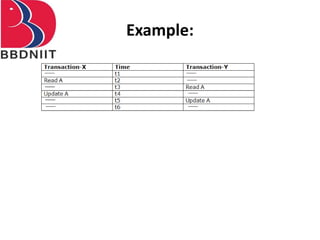
Example:
• Here,
• At time t2, transaction-X reads A's value.
• At time t3, Transaction-Y reads A's value.
• At time t4, Transactions-X writes A's value on the basis of
the value seen at time t2.
• At time t5, Transactions-Y writes A's value on the basis of
the value seen at time t3.
• So at time T5, the update of Transaction-X is lost because
Transaction y overwrites it without looking at its current
value.
• Such type of problem is known as Lost Update Problem as
update made by one transaction is lost here.
2. Dirty Read
• The dirty read occurs in the case when one
transaction updates an item of the database, and
then the transaction fails for some reason. The
updated database item is accessed by another
transaction before it is changed back to the
original value.
• A transaction T1 updates a record which is read
by T2. If T1 aborts then T2 now has values which
have never formed part of the stable database.
• Example:
•
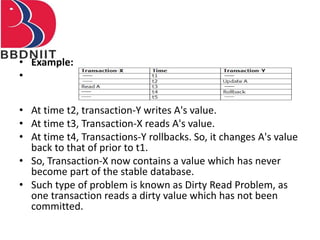
• At time t2, transaction-Y writes A's value.
• At time t3, Transaction-X reads A's value.
• At time t4, Transactions-Y rollbacks. So, it changes A's value
back to that of prior to t1.
• So, Transaction-X now contains a value which has never
become part of the stable database.
• Such type of problem is known as Dirty Read Problem, as
one transaction reads a dirty value which has not been
committed.
3.
Inconsistent Retrievals Problem
• Inconsistent Retrievals Problem is also known as
unrepeatable read. When a transaction calculates
some summary function over a set of data while
the other transactions are updating the data,
then the Inconsistent Retrievals Problem occurs.
• A transaction T1 reads a record and then does
some other processing during which the
transaction T2 updates the record. Now when the
transaction T1 reads the record, then the new
value will be inconsistent with the previous value.
Example:
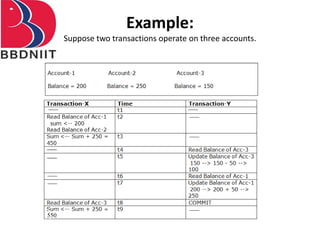
Suppose two transactions operate on three accounts.
• Transaction-X is doing the sum of all balance
while transaction-Y is transferring an amount 50
from Account-1 to Account-3.
• Here, transaction-X produces the result of 550
which is incorrect. If we write this produced
result in the database, the database will become
an inconsistent state because the actual sum is
600.
• Here, transaction-X has seen an inconsistent state
of the database.
Concurrency Control Protocol
• Concurrency control protocols ensure
atomicity, isolation, and serializability of
concurrent transactions. The concurrency
control protocol can be divided into three
categories:
• Lock based protocol
• Time-stamp protocol
• Validation based protocol
Lock-Based Protocol
• In this type of protocol, any transaction cannot read or write data
until it acquires an appropriate lock on it. There are two types of
lock:
• 1. Shared lock:
• It is also known as a Read-only lock. In a shared lock, the data item
can only read by the transaction.
• It can be shared between the transactions because when the
transaction holds a lock, then it can't update the data on the data
item.
• 2. Exclusive lock:
• In the exclusive lock, the data item can be both reads as well as
written by the transaction.
• This lock is exclusive, and in this lock, multiple transactions do not
modify the same data simultaneously.
There are four types of lock protocols available:
• 1. Simplistic lock protocol
• It is the simplest way of locking the data while transaction.
Simplistic lock-based protocols allow all the transactions to get the
lock on the data before insert or delete or update on it. It will
unlock the data item after completing the transaction.
• 2. Pre-claiming Lock Protocol
• Pre-claiming Lock Protocols evaluate the transaction to list all the
data items on which they need locks.
• Before initiating an execution of the transaction, it requests DBMS
for all the lock on all those data items.
• If all the locks are granted then this protocol allows the transaction
to begin. When the transaction is completed then it releases all the
lock.
• If all the locks are not granted then this protocol allows the
transaction to rolls back and waits until all the locks are granted.
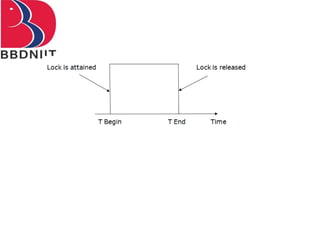
3. Two-phase locking (2PL)
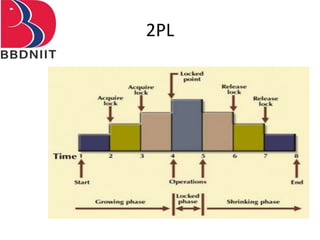
• The two-phase locking protocol divides the execution
phase of the transaction into three parts.
• In the first part, when the execution of the transaction
starts, it seeks permission for the lock it requires.
• In the second part, the transaction acquires all the
locks. The third phase is started as soon as the
transaction releases its first lock.
• In the third phase, the transaction cannot demand any
new locks. It only releases the acquired locks.
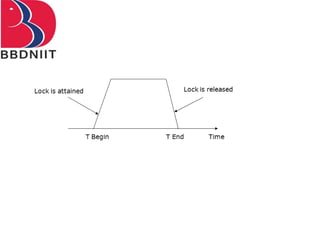
• There are two phases of 2PL:
• Growing phase: In the growing phase, a new lock on the data item
may be acquired by the transaction, but none can be released.
• Growing Phase: In this phase transaction may obtain locks but may
not release any locks.
• Shrinking phase: In the shrinking phase, existing lock held by the
transaction may be released, but no new locks can be acquired.
• Shrinking Phase: In this phase, a transaction may release locks but
not obtain any new lock
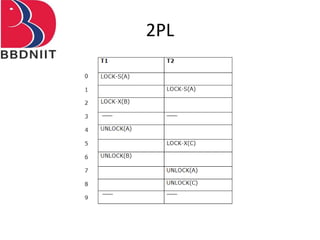
• In the below example, if lock conversion is allowed then the
following phase can happen:
• Upgrading of lock (from S(a) to X (a)) is allowed in growing phase.
• Downgrading of lock (from X(a) to S(a)) must be done in shrinking
phase.
2PL
2PL
2PL
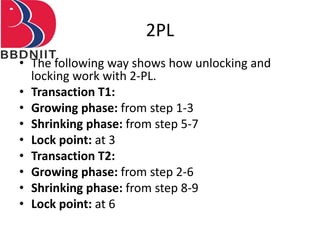
• The following way shows how unlocking and
locking work with 2-PL.
• Transaction T1:
• Growing phase: from step 1-3
• Shrinking phase: from step 5-7
• Lock point: at 3
• Transaction T2:
• Growing phase: from step 2-6
• Shrinking phase: from step 8-9
• Lock point: at 6
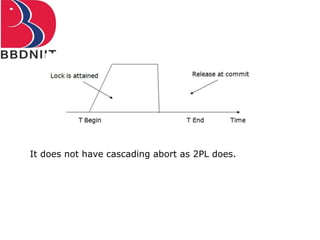
4. Strict Two-phase locking (Strict-2PL)
• The first phase of Strict-2PL is similar to 2PL. In
the first phase, after acquiring all the locks, the
transaction continues to execute normally.
• The only difference between 2PL and strict 2PL is
that Strict-2PL does not release a lock after using
it.
• Strict-2PL waits until the whole transaction to
commit, and then it releases all the locks at a
time.
• Strict-2PL protocol does not have shrinking phase
of lock release.
It does not have cascading abort as 2PL does.
Timestamp Ordering Protocol
• The Timestamp Ordering Protocol is used to order the transactions based on their
Timestamps. The order of transaction is nothing but the ascending order of the
transaction creation.
• Timestamp based Protocol in DBMS is an algorithm which uses the System Time or
Logical Counter as a timestamp to serialize the execution of concurrent
transactions. The Timestamp-based protocol ensures that every conflicting read
and write operations are executed in a timestamp order.
• The older transaction is always given priority in this method. It uses system time to
determine the time stamp of the transaction. This is the most commonly used
concurrency protocol.
• The priority of the older transaction is higher that's why it executes first. To
determine the timestamp of the transaction, this protocol uses system time or
logical counter.
• The lock-based protocol is used to manage the order between conflicting pairs
among transactions at the execution time. But Timestamp based protocols start
working as soon as a transaction is created.
Example:
• Suppose there are there transactions T1, T2, and T3.
• T1 has entered the system at time 0010
• T2 has entered the system at 0020
• T3 has entered the system at 0030
• Priority will be given to transaction T1, then transaction T2 and lastl
y Transaction T3.
• or
• Let's assume there are two transactions T1 and T2. Suppose the
transaction T1 has entered the system at 007 times and transaction
T2 has entered the system at 009 times. T1 has the higher priority,
so it executes first as it is entered the system first.
• The timestamp ordering protocol also maintains the timestamp of
last 'read' and 'write' operation on a data.
Basic Timestamp ordering protocol works as follows:
• 1. Check the following condition whenever a transaction Ti issues a Read
(X) operation:
• If W_TS(X) >TS(Ti) then the operation is rejected.
• If W_TS(X) <= TS(Ti) then the operation is executed.
• Timestamps of all the data items are updated.
• 2.Check the following condition whenever a transaction Ti issues
a Write(X) operation:
• If TS(Ti) < R_TS(X) then the operation is rejected.
• If TS(Ti) < W_TS(X) then the operation is rejected and Ti is rolled back
otherwise the operation is executed.
• Where,
• TS(TI) denotes the timestamp of the transaction Ti.
• R_TS(X) denotes the Read time-stamp of data-item X.
• W_TS(X) denotes the Write time-stamp of data-item X.
Validation(Optimistic) Based Protocol
• Validation phase is also known as optimistic concurrency control technique.
• It is proposed by Kung Robinson.
• The optimistic method does not require locking or time stamping techniques. Instead, a transaction
is executed without restrictions until it is committed.
• In the validation based protocol, the transaction is executed in the following three phases:
• Read phase: In this phase, the transaction T is read and executed. It is used to read the value of
various data items and stores them in temporary local variables. It can perform all the write
operations on temporary variables without an update to the actual database.
• In the Read Phase, the data values from the database can be read by a transaction but the write
operation or updates are only applied to the local data copies, not the actual database.
• Validation phase: In this phase, the temporary variable value will be validated against the actual
data to see if it violates the serializability.
• In Validation Phase, the data is checked to ensure that there is no violation of serializability while
applying the transaction updates to the database.
• Write phase: If the validation of the transaction is validated, then the temporary results are written
to the database or system otherwise the transaction is rolled back.
• In the Write Phase, the updates are applied to the database if the validation is successful, else; the
updates are not applied, and the transaction is rolled back.
Here each phase has the following different timestamps:
• Start(Ti): It contains the time when Ti started its execution.
• Validation (Ti): It contains the time when Ti finishes its read phase and starts its validation phase.
• Finish(Ti): It contains the time when Ti finishes its write phase.
• This protocol is used to determine the time stamp for the transaction for serialization using the time stamp of the
validation phase, as it is the actual phase which determines if the transaction will commit or rollback.
• Hence TS(T) = validation(T).
• The serializability is determined during the validation process. It can't be decided in advance.
• While executing the transaction, it ensures a greater degree of concurrency and also less number of conflicts.
• Thus it contains transactions which have less number of rollbacks.
• Concurrency control is provided in a database to:
• (i) enforce isolation among transactions.
• (ii) preserve database consistency through consistency preserving execution of transactions.
• (iii) resolve read-write and write-read conflicts.
• Various concurrency control techniques are:
• 1. Two-phase locking Protocol
• 2. Time stamp ordering Protocol
• 3. Multi version concurrency control
• 4. Validation concurrency control
Multiple Granularity
• Granularity: It is the size of data item allowed to lock.
• Multiple Granularity:
• It can be defined as hierarchically breaking up the database into blocks which can be locked.
• The Multiple Granularity protocol enhances concurrency and reduces lock overhead.
• It maintains the track of what to lock and how to lock.
• It makes easy to decide either to lock a data item or to unlock a data item. This type of hierarchy can be
graphically represented as a tree.
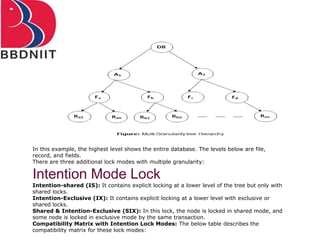
• For example: Consider a tree which has four levels of nodes.
• The first level or higher level shows the entire database.
• The second level represents a node of type area. The higher level database consists of exactly these areas.
• The area consists of children nodes which are known as files. No file can be present in more than one area.
• Finally, each file contains child nodes known as records. The file has exactly those records that are its child
nodes. No records represent in more than one file.
• Hence, the levels of the tree starting from the top level are as follows:
– Database
– Area
– File
– Record
In this example, the highest level shows the entire database. The levels below are file,
record, and fields.
There are three additional lock modes with multiple granularity:
Intention Mode Lock
Intention-shared (IS): It contains explicit locking at a lower level of the tree but only with
shared locks.
Intention-Exclusive (IX): It contains explicit locking at a lower level with exclusive or
shared locks.
Shared & Intention-Exclusive (SIX): In this lock, the node is locked in shared mode, and
some node is locked in exclusive mode by the same transaction.
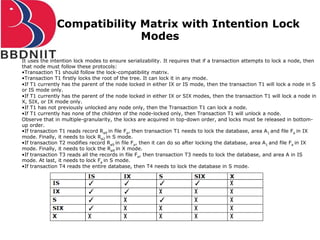
Compatibility Matrix with Intention Lock Modes: The below table describes the
compatibility matrix for these lock modes:
Compatibility Matrix with Intention Lock
Modes
It uses the intention lock modes to ensure serializability. It requires that if a transaction attempts to lock a node, then
that node must follow these protocols:
•Transaction T1 should follow the lock-compatibility matrix.
•Transaction T1 firstly locks the root of the tree. It can lock it in any mode.
•If T1 currently has the parent of the node locked in either IX or IS mode, then the transaction T1 will lock a node in S
or IS mode only.
•If T1 currently has the parent of the node locked in either IX or SIX modes, then the transaction T1 will lock a node in
X, SIX, or IX mode only.
•If T1 has not previously unlocked any node only, then the Transaction T1 can lock a node.
•If T1 currently has none of the children of the node-locked only, then Transaction T1 will unlock a node.
Observe that in multiple-granularity, the locks are acquired in top-down order, and locks must be released in bottom-
up order.
•If transaction T1 reads record Ra9 in file Fa, then transaction T1 needs to lock the database, area A1 and file Fa in IX
mode. Finally, it needs to lock Ra2 in S mode.
•If transaction T2 modifies record Ra9 in file Fa, then it can do so after locking the database, area A1 and file Fa in IX
mode. Finally, it needs to lock the Ra9 in X mode.
•If transaction T3 reads all the records in file Fa, then transaction T3 needs to lock the database, and area A in IS
mode. At last, it needs to lock Fa in S mode.
•If transaction T4 reads the entire database, then T4 needs to lock the database in S mode.
Recovery with Concurrent
Transaction
• Whenever more than one transaction is being
executed, then the interleaved of logs occur.
During recovery, it would become difficult for
the recovery system to backtrack all logs and
then start recovering.
• To ease this situation, 'checkpoint' concept is
used by most DBMS.
Checkpoint
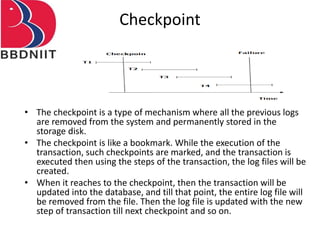
• The checkpoint is a type of mechanism where all the previous logs
are removed from the system and permanently stored in the
storage disk.
• The checkpoint is like a bookmark. While the execution of the
transaction, such checkpoints are marked, and the transaction is
executed then using the steps of the transaction, the log files will be
created.
• When it reaches to the checkpoint, then the transaction will be
updated into the database, and till that point, the entire log file will
be removed from the file. Then the log file is updated with the new
step of transaction till next checkpoint and so on.
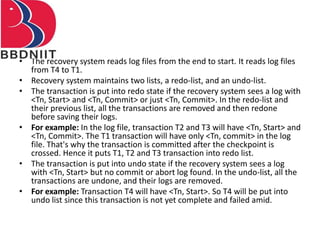
• The recovery system reads log files from the end to start. It reads log files
from T4 to T1.
• Recovery system maintains two lists, a redo-list, and an undo-list.
• The transaction is put into redo state if the recovery system sees a log with
<Tn, Start> and <Tn, Commit> or just <Tn, Commit>. In the redo-list and
their previous list, all the transactions are removed and then redone
before saving their logs.
• For example: In the log file, transaction T2 and T3 will have <Tn, Start> and
<Tn, Commit>. The T1 transaction will have only <Tn, commit> in the log
file. That's why the transaction is committed after the checkpoint is
crossed. Hence it puts T1, T2 and T3 transaction into redo list.
• The transaction is put into undo state if the recovery system sees a log
with <Tn, Start> but no commit or abort log found. In the undo-list, all the
transactions are undone, and their logs are removed.
• For example: Transaction T4 will have <Tn, Start>. So T4 will be put into
undo list since this transaction is not yet complete and failed amid.
Multi Version Schemes
• A concurrency control scheme using multiple
versions of data objects is presented which
allows increased concurrency.
The scheme grants an appropriate version to
each read request. Transactions issuing write
requests which might destroy database
integrity are aborted.
•THANK YOU

Unit 5 dbms

  • 1.
    UNIT -5 Concurrency ControlTechniques By: Ms. SWETA SINGH Assistant Professor(CSE)
  • 2.
    Concurrency Control • Inthe concurrency control, the multiple transactions can be executed simultaneously. • It may affect the transaction result. It is highly important to maintain the order of execution of those transactions. • Problems of concurrency control • Several problems can occur when concurrent transactions are executed in an uncontrolled manner. Following are the three problems in concurrency control. • Lost updates • Dirty read • Unrepeatable read
  • 3.
    1. Lost updateproblem • When two transactions that access the same database items contain their operations in a way that makes the value of some database item incorrect, then the lost update problem occurs. • If two transactions T1 and T2 read a record and then update it, then the effect of updating of the first record will be overwritten by the second update.
  • 4.
  • 5.
    • Here, • Attime t2, transaction-X reads A's value. • At time t3, Transaction-Y reads A's value. • At time t4, Transactions-X writes A's value on the basis of the value seen at time t2. • At time t5, Transactions-Y writes A's value on the basis of the value seen at time t3. • So at time T5, the update of Transaction-X is lost because Transaction y overwrites it without looking at its current value. • Such type of problem is known as Lost Update Problem as update made by one transaction is lost here.
  • 6.
    2. Dirty Read •The dirty read occurs in the case when one transaction updates an item of the database, and then the transaction fails for some reason. The updated database item is accessed by another transaction before it is changed back to the original value. • A transaction T1 updates a record which is read by T2. If T1 aborts then T2 now has values which have never formed part of the stable database.
  • 7.
    • Example: • • Attime t2, transaction-Y writes A's value. • At time t3, Transaction-X reads A's value. • At time t4, Transactions-Y rollbacks. So, it changes A's value back to that of prior to t1. • So, Transaction-X now contains a value which has never become part of the stable database. • Such type of problem is known as Dirty Read Problem, as one transaction reads a dirty value which has not been committed.
  • 8.
    3. Inconsistent Retrievals Problem •Inconsistent Retrievals Problem is also known as unrepeatable read. When a transaction calculates some summary function over a set of data while the other transactions are updating the data, then the Inconsistent Retrievals Problem occurs. • A transaction T1 reads a record and then does some other processing during which the transaction T2 updates the record. Now when the transaction T1 reads the record, then the new value will be inconsistent with the previous value.
  • 9.
    Example: Suppose two transactionsoperate on three accounts.
  • 10.
    • Transaction-X isdoing the sum of all balance while transaction-Y is transferring an amount 50 from Account-1 to Account-3. • Here, transaction-X produces the result of 550 which is incorrect. If we write this produced result in the database, the database will become an inconsistent state because the actual sum is 600. • Here, transaction-X has seen an inconsistent state of the database.
  • 11.
    Concurrency Control Protocol •Concurrency control protocols ensure atomicity, isolation, and serializability of concurrent transactions. The concurrency control protocol can be divided into three categories: • Lock based protocol • Time-stamp protocol • Validation based protocol
  • 12.
    Lock-Based Protocol • Inthis type of protocol, any transaction cannot read or write data until it acquires an appropriate lock on it. There are two types of lock: • 1. Shared lock: • It is also known as a Read-only lock. In a shared lock, the data item can only read by the transaction. • It can be shared between the transactions because when the transaction holds a lock, then it can't update the data on the data item. • 2. Exclusive lock: • In the exclusive lock, the data item can be both reads as well as written by the transaction. • This lock is exclusive, and in this lock, multiple transactions do not modify the same data simultaneously.
  • 13.
    There are fourtypes of lock protocols available: • 1. Simplistic lock protocol • It is the simplest way of locking the data while transaction. Simplistic lock-based protocols allow all the transactions to get the lock on the data before insert or delete or update on it. It will unlock the data item after completing the transaction. • 2. Pre-claiming Lock Protocol • Pre-claiming Lock Protocols evaluate the transaction to list all the data items on which they need locks. • Before initiating an execution of the transaction, it requests DBMS for all the lock on all those data items. • If all the locks are granted then this protocol allows the transaction to begin. When the transaction is completed then it releases all the lock. • If all the locks are not granted then this protocol allows the transaction to rolls back and waits until all the locks are granted.
  • 15.
    3. Two-phase locking(2PL) • The two-phase locking protocol divides the execution phase of the transaction into three parts. • In the first part, when the execution of the transaction starts, it seeks permission for the lock it requires. • In the second part, the transaction acquires all the locks. The third phase is started as soon as the transaction releases its first lock. • In the third phase, the transaction cannot demand any new locks. It only releases the acquired locks.
  • 17.
    • There aretwo phases of 2PL: • Growing phase: In the growing phase, a new lock on the data item may be acquired by the transaction, but none can be released. • Growing Phase: In this phase transaction may obtain locks but may not release any locks. • Shrinking phase: In the shrinking phase, existing lock held by the transaction may be released, but no new locks can be acquired. • Shrinking Phase: In this phase, a transaction may release locks but not obtain any new lock • In the below example, if lock conversion is allowed then the following phase can happen: • Upgrading of lock (from S(a) to X (a)) is allowed in growing phase. • Downgrading of lock (from X(a) to S(a)) must be done in shrinking phase.
  • 18.
  • 19.
  • 20.
    2PL • The followingway shows how unlocking and locking work with 2-PL. • Transaction T1: • Growing phase: from step 1-3 • Shrinking phase: from step 5-7 • Lock point: at 3 • Transaction T2: • Growing phase: from step 2-6 • Shrinking phase: from step 8-9 • Lock point: at 6
  • 21.
    4. Strict Two-phaselocking (Strict-2PL) • The first phase of Strict-2PL is similar to 2PL. In the first phase, after acquiring all the locks, the transaction continues to execute normally. • The only difference between 2PL and strict 2PL is that Strict-2PL does not release a lock after using it. • Strict-2PL waits until the whole transaction to commit, and then it releases all the locks at a time. • Strict-2PL protocol does not have shrinking phase of lock release.
  • 22.
    It does nothave cascading abort as 2PL does.
  • 23.
    Timestamp Ordering Protocol •The Timestamp Ordering Protocol is used to order the transactions based on their Timestamps. The order of transaction is nothing but the ascending order of the transaction creation. • Timestamp based Protocol in DBMS is an algorithm which uses the System Time or Logical Counter as a timestamp to serialize the execution of concurrent transactions. The Timestamp-based protocol ensures that every conflicting read and write operations are executed in a timestamp order. • The older transaction is always given priority in this method. It uses system time to determine the time stamp of the transaction. This is the most commonly used concurrency protocol. • The priority of the older transaction is higher that's why it executes first. To determine the timestamp of the transaction, this protocol uses system time or logical counter. • The lock-based protocol is used to manage the order between conflicting pairs among transactions at the execution time. But Timestamp based protocols start working as soon as a transaction is created.
  • 24.
    Example: • Suppose thereare there transactions T1, T2, and T3. • T1 has entered the system at time 0010 • T2 has entered the system at 0020 • T3 has entered the system at 0030 • Priority will be given to transaction T1, then transaction T2 and lastl y Transaction T3. • or • Let's assume there are two transactions T1 and T2. Suppose the transaction T1 has entered the system at 007 times and transaction T2 has entered the system at 009 times. T1 has the higher priority, so it executes first as it is entered the system first. • The timestamp ordering protocol also maintains the timestamp of last 'read' and 'write' operation on a data.
  • 25.
    Basic Timestamp orderingprotocol works as follows: • 1. Check the following condition whenever a transaction Ti issues a Read (X) operation: • If W_TS(X) >TS(Ti) then the operation is rejected. • If W_TS(X) <= TS(Ti) then the operation is executed. • Timestamps of all the data items are updated. • 2.Check the following condition whenever a transaction Ti issues a Write(X) operation: • If TS(Ti) < R_TS(X) then the operation is rejected. • If TS(Ti) < W_TS(X) then the operation is rejected and Ti is rolled back otherwise the operation is executed. • Where, • TS(TI) denotes the timestamp of the transaction Ti. • R_TS(X) denotes the Read time-stamp of data-item X. • W_TS(X) denotes the Write time-stamp of data-item X.
  • 26.
    Validation(Optimistic) Based Protocol •Validation phase is also known as optimistic concurrency control technique. • It is proposed by Kung Robinson. • The optimistic method does not require locking or time stamping techniques. Instead, a transaction is executed without restrictions until it is committed. • In the validation based protocol, the transaction is executed in the following three phases: • Read phase: In this phase, the transaction T is read and executed. It is used to read the value of various data items and stores them in temporary local variables. It can perform all the write operations on temporary variables without an update to the actual database. • In the Read Phase, the data values from the database can be read by a transaction but the write operation or updates are only applied to the local data copies, not the actual database. • Validation phase: In this phase, the temporary variable value will be validated against the actual data to see if it violates the serializability. • In Validation Phase, the data is checked to ensure that there is no violation of serializability while applying the transaction updates to the database. • Write phase: If the validation of the transaction is validated, then the temporary results are written to the database or system otherwise the transaction is rolled back. • In the Write Phase, the updates are applied to the database if the validation is successful, else; the updates are not applied, and the transaction is rolled back.
  • 27.
    Here each phasehas the following different timestamps: • Start(Ti): It contains the time when Ti started its execution. • Validation (Ti): It contains the time when Ti finishes its read phase and starts its validation phase. • Finish(Ti): It contains the time when Ti finishes its write phase. • This protocol is used to determine the time stamp for the transaction for serialization using the time stamp of the validation phase, as it is the actual phase which determines if the transaction will commit or rollback. • Hence TS(T) = validation(T). • The serializability is determined during the validation process. It can't be decided in advance. • While executing the transaction, it ensures a greater degree of concurrency and also less number of conflicts. • Thus it contains transactions which have less number of rollbacks. • Concurrency control is provided in a database to: • (i) enforce isolation among transactions. • (ii) preserve database consistency through consistency preserving execution of transactions. • (iii) resolve read-write and write-read conflicts. • Various concurrency control techniques are: • 1. Two-phase locking Protocol • 2. Time stamp ordering Protocol • 3. Multi version concurrency control • 4. Validation concurrency control
  • 28.
    Multiple Granularity • Granularity:It is the size of data item allowed to lock. • Multiple Granularity: • It can be defined as hierarchically breaking up the database into blocks which can be locked. • The Multiple Granularity protocol enhances concurrency and reduces lock overhead. • It maintains the track of what to lock and how to lock. • It makes easy to decide either to lock a data item or to unlock a data item. This type of hierarchy can be graphically represented as a tree. • For example: Consider a tree which has four levels of nodes. • The first level or higher level shows the entire database. • The second level represents a node of type area. The higher level database consists of exactly these areas. • The area consists of children nodes which are known as files. No file can be present in more than one area. • Finally, each file contains child nodes known as records. The file has exactly those records that are its child nodes. No records represent in more than one file. • Hence, the levels of the tree starting from the top level are as follows: – Database – Area – File – Record
  • 29.
    In this example,the highest level shows the entire database. The levels below are file, record, and fields. There are three additional lock modes with multiple granularity: Intention Mode Lock Intention-shared (IS): It contains explicit locking at a lower level of the tree but only with shared locks. Intention-Exclusive (IX): It contains explicit locking at a lower level with exclusive or shared locks. Shared & Intention-Exclusive (SIX): In this lock, the node is locked in shared mode, and some node is locked in exclusive mode by the same transaction. Compatibility Matrix with Intention Lock Modes: The below table describes the compatibility matrix for these lock modes:
  • 30.
    Compatibility Matrix withIntention Lock Modes It uses the intention lock modes to ensure serializability. It requires that if a transaction attempts to lock a node, then that node must follow these protocols: •Transaction T1 should follow the lock-compatibility matrix. •Transaction T1 firstly locks the root of the tree. It can lock it in any mode. •If T1 currently has the parent of the node locked in either IX or IS mode, then the transaction T1 will lock a node in S or IS mode only. •If T1 currently has the parent of the node locked in either IX or SIX modes, then the transaction T1 will lock a node in X, SIX, or IX mode only. •If T1 has not previously unlocked any node only, then the Transaction T1 can lock a node. •If T1 currently has none of the children of the node-locked only, then Transaction T1 will unlock a node. Observe that in multiple-granularity, the locks are acquired in top-down order, and locks must be released in bottom- up order. •If transaction T1 reads record Ra9 in file Fa, then transaction T1 needs to lock the database, area A1 and file Fa in IX mode. Finally, it needs to lock Ra2 in S mode. •If transaction T2 modifies record Ra9 in file Fa, then it can do so after locking the database, area A1 and file Fa in IX mode. Finally, it needs to lock the Ra9 in X mode. •If transaction T3 reads all the records in file Fa, then transaction T3 needs to lock the database, and area A in IS mode. At last, it needs to lock Fa in S mode. •If transaction T4 reads the entire database, then T4 needs to lock the database in S mode.
  • 31.
    Recovery with Concurrent Transaction •Whenever more than one transaction is being executed, then the interleaved of logs occur. During recovery, it would become difficult for the recovery system to backtrack all logs and then start recovering. • To ease this situation, 'checkpoint' concept is used by most DBMS.
  • 32.
    Checkpoint • The checkpointis a type of mechanism where all the previous logs are removed from the system and permanently stored in the storage disk. • The checkpoint is like a bookmark. While the execution of the transaction, such checkpoints are marked, and the transaction is executed then using the steps of the transaction, the log files will be created. • When it reaches to the checkpoint, then the transaction will be updated into the database, and till that point, the entire log file will be removed from the file. Then the log file is updated with the new step of transaction till next checkpoint and so on.
  • 33.
    • The recoverysystem reads log files from the end to start. It reads log files from T4 to T1. • Recovery system maintains two lists, a redo-list, and an undo-list. • The transaction is put into redo state if the recovery system sees a log with <Tn, Start> and <Tn, Commit> or just <Tn, Commit>. In the redo-list and their previous list, all the transactions are removed and then redone before saving their logs. • For example: In the log file, transaction T2 and T3 will have <Tn, Start> and <Tn, Commit>. The T1 transaction will have only <Tn, commit> in the log file. That's why the transaction is committed after the checkpoint is crossed. Hence it puts T1, T2 and T3 transaction into redo list. • The transaction is put into undo state if the recovery system sees a log with <Tn, Start> but no commit or abort log found. In the undo-list, all the transactions are undone, and their logs are removed. • For example: Transaction T4 will have <Tn, Start>. So T4 will be put into undo list since this transaction is not yet complete and failed amid.
  • 34.
    Multi Version Schemes •A concurrency control scheme using multiple versions of data objects is presented which allows increased concurrency. The scheme grants an appropriate version to each read request. Transactions issuing write requests which might destroy database integrity are aborted.
  • 35.