Savitribai Phule Pune University, Pune
FYBSc (CS) / Bcom/BBA etc.
Paper – II : Continuous Probability Distribution and Testing of Hypothesis (CPDTH)
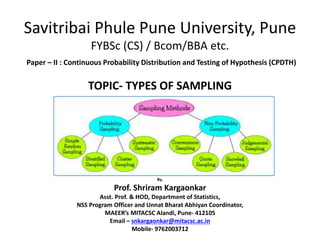
TOPIC- TYPES OF SAMPLING
By,
Prof. Shriram Kargaonkar
Asst. Prof. & HOD, Department of Statistics,
NSS Program Officer and Unnat Bharat Abhiyan Coordinator,
MAEER’s MITACSC Alandi, Pune- 412105
Email – snkargaonkar@mitacsc.ac.in
Mobile- 9762003712
Introduction
In Statistics, Sampling is a technique of selecting
individual members or a subset of the population to
make statistical inferences from them and estimate
characteristics of the whole population.
Different sampling methods are widely used by
researchers so that they do not need to research the
entire population to collect actionable insights.
In this lecture, I will teach you types of sampling and
different sampling methods with the help of simple
examples in our daily life.
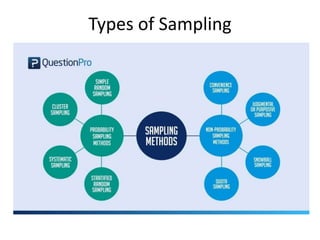
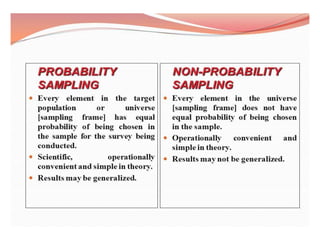
Types of Sampling
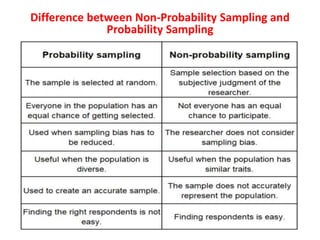
Difference between Non-Probability Sampling and
Probability Sampling
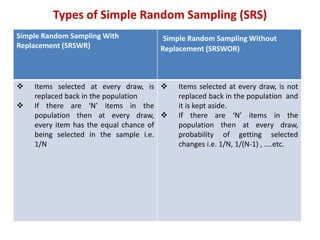
Types of Simple Random Sampling (SRS)
Simple Random Sampling With
Replacement (SRSWR)
Simple Random Sampling Without
Replacement (SRSWOR)
 Items selected at every draw, is
replaced back in the population
 If there are ‘N’ items in the
population then at every draw,
every item has the equal chance of
being selected in the sample i.e.
1/N
 Items selected at every draw, is not
replaced back in the population and
it is kept aside.
 If there are ‘N’ items in the
population then at every draw,
probability of getting selected
changes i.e. 1/N, 1/(N-1) , ....etc.
Cluster Sampling
It is a method where the researchers divide the entire
population into sections or clusters that represent a
population.
It Contains heterogeneous population.
Clusters are identified and included in a sample based
on demographic parameters like age, sex, location, etc.
This makes it very simple for a survey creator to derive
effective inference from the feedback.
Systematic Sampling Method
 Researchers use the Systematic Sampling Method to
choose the sample members of a population at regular
intervals.
 It requires the selection of a starting point for the sample
and sample size that can be repeated at regular intervals.
 This type of sampling method has a predefined range, and
hence this sampling technique is the least time-consuming.
Uses of probability sampling
There are multiple uses of probability sampling:
Reduce Sample Bias: Using the probability sampling method, the bias in
the sample derived from a population is negligible to non-existent. The
selection of the sample mainly depicts the understanding and the inference
of the researcher.
Higher quality data collection: Probability sampling leads to higher
quality data collection as the sample appropriately represents the
population.
Diverse Population: When the population is vast and diverse, it is
essential to have adequate representation so that the data is not skewed
towards one demographic.
Create an Accurate Sample: Probability sampling helps the researchers
plan and create an accurate sample. This helps to obtain well-defined data.
Types of Non-Probability Sampling
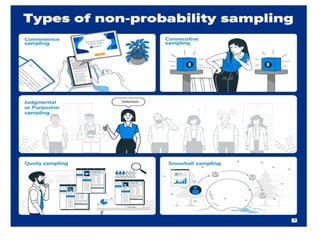
1) Convenience Sampling. The selection of these cases is due
to the accessibility of the inclusion of the element and the
proximity of this subject with the researcher. It is useful
when it is necessary to have information quickly and
inexpensively, regardless of whether it is generalizable to the
population. When a person approaches us in the street to fill
out a survey, it is convenience sampling.
2) Snowball Sampling. Snowball sampling — also known as
referral sampling — is carried out on populations in which
their individuals are not known, or it is tough to access them.
So each subject studied proposes others, in such a way that
generates a cumulative effect of observations. It is widely
used in public policy and social studies. This is the most
common system for finding information on organized crime.
3) Quota Sampling.
Quota sampling is based on selecting the sample after dividing the
population into strata. The subjects within each group are chosen by
non-probabilistic methods. Furthermore, the number of elements
selected is due to an arbitrary number (quotas) from which a sample
relatively proportional to the population is built.
4) Judgmental or purposive sampling: Judgmental or purposive
sampling are formed by the discretion of the researcher. Researchers
purely consider the purpose of the study, along with the
understanding of the target audience.
For instance, when researchers want to understand the thought
process of people interested in studying for their master’s degree.
The selection criteria will be: “Are you interested in doing your
masters in …?” and those who respond with a “No” are excluded
from the sample.
Uses of non-probability sampling
Non-probability sampling is used for the following:
• Create a hypothesis: Researchers use the non-probability sampling
method to create an assumption when limited to no prior
information is available. This method helps with the immediate
return of data and builds a base for further research.
• Exploratory research: Researchers use this sampling technique
widely when conducting qualitative research, pilot studies,
or exploratory research.
• Budget and time constraints: The non-probability method when
there are budget and time constraints, and some preliminary data
must be collected. Since the survey design is not rigid, it is easier to
pick respondents at random and have them take the survey
or questionnaire.
Sampling Methods.pptx

Sampling Methods.pptx

  • 1.
    Savitribai Phule PuneUniversity, Pune FYBSc (CS) / Bcom/BBA etc. Paper – II : Continuous Probability Distribution and Testing of Hypothesis (CPDTH) TOPIC- TYPES OF SAMPLING By, Prof. Shriram Kargaonkar Asst. Prof. & HOD, Department of Statistics, NSS Program Officer and Unnat Bharat Abhiyan Coordinator, MAEER’s MITACSC Alandi, Pune- 412105 Email – snkargaonkar@mitacsc.ac.in Mobile- 9762003712
  • 2.
    Introduction In Statistics, Samplingis a technique of selecting individual members or a subset of the population to make statistical inferences from them and estimate characteristics of the whole population. Different sampling methods are widely used by researchers so that they do not need to research the entire population to collect actionable insights. In this lecture, I will teach you types of sampling and different sampling methods with the help of simple examples in our daily life.
  • 4.
  • 6.
    Difference between Non-ProbabilitySampling and Probability Sampling
  • 8.
    Types of SimpleRandom Sampling (SRS) Simple Random Sampling With Replacement (SRSWR) Simple Random Sampling Without Replacement (SRSWOR)  Items selected at every draw, is replaced back in the population  If there are ‘N’ items in the population then at every draw, every item has the equal chance of being selected in the sample i.e. 1/N  Items selected at every draw, is not replaced back in the population and it is kept aside.  If there are ‘N’ items in the population then at every draw, probability of getting selected changes i.e. 1/N, 1/(N-1) , ....etc.
  • 10.
    Cluster Sampling It isa method where the researchers divide the entire population into sections or clusters that represent a population. It Contains heterogeneous population. Clusters are identified and included in a sample based on demographic parameters like age, sex, location, etc. This makes it very simple for a survey creator to derive effective inference from the feedback.
  • 11.
    Systematic Sampling Method Researchers use the Systematic Sampling Method to choose the sample members of a population at regular intervals.  It requires the selection of a starting point for the sample and sample size that can be repeated at regular intervals.  This type of sampling method has a predefined range, and hence this sampling technique is the least time-consuming.
  • 12.
    Uses of probabilitysampling There are multiple uses of probability sampling: Reduce Sample Bias: Using the probability sampling method, the bias in the sample derived from a population is negligible to non-existent. The selection of the sample mainly depicts the understanding and the inference of the researcher. Higher quality data collection: Probability sampling leads to higher quality data collection as the sample appropriately represents the population. Diverse Population: When the population is vast and diverse, it is essential to have adequate representation so that the data is not skewed towards one demographic. Create an Accurate Sample: Probability sampling helps the researchers plan and create an accurate sample. This helps to obtain well-defined data.
  • 14.
    Types of Non-ProbabilitySampling 1) Convenience Sampling. The selection of these cases is due to the accessibility of the inclusion of the element and the proximity of this subject with the researcher. It is useful when it is necessary to have information quickly and inexpensively, regardless of whether it is generalizable to the population. When a person approaches us in the street to fill out a survey, it is convenience sampling. 2) Snowball Sampling. Snowball sampling — also known as referral sampling — is carried out on populations in which their individuals are not known, or it is tough to access them. So each subject studied proposes others, in such a way that generates a cumulative effect of observations. It is widely used in public policy and social studies. This is the most common system for finding information on organized crime.
  • 15.
    3) Quota Sampling. Quotasampling is based on selecting the sample after dividing the population into strata. The subjects within each group are chosen by non-probabilistic methods. Furthermore, the number of elements selected is due to an arbitrary number (quotas) from which a sample relatively proportional to the population is built. 4) Judgmental or purposive sampling: Judgmental or purposive sampling are formed by the discretion of the researcher. Researchers purely consider the purpose of the study, along with the understanding of the target audience. For instance, when researchers want to understand the thought process of people interested in studying for their master’s degree. The selection criteria will be: “Are you interested in doing your masters in …?” and those who respond with a “No” are excluded from the sample.
  • 16.
    Uses of non-probabilitysampling Non-probability sampling is used for the following: • Create a hypothesis: Researchers use the non-probability sampling method to create an assumption when limited to no prior information is available. This method helps with the immediate return of data and builds a base for further research. • Exploratory research: Researchers use this sampling technique widely when conducting qualitative research, pilot studies, or exploratory research. • Budget and time constraints: The non-probability method when there are budget and time constraints, and some preliminary data must be collected. Since the survey design is not rigid, it is easier to pick respondents at random and have them take the survey or questionnaire.