RESEARCH METHDOLOGY
SAMPLING
2 5 N A V Y A N A V E E N S 7 A
SAMPLING
SAMPLING is a process of selecting a subset
of a population to study. The goal of sampling
is to obtain a representative sample, which is
a subset that accurately reflects the
characteristics of the entire population.
For example, if you are researching the
opinions of students in your university, you
could survey a sample of 100 students. In
statistics, sampling allows you to test a
hypothesis about the characteristics of a
population.
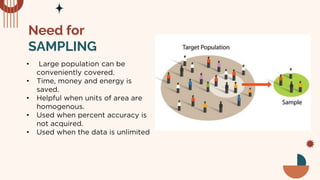
• Large population can be
conveniently covered.
• Time, money and energy is
saved.
• Helpful when units of area are
homogenous.
• Used when percent accuracy is
not acquired.
• Used when the data is unlimited
Need for
SAMPLING
• Biasedness: Chancesof biased selection
leading to incorrect conclusion
• Selection of true representative sample:
Sometimes it is difficult to select the right
representative sample
• Need for specialized knowledge: The
researcher needs knowledge, training and
experience in sampling technique,
statistical analysis and calculation of
probable error
• Impossibility of sampling: Sometimes
population is too small or too
heterogeneous to select a representative
sample.
• Economical: Reduce the cost compare
to entire population.
• Increased speed: Collection of data,
analysis and Interpretation of data etc
take less time than the population.
• Accuracy: Due to limited area of
coverage, completeness and accuracy
is possible.
• Rapport: Better rapport is established
with the respondents, which helps in
validity and reliability of the results
ADVANTAGES
OF SAMPLING
SAMPLING
DISADVANTAGES
OF SAMPLING
SAMPLE SIZE
• Right sample size is necessary for success of data
collection
• What is the correct number for a sample size ?
• What parameters decide a sample size?
• What are the distribution methods of survey
Sample size is an important consideration in research. It
refers to the number of participants or observations that are
included in a study. The size of the sample determines how
representative it is of the population and
how much statistical power the study has.
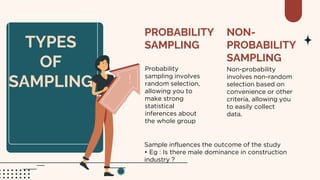
PROBABILITY
SAMPLING
TYPES
OF
SAMPLING
Probability
sampling involves
random selection,
allowing you to
make strong
statistical
inferences about
the whole group
NON-
PROBABILITY
SAMPLING
Non-probability
involves non-random
selection based on
convenience or other
criteria, allowing you
to easily collect
data.
Sample influences the outcome of the study
• Eg : Is there male dominance in construction
industry ?
• CONVENIENCE SAMPLING
• JUDGEMENTAL OR PURPOSIVE
SAMPLING
• SNOWBALL SAMPLING
• QUOTA SAMPLING
• SIMPLE RANDOM SAMPLING
• CLUSTER SAMPLING
• SYSTEMATIC SAMPLING
• STRATIFIED RANDOM SAMPLING
Types of
PROBABILITY SAMPLING
Cover letter
Types of
NON- PROBABILITY
SAMPLING
PROBABILITY SAMPLING
1) Identifying sampling frame
Probability sampling : Randomly choosing subjects from the population
2) Decide the sample size
Sampling frame is complete list of all cases in the population from
which your sample will be drawn
Eg: Accommodation facility of MCAP
If the sample frame or population < 50 ,probability sampling should
not be used.
Sample size should be atleast 30
Confidence Level
The certainty with which the data collected will represent the
characteristics of the population. 95 % confidence level is preferable
Margin of error
Accuracy you require for any estimates made from your sample –
Most likely 3-5 %
Eg: if the result is 53% then result will be 53+_3%
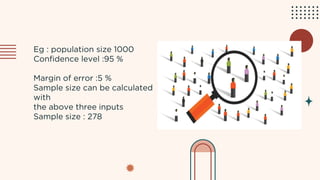
Eg : population size 1000
Confidence level :95 %
Margin of error :5 %
Sample size can be calculated
with
the above three inputs
Sample size : 278
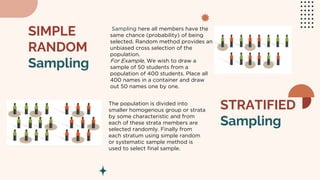
SIMPLE
RANDOM
Sampling
STRATIFIED
Sampling
The population is divided into
smaller homogenous group or strata
by some characteristic and from
each of these strata members are
selected randomly. Finally from
each stratum using simple random
or systematic sample method is
used to select final sample.
Sampling here all members have the
same chance (probability) of being
selected. Random method provides an
unbiased cross selection of the
population.
For Example, We wish to draw a
sample of 50 students from a
population of 400 students. Place all
400 names in a container and draw
out 50 names one by one.
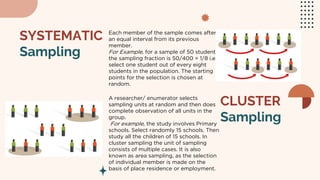
SYSTEMATIC
Sampling
CLUSTER
Sampling
A researcher/ enumerator selects
sampling units at random and then does
complete observation of all units in the
group.
For example, the study involves Primary
schools. Select randomly 15 schools. Then
study all the children of 15 schools. In
cluster sampling the unit of sampling
consists of multiple cases. It is also
known as area sampling, as the selection
of individual member is made on the
basis of place residence or employment.
Each member of the sample comes after
an equal interval from its previous
member.
For Example, for a sample of 50 students,
the sampling fraction is 50/400 = 1/8 i.e.
select one student out of every eight
students in the population. The starting
points for the selection is chosen at
random.
NON- PROBABILITY SAMPLING
• Non-probability sampling is a sampling technique in which
not every member of the population has an equal chance of
being selected for the sample.
• This means that some members of the population may be
more likely to be selected for the sample than others.
• Non-probability sampling is often used when it is difficult or
expensive to obtain a complete list of the population, or when
it is not necessary to have a representative sample of the
population.
• Non-probability sampling is often used in qualitative research
studies, where the goal is to gain a deeper understanding of a
particular phenomenon or group of people.
• Non-probability sampling can also be used in quantitative
research studies, if the researchers are careful to consider the
potential biases introduced by the sampling method.
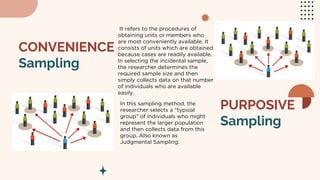
CONVENIENCE
Sampling
PURPOSIVE
Sampling
In this sampling method, the
researcher selects a "typical
group" of individuals who might
represent the larger population
and then collects data from this
group. Also known as
Judgmental Sampling.
It refers to the procedures of
obtaining units or members who
are most conveniently available. It
consists of units which are obtained
because cases are readily available.
In selecting the incidental sample,
the researcher determines the
required sample size and then
simply collects data on that number
of individuals who are available
easily.
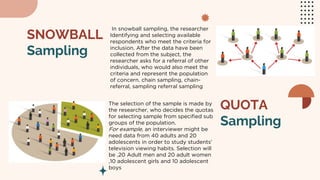
SNOWBALL
Sampling
QUOTA
Sampling
The selection of the sample is made by
the researcher, who decides the quotas
for selecting sample from specified sub
groups of the population.
For example, an interviewer might be
need data from 40 adults and 20
adolescents in order to study students’
television viewing habits. Selection will
be ,20 Adult men and 20 adult women
,10 adolescent girls and 10 adolescent
boys
In snowball sampling, the researcher
Identifying and selecting available
respondents who meet the criteria for
inclusion. After the data have been
collected from the subject, the
researcher asks for a referral of other
individuals, who would also meet the
criteria and represent the population
of concern. chain sampling, chain-
referral, sampling referral sampling
CREDITS: This presentation template was created
by Slidesgo, and includes icons by Flaticon, and
infographics & images by Freepik
Thanks!

Sampling in research methodology.........

  • 1.
    RESEARCH METHDOLOGY SAMPLING 2 5N A V Y A N A V E E N S 7 A
  • 2.
    SAMPLING SAMPLING is aprocess of selecting a subset of a population to study. The goal of sampling is to obtain a representative sample, which is a subset that accurately reflects the characteristics of the entire population. For example, if you are researching the opinions of students in your university, you could survey a sample of 100 students. In statistics, sampling allows you to test a hypothesis about the characteristics of a population.
  • 3.
    • Large populationcan be conveniently covered. • Time, money and energy is saved. • Helpful when units of area are homogenous. • Used when percent accuracy is not acquired. • Used when the data is unlimited Need for SAMPLING
  • 4.
    • Biasedness: Chancesofbiased selection leading to incorrect conclusion • Selection of true representative sample: Sometimes it is difficult to select the right representative sample • Need for specialized knowledge: The researcher needs knowledge, training and experience in sampling technique, statistical analysis and calculation of probable error • Impossibility of sampling: Sometimes population is too small or too heterogeneous to select a representative sample. • Economical: Reduce the cost compare to entire population. • Increased speed: Collection of data, analysis and Interpretation of data etc take less time than the population. • Accuracy: Due to limited area of coverage, completeness and accuracy is possible. • Rapport: Better rapport is established with the respondents, which helps in validity and reliability of the results ADVANTAGES OF SAMPLING SAMPLING DISADVANTAGES OF SAMPLING
  • 5.
    SAMPLE SIZE • Rightsample size is necessary for success of data collection • What is the correct number for a sample size ? • What parameters decide a sample size? • What are the distribution methods of survey Sample size is an important consideration in research. It refers to the number of participants or observations that are included in a study. The size of the sample determines how representative it is of the population and how much statistical power the study has.
  • 6.
    PROBABILITY SAMPLING TYPES OF SAMPLING Probability sampling involves random selection, allowingyou to make strong statistical inferences about the whole group NON- PROBABILITY SAMPLING Non-probability involves non-random selection based on convenience or other criteria, allowing you to easily collect data. Sample influences the outcome of the study • Eg : Is there male dominance in construction industry ?
  • 7.
    • CONVENIENCE SAMPLING •JUDGEMENTAL OR PURPOSIVE SAMPLING • SNOWBALL SAMPLING • QUOTA SAMPLING • SIMPLE RANDOM SAMPLING • CLUSTER SAMPLING • SYSTEMATIC SAMPLING • STRATIFIED RANDOM SAMPLING Types of PROBABILITY SAMPLING Cover letter Types of NON- PROBABILITY SAMPLING
  • 8.
    PROBABILITY SAMPLING 1) Identifyingsampling frame Probability sampling : Randomly choosing subjects from the population 2) Decide the sample size Sampling frame is complete list of all cases in the population from which your sample will be drawn Eg: Accommodation facility of MCAP If the sample frame or population < 50 ,probability sampling should not be used. Sample size should be atleast 30 Confidence Level The certainty with which the data collected will represent the characteristics of the population. 95 % confidence level is preferable Margin of error Accuracy you require for any estimates made from your sample – Most likely 3-5 % Eg: if the result is 53% then result will be 53+_3%
  • 9.
    Eg : populationsize 1000 Confidence level :95 % Margin of error :5 % Sample size can be calculated with the above three inputs Sample size : 278
  • 10.
    SIMPLE RANDOM Sampling STRATIFIED Sampling The population isdivided into smaller homogenous group or strata by some characteristic and from each of these strata members are selected randomly. Finally from each stratum using simple random or systematic sample method is used to select final sample. Sampling here all members have the same chance (probability) of being selected. Random method provides an unbiased cross selection of the population. For Example, We wish to draw a sample of 50 students from a population of 400 students. Place all 400 names in a container and draw out 50 names one by one.
  • 11.
    SYSTEMATIC Sampling CLUSTER Sampling A researcher/ enumeratorselects sampling units at random and then does complete observation of all units in the group. For example, the study involves Primary schools. Select randomly 15 schools. Then study all the children of 15 schools. In cluster sampling the unit of sampling consists of multiple cases. It is also known as area sampling, as the selection of individual member is made on the basis of place residence or employment. Each member of the sample comes after an equal interval from its previous member. For Example, for a sample of 50 students, the sampling fraction is 50/400 = 1/8 i.e. select one student out of every eight students in the population. The starting points for the selection is chosen at random.
  • 12.
    NON- PROBABILITY SAMPLING •Non-probability sampling is a sampling technique in which not every member of the population has an equal chance of being selected for the sample. • This means that some members of the population may be more likely to be selected for the sample than others. • Non-probability sampling is often used when it is difficult or expensive to obtain a complete list of the population, or when it is not necessary to have a representative sample of the population. • Non-probability sampling is often used in qualitative research studies, where the goal is to gain a deeper understanding of a particular phenomenon or group of people. • Non-probability sampling can also be used in quantitative research studies, if the researchers are careful to consider the potential biases introduced by the sampling method.
  • 13.
    CONVENIENCE Sampling PURPOSIVE Sampling In this samplingmethod, the researcher selects a "typical group" of individuals who might represent the larger population and then collects data from this group. Also known as Judgmental Sampling. It refers to the procedures of obtaining units or members who are most conveniently available. It consists of units which are obtained because cases are readily available. In selecting the incidental sample, the researcher determines the required sample size and then simply collects data on that number of individuals who are available easily.
  • 14.
    SNOWBALL Sampling QUOTA Sampling The selection ofthe sample is made by the researcher, who decides the quotas for selecting sample from specified sub groups of the population. For example, an interviewer might be need data from 40 adults and 20 adolescents in order to study students’ television viewing habits. Selection will be ,20 Adult men and 20 adult women ,10 adolescent girls and 10 adolescent boys In snowball sampling, the researcher Identifying and selecting available respondents who meet the criteria for inclusion. After the data have been collected from the subject, the researcher asks for a referral of other individuals, who would also meet the criteria and represent the population of concern. chain sampling, chain- referral, sampling referral sampling
  • 15.
    CREDITS: This presentationtemplate was created by Slidesgo, and includes icons by Flaticon, and infographics & images by Freepik Thanks!