Data Sources
Dr Raju Indukoori
Types of Sources of Data
1. Primary sources
2. Secondary sources
3. Tertiary sources
2Dr Raju Indukoori
Primary sources
Original works of research or raw data without
interpretation or pronouncements that
represent an official opinion or position.
Sampling is a primary sources of data.
It remains public till it is used / interpreted
by secondary party.
3Dr Raju Indukoori
Primary sources
Notifications
•Memos
•Letters
•Circulars
Interviews & Speeches
• Audio
• Videos
• Written transcript
Government Decisions
•Laws
•Regulation
•Court Decision
Government Data
•Census
•Economic Data
•Labor Data
4Dr Raju Indukoori
Primary Investigations
• Observational Studies
• Surveys
• Experiments
5Dr Raju Indukoori
Observational Studies
• Behavioral Studies
• Non Behavioral Studies
6Dr Raju Indukoori
Surveys
It is the communication form gathering primary
data. It has 3 forms as follows
• Survey Via Personal Interviews
• Telephonic Survey
• Self Administered Survey
7Dr Raju Indukoori
Experiment Process
1) Select Relevant Variables
2) Specify the treatment levels
3) Control the experimental environment
4) Choose the experimental design
5) Select and assign the subjects
6) Pilot test, revise and test
7) Analyze the data
8Dr Raju Indukoori
Experimental Research Designs
• Pre experimental Designs
• After-Only Study
• One-Group Pretest-Posttest Design
• Static Group Comparison
• True Experimental Designs
• Pretest-Posttest Control Group Design
• Posttest – Only Control Group Design
• Field Experiments: Quasi or Semi-Experiments
• Non Equivalent Control Group Design
• Separate Sample Pretest-Posttest Design
• Group Time Series Design
9Dr Raju Indukoori
Test Markets
1) Standard test markets
2) Controlled test markets
3) Electronic test markets
4) Simulated test markets
5) Virtual test markets
6) Web-Enabled test markets
10Dr Raju Indukoori
Secondary Sources of Data
• Follows primary data
• These are the interpretations of primary data.
• Easy to access and record compared to
primary source of data.
11Dr Raju Indukoori
Secondary sources
Public
•Encyclopedia
•Text Books
•Magazines
•Newspapers
•News casts
•Websites
Published
•Dictionaries
•Encyclopedias
•Handbooks
•Directories
•Government Sources
Internal
• Sales Analysis
• Annual Reports
• Financial Statements
Paid
• Data Bases
• Data Mining
12Dr Raju Indukoori
Need For Secondary Data
• Exploratory Research
• Analytical Research
• Data Base
• Government Sources
• Data Mining
13Dr Raju Indukoori
Types of Secondary Sources of Data
• Indexes and Bibliographies
• Dictionaries
• Encyclopedias
• Handbooks
• Directories
14Dr Raju Indukoori
Secondary Sources by Type
Indexes and Bibliographies
• to find or locate books or articles
• to find authors, topics to use in online
searches
15Dr Raju Indukoori
Dictionaries
• to identify jargon of an industry--used for
online searches
• to identify bell-weather events in an industry
• to identify knowledgeable people to interview
• to identify organizations of influence
Secondary Sources by Type
16Dr Raju Indukoori
Encyclopedias
• To identify historical or background
information
• To find critical dates within an industry
• To find events of significance to the industry,
company
Secondary Sources by Type
17Dr Raju Indukoori
Handbooks
• To find facts relevant to topic
• To identify influential individuals through
source citations
Secondary Sources by Type
18Dr Raju Indukoori
Directories
• To identify influential people and
organizations
• to find addresses, e-mail, other contact info
on these people and organizations
Secondary Sources by Type
19Dr Raju Indukoori
Tertiary Sources
• Indexes
• Bibliographies
• Internet Search Engines
20Dr Raju Indukoori
Value of Data
• From primary to tertiary the value of data
deteriorates.
• So the best option is primary if available
and feasible
21Dr Raju Indukoori
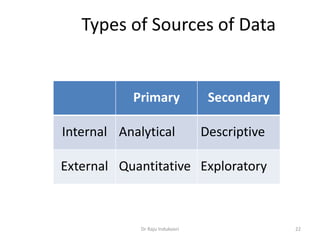
Types of Sources of Data
Primary Secondary
Internal Analytical Descriptive
External Quantitative Exploratory
22Dr Raju Indukoori
Types of Sources of Data
Primary Secondary Tertiary
Cost High Moderate Low
Time High Moderate Low
Value High Moderate Low
Efforts High Moderate Low
23Dr Raju Indukoori

Data sources

  • 1.
  • 2.
    Types of Sourcesof Data 1. Primary sources 2. Secondary sources 3. Tertiary sources 2Dr Raju Indukoori
  • 3.
    Primary sources Original worksof research or raw data without interpretation or pronouncements that represent an official opinion or position. Sampling is a primary sources of data. It remains public till it is used / interpreted by secondary party. 3Dr Raju Indukoori
  • 4.
    Primary sources Notifications •Memos •Letters •Circulars Interviews &Speeches • Audio • Videos • Written transcript Government Decisions •Laws •Regulation •Court Decision Government Data •Census •Economic Data •Labor Data 4Dr Raju Indukoori
  • 5.
    Primary Investigations • ObservationalStudies • Surveys • Experiments 5Dr Raju Indukoori
  • 6.
    Observational Studies • BehavioralStudies • Non Behavioral Studies 6Dr Raju Indukoori
  • 7.
    Surveys It is thecommunication form gathering primary data. It has 3 forms as follows • Survey Via Personal Interviews • Telephonic Survey • Self Administered Survey 7Dr Raju Indukoori
  • 8.
    Experiment Process 1) SelectRelevant Variables 2) Specify the treatment levels 3) Control the experimental environment 4) Choose the experimental design 5) Select and assign the subjects 6) Pilot test, revise and test 7) Analyze the data 8Dr Raju Indukoori
  • 9.
    Experimental Research Designs •Pre experimental Designs • After-Only Study • One-Group Pretest-Posttest Design • Static Group Comparison • True Experimental Designs • Pretest-Posttest Control Group Design • Posttest – Only Control Group Design • Field Experiments: Quasi or Semi-Experiments • Non Equivalent Control Group Design • Separate Sample Pretest-Posttest Design • Group Time Series Design 9Dr Raju Indukoori
  • 10.
    Test Markets 1) Standardtest markets 2) Controlled test markets 3) Electronic test markets 4) Simulated test markets 5) Virtual test markets 6) Web-Enabled test markets 10Dr Raju Indukoori
  • 11.
    Secondary Sources ofData • Follows primary data • These are the interpretations of primary data. • Easy to access and record compared to primary source of data. 11Dr Raju Indukoori
  • 12.
    Secondary sources Public •Encyclopedia •Text Books •Magazines •Newspapers •Newscasts •Websites Published •Dictionaries •Encyclopedias •Handbooks •Directories •Government Sources Internal • Sales Analysis • Annual Reports • Financial Statements Paid • Data Bases • Data Mining 12Dr Raju Indukoori
  • 13.
    Need For SecondaryData • Exploratory Research • Analytical Research • Data Base • Government Sources • Data Mining 13Dr Raju Indukoori
  • 14.
    Types of SecondarySources of Data • Indexes and Bibliographies • Dictionaries • Encyclopedias • Handbooks • Directories 14Dr Raju Indukoori
  • 15.
    Secondary Sources byType Indexes and Bibliographies • to find or locate books or articles • to find authors, topics to use in online searches 15Dr Raju Indukoori
  • 16.
    Dictionaries • to identifyjargon of an industry--used for online searches • to identify bell-weather events in an industry • to identify knowledgeable people to interview • to identify organizations of influence Secondary Sources by Type 16Dr Raju Indukoori
  • 17.
    Encyclopedias • To identifyhistorical or background information • To find critical dates within an industry • To find events of significance to the industry, company Secondary Sources by Type 17Dr Raju Indukoori
  • 18.
    Handbooks • To findfacts relevant to topic • To identify influential individuals through source citations Secondary Sources by Type 18Dr Raju Indukoori
  • 19.
    Directories • To identifyinfluential people and organizations • to find addresses, e-mail, other contact info on these people and organizations Secondary Sources by Type 19Dr Raju Indukoori
  • 20.
    Tertiary Sources • Indexes •Bibliographies • Internet Search Engines 20Dr Raju Indukoori
  • 21.
    Value of Data •From primary to tertiary the value of data deteriorates. • So the best option is primary if available and feasible 21Dr Raju Indukoori
  • 22.
    Types of Sourcesof Data Primary Secondary Internal Analytical Descriptive External Quantitative Exploratory 22Dr Raju Indukoori
  • 23.
    Types of Sourcesof Data Primary Secondary Tertiary Cost High Moderate Low Time High Moderate Low Value High Moderate Low Efforts High Moderate Low 23Dr Raju Indukoori