The lacrimal system
Dr. Samten Dorji
Outline
• Introduction
• Embryology
• Osteology
• Secretory system
• Excretory system
• Physiology of lacrimal pump
Introduction
Introduction
• Tear formation and transport
• Secretory system
• Excretory system
Embryology
Lacrimal drainage system embryology. A. At 5.5 weeks' gestation, an ectodermal invagination
forms between the lateral nasal process and maxillary process, which becomes pinched off from
the surface. B. At 6 weeks' gestation, a solid cord of ectoderm is located between the primitive
medial canthus and nose. C. At 12 weeks' gestation, proliferation of the cord occurs laterally
toward the eyelid and inferiorly toward the inferior turbinate. The isolated cavities shown appear at
3 to 4 months. D. At 7 months, canalization is nearly complete, with only the puncta and valve of
hasner remaining imperforate.
• Punctal membranes open at full term
• The membrane of Hasner remains
imperforate in up to 70% newborns.
This usually opens within the first
month but may remain imperforate for
a longer time, resulting in epiphora
and/or mucopurulent discharge.
Congenital nasolacrimal duct
obstruction
Lacrimal duct anlage
Congenital atresia of punctum
Absence of valves
Anomalies of canaliculi
Osteology
• The lacrimal sac fossa is a depression in
inferior medial orbital rim
• Bordered by anterior lacrimal
crest(maxillary bone) and posterior
lacrimal crest(lacrimal bone).
Osteology
Frontoethmoidal suture
16mm high*4-9mm
wide*2mm deep
• marks the roof of ethmoid
sinus
• Bony dissection superior to it
may expose dura.
The secretory system
1. Lacrimal gland
2. Accessory glands
Lacrimal gland
orbital lobe (black arrow) and the palpebral lobe (white arrow) separated
by the lateral horn of the levator aponeurosis (pointer).
The orbital part
• Almond shape
• 65% to 75% of gland
• 20 mm long × 5 mm thick × 12
mm wide
The sharp anterior border of the left lacrimal gland
(black arrow) rests behind the orbital septum
(pointer)
The temporal portion of the central
preaponeurotic fat pad (pointer) rests near the
anterior border of the orbital portion of the
lacrimal gland
The palpebral part
• 25% to 35% of the gland
• extends anteriorly beyond the orbital
margin to lie in the lateral portion of
the superior fornix
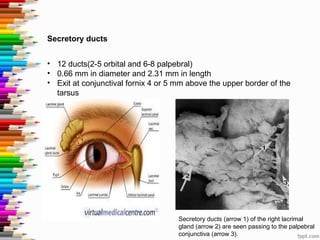
Secretory ducts
• 12 ducts(2-5 orbital and 6-8 palpebral)
• 0.66 mm in diameter and 2.31 mm in length
• Exit at conjunctival fornix 4 or 5 mm above the upper border of the
tarsus
Secretory ducts (arrow 1) of the right lacrimal
gland (arrow 2) are seen passing to the palpebral
conjunctiva (arrow 3).
Accessory glands
• exocrine glands of Wolfring and Krause
Blood supply and drainage
• Lacrimal branch of the ophthalmic artery
• Lacrimal vein
• Preauricular lymphnodes
Nerve supply
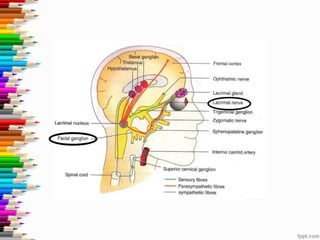
• lacrimal nerve (sensory)
• The facial nerve (parasympathetic)
• The sympathetic nervous system
Histology
Lobe
Lobules
Acinar unit Ductal system
• central lumen,
• a continuous inner layer
of columnar secretory
epithelial cells
• myoepithelial (basket)
cells
• central lumen,
• luminal cell layer
• basal cell layer.
1. Intralobular ducts
2. Interlobular ducts
3. main excretory
ducts
Lacrimal gland architecture
The acinar unit is composed of a central lumen, a
continuous inner epithelial layer of secretory cells,
and an interrupted outer layer of myoepithelial cells.
A larger interlobular duct is seen (middle right). A smaller intralobular duct is
seen among the acini.
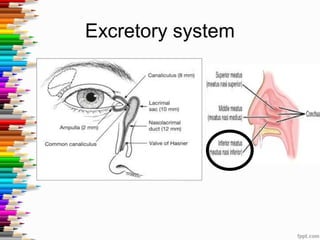
Excretory system
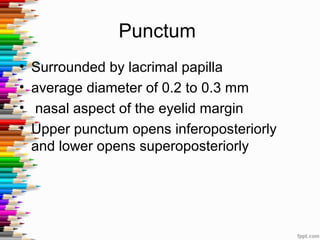
Punctum
• Surrounded by lacrimal papilla
• average diameter of 0.2 to 0.3 mm
• nasal aspect of the eyelid margin
• Upper punctum opens inferoposteriorly
and lower opens superoposteriorly
Canaliculi
• First vertical and then
horizontal
• Vertical=2mm, horizontal 8mm
• Angle has 1mm dilatation
called ampulla
• traverse the lacrimal fascia
individually before they join to
form the common canaliculus
• Stratified squamous epithelium
supported by elastic tissue
Lacrimal sac
• lies within the bony
lacrimal sac fossa
• The layer of periorbita
that covers the lacrimal
fossa is termed the
lacrimal fascia
• 12 mm in height, 4 to 6
mm in depth, and 2 mm
wide.
Nasolacrimal duct
• Inferiorly directed
continuation of the
nasolacrimal sac
• 3 to 4 mm in diameter in
adults and 2 mm in
infants
• 12.5 mm in vertical length
and usually terminates as
a 5-mm extension into the
inferior nasal meatus
Valves
• The mucosal lining of the nasolacrimal duct
contain crypts and folds that usually disappear by
adulthood.
• .The most significant fold is the one situated at the
meatal opening of the nasolacrimal duct called the
valve of Hasner.
• 30% of full-term neonates, there persists a
delicate membrane that, within 6 months after
birth, usually undergoes spontaneous perforation.
• Massage or lacrimal probing may be necessary to
permit patency
Diagram of the valves
and sinuses of the
nasolacrimal passages.
1 = Maier's sinus
2 = Rosenmüller's valve
3 = Arlt's sinus
4 = Kraus's or Béraud's
valve
5 = spiral valve of Hyrtl
6 = Taillefer's valve
7 = Hasner's valve
Prevents sudden blast of air from entering the lacrimal sac
Vascular supply
• The ophthalmic artery terminates as
the dorsal nasal artery, from which
emanates the superior medial
palpebral branches that supply the
lacrimal sac.
• The angular artery perforates the
superior orbital septum above the
medial canthal tendon to send
branches to the lacrimal sac as well
as to the duct.
• The infraorbital artery sends
branches to the lower lid that
eventually pierce the lateral margin
of the upper nasolacrimal canal to
supply the sac as well as the duct.
Venous drainage
• Superior aspect- see picture
• Inferior aspect-sphenophenopalatine
veins into the pterygoid plexus and
the internal maxillary vein
• The angular vein and artery are
important surgical landmarks in
dacryocystorhinostomy surgery.
Lymphatic drainage
• Sac- submaxillary nodes
• Lower aspect of nasolacrimal duct- deep
cervical nodes
Nerve supply
Sensory nerve supply
•sac-infratrochlear nerve
•The lower portion of the nasolacrimal
duct receives sensation from the
anterior superior alveolar branch of the
maxillary division of the fifth cranial
nerve
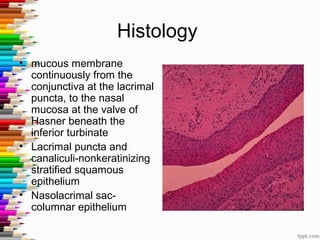
Histology
• mucous membrane
continuously from the
conjunctiva at the lacrimal
puncta, to the nasal
mucosa at the valve of
Hasner beneath the
inferior turbinate
• Lacrimal puncta and
canaliculi-nonkeratinizing
stratified squamous
epithelium
• Nasolacrimal sac-
columnar epithelium
Physiology of lacrimal pump
• Action of orbicularis oculi
Pump mechanism
• (1) the superficial and deep heads of the
pretarsal orbicularis muscle;
• (2) the deep heads of the preseptal
orbicularis muscle; and
• (3) the lacrimal fascia.
Passive phase
• Eyelids open
• The superficial and deep heads of the
pretarsal orbicularis muscle relax
• Canaliculus elongate and the puncta
opens to lie in contact with the lacrimal
lake.
• Aided by capillary attraction, tears collect
within the ampulla and canaliculus.
Passive phase
• The deep head of the preseptal orbicularis
muscle relaxes
• lacrimal sac collapse.
• The positive pressure assisted by gravity
forces fluid within the sac to move into the
nasolacrimal duct.
• The valve of Rosenmüller
prevents retrograde flow of
fluid from the lacrimal sac into
the canaliculus.
Active phase
• eyelid closure
• Contraction of the superficial and deep
head of the pretarsal orbicularis
• The canaliculi shorten and the puncta
close.
Active phase
• contraction of the deep heads of the
preseptal orbicularis muscle
• Fluid within the canaliculi is drawn into the
lacrimal sac by the negative pressure in
sac.
• As the lids reopen and the
passive phase returns
• The lacrimal fascia and sac
resume their relaxed, closed
position.
• The puncta reopen and the
canaliculi elongate, permitting the
drainage system to accept fluid
once again.
Outline
• Introduction
• Embryology
• Osteology
• Secretory system
• Excretory system
• Physiology of lacrimal pump
Thank you
References
• Duane’s Clinical ophthalmology Chapter
21
Orbital Anatomy and Its Clinical
Applications
Deborah D. Sherman, Cat N. Burkat and
Bradley N. Lemke
• American academy of ophthalmology
• Medscape
• internet

lacrimal system

  • 1.
  • 2.
    Outline • Introduction • Embryology •Osteology • Secretory system • Excretory system • Physiology of lacrimal pump
  • 5.
  • 6.
    Introduction • Tear formationand transport • Secretory system • Excretory system
  • 7.
  • 9.
    Lacrimal drainage systemembryology. A. At 5.5 weeks' gestation, an ectodermal invagination forms between the lateral nasal process and maxillary process, which becomes pinched off from the surface. B. At 6 weeks' gestation, a solid cord of ectoderm is located between the primitive medial canthus and nose. C. At 12 weeks' gestation, proliferation of the cord occurs laterally toward the eyelid and inferiorly toward the inferior turbinate. The isolated cavities shown appear at 3 to 4 months. D. At 7 months, canalization is nearly complete, with only the puncta and valve of hasner remaining imperforate.
  • 10.
    • Punctal membranesopen at full term • The membrane of Hasner remains imperforate in up to 70% newborns. This usually opens within the first month but may remain imperforate for a longer time, resulting in epiphora and/or mucopurulent discharge.
  • 11.
    Congenital nasolacrimal duct obstruction Lacrimalduct anlage Congenital atresia of punctum Absence of valves Anomalies of canaliculi
  • 12.
    Osteology • The lacrimalsac fossa is a depression in inferior medial orbital rim • Bordered by anterior lacrimal crest(maxillary bone) and posterior lacrimal crest(lacrimal bone).
  • 13.
    Osteology Frontoethmoidal suture 16mm high*4-9mm wide*2mmdeep • marks the roof of ethmoid sinus • Bony dissection superior to it may expose dura.
  • 14.
    The secretory system 1.Lacrimal gland 2. Accessory glands
  • 15.
    Lacrimal gland orbital lobe(black arrow) and the palpebral lobe (white arrow) separated by the lateral horn of the levator aponeurosis (pointer).
  • 16.
    The orbital part •Almond shape • 65% to 75% of gland • 20 mm long × 5 mm thick × 12 mm wide The sharp anterior border of the left lacrimal gland (black arrow) rests behind the orbital septum (pointer) The temporal portion of the central preaponeurotic fat pad (pointer) rests near the anterior border of the orbital portion of the lacrimal gland
  • 17.
    The palpebral part •25% to 35% of the gland • extends anteriorly beyond the orbital margin to lie in the lateral portion of the superior fornix
  • 18.
    Secretory ducts • 12ducts(2-5 orbital and 6-8 palpebral) • 0.66 mm in diameter and 2.31 mm in length • Exit at conjunctival fornix 4 or 5 mm above the upper border of the tarsus Secretory ducts (arrow 1) of the right lacrimal gland (arrow 2) are seen passing to the palpebral conjunctiva (arrow 3).
  • 19.
    Accessory glands • exocrineglands of Wolfring and Krause
  • 20.
    Blood supply anddrainage • Lacrimal branch of the ophthalmic artery • Lacrimal vein • Preauricular lymphnodes
  • 22.
    Nerve supply • lacrimalnerve (sensory) • The facial nerve (parasympathetic) • The sympathetic nervous system
  • 24.
    Histology Lobe Lobules Acinar unit Ductalsystem • central lumen, • a continuous inner layer of columnar secretory epithelial cells • myoepithelial (basket) cells • central lumen, • luminal cell layer • basal cell layer. 1. Intralobular ducts 2. Interlobular ducts 3. main excretory ducts
  • 25.
    Lacrimal gland architecture Theacinar unit is composed of a central lumen, a continuous inner epithelial layer of secretory cells, and an interrupted outer layer of myoepithelial cells. A larger interlobular duct is seen (middle right). A smaller intralobular duct is seen among the acini.
  • 26.
  • 27.
    Punctum • Surrounded bylacrimal papilla • average diameter of 0.2 to 0.3 mm • nasal aspect of the eyelid margin • Upper punctum opens inferoposteriorly and lower opens superoposteriorly
  • 29.
    Canaliculi • First verticaland then horizontal • Vertical=2mm, horizontal 8mm • Angle has 1mm dilatation called ampulla • traverse the lacrimal fascia individually before they join to form the common canaliculus • Stratified squamous epithelium supported by elastic tissue
  • 30.
    Lacrimal sac • lieswithin the bony lacrimal sac fossa • The layer of periorbita that covers the lacrimal fossa is termed the lacrimal fascia • 12 mm in height, 4 to 6 mm in depth, and 2 mm wide.
  • 31.
    Nasolacrimal duct • Inferiorlydirected continuation of the nasolacrimal sac • 3 to 4 mm in diameter in adults and 2 mm in infants • 12.5 mm in vertical length and usually terminates as a 5-mm extension into the inferior nasal meatus
  • 32.
    Valves • The mucosallining of the nasolacrimal duct contain crypts and folds that usually disappear by adulthood. • .The most significant fold is the one situated at the meatal opening of the nasolacrimal duct called the valve of Hasner. • 30% of full-term neonates, there persists a delicate membrane that, within 6 months after birth, usually undergoes spontaneous perforation. • Massage or lacrimal probing may be necessary to permit patency
  • 33.
    Diagram of thevalves and sinuses of the nasolacrimal passages. 1 = Maier's sinus 2 = Rosenmüller's valve 3 = Arlt's sinus 4 = Kraus's or Béraud's valve 5 = spiral valve of Hyrtl 6 = Taillefer's valve 7 = Hasner's valve Prevents sudden blast of air from entering the lacrimal sac
  • 34.
    Vascular supply • Theophthalmic artery terminates as the dorsal nasal artery, from which emanates the superior medial palpebral branches that supply the lacrimal sac. • The angular artery perforates the superior orbital septum above the medial canthal tendon to send branches to the lacrimal sac as well as to the duct. • The infraorbital artery sends branches to the lower lid that eventually pierce the lateral margin of the upper nasolacrimal canal to supply the sac as well as the duct.
  • 35.
    Venous drainage • Superioraspect- see picture • Inferior aspect-sphenophenopalatine veins into the pterygoid plexus and the internal maxillary vein • The angular vein and artery are important surgical landmarks in dacryocystorhinostomy surgery.
  • 36.
    Lymphatic drainage • Sac-submaxillary nodes • Lower aspect of nasolacrimal duct- deep cervical nodes Nerve supply Sensory nerve supply •sac-infratrochlear nerve •The lower portion of the nasolacrimal duct receives sensation from the anterior superior alveolar branch of the maxillary division of the fifth cranial nerve
  • 37.
    Histology • mucous membrane continuouslyfrom the conjunctiva at the lacrimal puncta, to the nasal mucosa at the valve of Hasner beneath the inferior turbinate • Lacrimal puncta and canaliculi-nonkeratinizing stratified squamous epithelium • Nasolacrimal sac- columnar epithelium
  • 38.
    Physiology of lacrimalpump • Action of orbicularis oculi Pump mechanism • (1) the superficial and deep heads of the pretarsal orbicularis muscle; • (2) the deep heads of the preseptal orbicularis muscle; and • (3) the lacrimal fascia.
  • 39.
    Passive phase • Eyelidsopen • The superficial and deep heads of the pretarsal orbicularis muscle relax • Canaliculus elongate and the puncta opens to lie in contact with the lacrimal lake. • Aided by capillary attraction, tears collect within the ampulla and canaliculus.
  • 40.
    Passive phase • Thedeep head of the preseptal orbicularis muscle relaxes • lacrimal sac collapse. • The positive pressure assisted by gravity forces fluid within the sac to move into the nasolacrimal duct.
  • 41.
    • The valveof Rosenmüller prevents retrograde flow of fluid from the lacrimal sac into the canaliculus.
  • 42.
    Active phase • eyelidclosure • Contraction of the superficial and deep head of the pretarsal orbicularis • The canaliculi shorten and the puncta close.
  • 43.
    Active phase • contractionof the deep heads of the preseptal orbicularis muscle • Fluid within the canaliculi is drawn into the lacrimal sac by the negative pressure in sac.
  • 44.
    • As thelids reopen and the passive phase returns • The lacrimal fascia and sac resume their relaxed, closed position. • The puncta reopen and the canaliculi elongate, permitting the drainage system to accept fluid once again.
  • 45.
    Outline • Introduction • Embryology •Osteology • Secretory system • Excretory system • Physiology of lacrimal pump
  • 46.
  • 47.
    References • Duane’s Clinicalophthalmology Chapter 21 Orbital Anatomy and Its Clinical Applications Deborah D. Sherman, Cat N. Burkat and Bradley N. Lemke • American academy of ophthalmology • Medscape • internet