Conjunctiva and
sclera
Outline
• Conjunctiva
• sclera
Conjunctiva
• Introduction
• Surface anatomy
• Conjunctival layers
• Blood supply and drainage and nerve
supply
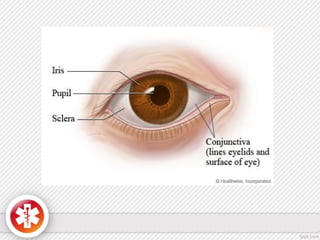
What is conjunctiva?
• Vascularized mucous membrane that
covers the anterior surface of the globe
(bulbar and forniceal conjunctiva) and the
posterior surface of the upper and lower
eyelids (palpebral conjunctiva).
Combats infection
1. Highly vascular
2. The different cell types can initiate and
participate in defensive inflammatory
reaction
3. Immunocompetent cells that contribute a
rich supply of immunoglobulins
4. The surface anatomy (microvilli) and
biochemistry (enzymatic activity) enable that
tissue to engulf and neutralize foreign
particles, such as viruses
Surface anatomy
• The conjunctiva lines the posterior surface
of the upper and lower lids and the
anterior surface of the globe
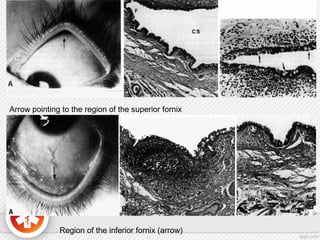
• Forms superior fornix(8-10mm from
limbus) and inferior fornix(8 mm from
limbus)
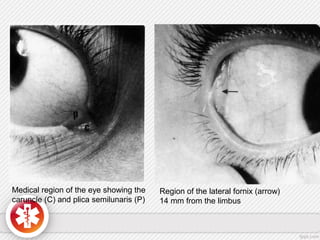
• Caruncle and the plica semilunaris
Arrow pointing to the region of the superior fornix
Region of the inferior fornix (arrow)
Medical region of the eye showing the
caruncle (C) and plica semilunaris (P)
Region of the lateral fornix (arrow)
14 mm from the limbus
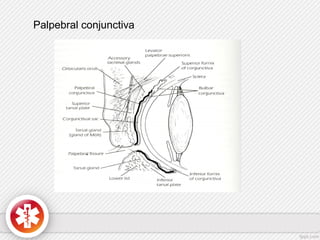
Palpebral conjunctiva
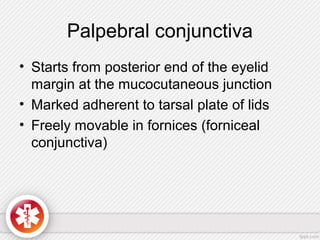
• Starts from posterior end of the eyelid
margin at the mucocutaneous junction
• Marked adherent to tarsal plate of lids
• Freely movable in fornices (forniceal
conjunctiva)
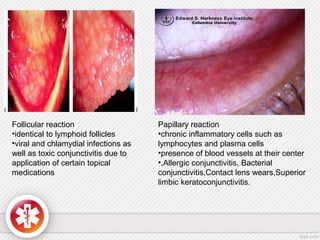
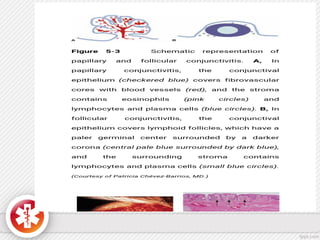
Follicular reaction
•identical to lymphoid follicles
•viral and chlamydial infections as
well as toxic conjunctivitis due to
application of certain topical
medications
Papillary reaction
•chronic inflammatory cells such as
lymphocytes and plasma cells
•presence of blood vessels at their center
•,Allergic conjunctivitis, Bacterial
conjunctivitis,Contact lens wears,Superior
limbic keratoconjunctivitis.
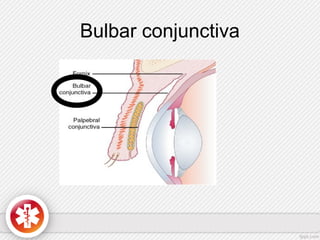
Bulbar conjunctiva
Bulbar conjunctiva
• limbus to the forniceal area.
• thin and translucent.
• loosely adherent to the sclera to allow the eye free
movement in all directions.
• Approximately 3 mm from the limbus, the bulbar
conjunctiva, Tenon's capsule, and sclera become
firmly attached, and the conjunctiva cannot be
easily picked up.
This attachment is routinely
encountered during the dissection
of a limbal-based conjunctival flap
in ocular surgery.
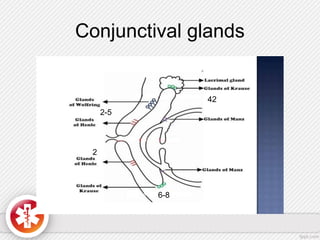
Conjunctival glands
42
6-8
2-5
2
Conjunctival layers
• The stratified epithelial layer
• The substantia propria layer
Conjunctival epithelium
• 2 to 4 layers-upper tarsal portion
• 6 to 8 layers-corneoscleral junction,
• 8 to 10 layers-conjunctival margins
Conjunctival epithelium
• Columnar in the fornix
• Cuboidal on the bulbar and tarsal
conjunctiva
Types of cells
• Type I cells are the goblet cells
• Type II cells are defined by the numerous
60- to 300-nm electron-dense granules
• Type III cells are recognizable by their well
developed Golgi complex
• type IV cells are characterized by rough
endoplasmic reticulum
• Type V cells are identified by the high
content of mitochondria
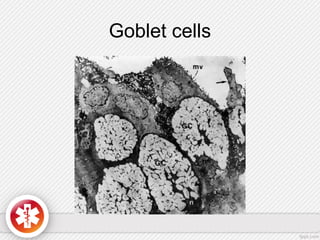
Goblet cells
Goblet cells
• middle and superficial layers of the
epithelium
• 25 by 25 μm
• 2.2 μL of mucus daily
Function of goblet cell mucus
• Preserve stability of tear film
• Local immunity
• Cleansing mechanism of the eye
• Traps cell debris, foreign bodies, and
bacteria
• inflammatory response
Substantia propria
• Connective tissue layer
• Anti-infectious potential
• Numerous mast cells (6000/mm3),
lymphocytes, plasma cells, and
neutrophils are normally present in this
layer.
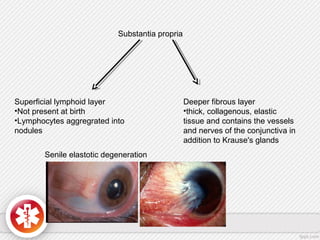
Substantia propria
Superficial lymphoid layer
•Not present at birth
•Lymphocytes aggregrated into
nodules
Deeper fibrous layer
•thick, collagenous, elastic
tissue and contains the vessels
and nerves of the conjunctiva in
addition to Krause's glands
Senile elastotic degeneration
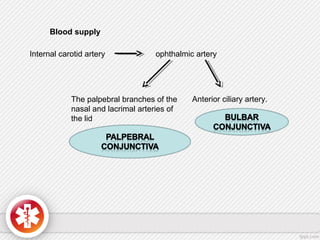
Blood supply
Internal carotid artery ophthalmic artery
The palpebral branches of the
nasal and lacrimal arteries of
the lid
Anterior ciliary artery.
Venous drainage
• numerous than the arteries
• tarsal conjunctiva and the bulbar
conjunctiva is directed to the palpebral
veins
• superior and inferior ophthalmic veins
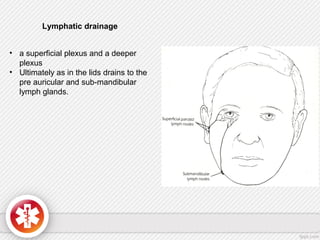
Lymphatic drainage
• a superficial plexus and a deeper
plexus
• Ultimately as in the lids drains to the
pre auricular and sub-mandibular
lymph glands.
Nerve supply
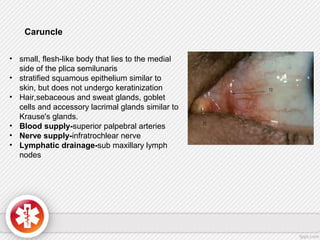
Caruncle
• small, flesh-like body that lies to the medial
side of the plica semilunaris
• stratified squamous epithelium similar to
skin, but does not undergo keratinization
• Hair,sebaceous and sweat glands, goblet
cells and accessory lacrimal glands similar to
Krause's glands.
• Blood supply-superior palpebral arteries
• Nerve supply-infratrochlear nerve
• Lymphatic drainage-sub maxillary lymph
nodes
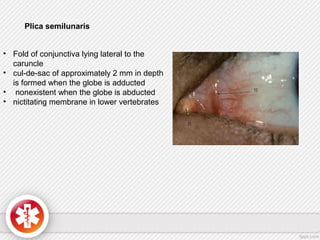
Plica semilunaris
• Fold of conjunctiva lying lateral to the
caruncle
• cul-de-sac of approximately 2 mm in depth
is formed when the globe is adducted
• nonexistent when the globe is abducted
• nictitating membrane in lower vertebrates
Sclera
• Introduction
• Development
• Gross anatomy
• Layers
• Blood supply,drainage and nerve supply
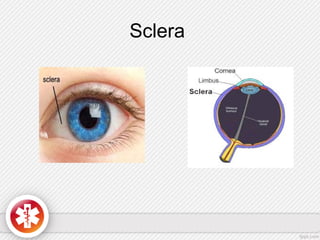
Sclera
Introduction
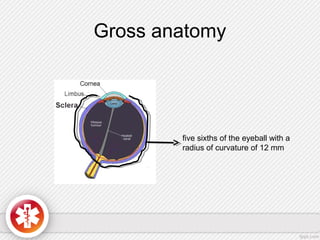
• dense connective tissue that accounts for five
sixths of the outer coat of the eyeball
• sklera mannix- hard membrane
1.protects intraocular components from trauma,
light, and mechanical displacement
2.withstands the considerable expansive force
generated by the intraocular pressure
maintaining the shape of the globe
3.provides attachment sites for the extraocular
muscles.
Prenatal development
• neural crest-mesodermal origin
• anterior to posterior and from inside to
outside
5th
week double-layered optic cup or
neuroectoderm
6th
week Differentiation into sclera
and choroid anterior to
equator
8th
week Backward to the equator
12th
week Posterior pole
4th
month Scleral spur
5th
month Lamina cibrosa
Postnatal development and age
related characterstics
• Postnatal- relatively thin, bluish,
distensible, small, and translucent
• Childhood and puberty-thicker, whiter, less
distensible, larger, and more opaque
• Adult- poorly distensible,opaque or
translucent depending on water content
• Elderly- less distensible,yellowish color
and senile scleral plaques.
Gross anatomy
five sixths of the eyeball with a
radius of curvature of 12 mm
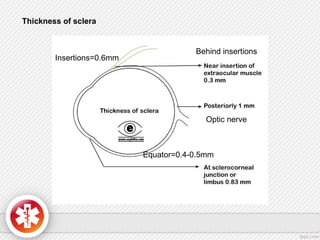
Optic nerve
Equator=0.4-0.5mm
Behind insertions
Insertions=0.6mm
Thickness of sclera
Clinical applications
• The traumatic scleral rupture
• Strabismus surgery.
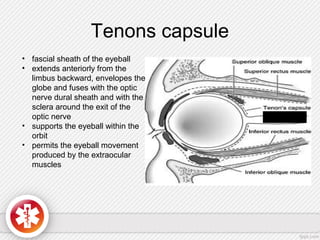
Tenons capsule
• fascial sheath of the eyeball
• extends anteriorly from the
limbus backward, envelopes the
globe and fuses with the optic
nerve dural sheath and with the
sclera around the exit of the
optic nerve
• supports the eyeball within the
orbit
• permits the eyeball movement
produced by the extraocular
muscles
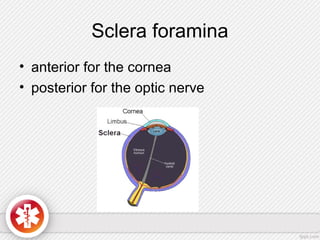
Sclera foramina
• anterior for the cornea
• posterior for the optic nerve
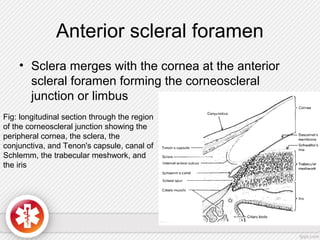
Anterior scleral foramen
• Sclera merges with the cornea at the anterior
scleral foramen forming the corneoscleral
junction or limbus
Fig: longitudinal section through the region
of the corneoscleral junction showing the
peripheral cornea, the sclera, the
conjunctiva, and Tenon's capsule, canal of
Schlemm, the trabecular meshwork, and
the iris
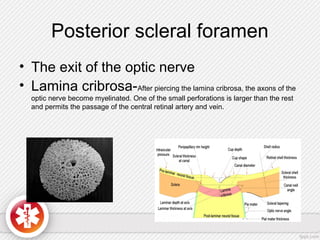
Posterior scleral foramen
• The exit of the optic nerve
• Lamina cribrosa-After piercing the lamina cribrosa, the axons of the
optic nerve become myelinated. One of the small perforations is larger than the rest
and permits the passage of the central retinal artery and vein.
Layers of sclera
• Episclera
• Scleral stroma
• Lamina fusca
Episclera
• Superficial aspect of sclera
• bundles of collagen circumferentially
arranged
• rich blood supply anteriorly
• thickest anterior to the rectus muscle
insertions and becomes progressively
thinner toward the back of the eye.
Scleral stroma
• bundles of collagen intermingled with
fibroblasts, melanocytes, elastic fibers,
proteoglycans, and glycoproteins
• variability in collagen fiber diameter,
interlacing in bundles of collagen, and
relative deficiency in water-binding
substances accounts for the scleral dull-
white color.
Lamina fusca
• Brown color due to melanocytes
• grooves for the passage of ciliary vessels
and nerves (emissary canals)
• attached to the choroid by fine collagen
fibers
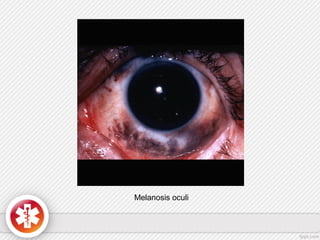
Melanosis oculi
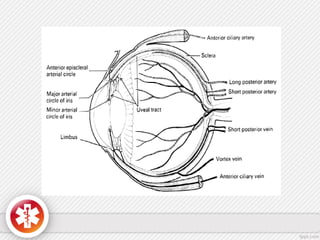
Blood supply
• Episclera-anterior and posterior ciliary
arteries
• Scleral stroma-relatively avasculature
structure
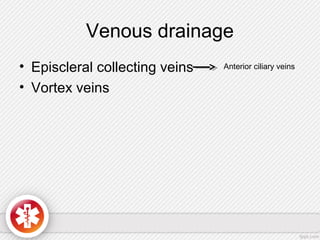
Venous drainage
• Episcleral collecting veins
• Vortex veins
Anterior ciliary veins
Nerve supply
• Rich in nerve supply
• Anterior sclera- long posterior ciliary
nerves
• Posterior sclera- short posterior ciliary
nerves
• Pain- inflammation, stretching due to
oedema and movement of eye
Thank you
References
1. Fundamentals and principles of Ophthalmology,section
2,2014-2015, American Academy of Ophthalmology
2. External Disease and Cornea, Section 8, 2014-2015,
American Academy of Ophthalmology
3. Duane's Foundations of Clinical Ophthalmology, Foundation
volume 1
4. Jack J Kanski, Brad Bowling, Clinical Ophthalmology,
seventh edition 2011
5. M.J. Roper- Hall, Stallard’s Eye Surgery, Seventh Edition,
1989
6. Parsons’ Diseases of the Eye, Twentieth Edition 2007
7. Internet

Conjunctiva

  • 1.
  • 2.
  • 3.
    Conjunctiva • Introduction • Surfaceanatomy • Conjunctival layers • Blood supply and drainage and nerve supply
  • 5.
    What is conjunctiva? •Vascularized mucous membrane that covers the anterior surface of the globe (bulbar and forniceal conjunctiva) and the posterior surface of the upper and lower eyelids (palpebral conjunctiva).
  • 6.
    Combats infection 1. Highlyvascular 2. The different cell types can initiate and participate in defensive inflammatory reaction 3. Immunocompetent cells that contribute a rich supply of immunoglobulins 4. The surface anatomy (microvilli) and biochemistry (enzymatic activity) enable that tissue to engulf and neutralize foreign particles, such as viruses
  • 7.
    Surface anatomy • Theconjunctiva lines the posterior surface of the upper and lower lids and the anterior surface of the globe • Forms superior fornix(8-10mm from limbus) and inferior fornix(8 mm from limbus) • Caruncle and the plica semilunaris
  • 8.
    Arrow pointing tothe region of the superior fornix Region of the inferior fornix (arrow)
  • 9.
    Medical region ofthe eye showing the caruncle (C) and plica semilunaris (P) Region of the lateral fornix (arrow) 14 mm from the limbus
  • 10.
  • 11.
    Palpebral conjunctiva • Startsfrom posterior end of the eyelid margin at the mucocutaneous junction • Marked adherent to tarsal plate of lids • Freely movable in fornices (forniceal conjunctiva)
  • 12.
    Follicular reaction •identical tolymphoid follicles •viral and chlamydial infections as well as toxic conjunctivitis due to application of certain topical medications Papillary reaction •chronic inflammatory cells such as lymphocytes and plasma cells •presence of blood vessels at their center •,Allergic conjunctivitis, Bacterial conjunctivitis,Contact lens wears,Superior limbic keratoconjunctivitis.
  • 14.
  • 15.
    Bulbar conjunctiva • limbusto the forniceal area. • thin and translucent. • loosely adherent to the sclera to allow the eye free movement in all directions. • Approximately 3 mm from the limbus, the bulbar conjunctiva, Tenon's capsule, and sclera become firmly attached, and the conjunctiva cannot be easily picked up. This attachment is routinely encountered during the dissection of a limbal-based conjunctival flap in ocular surgery.
  • 16.
  • 17.
    Conjunctival layers • Thestratified epithelial layer • The substantia propria layer
  • 18.
    Conjunctival epithelium • 2to 4 layers-upper tarsal portion • 6 to 8 layers-corneoscleral junction, • 8 to 10 layers-conjunctival margins
  • 19.
    Conjunctival epithelium • Columnarin the fornix • Cuboidal on the bulbar and tarsal conjunctiva
  • 20.
    Types of cells •Type I cells are the goblet cells • Type II cells are defined by the numerous 60- to 300-nm electron-dense granules • Type III cells are recognizable by their well developed Golgi complex • type IV cells are characterized by rough endoplasmic reticulum • Type V cells are identified by the high content of mitochondria
  • 21.
  • 22.
    Goblet cells • middleand superficial layers of the epithelium • 25 by 25 μm • 2.2 μL of mucus daily
  • 23.
    Function of gobletcell mucus • Preserve stability of tear film • Local immunity • Cleansing mechanism of the eye • Traps cell debris, foreign bodies, and bacteria • inflammatory response
  • 24.
    Substantia propria • Connectivetissue layer • Anti-infectious potential • Numerous mast cells (6000/mm3), lymphocytes, plasma cells, and neutrophils are normally present in this layer.
  • 25.
    Substantia propria Superficial lymphoidlayer •Not present at birth •Lymphocytes aggregrated into nodules Deeper fibrous layer •thick, collagenous, elastic tissue and contains the vessels and nerves of the conjunctiva in addition to Krause's glands Senile elastotic degeneration
  • 26.
    Blood supply Internal carotidartery ophthalmic artery The palpebral branches of the nasal and lacrimal arteries of the lid Anterior ciliary artery.
  • 27.
    Venous drainage • numerousthan the arteries • tarsal conjunctiva and the bulbar conjunctiva is directed to the palpebral veins • superior and inferior ophthalmic veins
  • 28.
    Lymphatic drainage • asuperficial plexus and a deeper plexus • Ultimately as in the lids drains to the pre auricular and sub-mandibular lymph glands.
  • 29.
  • 30.
    Caruncle • small, flesh-likebody that lies to the medial side of the plica semilunaris • stratified squamous epithelium similar to skin, but does not undergo keratinization • Hair,sebaceous and sweat glands, goblet cells and accessory lacrimal glands similar to Krause's glands. • Blood supply-superior palpebral arteries • Nerve supply-infratrochlear nerve • Lymphatic drainage-sub maxillary lymph nodes
  • 31.
    Plica semilunaris • Foldof conjunctiva lying lateral to the caruncle • cul-de-sac of approximately 2 mm in depth is formed when the globe is adducted • nonexistent when the globe is abducted • nictitating membrane in lower vertebrates
  • 32.
    Sclera • Introduction • Development •Gross anatomy • Layers • Blood supply,drainage and nerve supply
  • 33.
  • 34.
    Introduction • dense connectivetissue that accounts for five sixths of the outer coat of the eyeball • sklera mannix- hard membrane 1.protects intraocular components from trauma, light, and mechanical displacement 2.withstands the considerable expansive force generated by the intraocular pressure maintaining the shape of the globe 3.provides attachment sites for the extraocular muscles.
  • 35.
    Prenatal development • neuralcrest-mesodermal origin • anterior to posterior and from inside to outside 5th week double-layered optic cup or neuroectoderm 6th week Differentiation into sclera and choroid anterior to equator 8th week Backward to the equator 12th week Posterior pole 4th month Scleral spur 5th month Lamina cibrosa
  • 36.
    Postnatal development andage related characterstics • Postnatal- relatively thin, bluish, distensible, small, and translucent • Childhood and puberty-thicker, whiter, less distensible, larger, and more opaque • Adult- poorly distensible,opaque or translucent depending on water content • Elderly- less distensible,yellowish color and senile scleral plaques.
  • 37.
    Gross anatomy five sixthsof the eyeball with a radius of curvature of 12 mm
  • 38.
  • 39.
    Clinical applications • Thetraumatic scleral rupture • Strabismus surgery.
  • 40.
    Tenons capsule • fascialsheath of the eyeball • extends anteriorly from the limbus backward, envelopes the globe and fuses with the optic nerve dural sheath and with the sclera around the exit of the optic nerve • supports the eyeball within the orbit • permits the eyeball movement produced by the extraocular muscles
  • 41.
    Sclera foramina • anteriorfor the cornea • posterior for the optic nerve
  • 42.
    Anterior scleral foramen •Sclera merges with the cornea at the anterior scleral foramen forming the corneoscleral junction or limbus Fig: longitudinal section through the region of the corneoscleral junction showing the peripheral cornea, the sclera, the conjunctiva, and Tenon's capsule, canal of Schlemm, the trabecular meshwork, and the iris
  • 43.
    Posterior scleral foramen •The exit of the optic nerve • Lamina cribrosa-After piercing the lamina cribrosa, the axons of the optic nerve become myelinated. One of the small perforations is larger than the rest and permits the passage of the central retinal artery and vein.
  • 44.
    Layers of sclera •Episclera • Scleral stroma • Lamina fusca
  • 45.
    Episclera • Superficial aspectof sclera • bundles of collagen circumferentially arranged • rich blood supply anteriorly • thickest anterior to the rectus muscle insertions and becomes progressively thinner toward the back of the eye.
  • 46.
    Scleral stroma • bundlesof collagen intermingled with fibroblasts, melanocytes, elastic fibers, proteoglycans, and glycoproteins • variability in collagen fiber diameter, interlacing in bundles of collagen, and relative deficiency in water-binding substances accounts for the scleral dull- white color.
  • 47.
    Lamina fusca • Browncolor due to melanocytes • grooves for the passage of ciliary vessels and nerves (emissary canals) • attached to the choroid by fine collagen fibers
  • 48.
  • 49.
    Blood supply • Episclera-anteriorand posterior ciliary arteries • Scleral stroma-relatively avasculature structure
  • 51.
    Venous drainage • Episcleralcollecting veins • Vortex veins Anterior ciliary veins
  • 52.
    Nerve supply • Richin nerve supply • Anterior sclera- long posterior ciliary nerves • Posterior sclera- short posterior ciliary nerves • Pain- inflammation, stretching due to oedema and movement of eye
  • 53.
  • 54.
    References 1. Fundamentals andprinciples of Ophthalmology,section 2,2014-2015, American Academy of Ophthalmology 2. External Disease and Cornea, Section 8, 2014-2015, American Academy of Ophthalmology 3. Duane's Foundations of Clinical Ophthalmology, Foundation volume 1 4. Jack J Kanski, Brad Bowling, Clinical Ophthalmology, seventh edition 2011 5. M.J. Roper- Hall, Stallard’s Eye Surgery, Seventh Edition, 1989 6. Parsons’ Diseases of the Eye, Twentieth Edition 2007 7. Internet