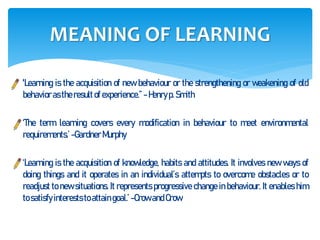
'Learning is the acquisition of new behaviour or the strengthening or weakening of old
behaviorastheresultof experience.” - Henryp. Smith
‘The term learning covers every modification in behaviour to meet environmental
requirements.’-Gardner Murphy
‘Learning is the acquisition of knowledge, habits and attitudes. It involves new ways of
doing things and it operates in an individual’s attempts to overcome obstacles or to
readjust to new situations. It represents progressive change in behaviour. It enables him
to satisfyintereststo attaingoal.’ -Crow and Crow
MEANING OF LEARNING
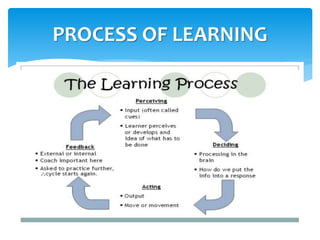
PROCESS OF LEARNING
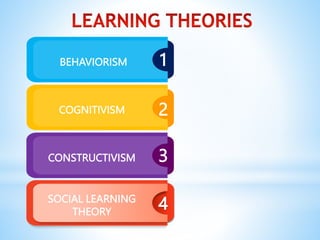
assumesalearnerisessentially
passive,andwill beshaped through
positive or negative reinforcement. 1
BEHAVIORISM
Learningisunderstoodastheacquisitionof
knowledge:thelearnerisaninformation-
processorwhoabsorbsinformation,undertakes
cognitiveoperationsonit,andstocksitin
memory.
2
COGNITIVISM
learners actively construct or create
their own subjective representations of
objective reality,and link new
information to priorknowledge.
3
CONSTRUCTIVISM
4
childrenlearn fromobserving others as
well asfrom“model” behaviour, which are
processes involving attention, retention,
reproduction and motivation.
SOCIAL LEARNING
THEORY
Different psychologists have defined various laws of learning. Amongst
these, psychologist Thorndike formulated three major laws of learning
whicharewidely accepted andappliedinthefieldof education.They are:
 Law of Readiness: When a person is ready to act or to learn, he acts or
learns more effectively and with greater satisfaction than when not
ready. Before actuallearning,onemustbementally prepared.
LAWS OF LEARNING
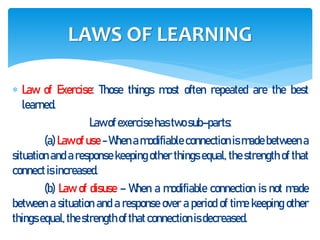
 Law of Exercise: Those things most often repeated are the best
learned.
Lawofexercise hastwosub–parts:
(a) Law of use - When a modifiable connection is made between a
situation and a response keeping other things equal, the strength of that
connectisincreased.
(b) Law of disuse – When a modifiable connection is not made
between a situation and a response over a period of time keeping other
things equal, thestrength of thatconnectionis decreased.
LAWS OF LEARNING
 Law of Effect: means that the learning takes place properly
when it results in satisfaction and the learner derives
pleasure out of it . On the other hand, if the learner faces
failure or get dissatisfaction, the progress on the path of
learningishampered.
LAWS OF LEARNING
TRILOGY OF EFFECTIVE TEACHING
TEACHER LEARNER LEARNING
PROCESS
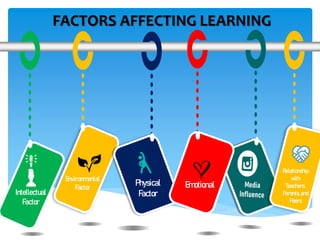
Intellectual
Factor
FACTORS AFFECTING LEARNING
Environmental
Factor
Physical
Factor
Emotional
Relationship
with
Teachers,
Parents,and
Peers
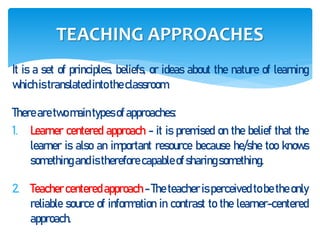
It is a set of principles, beliefs, or ideas about the nature of learning
whichistranslated intotheclassroom.
There aretwo maintypes of approaches:
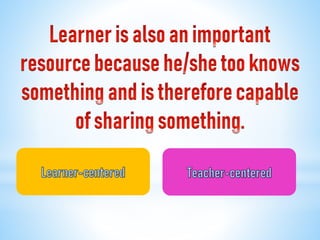
1. Learner centered approach - it is premised on the belief that the
learner is also an important resource because he/she too knows
something andis therefore capableof sharingsomething.
2. Teacher centered approach - The teacher is perceived to be the only
reliable source of information in contrast to the learner-centered
approach.
TEACHING APPROACHES
Educ 201-Learning and Information Processing

Educ 201-Learning and Information Processing

  • 2.
    'Learning is theacquisition of new behaviour or the strengthening or weakening of old behaviorastheresultof experience.” - Henryp. Smith ‘The term learning covers every modification in behaviour to meet environmental requirements.’-Gardner Murphy ‘Learning is the acquisition of knowledge, habits and attitudes. It involves new ways of doing things and it operates in an individual’s attempts to overcome obstacles or to readjust to new situations. It represents progressive change in behaviour. It enables him to satisfyintereststo attaingoal.’ -Crow and Crow MEANING OF LEARNING
  • 3.
  • 4.
    assumesalearnerisessentially passive,andwill beshaped through positiveor negative reinforcement. 1 BEHAVIORISM Learningisunderstoodastheacquisitionof knowledge:thelearnerisaninformation- processorwhoabsorbsinformation,undertakes cognitiveoperationsonit,andstocksitin memory. 2 COGNITIVISM learners actively construct or create their own subjective representations of objective reality,and link new information to priorknowledge. 3 CONSTRUCTIVISM 4 childrenlearn fromobserving others as well asfrom“model” behaviour, which are processes involving attention, retention, reproduction and motivation. SOCIAL LEARNING THEORY
  • 5.
    Different psychologists havedefined various laws of learning. Amongst these, psychologist Thorndike formulated three major laws of learning whicharewidely accepted andappliedinthefieldof education.They are:  Law of Readiness: When a person is ready to act or to learn, he acts or learns more effectively and with greater satisfaction than when not ready. Before actuallearning,onemustbementally prepared. LAWS OF LEARNING
  • 6.
     Law ofExercise: Those things most often repeated are the best learned. Lawofexercise hastwosub–parts: (a) Law of use - When a modifiable connection is made between a situation and a response keeping other things equal, the strength of that connectisincreased. (b) Law of disuse – When a modifiable connection is not made between a situation and a response over a period of time keeping other things equal, thestrength of thatconnectionis decreased. LAWS OF LEARNING
  • 7.
     Law ofEffect: means that the learning takes place properly when it results in satisfaction and the learner derives pleasure out of it . On the other hand, if the learner faces failure or get dissatisfaction, the progress on the path of learningishampered. LAWS OF LEARNING
  • 8.
  • 12.
    TRILOGY OF EFFECTIVETEACHING TEACHER LEARNER LEARNING PROCESS
  • 13.
  • 25.
    It is aset of principles, beliefs, or ideas about the nature of learning whichistranslated intotheclassroom. There aretwo maintypes of approaches: 1. Learner centered approach - it is premised on the belief that the learner is also an important resource because he/she too knows something andis therefore capableof sharingsomething. 2. Teacher centered approach - The teacher is perceived to be the only reliable source of information in contrast to the learner-centered approach. TEACHING APPROACHES