LEARNING
PREPARE BY:
MS.MEERA CHANDRAN
DEFINITION
 HENRY P.SMITH: “ Learning is the acquisition
of new behavior or the strengthening or
weakening of old behavior as a result of
experience”.
 WOODWORTH : “Any activity can be called
Learning so far as it develops the individual (in
any aspects, good or bad) & makes his
behavior & experiences different from what
otherwise would have been”.
FEATURES OF LEARNING:
•1. Learning is a change in behavior for better or
worse. •
•2. It is a change that takes place through
practice & experience.
•3. The change in behavior must be relatively
permanent i.e it must last for a long time,
learning lasting for days, months, years.
CONCEPT OF LEARNING:
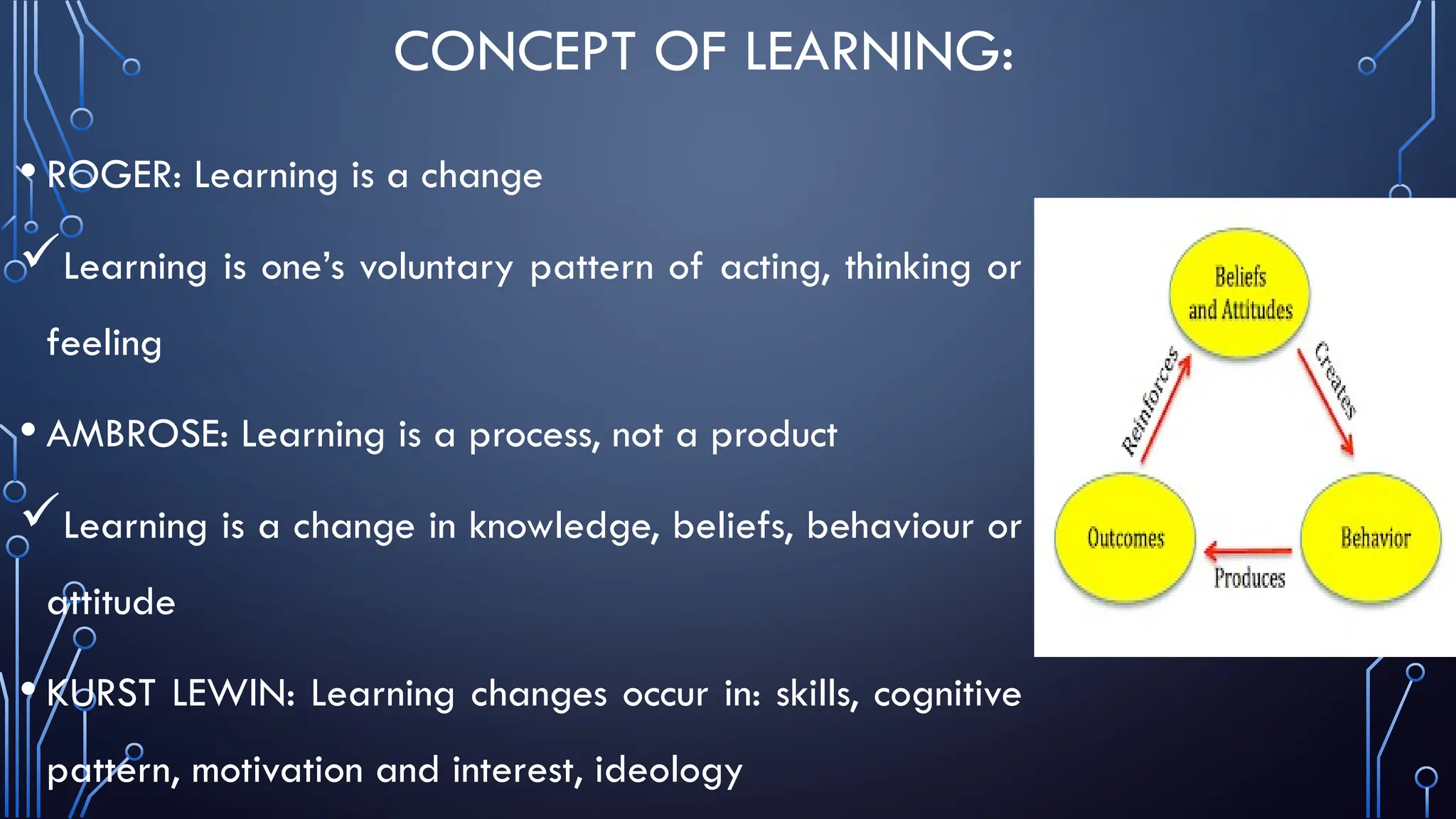
• ROGER: Learning is a change
Learning is one’s voluntary pattern of acting, thinking or
feeling
• AMBROSE: Learning is a process, not a product
Learning is a change in knowledge, beliefs, behaviour or
attitude
• KURST LEWIN: Learning changes occur in: skills, cognitive
pattern, motivation and interest, ideology
CONCEPT OF LEARNING:
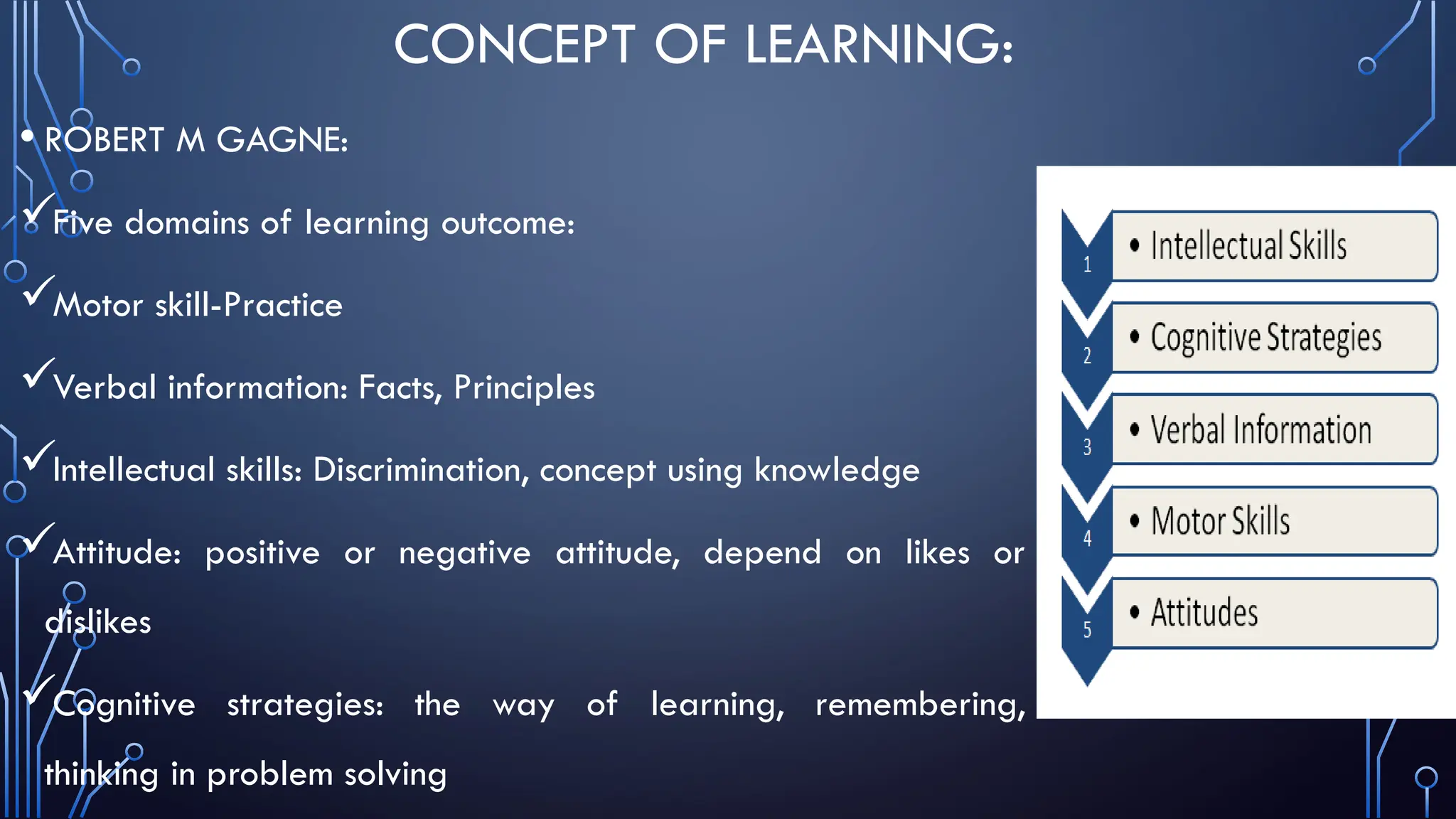
• ROBERT M GAGNE:
Five domains of learning outcome:
Motor skill-Practice
Verbal information: Facts, Principles
Intellectual skills: Discrimination, concept using knowledge
Attitude: positive or negative attitude, depend on likes or
dislikes
Cognitive strategies: the way of learning, remembering,
thinking in problem solving
NATURE OF LEARNING
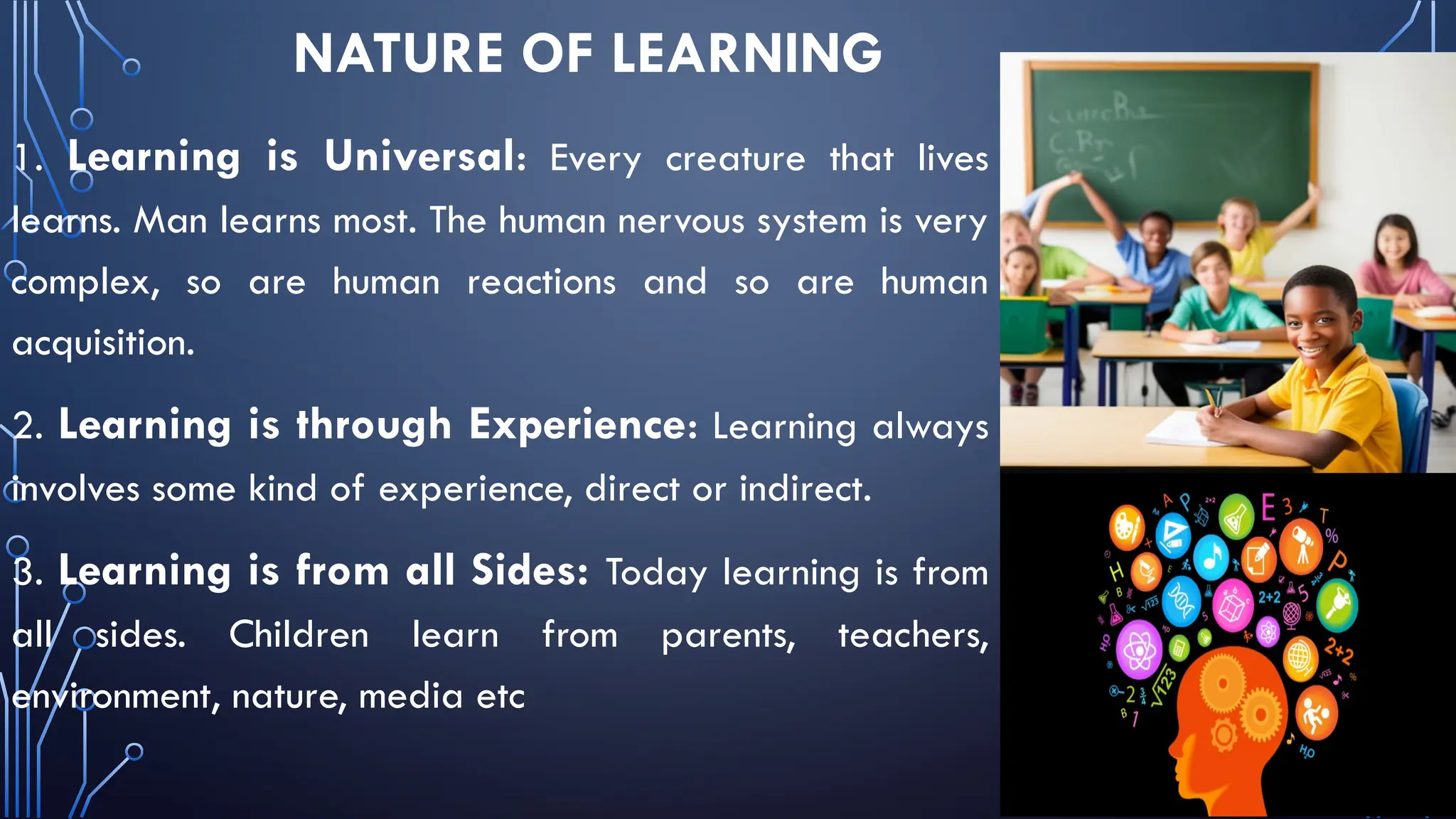
1. Learning is Universal: Every creature that lives
learns. Man learns most. The human nervous system is very
complex, so are human reactions and so are human
acquisition.
2. Learning is through Experience: Learning always
involves some kind of experience, direct or indirect.
3. Learning is from all Sides: Today learning is from
all sides. Children learn from parents, teachers,
environment, nature, media etc
NATURE OF LEARNING
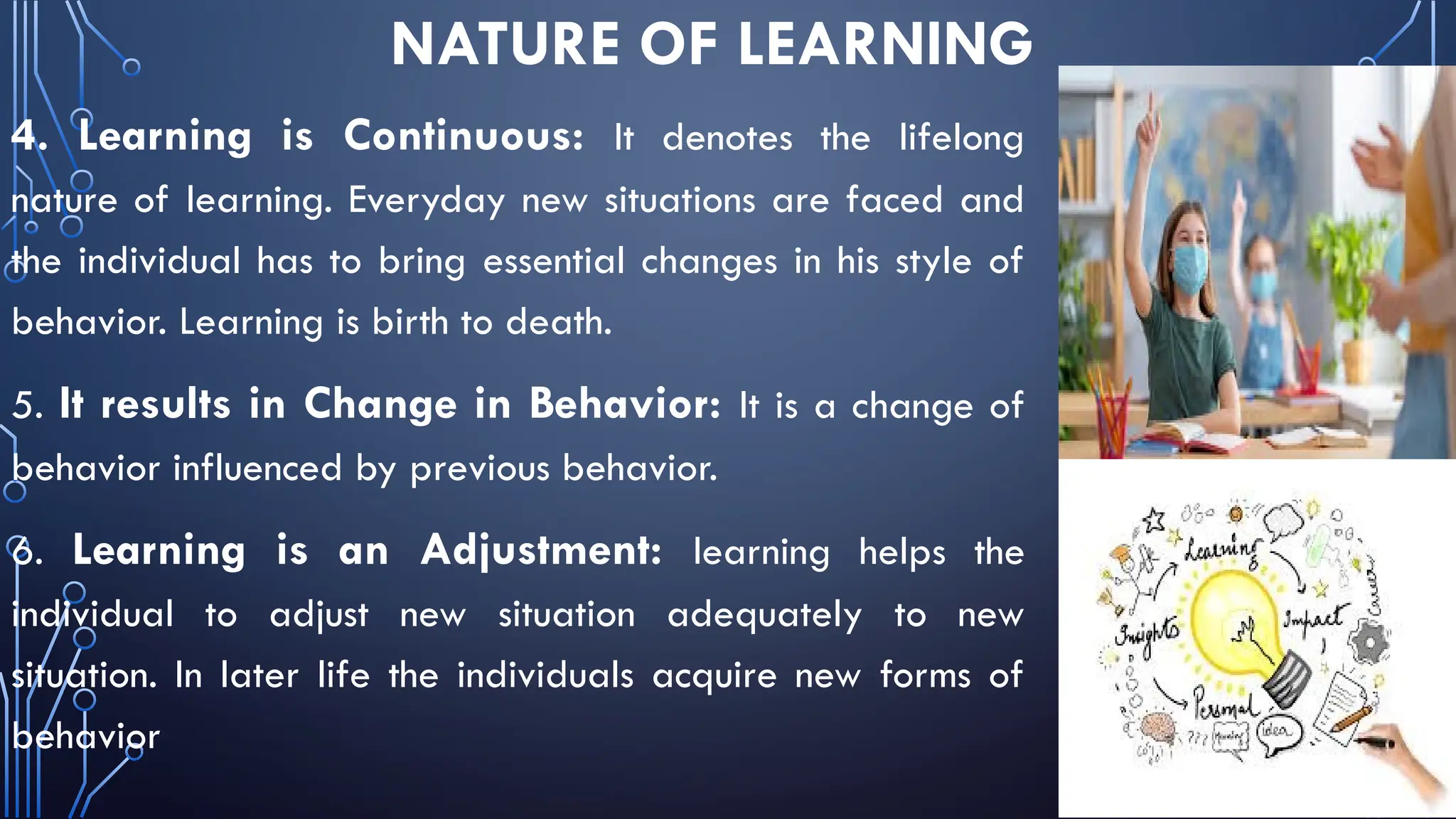
4. Learning is Continuous: It denotes the lifelong
nature of learning. Everyday new situations are faced and
the individual has to bring essential changes in his style of
behavior. Learning is birth to death.
5. It results in Change in Behavior: It is a change of
behavior influenced by previous behavior.
6. Learning is an Adjustment: learning helps the
individual to adjust new situation adequately to new
situation. In later life the individuals acquire new forms of
behavior
NATURE OF LEARNING
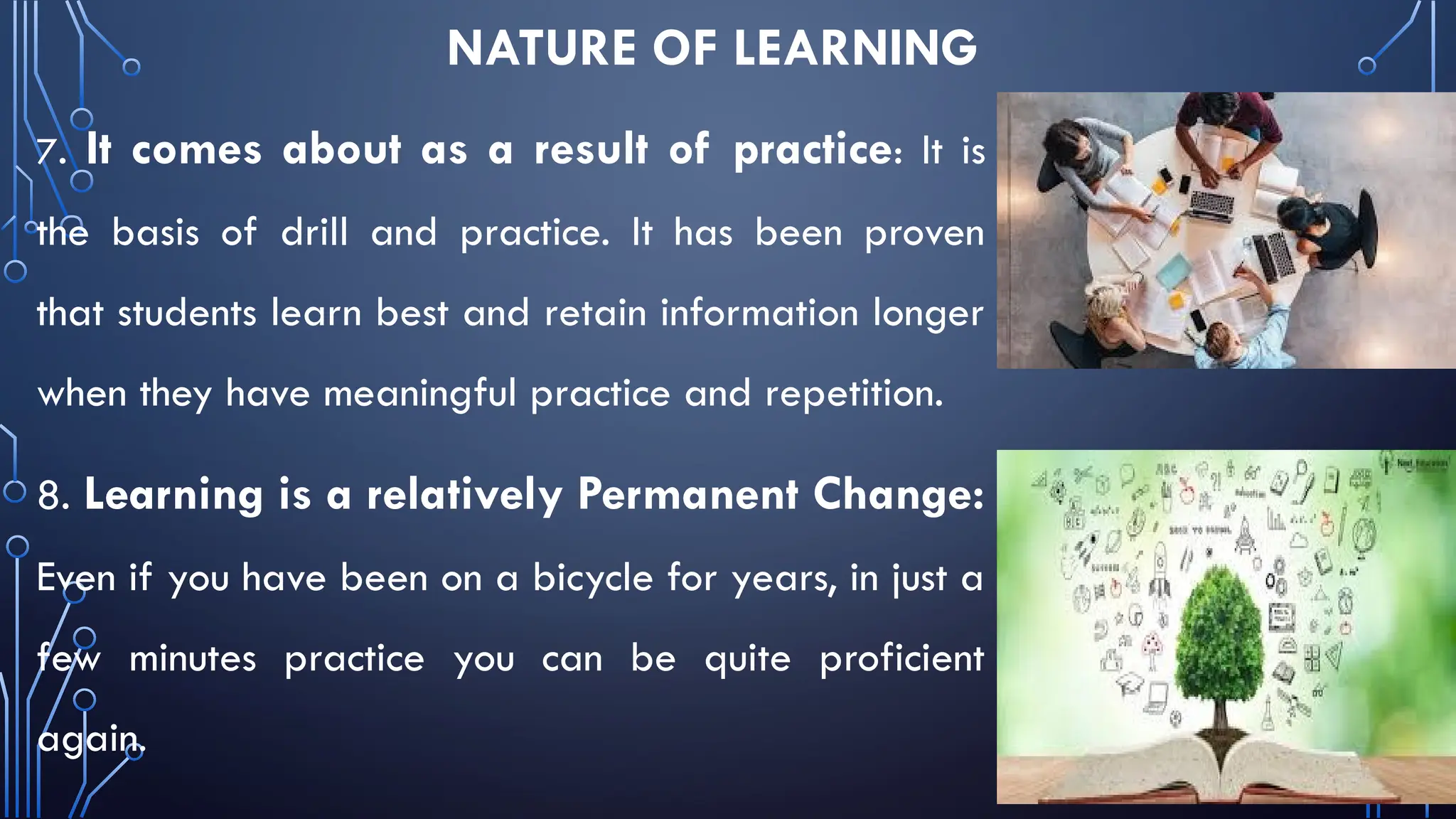
7. It comes about as a result of practice: It is
the basis of drill and practice. It has been proven
that students learn best and retain information longer
when they have meaningful practice and repetition.
8. Learning is a relatively Permanent Change:
Even if you have been on a bicycle for years, in just a
few minutes practice you can be quite proficient
again.
NATURE OF LEARNING
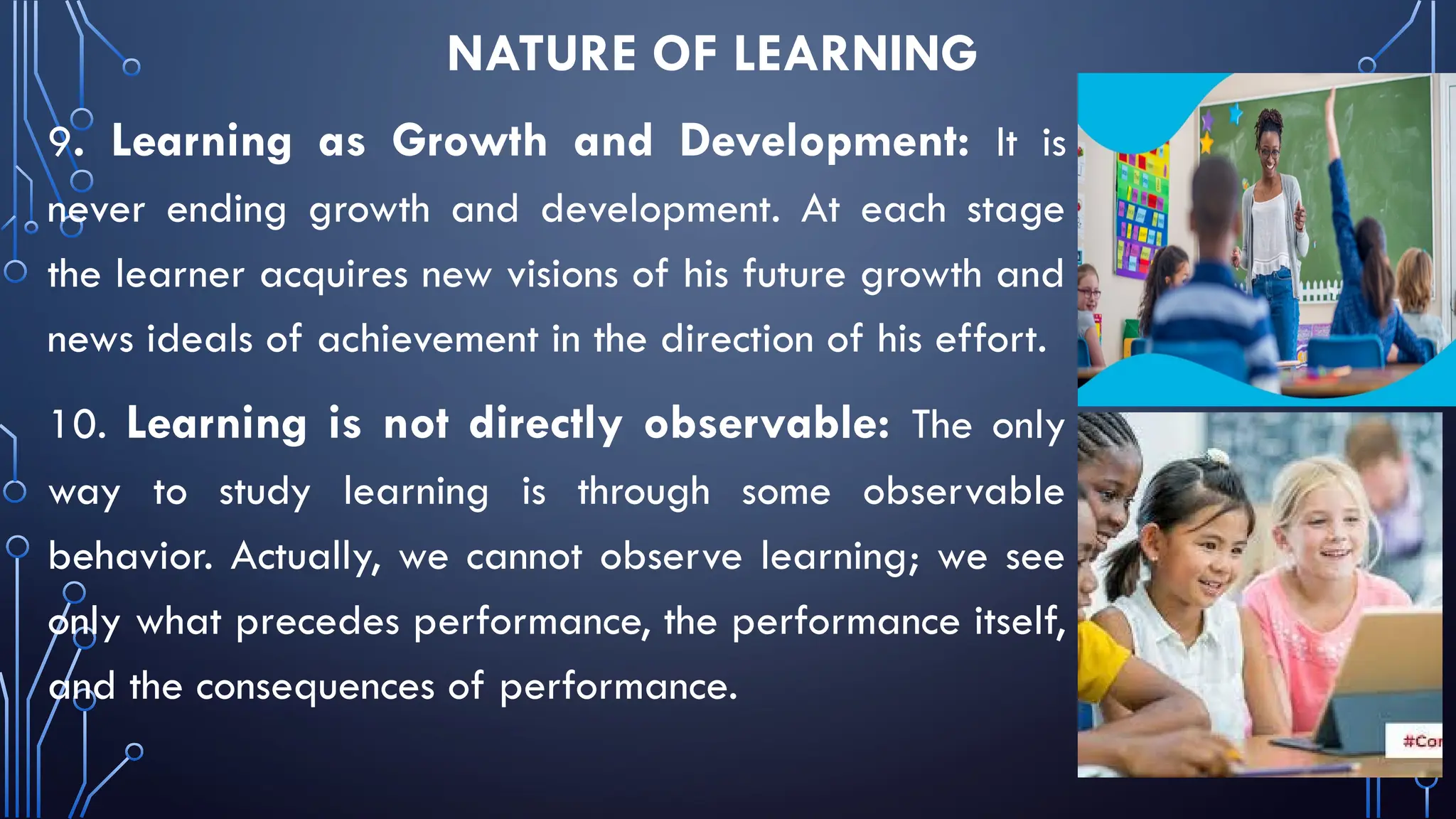
9. Learning as Growth and Development: It is
never ending growth and development. At each stage
the learner acquires new visions of his future growth and
news ideals of achievement in the direction of his effort.
10. Learning is not directly observable: The only
way to study learning is through some observable
behavior. Actually, we cannot observe learning; we see
only what precedes performance, the performance itself,
and the consequences of performance.
TYPES OF LEARNING
• MOTOR LEARNING
• VERBAL LEARNING
• CONCEPT LEARNING
• DISCRIMINATION LEARNING
• LEARNING OF PRINCIPLE
• PROBLEM SOLVING
• ATTITUDE LEARNING
TYPES OF LEARNING
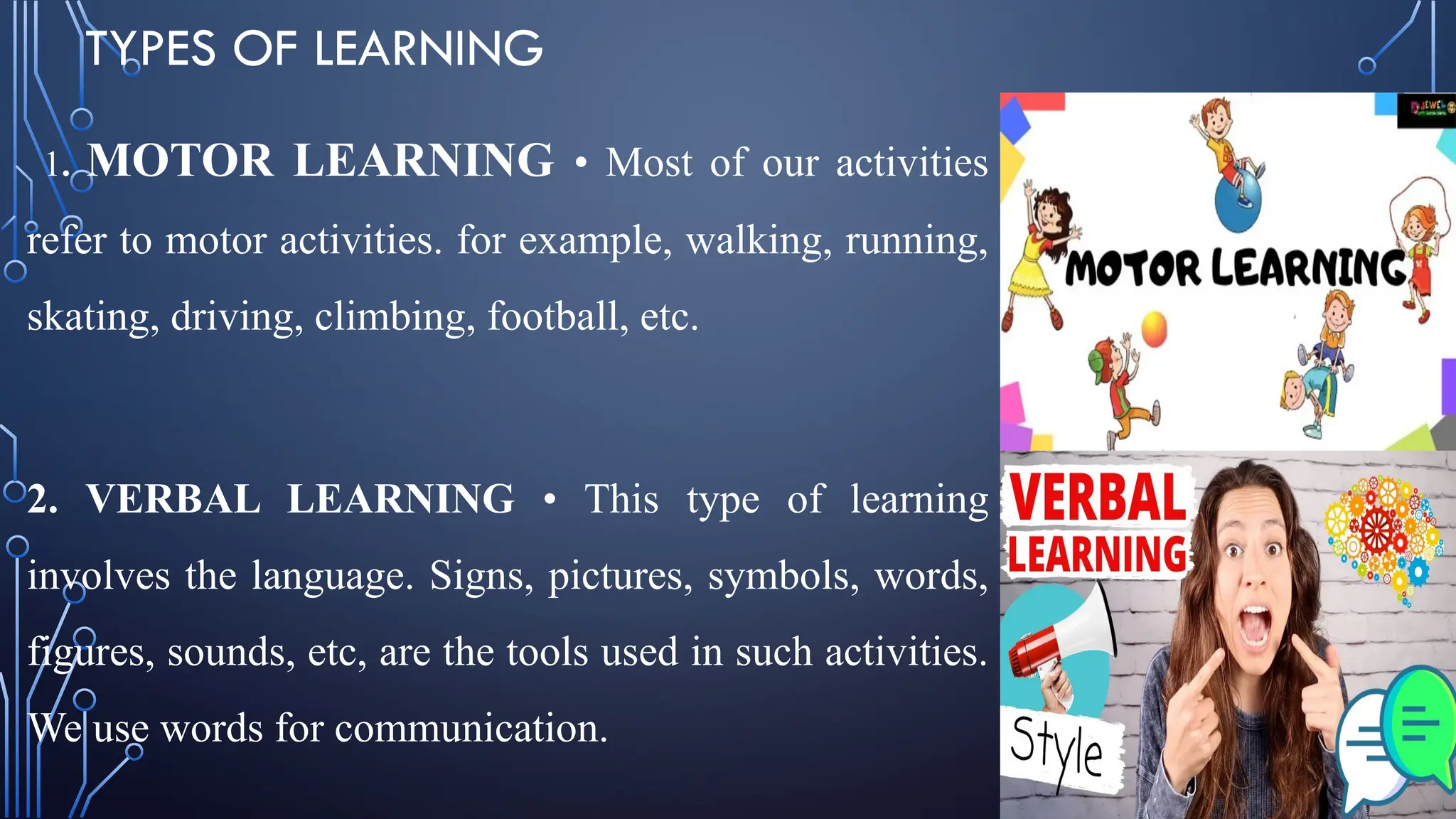
1. MOTOR LEARNING • Most of our activities
refer to motor activities. for example, walking, running,
skating, driving, climbing, football, etc.
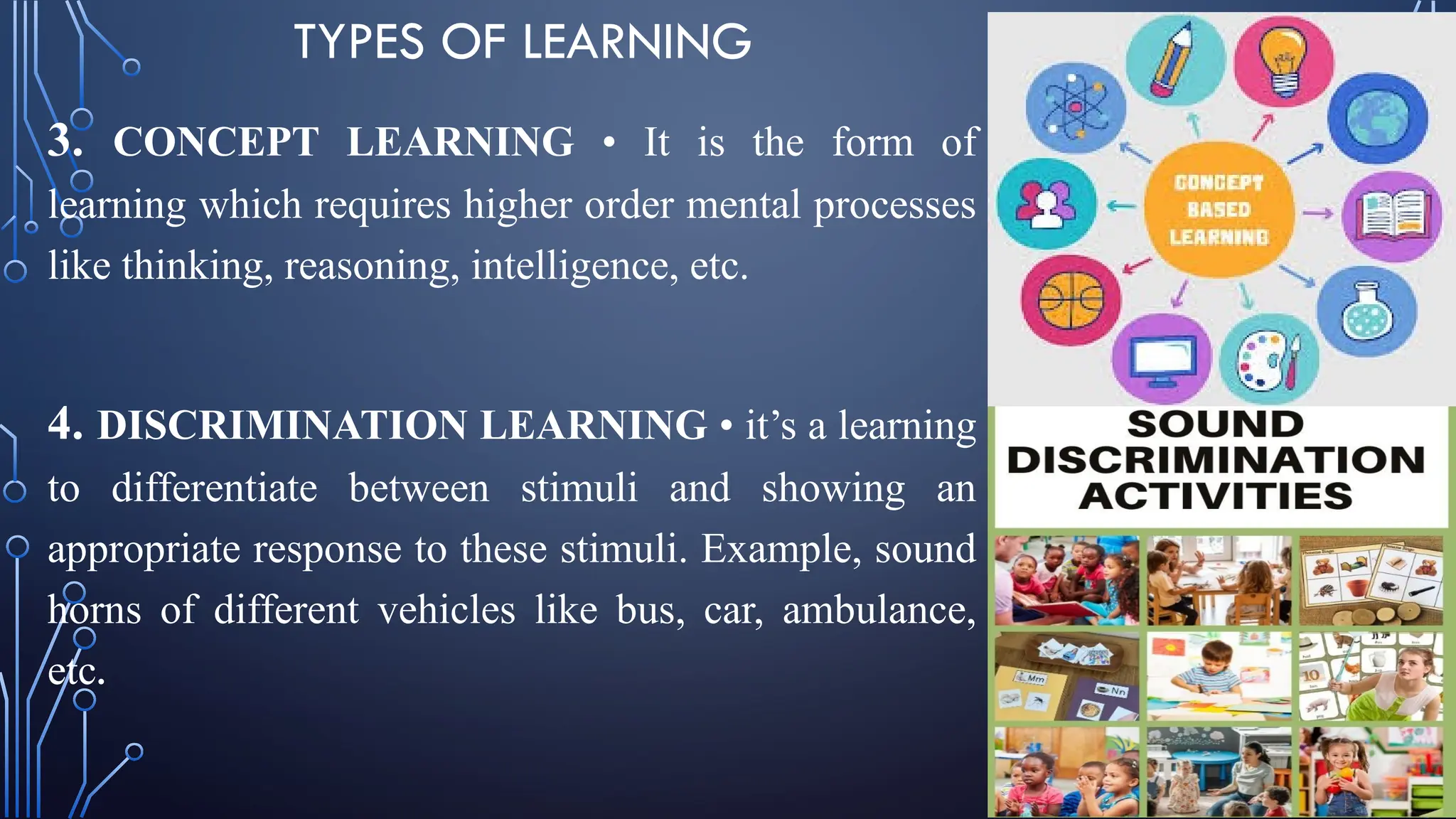
2. VERBAL LEARNING • This type of learning
involves the language. Signs, pictures, symbols, words,
figures, sounds, etc, are the tools used in such activities.
We use words for communication.
TYPES OF LEARNING
3. CONCEPT LEARNING • It is the form of
learning which requires higher order mental processes
like thinking, reasoning, intelligence, etc.
4. DISCRIMINATION LEARNING • it’s a learning
to differentiate between stimuli and showing an
appropriate response to these stimuli. Example, sound
horns of different vehicles like bus, car, ambulance,
etc.
TYPES OF LEARNING
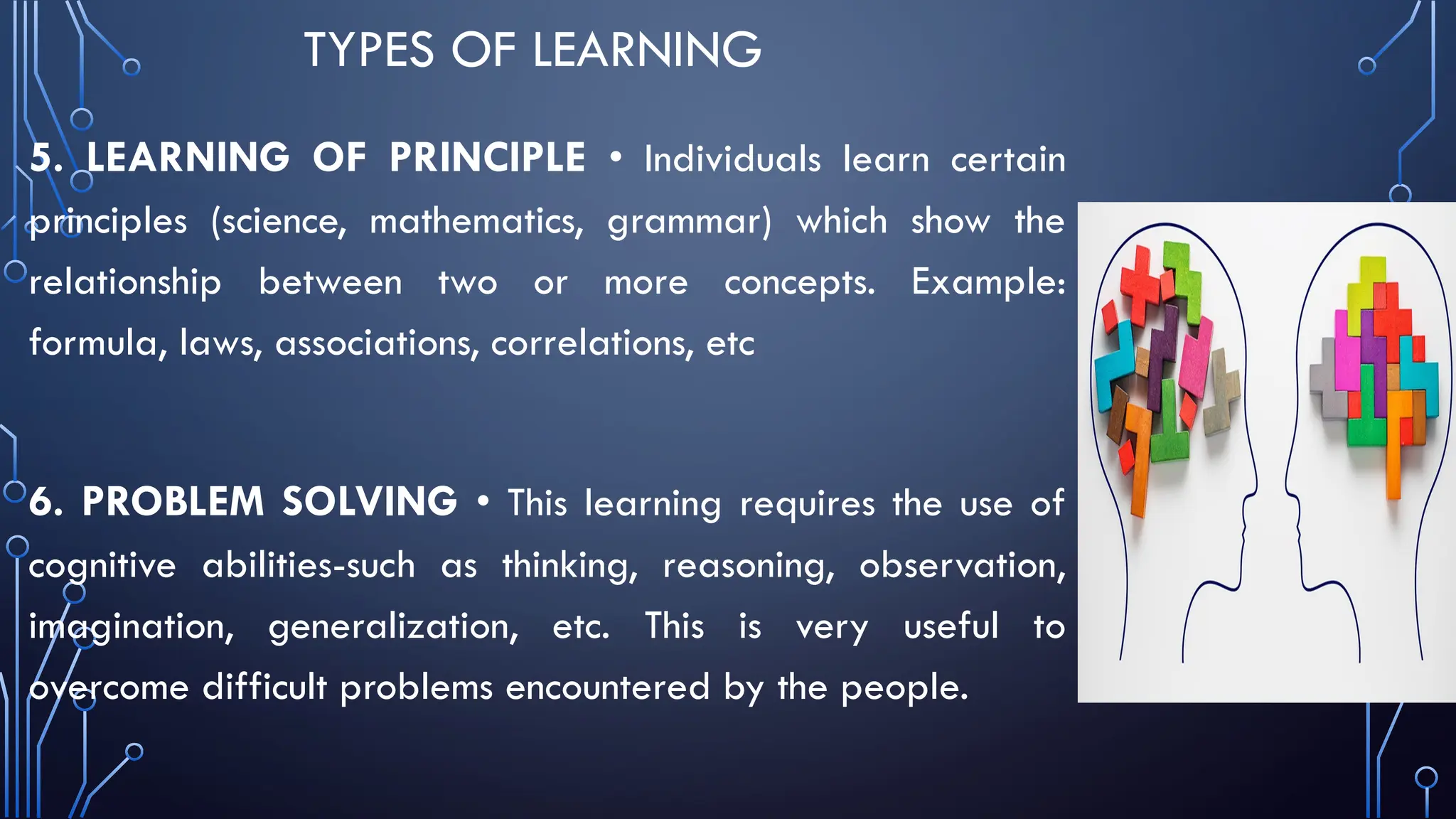
5. LEARNING OF PRINCIPLE • Individuals learn certain
principles (science, mathematics, grammar) which show the
relationship between two or more concepts. Example:
formula, laws, associations, correlations, etc
6. PROBLEM SOLVING • This learning requires the use of
cognitive abilities-such as thinking, reasoning, observation,
imagination, generalization, etc. This is very useful to
overcome difficult problems encountered by the people.
TYPES OF LEARNING
7. ATTITUDE LEARNING • Attitude is a
predisposition which determines and directs our behavior.
We develop different attitudes from our childhood about
the people, objects and everything we know. Example:
attitudes of nurse towards her profession, patients, etc.
LAWS OF LEARNING
• On the basis of trial &
error theory of learning,
Thorndike formulated some
laws of learning. There are
three primary laws and five
secondary laws of learning.
LAWS OF LEARNING
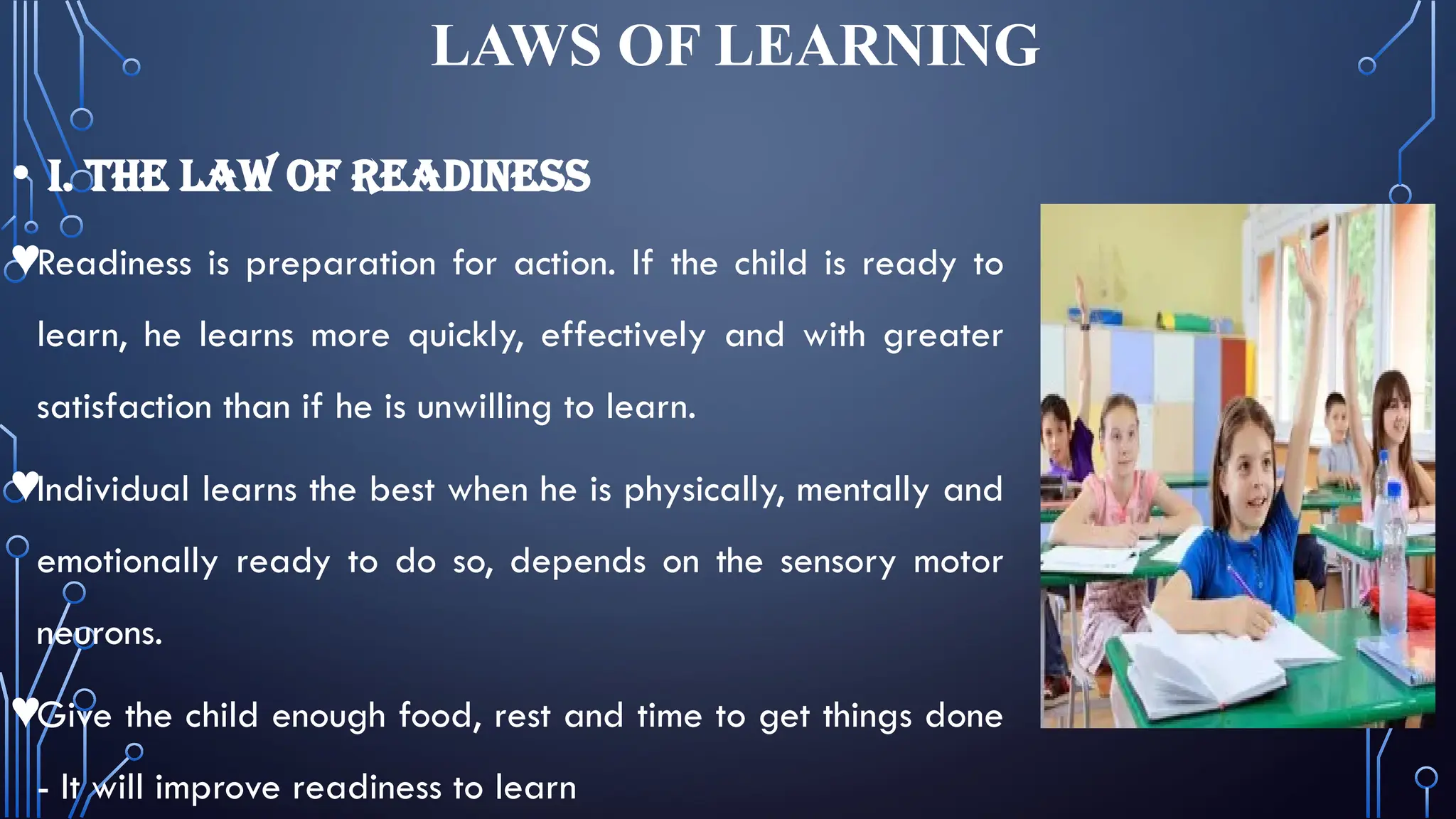
• I. THE LAW OF READINESS
♥Readiness is preparation for action. If the child is ready to
learn, he learns more quickly, effectively and with greater
satisfaction than if he is unwilling to learn.
♥Individual learns the best when he is physically, mentally and
emotionally ready to do so, depends on the sensory motor
neurons.
♥Give the child enough food, rest and time to get things done
- It will improve readiness to learn
LAWS OF LEARNING
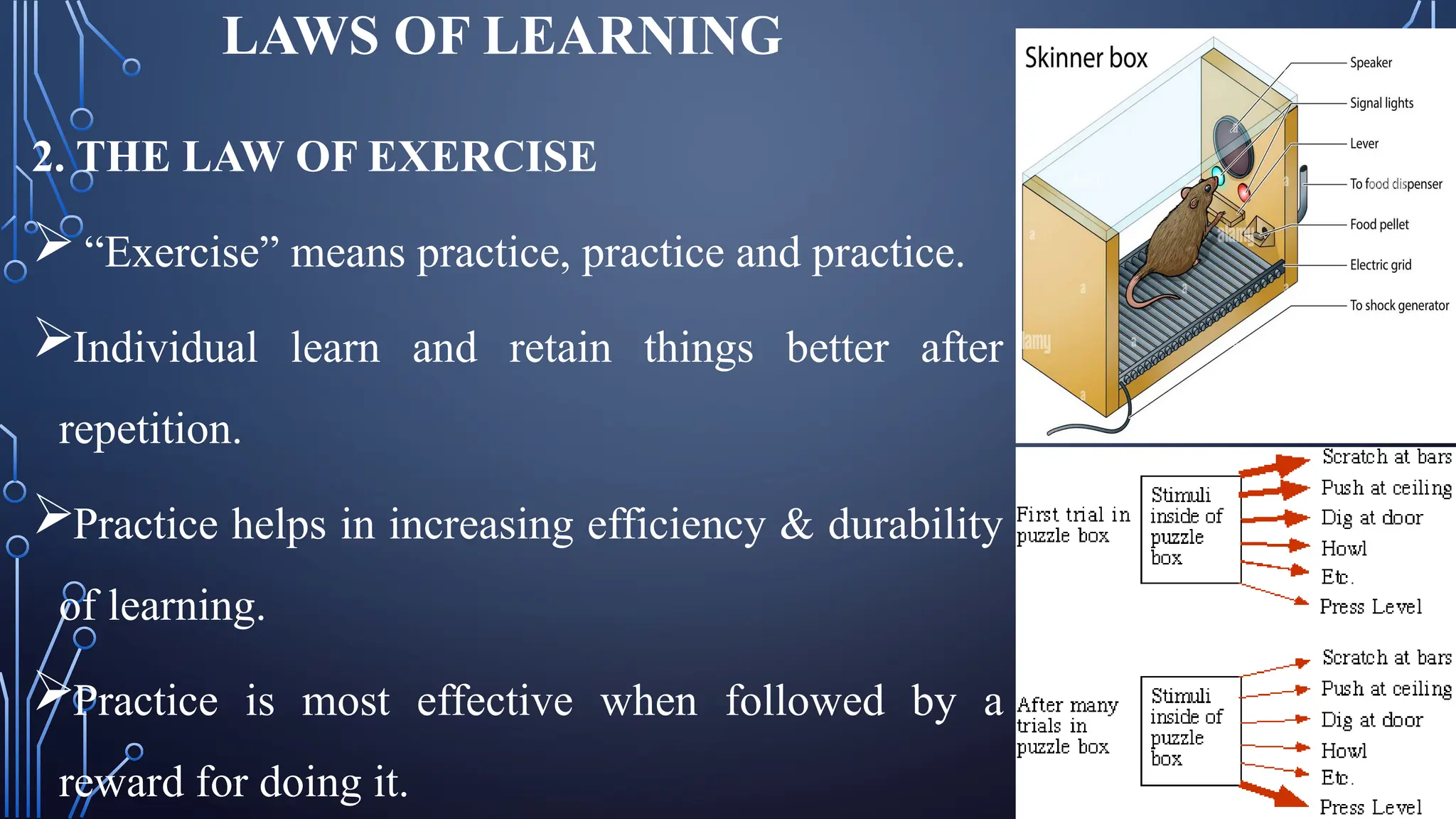
2. THE LAW OF EXERCISE
“Exercise” means practice, practice and practice.
Individual learn and retain things better after
repetition.
Practice helps in increasing efficiency & durability
of learning.
Practice is most effective when followed by a
reward for doing it.
LAWS OF LEARNING
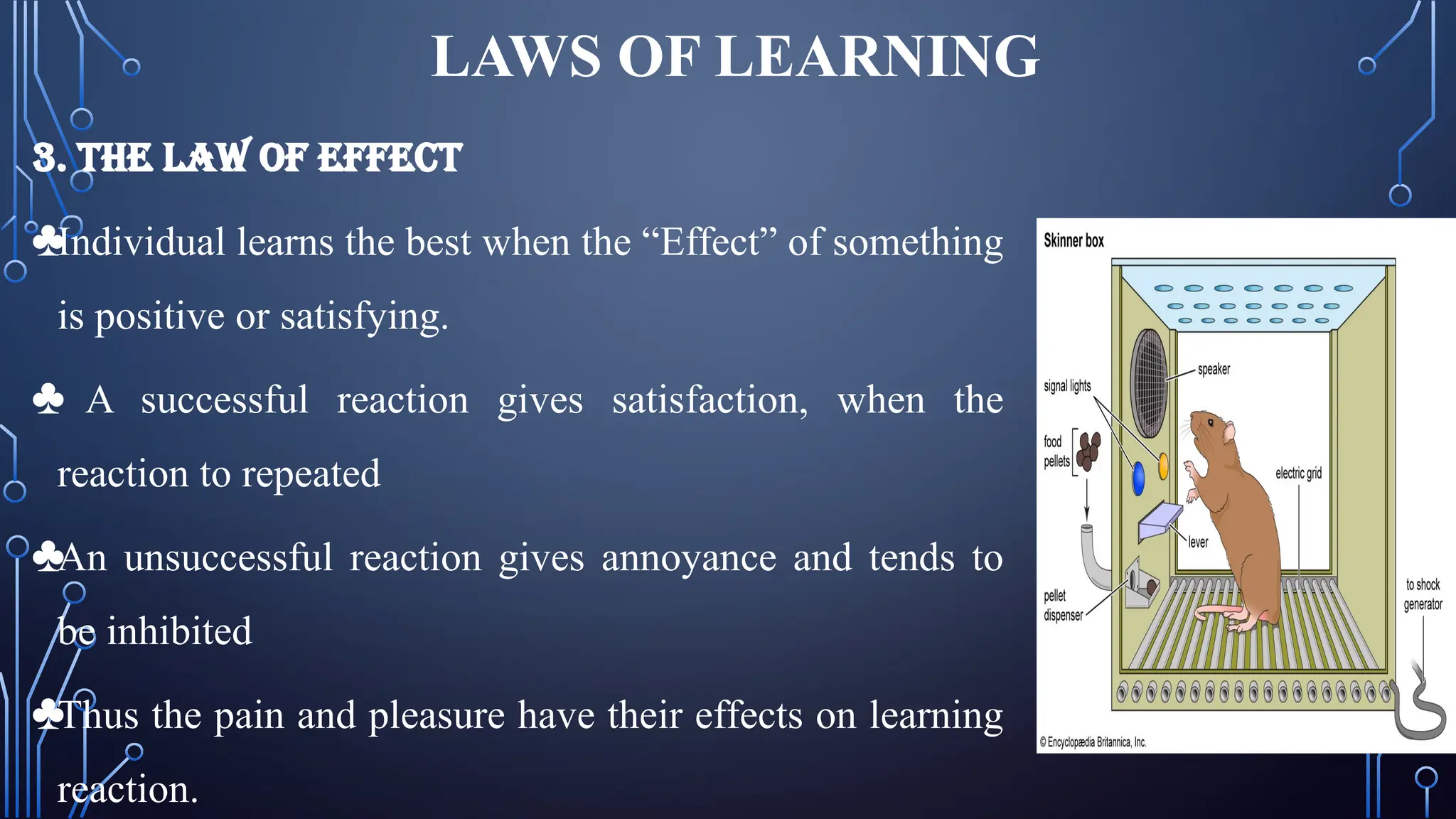
3. THE LAW OF EFFECT
♣Individual learns the best when the “Effect” of something
is positive or satisfying.
♣ A successful reaction gives satisfaction, when the
reaction to repeated
♣An unsuccessful reaction gives annoyance and tends to
be inhibited
♣Thus the pain and pleasure have their effects on learning
reaction.
LAWS OF LEARNING
4. THE LAW OF PRIMACY
ª
The law of primacy is a learning and
memory principle that states that first
encounters with new things have a greater
impact on subsequent thought and behavior
than later encounters
ª
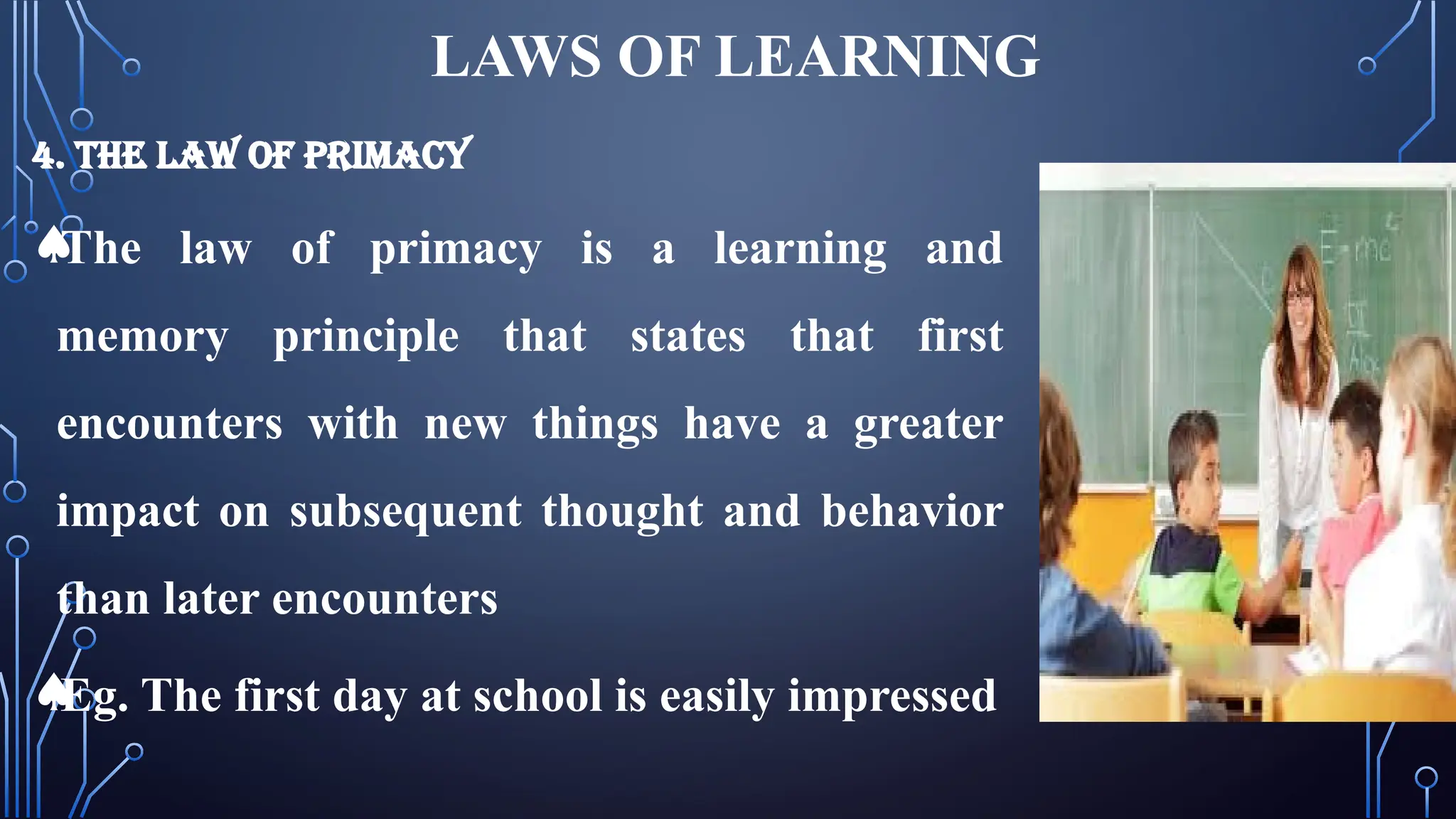
Eg. The first day at school is easily impressed
LAWS OF LEARNING
5. THE LAW OF ASSOCIATION

It states that thoughts, memories, concepts, and stimuli that
occur together or nearby become interconnected. This principle
explains how we learn and remember things.

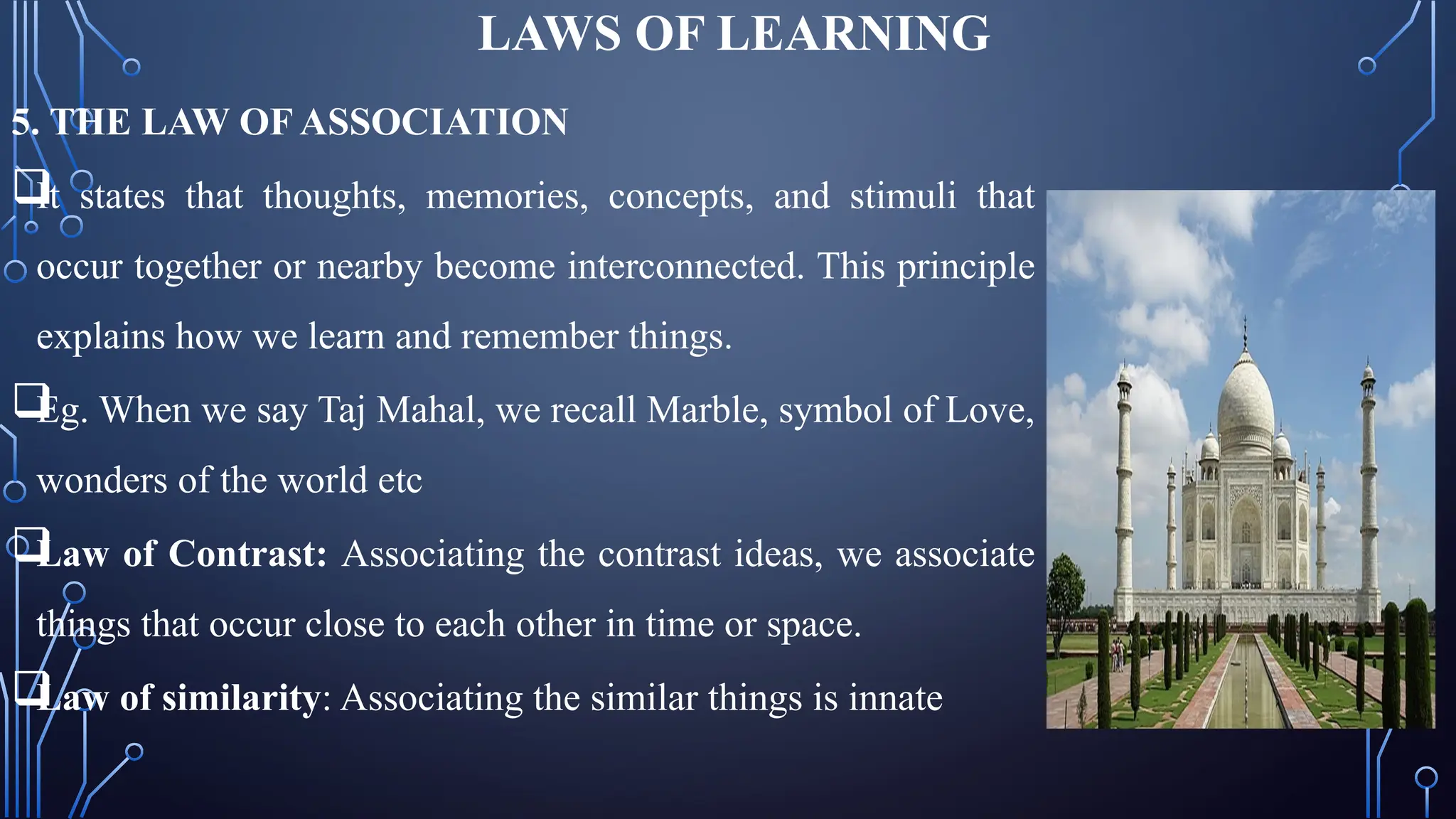
Eg. When we say Taj Mahal, we recall Marble, symbol of Love,
wonders of the world etc

Law of Contrast: Associating the contrast ideas, we associate
things that occur close to each other in time or space.

Law of similarity: Associating the similar things is innate
LAWS OF LEARNING
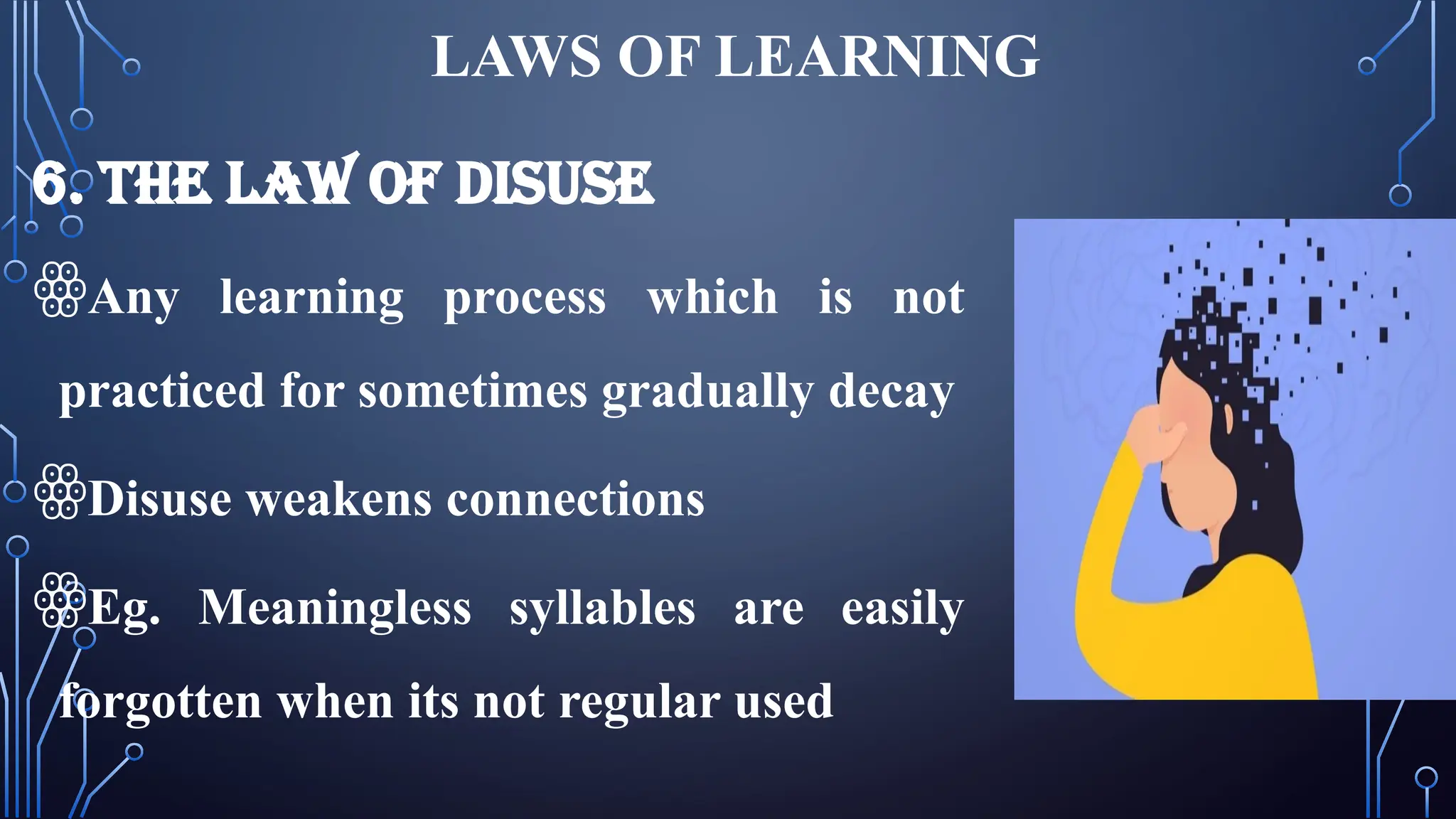
6. THE LAW OF DISUSE
ꙮAny learning process which is not
practiced for sometimes gradually decay
ꙮDisuse weakens connections
ꙮEg. Meaningless syllables are easily
forgotten when its not regular used
LAWS OF LEARNING
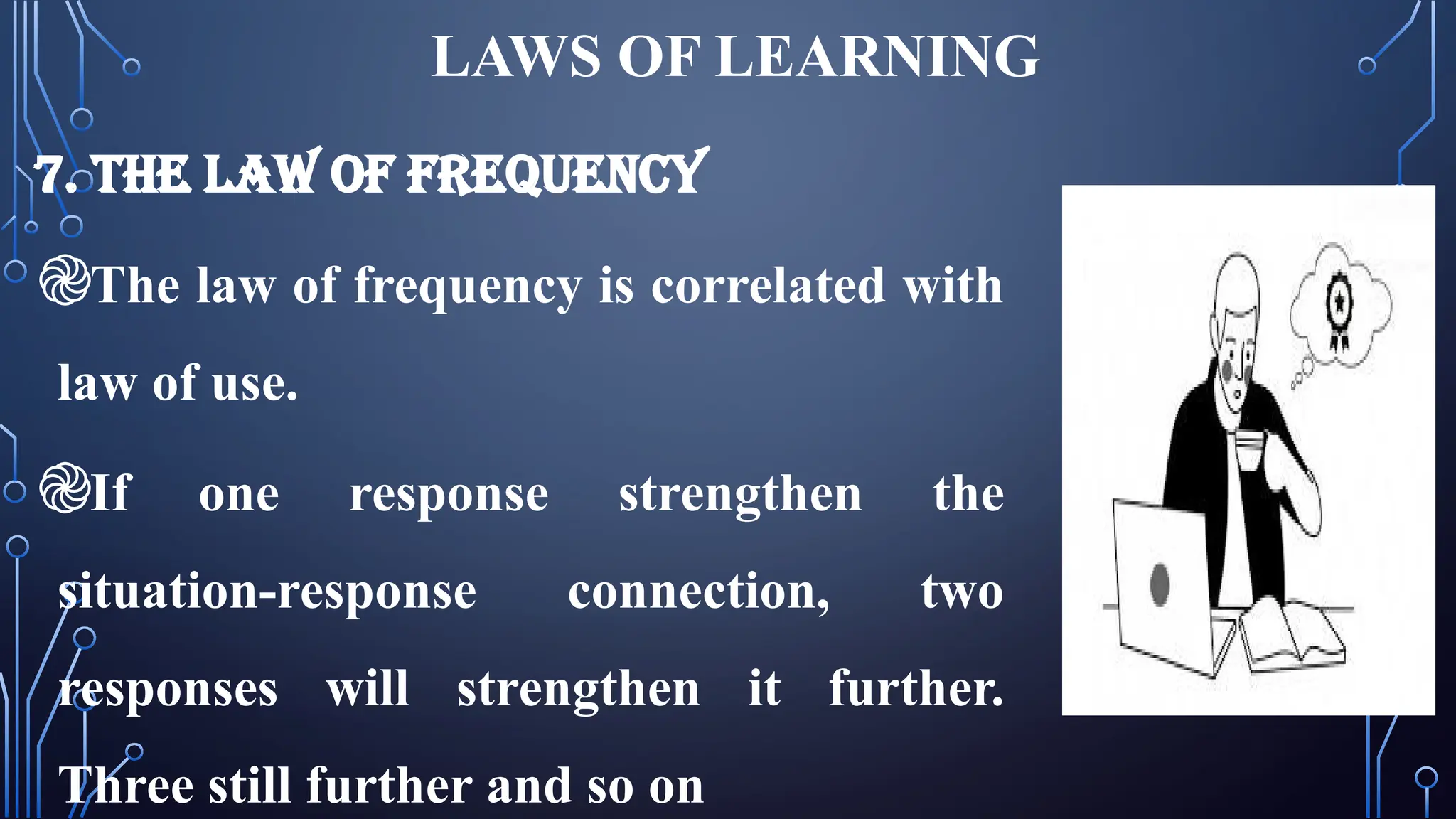
7. THE LAW OF FREQUENCY
֎The law of frequency is correlated with
law of use.
֎If one response strengthen the
situation-response connection, two
responses will strengthen it further.
Three still further and so on
LAWS OF LEARNING
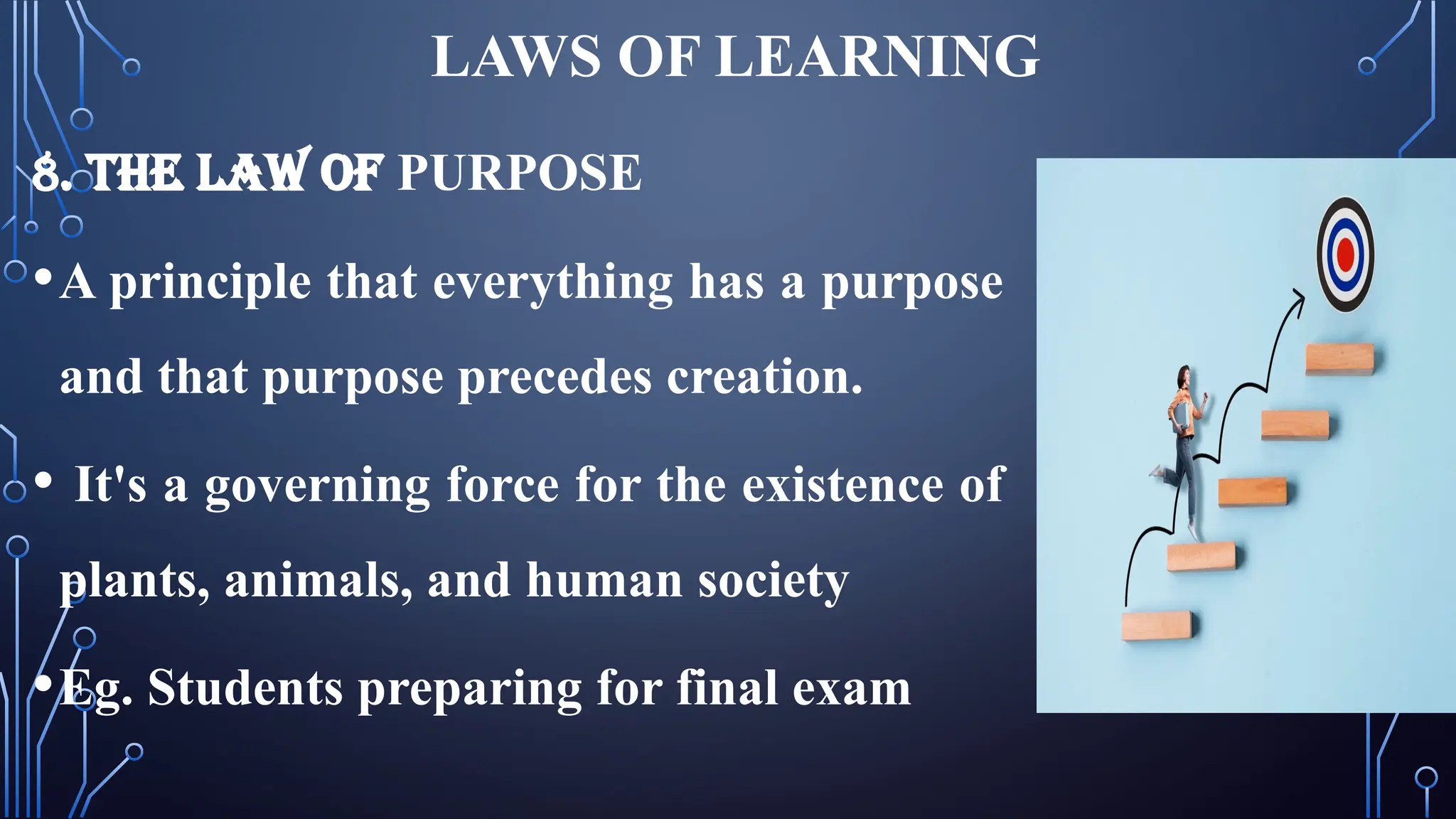
8. THE LAW OF PURPOSE
•A principle that everything has a purpose
and that purpose precedes creation.
• It's a governing force for the existence of
plants, animals, and human society
•Eg. Students preparing for final exam
LAWS OF LEARNING
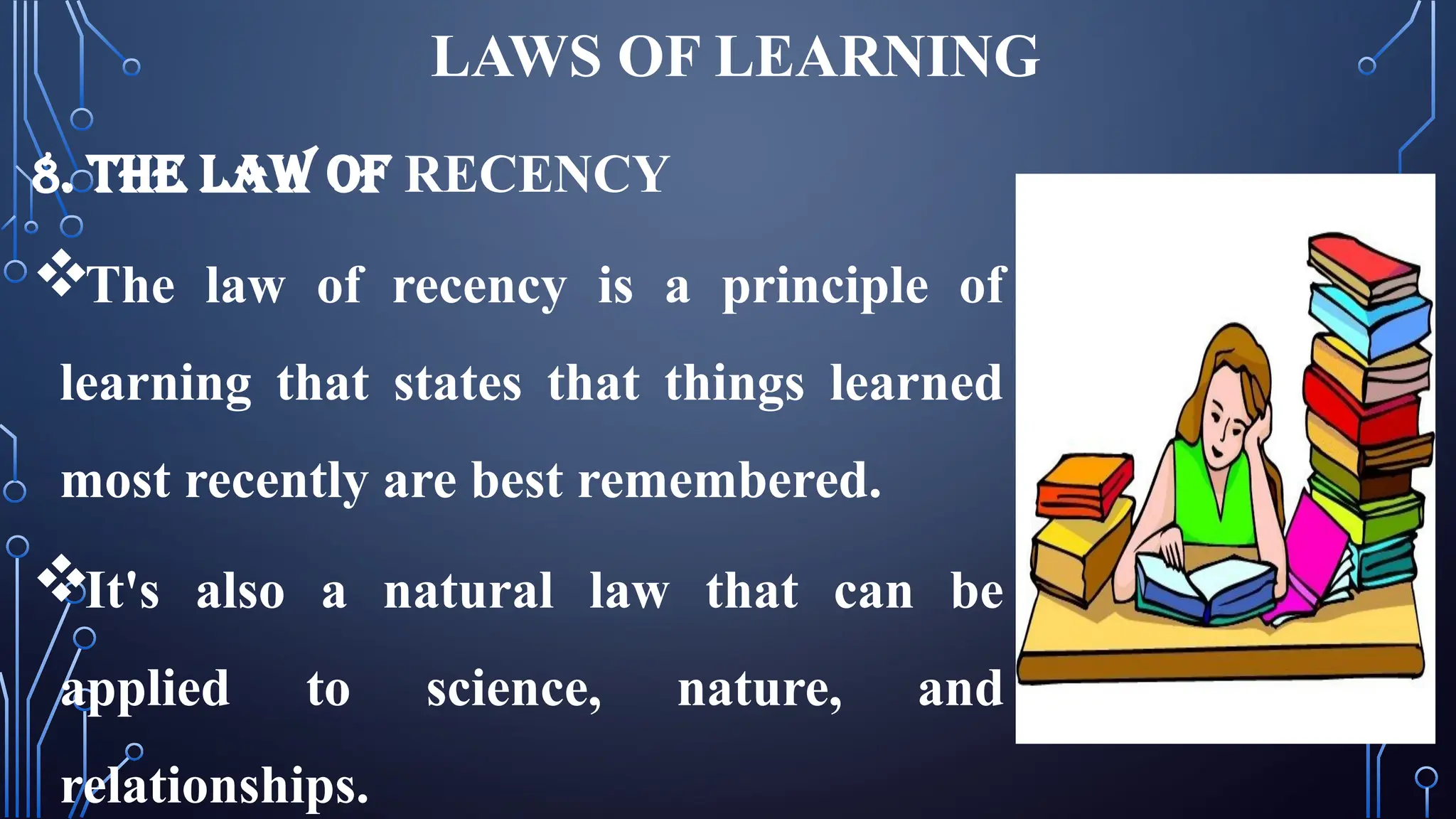
8. THE LAW OF RECENCY
The law of recency is a principle of
learning that states that things learned
most recently are best remembered.
It's also a natural law that can be
applied to science, nature, and
relationships.
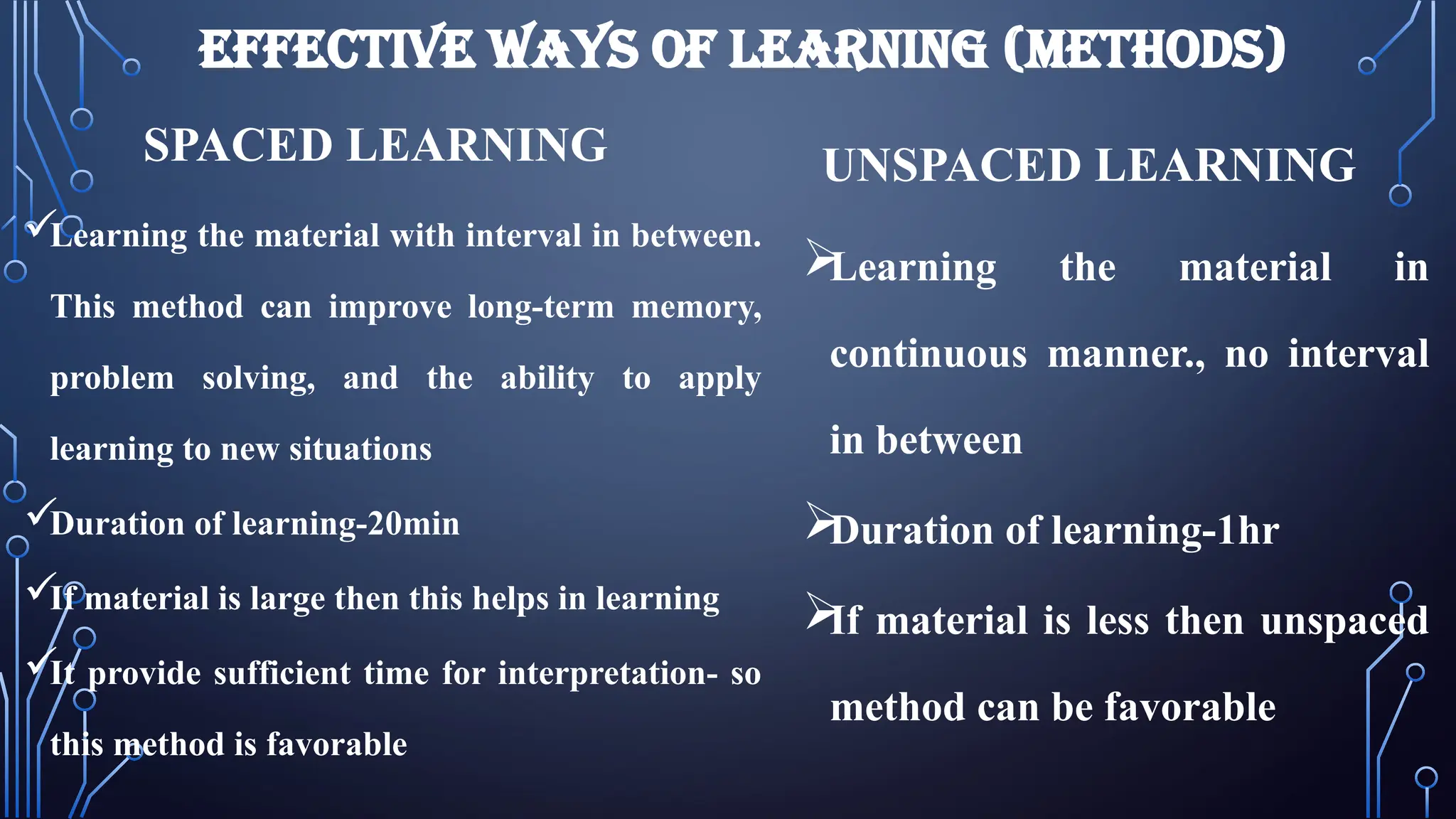
EFFECTIVE WAYS OF LEARNING (METHODS)
SPACED LEARNING

Learning the material with interval in between.
This method can improve long-term memory,
problem solving, and the ability to apply
learning to new situations

Duration of learning-20min

If material is large then this helps in learning

It provide sufficient time for interpretation- so
this method is favorable
UNSPACED LEARNING

Learning the material in
continuous manner., no interval
in between

Duration of learning-1hr

If material is less then unspaced
method can be favorable
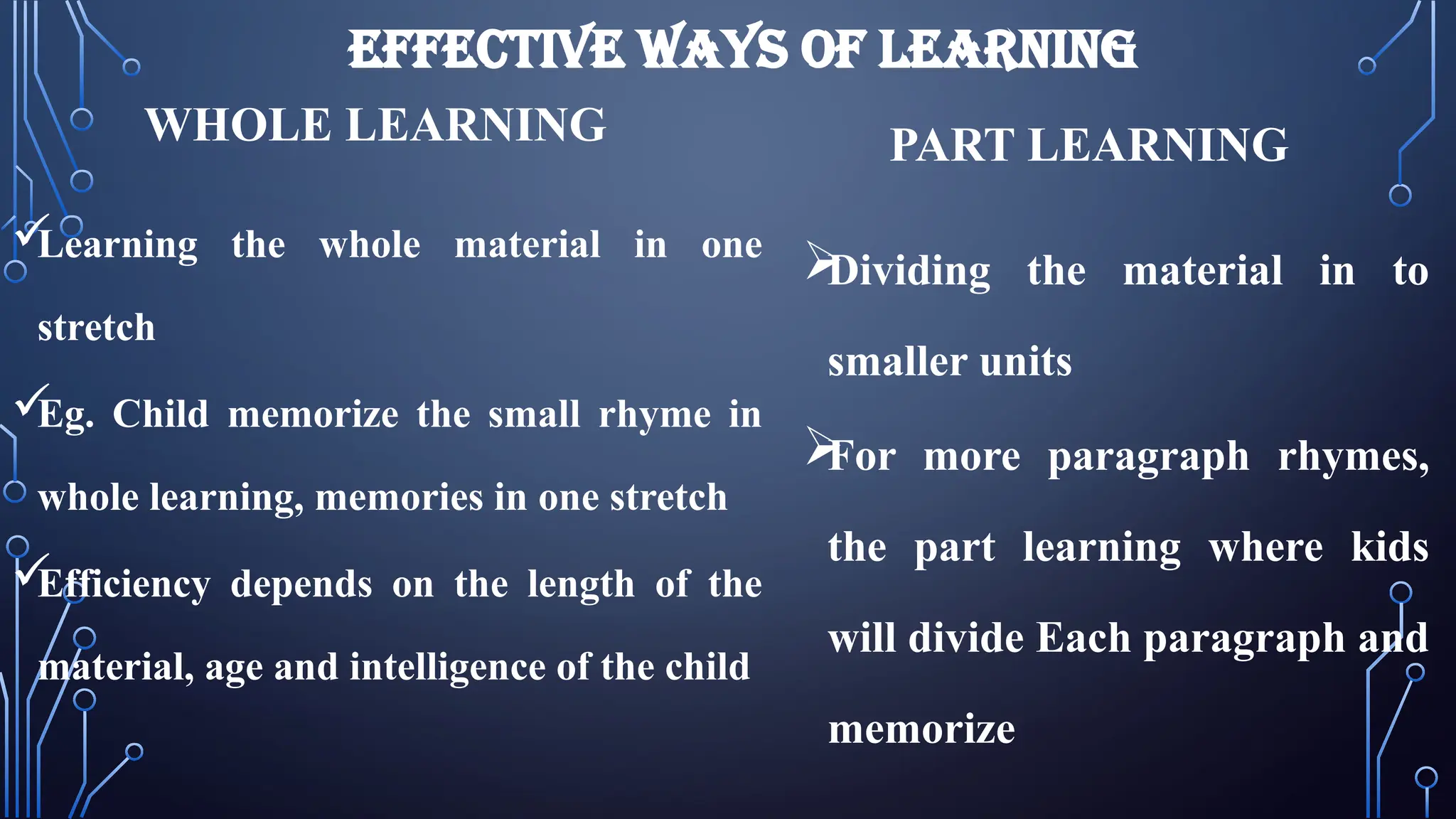
EFFECTIVE WAYS OF LEARNING
WHOLE LEARNING

Learning the whole material in one
stretch

Eg. Child memorize the small rhyme in
whole learning, memories in one stretch

Efficiency depends on the length of the
material, age and intelligence of the child
PART LEARNING

Dividing the material in to
smaller units

For more paragraph rhymes,
the part learning where kids
will divide Each paragraph and
memorize
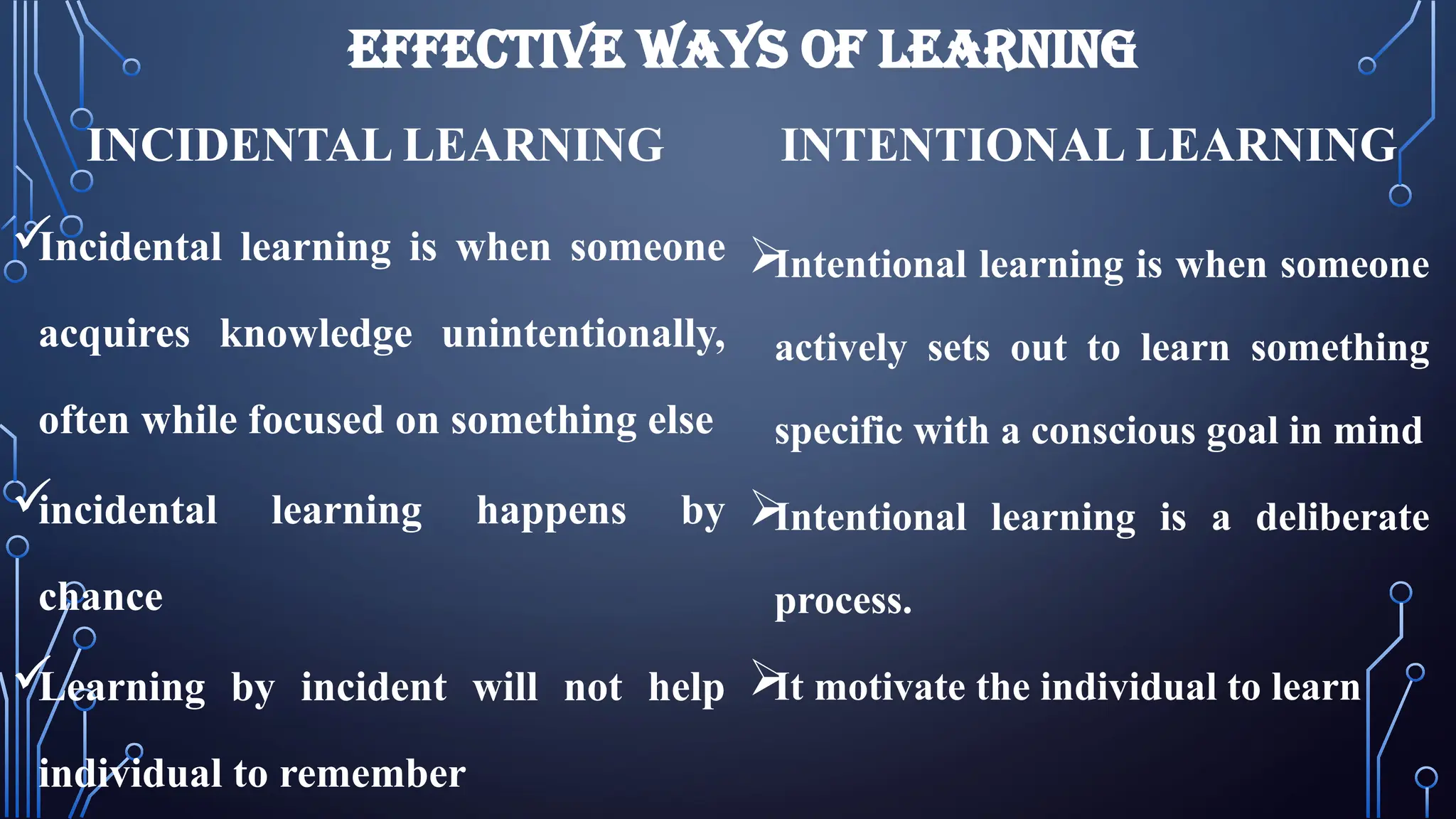
EFFECTIVE WAYS OF LEARNING
INCIDENTAL LEARNING

Incidental learning is when someone
acquires knowledge unintentionally,
often while focused on something else

incidental learning happens by
chance

Learning by incident will not help
individual to remember
INTENTIONAL LEARNING

Intentional learning is when someone
actively sets out to learn something
specific with a conscious goal in mind

Intentional learning is a deliberate
process.

It motivate the individual to learn
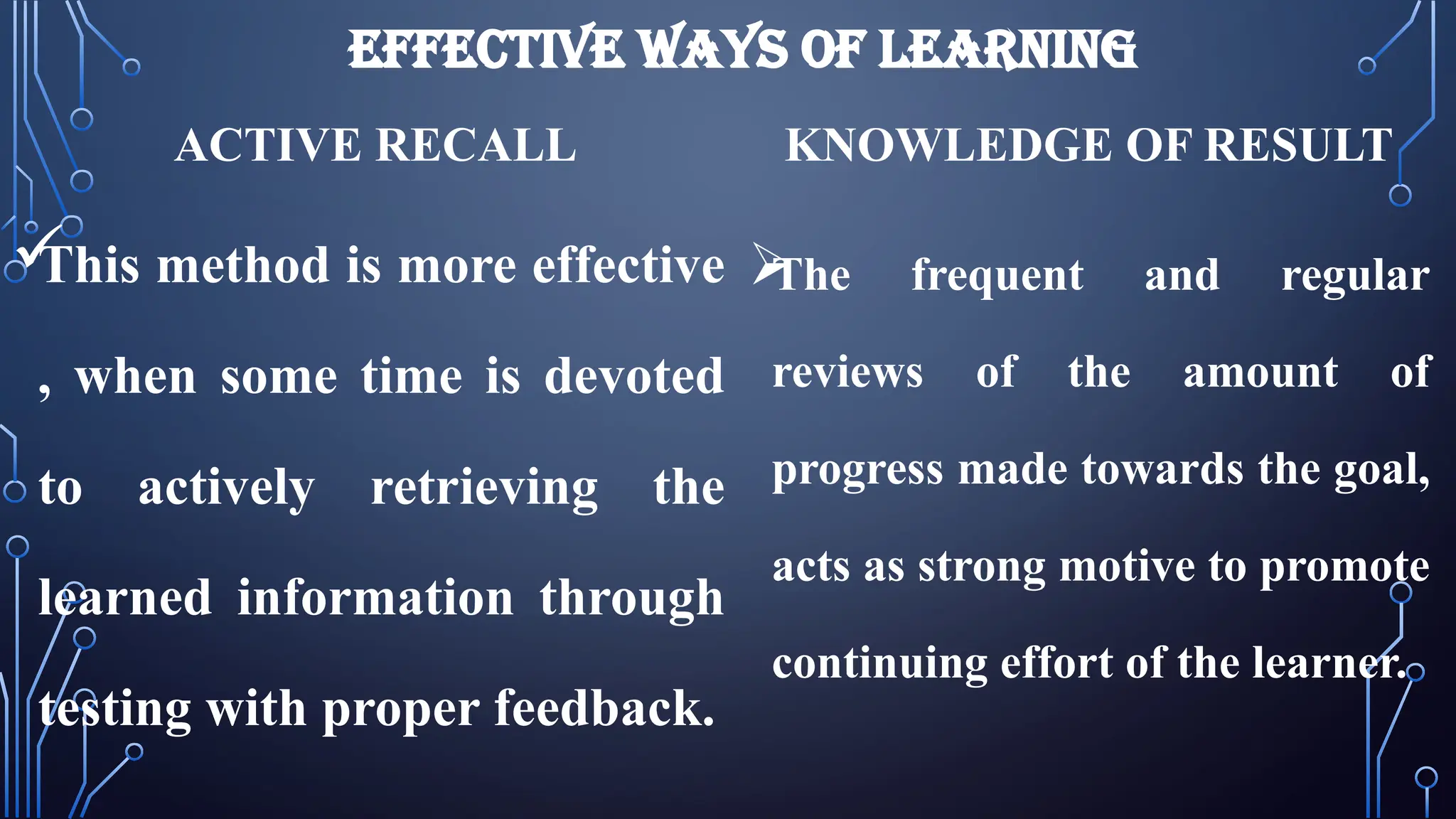
EFFECTIVE WAYS OF LEARNING
ACTIVE RECALL

This method is more effective
, when some time is devoted
to actively retrieving the
learned information through
testing with proper feedback.
KNOWLEDGE OF RESULT

The frequent and regular
reviews of the amount of
progress made towards the goal,
acts as strong motive to promote
continuing effort of the learner.
EFFECTIVE WAYS OF LEARNING
•REPETITION /OVER LEARNING
☻Repetition at regular intervals helps the individual to
retain the material for longer period of time.
☻Eg. The student who repeats the lesson at regular
interval will remember the lesson till the final exam.
EFFECTIVE WAYS OF LEARNING
•MNEMONIC METHOD
※It comes from the Greek word for memory,
referring to specific memory in human technique
※It is based on the principle that the human mind
more easily remembers more meaningful
information’s of a person, surprises, sexual or
humorous incidents and sequences
※This involves the systematic and organized set
of images and words
•TECHNIQUES INCLUDE:
1.Memory pegs
2.Loci method
3.Rhyming system
4.Story telling method
5.Remembering names
and faces
6.chunking
EFFECTIVE WAYS OF LEARNING
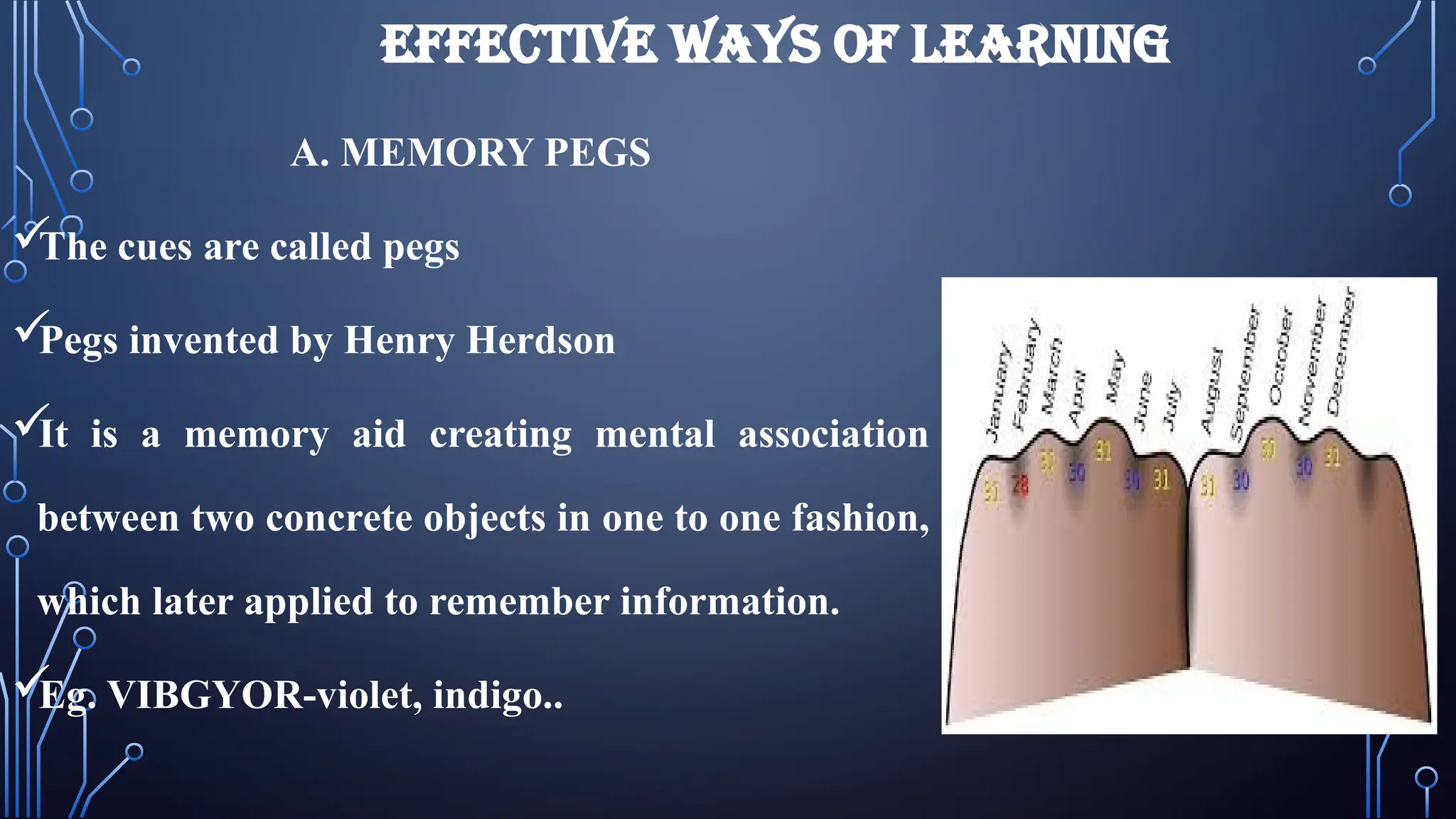
A. MEMORY PEGS

The cues are called pegs

Pegs invented by Henry Herdson

It is a memory aid creating mental association
between two concrete objects in one to one fashion,
which later applied to remember information.

Eg. VIBGYOR-violet, indigo..
EFFECTIVE WAYS OF LEARNING
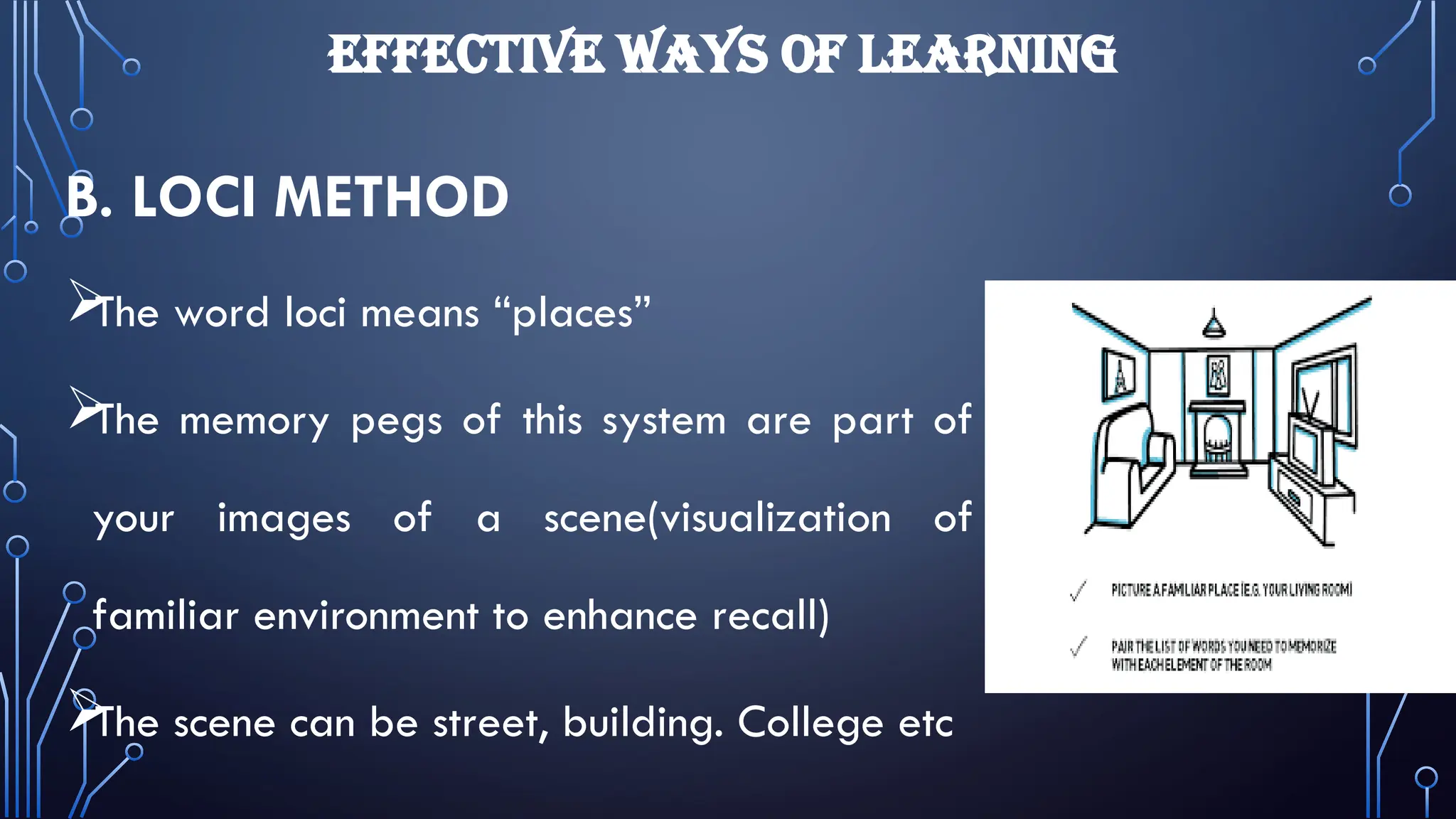
B. LOCI METHOD

The word loci means “places”

The memory pegs of this system are part of
your images of a scene(visualization of
familiar environment to enhance recall)

The scene can be street, building. College etc
EFFECTIVE WAYS OF LEARNING
C. RHYMIMG SYSTEM

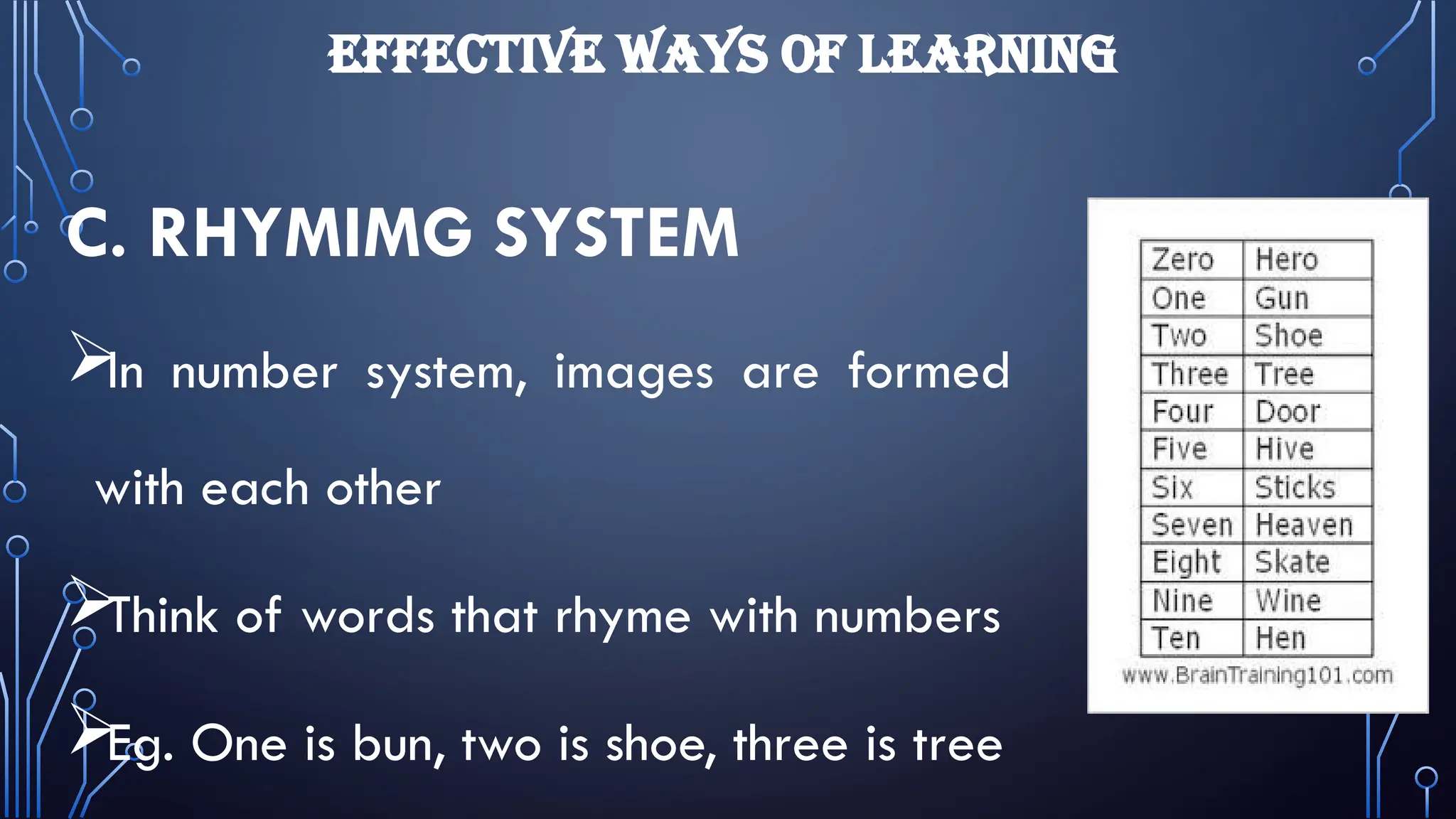
In number system, images are formed
with each other

Think of words that rhyme with numbers

Eg. One is bun, two is shoe, three is tree
EFFECTIVE WAYS OF LEARNING
D. STORY TELLING METHOD

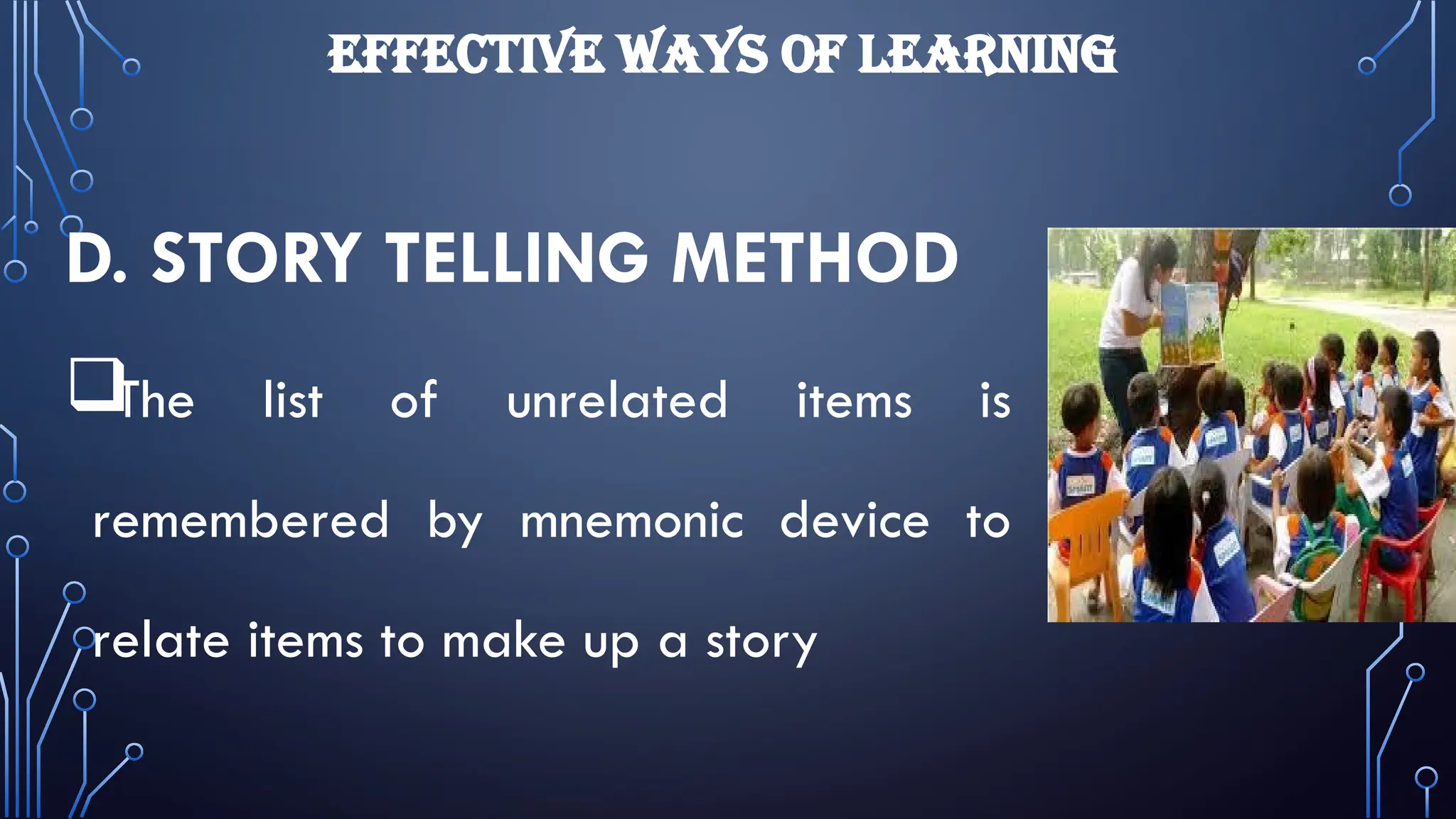
The list of unrelated items is
remembered by mnemonic device to
relate items to make up a story
EFFECTIVE WAYS OF LEARNING
E. REMEMBERING NAMES &FACES

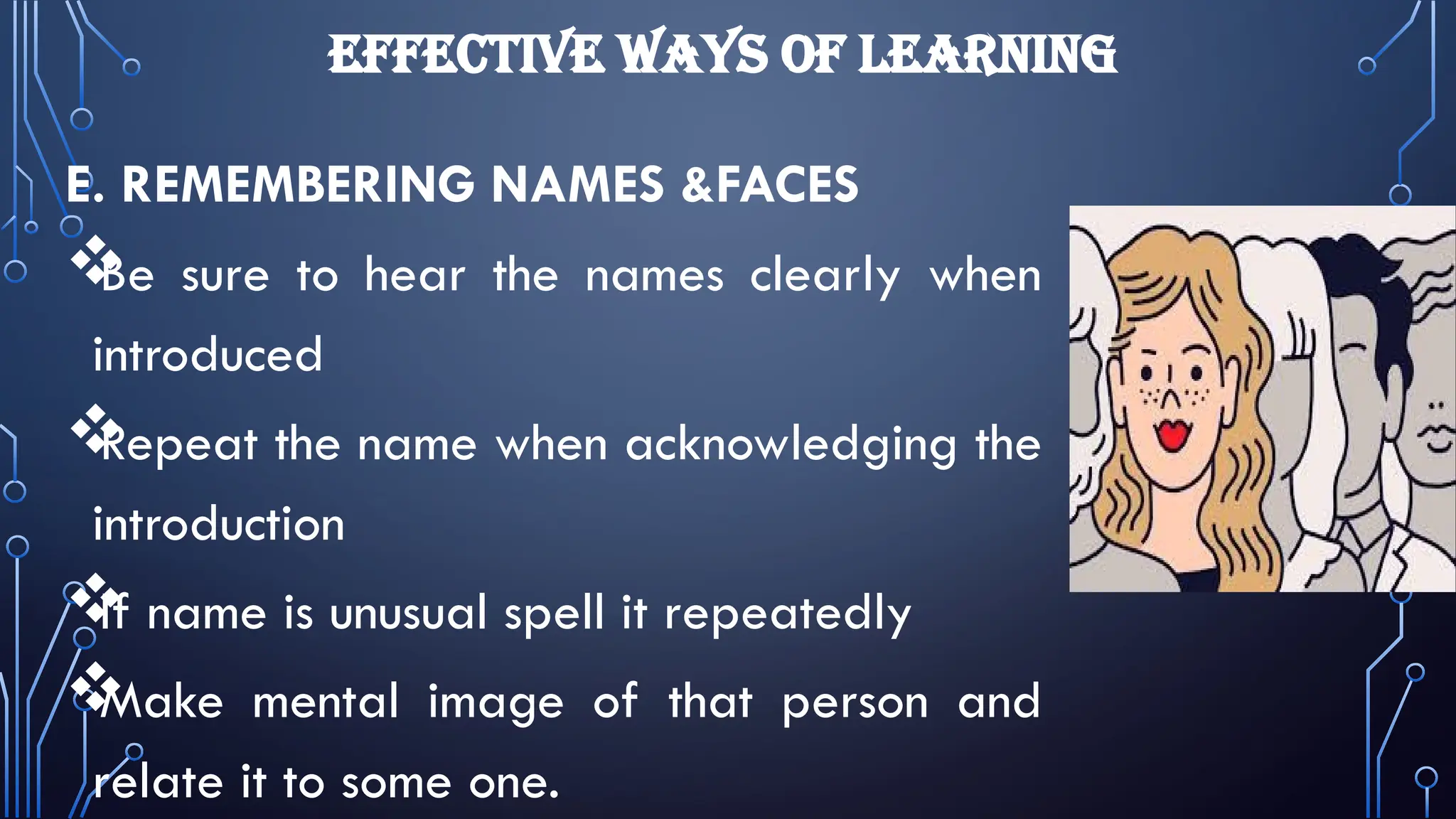
Be sure to hear the names clearly when
introduced

Repeat the name when acknowledging the
introduction

If name is unusual spell it repeatedly

Make mental image of that person and
relate it to some one.
EFFECTIVE WAYS OF LEARNING
F.CHUNKING

A systematic way of encoding information.

Eg. cell phone number consists of 10 items
can be arranged in 2 or 4,3,3.

Eg. 6305050431 as 630-50-50-431 0r 63-05-
05-04-31
THEORIES OF LEARNING
1. TRIAL AND ERROR THEORY OF LEARNING BY E L THORNDIKE
This theory was proposed by E L Thorndike
CONCEPT: learning is nothing but stamping in thecorrectre response
and stamping out of the incorrect response through trial and error.
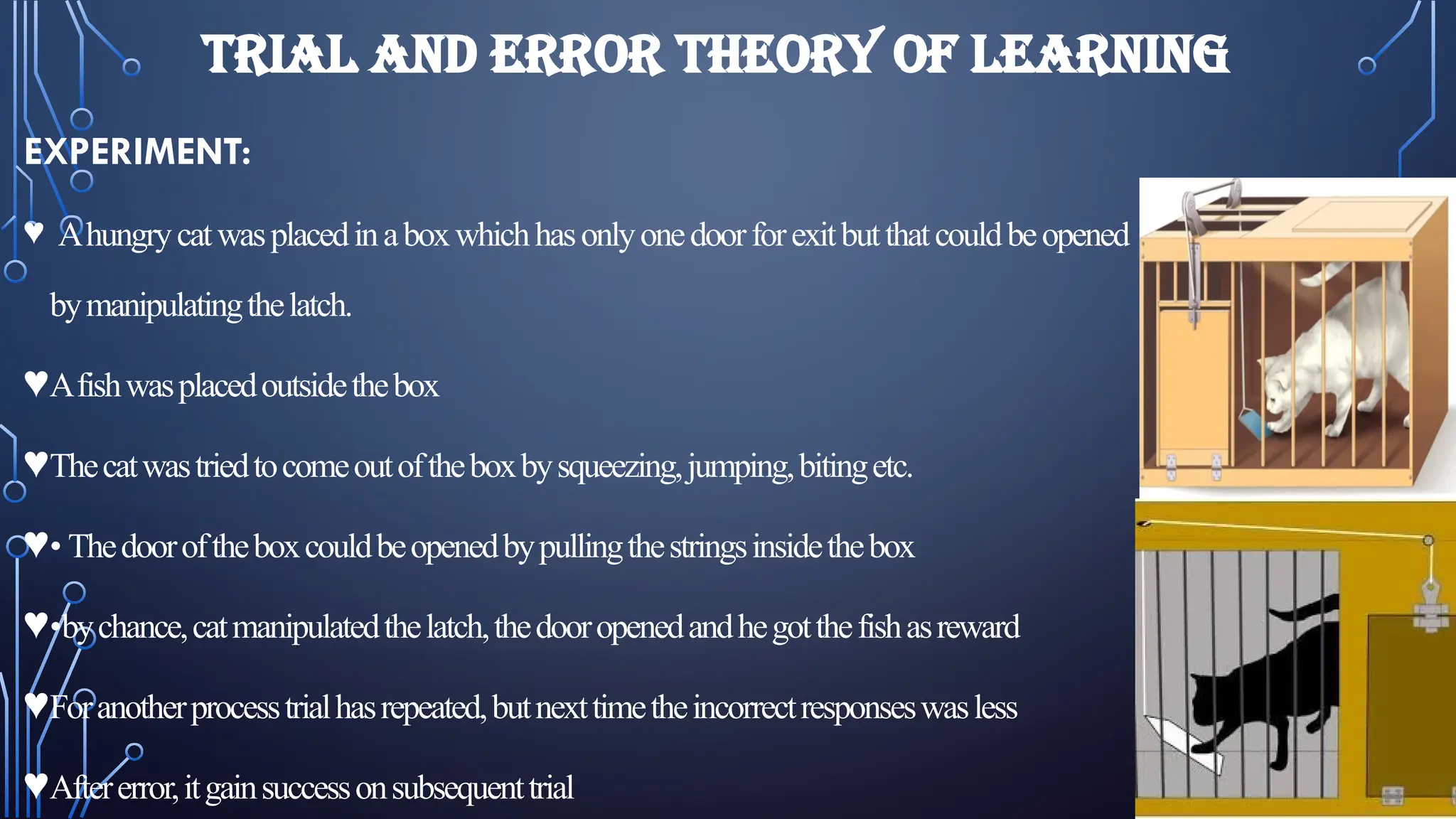
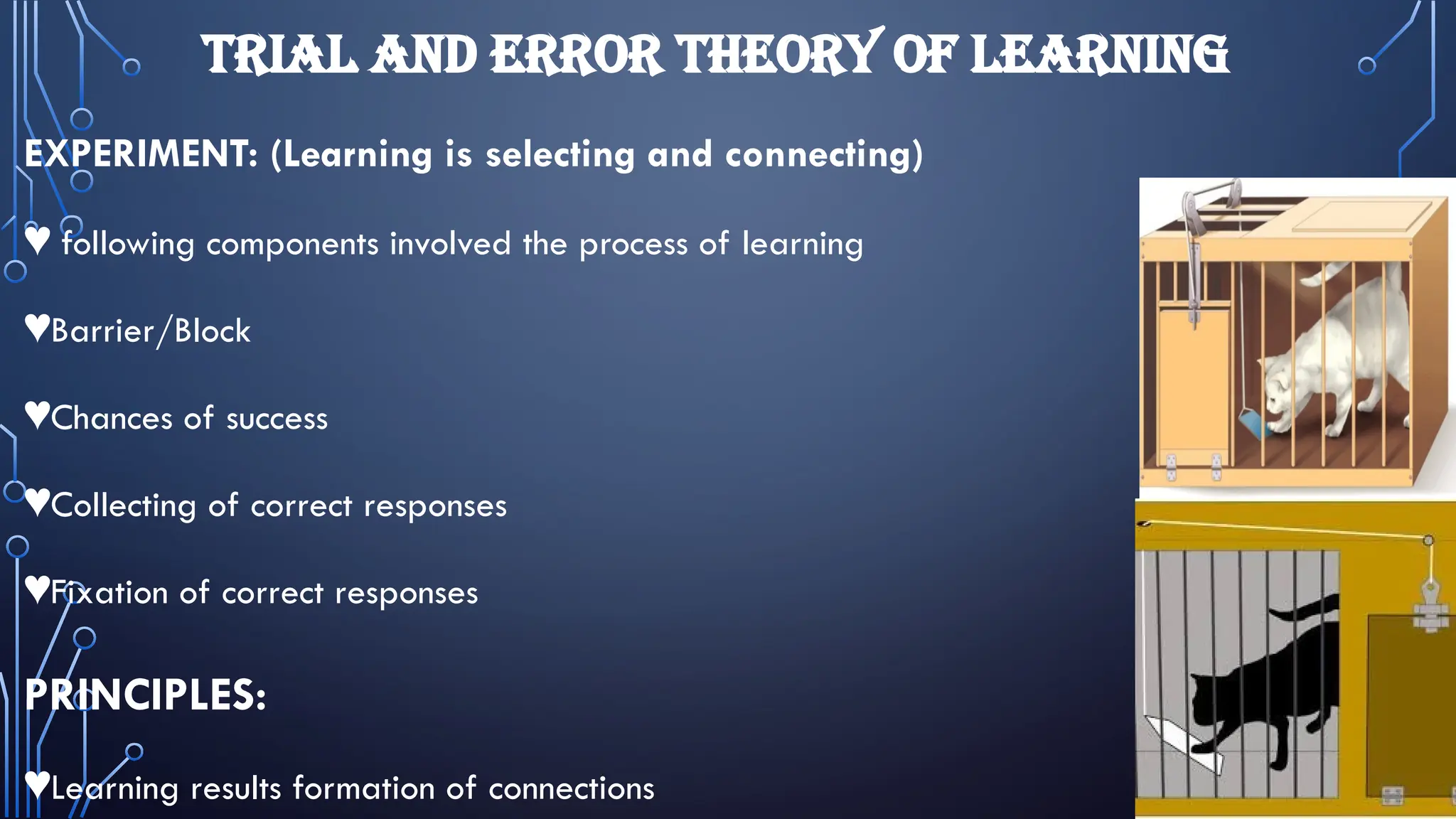
To support this point of view about learning, Thorndike conducted
experiment on Cat
TRIAL AND ERROR THEORY OF LEARNING
EXPERIMENT:
♥ Ahungrycatwasplacedinaboxwhichhasonlyonedoorforexitbutthatcouldbeopened
bymanipulatingthelatch.
♥Afishwasplacedoutsidethebox
♥Thecatwastriedtocomeoutoftheboxbysqueezing,jumping,bitingetc.
♥• Thedooroftheboxcouldbeopenedbypullingthestringsinsidethebox
♥•bychance,catmanipulatedthelatch,thedooropenedandhegotthefishasreward
♥Foranotherprocesstrialhasrepeated,butnexttimetheincorrectresponseswasless
♥Aftererror,itgainsuccessonsubsequenttrial
TRIAL AND ERROR THEORY OF LEARNING
EXPERIMENT: (Learning is selecting and connecting)
♥ following components involved the process of learning
♥Barrier/Block
♥Chances of success
♥Collecting of correct responses
♥Fixation of correct responses
PRINCIPLES:
♥Learning results formation of connections
CLASSICAL CONDITIONING LEARNING
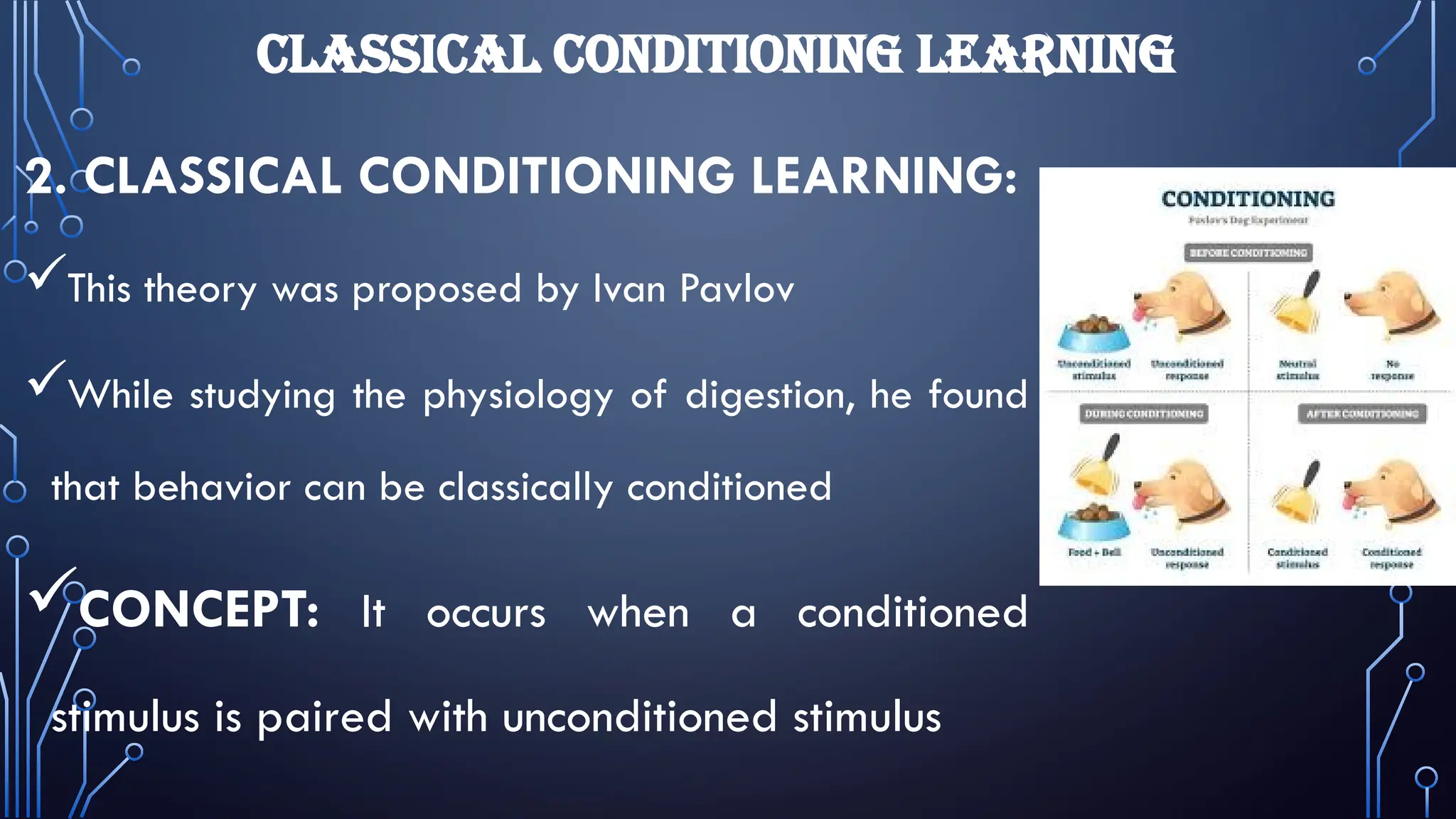
2. CLASSICAL CONDITIONING LEARNING:
This theory was proposed by Ivan Pavlov
While studying the physiology of digestion, he found
that behavior can be classically conditioned
CONCEPT: It occurs when a conditioned
stimulus is paired with unconditioned stimulus
CLASSICAL CONDITIONING LEARNING
• EXPERIMENT:
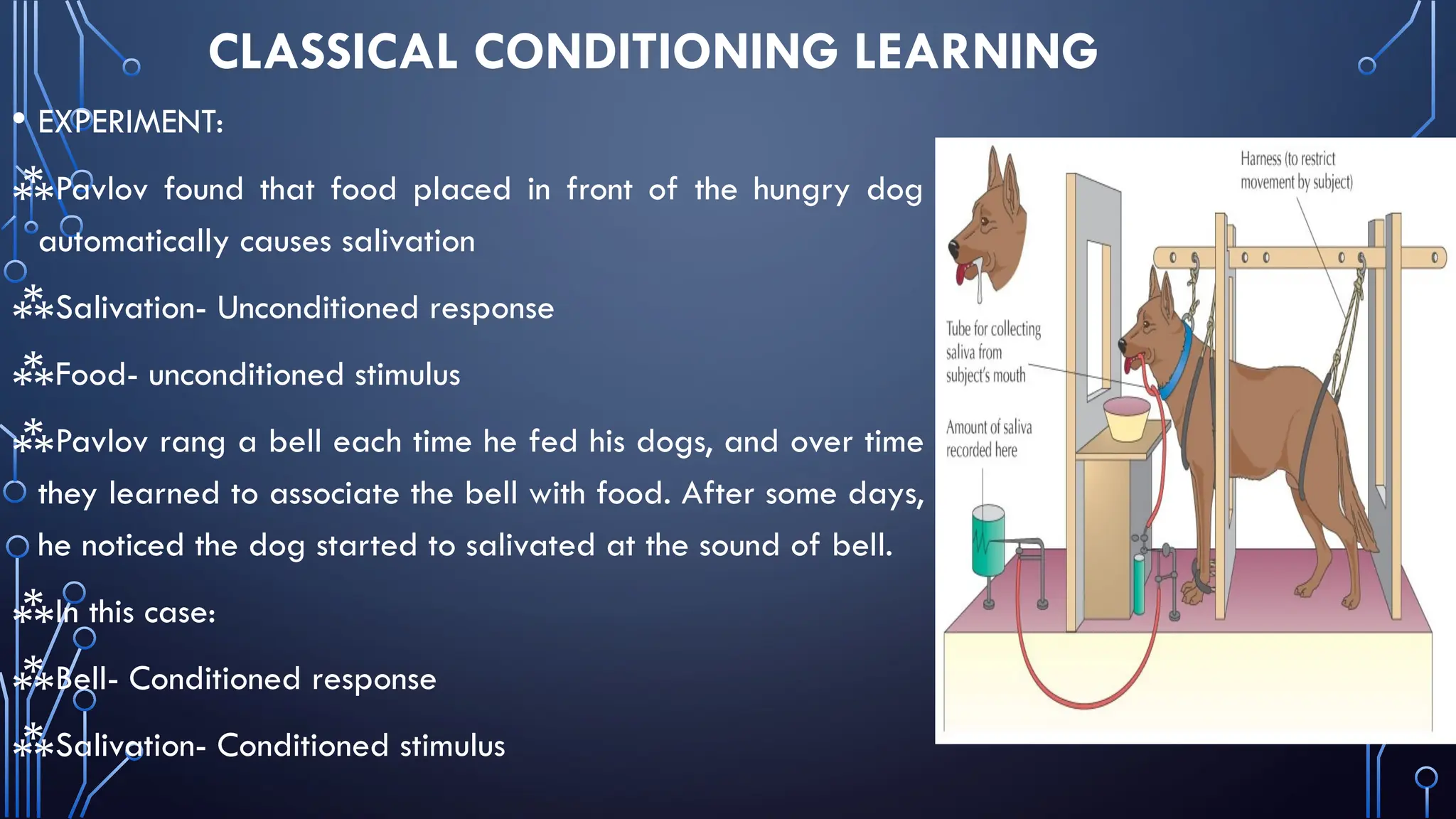
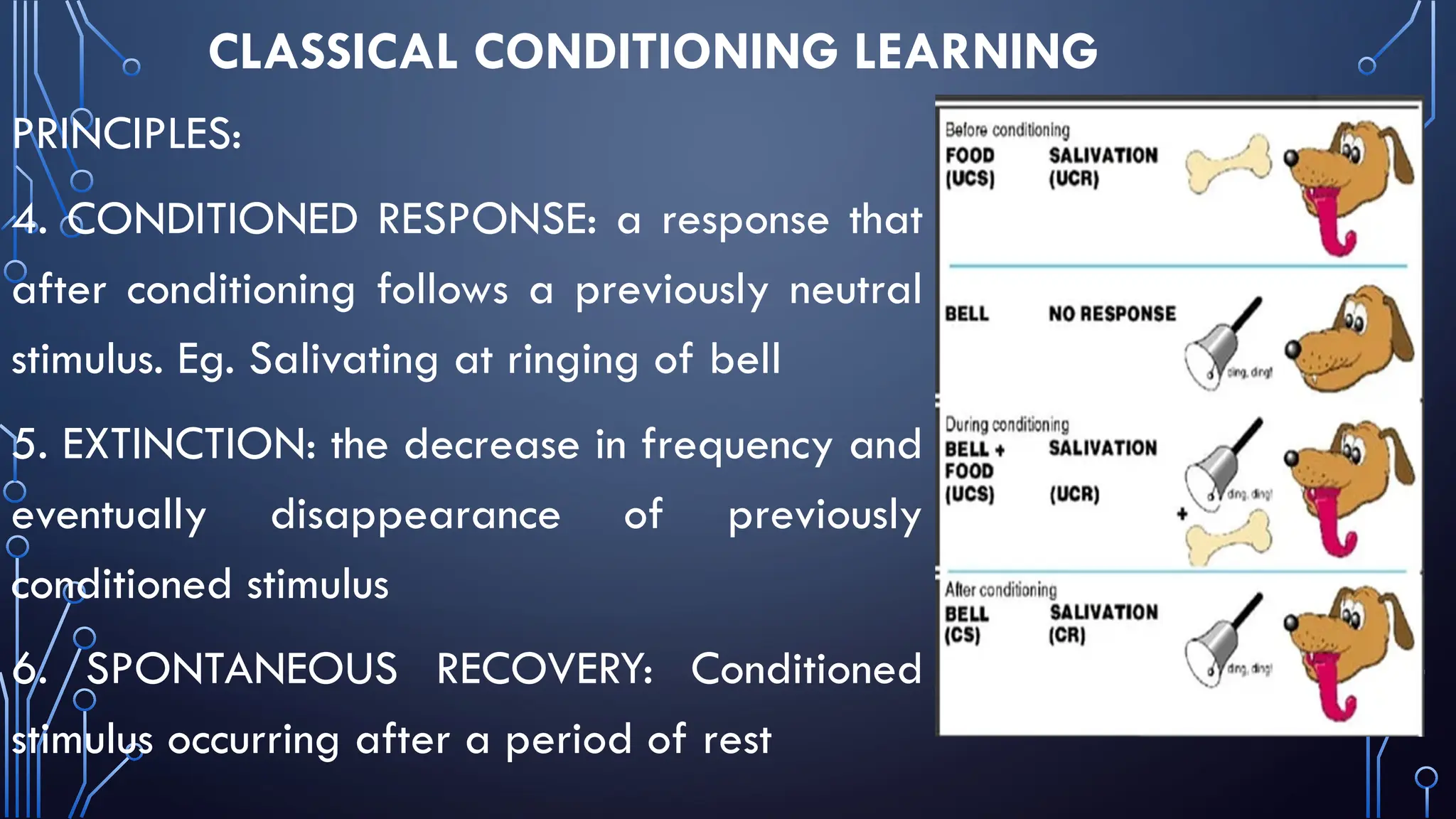
⁂Pavlov found that food placed in front of the hungry dog
automatically causes salivation
⁂Salivation- Unconditioned response
⁂Food- unconditioned stimulus
⁂Pavlov rang a bell each time he fed his dogs, and over time
they learned to associate the bell with food. After some days,
he noticed the dog started to salivated at the sound of bell.
⁂In this case:
⁂Bell- Conditioned response
⁂Salivation- Conditioned stimulus
CLASSICAL CONDITIONING LEARNING
PRINCIPLES:
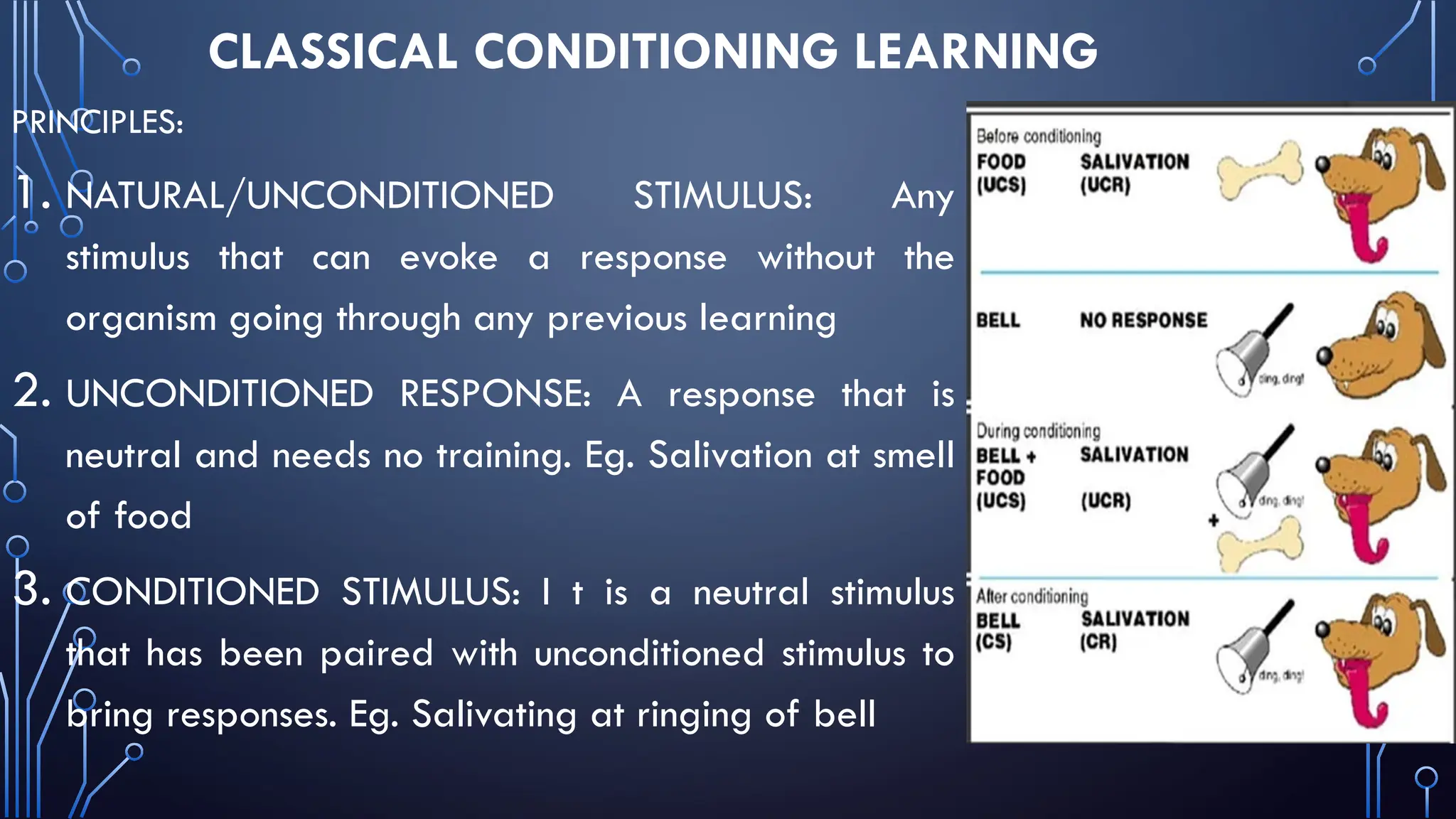
1. NATURAL/UNCONDITIONED STIMULUS: Any
stimulus that can evoke a response without the
organism going through any previous learning
2. UNCONDITIONED RESPONSE: A response that is
neutral and needs no training. Eg. Salivation at smell
of food
3. CONDITIONED STIMULUS: I t is a neutral stimulus
that has been paired with unconditioned stimulus to
bring responses. Eg. Salivating at ringing of bell
CLASSICAL CONDITIONING LEARNING
PRINCIPLES:
4. CONDITIONED RESPONSE: a response that
after conditioning follows a previously neutral
stimulus. Eg. Salivating at ringing of bell
5. EXTINCTION: the decrease in frequency and
eventually disappearance of previously
conditioned stimulus
6. SPONTANEOUS RECOVERY: Conditioned
stimulus occurring after a period of rest
3. OPERENT CONDITIONING LEARNING
It is proposed by B.F Skinner
CONCEPT:
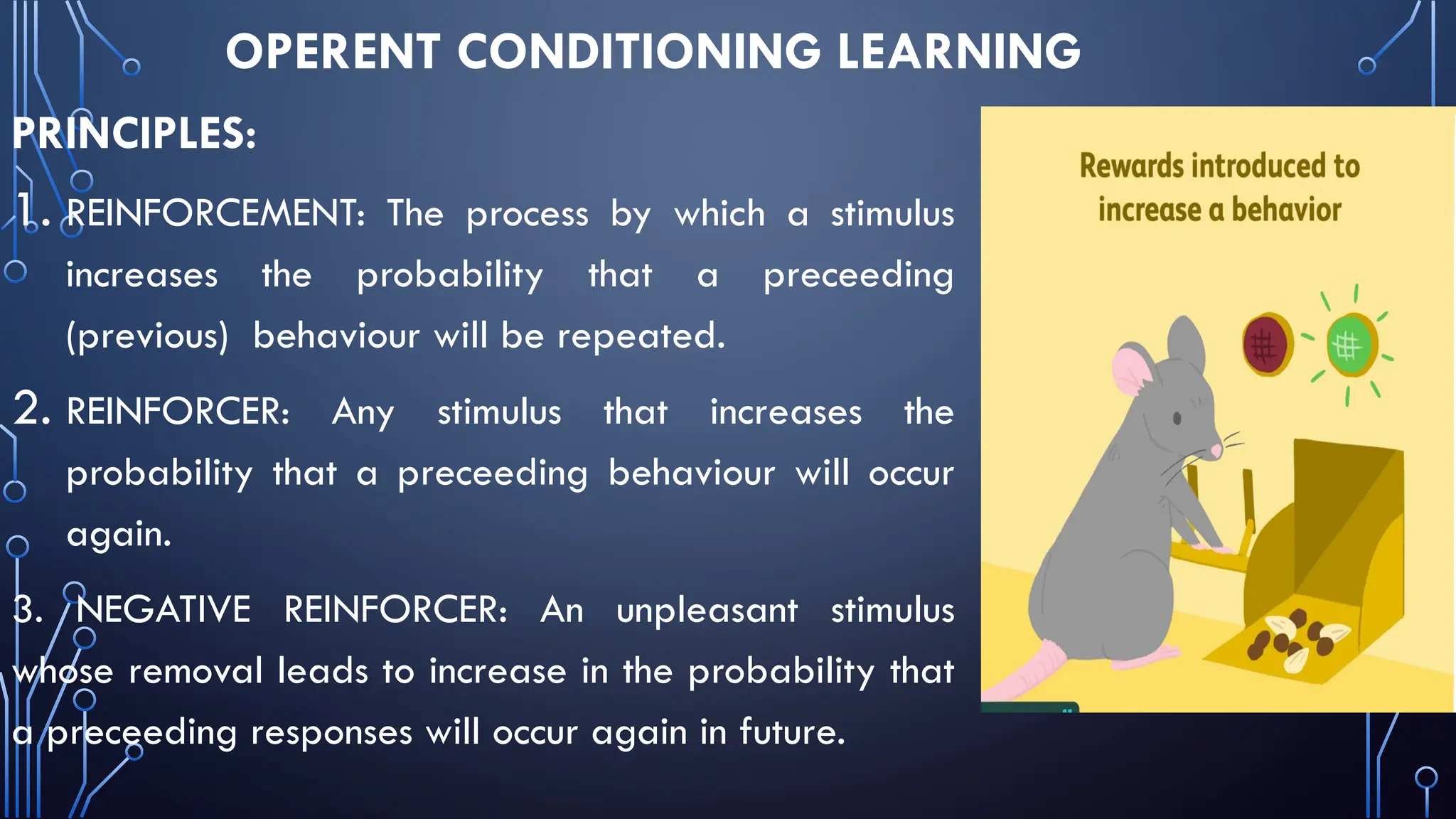
In operant conditioning, behavior is increased
or decreased based on the consequences that
follow it.
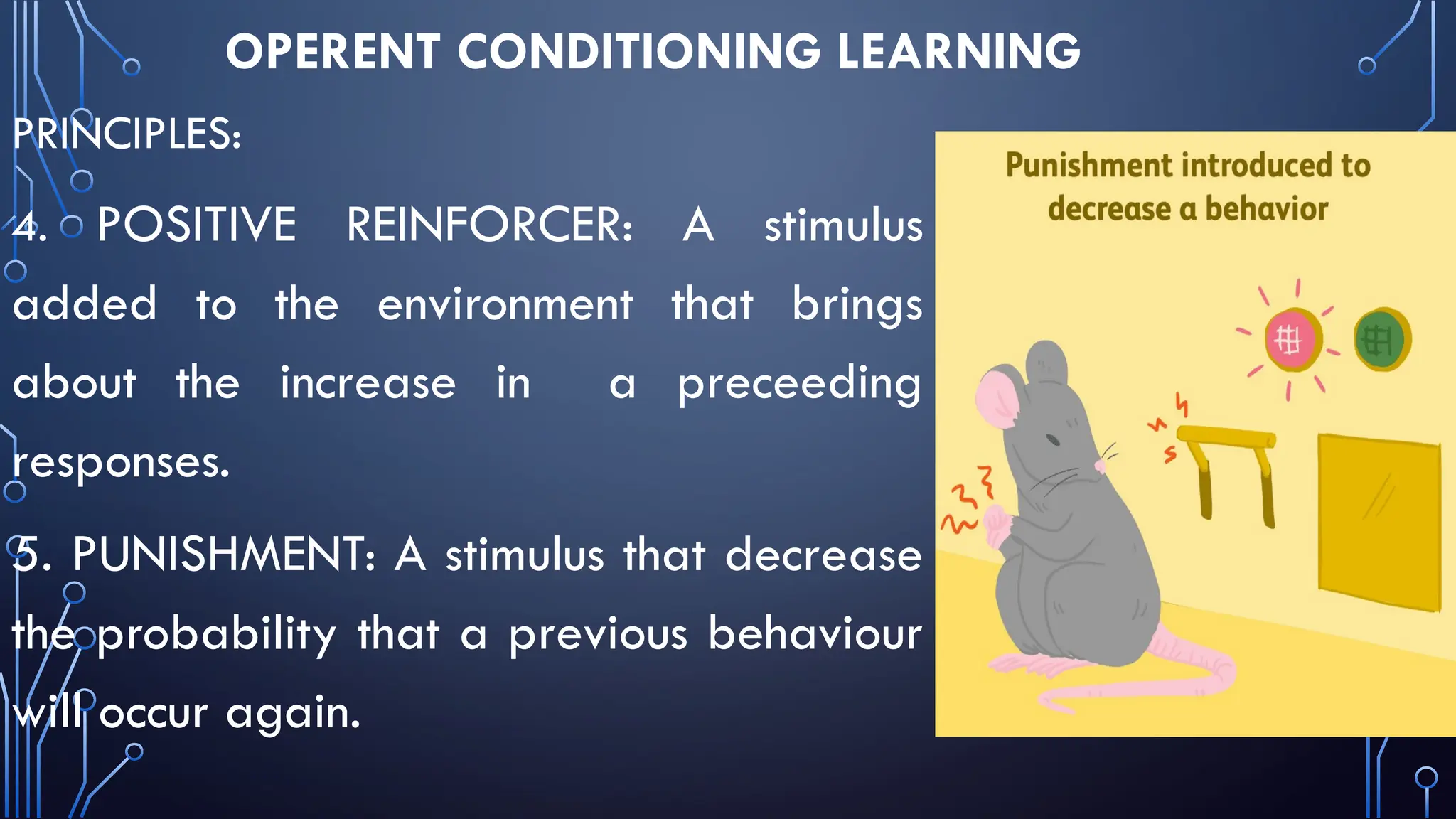
Behaviors that are rewarded are likely to be
repeated, while behaviors that are punished
are less likely to happen.
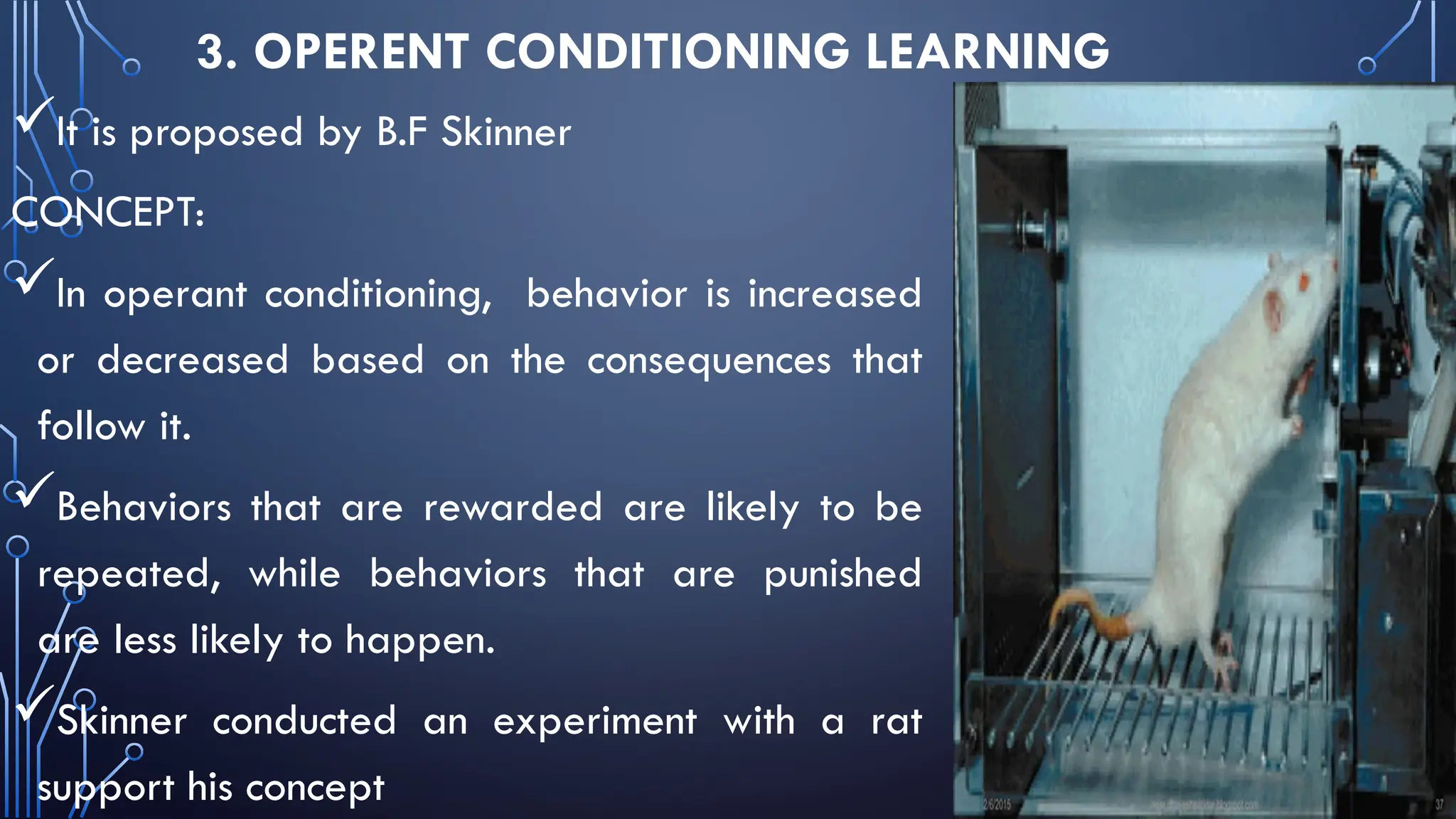
Skinner conducted an experiment with a rat
support his concept
OPERENT CONDITIONING LEARNING
EXPERIMENT:
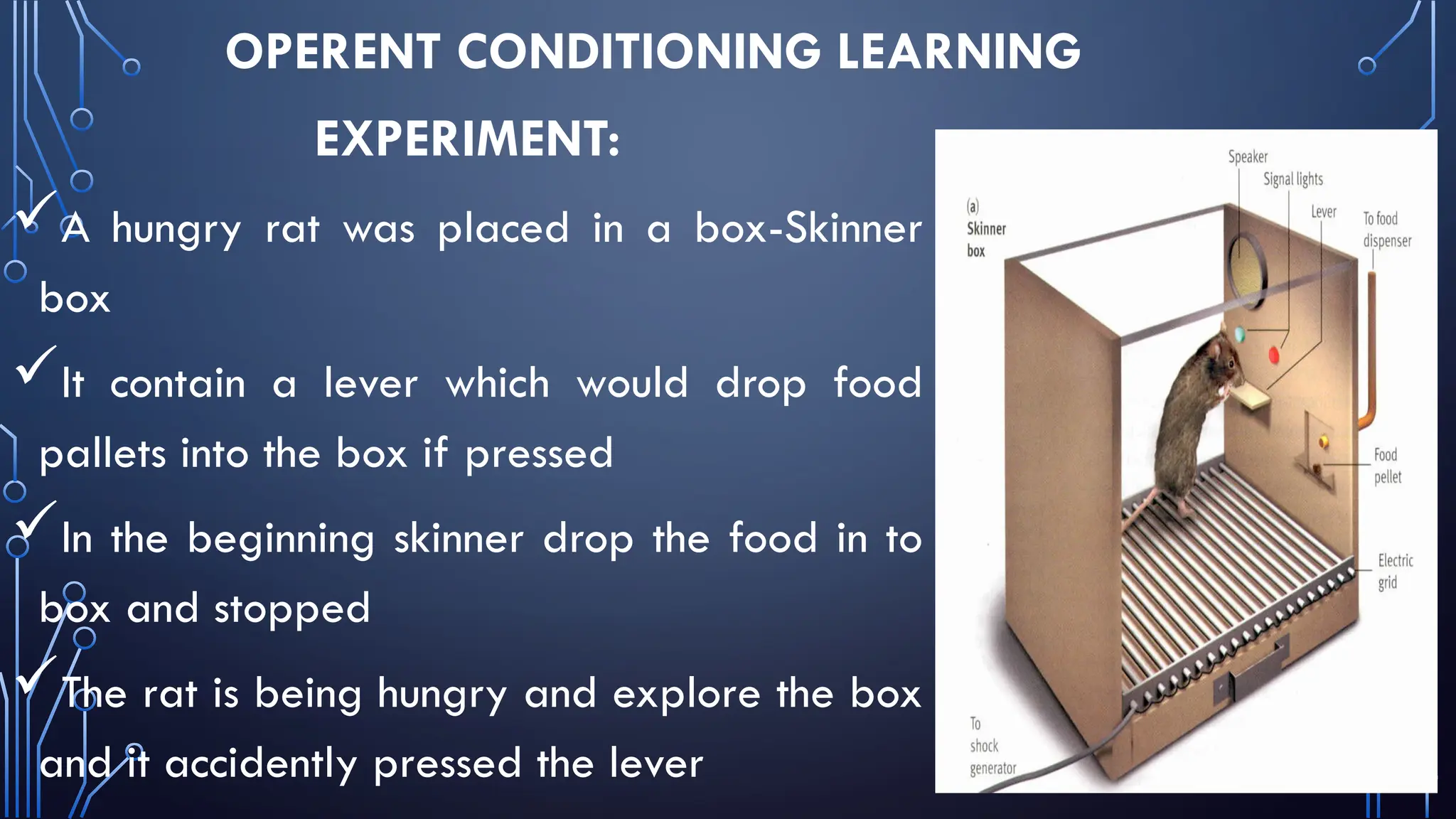
A hungry rat was placed in a box-Skinner
box
It contain a lever which would drop food
pallets into the box if pressed
In the beginning skinner drop the food in to
box and stopped
The rat is being hungry and explore the box
and it accidently pressed the lever
OPERENT CONDITIONING LEARNING
EXPERIMENT:
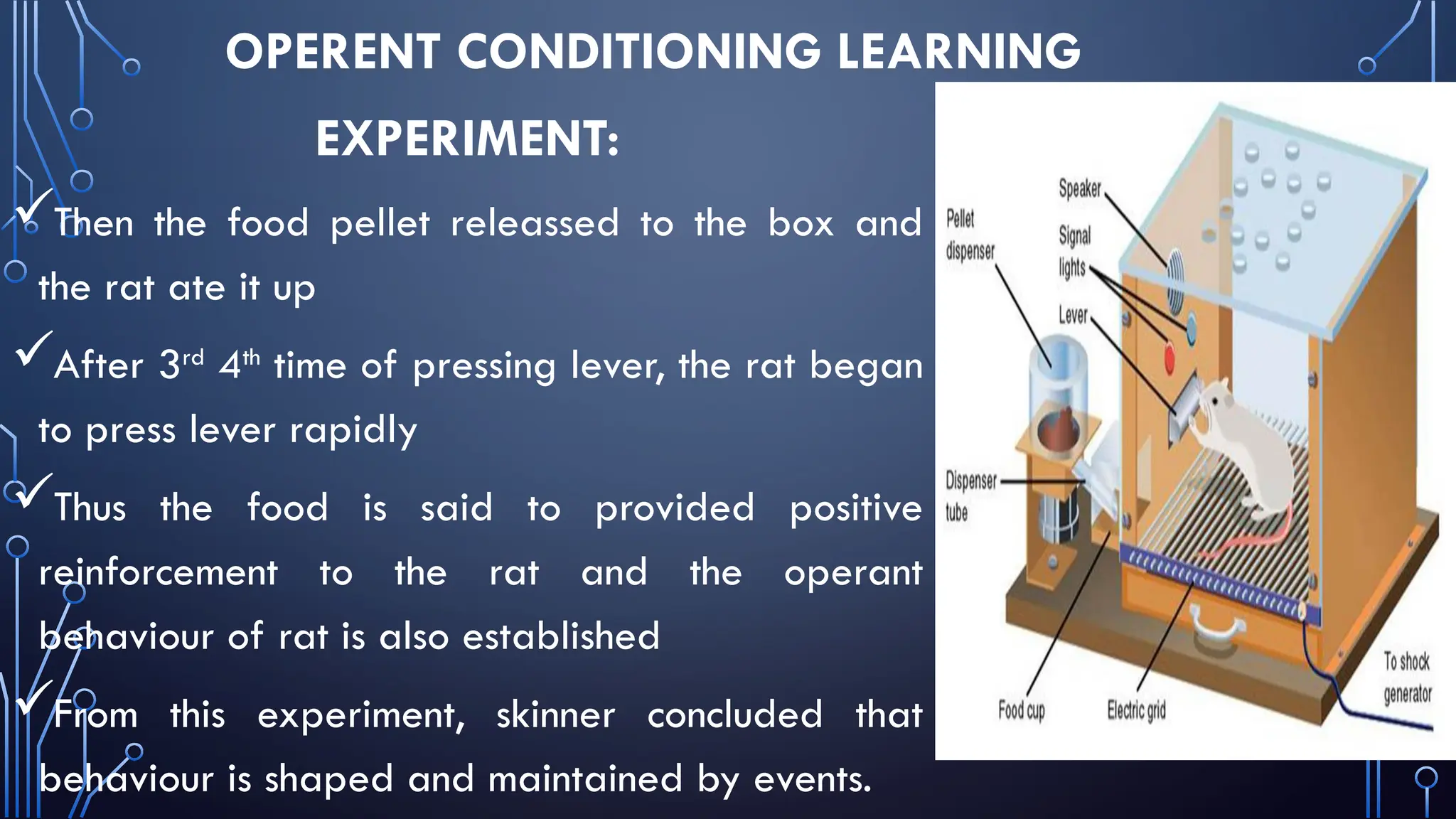
Then the food pellet releassed to the box and
the rat ate it up
After 3rd
4th
time of pressing lever, the rat began
to press lever rapidly
Thus the food is said to provided positive
reinforcement to the rat and the operant
behaviour of rat is also established
From this experiment, skinner concluded that
behaviour is shaped and maintained by events.
OPERENT CONDITIONING LEARNING
PRINCIPLES:
1. REINFORCEMENT: The process by which a stimulus
increases the probability that a preceeding
(previous) behaviour will be repeated.
2. REINFORCER: Any stimulus that increases the
probability that a preceeding behaviour will occur
again.
3. NEGATIVE REINFORCER: An unpleasant stimulus
whose removal leads to increase in the probability that
a preceeding responses will occur again in future.
OPERENT CONDITIONING LEARNING
PRINCIPLES:
4. POSITIVE REINFORCER: A stimulus
added to the environment that brings
about the increase in a preceeding
responses.
5. PUNISHMENT: A stimulus that decrease
the probability that a previous behaviour
will occur again.
4. THEORY OF INSIGHTFUL LEARNING
♥It is also known as Gestalt psychology
♥The founder is Max Wertheimer
CONCEPT:
♥Learning is a purposive, explanatory and creative
process rather than mere trial and error on even
conditioning.
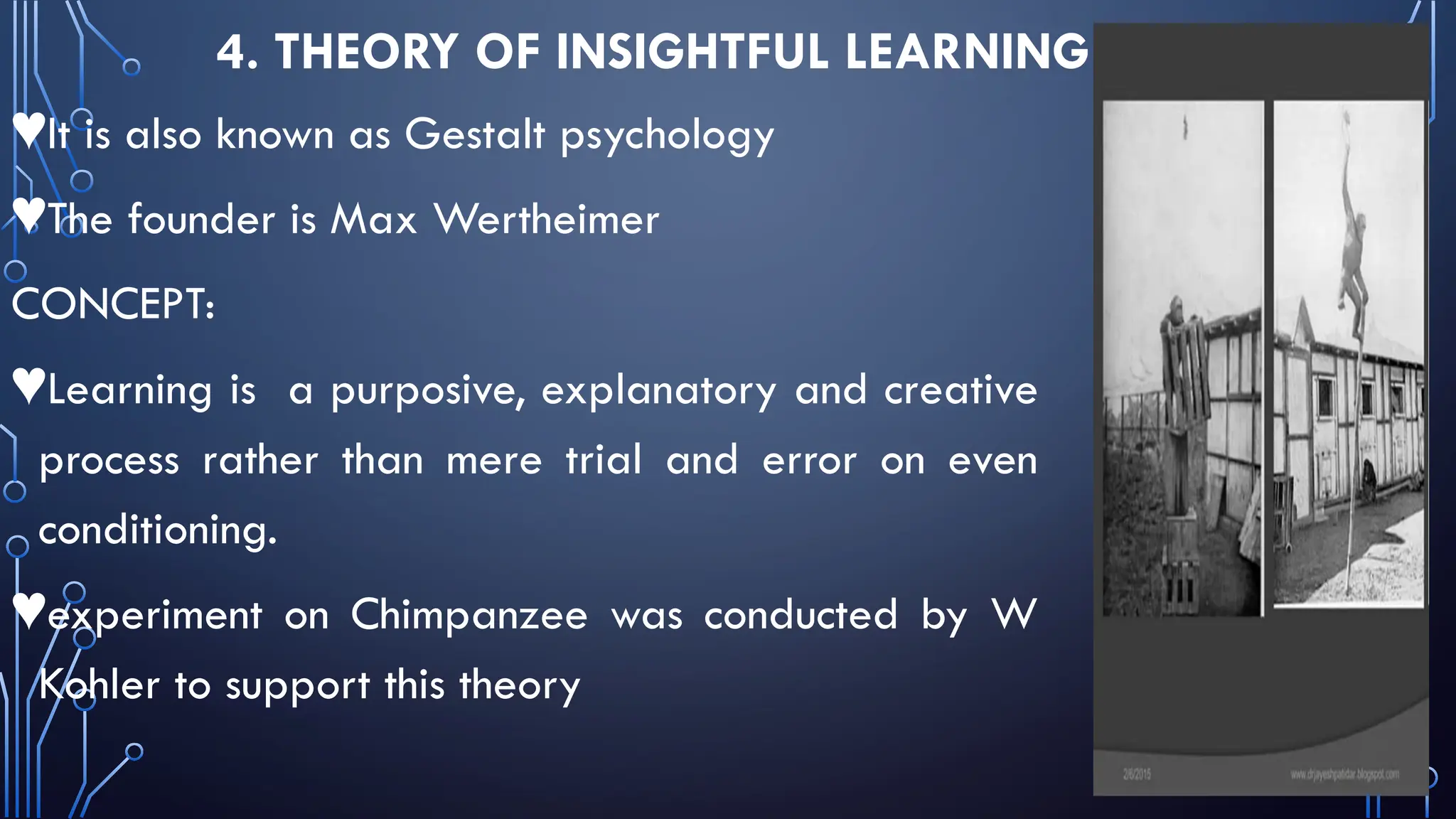
♥experiment on Chimpanzee was conducted by W
Kohler to support this theory
4. THEORY OF INSIGHTFUL LEARNING
♥EXPERIMENT:
♥Kohler made three arrangements in this experiment.
♥FIRST ARRANGEMENT:
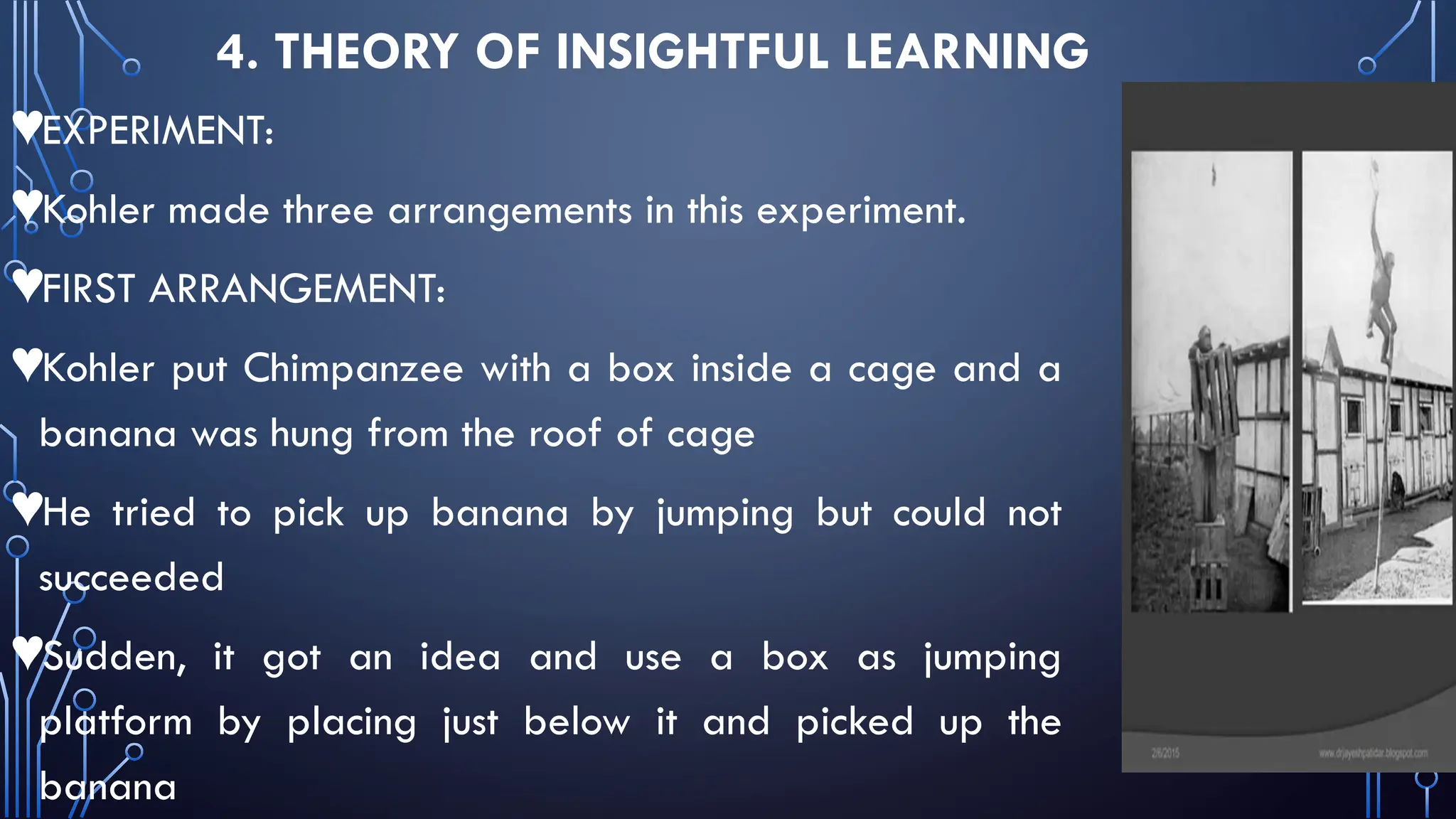
♥Kohler put Chimpanzee with a box inside a cage and a
banana was hung from the roof of cage
♥He tried to pick up banana by jumping but could not
succeeded
♥Sudden, it got an idea and use a box as jumping
platform by placing just below it and picked up the
banana
4. THEORY OF INSIGHTFUL LEARNING
♥EXPERIMENT:
♥SECOND ARRANGEMENT:
♥Kohler hung the banana higher than the 1st
arrangement.
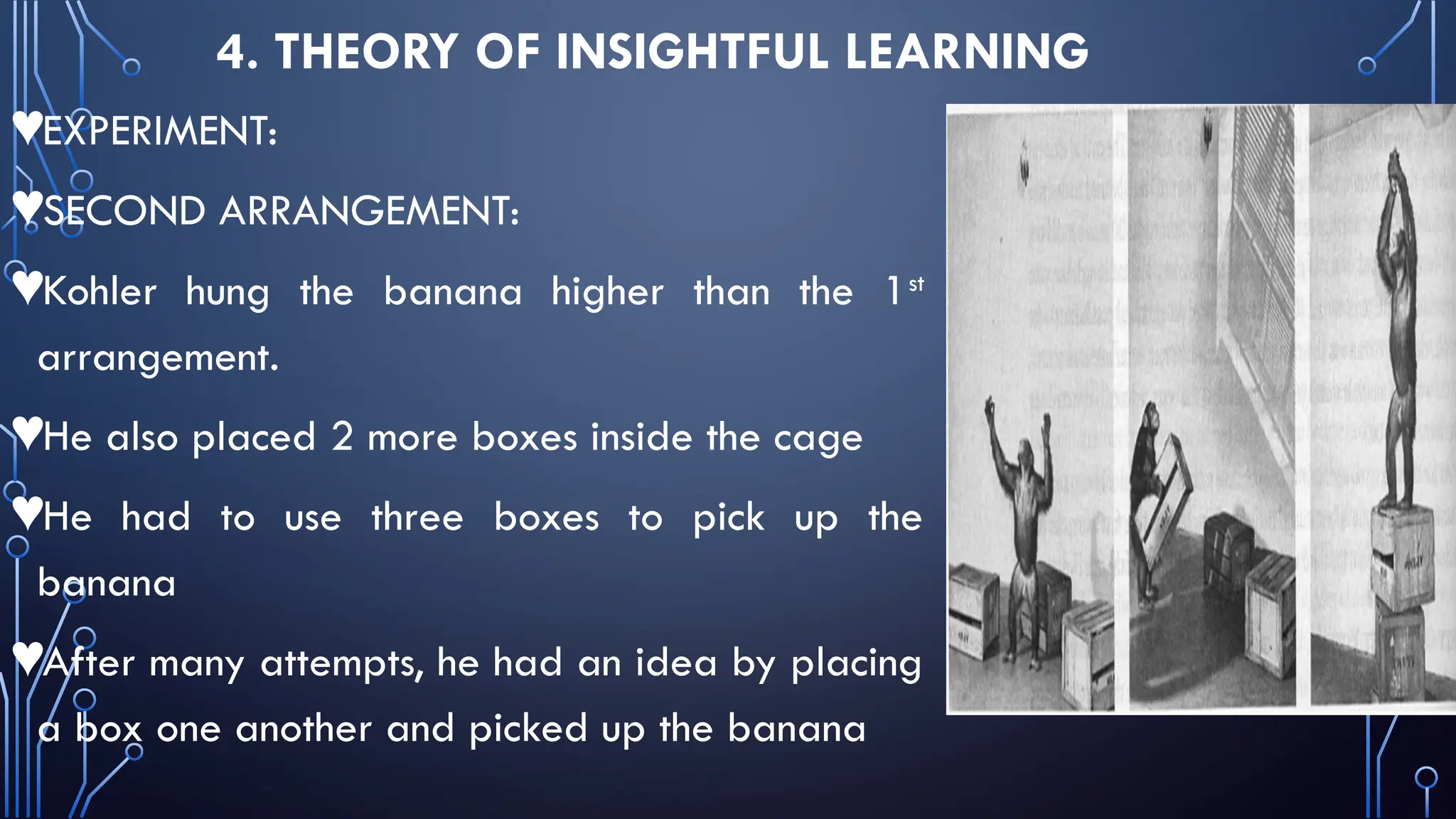
♥He also placed 2 more boxes inside the cage
♥He had to use three boxes to pick up the
banana
♥After many attempts, he had an idea by placing
a box one another and picked up the banana
4. THEORY OF INSIGHTFUL LEARNING
♥EXPERIMENT:
♥THIRD ARRANGEMENT:
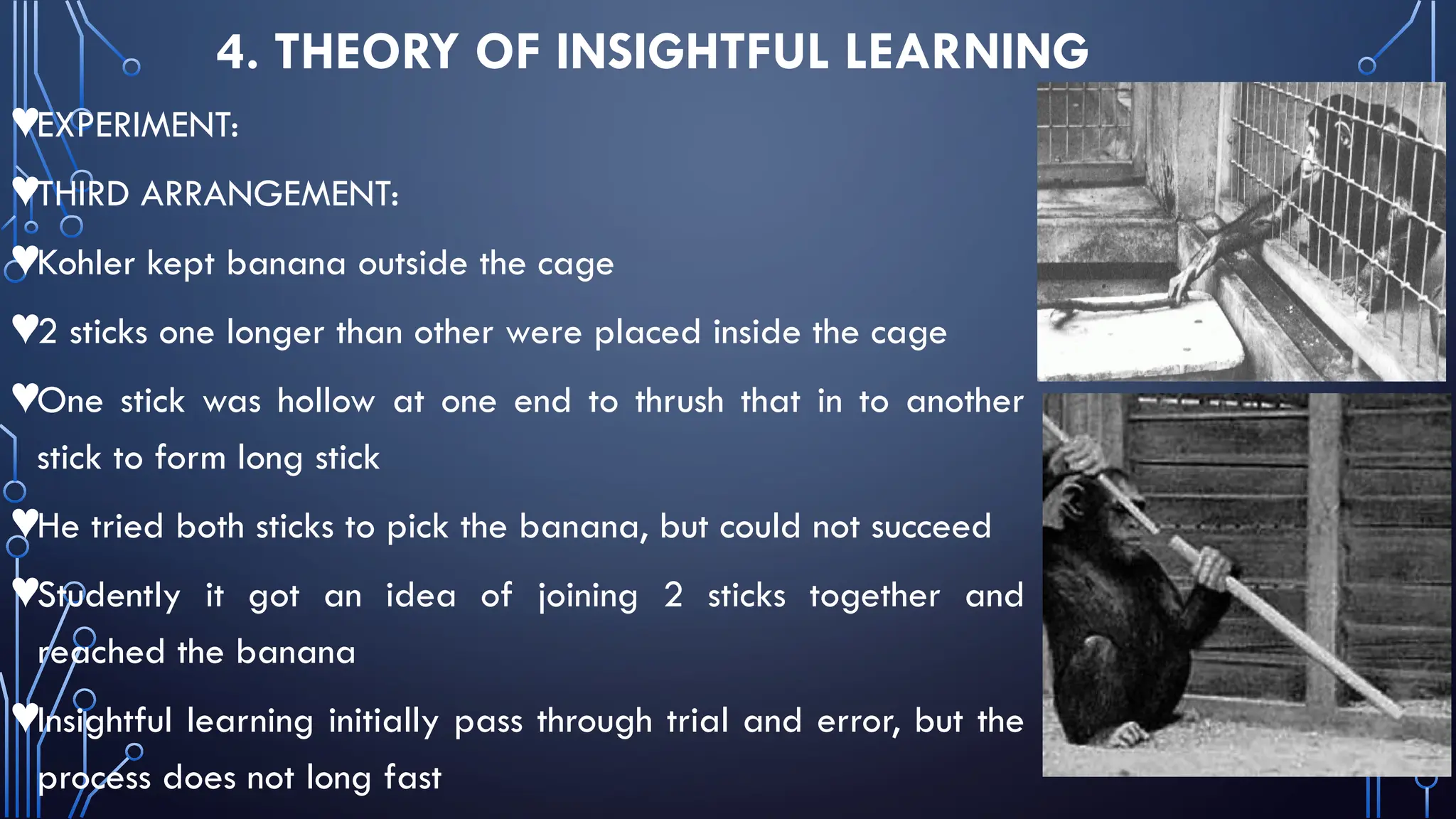
♥Kohler kept banana outside the cage
♥2 sticks one longer than other were placed inside the cage
♥One stick was hollow at one end to thrush that in to another
stick to form long stick
♥He tried both sticks to pick the banana, but could not succeed
♥Studently it got an idea of joining 2 sticks together and
reached the banana
♥Insightful learning initially pass through trial and error, but the
process does not long fast
5. OBSERVATIONAL LEARNING
♥By Alber Bandura
♥It is learning through imitation
♥It is also called social learning theory
♥CONCEPT:
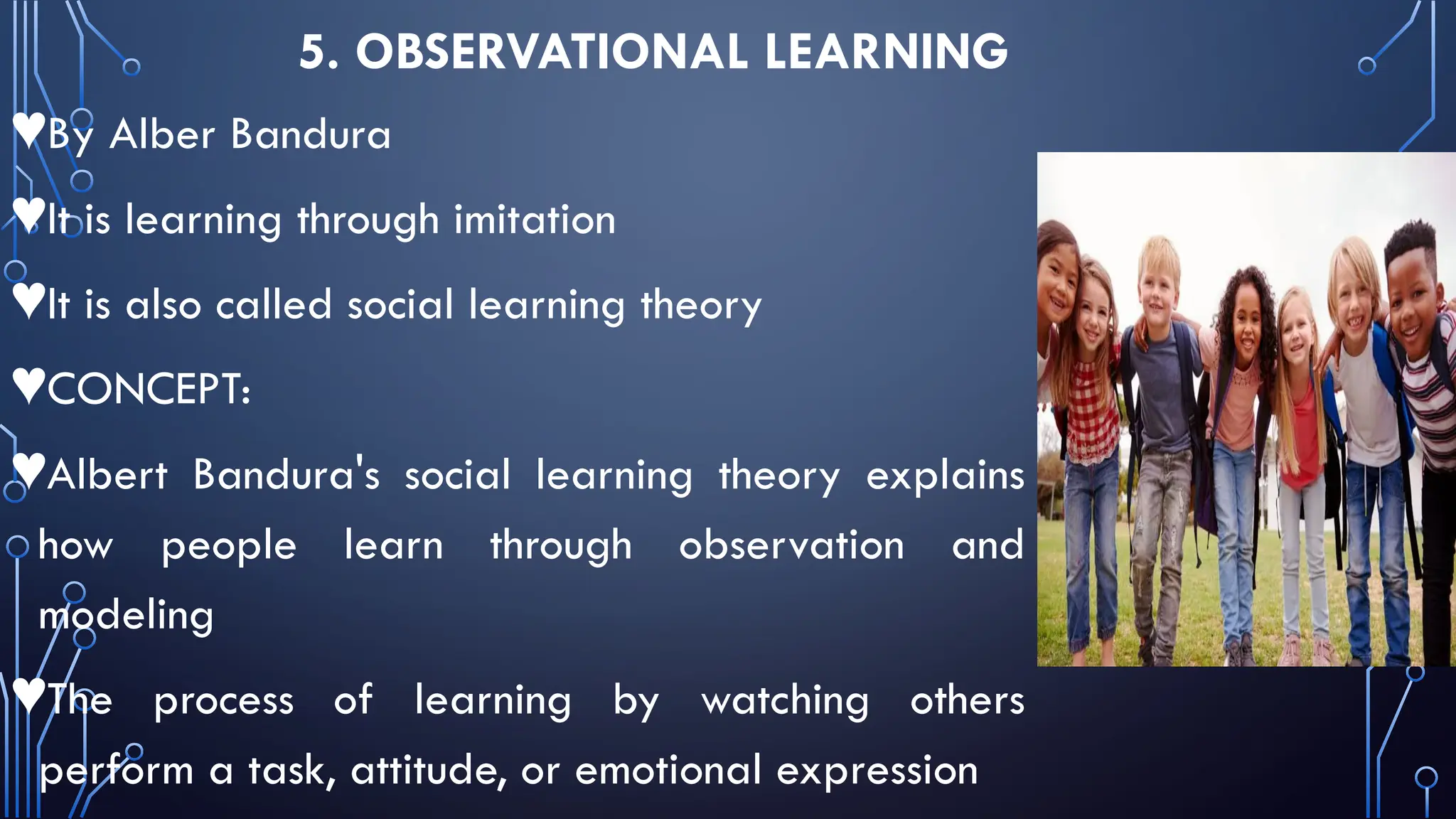
♥Albert Bandura's social learning theory explains
how people learn through observation and
modeling
♥The process of learning by watching others
perform a task, attitude, or emotional expression
5. OBSERVATIONAL LEARNING
♥It has four steps:
1. Paying attention of another person’s behaviour
2. Remembering the behaviour
3. Reproducing the action
4. Being motivated to learn and carry out the behaviour
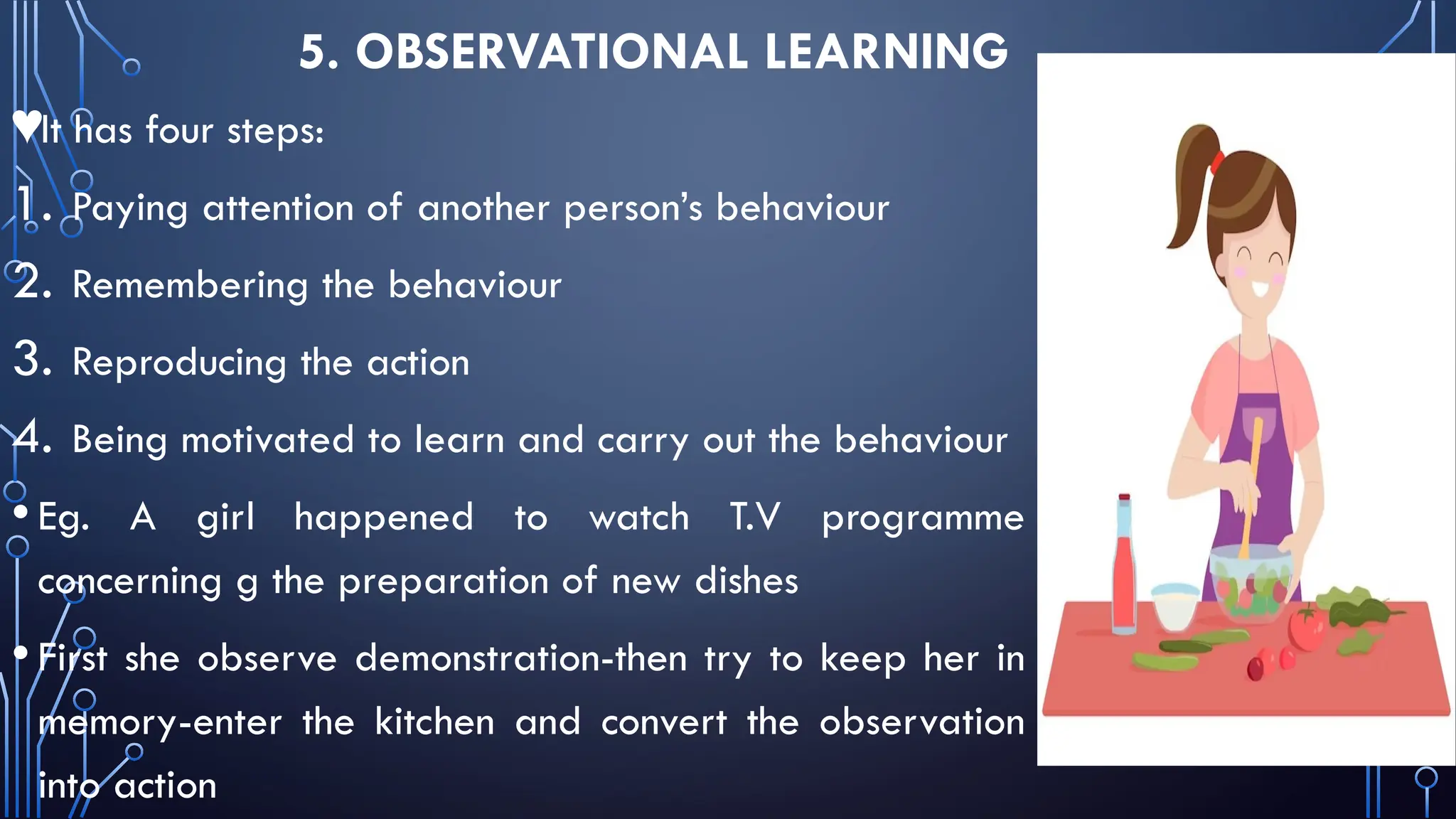
•Eg. A girl happened to watch T.V programme
concerning g the preparation of new dishes
•First she observe demonstration-then try to keep her in
memory-enter the kitchen and convert the observation
into action
FACTORS AFFECTING LEARNING
I. EXTERNAL FACTORS
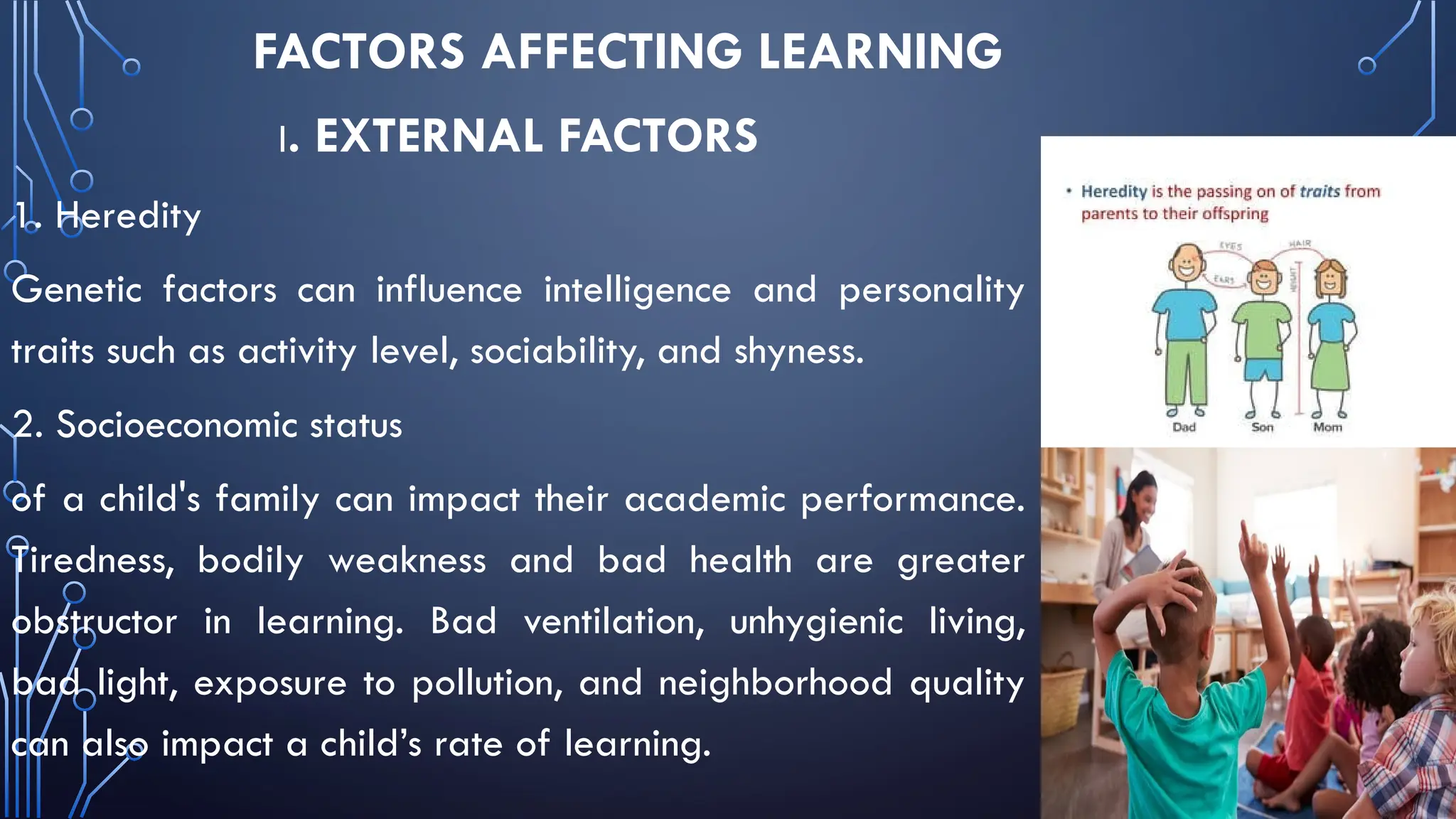
1. Heredity
Genetic factors can influence intelligence and personality
traits such as activity level, sociability, and shyness.
2. Socioeconomic status
of a child's family can impact their academic performance.
Tiredness, bodily weakness and bad health are greater
obstructor in learning. Bad ventilation, unhygienic living,
bad light, exposure to pollution, and neighborhood quality
can also impact a child’s rate of learning.
FACTORS AFFECTING LEARNING
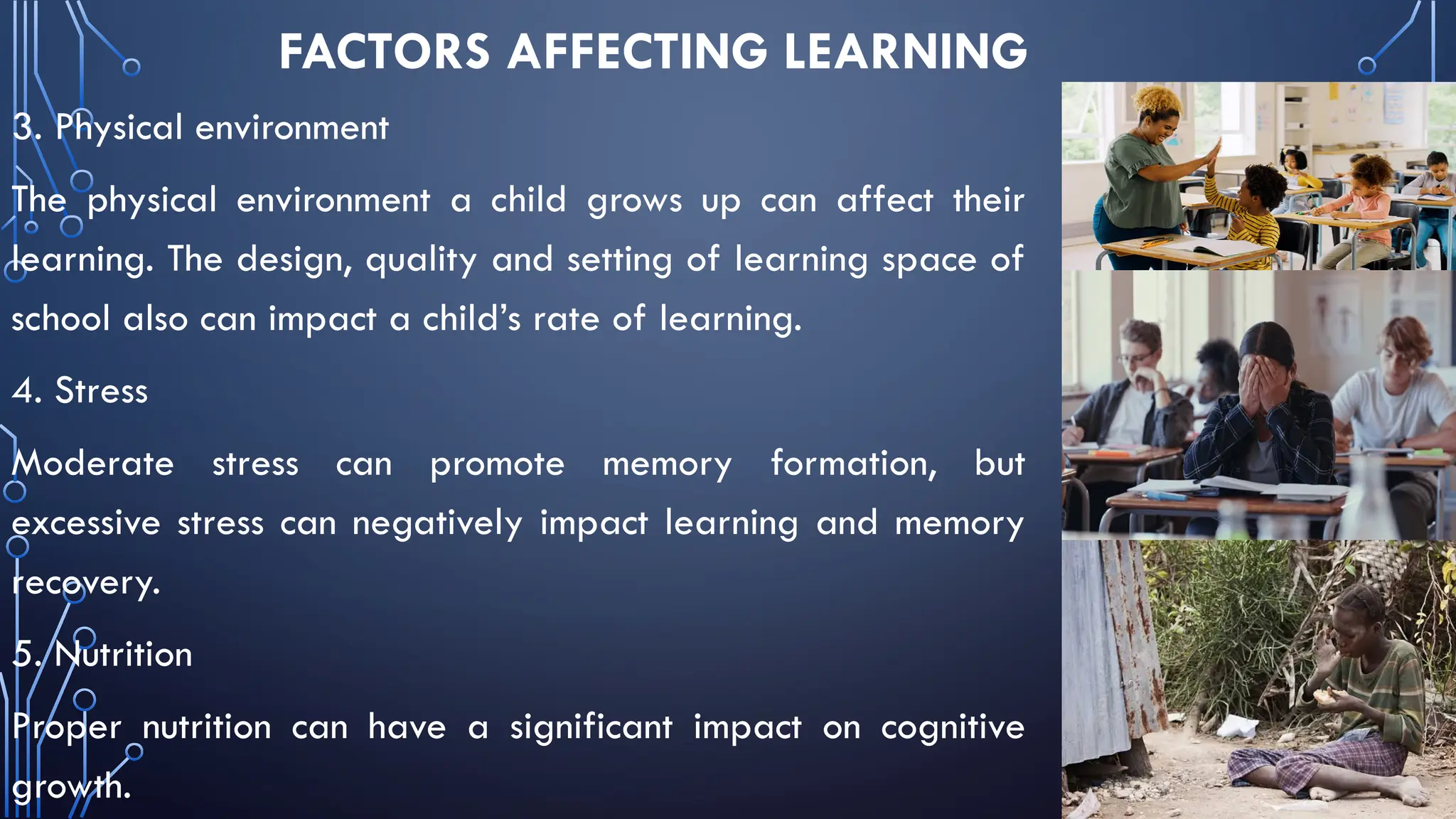
3. Physical environment
The physical environment a child grows up can affect their
learning. The design, quality and setting of learning space of
school also can impact a child’s rate of learning.
4. Stress
Moderate stress can promote memory formation, but
excessive stress can negatively impact learning and memory
recovery.
5. Nutrition
Proper nutrition can have a significant impact on cognitive
growth.
FACTORS AFFECTING LEARNING
II INTERNAL FACTORS:
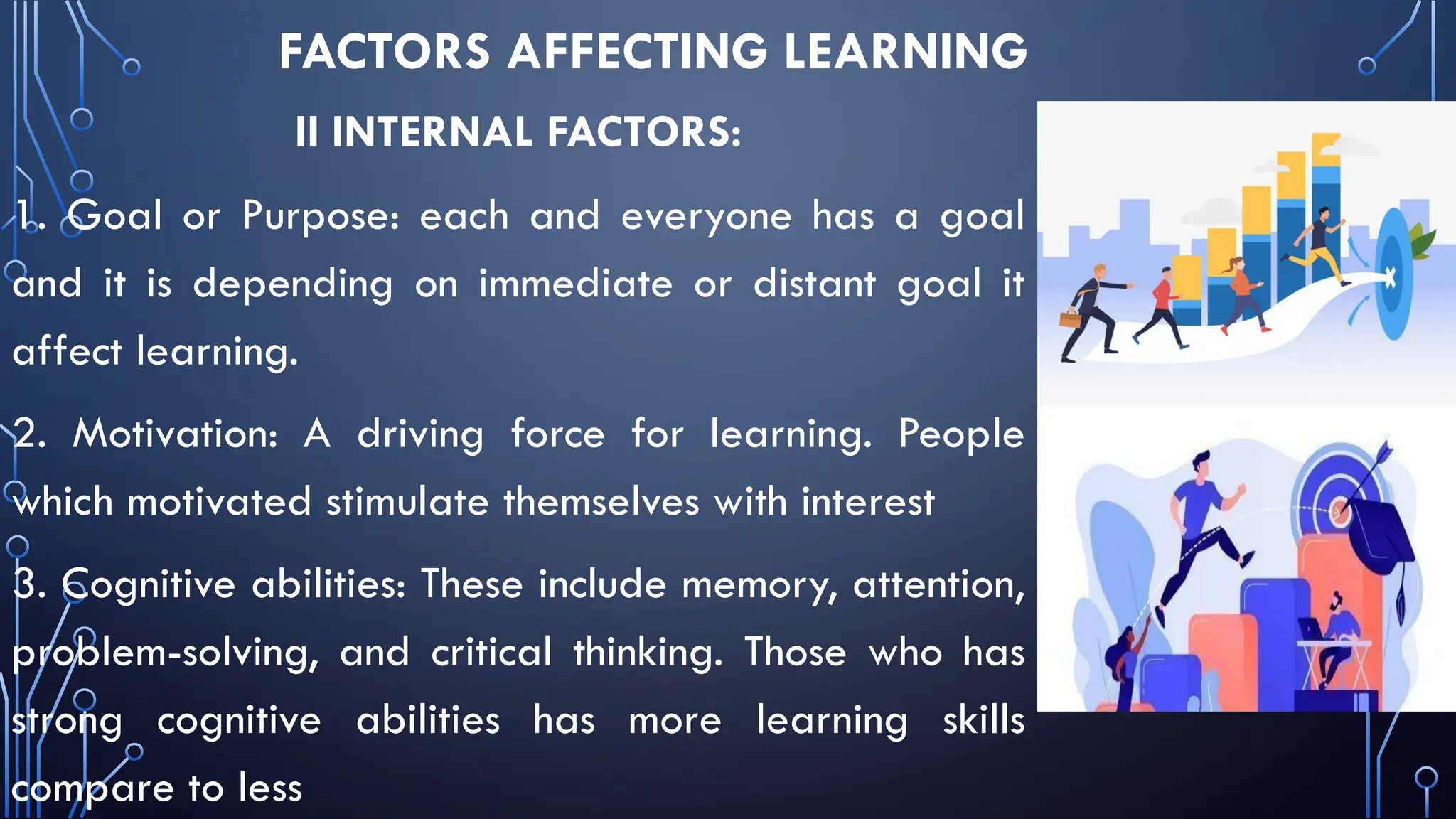
1. Goal or Purpose: each and everyone has a goal
and it is depending on immediate or distant goal it
affect learning.
2. Motivation: A driving force for learning. People
which motivated stimulate themselves with interest
3. Cognitive abilities: These include memory, attention,
problem-solving, and critical thinking. Those who has
strong cognitive abilities has more learning skills
compare to less
FACTORS AFFECTING LEARNING
II INTERNAL FACTORS:
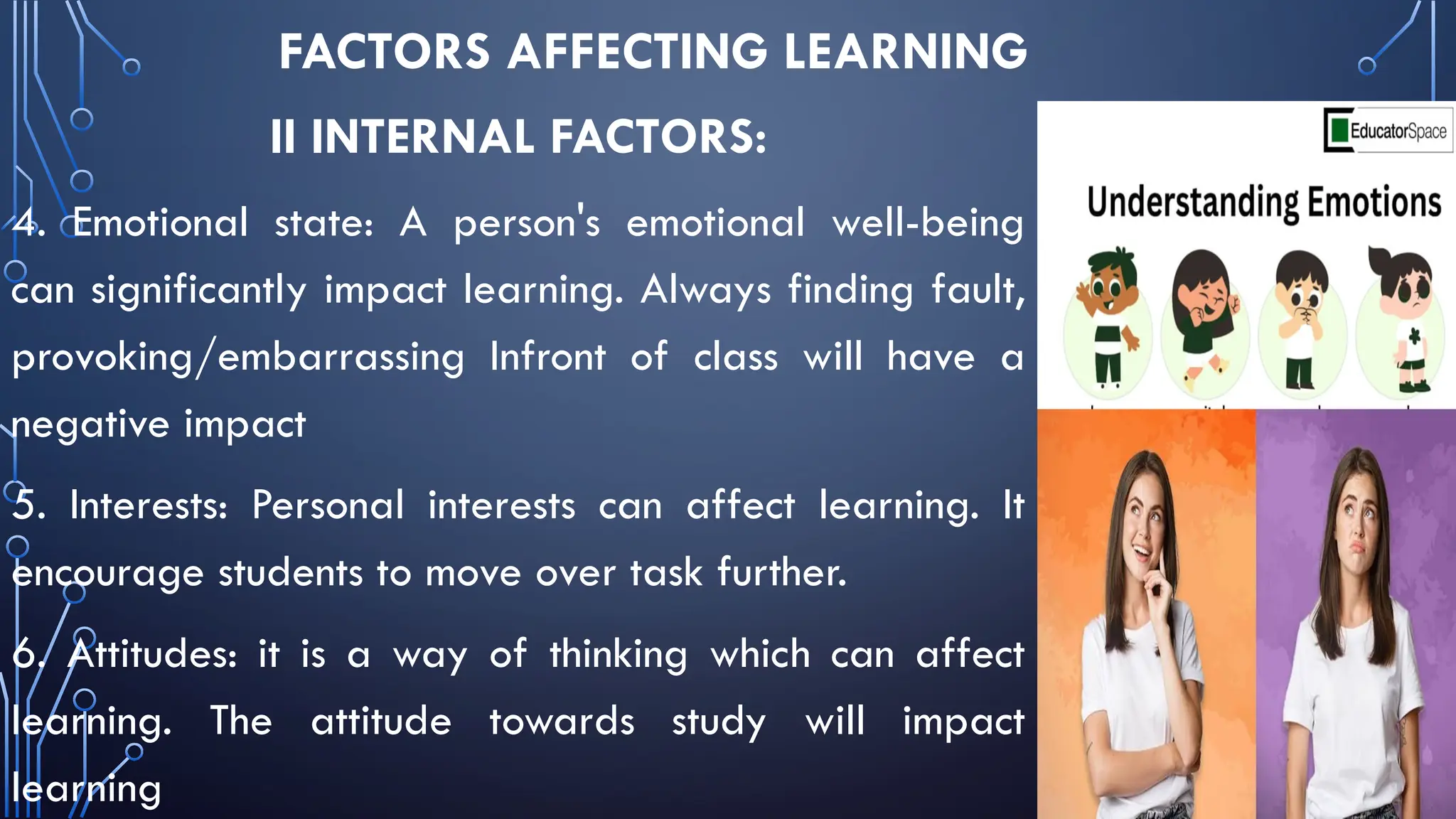
4. Emotional state: A person's emotional well-being
can significantly impact learning. Always finding fault,
provoking/embarrassing Infront of class will have a
negative impact
5. Interests: Personal interests can affect learning. It
encourage students to move over task further.
6. Attitudes: it is a way of thinking which can affect
learning. The attitude towards study will impact
learning
FACTORS AFFECTING LEARNING
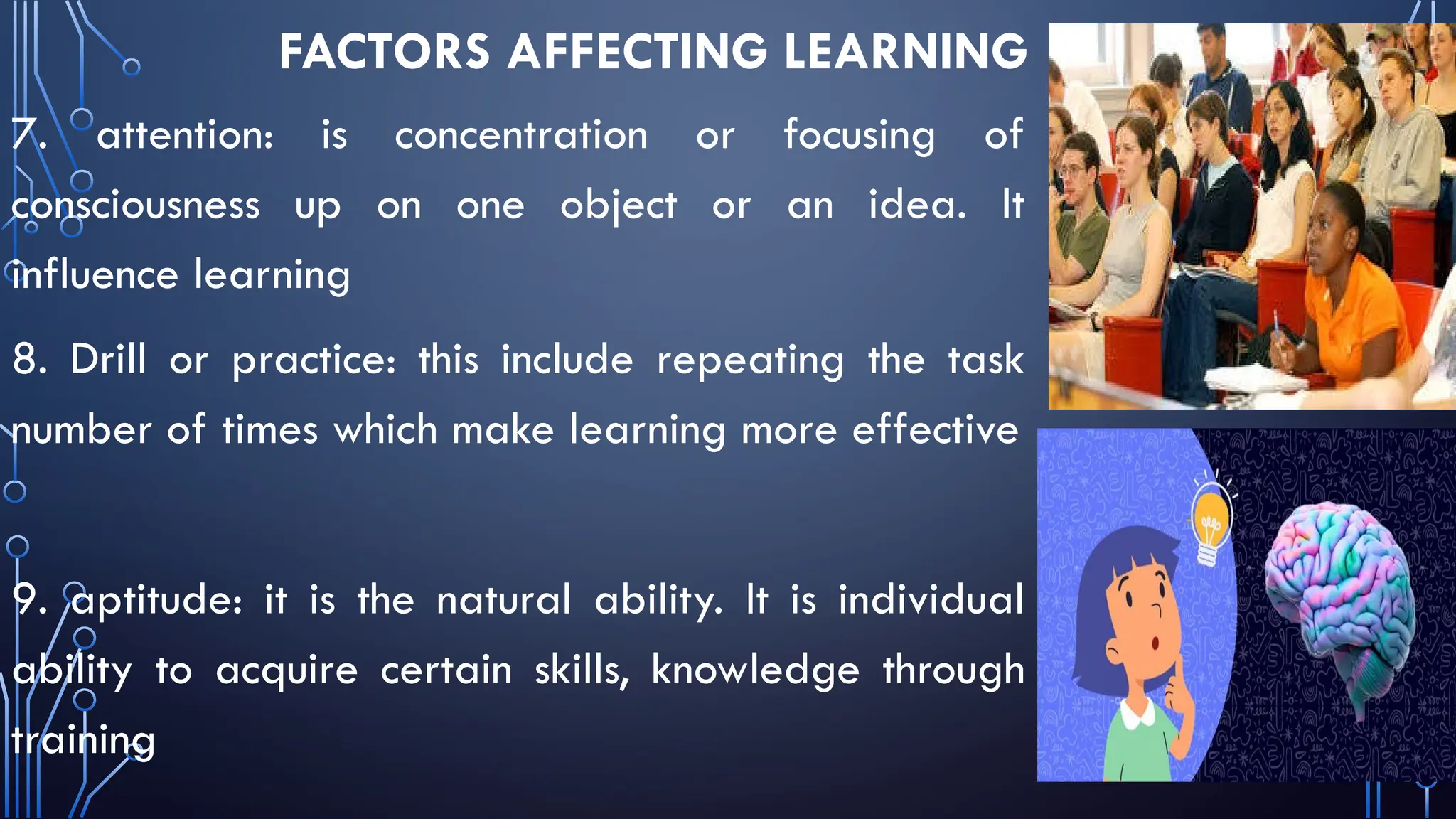
7. attention: is concentration or focusing of
consciousness up on one object or an idea. It
influence learning
8. Drill or practice: this include repeating the task
number of times which make learning more effective
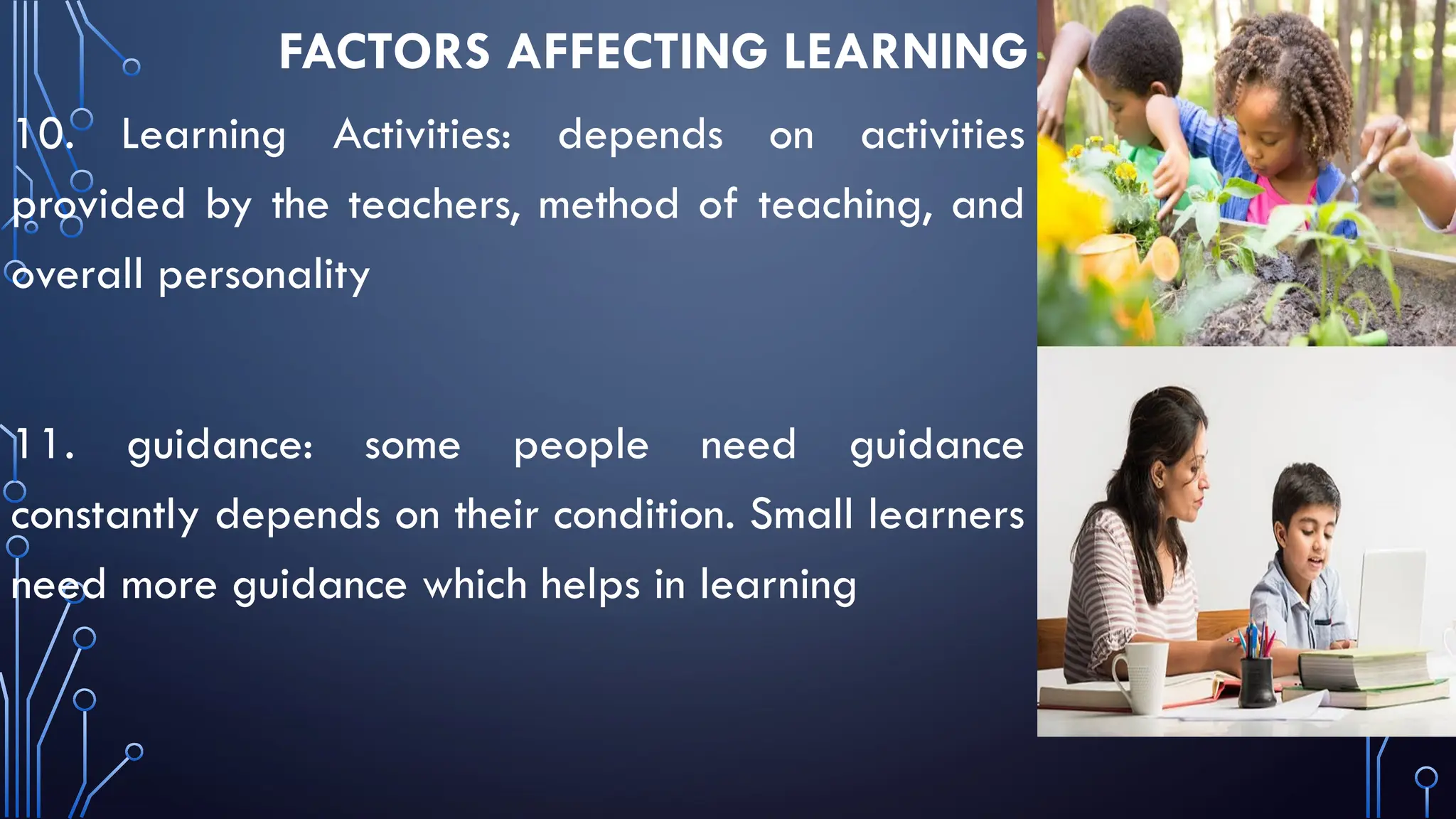
9. aptitude: it is the natural ability. It is individual
ability to acquire certain skills, knowledge through
training
FACTORS AFFECTING LEARNING
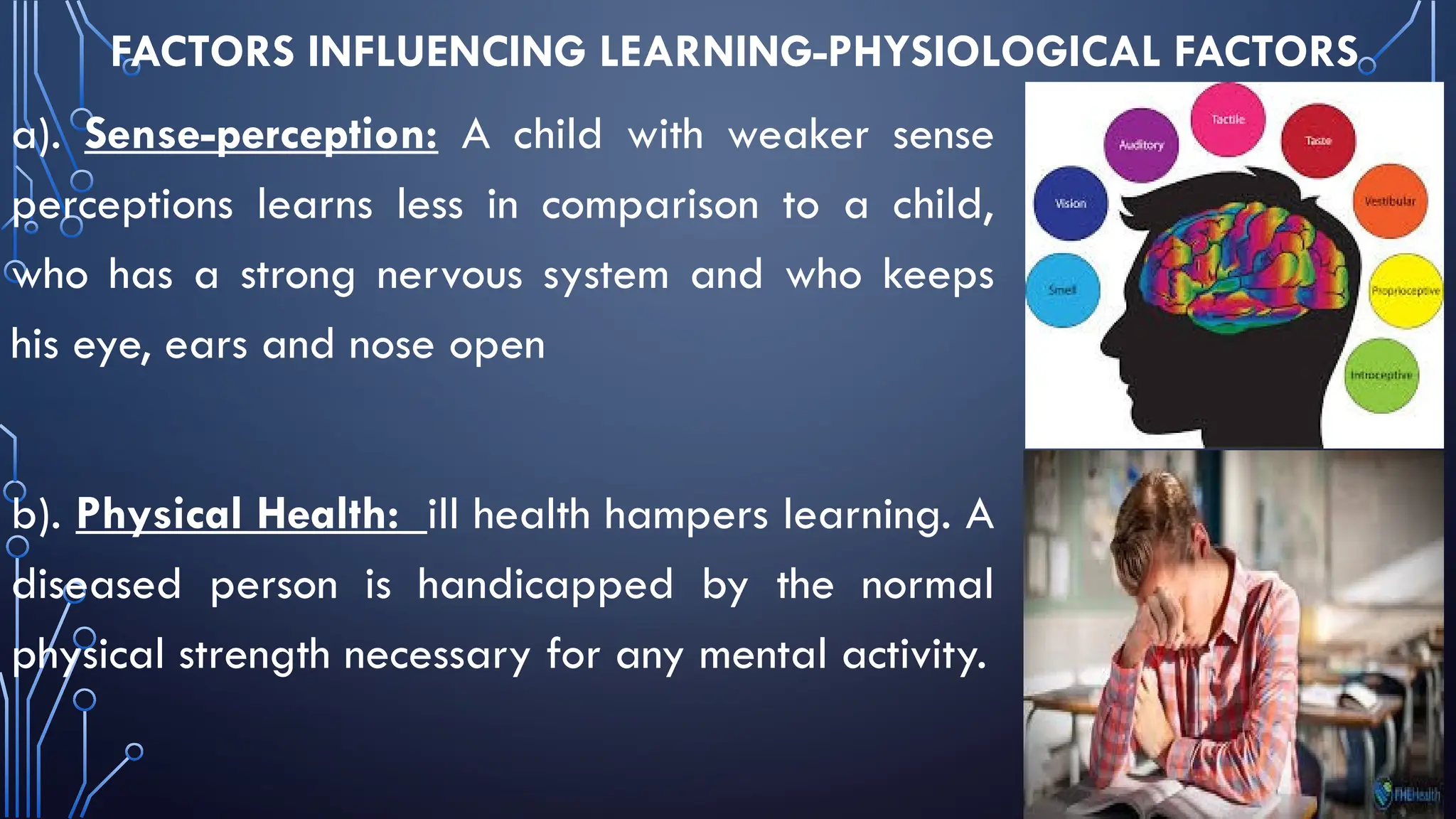
10. Learning Activities: depends on activities
provided by the teachers, method of teaching, and
overall personality
11. guidance: some people need guidance
constantly depends on their condition. Small learners
need more guidance which helps in learning
FACTORS INFLUENCING LEARNING-PHYSIOLOGICAL FACTORS
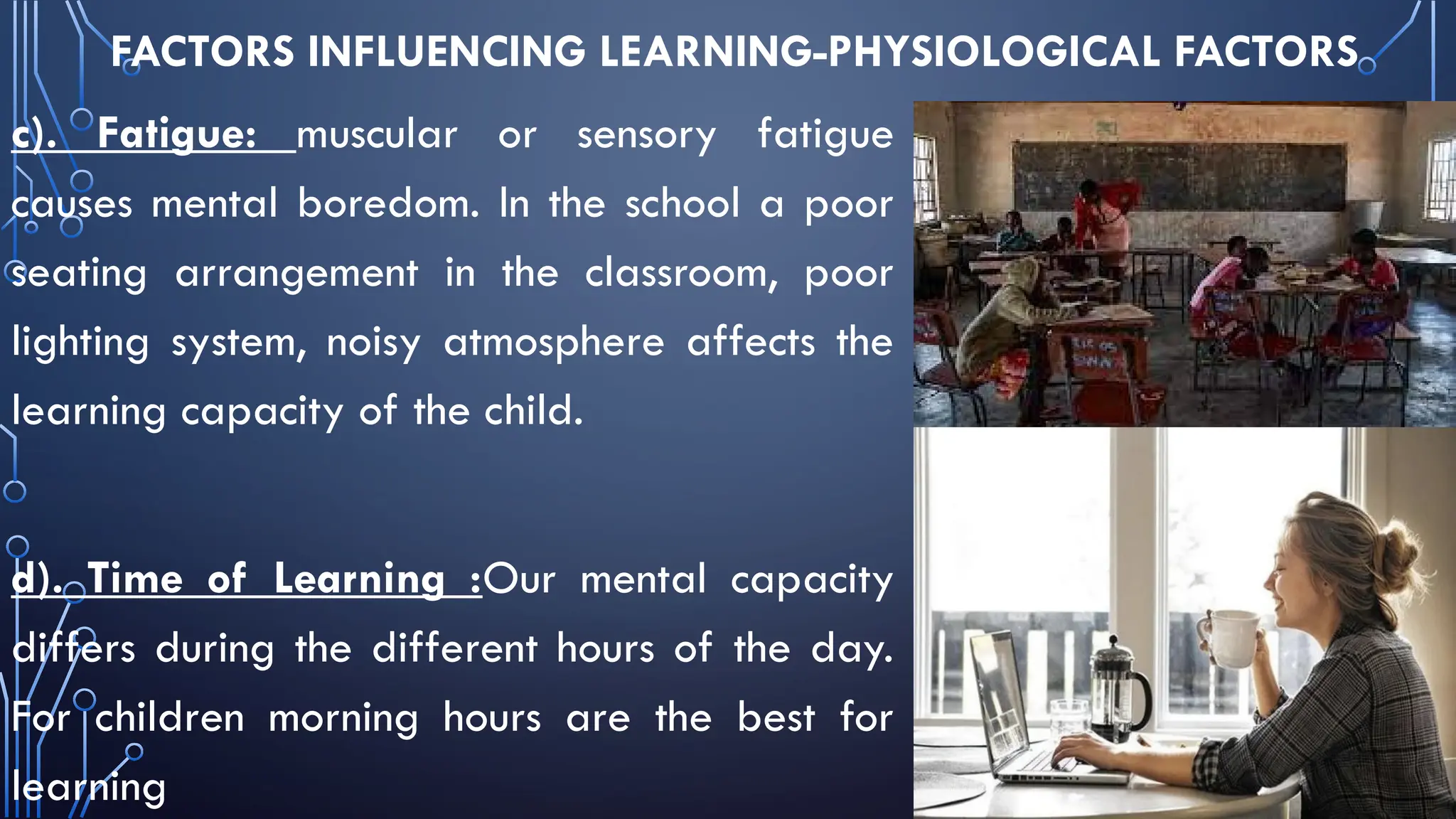
a). Sense-perception: A child with weaker sense
perceptions learns less in comparison to a child,
who has a strong nervous system and who keeps
his eye, ears and nose open
b). Physical Health: ill health hampers learning. A
diseased person is handicapped by the normal
physical strength necessary for any mental activity.
FACTORS INFLUENCING LEARNING-PHYSIOLOGICAL FACTORS
c). Fatigue: muscular or sensory fatigue
causes mental boredom. In the school a poor
seating arrangement in the classroom, poor
lighting system, noisy atmosphere affects the
learning capacity of the child.
d). Time of Learning :Our mental capacity
differs during the different hours of the day.
For children morning hours are the best for
learning
FACTORS INFLUENCING LEARNING-PHYSIOLOGICAL FACTORS
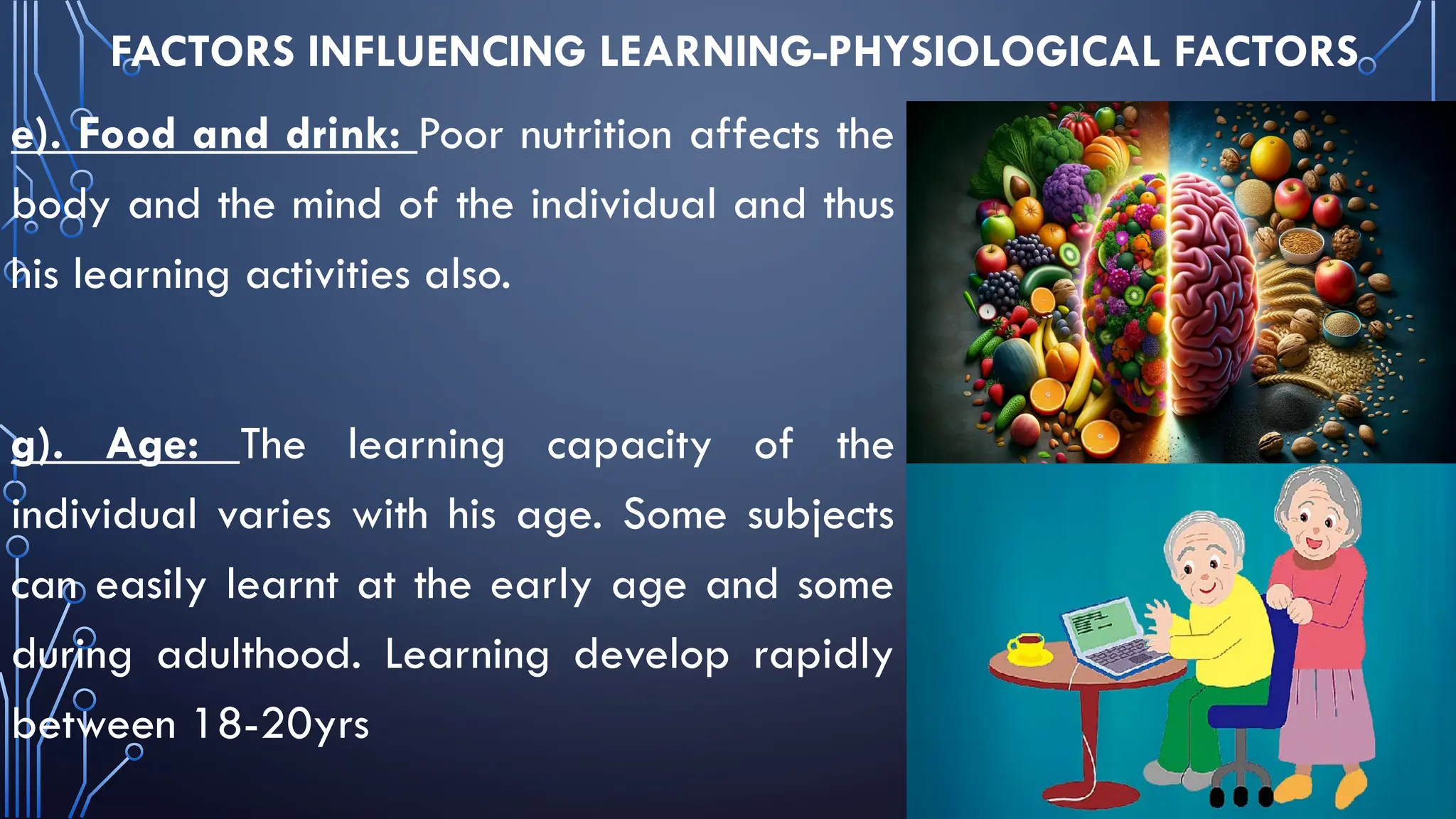
e). Food and drink: Poor nutrition affects the
body and the mind of the individual and thus
his learning activities also.
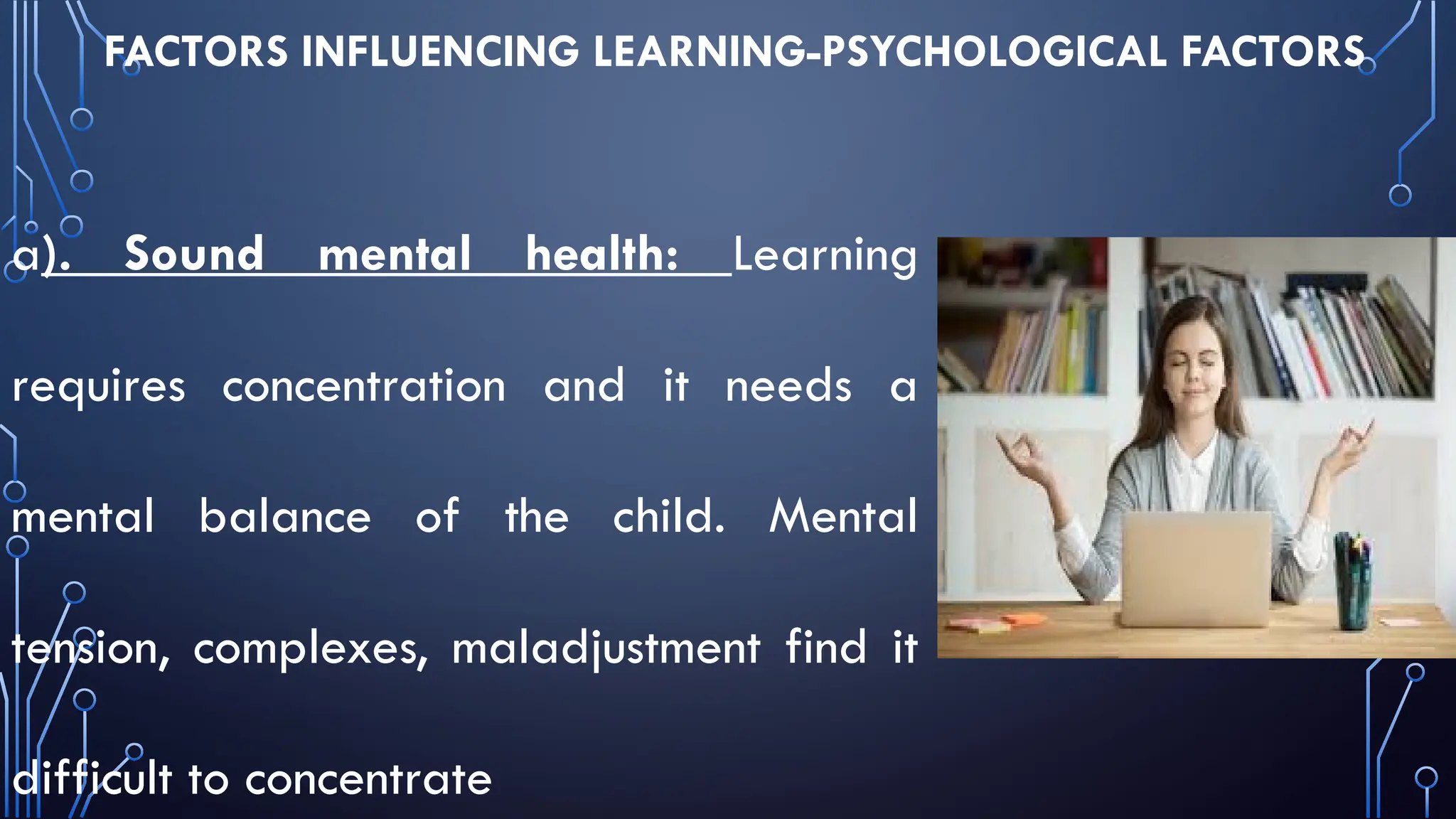
g). Age: The learning capacity of the
individual varies with his age. Some subjects
can easily learnt at the early age and some
during adulthood. Learning develop rapidly
between 18-20yrs
FACTORS INFLUENCING LEARNING-PSYCHOLOGICAL FACTORS
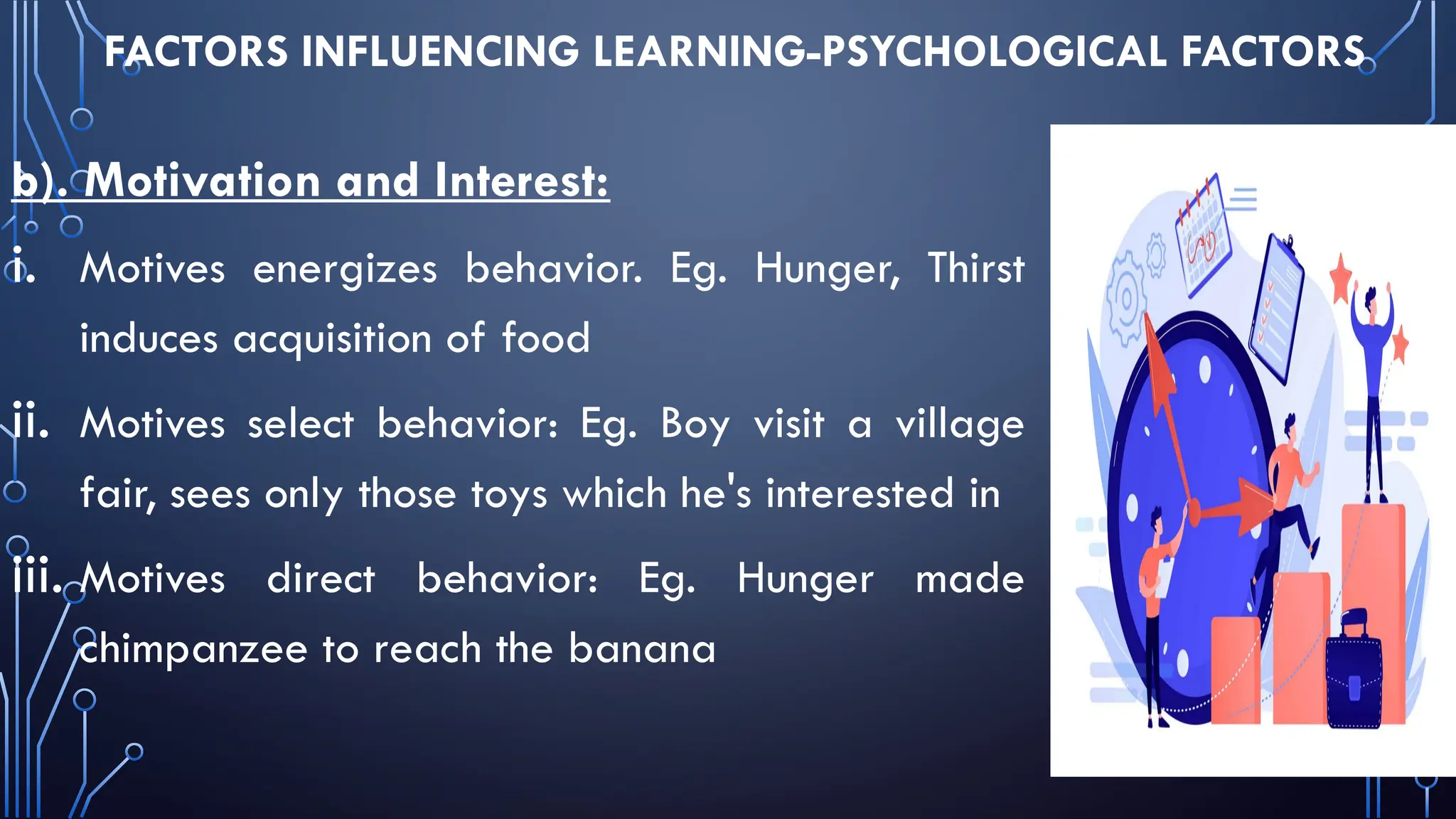
a). Sound mental health: Learning
requires concentration and it needs a
mental balance of the child. Mental
tension, complexes, maladjustment find it
difficult to concentrate
FACTORS INFLUENCING LEARNING-PSYCHOLOGICAL FACTORS
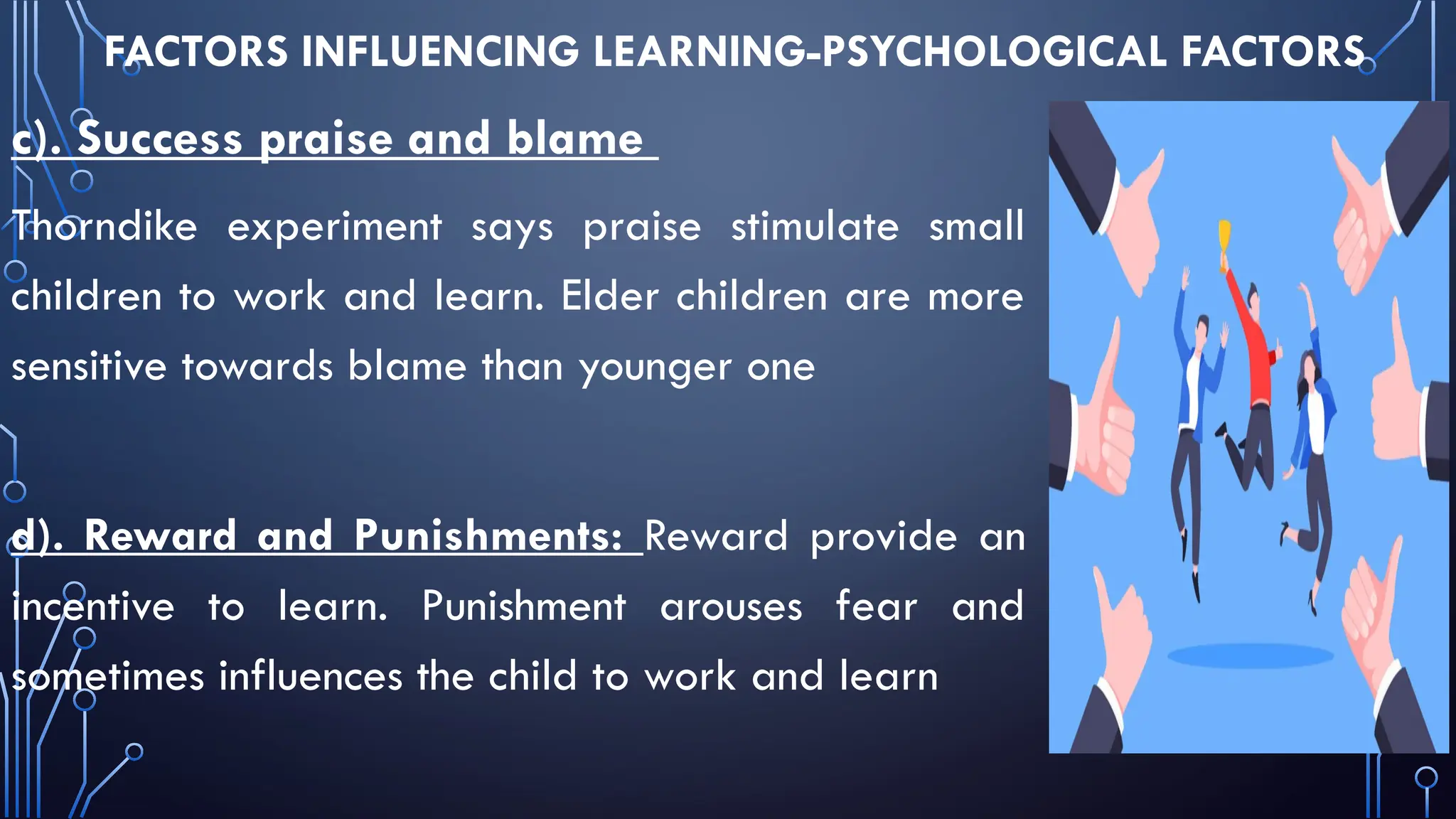
b). Motivation and Interest:
i. Motives energizes behavior. Eg. Hunger, Thirst
induces acquisition of food
ii. Motives select behavior: Eg. Boy visit a village
fair, sees only those toys which he's interested in
iii. Motives direct behavior: Eg. Hunger made
chimpanzee to reach the banana
FACTORS INFLUENCING LEARNING-PSYCHOLOGICAL FACTORS
c). Success praise and blame
Thorndike experiment says praise stimulate small
children to work and learn. Elder children are more
sensitive towards blame than younger one
d). Reward and Punishments: Reward provide an
incentive to learn. Punishment arouses fear and
sometimes influences the child to work and learn
FACTORS INFLUENCING LEARNING-ENVIRONMENTAL FACTORS
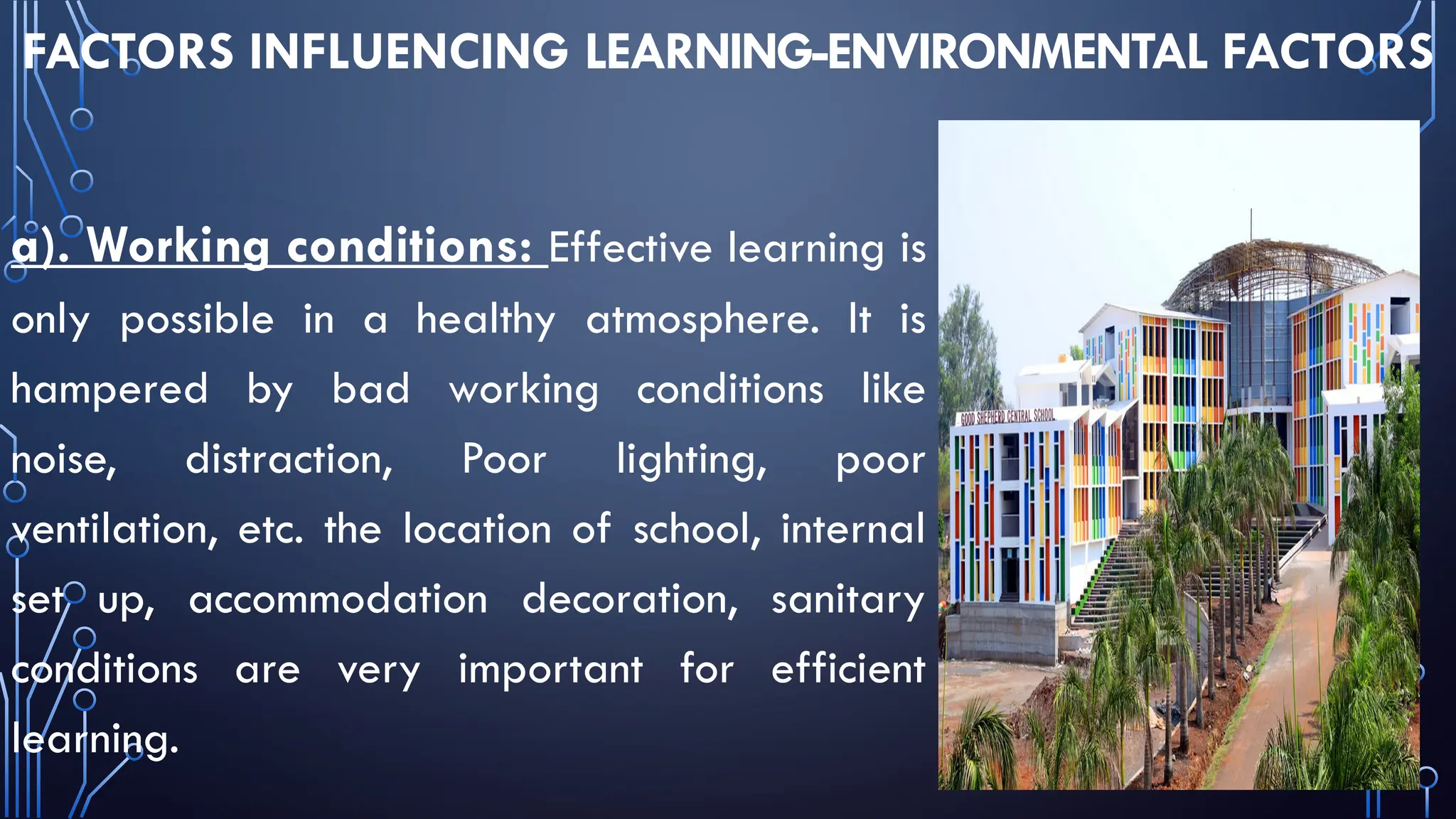
a). Working conditions: Effective learning is
only possible in a healthy atmosphere. It is
hampered by bad working conditions like
noise, distraction, Poor lighting, poor
ventilation, etc. the location of school, internal
set up, accommodation decoration, sanitary
conditions are very important for efficient
learning.
FACTORS INFLUENCING LEARNING-ENVIRONMENTAL FACTORS
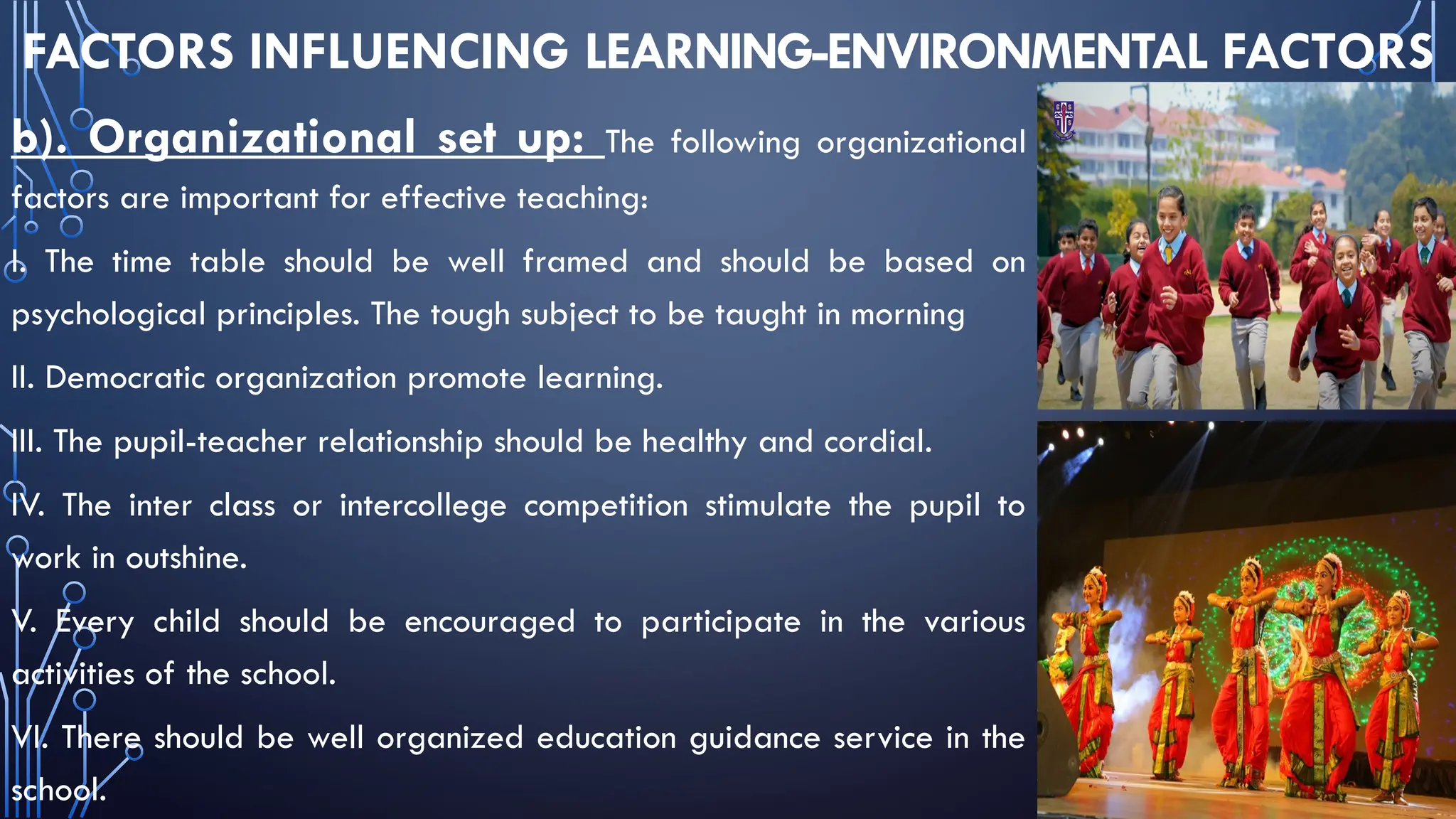
b). Organizational set up: The following organizational
factors are important for effective teaching:
I. The time table should be well framed and should be based on
psychological principles. The tough subject to be taught in morning
II. Democratic organization promote learning.
III. The pupil-teacher relationship should be healthy and cordial.
IV. The inter class or intercollege competition stimulate the pupil to
work in outshine.
V. Every child should be encouraged to participate in the various
activities of the school.
VI. There should be well organized education guidance service in the
school.
FACTORS INFLUENCING LEARNING-METHODOLOGICAL FACTORS
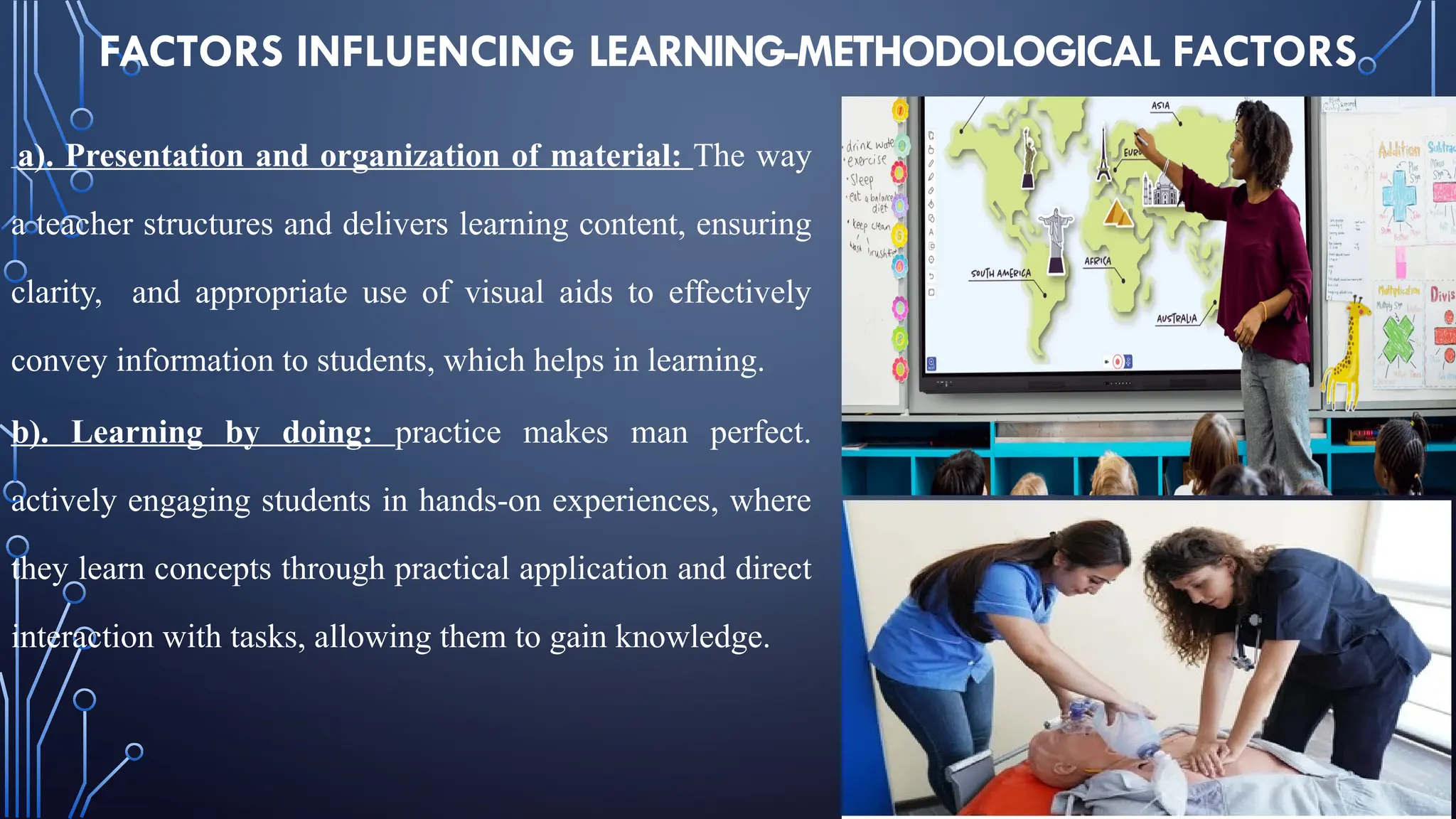
a). Presentation and organization of material: The way
a teacher structures and delivers learning content, ensuring
clarity, and appropriate use of visual aids to effectively
convey information to students, which helps in learning.
b). Learning by doing: practice makes man perfect.
actively engaging students in hands-on experiences, where
they learn concepts through practical application and direct
interaction with tasks, allowing them to gain knowledge.
FACTORS INFLUENCING LEARNING-METHODOLOGICAL FACTORS
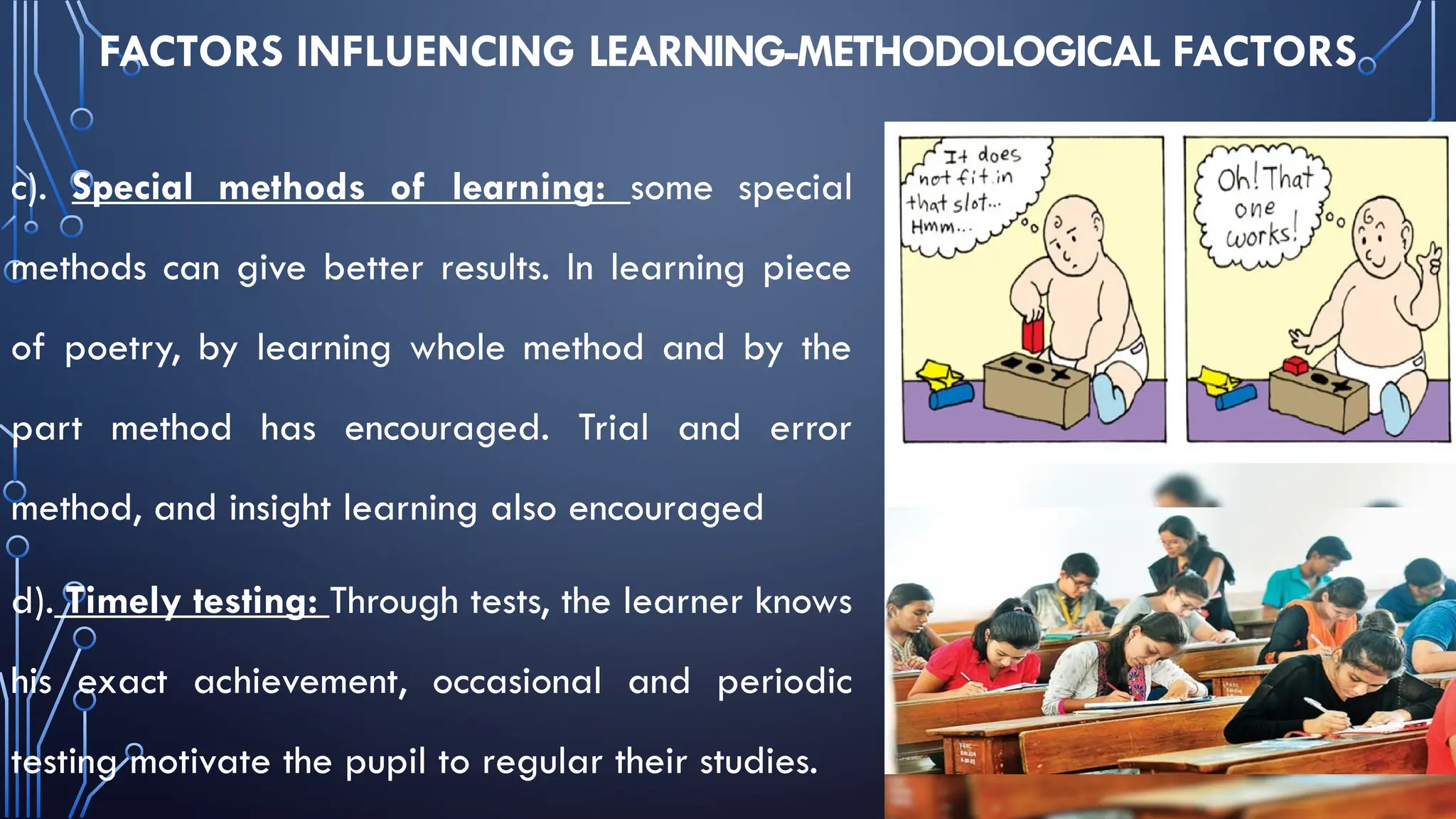
c). Special methods of learning: some special
methods can give better results. In learning piece
of poetry, by learning whole method and by the
part method has encouraged. Trial and error
method, and insight learning also encouraged
d). Timely testing: Through tests, the learner knows
his exact achievement, occasional and periodic
testing motivate the pupil to regular their studies.

Unit VI. 6. 4. LEARNING, DEFINITION, CONCEPT, TYPES OF LEARNING, LAWS OF LEARNING, EFFECTIVE WAYS OF LEARNING, FACTORS INFLUENCING, .pptx

  • 1.
  • 2.
    DEFINITION  HENRY P.SMITH:“ Learning is the acquisition of new behavior or the strengthening or weakening of old behavior as a result of experience”.  WOODWORTH : “Any activity can be called Learning so far as it develops the individual (in any aspects, good or bad) & makes his behavior & experiences different from what otherwise would have been”.
  • 3.
    FEATURES OF LEARNING: •1.Learning is a change in behavior for better or worse. • •2. It is a change that takes place through practice & experience. •3. The change in behavior must be relatively permanent i.e it must last for a long time, learning lasting for days, months, years.
  • 4.
    CONCEPT OF LEARNING: •ROGER: Learning is a change Learning is one’s voluntary pattern of acting, thinking or feeling • AMBROSE: Learning is a process, not a product Learning is a change in knowledge, beliefs, behaviour or attitude • KURST LEWIN: Learning changes occur in: skills, cognitive pattern, motivation and interest, ideology
  • 5.
    CONCEPT OF LEARNING: •ROBERT M GAGNE: Five domains of learning outcome: Motor skill-Practice Verbal information: Facts, Principles Intellectual skills: Discrimination, concept using knowledge Attitude: positive or negative attitude, depend on likes or dislikes Cognitive strategies: the way of learning, remembering, thinking in problem solving
  • 6.
    NATURE OF LEARNING 1.Learning is Universal: Every creature that lives learns. Man learns most. The human nervous system is very complex, so are human reactions and so are human acquisition. 2. Learning is through Experience: Learning always involves some kind of experience, direct or indirect. 3. Learning is from all Sides: Today learning is from all sides. Children learn from parents, teachers, environment, nature, media etc
  • 7.
    NATURE OF LEARNING 4.Learning is Continuous: It denotes the lifelong nature of learning. Everyday new situations are faced and the individual has to bring essential changes in his style of behavior. Learning is birth to death. 5. It results in Change in Behavior: It is a change of behavior influenced by previous behavior. 6. Learning is an Adjustment: learning helps the individual to adjust new situation adequately to new situation. In later life the individuals acquire new forms of behavior
  • 8.
    NATURE OF LEARNING 7.It comes about as a result of practice: It is the basis of drill and practice. It has been proven that students learn best and retain information longer when they have meaningful practice and repetition. 8. Learning is a relatively Permanent Change: Even if you have been on a bicycle for years, in just a few minutes practice you can be quite proficient again.
  • 9.
    NATURE OF LEARNING 9.Learning as Growth and Development: It is never ending growth and development. At each stage the learner acquires new visions of his future growth and news ideals of achievement in the direction of his effort. 10. Learning is not directly observable: The only way to study learning is through some observable behavior. Actually, we cannot observe learning; we see only what precedes performance, the performance itself, and the consequences of performance.
  • 10.
    TYPES OF LEARNING •MOTOR LEARNING • VERBAL LEARNING • CONCEPT LEARNING • DISCRIMINATION LEARNING • LEARNING OF PRINCIPLE • PROBLEM SOLVING • ATTITUDE LEARNING
  • 11.
    TYPES OF LEARNING 1.MOTOR LEARNING • Most of our activities refer to motor activities. for example, walking, running, skating, driving, climbing, football, etc. 2. VERBAL LEARNING • This type of learning involves the language. Signs, pictures, symbols, words, figures, sounds, etc, are the tools used in such activities. We use words for communication.
  • 12.
    TYPES OF LEARNING 3.CONCEPT LEARNING • It is the form of learning which requires higher order mental processes like thinking, reasoning, intelligence, etc. 4. DISCRIMINATION LEARNING • it’s a learning to differentiate between stimuli and showing an appropriate response to these stimuli. Example, sound horns of different vehicles like bus, car, ambulance, etc.
  • 13.
    TYPES OF LEARNING 5.LEARNING OF PRINCIPLE • Individuals learn certain principles (science, mathematics, grammar) which show the relationship between two or more concepts. Example: formula, laws, associations, correlations, etc 6. PROBLEM SOLVING • This learning requires the use of cognitive abilities-such as thinking, reasoning, observation, imagination, generalization, etc. This is very useful to overcome difficult problems encountered by the people.
  • 14.
    TYPES OF LEARNING 7.ATTITUDE LEARNING • Attitude is a predisposition which determines and directs our behavior. We develop different attitudes from our childhood about the people, objects and everything we know. Example: attitudes of nurse towards her profession, patients, etc.
  • 15.
    LAWS OF LEARNING •On the basis of trial & error theory of learning, Thorndike formulated some laws of learning. There are three primary laws and five secondary laws of learning.
  • 16.
    LAWS OF LEARNING •I. THE LAW OF READINESS ♥Readiness is preparation for action. If the child is ready to learn, he learns more quickly, effectively and with greater satisfaction than if he is unwilling to learn. ♥Individual learns the best when he is physically, mentally and emotionally ready to do so, depends on the sensory motor neurons. ♥Give the child enough food, rest and time to get things done - It will improve readiness to learn
  • 17.
    LAWS OF LEARNING 2.THE LAW OF EXERCISE “Exercise” means practice, practice and practice. Individual learn and retain things better after repetition. Practice helps in increasing efficiency & durability of learning. Practice is most effective when followed by a reward for doing it.
  • 18.
    LAWS OF LEARNING 3.THE LAW OF EFFECT ♣Individual learns the best when the “Effect” of something is positive or satisfying. ♣ A successful reaction gives satisfaction, when the reaction to repeated ♣An unsuccessful reaction gives annoyance and tends to be inhibited ♣Thus the pain and pleasure have their effects on learning reaction.
  • 19.
    LAWS OF LEARNING 4.THE LAW OF PRIMACY ª The law of primacy is a learning and memory principle that states that first encounters with new things have a greater impact on subsequent thought and behavior than later encounters ª Eg. The first day at school is easily impressed
  • 20.
    LAWS OF LEARNING 5.THE LAW OF ASSOCIATION  It states that thoughts, memories, concepts, and stimuli that occur together or nearby become interconnected. This principle explains how we learn and remember things.  Eg. When we say Taj Mahal, we recall Marble, symbol of Love, wonders of the world etc  Law of Contrast: Associating the contrast ideas, we associate things that occur close to each other in time or space.  Law of similarity: Associating the similar things is innate
  • 21.
    LAWS OF LEARNING 6.THE LAW OF DISUSE ꙮAny learning process which is not practiced for sometimes gradually decay ꙮDisuse weakens connections ꙮEg. Meaningless syllables are easily forgotten when its not regular used
  • 22.
    LAWS OF LEARNING 7.THE LAW OF FREQUENCY ֎The law of frequency is correlated with law of use. ֎If one response strengthen the situation-response connection, two responses will strengthen it further. Three still further and so on
  • 23.
    LAWS OF LEARNING 8.THE LAW OF PURPOSE •A principle that everything has a purpose and that purpose precedes creation. • It's a governing force for the existence of plants, animals, and human society •Eg. Students preparing for final exam
  • 24.
    LAWS OF LEARNING 8.THE LAW OF RECENCY The law of recency is a principle of learning that states that things learned most recently are best remembered. It's also a natural law that can be applied to science, nature, and relationships.
  • 25.
    EFFECTIVE WAYS OFLEARNING (METHODS) SPACED LEARNING  Learning the material with interval in between. This method can improve long-term memory, problem solving, and the ability to apply learning to new situations  Duration of learning-20min  If material is large then this helps in learning  It provide sufficient time for interpretation- so this method is favorable UNSPACED LEARNING  Learning the material in continuous manner., no interval in between  Duration of learning-1hr  If material is less then unspaced method can be favorable
  • 26.
    EFFECTIVE WAYS OFLEARNING WHOLE LEARNING  Learning the whole material in one stretch  Eg. Child memorize the small rhyme in whole learning, memories in one stretch  Efficiency depends on the length of the material, age and intelligence of the child PART LEARNING  Dividing the material in to smaller units  For more paragraph rhymes, the part learning where kids will divide Each paragraph and memorize
  • 27.
    EFFECTIVE WAYS OFLEARNING INCIDENTAL LEARNING  Incidental learning is when someone acquires knowledge unintentionally, often while focused on something else  incidental learning happens by chance  Learning by incident will not help individual to remember INTENTIONAL LEARNING  Intentional learning is when someone actively sets out to learn something specific with a conscious goal in mind  Intentional learning is a deliberate process.  It motivate the individual to learn
  • 28.
    EFFECTIVE WAYS OFLEARNING ACTIVE RECALL  This method is more effective , when some time is devoted to actively retrieving the learned information through testing with proper feedback. KNOWLEDGE OF RESULT  The frequent and regular reviews of the amount of progress made towards the goal, acts as strong motive to promote continuing effort of the learner.
  • 29.
    EFFECTIVE WAYS OFLEARNING •REPETITION /OVER LEARNING ☻Repetition at regular intervals helps the individual to retain the material for longer period of time. ☻Eg. The student who repeats the lesson at regular interval will remember the lesson till the final exam.
  • 30.
    EFFECTIVE WAYS OFLEARNING •MNEMONIC METHOD ※It comes from the Greek word for memory, referring to specific memory in human technique ※It is based on the principle that the human mind more easily remembers more meaningful information’s of a person, surprises, sexual or humorous incidents and sequences ※This involves the systematic and organized set of images and words •TECHNIQUES INCLUDE: 1.Memory pegs 2.Loci method 3.Rhyming system 4.Story telling method 5.Remembering names and faces 6.chunking
  • 31.
    EFFECTIVE WAYS OFLEARNING A. MEMORY PEGS  The cues are called pegs  Pegs invented by Henry Herdson  It is a memory aid creating mental association between two concrete objects in one to one fashion, which later applied to remember information.  Eg. VIBGYOR-violet, indigo..
  • 32.
    EFFECTIVE WAYS OFLEARNING B. LOCI METHOD  The word loci means “places”  The memory pegs of this system are part of your images of a scene(visualization of familiar environment to enhance recall)  The scene can be street, building. College etc
  • 33.
    EFFECTIVE WAYS OFLEARNING C. RHYMIMG SYSTEM  In number system, images are formed with each other  Think of words that rhyme with numbers  Eg. One is bun, two is shoe, three is tree
  • 34.
    EFFECTIVE WAYS OFLEARNING D. STORY TELLING METHOD  The list of unrelated items is remembered by mnemonic device to relate items to make up a story
  • 35.
    EFFECTIVE WAYS OFLEARNING E. REMEMBERING NAMES &FACES  Be sure to hear the names clearly when introduced  Repeat the name when acknowledging the introduction  If name is unusual spell it repeatedly  Make mental image of that person and relate it to some one.
  • 36.
    EFFECTIVE WAYS OFLEARNING F.CHUNKING  A systematic way of encoding information.  Eg. cell phone number consists of 10 items can be arranged in 2 or 4,3,3.  Eg. 6305050431 as 630-50-50-431 0r 63-05- 05-04-31
  • 37.
    THEORIES OF LEARNING 1.TRIAL AND ERROR THEORY OF LEARNING BY E L THORNDIKE This theory was proposed by E L Thorndike CONCEPT: learning is nothing but stamping in thecorrectre response and stamping out of the incorrect response through trial and error. To support this point of view about learning, Thorndike conducted experiment on Cat
  • 38.
    TRIAL AND ERRORTHEORY OF LEARNING EXPERIMENT: ♥ Ahungrycatwasplacedinaboxwhichhasonlyonedoorforexitbutthatcouldbeopened bymanipulatingthelatch. ♥Afishwasplacedoutsidethebox ♥Thecatwastriedtocomeoutoftheboxbysqueezing,jumping,bitingetc. ♥• Thedooroftheboxcouldbeopenedbypullingthestringsinsidethebox ♥•bychance,catmanipulatedthelatch,thedooropenedandhegotthefishasreward ♥Foranotherprocesstrialhasrepeated,butnexttimetheincorrectresponseswasless ♥Aftererror,itgainsuccessonsubsequenttrial
  • 39.
    TRIAL AND ERRORTHEORY OF LEARNING EXPERIMENT: (Learning is selecting and connecting) ♥ following components involved the process of learning ♥Barrier/Block ♥Chances of success ♥Collecting of correct responses ♥Fixation of correct responses PRINCIPLES: ♥Learning results formation of connections
  • 40.
    CLASSICAL CONDITIONING LEARNING 2.CLASSICAL CONDITIONING LEARNING: This theory was proposed by Ivan Pavlov While studying the physiology of digestion, he found that behavior can be classically conditioned CONCEPT: It occurs when a conditioned stimulus is paired with unconditioned stimulus
  • 41.
    CLASSICAL CONDITIONING LEARNING •EXPERIMENT: ⁂Pavlov found that food placed in front of the hungry dog automatically causes salivation ⁂Salivation- Unconditioned response ⁂Food- unconditioned stimulus ⁂Pavlov rang a bell each time he fed his dogs, and over time they learned to associate the bell with food. After some days, he noticed the dog started to salivated at the sound of bell. ⁂In this case: ⁂Bell- Conditioned response ⁂Salivation- Conditioned stimulus
  • 42.
    CLASSICAL CONDITIONING LEARNING PRINCIPLES: 1.NATURAL/UNCONDITIONED STIMULUS: Any stimulus that can evoke a response without the organism going through any previous learning 2. UNCONDITIONED RESPONSE: A response that is neutral and needs no training. Eg. Salivation at smell of food 3. CONDITIONED STIMULUS: I t is a neutral stimulus that has been paired with unconditioned stimulus to bring responses. Eg. Salivating at ringing of bell
  • 43.
    CLASSICAL CONDITIONING LEARNING PRINCIPLES: 4.CONDITIONED RESPONSE: a response that after conditioning follows a previously neutral stimulus. Eg. Salivating at ringing of bell 5. EXTINCTION: the decrease in frequency and eventually disappearance of previously conditioned stimulus 6. SPONTANEOUS RECOVERY: Conditioned stimulus occurring after a period of rest
  • 44.
    3. OPERENT CONDITIONINGLEARNING It is proposed by B.F Skinner CONCEPT: In operant conditioning, behavior is increased or decreased based on the consequences that follow it. Behaviors that are rewarded are likely to be repeated, while behaviors that are punished are less likely to happen. Skinner conducted an experiment with a rat support his concept
  • 45.
    OPERENT CONDITIONING LEARNING EXPERIMENT: Ahungry rat was placed in a box-Skinner box It contain a lever which would drop food pallets into the box if pressed In the beginning skinner drop the food in to box and stopped The rat is being hungry and explore the box and it accidently pressed the lever
  • 46.
    OPERENT CONDITIONING LEARNING EXPERIMENT: Thenthe food pellet releassed to the box and the rat ate it up After 3rd 4th time of pressing lever, the rat began to press lever rapidly Thus the food is said to provided positive reinforcement to the rat and the operant behaviour of rat is also established From this experiment, skinner concluded that behaviour is shaped and maintained by events.
  • 47.
    OPERENT CONDITIONING LEARNING PRINCIPLES: 1.REINFORCEMENT: The process by which a stimulus increases the probability that a preceeding (previous) behaviour will be repeated. 2. REINFORCER: Any stimulus that increases the probability that a preceeding behaviour will occur again. 3. NEGATIVE REINFORCER: An unpleasant stimulus whose removal leads to increase in the probability that a preceeding responses will occur again in future.
  • 48.
    OPERENT CONDITIONING LEARNING PRINCIPLES: 4.POSITIVE REINFORCER: A stimulus added to the environment that brings about the increase in a preceeding responses. 5. PUNISHMENT: A stimulus that decrease the probability that a previous behaviour will occur again.
  • 49.
    4. THEORY OFINSIGHTFUL LEARNING ♥It is also known as Gestalt psychology ♥The founder is Max Wertheimer CONCEPT: ♥Learning is a purposive, explanatory and creative process rather than mere trial and error on even conditioning. ♥experiment on Chimpanzee was conducted by W Kohler to support this theory
  • 50.
    4. THEORY OFINSIGHTFUL LEARNING ♥EXPERIMENT: ♥Kohler made three arrangements in this experiment. ♥FIRST ARRANGEMENT: ♥Kohler put Chimpanzee with a box inside a cage and a banana was hung from the roof of cage ♥He tried to pick up banana by jumping but could not succeeded ♥Sudden, it got an idea and use a box as jumping platform by placing just below it and picked up the banana
  • 51.
    4. THEORY OFINSIGHTFUL LEARNING ♥EXPERIMENT: ♥SECOND ARRANGEMENT: ♥Kohler hung the banana higher than the 1st arrangement. ♥He also placed 2 more boxes inside the cage ♥He had to use three boxes to pick up the banana ♥After many attempts, he had an idea by placing a box one another and picked up the banana
  • 52.
    4. THEORY OFINSIGHTFUL LEARNING ♥EXPERIMENT: ♥THIRD ARRANGEMENT: ♥Kohler kept banana outside the cage ♥2 sticks one longer than other were placed inside the cage ♥One stick was hollow at one end to thrush that in to another stick to form long stick ♥He tried both sticks to pick the banana, but could not succeed ♥Studently it got an idea of joining 2 sticks together and reached the banana ♥Insightful learning initially pass through trial and error, but the process does not long fast
  • 53.
    5. OBSERVATIONAL LEARNING ♥ByAlber Bandura ♥It is learning through imitation ♥It is also called social learning theory ♥CONCEPT: ♥Albert Bandura's social learning theory explains how people learn through observation and modeling ♥The process of learning by watching others perform a task, attitude, or emotional expression
  • 54.
    5. OBSERVATIONAL LEARNING ♥Ithas four steps: 1. Paying attention of another person’s behaviour 2. Remembering the behaviour 3. Reproducing the action 4. Being motivated to learn and carry out the behaviour •Eg. A girl happened to watch T.V programme concerning g the preparation of new dishes •First she observe demonstration-then try to keep her in memory-enter the kitchen and convert the observation into action
  • 55.
    FACTORS AFFECTING LEARNING I.EXTERNAL FACTORS 1. Heredity Genetic factors can influence intelligence and personality traits such as activity level, sociability, and shyness. 2. Socioeconomic status of a child's family can impact their academic performance. Tiredness, bodily weakness and bad health are greater obstructor in learning. Bad ventilation, unhygienic living, bad light, exposure to pollution, and neighborhood quality can also impact a child’s rate of learning.
  • 56.
    FACTORS AFFECTING LEARNING 3.Physical environment The physical environment a child grows up can affect their learning. The design, quality and setting of learning space of school also can impact a child’s rate of learning. 4. Stress Moderate stress can promote memory formation, but excessive stress can negatively impact learning and memory recovery. 5. Nutrition Proper nutrition can have a significant impact on cognitive growth.
  • 57.
    FACTORS AFFECTING LEARNING IIINTERNAL FACTORS: 1. Goal or Purpose: each and everyone has a goal and it is depending on immediate or distant goal it affect learning. 2. Motivation: A driving force for learning. People which motivated stimulate themselves with interest 3. Cognitive abilities: These include memory, attention, problem-solving, and critical thinking. Those who has strong cognitive abilities has more learning skills compare to less
  • 58.
    FACTORS AFFECTING LEARNING IIINTERNAL FACTORS: 4. Emotional state: A person's emotional well-being can significantly impact learning. Always finding fault, provoking/embarrassing Infront of class will have a negative impact 5. Interests: Personal interests can affect learning. It encourage students to move over task further. 6. Attitudes: it is a way of thinking which can affect learning. The attitude towards study will impact learning
  • 59.
    FACTORS AFFECTING LEARNING 7.attention: is concentration or focusing of consciousness up on one object or an idea. It influence learning 8. Drill or practice: this include repeating the task number of times which make learning more effective 9. aptitude: it is the natural ability. It is individual ability to acquire certain skills, knowledge through training
  • 60.
    FACTORS AFFECTING LEARNING 10.Learning Activities: depends on activities provided by the teachers, method of teaching, and overall personality 11. guidance: some people need guidance constantly depends on their condition. Small learners need more guidance which helps in learning
  • 61.
    FACTORS INFLUENCING LEARNING-PHYSIOLOGICALFACTORS a). Sense-perception: A child with weaker sense perceptions learns less in comparison to a child, who has a strong nervous system and who keeps his eye, ears and nose open b). Physical Health: ill health hampers learning. A diseased person is handicapped by the normal physical strength necessary for any mental activity.
  • 62.
    FACTORS INFLUENCING LEARNING-PHYSIOLOGICALFACTORS c). Fatigue: muscular or sensory fatigue causes mental boredom. In the school a poor seating arrangement in the classroom, poor lighting system, noisy atmosphere affects the learning capacity of the child. d). Time of Learning :Our mental capacity differs during the different hours of the day. For children morning hours are the best for learning
  • 63.
    FACTORS INFLUENCING LEARNING-PHYSIOLOGICALFACTORS e). Food and drink: Poor nutrition affects the body and the mind of the individual and thus his learning activities also. g). Age: The learning capacity of the individual varies with his age. Some subjects can easily learnt at the early age and some during adulthood. Learning develop rapidly between 18-20yrs
  • 64.
    FACTORS INFLUENCING LEARNING-PSYCHOLOGICALFACTORS a). Sound mental health: Learning requires concentration and it needs a mental balance of the child. Mental tension, complexes, maladjustment find it difficult to concentrate
  • 65.
    FACTORS INFLUENCING LEARNING-PSYCHOLOGICALFACTORS b). Motivation and Interest: i. Motives energizes behavior. Eg. Hunger, Thirst induces acquisition of food ii. Motives select behavior: Eg. Boy visit a village fair, sees only those toys which he's interested in iii. Motives direct behavior: Eg. Hunger made chimpanzee to reach the banana
  • 66.
    FACTORS INFLUENCING LEARNING-PSYCHOLOGICALFACTORS c). Success praise and blame Thorndike experiment says praise stimulate small children to work and learn. Elder children are more sensitive towards blame than younger one d). Reward and Punishments: Reward provide an incentive to learn. Punishment arouses fear and sometimes influences the child to work and learn
  • 67.
    FACTORS INFLUENCING LEARNING-ENVIRONMENTALFACTORS a). Working conditions: Effective learning is only possible in a healthy atmosphere. It is hampered by bad working conditions like noise, distraction, Poor lighting, poor ventilation, etc. the location of school, internal set up, accommodation decoration, sanitary conditions are very important for efficient learning.
  • 68.
    FACTORS INFLUENCING LEARNING-ENVIRONMENTALFACTORS b). Organizational set up: The following organizational factors are important for effective teaching: I. The time table should be well framed and should be based on psychological principles. The tough subject to be taught in morning II. Democratic organization promote learning. III. The pupil-teacher relationship should be healthy and cordial. IV. The inter class or intercollege competition stimulate the pupil to work in outshine. V. Every child should be encouraged to participate in the various activities of the school. VI. There should be well organized education guidance service in the school.
  • 69.
    FACTORS INFLUENCING LEARNING-METHODOLOGICALFACTORS a). Presentation and organization of material: The way a teacher structures and delivers learning content, ensuring clarity, and appropriate use of visual aids to effectively convey information to students, which helps in learning. b). Learning by doing: practice makes man perfect. actively engaging students in hands-on experiences, where they learn concepts through practical application and direct interaction with tasks, allowing them to gain knowledge.
  • 70.
    FACTORS INFLUENCING LEARNING-METHODOLOGICALFACTORS c). Special methods of learning: some special methods can give better results. In learning piece of poetry, by learning whole method and by the part method has encouraged. Trial and error method, and insight learning also encouraged d). Timely testing: Through tests, the learner knows his exact achievement, occasional and periodic testing motivate the pupil to regular their studies.