Manpower Planning or
Human Resource Planning
Chapter outline
 HR Planning
 Environment of HR Planning
 Staffing Planning
 Legal Issue
 Current trends in HR Planning
 Forecasting Demand & Supply
 Quantitative & Qualitative determination
INTRODUCTION
HUMAN RESOURCE PLANNING
HRP is a process by which the management of an
organization determines its future human
resource requirement and how the existing
human resource can be effectively utilized to
fulfill the requirements.
HUMAN RESOURCE PLANNING
1) Employment-Unemployment Situation
2) Technological Change
3) Demographic Change
4) Skill Shortage
5) Governmental Influences
6) Legislative Control
7) Impact of the Pressure Group(unions, politician etc.)
8) Lead Time
WHY IS HUMAN RESOURCE
PLANNING IS NEEDED ?
Importance
• Organizational Objectives & Policies (expansion,downsizing,acquisition,merger)
• Forecast HR requirement (Prevent shortage / excess of staff )
• Determine future staff-mix
• Cope-up with the change — in market conditions, technologies, products,
government regulations and policies, etc.
• Helps in succession planning
• Use existing HR productivity.
• Promote employees in a systematic manner.
• Cut cost
HUMAN RESOURCE PLANNING
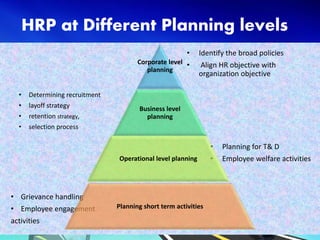
HRP at Different Planning levels
• Identify the broad policies
• Align HR objective with
organization objective
• Determining recruitment
• layoff strategy
• retention strategy,
• selection process
• Planning for T& D
• Employee welfare activities
• Grievance handling
• Employee engagement
activities
Corporate level
planning
Business level
planning
Operational level planning
Planning short term activities
HUMAN RESOURCE
PLANNING PROCESS
HUMAN RESOURCE PLANNING
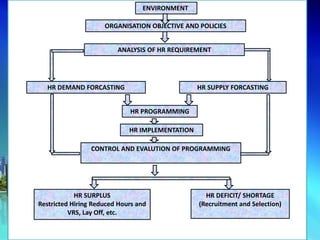
ENVIRONMENT
ORGANISATION OBJECTIVE AND POLICIES
HR DEMAND FORCASTING HR SUPPLY FORCASTING
HR PROGRAMMING
HR IMPLEMENTATION
CONTROL AND EVALUTION OF PROGRAMMING
HR SURPLUS
Restricted Hiring Reduced Hours and
VRS, Lay Off, etc.
HR DEFICIT/ SHORTAGE
(Recruitment and Selection)
ANALYSIS OF HR REQUIREMENT
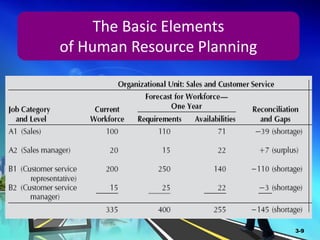
The Basic Elements
of Human Resource Planning
3-9
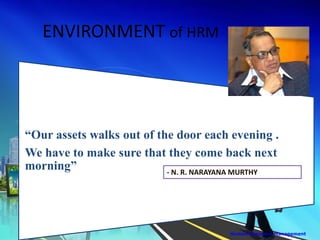
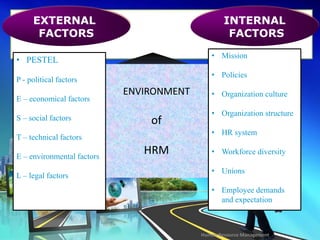
ENVIRONMENT of HRM
“Our assets walks out of the door each evening .
We have to make sure that they come back next
morning”
Human Resource Management
- N. R. NARAYANA MURTHY
EXTERNAL
FACTORS
INTERNAL
FACTORS
ENVIRONMENT
of
HRM
Human Resource Management
• Mission
• Policies
• Organization culture
• Organization structure
• HR system
• Workforce diversity
• Unions
• Employee demands
and expectation
• PESTEL
P - political factors
E – economical factors
S – social factors
T – technical factors
E – environmental factors
L – legal factors
3-12
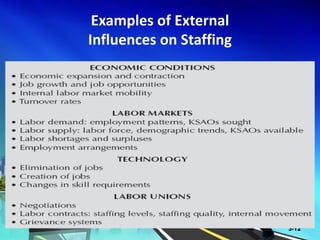
Examples of External
Influences on Staffing
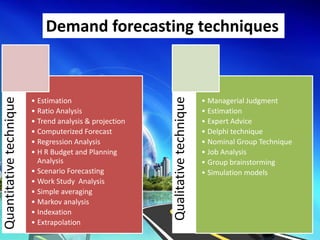
Demand forecasting techniques
Quantitativetechnique
• Estimation
• Ratio Analysis
• Trend analysis & projection
• Computerized Forecast
• Regression Analysis
• H R Budget and Planning
Analysis
• Scenario Forecasting
• Work Study Analysis
• Simple averaging
• Markov analysis
• Indexation
• Extrapolation
Qualitativetechnique
• Managerial Judgment
• Estimation
• Expert Advice
• Delphi technique
• Nominal Group Technique
• Job Analysis
• Group brainstorming
• Simulation models
5-12
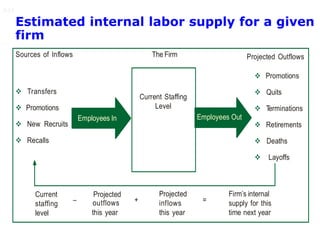
Estimated internal labor supply for a given
firm
The FirmSources of Inflows
 Transfers
 Promotions
 New Recruits
 Recalls
 Promotions
 Quits
 Terminations
 Retirements
 Deaths
 Layoffs
Employees In Employees Out
Current
staffing
level
Projected
outflows
this year
Projected
inflows
this year
Firm’s internal
supply for this
time next year
– + =
Projected Outflows
Current Staffing
Level
HR SUPPLY FORECASTING techniques
Supply Forecasting Methods
 Trend analysis
 Competency model
 Replacement Charts
 Staffing table
 Succession Planning
 Flow Modeling/Markov Analysis
Trend analysis
 Trend analysis involves collecting and evaluating
data to identify patterns of information that might
impact the future.
 By examining the trends of the past, the HR
department can predict the effect of the same
activity on the future of the organization,
because it is assumed that these patterns will
remain stable.
Trend analysis
 For example, an organization reviewing historical
data may realize that every year, approximately five
percent of their staff retire, six percent resign, and
three percent are dismissed.
 Using a simple trend analysis, future HR supply
forecasts can be established by assuming an
average reduction in internal HR supply of 14
percent per year.
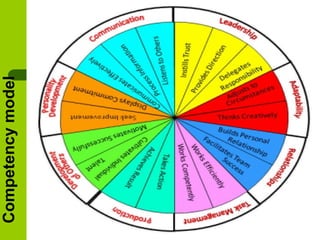
Competency model
 Competencies are behaviours that encompass
the knowledge, skills, and attitudes(KSA)
required for successful performance.
 Competency modelling is the activity of
determining the specific competencies that are
characteristic of high performance and success
in a given job.
Competency model
 A future-oriented model that first reviews
competencies that are aligned with an
organization’s mission, vision, and strategy, and
then aims to identify an ideal workforce in terms
of these competencies .
 Skills/competency models focus on matching the
right skills or competencies needed for each job
with the skills available within the organization
Competencymodel
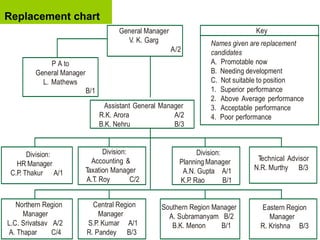
Replacement chart
 A chart used to estimate vacancies in higher
level jobs and identify how potential HR supply
can fill these vacancies via internal movements
from lower levels jobs
 Replacement charts provide identification of
potential replacements for vacancies within an
organization
Replacement chart
 A comprehensive replacement chart will include
information regarding possible replacements for
vertical or horizontal movement.
 Generally, a replacement chart includes
information about employees’ performance,
readiness to fill the position, and education.
Replacement chart
General Manager
V. K. Garg
A/2
Key
Names given are replacement

candidates
A. Promotable now
B. Needing development
C. Not suitable to position
1. Superior performance
2. Above Average performance
3. Acceptable performance
4. Poor performance
P A to
General Manager
L. Mathews
B/1
Assistant General Manager
R.K. Arora A/2
B.K. Nehru B/3
Division:
HR Manager
C.P. Thakur A/1
Division:
Accounting &
Taxation Manager
A.T. Roy C/2
Division:
Planning Manager
A.N. Gupta A/1
K.P. Rao B/1
Technical Advisor
N.R. Murthy B/3
Northern Region
Manager
L.C. Srivatsav A/2
A. Thapar C/4
Central Region
Manager
S.P. Kumar A/1
R. Pandey B/3
Southern Region Manager
A. Subramanyam B/2
B.K. Menon B/1
Eastern Region
Manager
R. Krishna B/3
Staffing table
Staffing tables are graphic representations of all
organizational jobs, along with the numbers of
employees currently occupying those jobs and
future (monthly or yearly) employment
requirements, which can be derived from demand
forecasts.
Staffing table
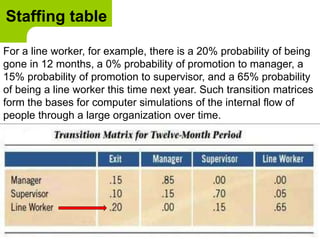
For a line worker, for example, there is a 20% probability of being
gone in 12 months, a 0% probability of promotion to manager, a
15% probability of promotion to supervisor, and a 65% probability
of being a line worker this time next year. Such transition matrices
form the bases for computer simulations of the internal flow of
people through a large organization over time.
Succession Planning
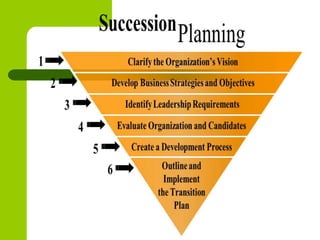
Succession planning is a longer-term process
of grooming a successor (selected from a pool
of candidates on the basis of perceived
competency) for management or critical
positions.
Succession Planning
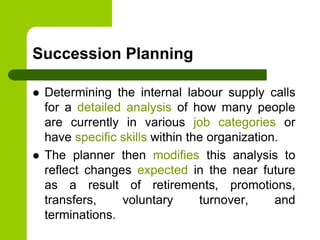
 Determining the internal labour supply calls
for a detailed analysis of how many people
are currently in various job categories or
have specific skills within the organization.
 The planner then modifies this analysis to
reflect changes expected in the near future
as a result of retirements, promotions,
transfers, voluntary turnover, and
terminations.
Markov analysis
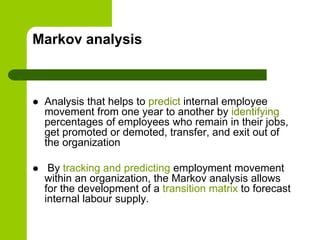
 Analysis that helps to predict internal employee
movement from one year to another by identifying
percentages of employees who remain in their jobs,
get promoted or demoted, transfer, and exit out of
the organization
 By tracking and predicting employment movement
within an organization, the Markov analysis allows
for the development of a transition matrix to forecast
internal labour supply.
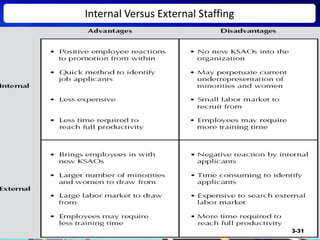
Internal Versus External Staffing
3-31
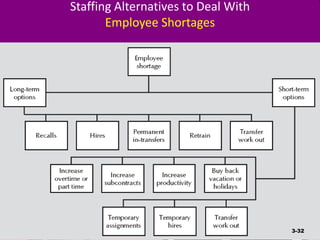
Staffing Alternatives to Deal With
Employee Shortages
3-32
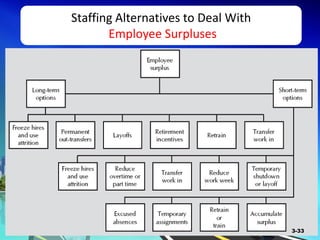
Staffing Alternatives to Deal With
Employee Surpluses
3-33
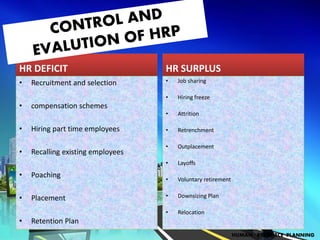
HR DEFICIT
• Recruitment and selection
• compensation schemes
• Hiring part time employees
• Recalling existing employees
• Poaching
• Placement
• Retention Plan
HR SURPLUS
• Job sharing
• Hiring freeze
• Attrition
• Retrenchment
• Outplacement
• Layoffs
• Voluntary retirement
• Downsizing Plan
• Relocation
HUMAN RESOURCE PLANNING
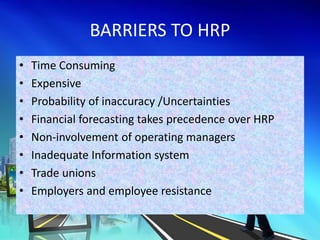
BARRIERS TO HRP
• Time Consuming
• Expensive
• Probability of inaccuracy /Uncertainties
• Financial forecasting takes precedence over HRP
• Non-involvement of operating managers
• Inadequate Information system
• Trade unions
• Employers and employee resistance
Thank You

2 hrp

  • 1.
    Manpower Planning or HumanResource Planning
  • 2.
    Chapter outline  HRPlanning  Environment of HR Planning  Staffing Planning  Legal Issue  Current trends in HR Planning  Forecasting Demand & Supply  Quantitative & Qualitative determination
  • 3.
    INTRODUCTION HUMAN RESOURCE PLANNING HRPis a process by which the management of an organization determines its future human resource requirement and how the existing human resource can be effectively utilized to fulfill the requirements.
  • 4.
    HUMAN RESOURCE PLANNING 1)Employment-Unemployment Situation 2) Technological Change 3) Demographic Change 4) Skill Shortage 5) Governmental Influences 6) Legislative Control 7) Impact of the Pressure Group(unions, politician etc.) 8) Lead Time WHY IS HUMAN RESOURCE PLANNING IS NEEDED ?
  • 5.
    Importance • Organizational Objectives& Policies (expansion,downsizing,acquisition,merger) • Forecast HR requirement (Prevent shortage / excess of staff ) • Determine future staff-mix • Cope-up with the change — in market conditions, technologies, products, government regulations and policies, etc. • Helps in succession planning • Use existing HR productivity. • Promote employees in a systematic manner. • Cut cost HUMAN RESOURCE PLANNING
  • 6.
    HRP at DifferentPlanning levels • Identify the broad policies • Align HR objective with organization objective • Determining recruitment • layoff strategy • retention strategy, • selection process • Planning for T& D • Employee welfare activities • Grievance handling • Employee engagement activities Corporate level planning Business level planning Operational level planning Planning short term activities
  • 7.
  • 8.
    ENVIRONMENT ORGANISATION OBJECTIVE ANDPOLICIES HR DEMAND FORCASTING HR SUPPLY FORCASTING HR PROGRAMMING HR IMPLEMENTATION CONTROL AND EVALUTION OF PROGRAMMING HR SURPLUS Restricted Hiring Reduced Hours and VRS, Lay Off, etc. HR DEFICIT/ SHORTAGE (Recruitment and Selection) ANALYSIS OF HR REQUIREMENT
  • 9.
    The Basic Elements ofHuman Resource Planning 3-9
  • 10.
    ENVIRONMENT of HRM “Ourassets walks out of the door each evening . We have to make sure that they come back next morning” Human Resource Management - N. R. NARAYANA MURTHY
  • 11.
    EXTERNAL FACTORS INTERNAL FACTORS ENVIRONMENT of HRM Human Resource Management •Mission • Policies • Organization culture • Organization structure • HR system • Workforce diversity • Unions • Employee demands and expectation • PESTEL P - political factors E – economical factors S – social factors T – technical factors E – environmental factors L – legal factors
  • 12.
  • 13.
    Demand forecasting techniques Quantitativetechnique •Estimation • Ratio Analysis • Trend analysis & projection • Computerized Forecast • Regression Analysis • H R Budget and Planning Analysis • Scenario Forecasting • Work Study Analysis • Simple averaging • Markov analysis • Indexation • Extrapolation Qualitativetechnique • Managerial Judgment • Estimation • Expert Advice • Delphi technique • Nominal Group Technique • Job Analysis • Group brainstorming • Simulation models
  • 14.
    5-12 Estimated internal laborsupply for a given firm The FirmSources of Inflows  Transfers  Promotions  New Recruits  Recalls  Promotions  Quits  Terminations  Retirements  Deaths  Layoffs Employees In Employees Out Current staffing level Projected outflows this year Projected inflows this year Firm’s internal supply for this time next year – + = Projected Outflows Current Staffing Level
  • 15.
  • 16.
    Supply Forecasting Methods Trend analysis  Competency model  Replacement Charts  Staffing table  Succession Planning  Flow Modeling/Markov Analysis
  • 17.
    Trend analysis  Trendanalysis involves collecting and evaluating data to identify patterns of information that might impact the future.  By examining the trends of the past, the HR department can predict the effect of the same activity on the future of the organization, because it is assumed that these patterns will remain stable.
  • 18.
    Trend analysis  Forexample, an organization reviewing historical data may realize that every year, approximately five percent of their staff retire, six percent resign, and three percent are dismissed.  Using a simple trend analysis, future HR supply forecasts can be established by assuming an average reduction in internal HR supply of 14 percent per year.
  • 19.
    Competency model  Competenciesare behaviours that encompass the knowledge, skills, and attitudes(KSA) required for successful performance.  Competency modelling is the activity of determining the specific competencies that are characteristic of high performance and success in a given job.
  • 20.
    Competency model  Afuture-oriented model that first reviews competencies that are aligned with an organization’s mission, vision, and strategy, and then aims to identify an ideal workforce in terms of these competencies .  Skills/competency models focus on matching the right skills or competencies needed for each job with the skills available within the organization
  • 21.
  • 22.
    Replacement chart  Achart used to estimate vacancies in higher level jobs and identify how potential HR supply can fill these vacancies via internal movements from lower levels jobs  Replacement charts provide identification of potential replacements for vacancies within an organization
  • 23.
    Replacement chart  Acomprehensive replacement chart will include information regarding possible replacements for vertical or horizontal movement.  Generally, a replacement chart includes information about employees’ performance, readiness to fill the position, and education.
  • 24.
    Replacement chart General Manager V.K. Garg A/2 Key Names given are replacement candidates A. Promotable now B. Needing development C. Not suitable to position 1. Superior performance 2. Above Average performance 3. Acceptable performance 4. Poor performance P A to General Manager L. Mathews B/1 Assistant General Manager R.K. Arora A/2 B.K. Nehru B/3 Division: HR Manager C.P. Thakur A/1 Division: Accounting & Taxation Manager A.T. Roy C/2 Division: Planning Manager A.N. Gupta A/1 K.P. Rao B/1 Technical Advisor N.R. Murthy B/3 Northern Region Manager L.C. Srivatsav A/2 A. Thapar C/4 Central Region Manager S.P. Kumar A/1 R. Pandey B/3 Southern Region Manager A. Subramanyam B/2 B.K. Menon B/1 Eastern Region Manager R. Krishna B/3
  • 25.
    Staffing table Staffing tablesare graphic representations of all organizational jobs, along with the numbers of employees currently occupying those jobs and future (monthly or yearly) employment requirements, which can be derived from demand forecasts.
  • 26.
    Staffing table For aline worker, for example, there is a 20% probability of being gone in 12 months, a 0% probability of promotion to manager, a 15% probability of promotion to supervisor, and a 65% probability of being a line worker this time next year. Such transition matrices form the bases for computer simulations of the internal flow of people through a large organization over time.
  • 27.
    Succession Planning Succession planningis a longer-term process of grooming a successor (selected from a pool of candidates on the basis of perceived competency) for management or critical positions.
  • 28.
    Succession Planning  Determiningthe internal labour supply calls for a detailed analysis of how many people are currently in various job categories or have specific skills within the organization.  The planner then modifies this analysis to reflect changes expected in the near future as a result of retirements, promotions, transfers, voluntary turnover, and terminations.
  • 30.
    Markov analysis  Analysisthat helps to predict internal employee movement from one year to another by identifying percentages of employees who remain in their jobs, get promoted or demoted, transfer, and exit out of the organization  By tracking and predicting employment movement within an organization, the Markov analysis allows for the development of a transition matrix to forecast internal labour supply.
  • 31.
  • 32.
    Staffing Alternatives toDeal With Employee Shortages 3-32
  • 33.
    Staffing Alternatives toDeal With Employee Surpluses 3-33
  • 34.
    HR DEFICIT • Recruitmentand selection • compensation schemes • Hiring part time employees • Recalling existing employees • Poaching • Placement • Retention Plan HR SURPLUS • Job sharing • Hiring freeze • Attrition • Retrenchment • Outplacement • Layoffs • Voluntary retirement • Downsizing Plan • Relocation HUMAN RESOURCE PLANNING
  • 35.
    BARRIERS TO HRP •Time Consuming • Expensive • Probability of inaccuracy /Uncertainties • Financial forecasting takes precedence over HRP • Non-involvement of operating managers • Inadequate Information system • Trade unions • Employers and employee resistance
  • 36.

Editor's Notes

  • #5 1) Employment-Unemployment Situation: Though in general the number of educated unemployment is on the rise, there is acute shortage for a variety of skills. This emphasizes on the need for more effective recruitment and employee retention. 2) Technological Change: The changes in production technologies, marketing methods and management techniques have been extensive and rapid. Their effect has been profound on the job contents and job contexts. These changes have caused problems relating to redundancies, retention and redeployment. All these suggest the need to plan manpower needs intensively and systematically. 3) Demographic Change: The changing profile of the work force in terms of age, sex, literacy, technical inputs and social background has implications for HRP. 4) Skill Shortage: Unemployment does not mean that the labour market is a buyer’s market. Organizations generally become more complex and require a wide range of specialist skills that are rare and scare. A problem arises in an organization when employees with such specialized skills leave. 5) Governmental Influences: Government control and changes in legislation with regard to affirmative action for disadvantages groups, working conditions and hours of work, restrictions on women and child employment, causal and contract labour, etc. have stimulated the organizations to be become involved in systematic HRP. 6) Legislative Control: The policies of “hire and fire” have gone. Now the legislation makes it difficult to reduce the size of an organization quickly and cheaply. It is easy to increase but difficult to shed the fat in terms of the numbers employed because of recent changes in labour law relating to lay-offs and closures. Those responsible for managing manpower must look far ahead and thus attempt to foresee manpower problems. 7) Impact of the Pressure Group: Pressure groups such as unions, politicians and persons displaced from land by location of giant enterprises have been raising contradictory pressure on enterprise management such as internal recruitment and promotion, preference to employees’ children, displace person, sons of soil etc. 8) Systems Approach: The spread of system thinking and advent of the macro computer as the part of the on-going revolution in information technology which emphasis planning and newer ways of handling voluminous personnel records. 9) Lead Time: The log lead time is necessary in the selection process and training and deployment of the employee to handle new knowledge and skills successfully.
  • #14 http://www.slideshare.net/bhomaram/techniques-for-forecasting-human-resources
  • #20 Competencies are behaviors that encompass the knowledge, skills, and attributes required for successful performance. In addition to intelligence and aptitude, the underlying characteristics of a person, such as traits, habits, motives, social roles, and self-image, as well as the environment around them, enable a person to deliver superior performance in a given job, role, or situation. Competency modeling is the activity of determining the specific competencies that are characteristic of high performance and success in a given job. Competency modeling can be applied to a variety of human resource activities. This research paper will describe how organizations identify their core competencies and how they are applying this competency data to improve performance. It will also explain some emerging trends in competency modeling. Developing Competency Models Competencies enable employees to achieve results, thereby creating value. It follows that competencies aligned with business objectives help foster an organization's success. Organizations must understand their core competency needs - the skills, knowledge, behaviors, and abilities that are necessary for people in key roles to deliver business results.